
Life, 1923-12-06 · page 40 of 84
Life — December 6, 1923 — page 40: what you’re looking at
What you’re looking at
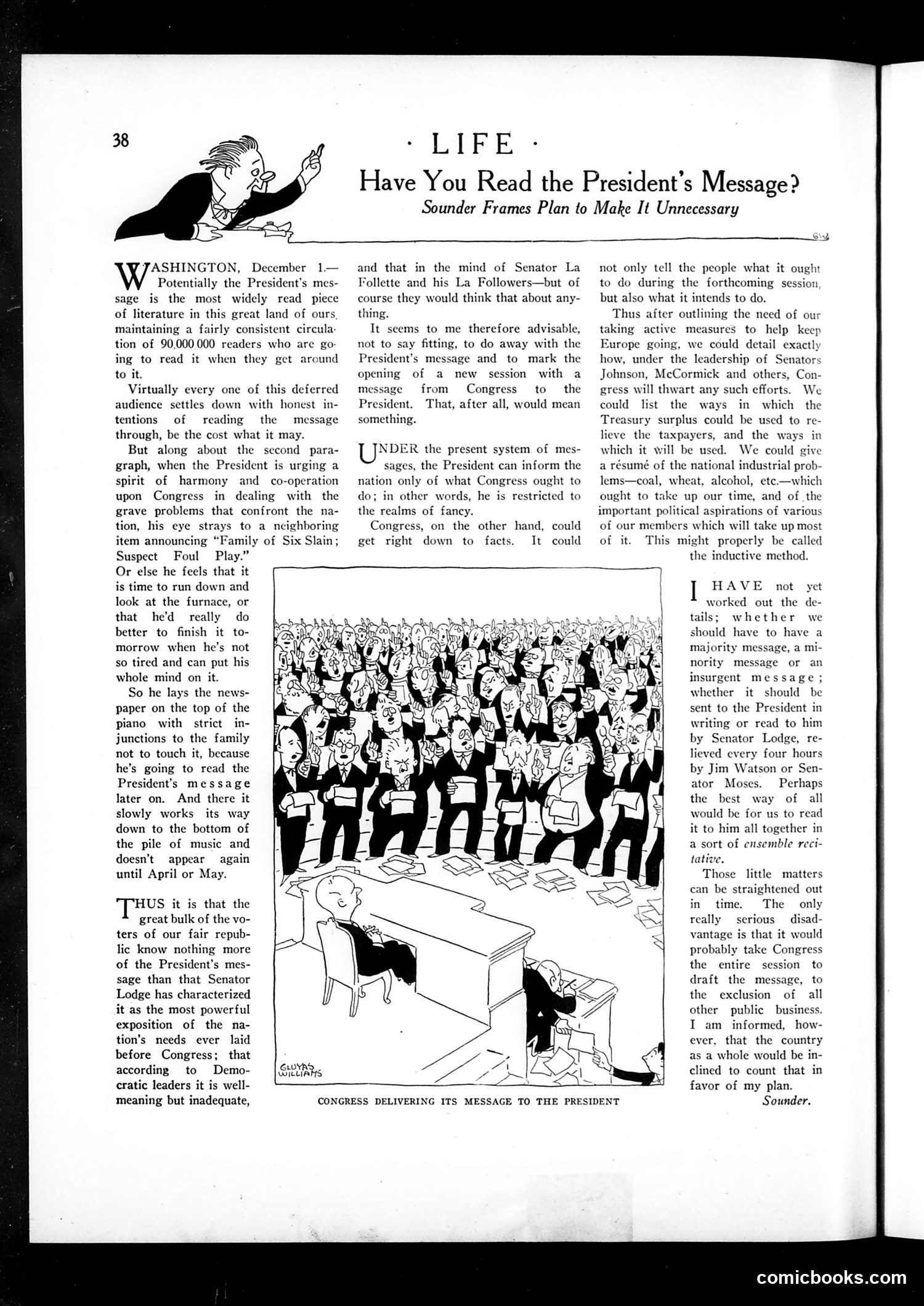
This satirical piece mocks the President's annual message to Congress as an unread formality. The author proposes a humorous alternative: have *Congress* deliver a message to the President instead, since Congress actually knows what it will do (or won't do), whereas the President can only suggest ideals. The cartoon depicts Congress presenting stacks of papers to a seated President, illustrating the absurdity of role-reversal. The satire targets post-WWI political gridlock: Congress members like Senator Lodge (Republican critic of the President) and insurgent Republicans (likely referencing opposition to Wilson's League of Nations) consistently blocked presidential initiatives. The author suggests Congress should be honest about its obstructionist intentions rather than pretend to listen to presidential rhetoric. The joke is that most Americans never actually read the President's message anyway—they abandon it halfway through to read gossip columns, then forget about it until next year.
📄 Transcribed text from this page (OCR, searchable)
Machine-transcribed from the original scan — historical spelling and the odd misread are preserved.
* LIFE, * Have You Read the President’s Message? Sounder Frames Plan to Make It Unnecessary JASHINGTON, December 1.— Potentially the President's mes- sage is the most widely read piece of literature in this great land of ours maintaining a fairly consistent circula tion of 90,000000 readers who are go: ing to read it when they get around to it. Virtually every one of this deferred audience settles down with honest in- tentions of reading the message through, be the cost what it may. But along about the second para- graph, when the President is urging a spirit of harmony and co-operation upon Congress in dealing with the grave problems that confront the na- tion, his eye strays to a neighboring item announcing “Family of Six Slain; Suspect Foul Play.” and that in the mind of Senator La Follette and his La Followers—but of course they would think that about any- thing. It seems to me therefore advisable, not to say fitting, to do away with the President’s message and to mark the opening of a new session with a from Congress to the That, after all, would mean message President. something. NDER the present system of mes- sages, the President can inform the nation only of what Congress ought to do; in other words, he is restricted to the realms of fancy. Congress, on the other hand, could get right down to facts. It could not only tell the people what it ought to do during the forthcoming session. but also what it intends to do. Thus after outlining the need of our taking active measures to help keep Europe going, we could detail exactly how, under the leadership of Senators Johnson, McCormick and others, Con- gress will thwart any such efforts. We could list the ways in which the Treasury surplus could be used to re- lieve the taxpayers, and the ways in which it will be used. We could give a résumé of the national industrial prob- lems—coal, wheat, alcohol, ete—which ought to take up our time, and of the important political aspirations of various of our members which will take up most of it. This might properly be called the inductive method. Or else he feels that it is time to run down and look at the furnace, or that he'd really do better to finish it to- morrow when he's not so tired and can put his whole mind on it. So he lays the news- paper on the top of the piano with strict in- junctions to the family not to touch it, because he’s going to read the President's message later on. And there it slowly works its way down to the bottom of the pile of music and doesn’t appear again until April or May. 'HUS it is that the great bulk of the vo- ters of our fair repub- lic know nothing more of the President's mes- sage than that Senator Lodge has characterized it as the most powerful exposition of the na- tion’s needs ever laid before Congress; that according to Demo- SB. cratic leaders it is well- I HAVE not yet worked out the de- tails; whether we should have to have a majority message, a mi- nority message or an insurgent message; whether it should be sent to the President in writing or read to him by Senator Lodge, re- lieved every four hours by Jim Watson or Sen- ator Moses. Perhaps the best way of all would be for us to read it to him all together in a sort of ensemble reci- tative. Those little can be straightened out in time. The only really serious disad- vantage is that it would probably take Congress the entire session to draft the message, to the exclusion of all other public business. I am informed, how- ever, that the country as a whole would be in- clined to count that in matters meaning but inadequate, CONGRESS DELIVERING ITS MESSAGE TO THE PRESIDENT favor of my plan. Sounder. comicbooks.com