
Life, 1923-12-06 · page 28 of 84
Life — December 6, 1923 — page 28: what you’re looking at
What you’re looking at
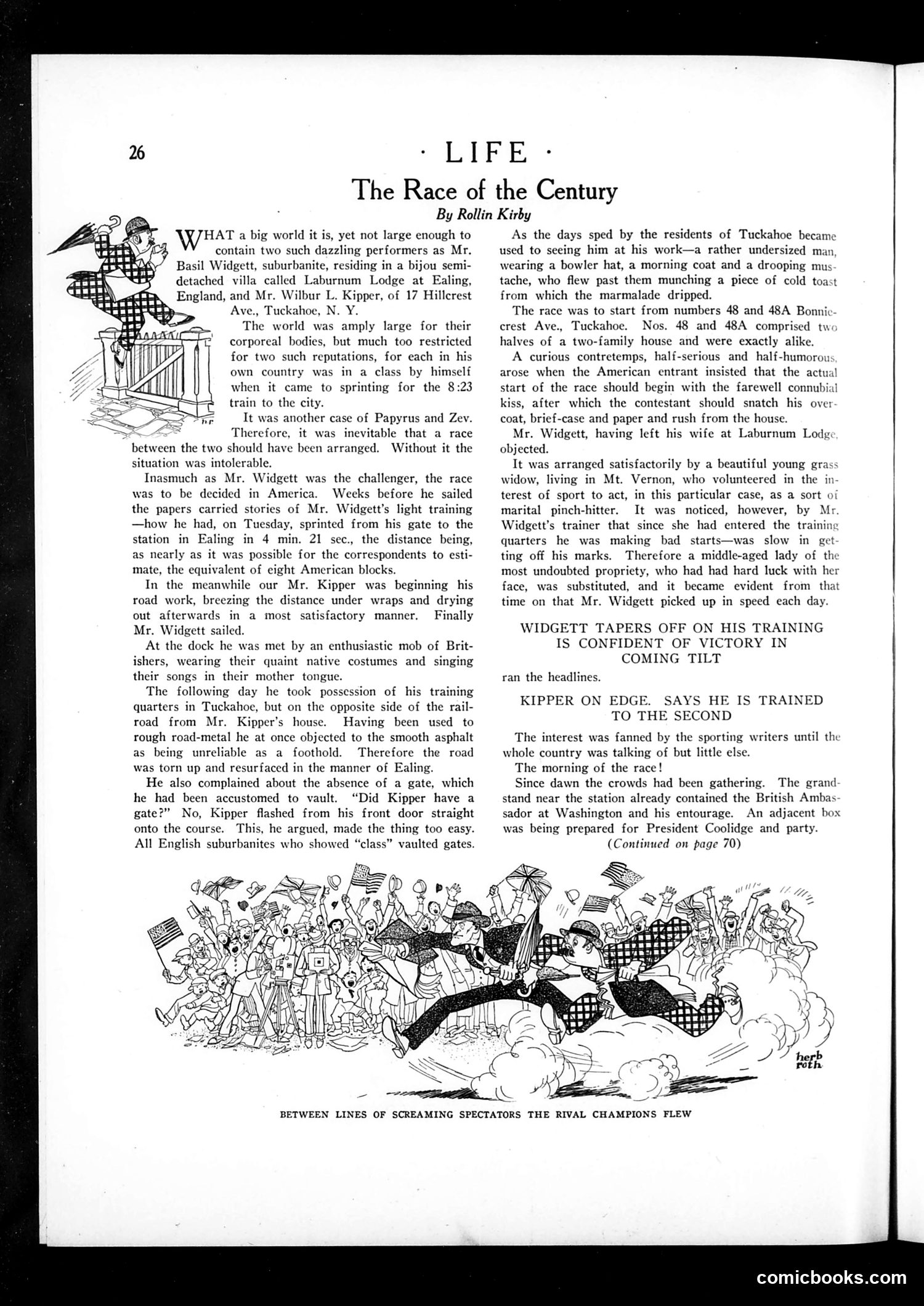
This is a humorous satire of transatlantic athletic rivalry, likely referencing the famous 1923 horse race between British horse Papyrus and American horse Zev (explicitly mentioned in the text). **The Setup:** A British suburbanite (Basil Widgett) challenges an American (Wilbur Kipper) to a sprint race—not for sport, but because each is the local champion at catching their morning commuter trains. The story parodies the excessive hype, training coverage, and national pride surrounding international sporting competitions. **The Satire:** The piece mocks both British pretentiousness (Widgett complains about asphalt, demands a gate to vault, wears morning coat while training) and American spectacle-building. Widgett's trainer troubles—distracted by an attractive woman, then refocused by an unattractive one—absurdly trivialize the "serious" competition. **The Point:** This deflates the grandiose rhetoric around international athletic contests by reducing them to suburban commuters sprinting for trains, exposing how trivial the underlying competition actually is beneath all the national fanfare and elaborate preparation.
📄 Transcribed text from this page (OCR, searchable)
Machine-transcribed from the original scan — historical spelling and the odd misread are preserved.
* LIVE - The Race of the Century HAT a big world it is, yet not large enough to contain two such dazzling performers as Mr. Basil Widgett, suburbanite, residing in a bijou semi- detached villa called Laburnum Lodge at Ealing, England, and Mr. Wilbur L. Kipper, of 17 Hillcrest Ave., Tuckahoe, N. Y. The world was amply large for their corporeal bodies, but much too restricted for two such reputations, for each in his own country was in a class by himself when it came to sprinting for the 8:23 train to the city. It was another case of Papyrus and Zev. > Therefore, it was inevitable that a race between the two should have been arranged. Without it the situation was intolerable. Inasmuch as Mr. Widgett was the challenger, the race was to be decided in America. Weeks before he sailed the papers carried stories of Mr. Widgett’s light training —how he had, on Tuesday, sprinted from his gate to the station in Ealing in 4 min. 21 sec., the distance being, as nearly as it was possible for the correspondents to esti- mate, the equivalent of eight American blocks. In the meanwhile our Mr. Kipper was beginning his road work, breezing the distance under wraps and drying out afterwards in a most satisfactory manner. Finally Mr. Widgett sailed. At the dock he was met by an enthusiastic mob of Brit- ishers, wearing their quaint native costumes and singing their songs in their mother tongue. The following day he took possession of his training quarters in Tuckahoe, but on the opposite side of the rail- road from Mr. Kipper’s house. Having been used to rough road-metal he at once objected to the smooth asphalt as being unreliable as a foothold. Therefore the road was torn up and resurfaced in the manner of Ealing. He also complained about the absence of a gate, which he had been accustomed to vault. “Did Kipper have a gate?” No, Kipper flashed from his front door straight onto the course. This, he argued, made the thing too easy. All English suburbanites who showed “class” vaulted gates. BETWEEN LINES OF SCREAMING SPECTATORS THE RIVAL CHAMPIONS FLEW By Rollin Kirby As the days sped by the residents of Tuckahoe became used to seeing him at his work—a rather undersized man, wearing a bowler hat, a morning coat and a drooping mus tache, who flew past them munching a piece of cold toast from which the marmalade dripped. The race was to start from numbers 48 and 48A Bonnic- crest Ave., Tuckahoe. Nos. 48 and 48A comprised tw halves of a two-family house and were exactly alike. A curious contretemps, half-serious and half-humorou arose when the American entrant insisted that the actual start of the race should begin with the farewell connubi kiss, after which the contestant should snatch his over coat, brief-case and paper and rush from the house. Mr. Widgett, having left his wife at Laburnum Lodg: objected. It was arranged satisfactorily by a beautiful young grass widow, living in Mt. Vernon, who volunteered in the in- terest of sport to act, in this particular case, as a sort oi marital pinch-hitter. It was noticed, however, by Mr. Widgett’s trainer that since she had entered the training quarters he was making bad starts—was slow in get ting off his marks. Therefore a middle-aged lady of the most undoubted propriety, who had had hard luck with her face, was substituted, and it became evident from that time on that Mr. Widgett picked up in speed each day. WIDGETT TAPERS OFF ON HIS TRAINING IS CONFIDENT OF VICTORY IN COMING TILT ran the headlines. KIPPER ON EDGE. SAYS HE IS TRAINED TO THE SECOND The interest was fanned by the sporting writers until the whole country was talking of but little else. The morning of the race! Since dawn the crowds had been gathering. The grand stand near the station already contained the British Ambas- sador at Washington and his entourage. An adjacent box was being prepared for President Coolidge and party. (Continued on page 70) AY comicbooks.com