
Life, 1923-12-06 · page 36 of 84
Life — December 6, 1923 — page 36: what you’re looking at
What you’re looking at
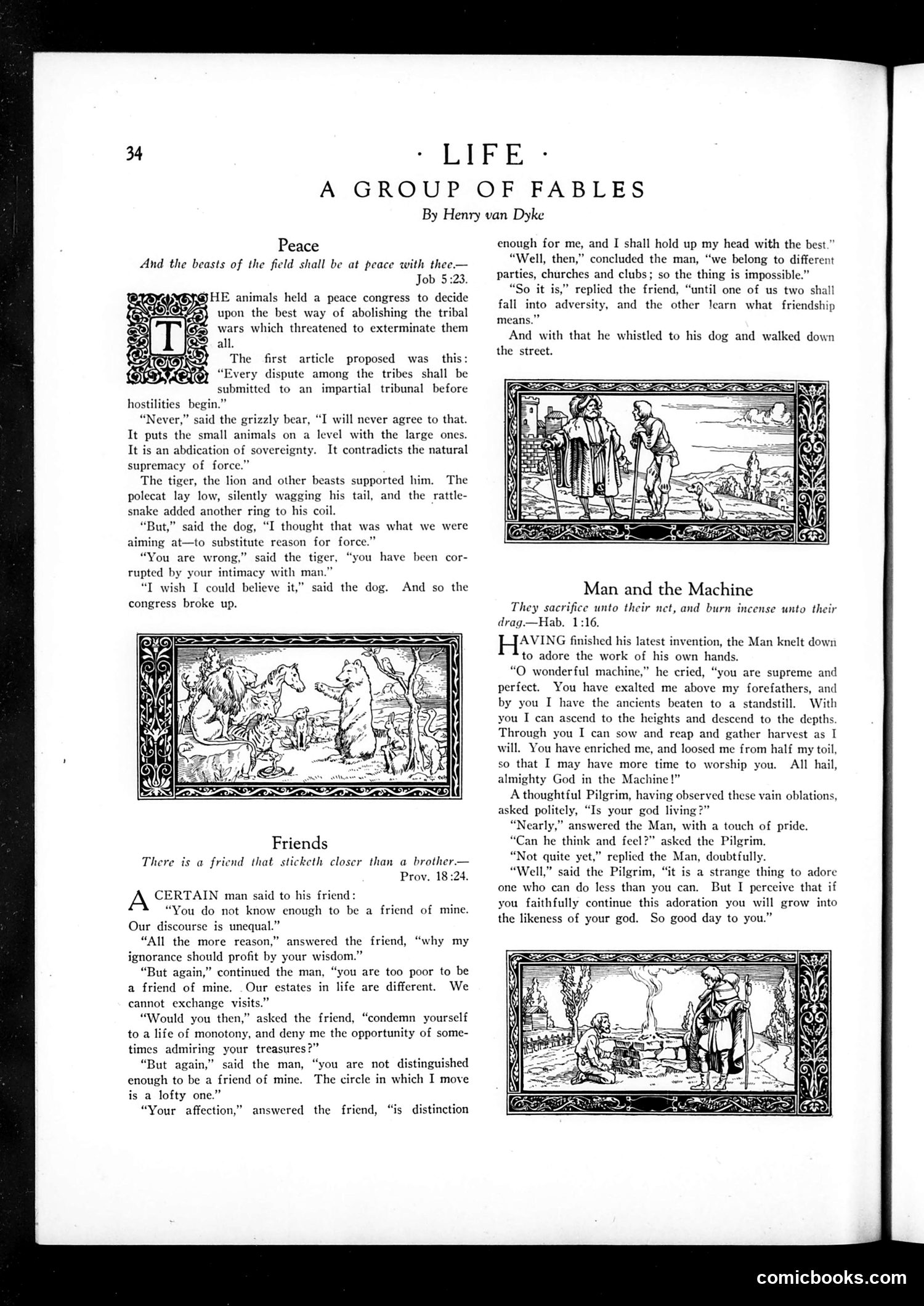
This page presents three allegorical fables addressing early 20th-century social tensions: **"Peace"**: Animals debate abolishing tribal warfare through impartial tribunals. The grizzly bear, tiger, and lion—representing powerful interests—reject this, claiming it violates "natural supremacy of force." The dog (representing humanity's conscience, corrupted by association with man) argues for reason over force. The satire critiques how the powerful resist arbitration and equality before law to preserve dominance. **"Friends"**: A wealthy man rejects friendship with a poor, less-distinguished person based on class differences. His friend argues affection transcends social hierarchy. The satire mocks snobbery and suggests true friendship emerges only through shared adversity. **"Man and the Machine"**: A man worships his technological creation as a god. A Pilgrim observes the machine lacks consciousness or feeling, warning that blind devotion to technology will diminish humanity itself. Together, these fables critique power inequality, class prejudice, and uncritical technological worship—concerns relevant to Progressive Era readers.
📄 Transcribed text from this page (OCR, searchable)
Machine-transcribed from the original scan — historical spelling and the odd misread are preserved.
LIF E, ° A GROUP OF FABLES By Henry van Dyke Peace And the beasts of the field shall be at peace with thee— Job 5:23. upon the best way of abolishing the tribal wars which threatened to exterminate them all. The first article proposed was this: “Every dispute among the tribes shall be submitted to an impartial tribunal before hostilities begin.” “Never,” said the grizzly bear, “I will never agree to that. It puts the small animals on a level with the large ones. It is an abdication of sovereignty. It contradicts the natural supremacy of force.” The tiger, the lion and other beasts supported him. The polecat lay low, silently wagging his tail, and the rattle- snake added another ring to his coil. “But,” said the dog, “I thought that was what we were aiming at—to substitute reason for force.” “You are wrong,” said the tiger, “you have been cor- rupted by your intimacy with man.” “I wish I could believe it,” said the dog. congress broke up. And so the There is a friend that sticketh closer than a brother— Prov. 18:24. CERTAIN man said to his friend: “You do not know enough to be a friend of mine. Our discourse is unequal.” “All the more reason,” answered the friend, “why my ignorance should profit by your wisdom.” “But again,” continued the man, “you are too poor to be a friend of mine. Our estates in life are different. We cannot exchange visits.” “Would you then,” asked the friend, “condemn yourself to a life of monotony, and deny me the opportunity of some- times admiring your treasures?” “But again,” said the man, “you are not distinguished enough to be a friend of mine. The circle in which I move is a lofty one.” “Your affection,” answered the friend, “is distinction enough for me, and I shall hold up my head with the best.” “Well, then,” concluded the man, “we belong to different parties, churches and clubs; so the thing is impossible.” “So it is,” replied the friend, “until one of us two shall fall into adversity, and the other learn what friendship means.” And with that he whistled to his dog and walked down the street. Man and the Machine They sacrifice unto their net, and burn incense unto their drag—Hab. 1:16. HAVING finished his latest invention, the Man knelt down to adore the work of his own hands. “O wonderful machine,” he cried, “you are supreme and perfect. You have exalted me above my forefathers, and by you I have the ancients beaten to a standstill. With you I can ascend to the heights and descend to the depths. Through you I can sow and reap and gather harvest as I will. You have enriched me, and loosed me from half my toil, so that I may have more time to worship you. All hail, almighty God in the Machine!” A thoughtful Pilgrim, having observed these vain oblations, asked politely, “Is your god livin: “Nearly,” answered the Man, with a touch of pride. “Can he think and feel?” asked the Pilgrim. “Not quite yet,” replied the Man, doubtfully. “Well,” said the Pilgrim, “it is a strange thing to adore one who can do less than you can. But I perceive that if you faithfully continue this adoration you will grow into the likeness of your god. So good day to you.” comicbooks.com