
Life, 1923-12-06 · page 18 of 84
Life — December 6, 1923 — page 18: what you’re looking at
What you’re looking at
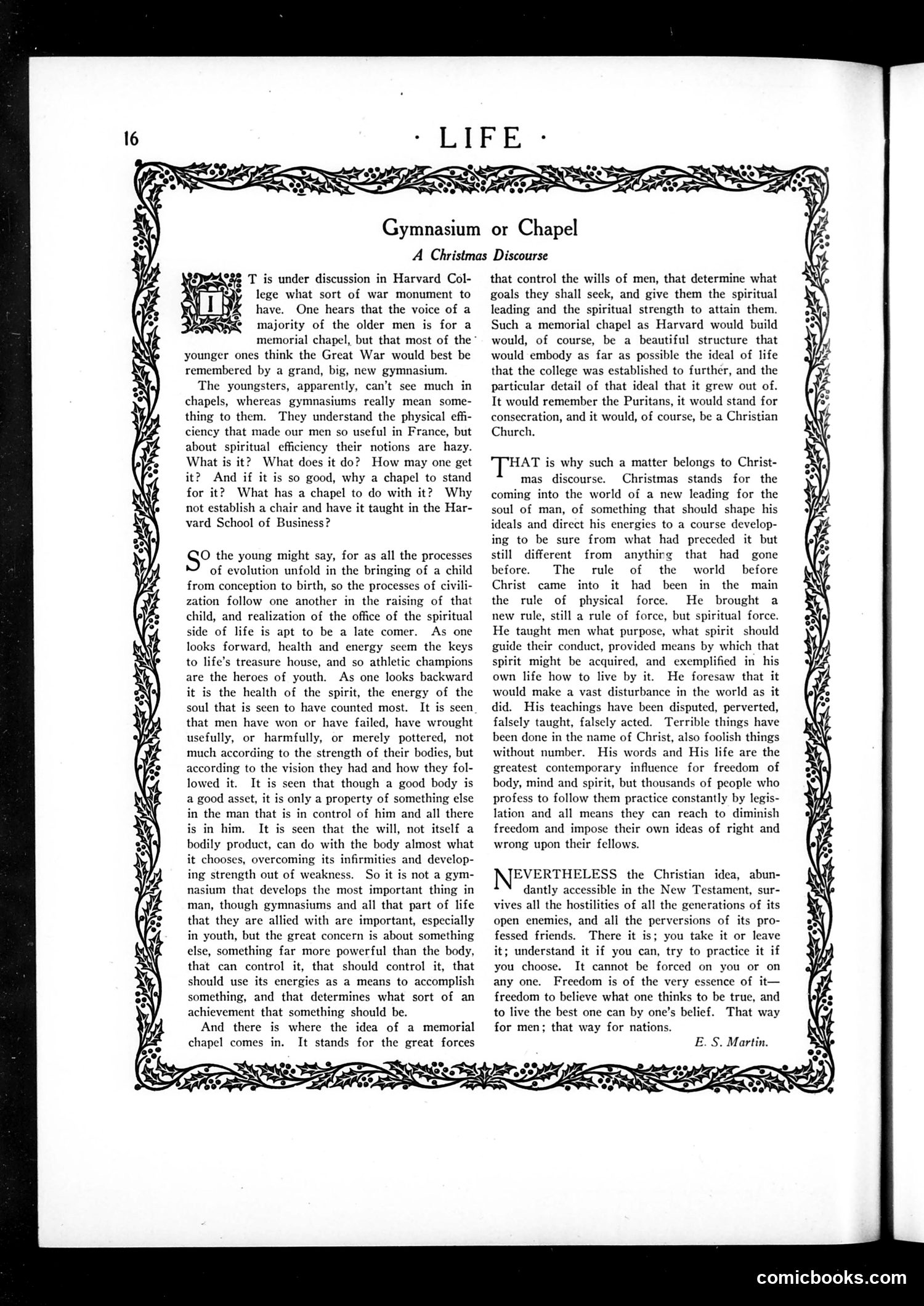
This is not a cartoon but an editorial essay debating Harvard College's proposed war memorial. The piece presents a generational divide: younger alumni favor a gymnasium to commemorate physical vigor that served soldiers in WWI, while older men prefer a chapel emphasizing spiritual values. The author (E. S. Martin) argues the younger generation prioritizes physical fitness because youth naturally does so, but maturity reveals that willpower and spiritual purpose—not bodily strength—ultimately determine human achievement. He contends a memorial chapel better honors the war dead by embodying the Christian spiritual ideals that should guide conduct, contrasting Christ's "spiritual force" with the pre-Christian world's "rule of physical force." The piece uses Christmas as its moral framework: Christ's teachings introduced spiritual direction to human purpose. Therefore, Martin concludes, a chapel appropriately memorializes sacrifice by emphasizing the values worth dying for.
📄 Transcribed text from this page (OCR, searchable)
Machine-transcribed from the original scan — historical spelling and the odd misread are preserved.
Gymnasium or Chapel A Christmas Discourse v3 T is under discussion in Harvard Col- lege what sort of war monument to have. One hears that the voice of a majority of the older men is for a memorial chapel, but that most of the” younger ones think the Great War would best be remembered by a grand, big, new gymnasium. The youngsters, apparently, can’t see much in chapels, whereas gymnasiums really mean some- thing to them. They understand the physical effi- ciency that made our men so useful in France, but about spiritual efficiency their notions are hazy. What is it? What does it do? How may one get it? And if it is so good, why a chapel to stand for it? What has a chapel to do with it? Why not establish a chair and have it taught in the Har- vard School of Business? O the young might say, for as all the processes of evolution unfold in the bringing of a child from conception to birth, so the processes of civili- zation follow one another in the raising of that child, and realization of the office of the spiritual side of life is apt to be a late comer. As one looks forward, health and energy seem the keys to life’s treasure house, and so athletic champions are the heroes of youth. As one looks backward it is the health of the spirit, the energy of the soul that is seen to have counted most. It is seen that men have won or have failed, have wrought usefully, or harmfully, or merely pottered, not much according to the strength of their bodies, but according to the vision they had and how they fol- lowed it. It is seen that though a good body is a good asset, it is only a property of something else in the man that is in control of him and all there is in him. It is seen that the will, not itself a bodily product, can do with the body almost what it chooses, overcoming its infirmities and develop- ing strength out of weakness. So it is not a gym- nasium that develops the most important thing in man, though gymnasiums and all that part of life that they are allied with are important, especially in youth, but the great concern is about something else, something far more powerful than the body, that can control it, that should control it, that should use its energies as a means to accomplish something, and that determines what sort of an achievement that something should be. And there is where the idea of a memorial chapel comes in. It stands for the great forces that control the wills of men, that determine what goals they shall seek, and give them the spiritual leading and the spiritual strength to attain them. Such a memorial chapel as Harvard would build would, of course, be a beautiful structure that would embody as far as possible the ideal of life that the college was established to further, and the particular detail of that ideal that it grew out of. It would remember the Puritans, it would stand for consecration, and it would, of course, be a Christian Church, HAT is why such a matter belongs to Christ- mas discourse. Christmas stands for the coming into the world of a new leading for the soul of man, of something that should shape his ideals and direct his energies to a course develop- ing to be sure from what had preceded it but still different from anythirg that had gone before. The rule of the world before Christ came into it had been in the main the rule of physical force. He brought a new rule, still a rule of force, but spiritual force. He taught men what purpose, what spirit should guide their conduct, provided means by which that spirit might be acquired, and exemplified in his own life how to live by it. He foresaw that it would make a vast disturbance in the world as it did. His teachings have been disputed, perverted, falsely taught, falsely acted. Terrible things have been done in the name of Christ, also foolish things without number. His words and His life are the greatest contemporary influence for freedom of body, mind and spirit, but thousands of people who profess to follow them practice constantly by legis- lation and all means they can reach to diminish freedom and impose their own ideas of right and wrong upon their fellows. EVERTHELESS the Christian idea, abun- dantly accessible in the New Testament, sur- vives all the hostilities of all the generations of its open enemies, and ali the perversions of its pro- fessed friends. There it is; you take it or leave it; understand it if you can, try to practice it if you choose. It cannot be forced on you or on any one. Freedom is of the very essence of it— freedom to believe what one thinks to be true, and to live the best one can by one’s belief. That way for men; that way for nations. E. S. Martin. comicbooks.com