
A complete issue · 80 pages · 1922
Life — December 7, 1922
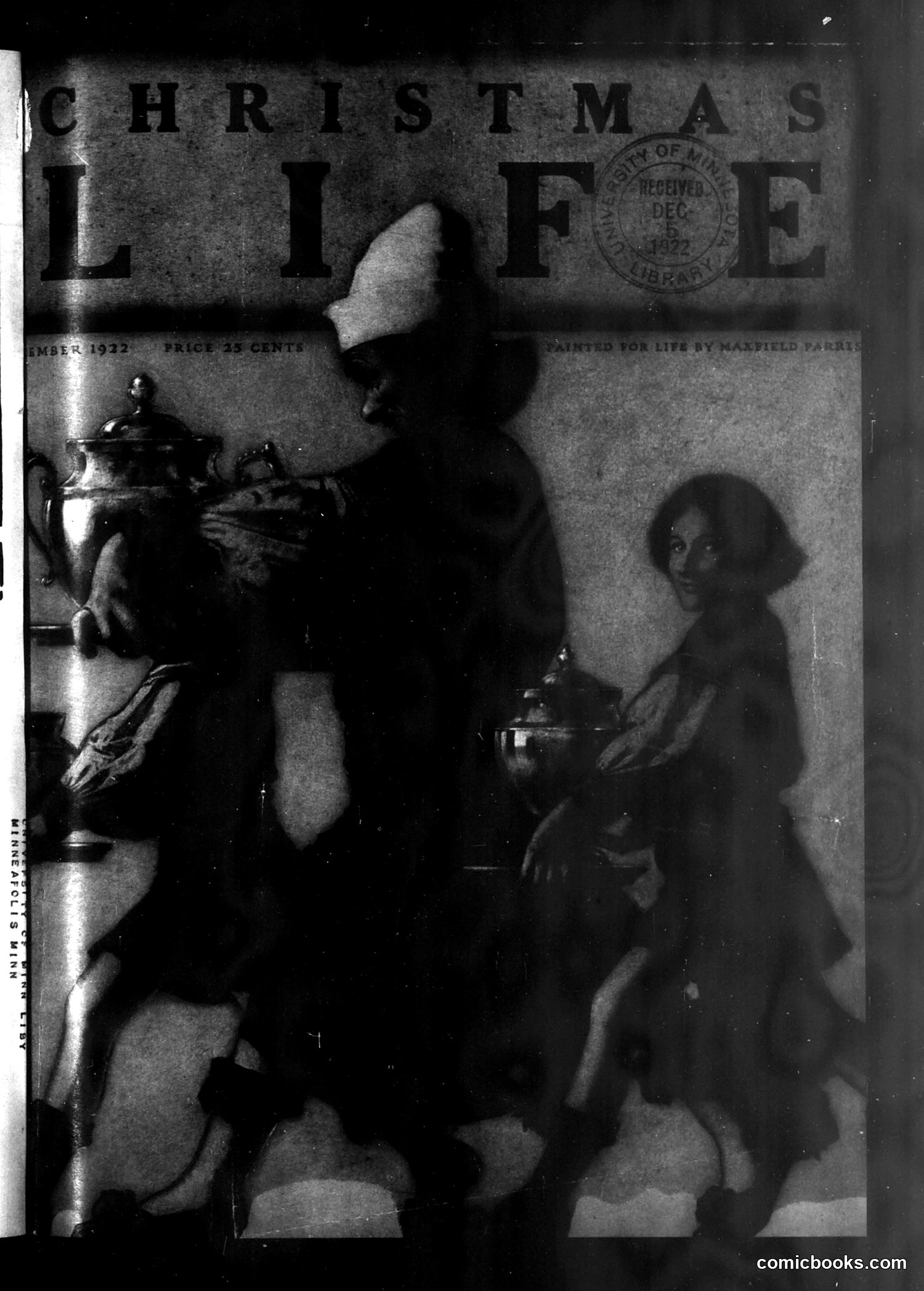
This is a **December 1922 issue** of *Life* magazine (price 25 cents). The cover depicts a domestic Christmas scene with silhouetted figures around what appears to be a fireplace or hearth with a teapot. The image shows family members in period dress gathered for holiday celebration. Given the silhouette style and intimate domestic setting, this appears to be a straightforward Christmas-themed cover illustration rather than political satire—typical of *Life*'s holiday issues which often featured sentimental family scenes. The library stamp indicates this copy was preserved in an institutional collection. Without visible captions identifying specific figures or satirical elements, the composition emphasizes traditional family holiday warmth rather than commentary on contemporary events.
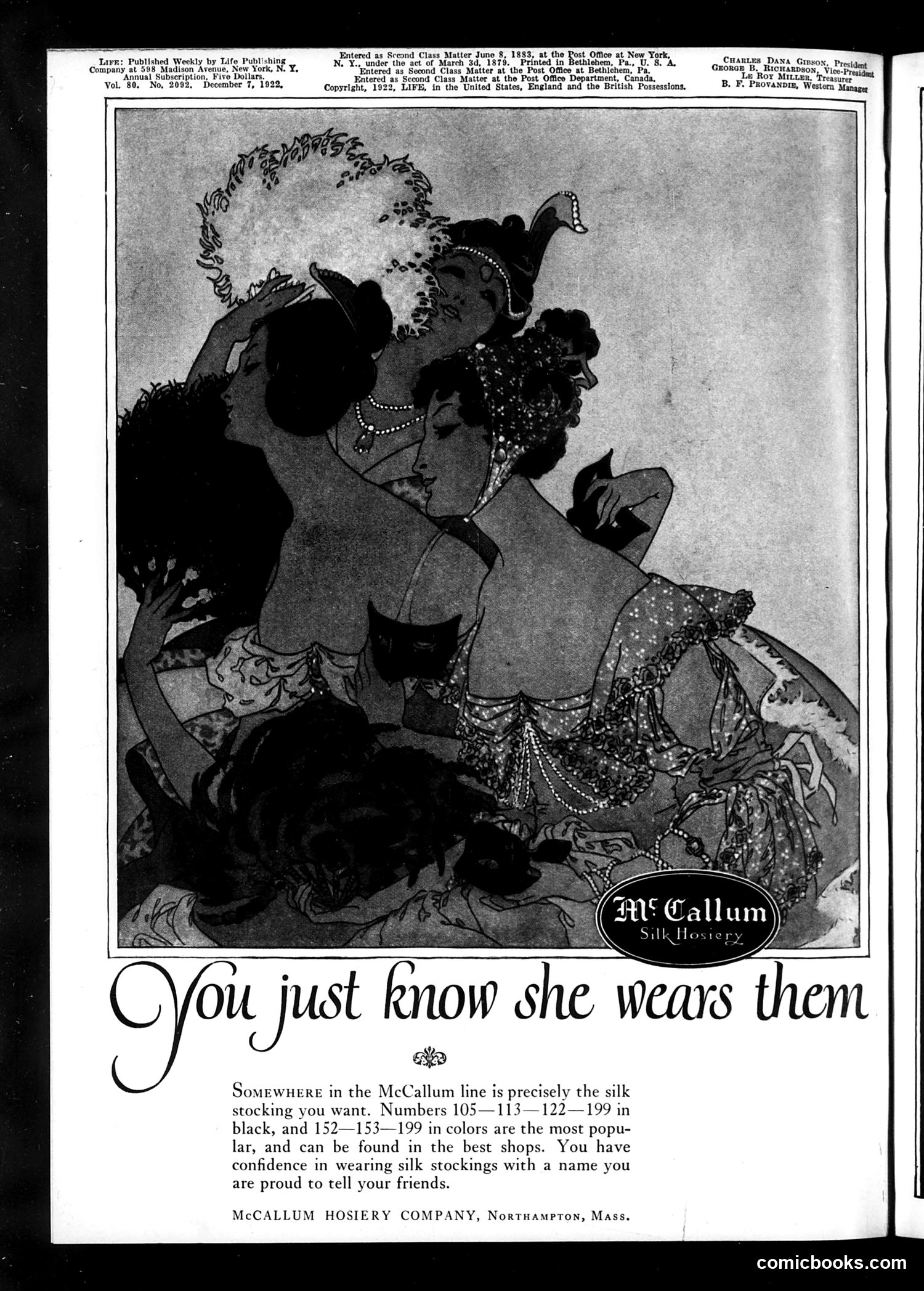
This page is primarily **advertising**, not satirical content. The image shows an illustration of two women in 1920s attire and styling, with the headline "You just know she wears them" promoting **McCullum Silk Hosiery**. The advertisement uses a common marketing strategy of the era: suggesting that fashionable, attractive women wear this brand. The copy claims specific stocking numbers (105-113-122-199 in black; 152-153-199 in colors) are "most popular, and can be found in the best shops," implying social status and taste through product association. This reflects 1920s consumer culture where silk stockings were luxury items signaling modernity and sophistication. The advertisement targets women by appealing to desire for fashion-consciousness and social approval—"a name you are proud to tell your friends."
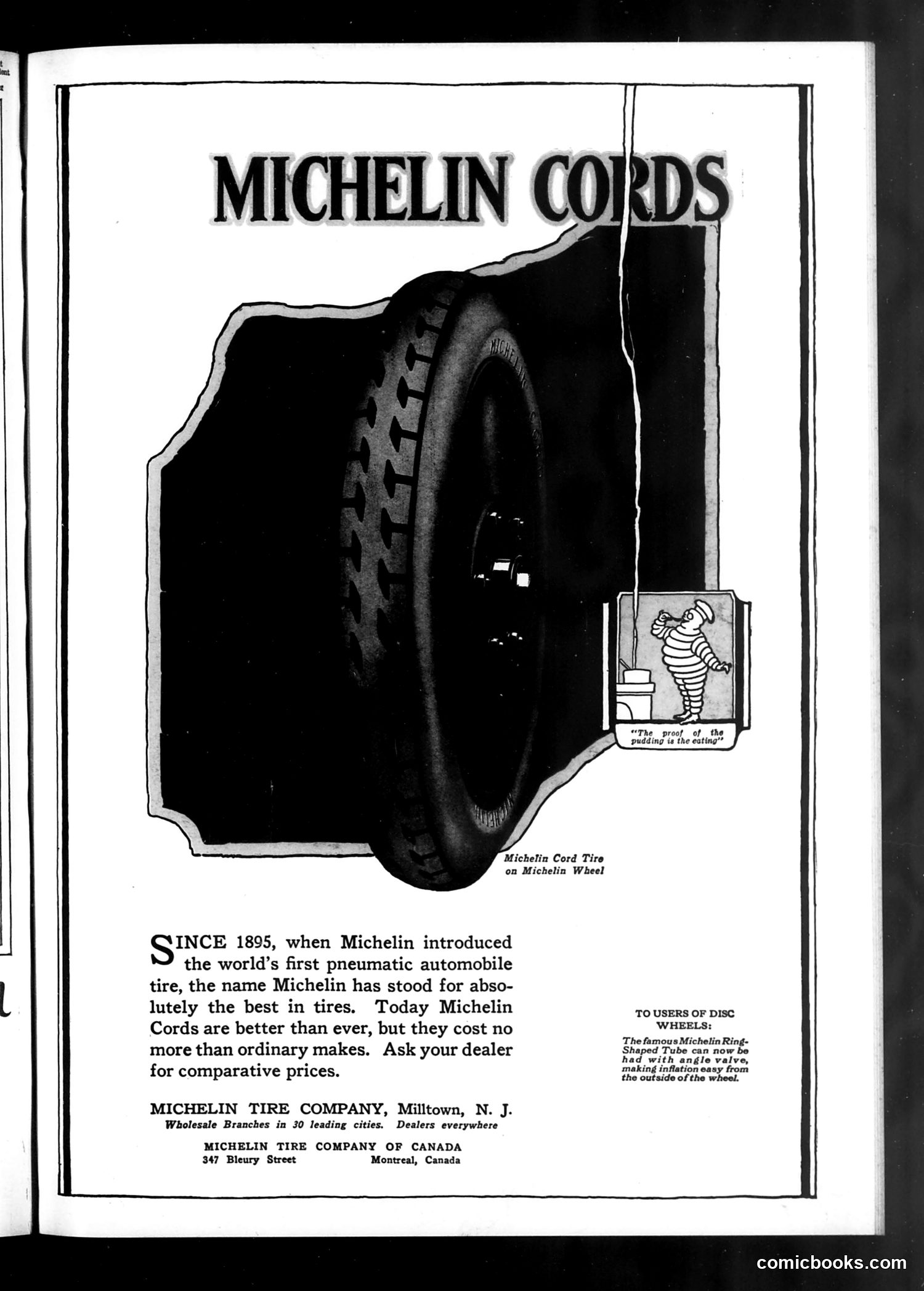
This is **not a political cartoon or satirical content**—it's a straightforward advertisement for Michelin automobile tires, likely from the 1910s-1920s based on the styling. The page features: - A large photograph of a Michelin cord tire on a Michelin wheel - The famous Michelin Man mascot (Bibendum) in the small inset, with his characteristic rotund appearance made of stacked tire rings - Marketing text emphasizing Michelin's dominance since 1895 as the first pneumatic tire maker - A note about Ring-Shaped Tubes for disc wheels (a technical innovation) - Company contact information for Milltown, N.J., and Montreal The humor is purely the cheerful mascot character, not satirical commentary. This is period advertising rather than editorial content.
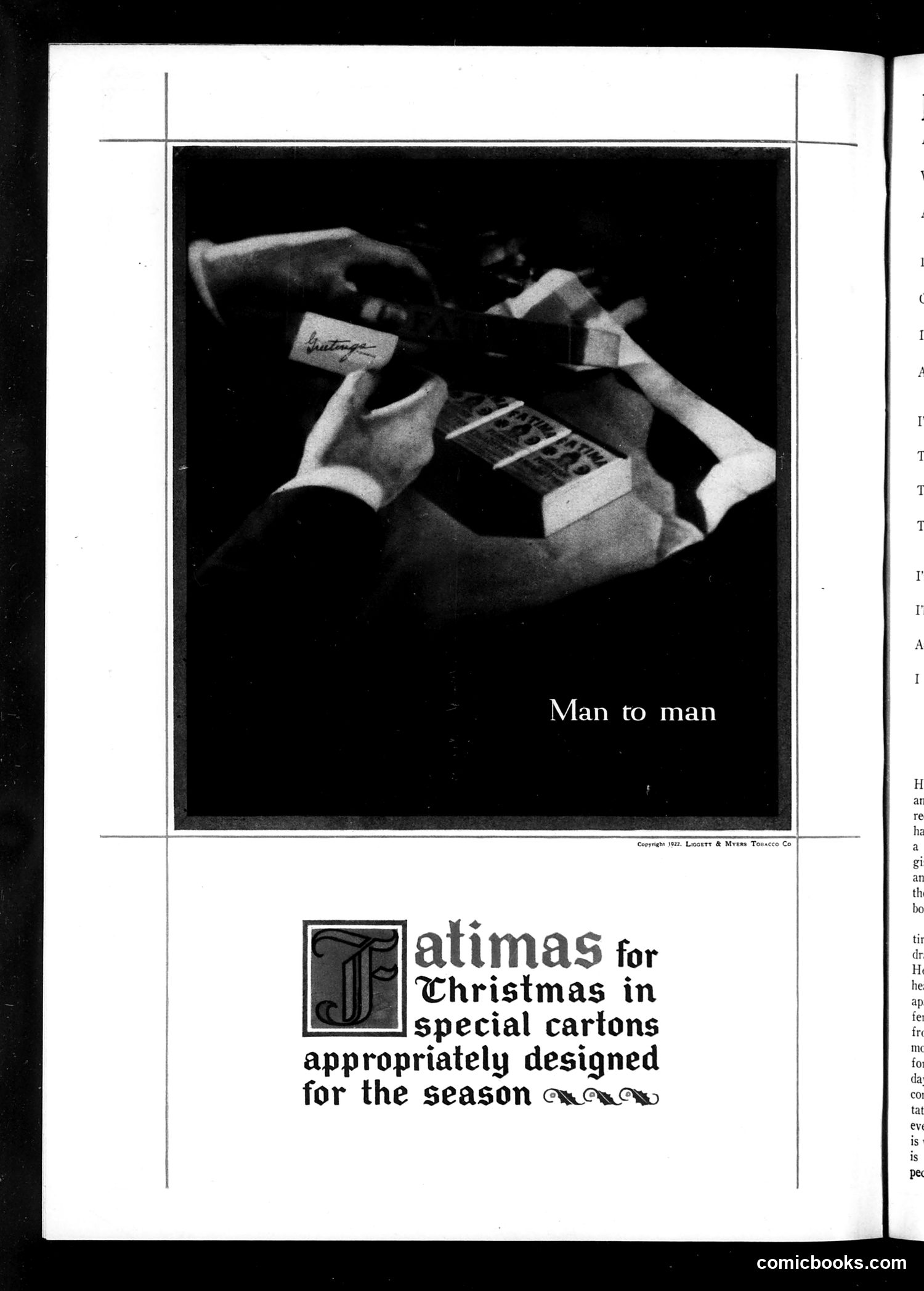
This page is primarily **advertising**, not editorial content or satire. It promotes **Latimas Christmas cigars** in special seasonal packaging. The upper image shows a black-and-white photograph titled "Man to man" depicting hands exchanging what appears to be a cigar box or gift—presenting the product as an appropriate gift between male acquaintances or business associates. The advertisement copy emphasizes that Latimas cigars come "in special cartons appropriately designed for the season," positioning the product as a premium Christmas gift option. There is **no political cartoon or satire** on this page. It's a straightforward commercial advertisement from an era when cigars were common, socially acceptable gift items, and when gendered marketing (presenting gifts "man to man") was standard advertising practice.
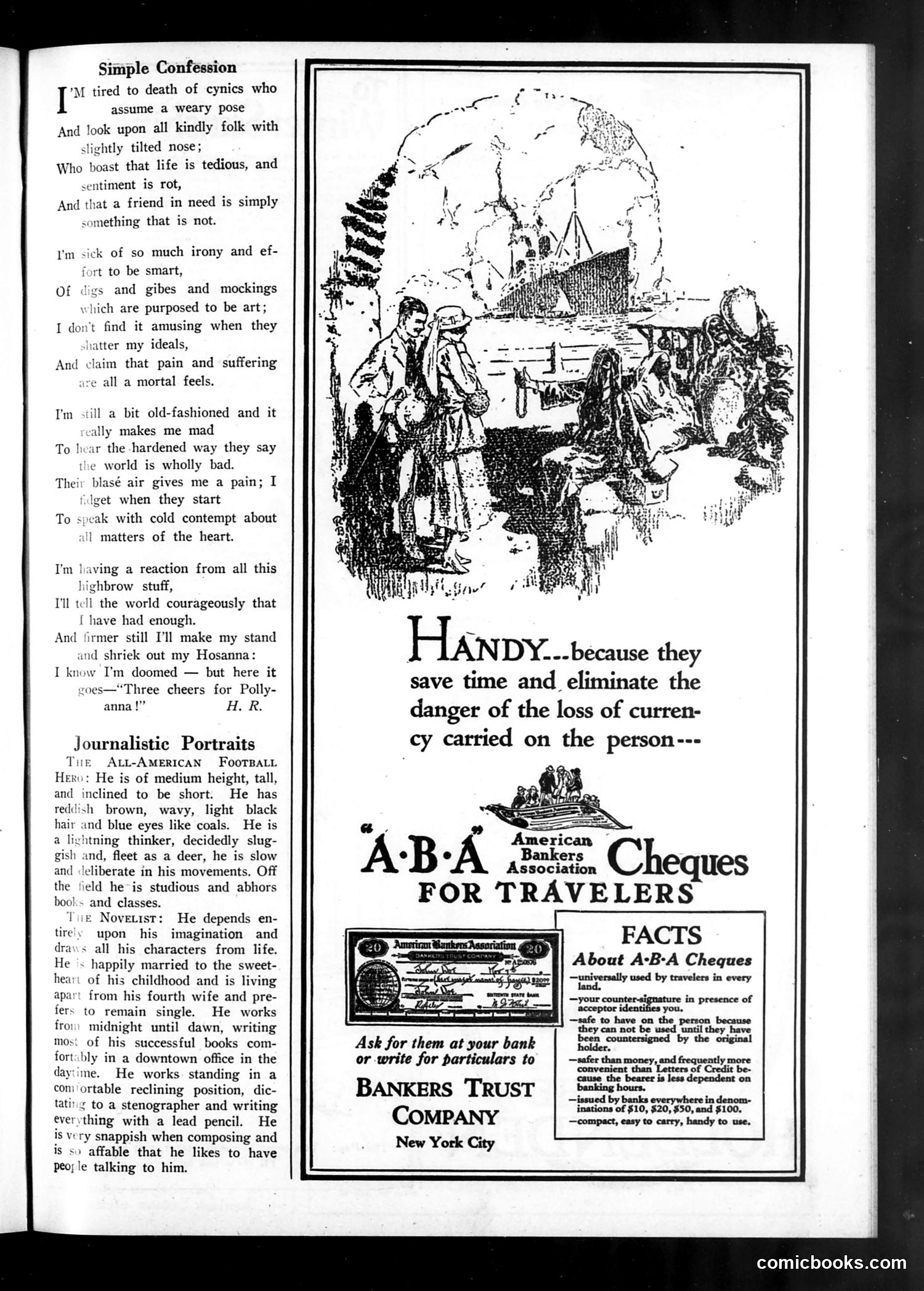
This page contains two distinct elements: **Left side:** A poem titled "Simple Confession" (signed H.R.) expressing frustration with cynicism and irony in modern discourse. The speaker rejects affected sophistication and advocates for genuine sentiment and compassion—a direct critique of the intellectual posturing popular in early 20th-century literary circles. **Right side:** A full-page advertisement for A.B.A. Cheques for Travelers, issued by Bankers Trust Company in New York City. The ad includes an illustration showing travelers exchanging currency and emphasizes the cheques' convenience and safety compared to carrying cash. The page juxtaposes sincere emotional expression against commercial messaging—likely reflecting *Life* magazine's characteristic blend of satire and advertising during this period.
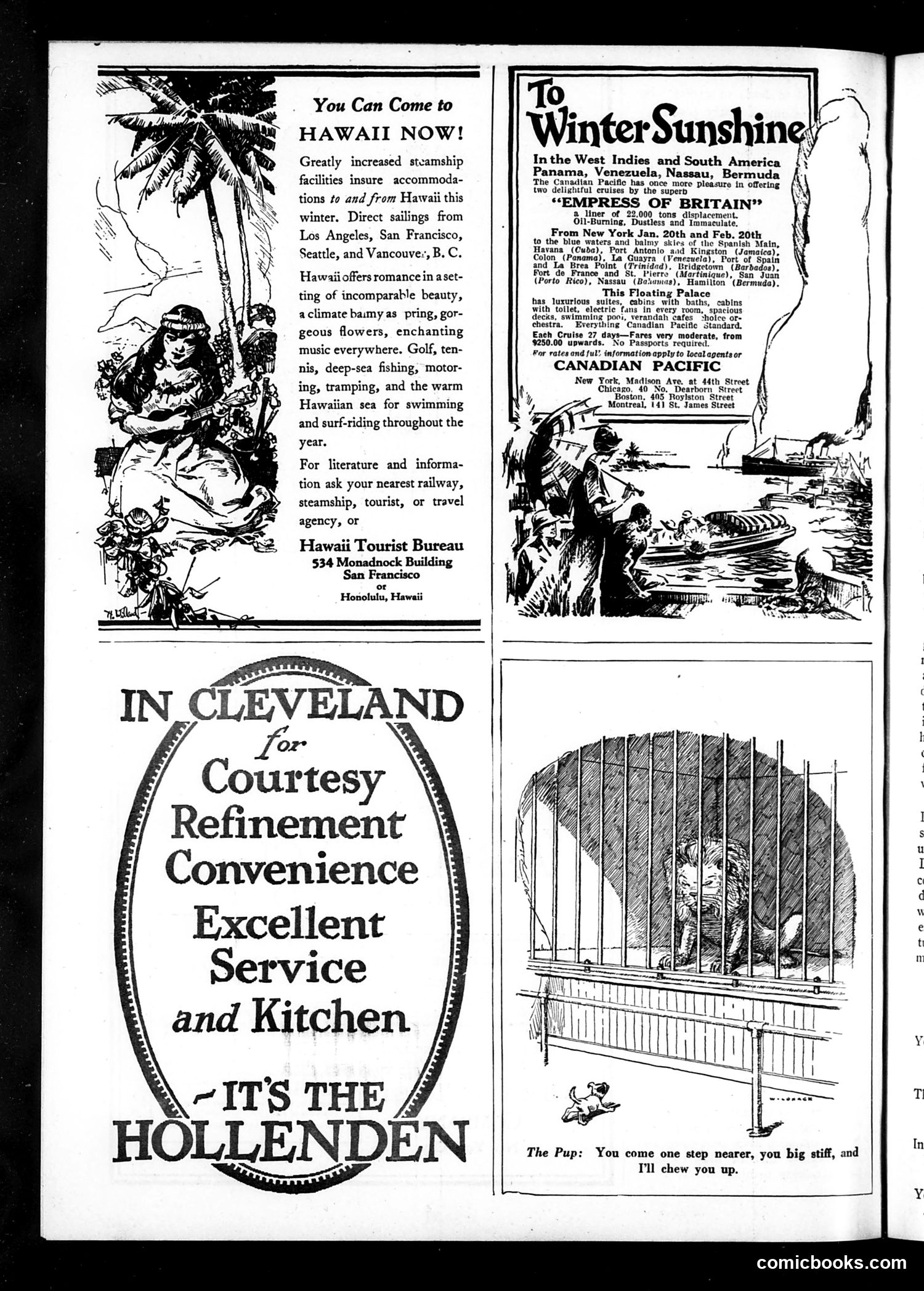
This page is primarily **advertising** rather than political satire. It contains three distinct ads: 1. **Hawaii Tourism Bureau** (top left): Promotes steamship travel to Hawaii from West Coast ports, highlighting romantic scenery and recreational activities. The illustration shows a woman in Hawaiian dress. 2. **Empress of Britain Cruise Line** (top right): Advertises Caribbean/South American winter cruises departing January-February, with the ship's specifications and itinerary details. 3. **The Hollenden Hotel** (bottom left): Cleveland hotel advertisement emphasizing service quality and dining. 4. **A cartoon** (bottom right): Shows a puppy behind a fence with caption "The Pup: You come one step nearer, you big stiff, and I'll chew you up." This is a humorous animal joke unrelated to politics—simply advertising-page filler.
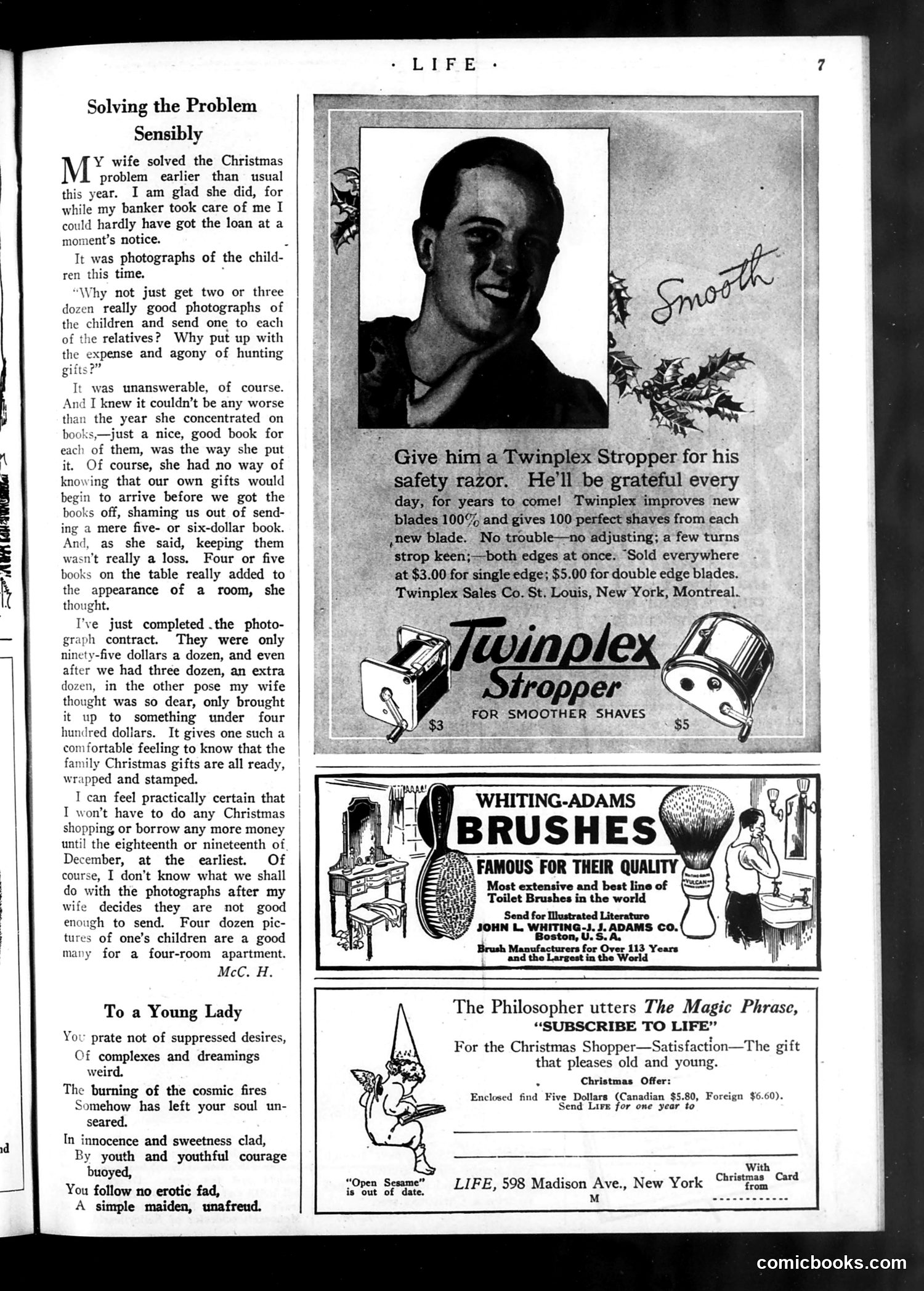
This page is primarily **advertisements and advice content**, not political satire. The main article, "Solving the Problem Sensibly," discusses practical Christmas gift-giving—specifically how the author's wife chose to give **photographs of their children** to relatives instead of purchasing multiple physical gifts. This reflects 1920s-era economic concerns about holiday spending. The advertisements promote consumer goods: a **Twinplex Stropper** safety razor, **Whiting-Adams brushes**, and a subscription offer for *Life* magazine itself. A short poem, "To a Young Lady," appears below, offering sentimental verse typical of period magazines. This represents *Life*'s evolution toward lifestyle and commercial content alongside its earlier satirical tradition.
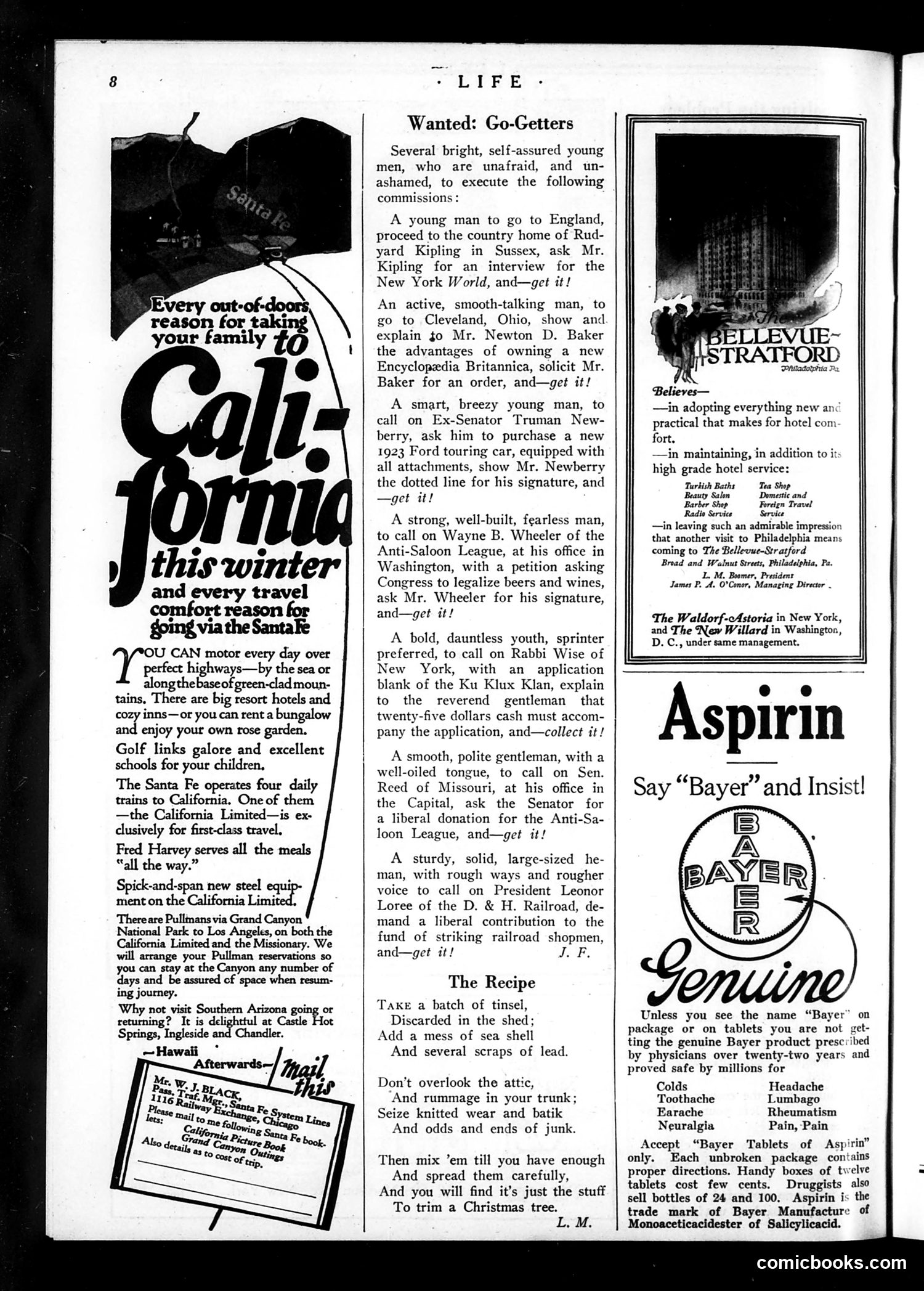
This page is primarily **advertising and humor content** rather than political satire. The main left advertisement promotes **California travel via the Santa Fe railroad** for winter vacations, emphasizing resort hotels, gardens, and good schools—targeting middle-class families. The center section titled **"Wanted: Co-Getters"** is satirical humor listing absurd "commissions" for young men, including visiting Rudyard Kipling, interviewing business figures, and collecting signatures from politicians like Ex-Senator Truman Newberry and President Leonor Loree. The joke is that these are ridiculous, impossible tasks presented as employment opportunities. The right side features the **Bellevue-Stratford hotel advertisement** and an **Aspirin advertisement** for Bayer brand, emphasizing it's "genuine" and widely trusted. The page reflects 1920s consumer culture and advertising-driven magazine content.
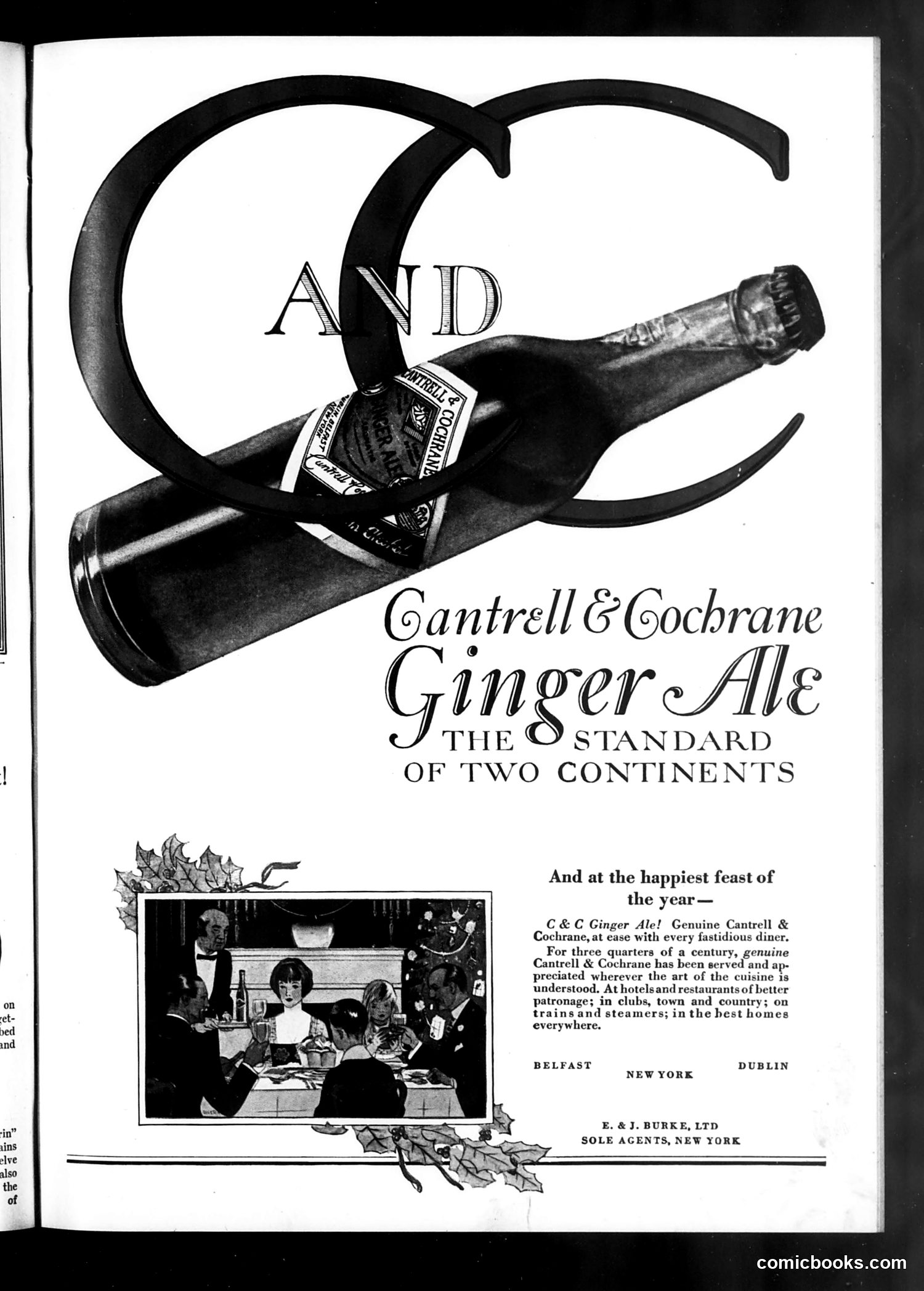
This is a **product advertisement**, not a political cartoon. It promotes Cantrell & Cochrane Ginger Ale, described as "the standard of two continents." The large decorative "C&C" letters frame a bottle of the beverage. The ad emphasizes the product's prestige and long history—"three quarters of a century" of service at "the happiest feast of the year" (Christmas, suggested by holly decoration). It claims the ginger ale appears "at case with every fastidious diner" in upscale venues: hotels, restaurants, clubs, trains, steamers, and "the best homes everywhere." The small photograph shows a formal dinner scene, reinforcing the product's association with refined, celebratory occasions. Distribution information lists Belfast, New York, and Dublin, with E. & J. Burke Ltd. as sole agents in New York.
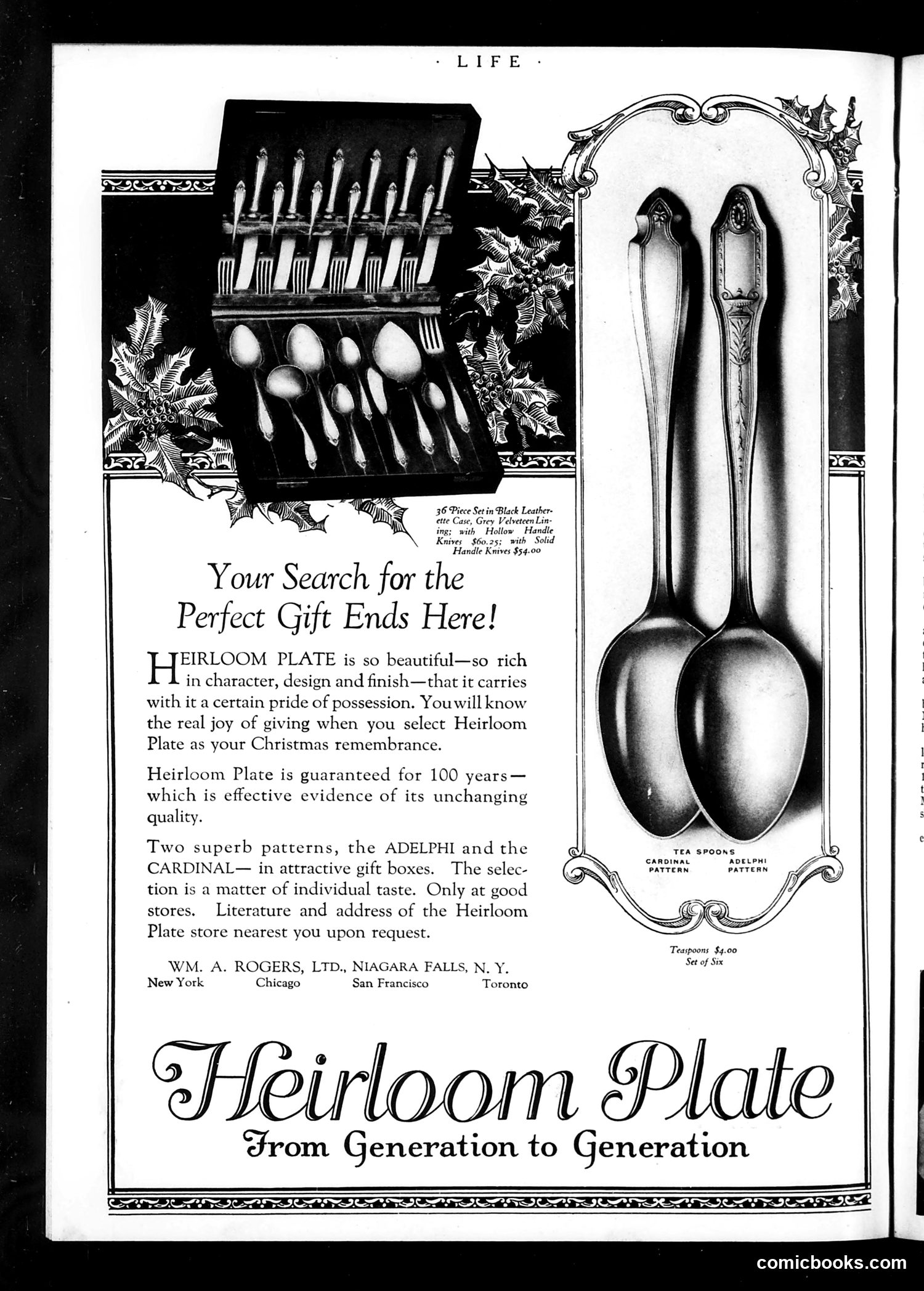
This is primarily an **advertisement, not a cartoon or satire**. It's a full-page ad for Heirloom Plate silverware by WM. A. Rogers, Ltd., based in Niagara Falls, New York. The ad uses holiday gift-giving messaging ("Your Search for the Perfect Gift Ends Here!") and emphasizes the product's permanence with a 100-year guarantee and the tagline "From Generation to Generation." Two patterns are shown: the Adelphi and Cardinal, displayed in decorative boxes and as individual tea spoons. The festive holly leaf decorations and formal silverware imagery target middle-to-upper-class consumers seeking elegant, long-lasting Christmas gifts. This reflects early 20th-century marketing that associated quality tableware with family heirlooms and social status.
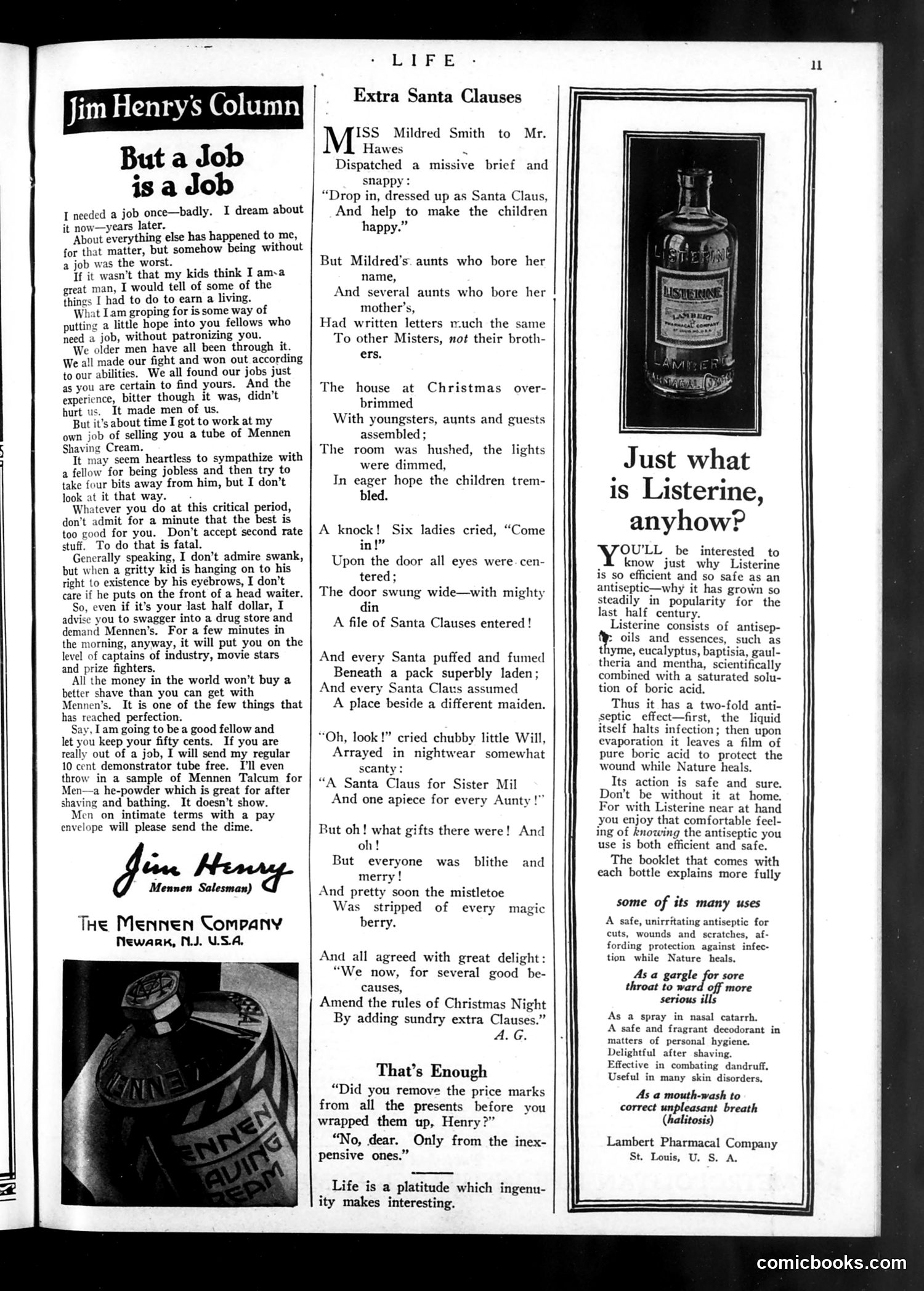
This page contains **Jim Henry's Column** titled "But a Job is a Job," a personal essay about working-class employment and dignity during what appears to be the early 20th century. Henry, identified as a Mennen salesman, reflects on his own job selling shaving cream, arguing that any honest work—even modest positions like demonstrating products—builds character and self-respect. The page also includes "Extra Santa Clauses," a humorous Christmas poem about multiple Santa Clauses arriving at a crowded holiday gathering, and a Listerine advertisement explaining the antiseptic mouthwash's uses. The satirical tone emphasizes working-class pride and challenges social prejudice against modest employment, while the Christmas verse gently mocks holiday chaos and gift-giving excess.
This appears to be an advertorial essay rather than political satire. Published by Metropolitan Life Insurance Company, it promotes scientific cooking and proper home nutrition as foundations for national health and prosperity. The piece argues that mothers' kitchen decisions directly affect family—and by extension, national—wellbeing. It references specific figures (Napoleon, Gilbert Chesterton, Louis XV, Brillat-Savarin) to establish that food preparation is serious business worthy of scientific study. The decorative illustration on the right shows a festive Christmas scene, supporting the seasonal theme: proper home cooking ensures family happiness during holidays. This is essentially 1920s domestic propaganda emphasizing mothers' responsibility for nutrition and efficiency—framed as patriotic duty and scientific progress rather than traditional women's work.
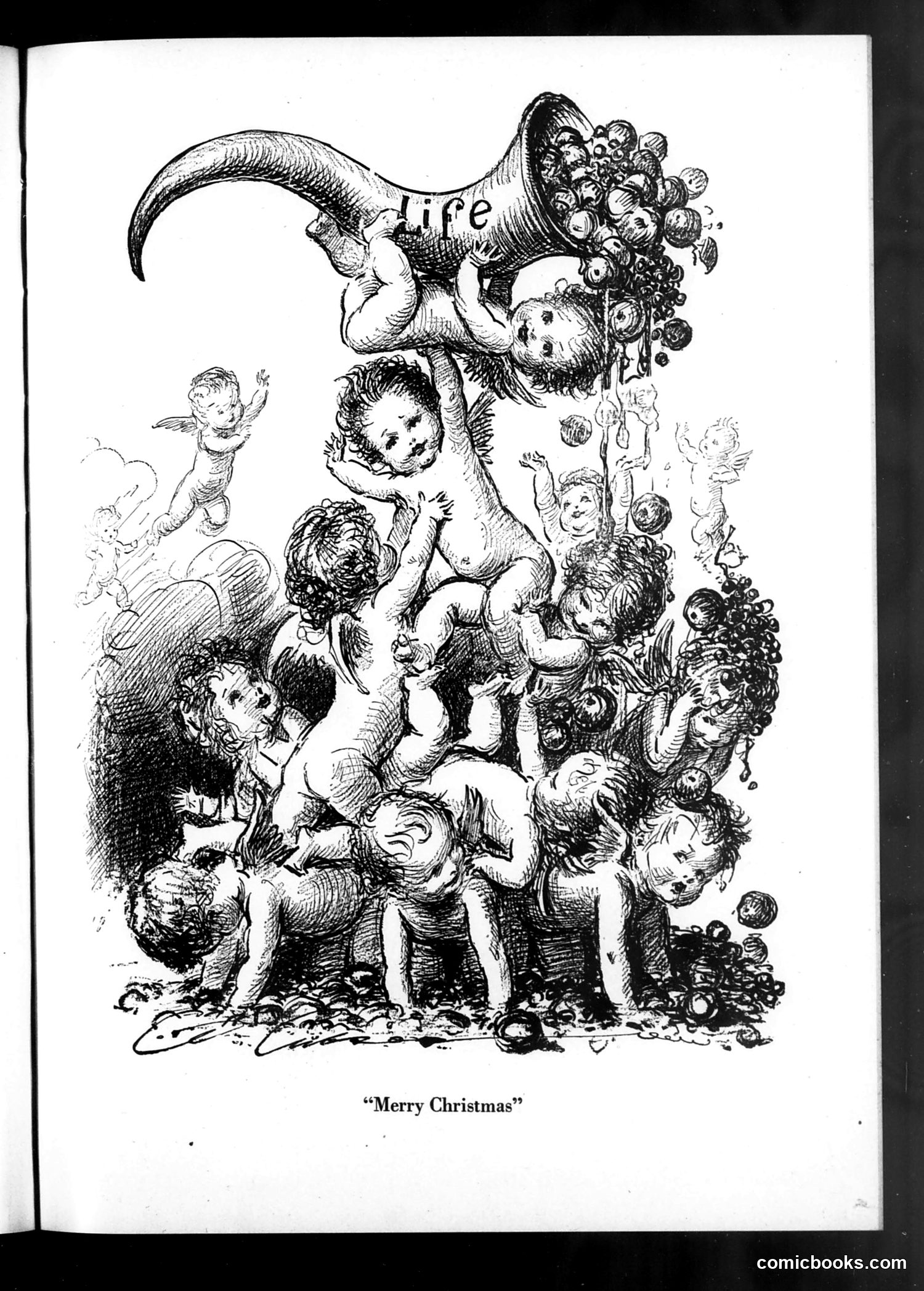
This is a Christmas greeting illustration from *Life* magazine captioned "Merry Christmas." The image depicts a cornucopia (horn of plenty) overflowing with grapes and other fruits, from which numerous cherubs or putti emerge and play. The word "life" appears on the horn itself. The satire appears to celebrate abundance and fertility—classical symbols of prosperity. The cherubs represent joy, innocence, and prosperity spilling forth. This likely served as a seasonal greeting promoting optimism and good cheer, possibly also subtly referencing Life magazine's own vitality and proliferation. Without the publication date visible, the specific historical context remains unclear, but the imagery suggests an era when *Life* positioned itself as a publication of abundance, humor, and cultural commentary during what appears to be a prosperous period.
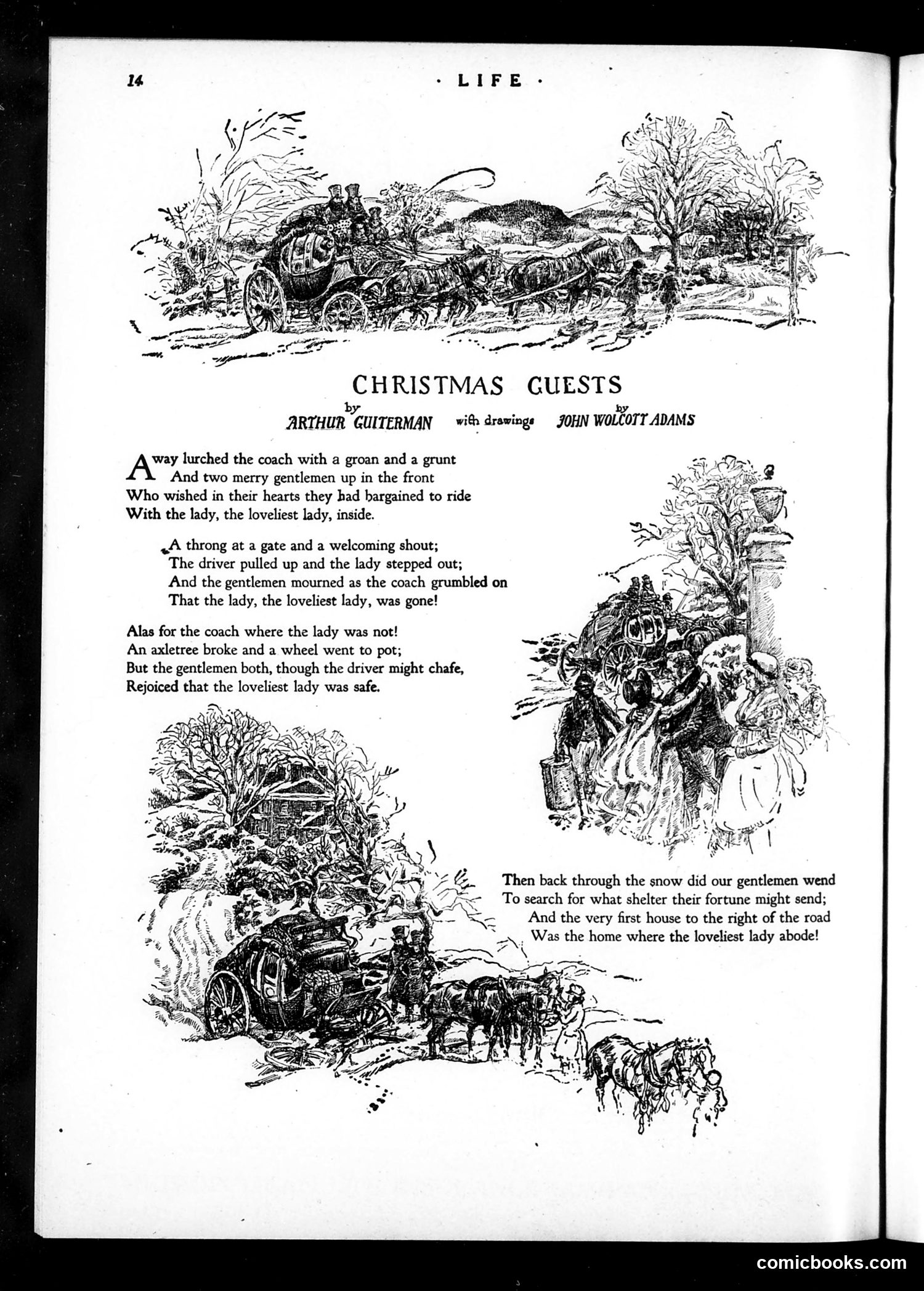
This is a lighthearted narrative poem illustrated with pen-and-ink drawings. It tells the story of a coach journey where two gentlemen and "the loveliest lady" set out together. When the coach stops at a gate, the lady mysteriously disappears—she steps out but never returns to the carriage. The gentlemen continue searching through snow, discovering the lady has arrived home ahead of them. The poem's gentle humor plays on the supernatural or magical nature of her inexplicable vanishing from the coach, suggesting either ghostly qualities or a practical joke at the gentlemen's expense. The illustrations depict the coaches, horses, and snowy landscape with period detail typical of early 20th-century holiday entertainment content.
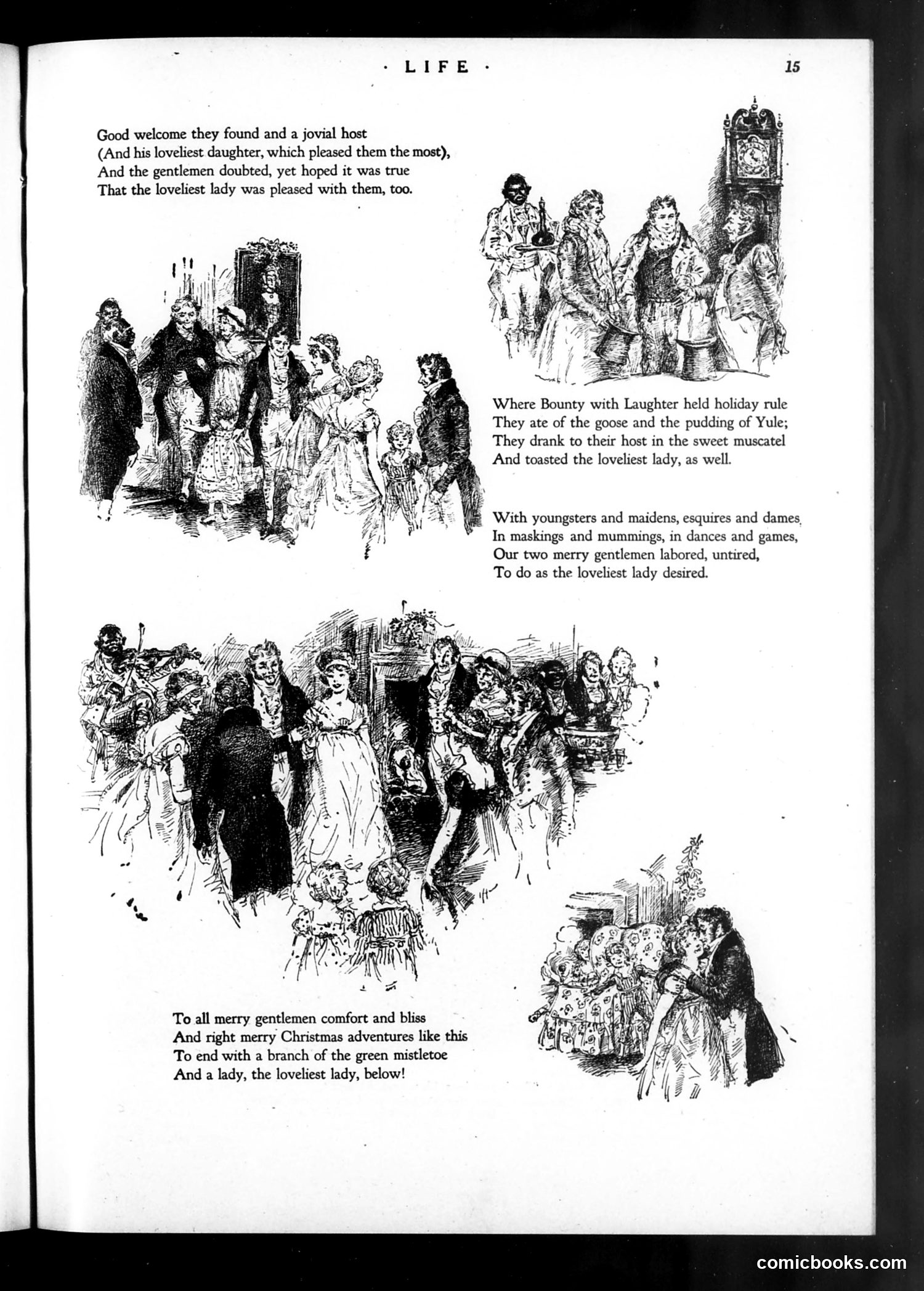
This page presents a Christmas-themed narrative poem with accompanying illustrations, rather than political satire. The text describes two gentlemen visiting a jovial host and his daughter during the holidays, participating in festive activities—dining on goose and pudding, engaging in games and dances, and ending with mistletoe kissing. The illustrations depict Victorian-era Christmas celebrations: welcoming guests, a crowded holiday gathering, and a romantic mistletoe moment. The repeated references to "the loveliest lady" suggest courtship humor typical of period satire. Without visible publication date or author attribution, this appears to be sentimental holiday entertainment rather than political commentary. The content celebrates genteel Christmas traditions and romantic possibilities within proper social circles of the era.
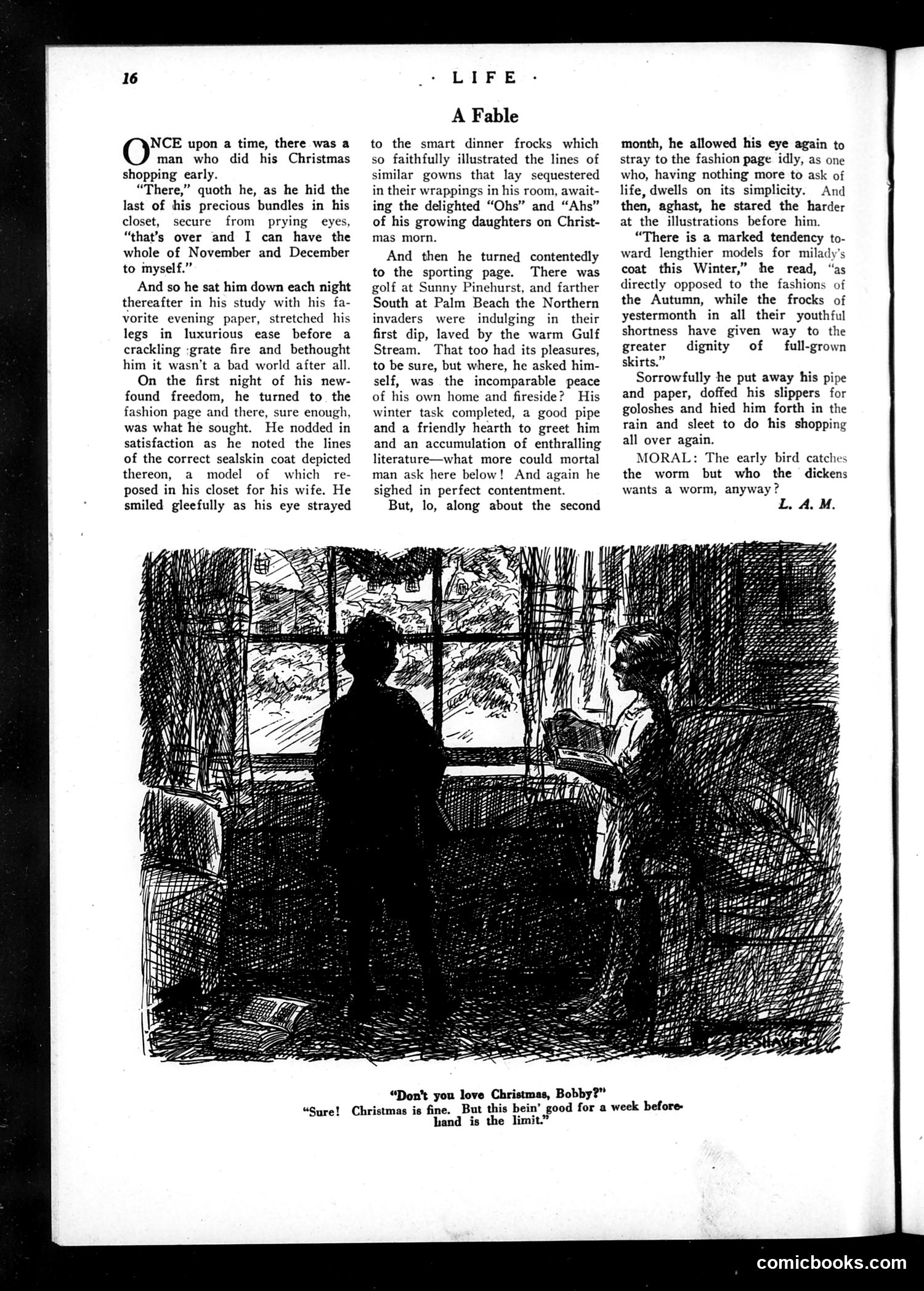
This page contains "A Fable," a short story about a man who hides his Christmas shopping until late November, then enjoys leisure reading fashion magazines and sports pages while imagining pleasant winter activities. The moral warns that "the early bird catches the worm but who the dickens wants a worm, anyway?" The accompanying illustration shows two figures at a window during what appears to be winter, with dialogue: "Don't you love Christmas, Bobby?" "Sure! Christmas is fine. But this bein' good for a week before-hand is the limit." The satire targets the tension between Christmas commercialism and childhood impatience—mocking both adult procrastination in holiday shopping and children's difficulty maintaining good behavior during the extended pre-holiday season. It's gentle social commentary on seasonal consumer culture and family dynamics.
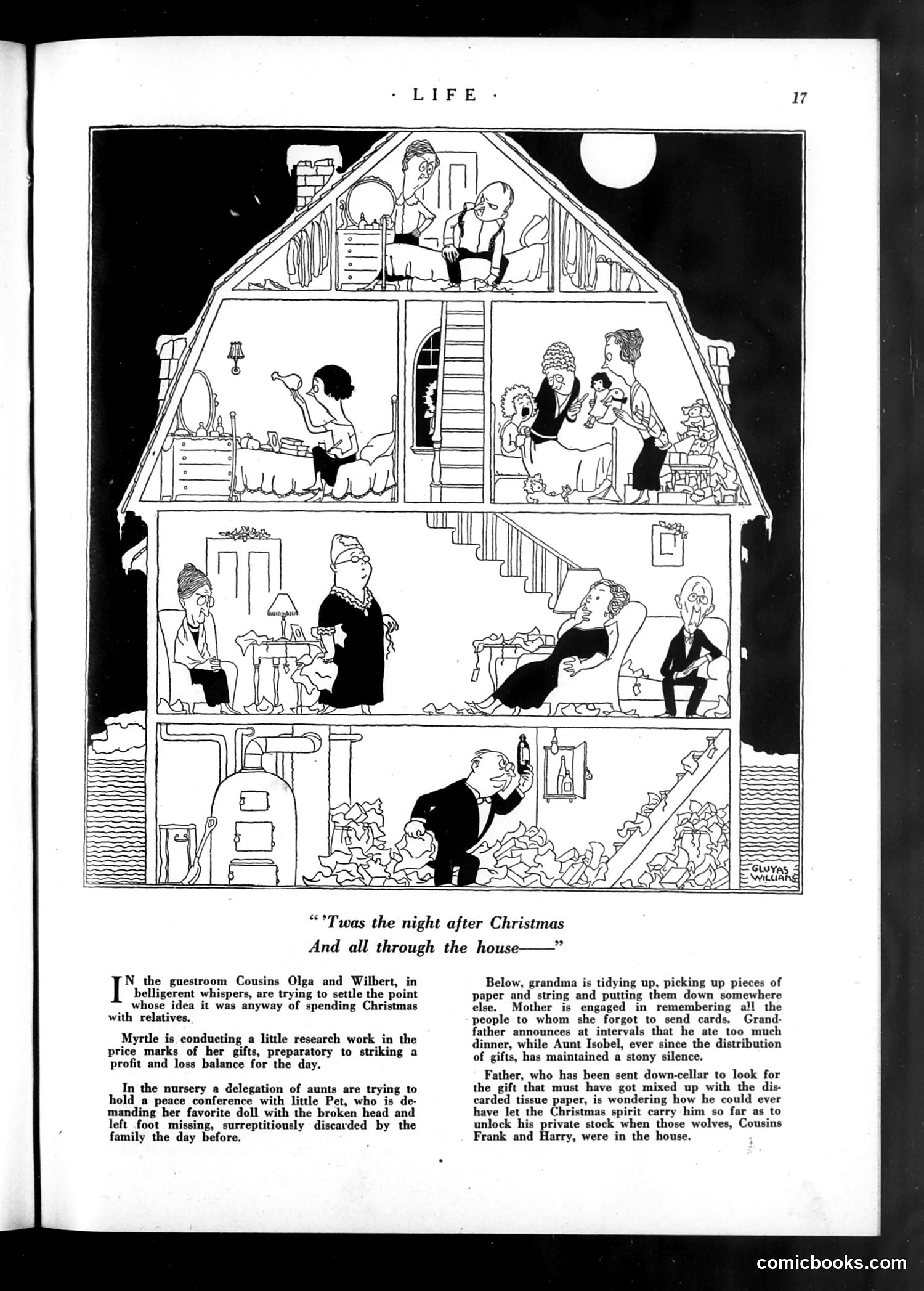
This is a humorous cross-section illustration satirizing the chaotic day *after* Christmas in a typical American household. The cartoon depicts the domestic discord that follows holiday celebration: **The satire targets:** - Post-Christmas family tension (bickering guests, strained relationships) - Materialism (Myrtle calculating gift profits/losses; concern over "discarded" presents) - Generational friction (aunts negotiating with a demanding child over a broken doll) - Exhaustion and regret (Father's depleted liquor stock, Grandfather's overindulgence, Aunt Isobel's silent resentment, Mother's forgotten thank-you cards) - Grandma's pointless busywork The opening line parodies the famous poem "'Twas the Night Before Christmas," inverting the magic and peace of Christmas Eve into the messy reality of the day after. The humor lies in recognizing universal family dysfunction masked by holiday sentimentality.
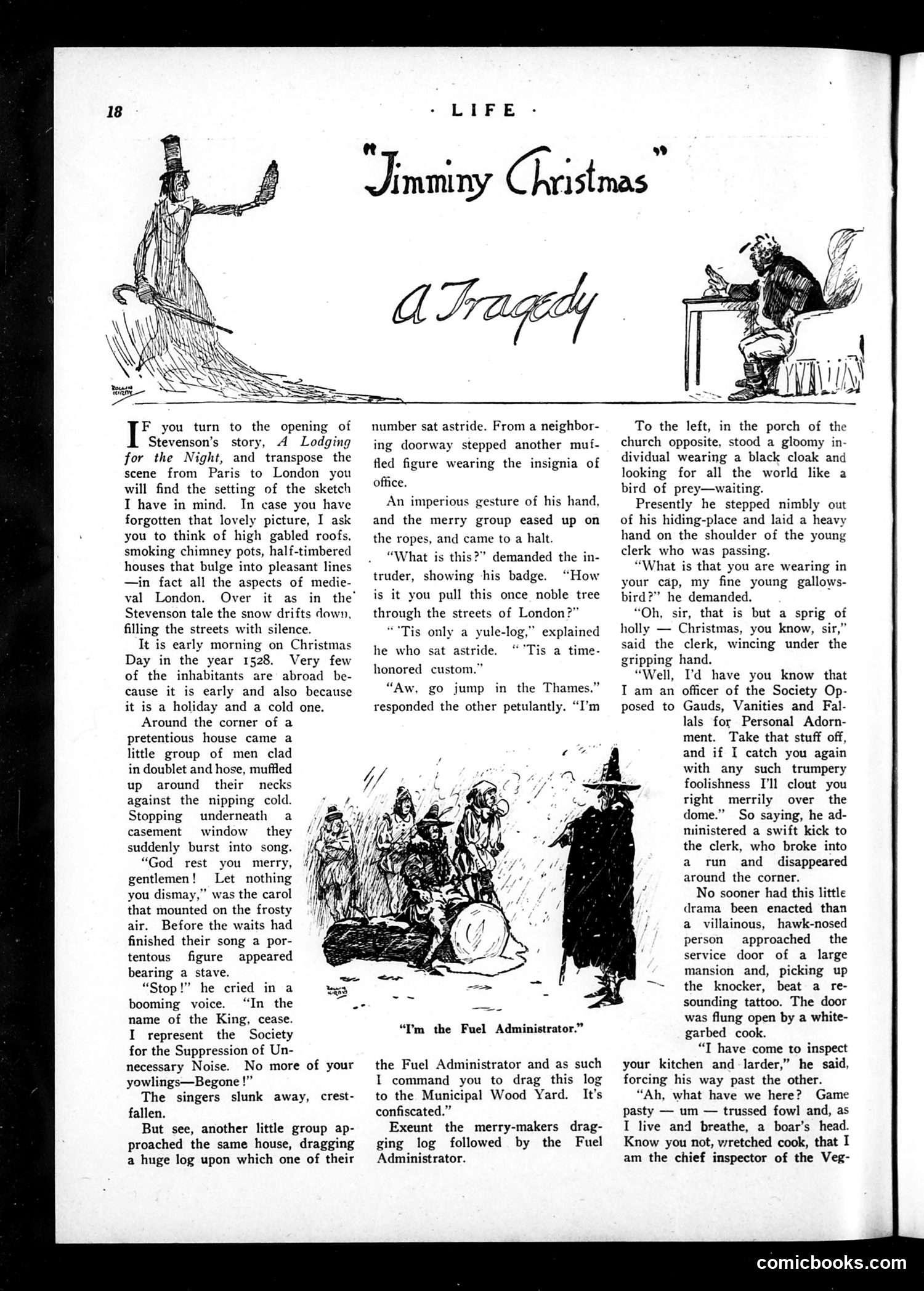
This satirical story mocks British wartime bureaucracy by imagining medieval London invaded by officious officials. During Christmas 1528, various administrators suppress traditional holiday customs: A "Society for the Suppression of Unnecessary Noise" officer stops carolers. A "Fuel Administrator" confiscates a yule log for the Municipal Wood Yard. An officer "Opposed to Gauds, Vanities and Fallals" violently removes holly from a clerk's cap. Finally, a vegetable inspector threatens to seize game and meat from a kitchen. The satire targets real WWI-era British regulations—fuel rationing, noise restrictions, and food controls—presented as absurd bureaucratic overreach that destroys Christmas joy. By transplanting these intrusions to historical medieval London, Life magazine critiques how modern government administration has become tyrannically zealous, destroying harmless traditions in the name of wartime necessity.
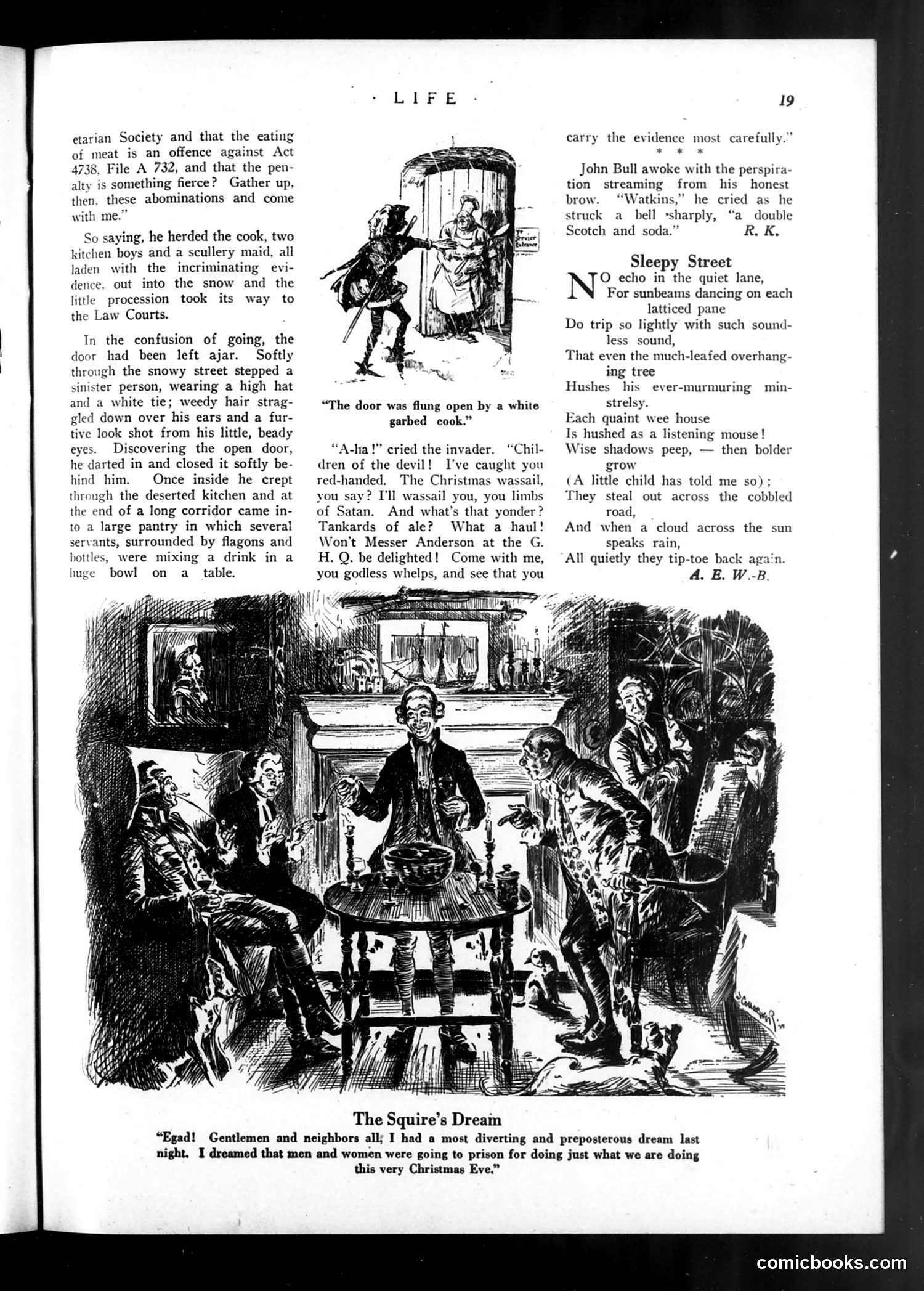
This page satirizes British wartime restrictions on alcohol and meat consumption. The narrative describes a zealous enforcer raiding a Christmas celebration, arresting servants for drinking wassail and ale, and seizing meat as violations of rationing laws. The protagonist, "John Bull" (personification of Britain), awakens in terror from this nightmare. **The satire's point**: The dream mocks the absurdity of the government's wartime restrictions so severe they criminalize ordinary holiday traditions. "The Squire's Dream" frames these regulations as dystopian overreach—people imprisoned for celebrating Christmas normally. The cartoon criticizes both the restrictive wartime policies and their enforcement as excessive and tyrannical, reflecting public resentment toward rationing and prohibition measures during World War I-era Britain. The joke: such draconian control seems like a bad dream, yet mirrors actual wartime regulations.
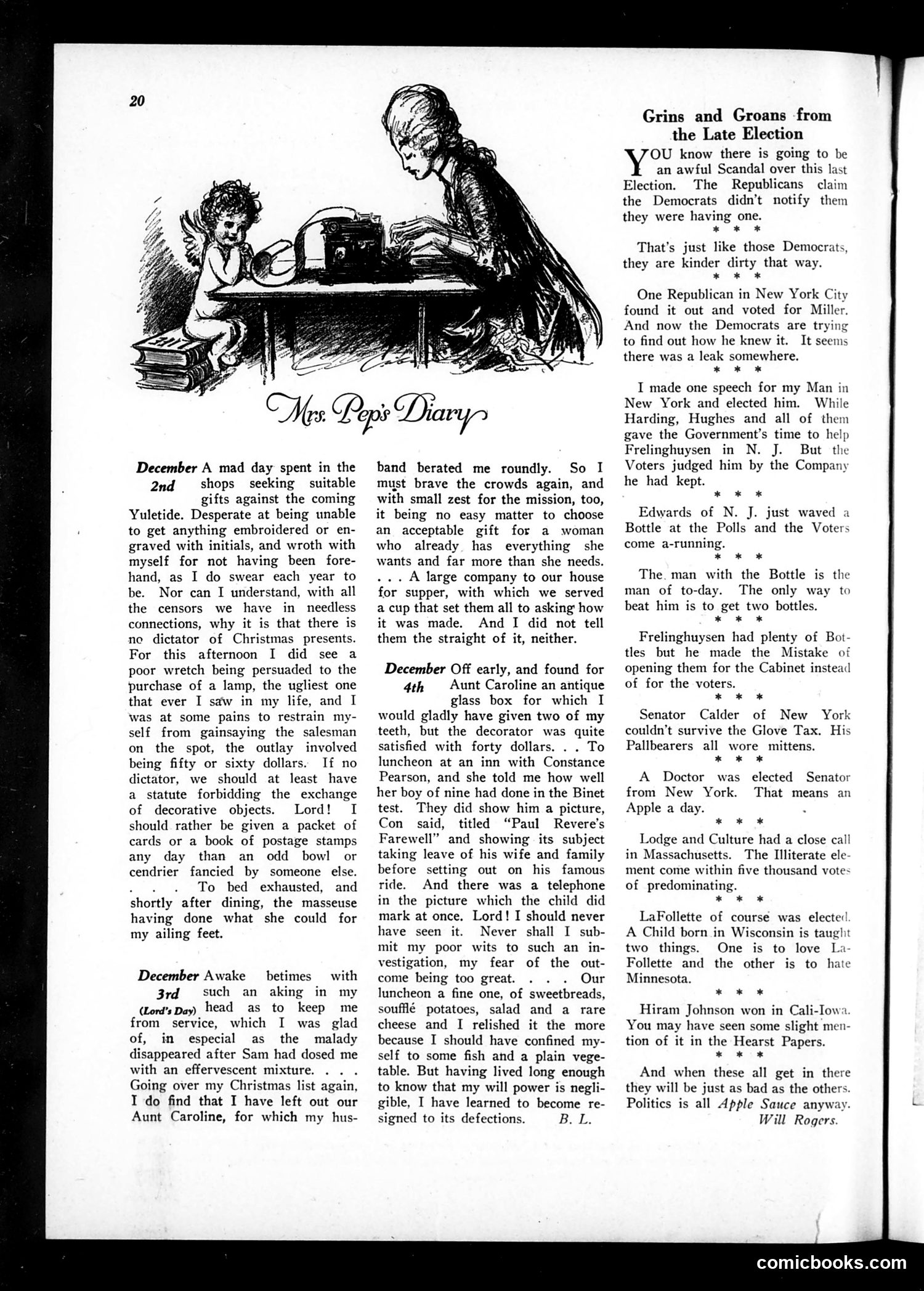
This Life magazine page contains two distinct sections: "Mrs. Lope's Diary" (a satirical society column about Christmas shopping frustrations) and "Grins and Groans from the Late Election" (political jokes). The election section references the 1920 U.S. presidential election, mocking both parties. The jokes suggest Republicans claim Democrats ran their campaign secretly, and reference a Republican voter in New York who somehow discovered his party was having an election. There are mentions of politicians Harding, Hughes, and Frelinghuysen (New Jersey), and a candidate "Miller." The satire targets voter ignorance and party secrecy—implying elections weren't well-publicized and voters made decisions based on candidates' associations rather than policy. The final jokes suggest crude campaigning tactics (waving bottles at polling places to attract voters). The cartoon depicts a woman at a typewriter, likely illustrating the diary's author documenting her holiday shopping complaints and social observations.
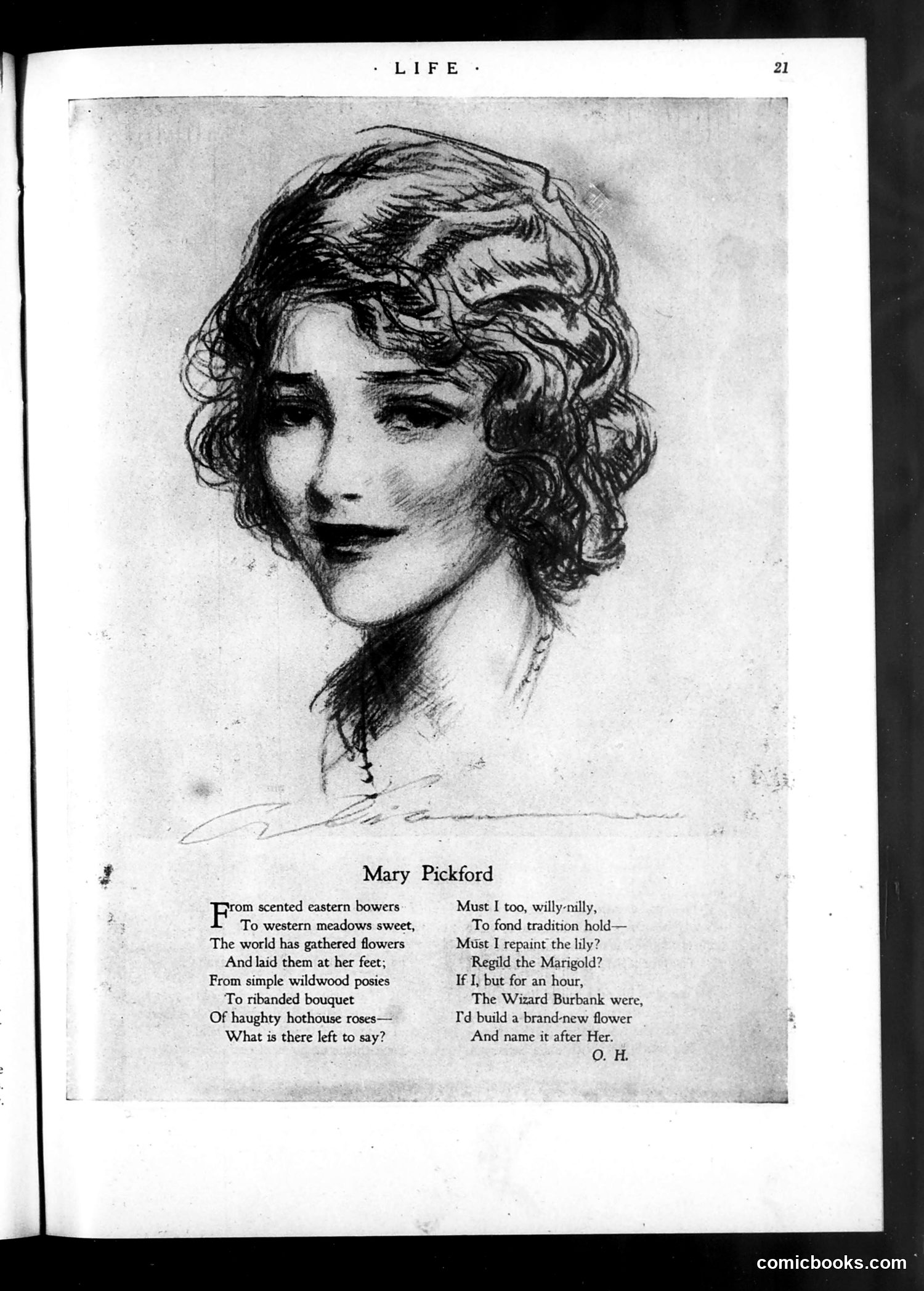
This page features a portrait sketch and poem celebrating **Mary Pickford**, a major silent-film star of the early 20th century. The poem, signed "O.H.," uses flowery language to praise her beauty and fame. The satire is gentle: the poet mock-laments that Pickford has received so much adulation (metaphorically, "flowers laid at her feet") that there's nothing left to say. He jokingly suggests that even legendary horticulturist Luther Burbank—referenced as "the Wizard Burbank"—couldn't improve upon her by creating a new flower in her honor. This is primarily a **fan tribute** rather than political satire. It reflects Pickford's celebrity status during Hollywood's golden age, when she was among the most famous actresses in the world.
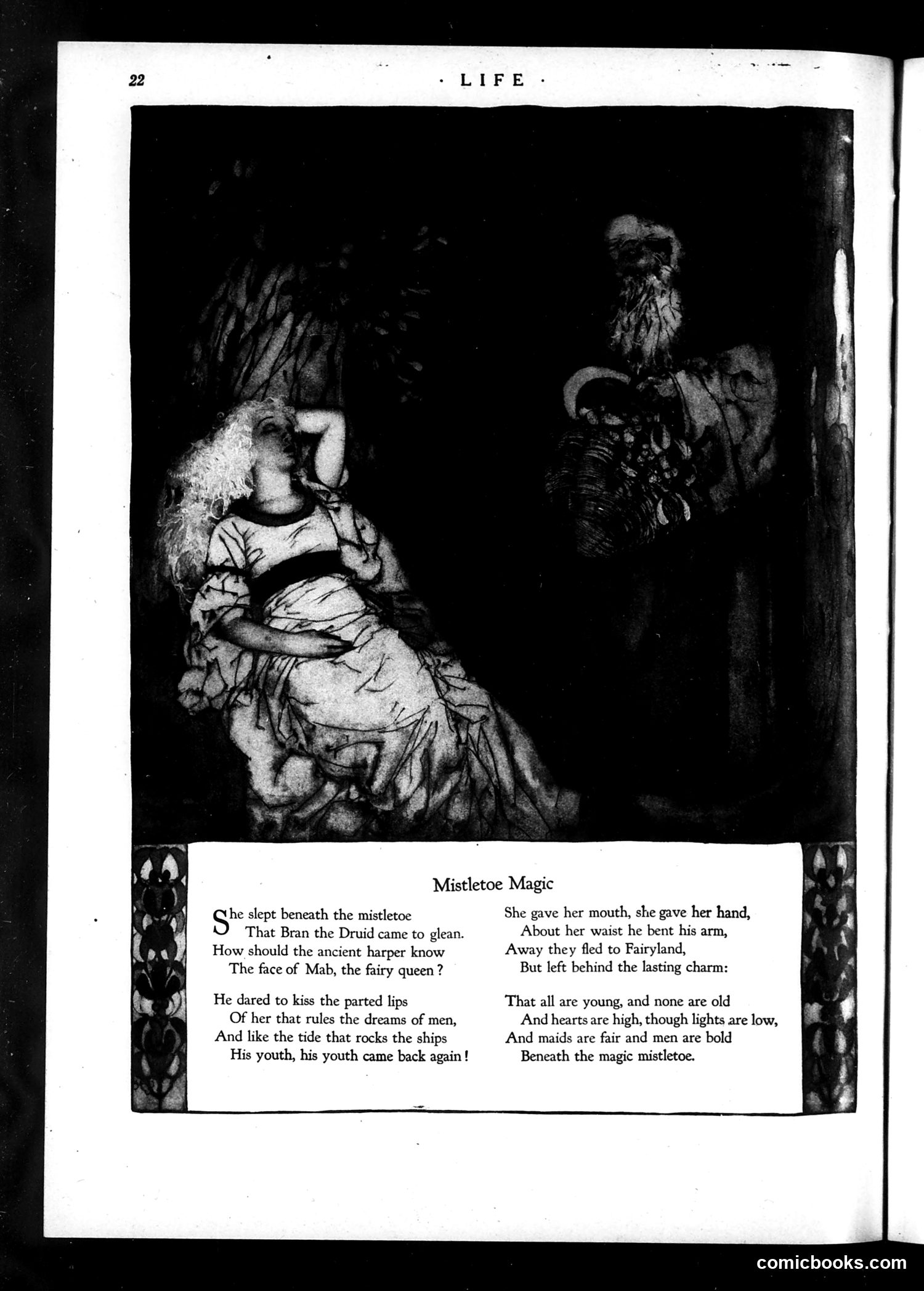
This is a romantic illustration and poem from Life magazine, not political satire. It depicts a fairy-tale scene where an old harper kisses a woman beneath mistletoe and experiences magical rejuvenation—his youth returns. The narrative references Celtic mythology (Bran the Druid, Mab the fairy queen) to create a whimsical fantasy. The poem celebrates mistletoe's legendary romantic properties: the kiss restores the man's vigor and transports both lovers to "Fairyland," while leaving behind an enchantment that makes youth eternal and love eternal beneath the mistletoe. This is sentimental, fantasy-based content typical of early Life magazine's lighter material—escapist entertainment with no apparent political commentary or social satire.
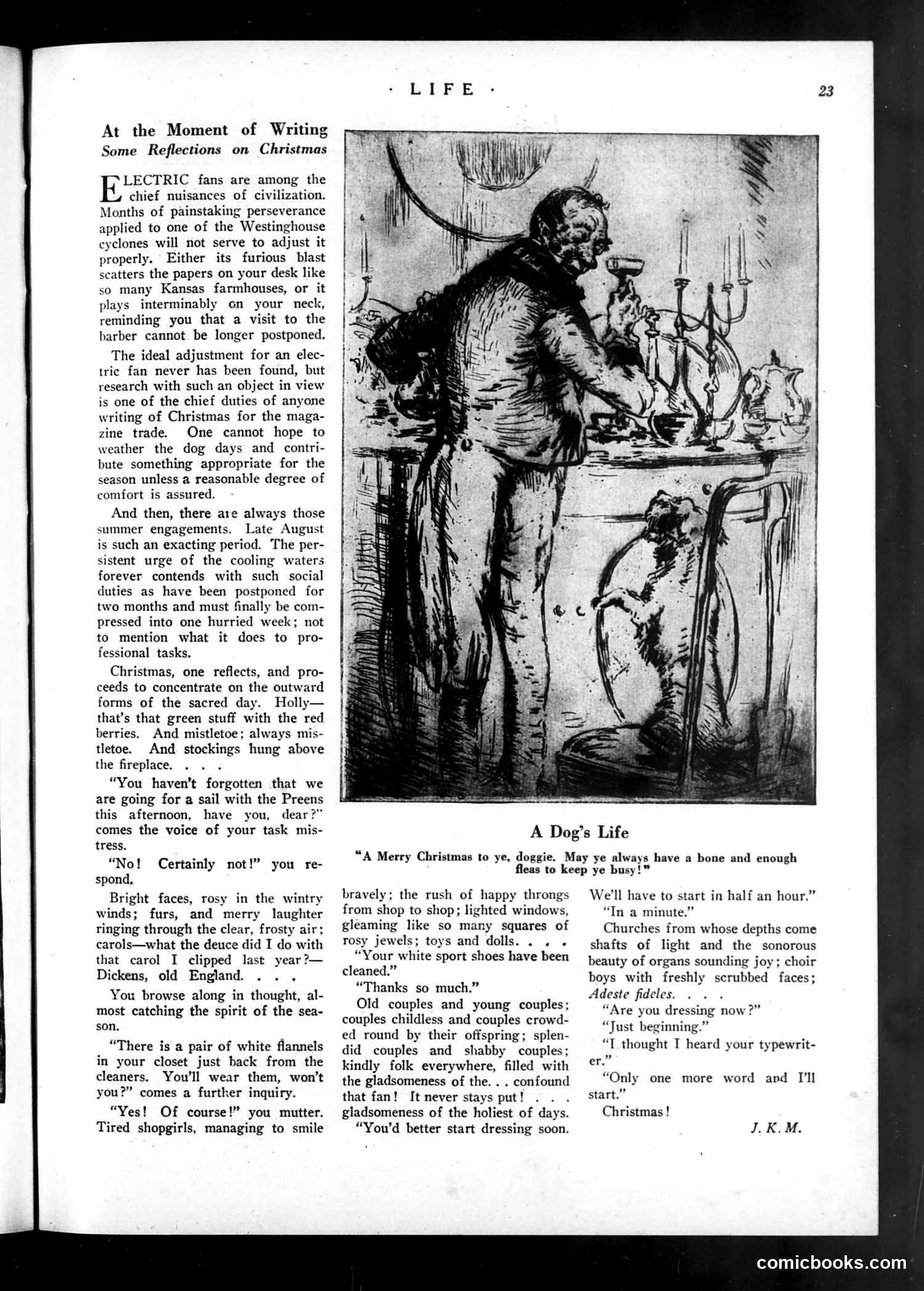
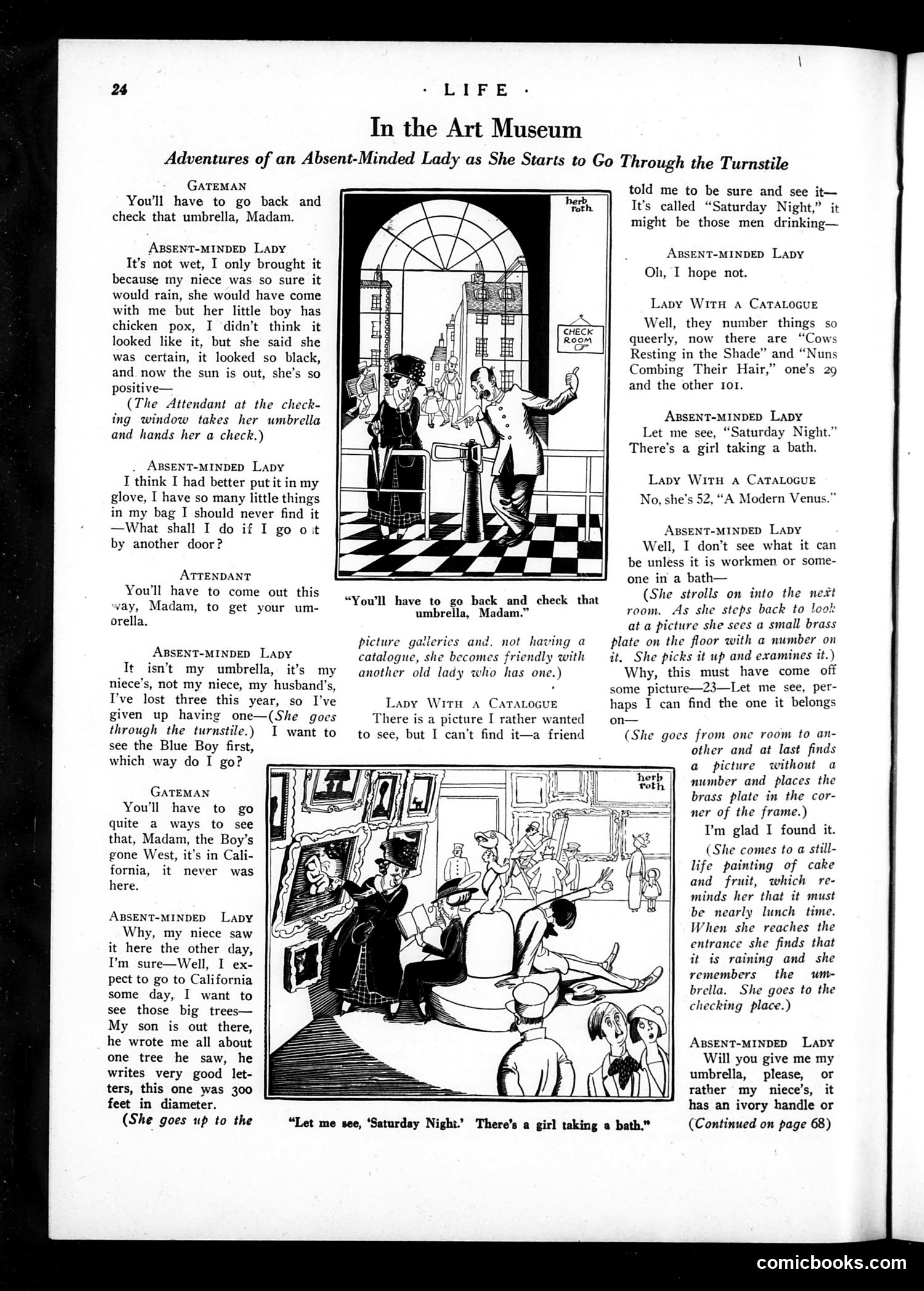
This is a humorous multi-panel comic strip satirizing the stereotypical absent-minded society lady visiting an art museum. The protagonist is comically forgetful and scattered: she checks an umbrella that isn't hers (her husband's, or her niece's—she can't remember), worries about exiting through the wrong door, gets lost finding paintings, and misidentifies artworks with her new acquaintance. The satire gently mocks both the absent-minded lady herself and the pretentious museum experience—vague painting titles like "A Modern Venus" and confusing numbering systems ("29" and "101"). Her casual observations (questioning whether "Saturday Night" depicts drinking men, or mistaking a still-life for lunch time) humorously deflate the solemnity of fine art appreciation. The comic assumes readers share bemused recognition of this social type: the well-meaning but perpetually scattered upper-class woman navigating cultural institutions.
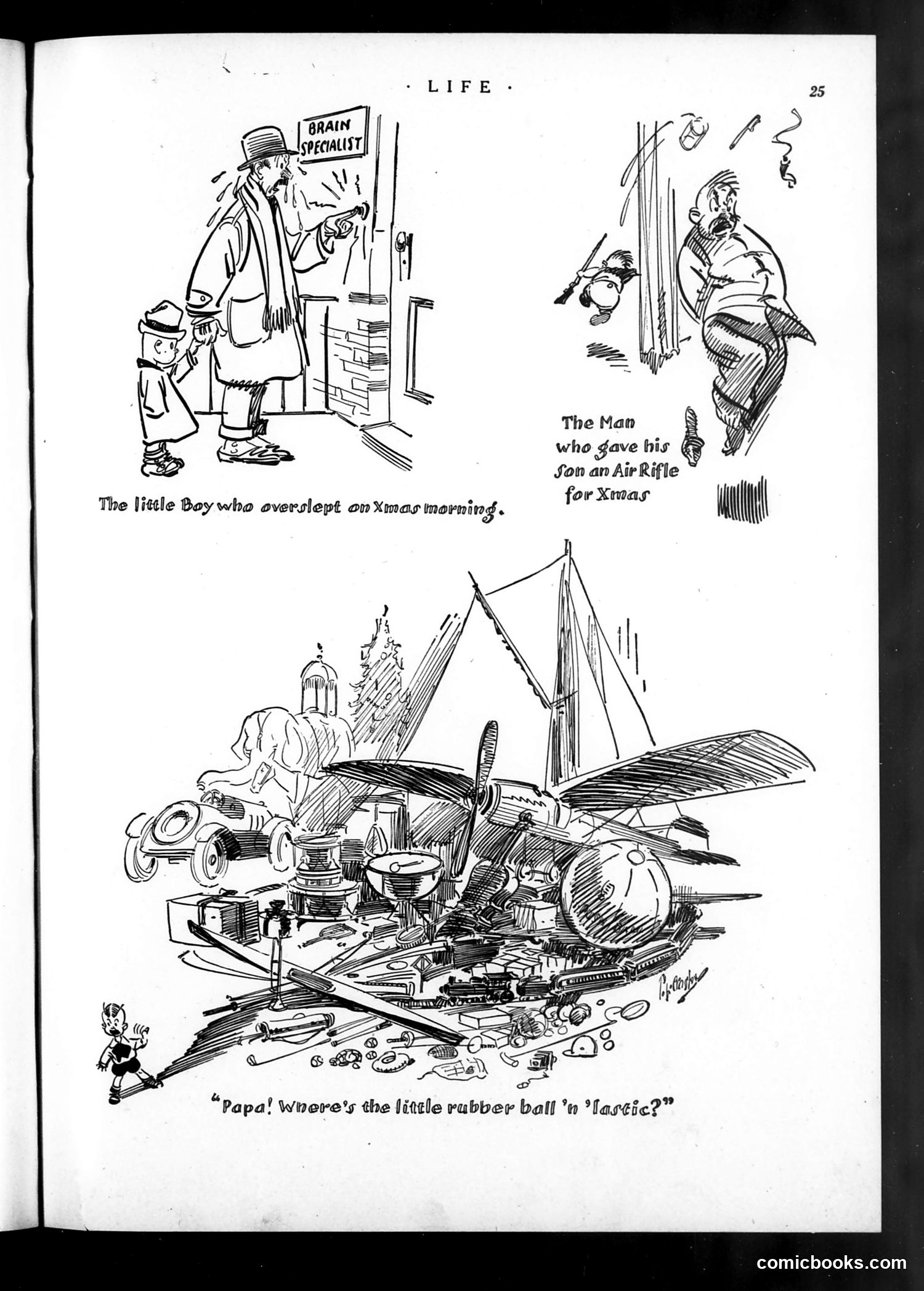
This page from *Life* magazine presents three satirical cartoon vignettes about Christmas gifts and parenting: 1. **Top left**: A "brain specialist" doctor examines a small boy who overslept on Christmas morning—likely satirizing parents' concern about children's intelligence and behavior. 2. **Top right**: A man gave his son an air rifle for Christmas, depicted as reckless or irresponsible parenting—reflecting period anxieties about dangerous toys. 3. **Bottom**: A child surveys a massive pile of toys—car, tent, airplane, sports equipment, and more—asking where the "little rubber ball in 'Elastic'" is, satirizing children's ingratitude and parents' excessive gift-giving during the holiday season. The humor targets both parental anxiety and consumer excess, common themes in early-twentieth-century American satire.
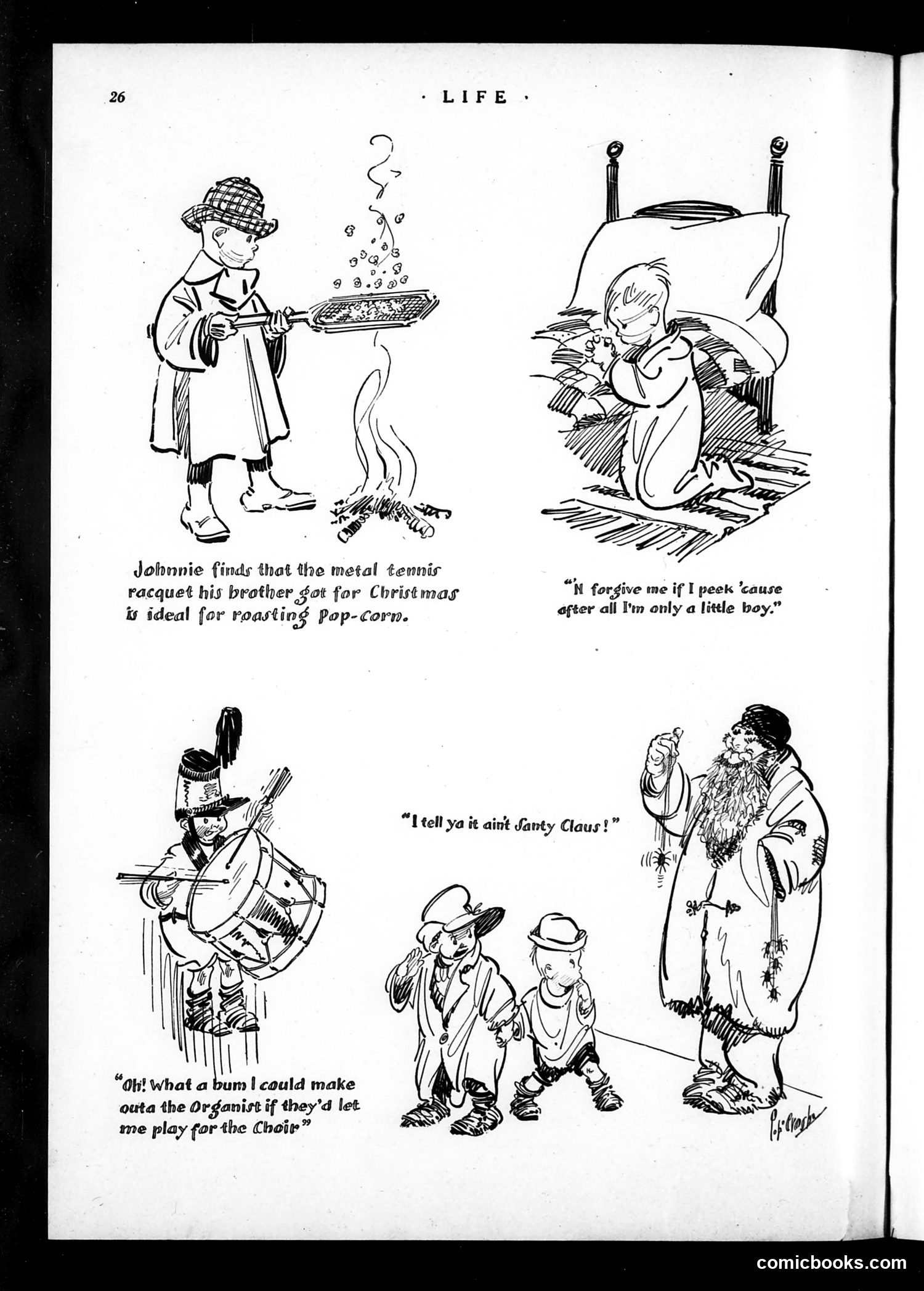
This page contains four unrelated comic vignettes satirizing everyday life, likely from the early-to-mid 20th century: 1. **Top left**: A boy uses a tennis racquet as a makeshift popcorn roaster over a fire—humor from resourceful (if questionable) repurposing of Christmas gifts. 2. **Top right**: A small boy in bed apologizes for peeking, exploiting his youth as an excuse—gentle satire of childhood innocence and rule-breaking. 3. **Bottom left**: A would-be drummer fantasizes about disrupting a church choir performance, mocking amateur musicians' inflated self-regard. 4. **Bottom right**: A figure in Santa costume claims to be the real Santa to two skeptical children, poking fun at holiday deceptions. The humor relies on domestic situations, innocent mischief, and gentle social observation rather than political commentary. No specific public figures appear identifiable.
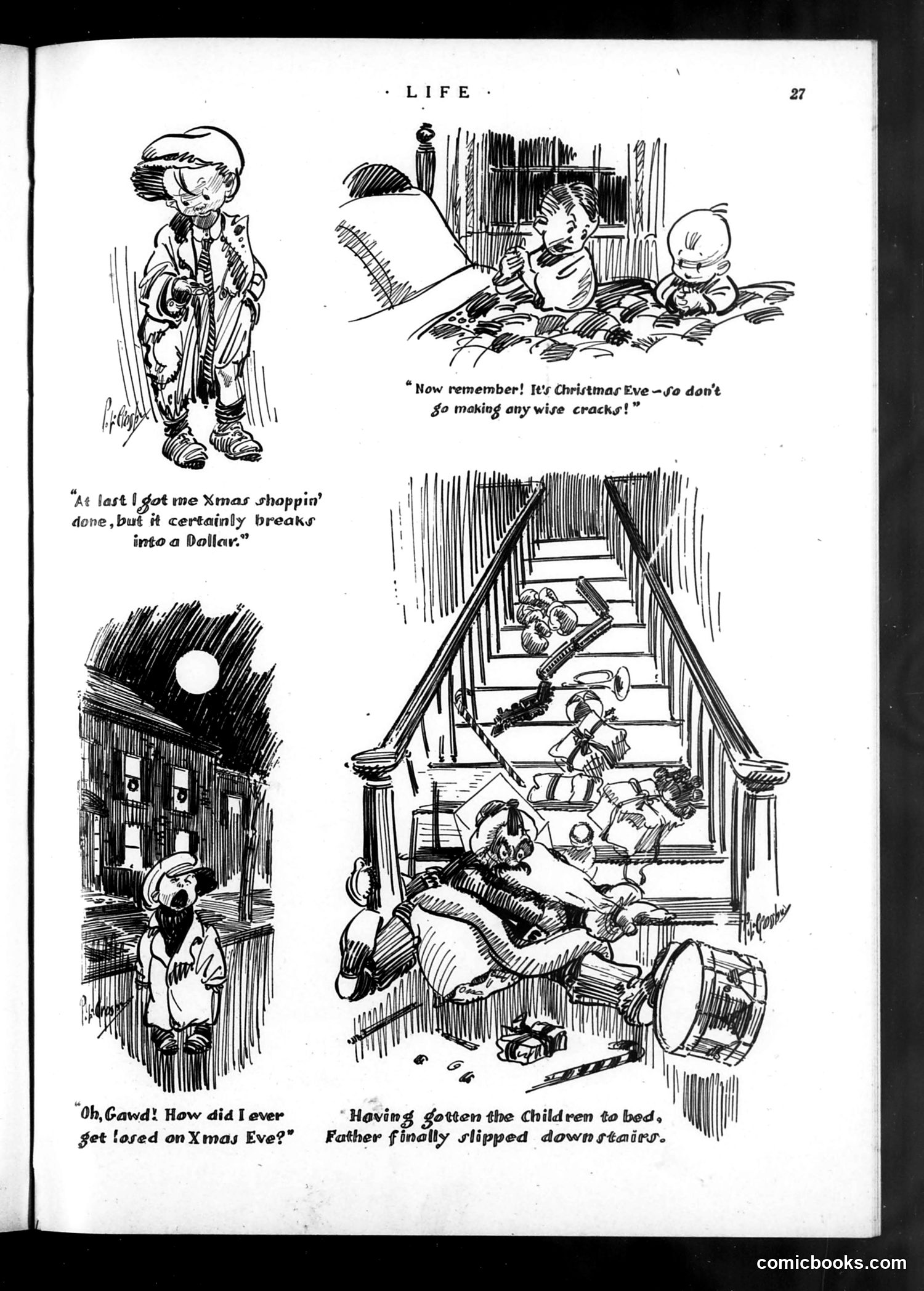
This is a humorous comic strip about Christmas Eve domestic chaos, likely from the early-to-mid 20th century. The four panels depict: 1. A tired shopper who completed Christmas shopping but is broke 2. Parents reminding children to behave on Christmas Eve (avoid "wise cracks") 3. A parent outside on a cold Christmas Eve night, exasperated 4. A father sneaking downstairs after putting rowdy children to bed, surrounded by scattered toys and musical instruments The satire targets the exhausting realities of Christmas—financial strain, children's misbehavior, and parental stress—contrasting with idealized holiday expectations. The final panel's caption about "Father finally slipped downstairs" suggests he's escaping the chaos, likely seeking alcohol or peace and quiet. The humor comes from depicting Christmas as chaotic and draining rather than magical and joyful.
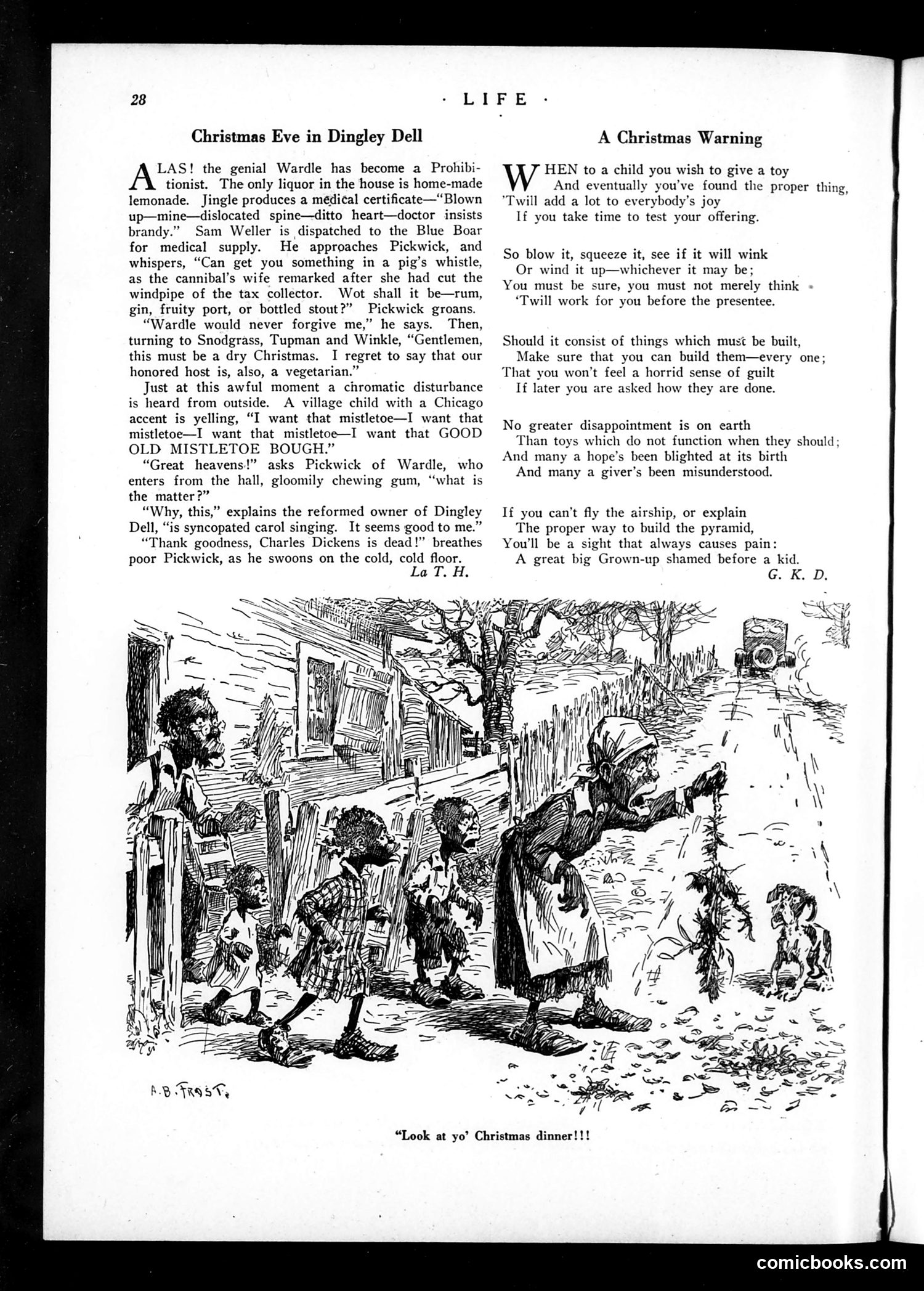
This page contains two separate pieces from *Life* magazine satirizing Christmas themes: **"Christmas Eve in Dingley Dell"** (left) is a humorous sketch featuring characters from Charles Dickens's *Pickwick Papers*. The joke centers on Prohibition—Wardle has become a teetotaler, serving only lemonade. Characters like Sam Weller and Pickwick navigate this alcohol-free Christmas, with the satire culminating when a child outside sings a modern, syncopated version of "Mistletoe Bough" in a "Chicago accent." The punchline has Pickwick exclaiming "Thank goodness, Charles Dickens is dead!"—suggesting Dickens would be appalled at modernized, Americanized versions of his Christmas story during Prohibition. **"A Christmas Warning"** (right) offers practical advice about testing toys before giving them as gifts, warning against disappointing children with malfunctioning or unbuildable items. The poem emphasizes adult responsibility and avoiding shame before children. The illustration shows poor families outside a home, captioned "Look at yo' Christmas dinner!!!"—likely contrasting the satirical Christmas concerns above with actual poverty.
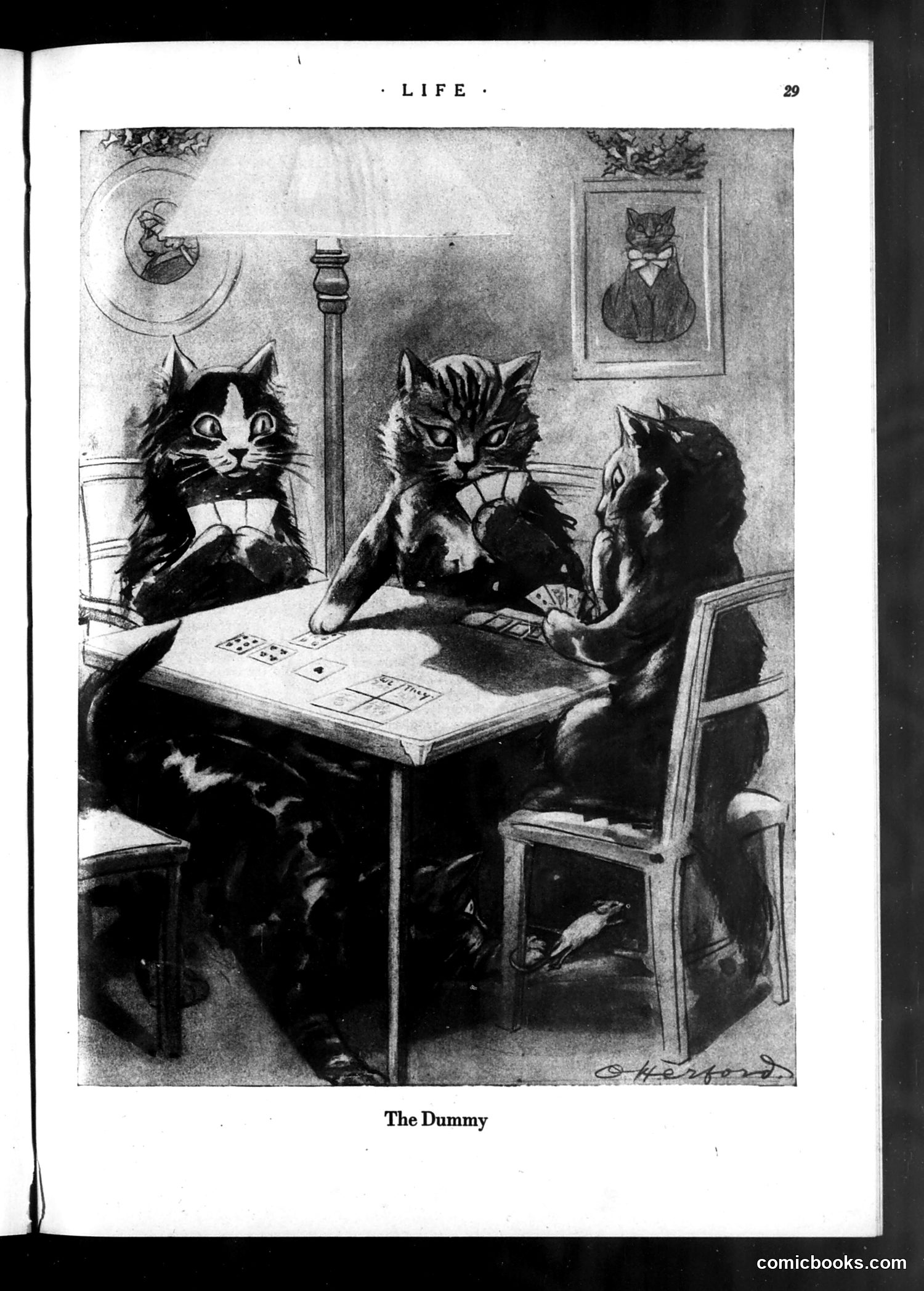
This is a satirical cartoon depicting anthropomorphized cats playing cards around a table. The title "The Dummy" refers to a card game term—in bridge, one player's cards are exposed and played by their partner. The cartoon's humor lies in the visual pun: actual cats are playing cards, with one cat serving as "the dummy" in the game. The scene includes period details like a lamp, framed cat portrait on the wall, and formal seating arrangement, treating the cats as if they were sophisticated gentlemen engaged in a serious game. The satire likely mocks human pretension and gambling culture by literalizing the card-game terminology through animal characters. Without a visible date, the exact historical context remains unclear, but this represents Life magazine's characteristic blend of visual wordplay and social observation.
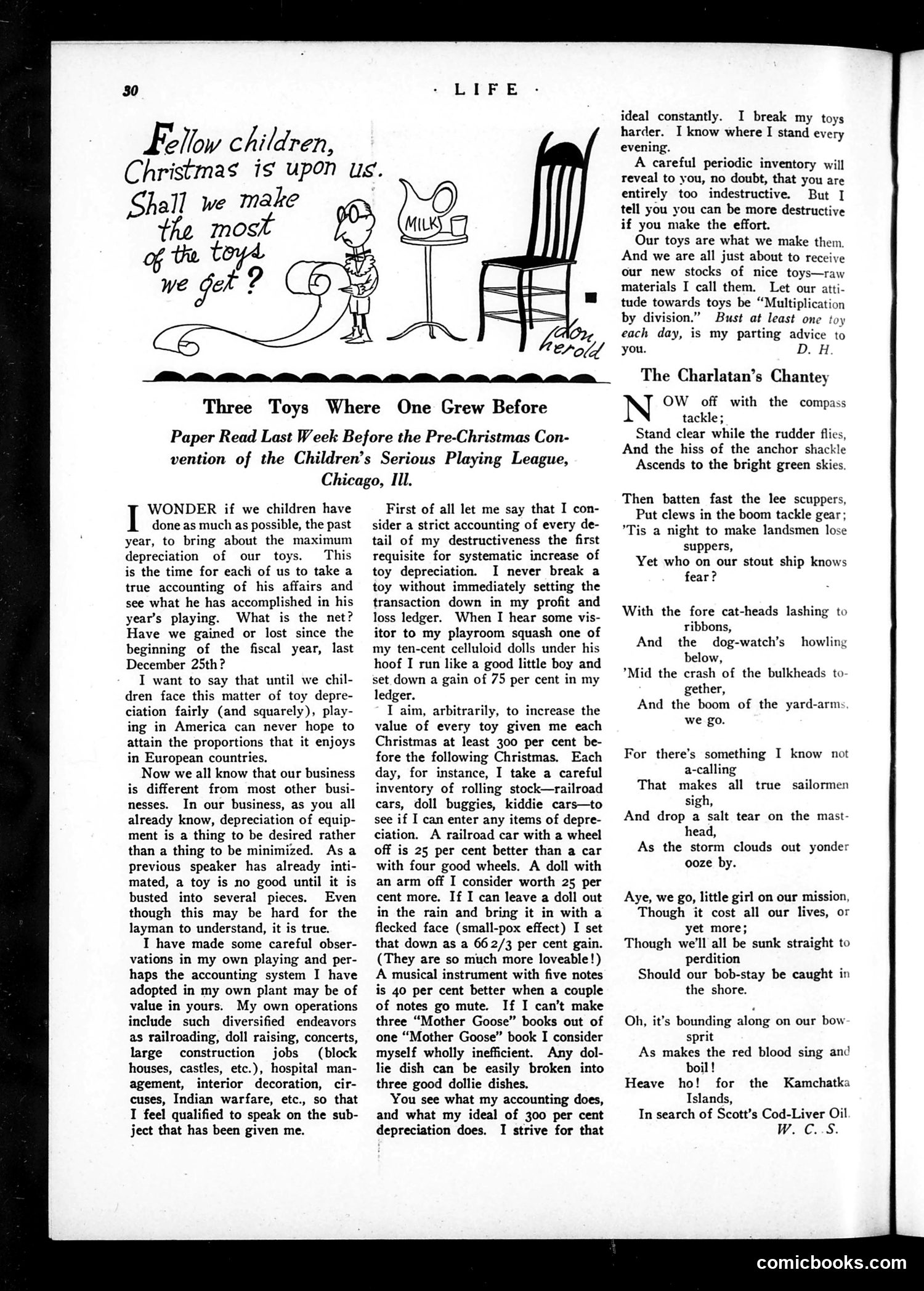
This page satirizes the American business culture of the early 20th century by having a child deliver a mock-corporate speech about toy destruction. The humor works through absurdist inversion: the speaker treats breaking toys as a legitimate accounting practice, using formal business language ("depreciation," "profit and loss ledger," "inventory") to describe what is actually just playing roughly. The satire targets American capitalism's obsession with systematic efficiency and cost accounting. By applying adult corporate logic to children's play—where "depreciation" is actually desirable—Life mocks the era's faith in quantifying and optimizing everything through ledgers and metrics. The accompanying poem "The Charlatan's Chantey" appears unrelated, suggesting this is a magazine page mixing editorial content. The title references a Chicago children's organization, grounding the satire in contemporary institutional culture.
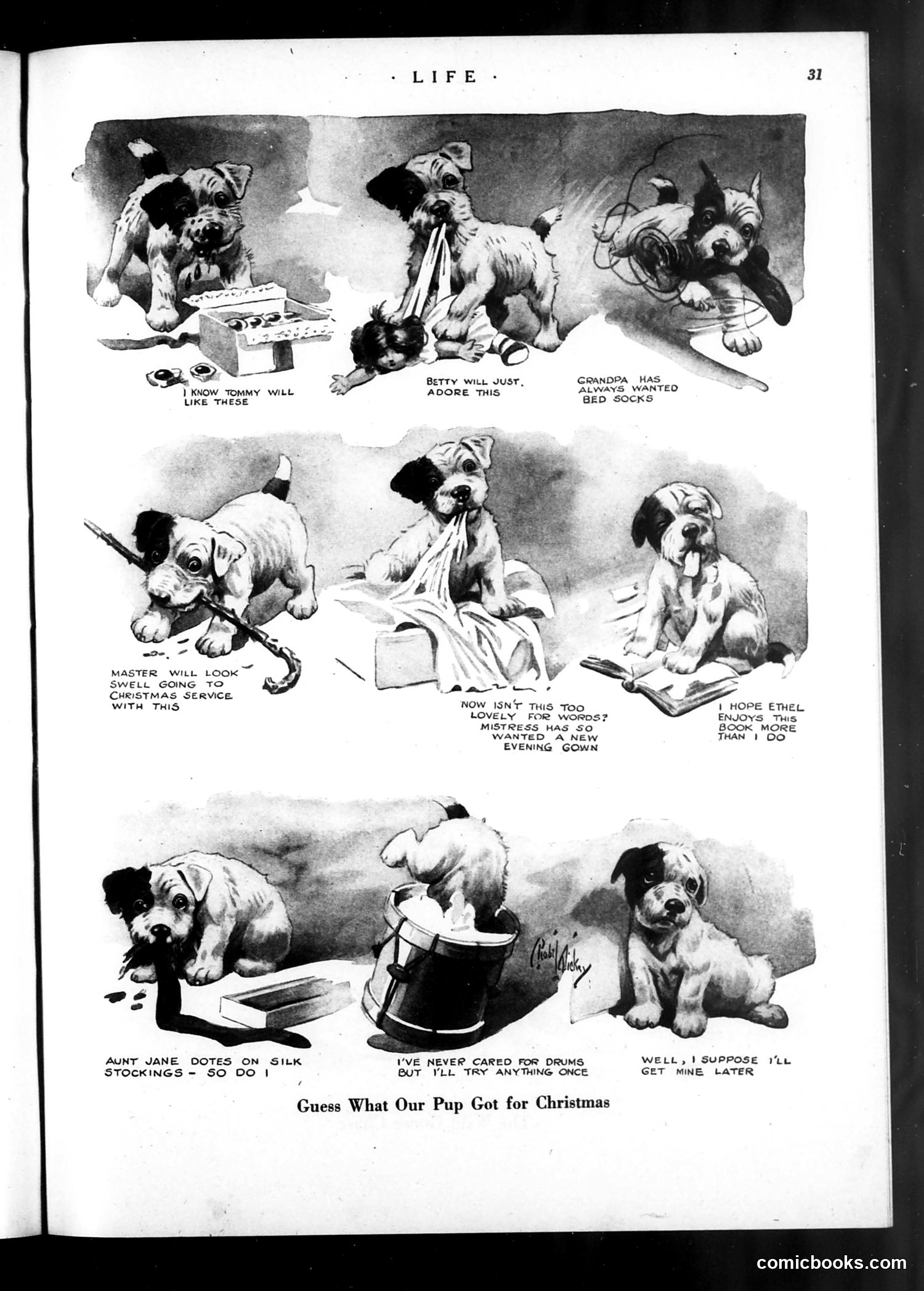
This is a humorous cartoon showing various dogs receiving Christmas gifts—but the joke is that each dog has received *human* gifts that reflect what their owners think they want, not what dogs actually desire. The gag works through irony: the captions show family members planning gifts like bed socks, evening gowns, silk stockings, and books for their human relatives, while the dogs are shown receiving these impractical items instead. One dog mentions "drums" it never wanted. The satire satirizes well-meaning but misguided gift-giving—people selecting presents based on assumption rather than the recipient's actual preferences. By applying this to dogs (who would obviously prefer toys or food), the cartoon gently mocks human Christmas shopping habits. This appears to be a lighthearted family-magazine piece from the early 20th century, using pets as stand-ins to humorously critique consumerism and thoughtless gift selection during the holiday season.
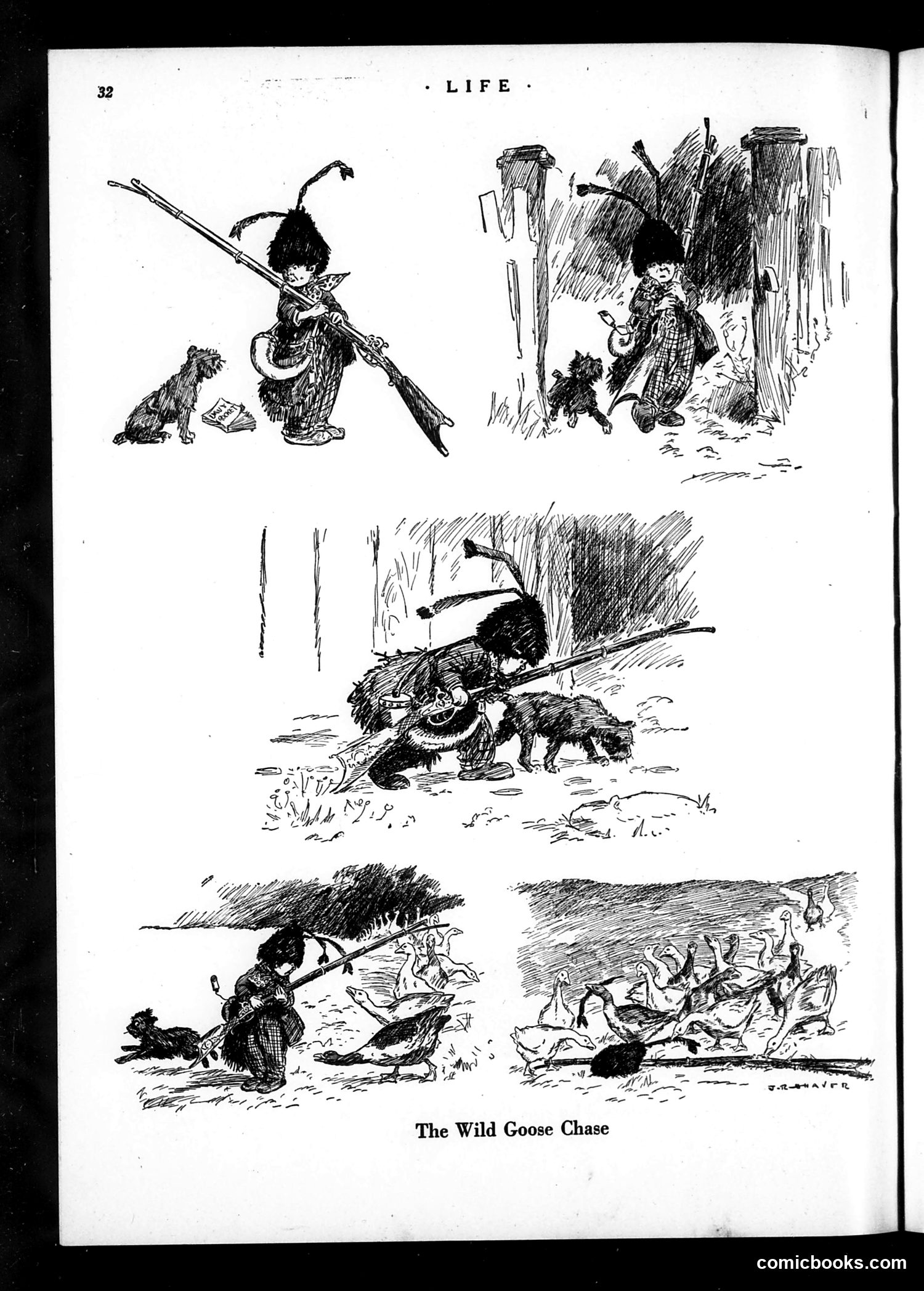
This is a humorous illustrated sequence showing a child and a small dog pursuing wild geese in increasingly chaotic fashion. The four panels depict an escalating chase: the child starts with a long pole or stick, attempts to catch the birds near water and vegetation, and the final panels show the child and dog being chased or overwhelmed by multiple geese in apparent pandemonium. The "wild goose chase" is an idiom meaning a futile, pointless pursuit. The cartoon literalizes this phrase as slapstick comedy—the child's determined but comically unsuccessful effort to catch geese results in being outnumbered and overrun. It's simple visual humor typical of early *Life* magazine's family-friendly entertainment content, with no apparent political or social commentary.
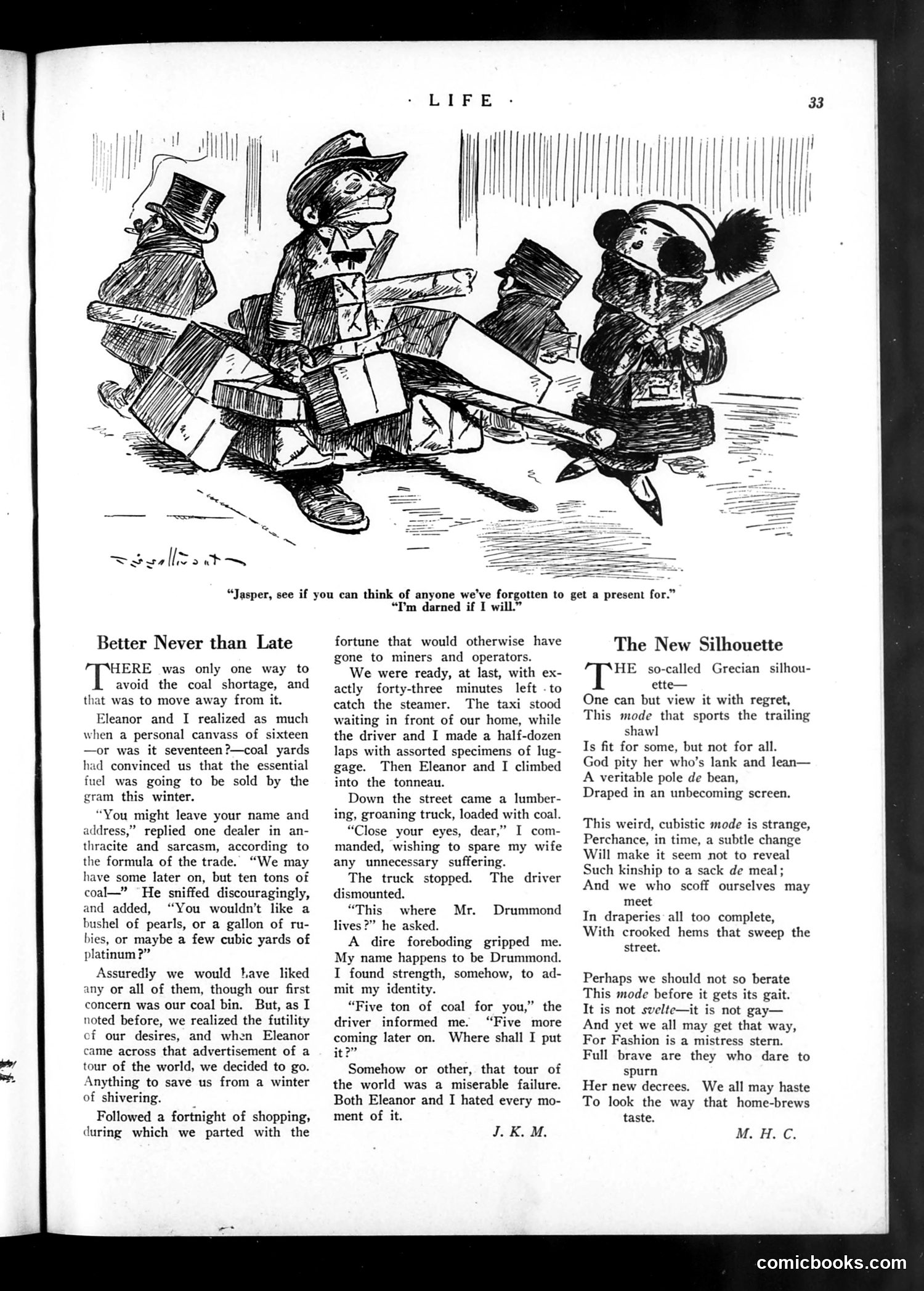
**Main Cartoon:** A Christmas shopping scene shows a figure surrounded by wrapped presents, asking an associate (Jasper) if they've forgotten anyone—satirizing the commercialized excess of holiday gift-giving. **"Better Never than Late":** This humorous story describes a couple avoiding a coal shortage during winter (likely WWI-era fuel rationing) by booking a world tour instead. The irony: after spending their fortune to escape, coal is delivered to their home just as they leave. It mocks both the coal shortage's severity and wealthy people's frivolous responses. **"The New Silhouette":** This poem critiques the fashionable "Grecian silhouette"—apparently a draped, loose-fitting style resembling a sack. The author questions whether it flatters all body types, particularly lean women, while acknowledging that fashion trends are tyrannical and inescapable. It's gentle satire on women's fashion absurdities. Both pieces reflect early 20th-century concerns: wartime shortages, conspicuous consumption, and the arbitrary nature of fashion standards.
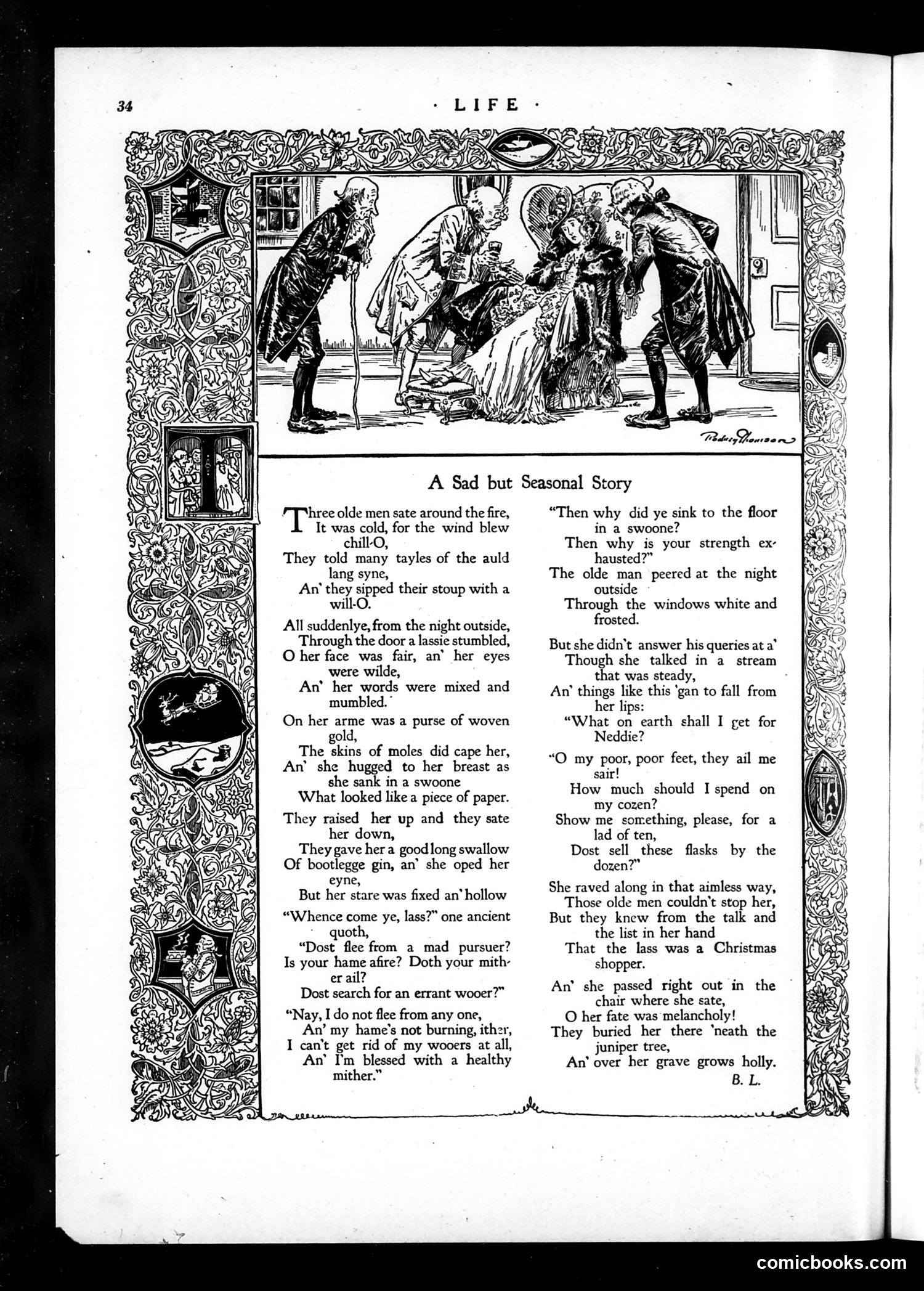
This is a humorous poem about Christmas shopping exhaustion, presented in mock-archaic Scottish dialect. The cartoon depicts three old men discovering an exhausted woman who has collapsed at their door during winter. The "joke" is that her mysterious distress—initially suggesting drama or danger—is revealed as simple holiday shopping fatigue. She rambles deliriously about gift purchases ("What on earth shall I get for Neddie?"), price concerns, and her aching feet, unable to answer the men's serious questions about her condition. The satire targets the frantic materialism and physical toll of Christmas shopping, particularly on women. The darkly comic ending—where she dies from exhaustion and is buried with holly growing over her grave—exaggerates this complaint into absurdist tragedy, mocking both the shopping culture and the romanticized Scottish vernacular often used in sentimental literature of the era. The piece is credited "B. L." and illustrated by what appears to be a professional cartoonist.
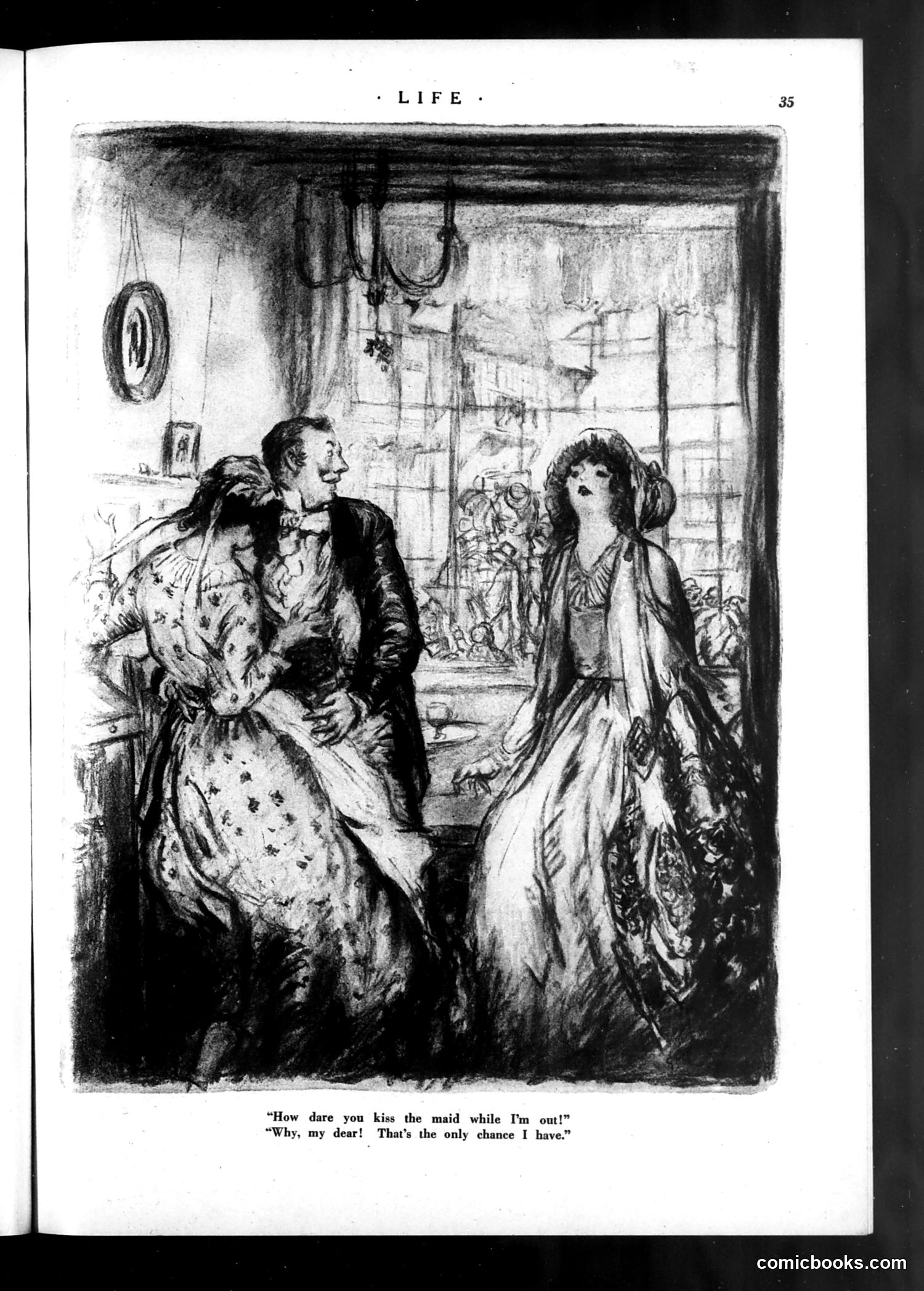
This is a domestic humor cartoon satirizing marital infidelity and gender dynamics of the early 20th century. The scene depicts a husband caught kissing a maid by his wife, who confronts him angrily ("How dare you kiss the maid while I'm out!"). His casual, unapologetic response—"That's the only chance I have"—implies his wife denies him physical affection, making the maid an available alternative. The joke relies on period assumptions about wives' sexual reluctance and servants' vulnerability to employer advances. The cartoon mocks both the husband's brazen opportunism and critiques the domestic power dynamics where wealthy households employed young women as domestic staff. For modern readers, it reveals outdated attitudes toward marriage, consent, and class exploitation treated as comedic material.
This editorial page discusses the tension between science and religion in post-WWI society. The article features commentary by Dr. Charles Steinmetz of General Electric, who argues that science and religion need not be incompatible—science addresses what our senses perceive, while religion rests on belief and addresses deeper questions like immortality that science cannot answer. The author challenges Steinmetz's neat separation, arguing that religion itself relies on sensory evidence: biblical miracles were witnessed by human eyes and ears, the Christmas story depends on shepherds' testimony. The piece reflects 1920s anxieties about modernism threatening traditional faith, presenting religion as necessary for addressing post-war social problems (industrialism, nationalism, racial conflict) that pure science cannot solve. The cartoon's meaning remains unclear from the image alone.
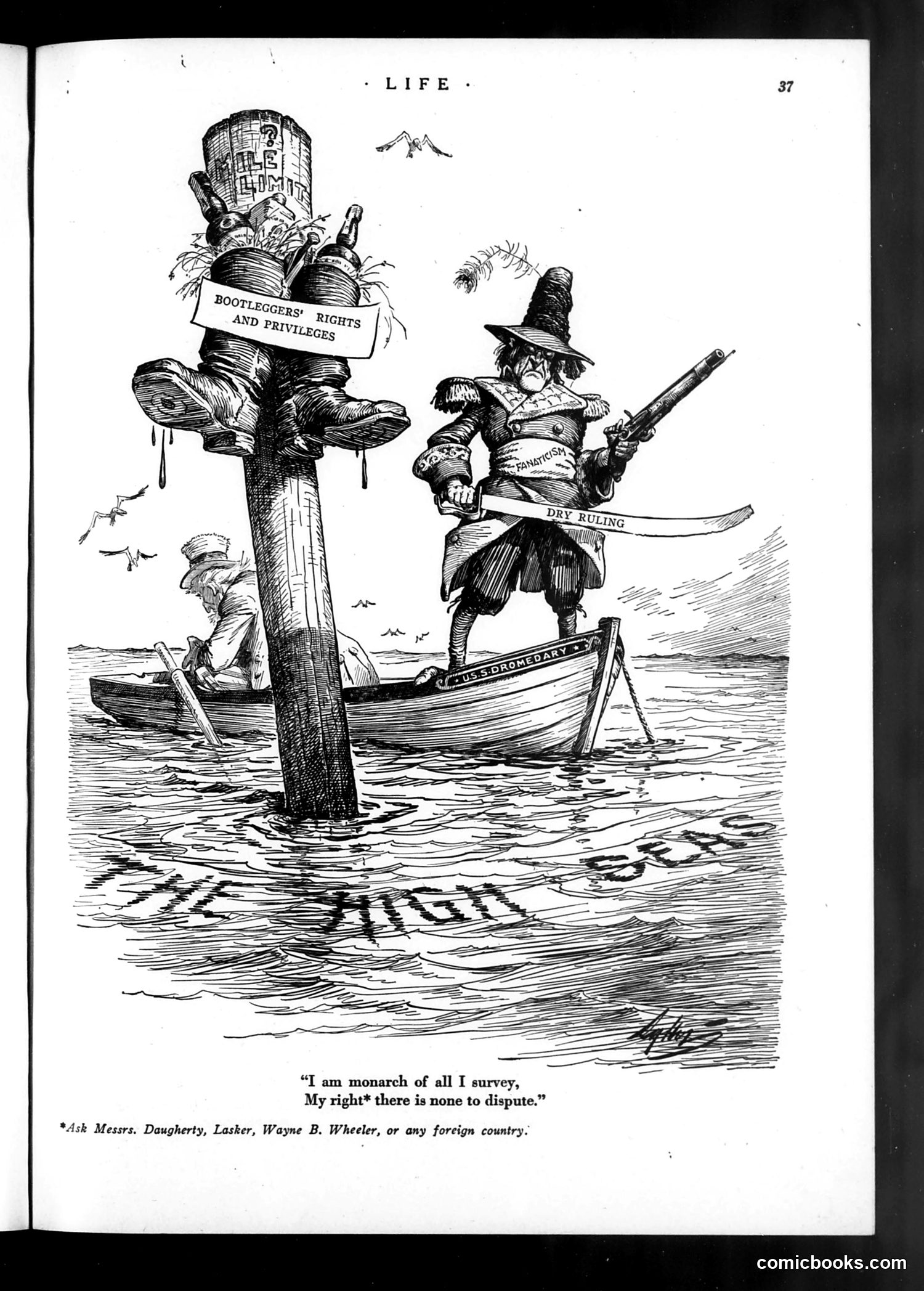
This Life magazine cartoon satirizes what appears to be corrupt or overreaching executive power during the early 1920s. A military/authoritarian figure stands in water claiming absolute authority ("monarch of all I survey"), while another figure nearby holds documents labeled "Bootleggers' Rights and Privileges" and "Dry Ruling." The footnote references specific men—Daugherty (likely Attorney General Harry Daugherty), Lasker, Wayne B. Wheeler (prominent Prohibition advocate), and foreign countries—suggesting the cartoon critiques either Prohibition enforcement corruption or broader executive overreach. The "Dry Ruling" label indicates this relates to Prohibition-era politics and alleged improper dealings between government officials and bootleggers. The imagery suggests ironic commentary on who actually holds power: not legitimate authority, but those involved in illicit dealings.
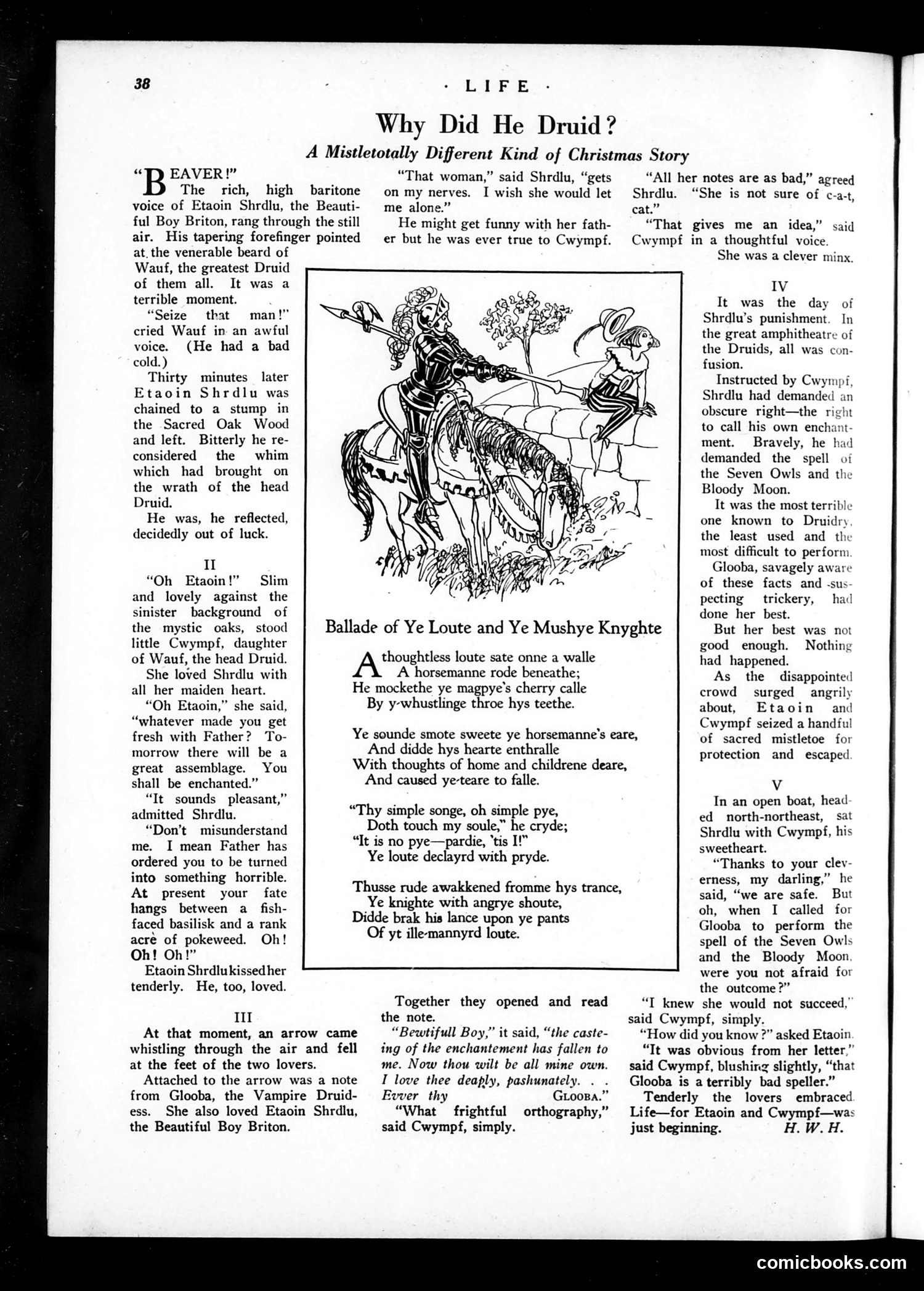
This is a humorous fantasy parody story, not political satire. The narrative mocks overwrought romantic literature and medieval fantasy tropes through absurdist humor. **Key elements:** - **Character names**: "Etaoin Shrdlu" and "Cwympf" are nonsense names (Etaoin Shrdlu is actually a famous printer's dummy text), signaling this is intentional parody - **The plot**: A love triangle involving a Beautiful Boy Briton, a druid's daughter, and a vampire druidess—deliberately melodramatic - **The satire**: Mocking pretentious medieval romance language, bad spelling presented as "authentic," and overwrought magical scenarios - **The joke**: The story is titled "A Mistletotally Different Kind of Christmas Story" (pun on "mistletoe"), yet contains zero Christmas elements—it's a fantasy pastiche instead - **The ballad**: Written in deliberately awkward pseudo-Middle English, further parodying romantic literature The humor relies on readers recognizing and enjoying the lampoon of sentimental fantasy romance conventions popular in the era.
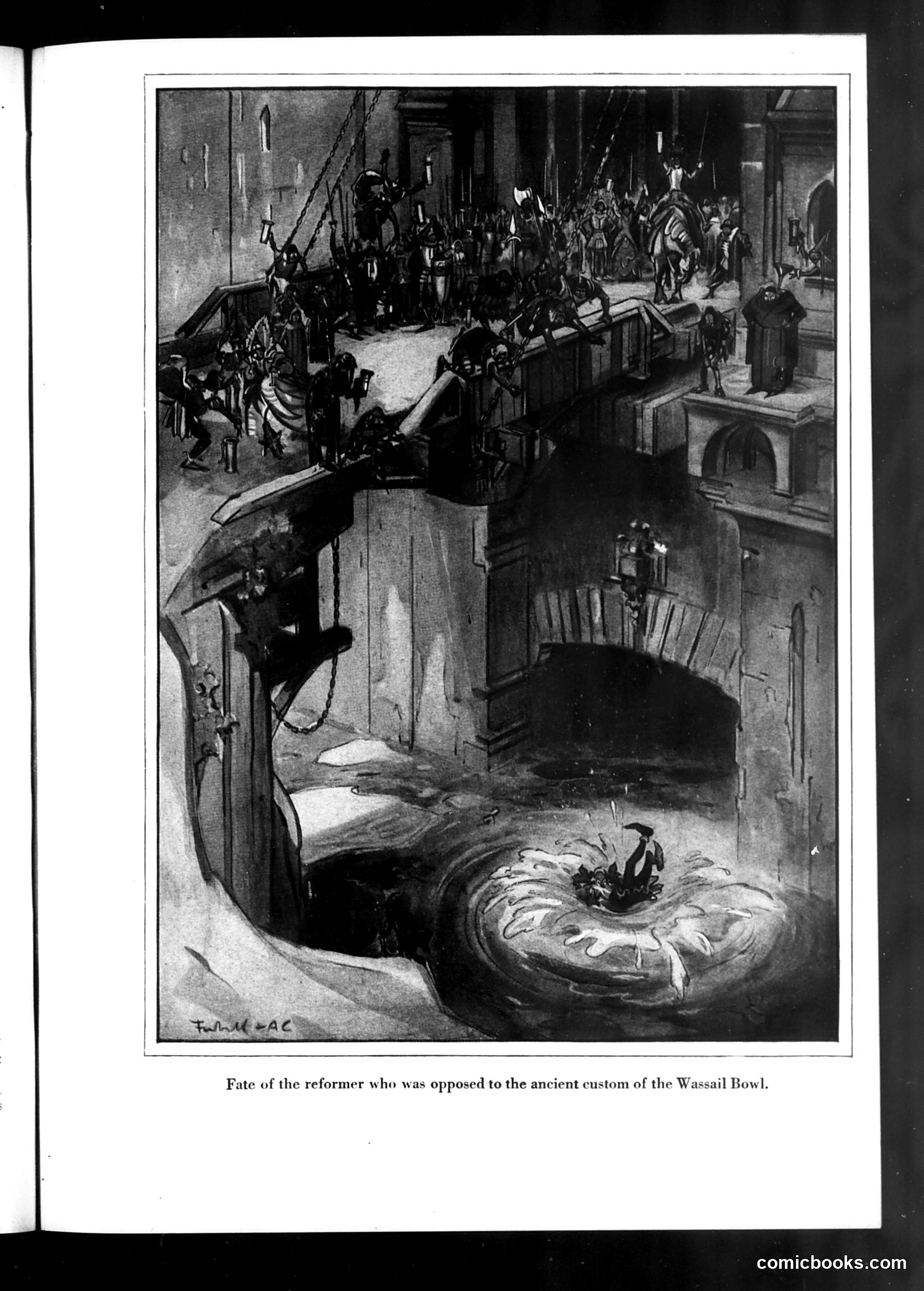
This is a political cartoon depicting the fate of a religious or social reformer who opposed the "Wassail Bowl" tradition. The image shows a medieval or ancient setting with a figure drowning in a large bowl while crowds gather on surrounding structures above, apparently celebrating or witnessing the event. The satire appears to target resistance to established customs. The caption suggests that opposing traditional practices—in this case, wassailing (a festive drinking tradition)—results in severe consequences, even death. The cartoon likely mocks either rigid traditionalists who punish reformers, or alternatively, critiques reformers as naive for challenging deeply-rooted social customs. Without additional context about the magazine's date and stance, the exact target of satire remains somewhat unclear, but the fundamental joke concerns the danger of opposing entrenched traditions.
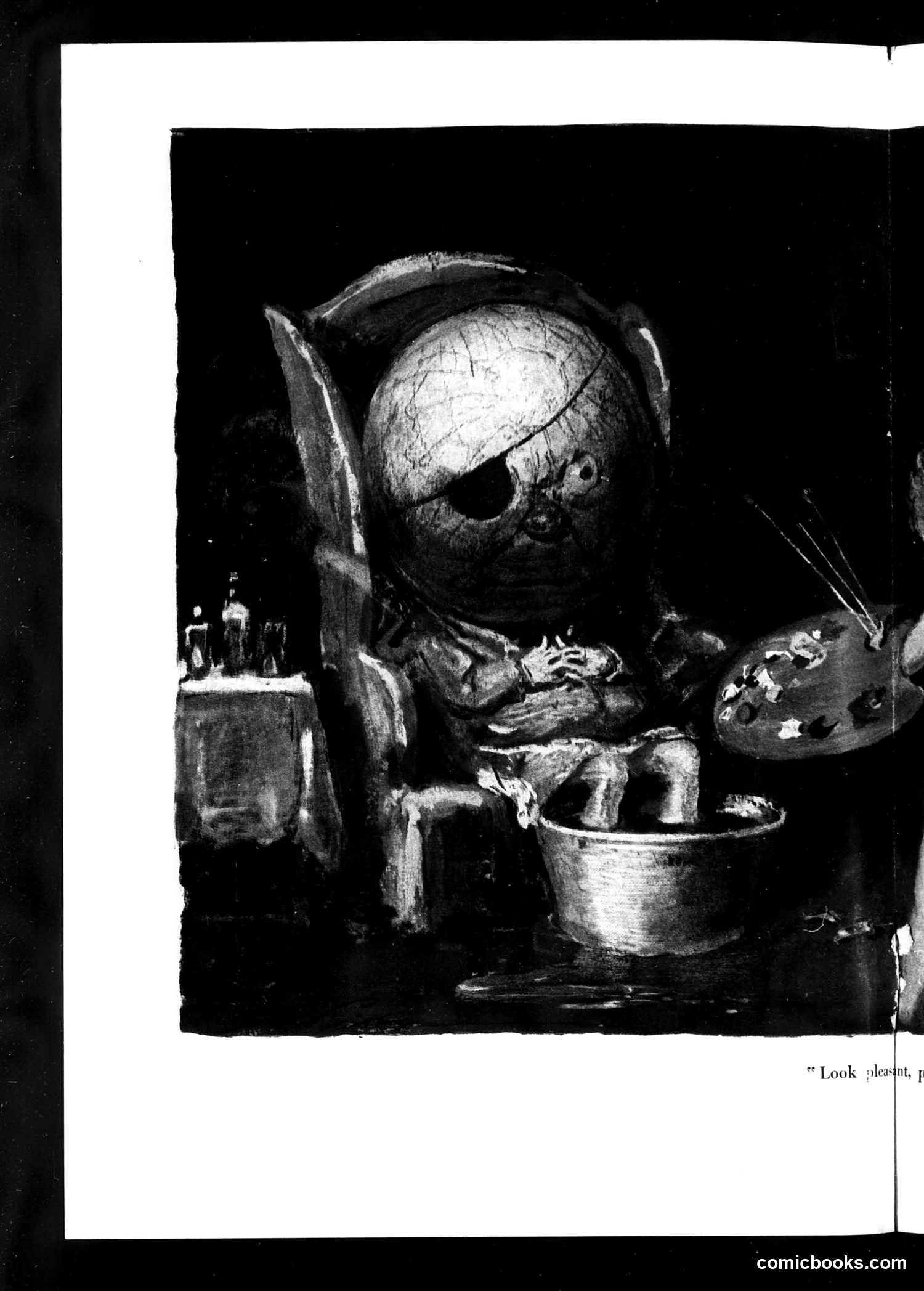
This appears to be a satirical illustration showing a caricatured figure with an exaggerated large head, seated and holding what looks like an artist's palette. The figure is positioned before a mirror or reflective surface. The partial caption reads "Look pleasant, p..." (text cut off). The style and grotesque exaggeration suggest this is political or social satire, likely mocking a public figure or type of person. The emphasis on the oversized head and the mirror setup implies commentary on vanity, self-importance, or distorted self-perception. However, without the complete caption and additional context about Life magazine's publication date, I cannot definitively identify the specific target of the satire or its precise political/social meaning.
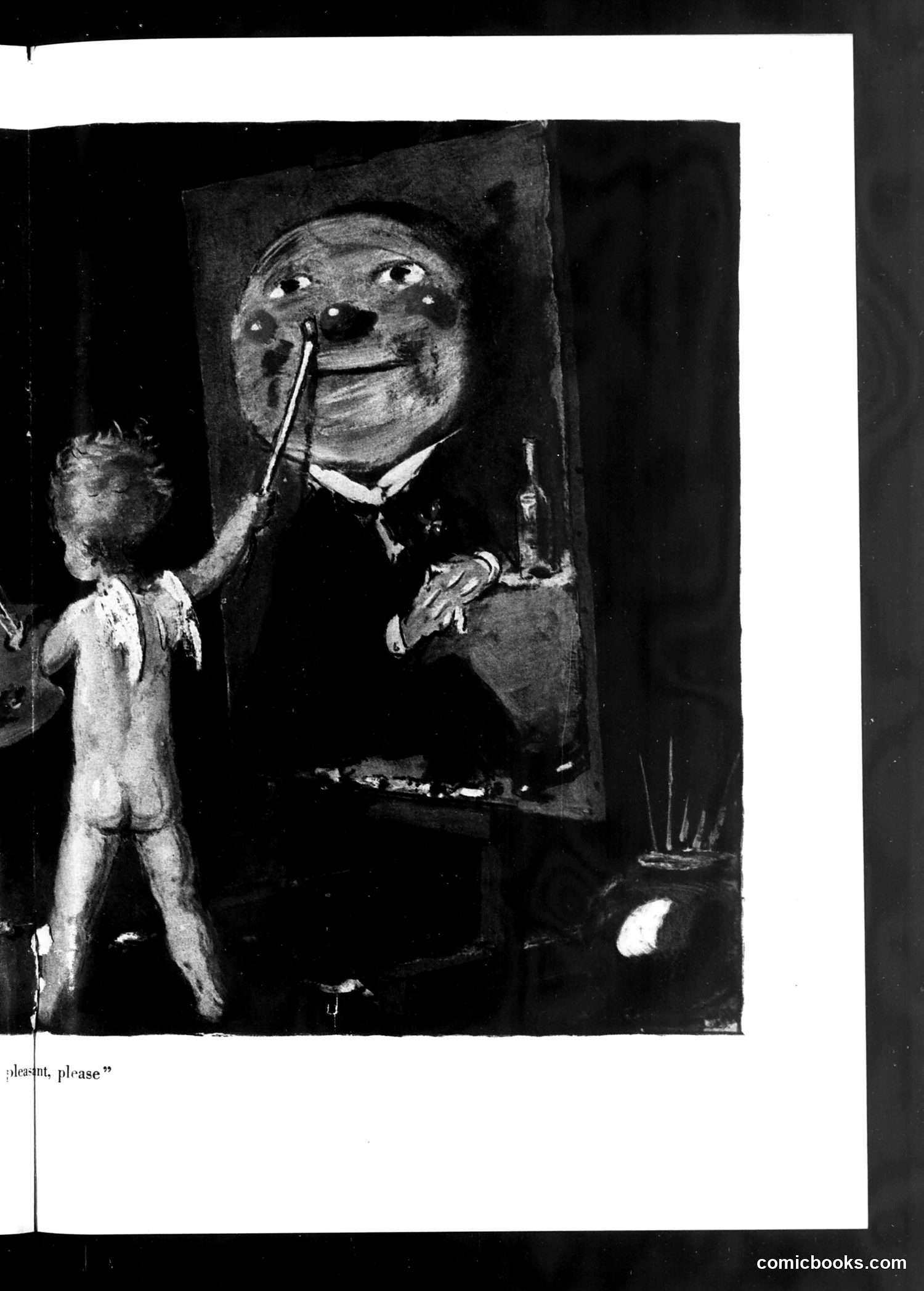
This appears to be a satirical illustration from *Life* magazine depicting a cherub or cupid figure painting a portrait of a grotesque, grinning face. The figure being painted wears formal attire (coat and bow tie) and holds a pipe and candle. The cartoon likely satirizes a political or public figure of the era, using the contrast between the cherub's innocent artistic act and the absurd, exaggerated visage it produces. The grotesque subject suggests mockery of someone's appearance or character. Without clearer text or additional context on this page, I cannot definitively identify the specific figure caricatured or the exact political event referenced. The style and technique suggest early 20th-century American satirical art, but precise dating and subject remain unclear from the visible image alone.
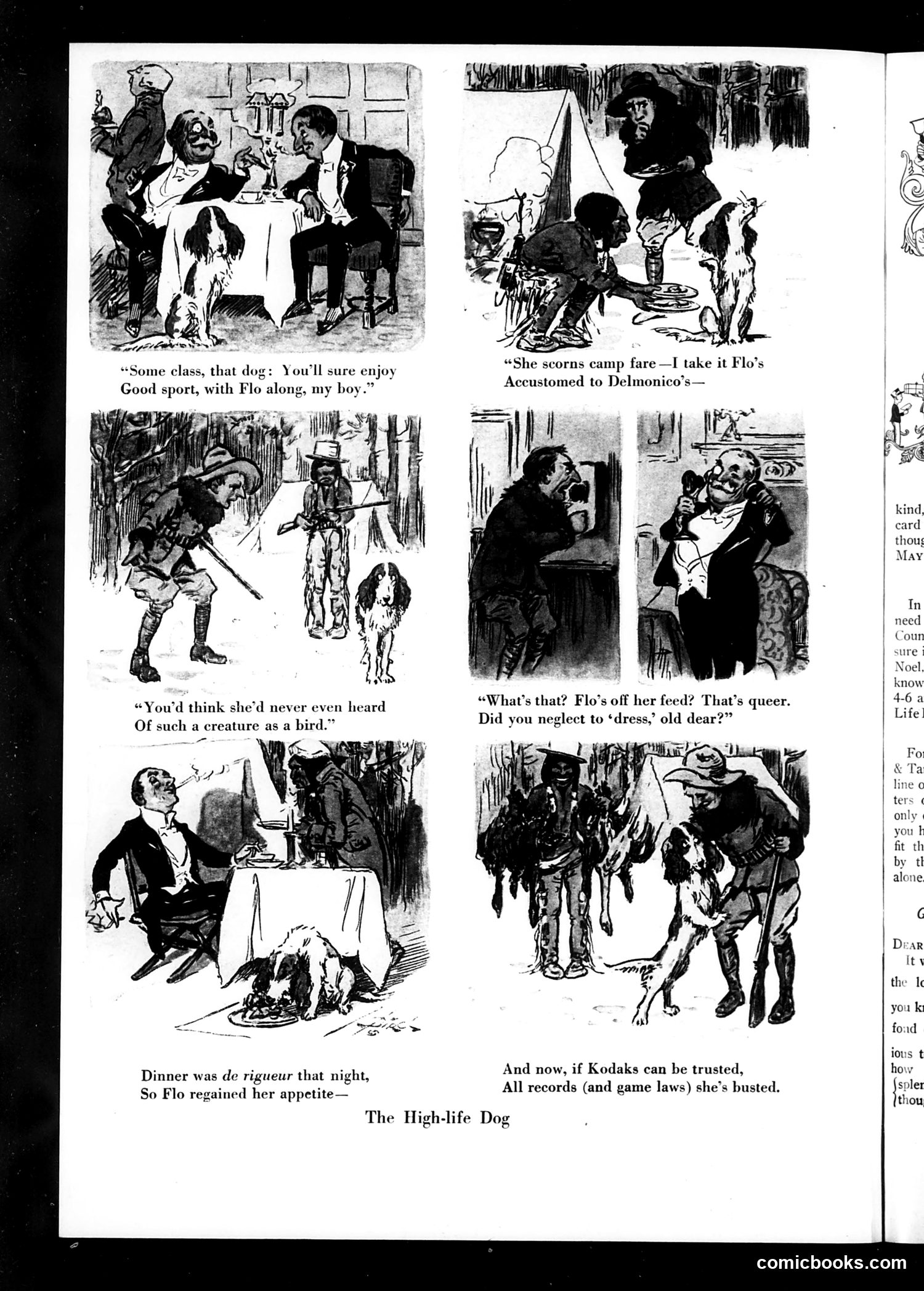
This comic strip satirizes wealth and social pretension through a dog named "Flo." The joke centers on a wealthy woman who brings her dog to fancy dining and hunting outings at exclusive establishments like Delmonico's (a famous upscale restaurant). The satire mocks how the wealthy anthropomorphize their pets—treating Flo as a society companion who must be entertained at high-class venues and given refined food. The humor escalates when Flo violates hunting laws by catching excessive game, yet the wealthy owner (or her associates) assume she can be trusted and won't face consequences. The final line—"Dinner was de rigueur that night, / So Flo regained her appetite"—ironically suggests that formal dining was necessary for the dog's wellbeing, mocking upper-class affectations. The strip ridicules both the absurdity of treating pets as status symbols and the assumption that wealth places one above legal restrictions.
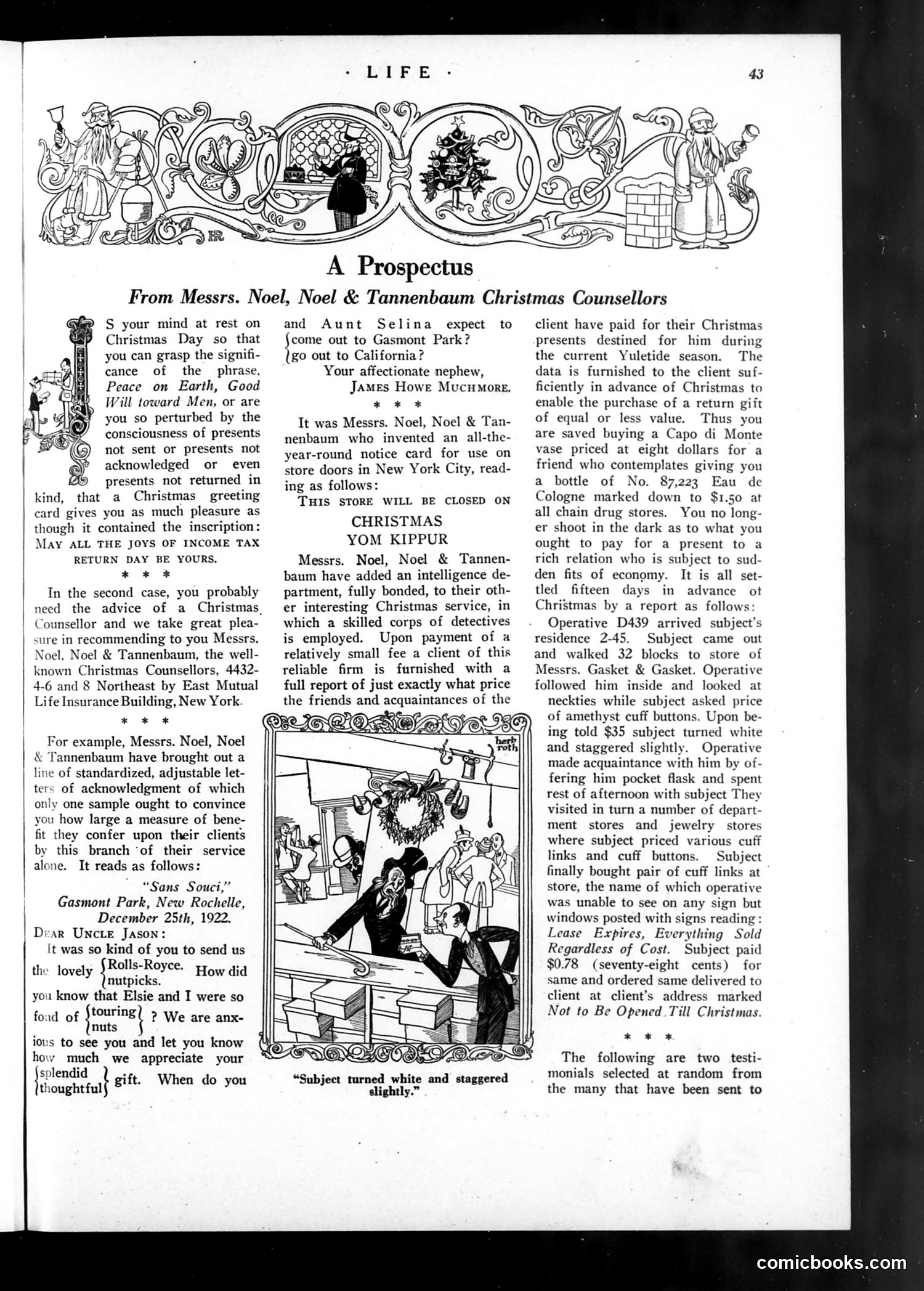
This satirical piece mocks the anxiety and social awkwardness surrounding Christmas gift-giving in the 1920s. The fictional "Messrs. Noel, Noel & Tannenbaum Christmas Counsellors" offer absurd services to anxious gift-givers. The satire targets several social problems: the obligation to acknowledge gifts with thank-you notes (shown via a hilariously vague template letter), the emotional exhaustion of holiday shopping, and—most pointedly—the arms race of gift-giving where recipients must match or slightly undercut the value of gifts received. The accompanying illustration depicts detectives hired to investigate what wealthy relatives spent on Christmas presents, allowing clients to calibrate return gifts accordingly. One operative reports following a subject who "turned white and staggered slightly" upon learning a gift's price, revealing the economic anxiety and class consciousness underlying holiday exchanges. The humor exposes how thoroughly commercialized Christmas had become, reducing generosity to calculable transactions.
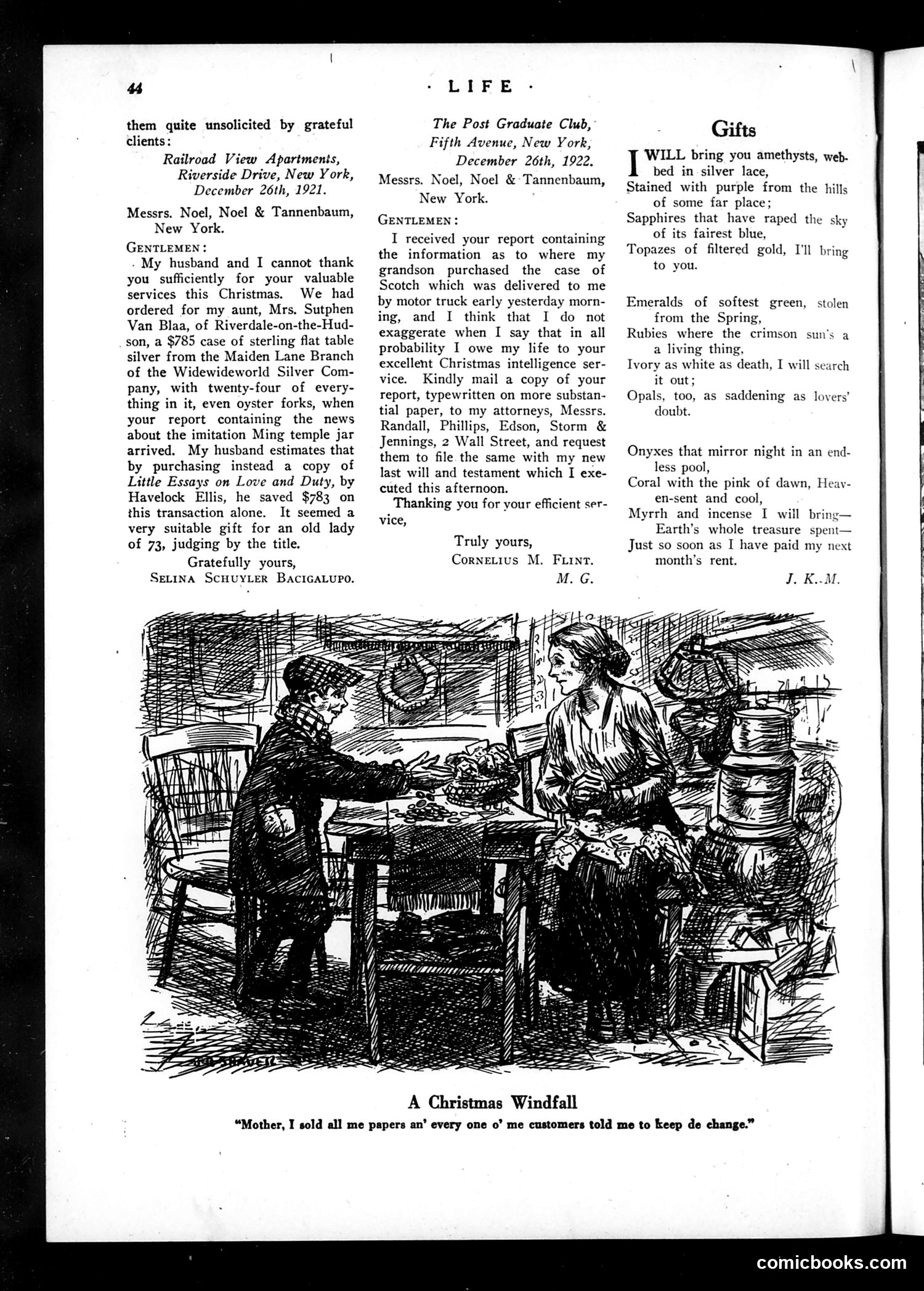
This page contains satirical letters about a detective or investigation agency ("Noel, Noel & Tannenbaum") that reports on gift purchases—apparently to help people avoid duplicating gifts or making poor choices. **The joke**: Two wealthy clients praise the agency extravagantly. The first woman avoided buying a $785 silver set by learning her aunt would prefer a Havelock Ellis book instead—saving $783. The second man received Prohibition-era contraband Scotch whisky from his grandson, and the report apparently prompted him to rewrite his will favorably. The satire mocks both conspicuous consumption among the wealthy and the absurdity of paying for espionage services on personal shopping. During Prohibition (1920-1933), the Scotch reference adds humor: the grandfather is so pleased about receiving illegal alcohol that he's rewriting his will. The cartoon below shows a street urchin telling his mother he sold papers and customers told him to "keep the change"—a sentimental Christmas moment contrasting sharply with the wealthy characters' material obsessions above.
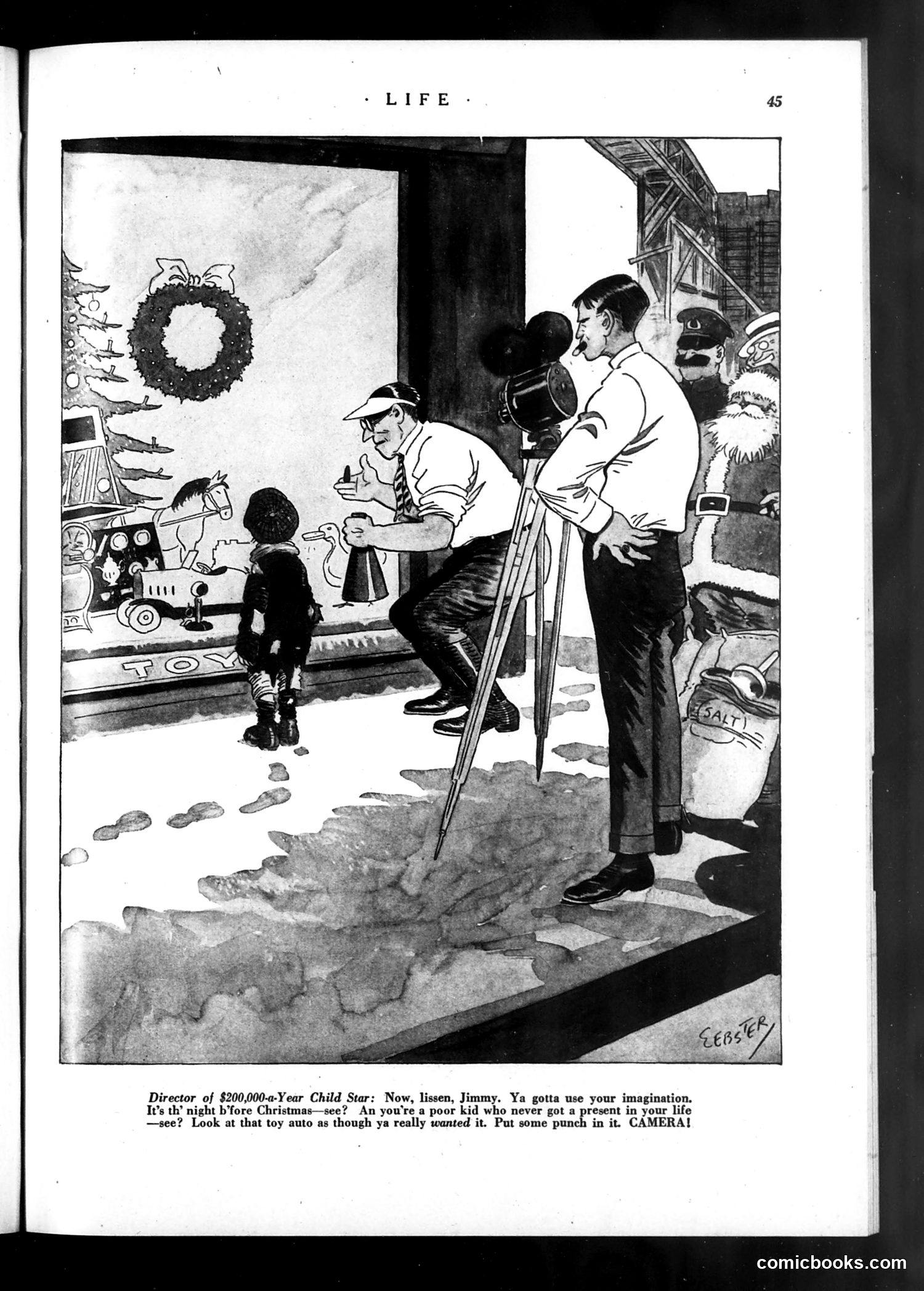
This cartoon satirizes child labor in early Hollywood filmmaking. A director instructs a young actor ("Jimmy") to emotionally perform poverty and longing for Christmas presents—ironic since the child star earns $200,000 annually (an enormous sum in the early 20th century). The joke targets the artificial nature of studio productions: the director demands the child fake desperation while surrounded by elaborate toy displays and film equipment. The satire exposes how Hollywood exploited child performers, forcing them to manufacture false emotions for profit, despite their actual wealth and privileged position. The caption's emphasis on the director's casual vernacular ("lissen," "th'") versus the astronomical salary creates additional ironic contrast—highlighting the disconnect between the industry's treatment of child stars and their economic reality.
This is a satirical theater review from *Life* magazine's "Drama" section. The author humorously catalogs the theatrical season, noting that of 66 plays produced, 17 failed entirely and only 15 achieved "hit" status. The satire targets: 1. **Theater economics**: "Hits" give box-office managers the right to charge premium prices without offering seats at advertised rates—a jab at theatrical price gouging. 2. **Playwrights' social criticism**: Eight plays dealt with marital unhappiness (none successful), suggesting audiences reject such themes. The author notes modern drama increasingly mocks the church, war, industrial efficiency, and marriage—trends he presents as intellectually troubling. 3. **Audience behavior**: The piece celebrates reduced coughing (attributed to either better health or staying home with books) while lamenting continued giggling, particularly at "Rain," a play about a clergyman's moral fall. The tone is tongue-in-cheek about theatrical conventions and audience tastes, reflecting early 1920s sensibilities about propriety and entertainment.
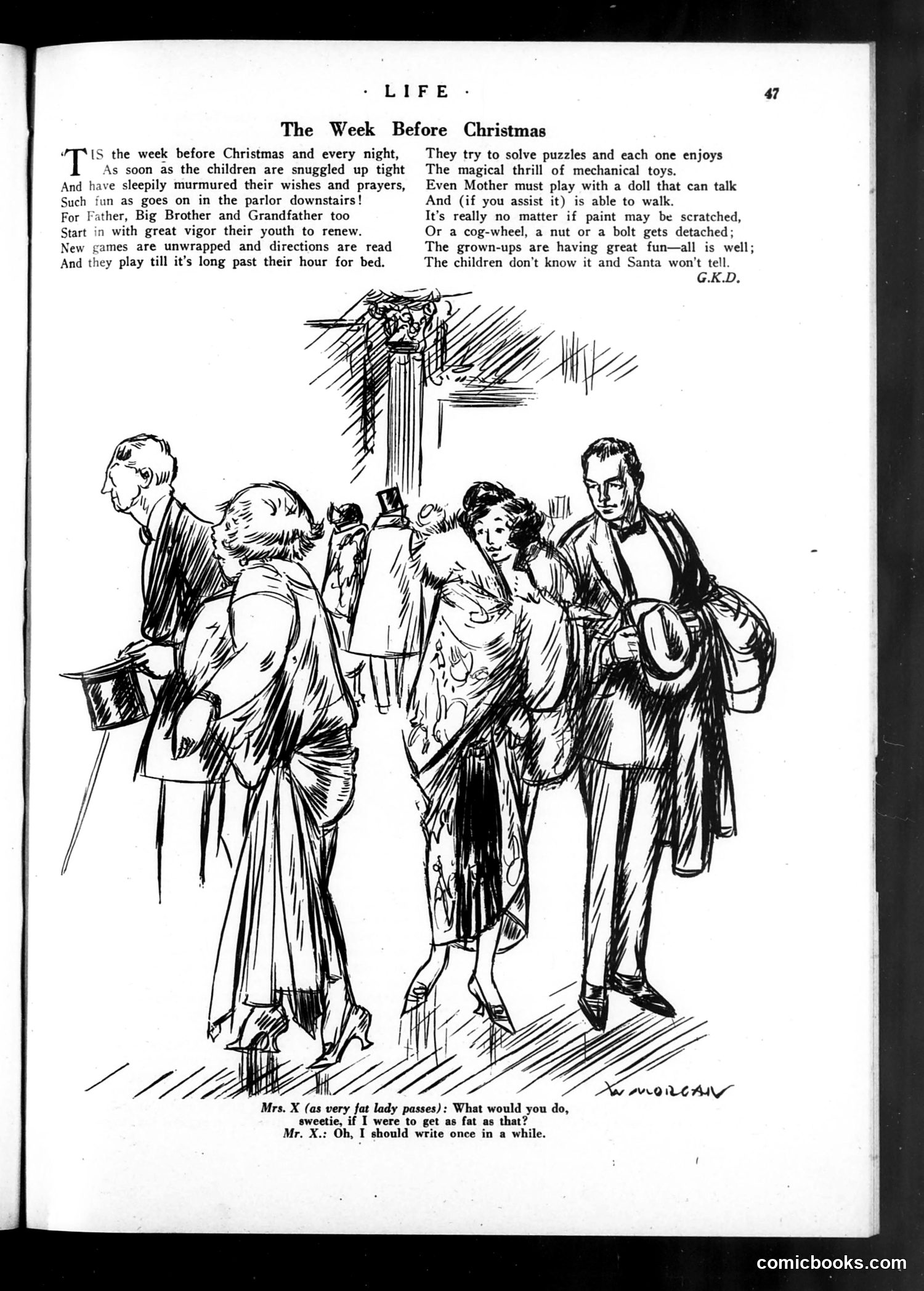
This page presents a humorous poem (by G.K.D.) about pre-Christmas evening activities, illustrated with a social cartoon below. **The poem's joke:** Adults claim to test children's new mechanical toys and games to ensure they work properly, but really they're having as much fun as the kids—staying up past bedtime playing with dolls, puzzles, and mechanical toys themselves. **The cartoon below** depicts a domestic scene at what appears to be an upscale home during the Christmas season. A woman (Mrs. X) addresses a man (Mr. X), making a self-deprecating comment about gaining weight. His response—that he'd only write "once in a while" if she got fat—is a witty, somewhat cutting remark typical of early 20th-century magazine humor, poking fun at both marital dynamics and vanity. The overall page satirizes middle-class Christmas traditions and the gap between adult and child perspectives on holiday gift-giving.
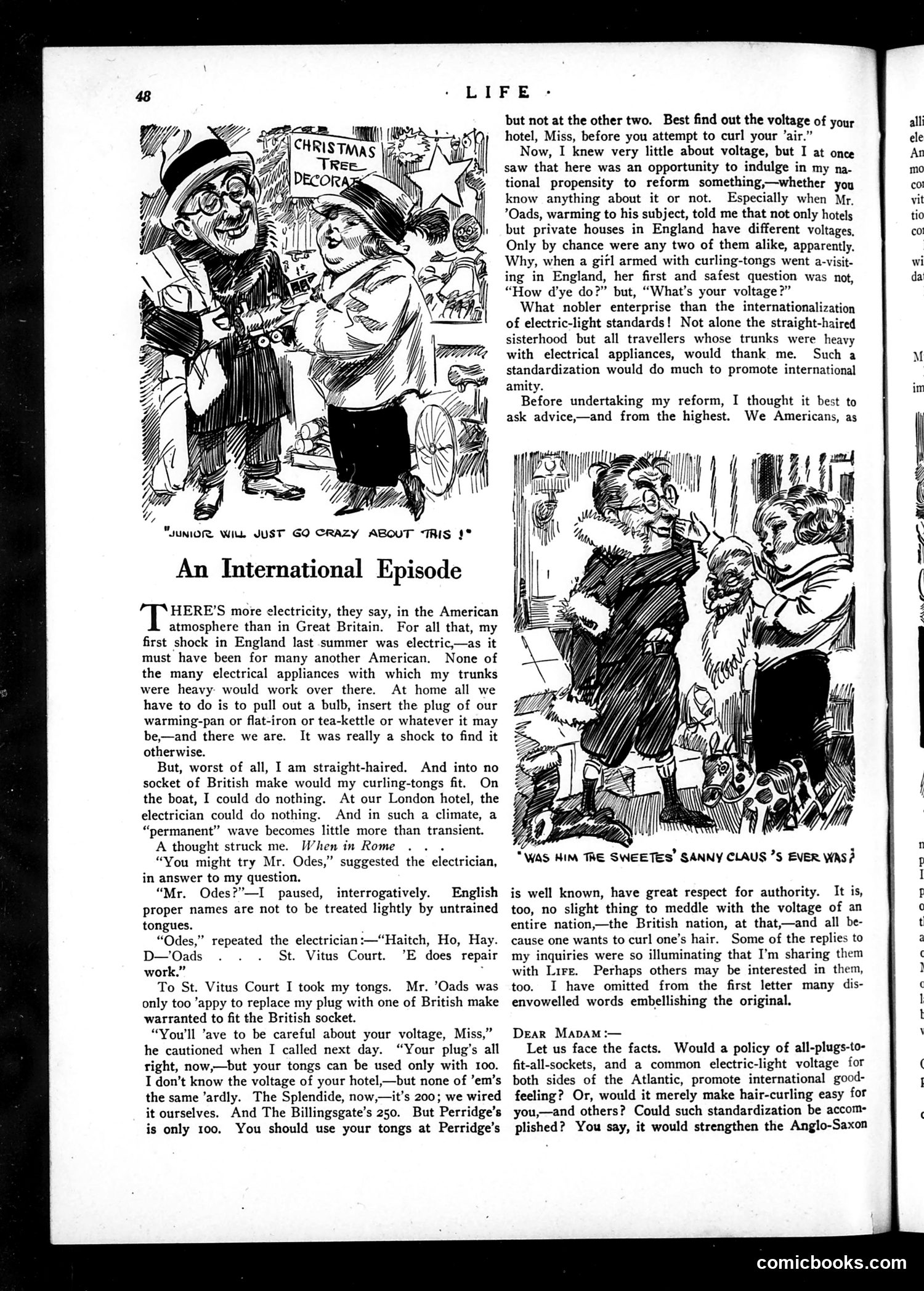
This 1920s *Life* magazine article satirizes American travelers' expectations and self-importance abroad. The narrator, an American woman visiting England, discovers her electrical appliances won't work due to Britain's different voltage standards. Rather than adapting, she decides Americans should reform British infrastructure to suit her needs—specifically, to use her curling tongs. The humor lies in her absurd confidence that standardizing international electrical systems is a reasonable personal project, justified by appeals to "international amity." The piece mocks American cultural imperialism: the assumption that other nations should change for American convenience, and the narrator's well-meaning but oblivious proposal to "fix" an entire country's electrical system to solve her hair-styling problem. The cartoons show her consulting electricians (Mr. "Odes"/H.O.D.) and dealing with the practical chaos of different voltages at different hotels—illustrating the everyday complications travelers faced before standardization existed.
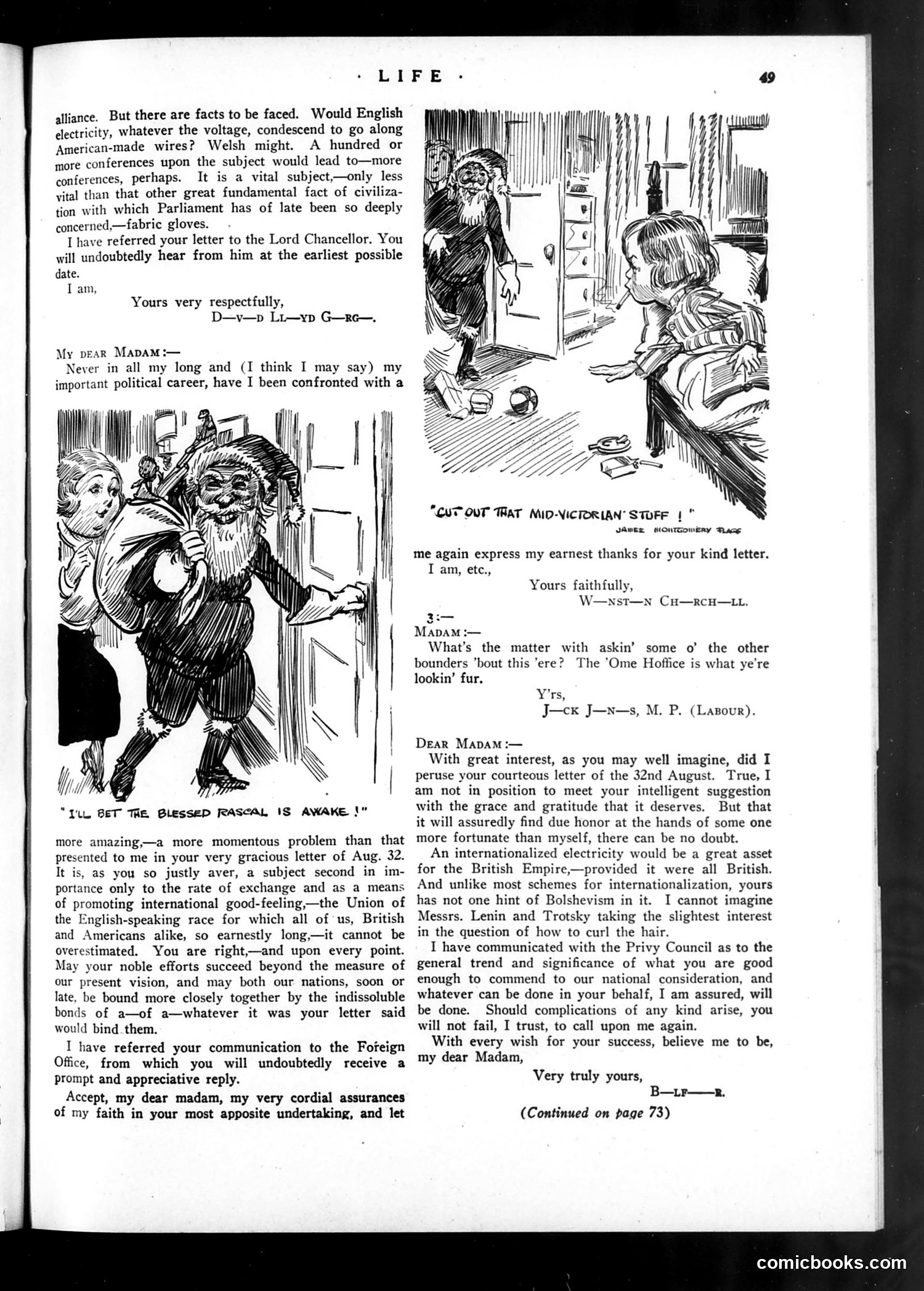
This page satirizes the British bureaucracy's response to a woman's inquiry about international electrical cooperation. Multiple fictional government officials—identifiable as **Winston Churchill**, a Labour MP, and others (names partially obscured)—respond with elaborate, verbose letters that completely dodge the actual question. The cartoons show a befuddled old man and woman, representing the confused citizen navigating this red tape. The satire's point: British officials respond to practical proposals with flowery language, vague reassurances, and endless referrals to other departments—accomplishing nothing. References to "fabric gloves" and "how to curl the hair" mock Parliament's trivial preoccupations. The note "Aug. 32" (impossible date) underscores the absurdity. The phrase "cut out that mid-Victorian stuff" suggests the satire critiques outdated bureaucratic pomposity hindering modern progress, particularly Anglo-American cooperation during this era.
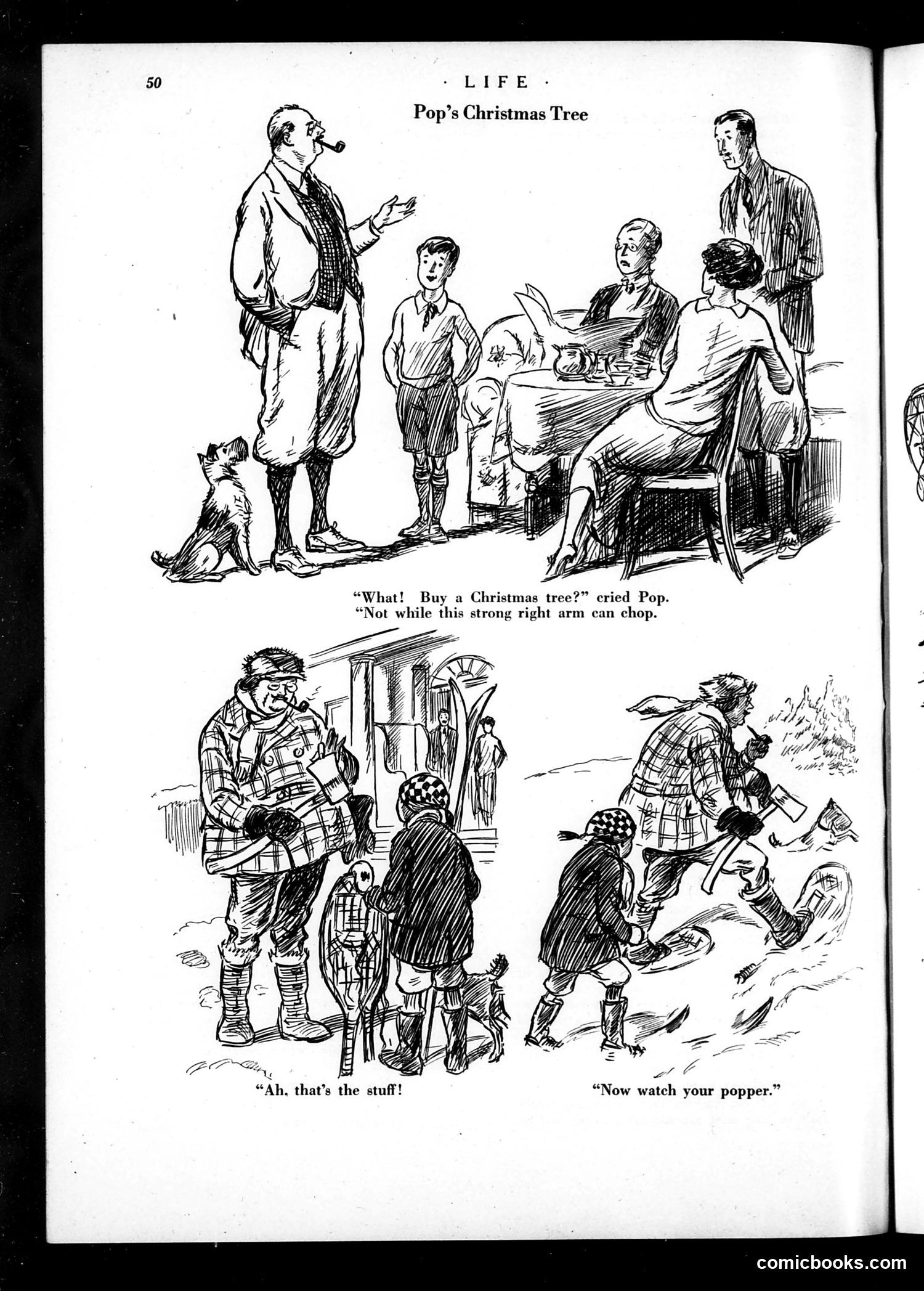
This humorous three-panel comic satirizes masculine self-reliance and pride. "Pop," a stout man with a cigar, refuses to *buy* a Christmas tree, boasting his "strong right arm can chop" one instead—a display of working-class independence and thrift during an era when purchasing vs. harvesting goods carried class implications. The joke unfolds in the lower panels: Pop ventures into the woods with an axe to fell a tree, but the subsequent scenes ("Ah, that's the stuff!" and "Now watch your popper") suggest comic disaster—likely showing Pop's overconfidence leading to mishap or injury, undermining his masculine bravado. The satire targets male pride and the performative demonstrations of capability that often backfire, a common theme in early 20th-century American humor magazines.
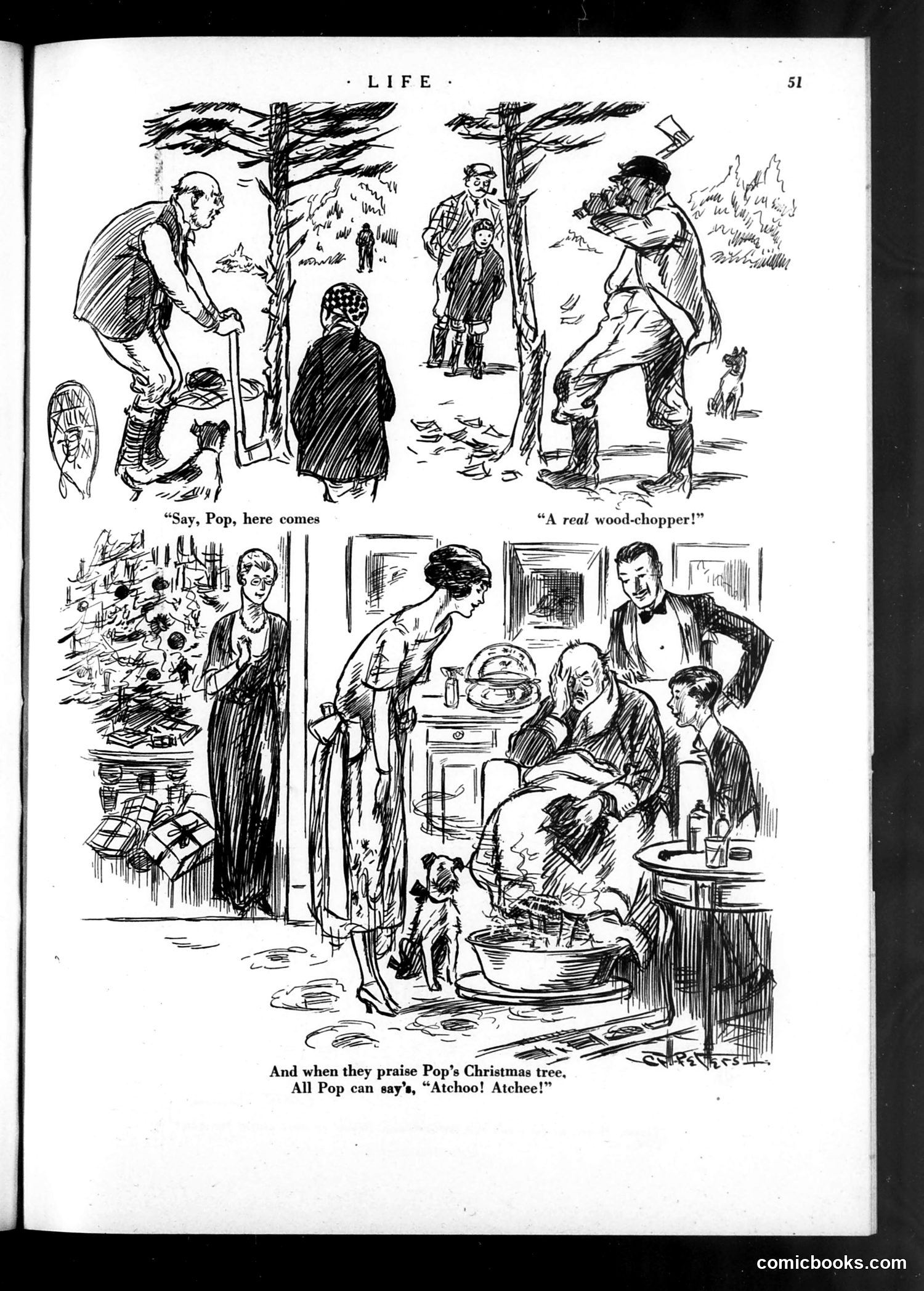
This is a humorous domestic comic strip about a father ("Pop") dealing with his allergies during Christmas preparation. The top panels show neighborhood children admiring Pop's woodcutting skills outdoors. The bottom panel depicts the family's Christmas celebration indoors, where Pop sits sneezing ("Atchoo! Atchee!") while receiving praise for the Christmas tree he cut. The satire is gentle and relatable: Pop's accomplishment—chopping and bringing in a fresh evergreen tree—comes with an ironic consequence. His allergic reaction to the tree's needles or sap prevents him from enjoying the praise and celebration his work made possible. It's a joke about the unintended side effects of holiday traditions and the comedic gap between expectation and reality in domestic life.
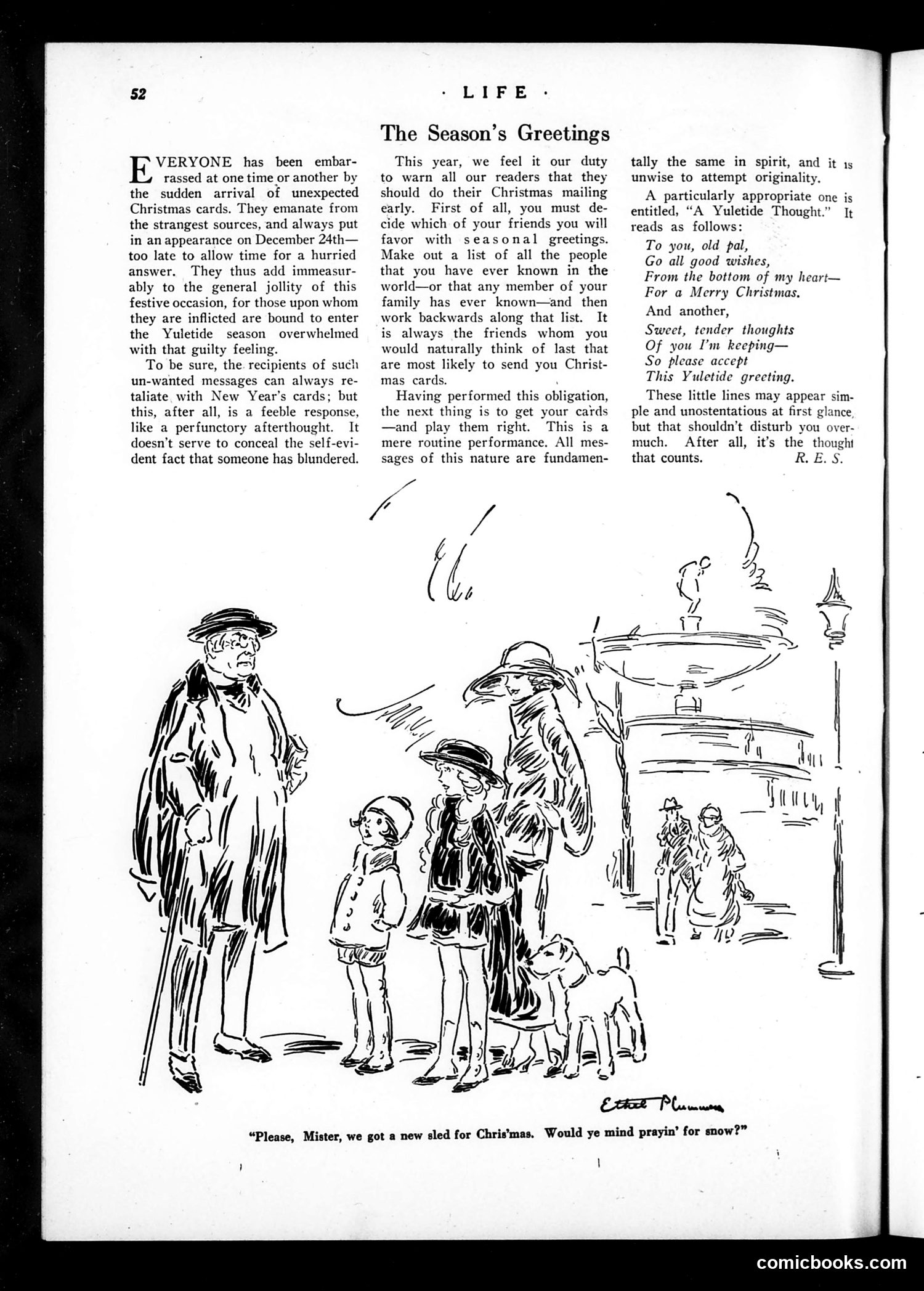
This page satirizes the awkwardness of Christmas card etiquette in early 20th-century America. The article humorously warns readers about the guilt of receiving unexpected holiday cards from forgotten acquaintances, then offers tongue-in-cheek advice: make exhaustive lists of everyone you've ever met, then work backwards—because you'll naturally forget the people most likely to send *you* cards. The cartoon below depicts a poor family approaching a wealthy man, asking him to pray for snow so their new sled will be usable. The irony is social: the children have received a Christmas gift they cannot actually enjoy without weather conditions beyond anyone's control—a gentle critique of gift-giving disconnected from recipients' real circumstances. Both pieces mock the performative, obligatory nature of Christmas rituals among the American middle and upper classes.
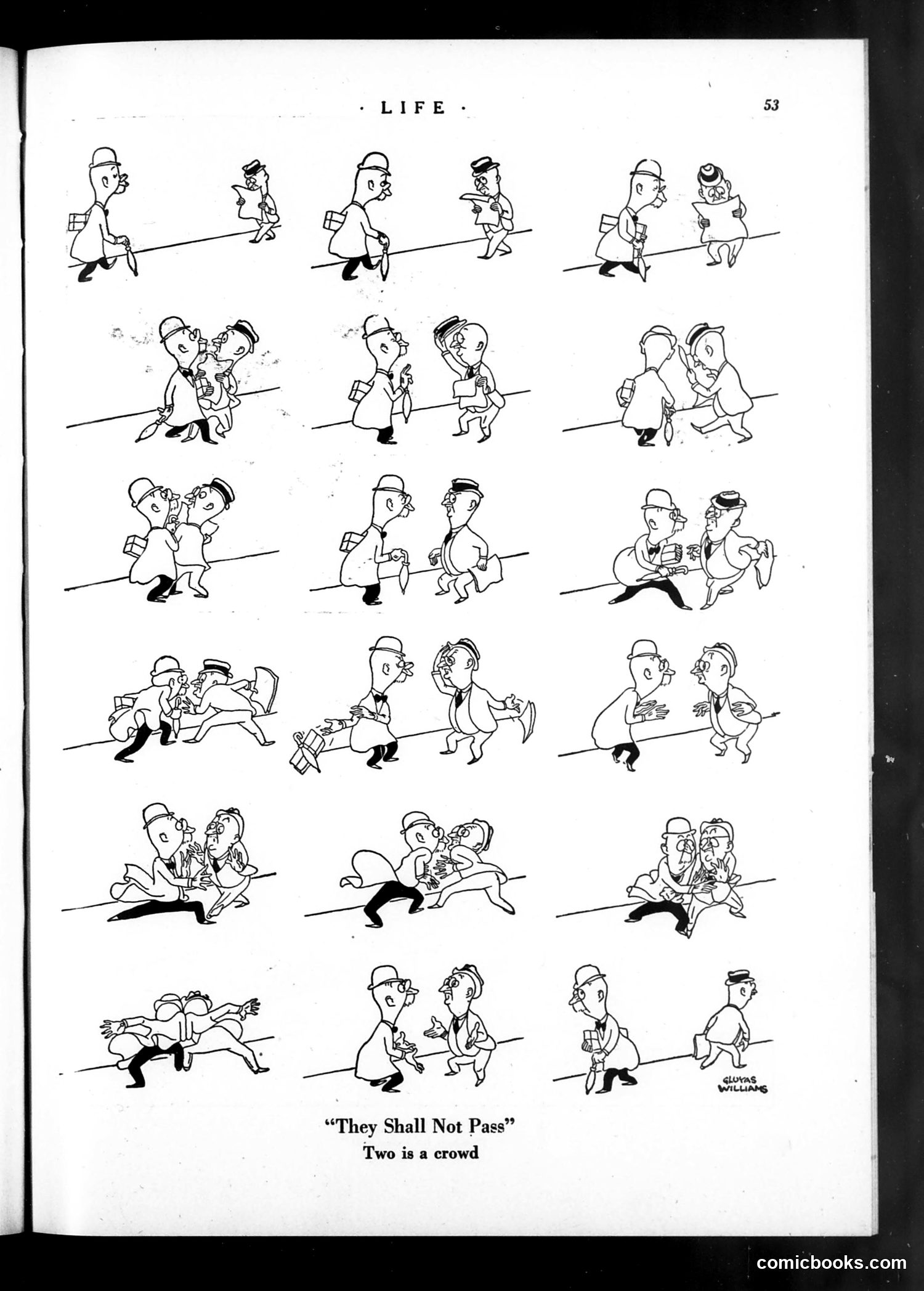
This is a sequential cartoon strip satirizing crowd control or blocking behavior. The title references the famous WWI slogan "They shall not pass," but applies it humorously to everyday situations. The strip shows a man in a hat repeatedly attempting to move past or through various encounters with other figures—some appearing to be children, others adults. The repeated pattern suggests the man is persistently blocked or impeded by groups of people in his path. The caption "Two is a crowd" suggests the satire concerns how even small groups can obstruct movement or progress. Without clearer OCR text or visible date, the specific political context remains unclear, though it likely comments on crowd dynamics, pedestrian traffic, or social obstruction during the early-to-mid 20th century.
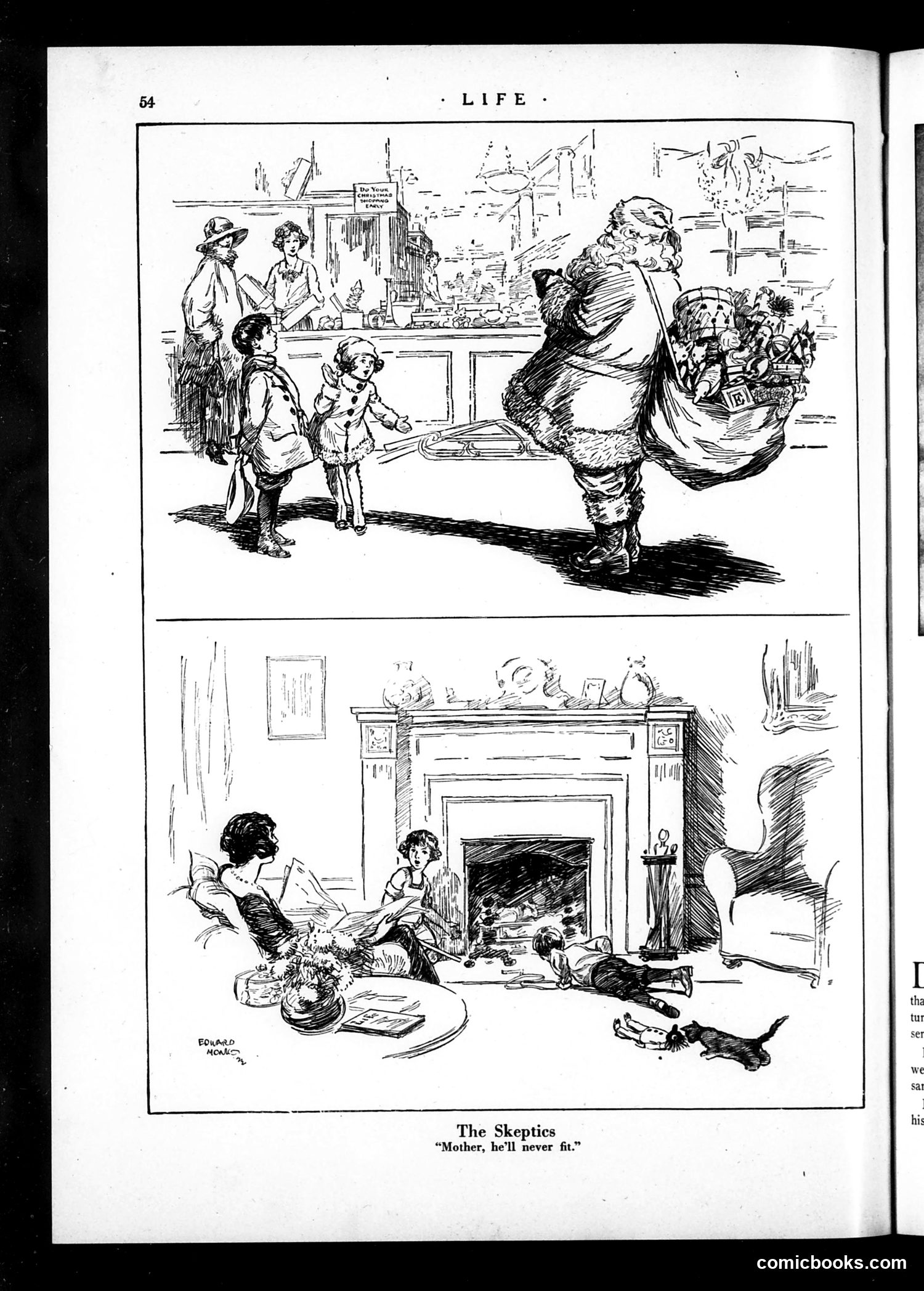
This two-panel cartoon satirizes parental skepticism about children's schemes and Santa Claus. **Top panel:** A rotund figure (Santa) demonstrates his ability to fit down a chimney to two skeptical children at what appears to be a toy shop or display window, while adults look on. **Bottom panel:** At home by the fireplace, children lie in wait with toys scattered about, with one child expressing doubt: "Mother, he'll never fit." The humor plays on the tension between children's hopeful belief in Santa's magical abilities (as demonstrated in the shop) versus their practical skepticism when confronting the physical reality of their actual chimney. The title "The Skeptics" suggests the children are too worldly-wise to fully suspend disbelief, even while wanting to believe in Santa's Christmas magic.
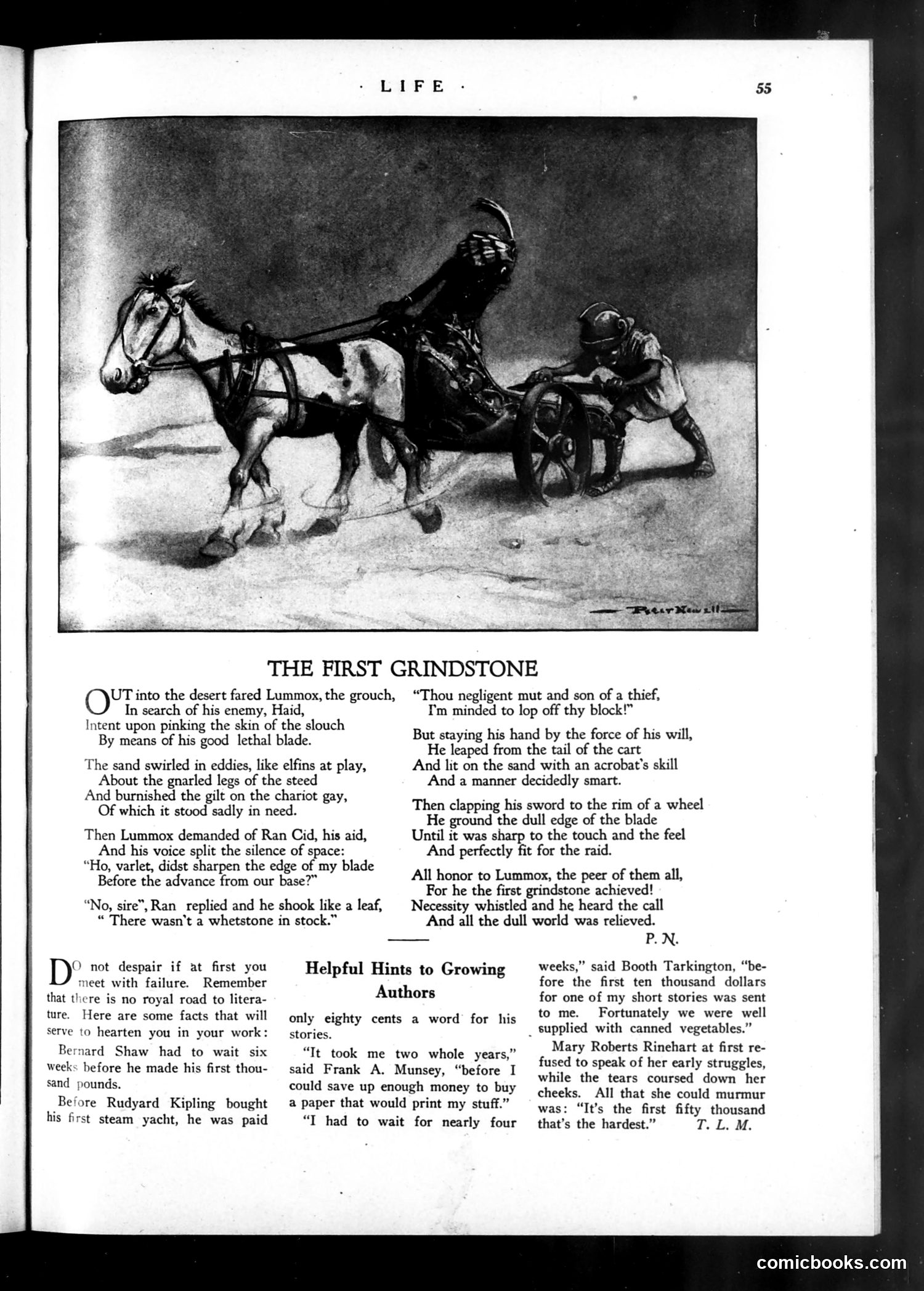
This page contains a humorous narrative poem illustrated above, followed by inspirational advice for aspiring writers below. The poem tells a mock-heroic tale of Lummox, a desert warrior, who discovers his servant failed to sharpen his sword before battle. Rather than punish him, Lummox improvises by using a chariot wheel as a grindstone—turning necessity into invention. The poem's overwrought language and rhyme scheme parody epic poetry while celebrating practical problem-solving. The lower section, "Helpful Hints to Growing Authors," offers encouragement to struggling writers by citing famous authors (Shaw, Kipling, Munsey, Tarkington, Rinehart) who experienced early financial hardship before success. The juxtaposition suggests that like Lummox overcoming his obstacle, writers must persist through their lean early years. The satire operates on two levels: mocking grandiose literary conventions while genuinely motivating readers that difficulty precedes achievement.
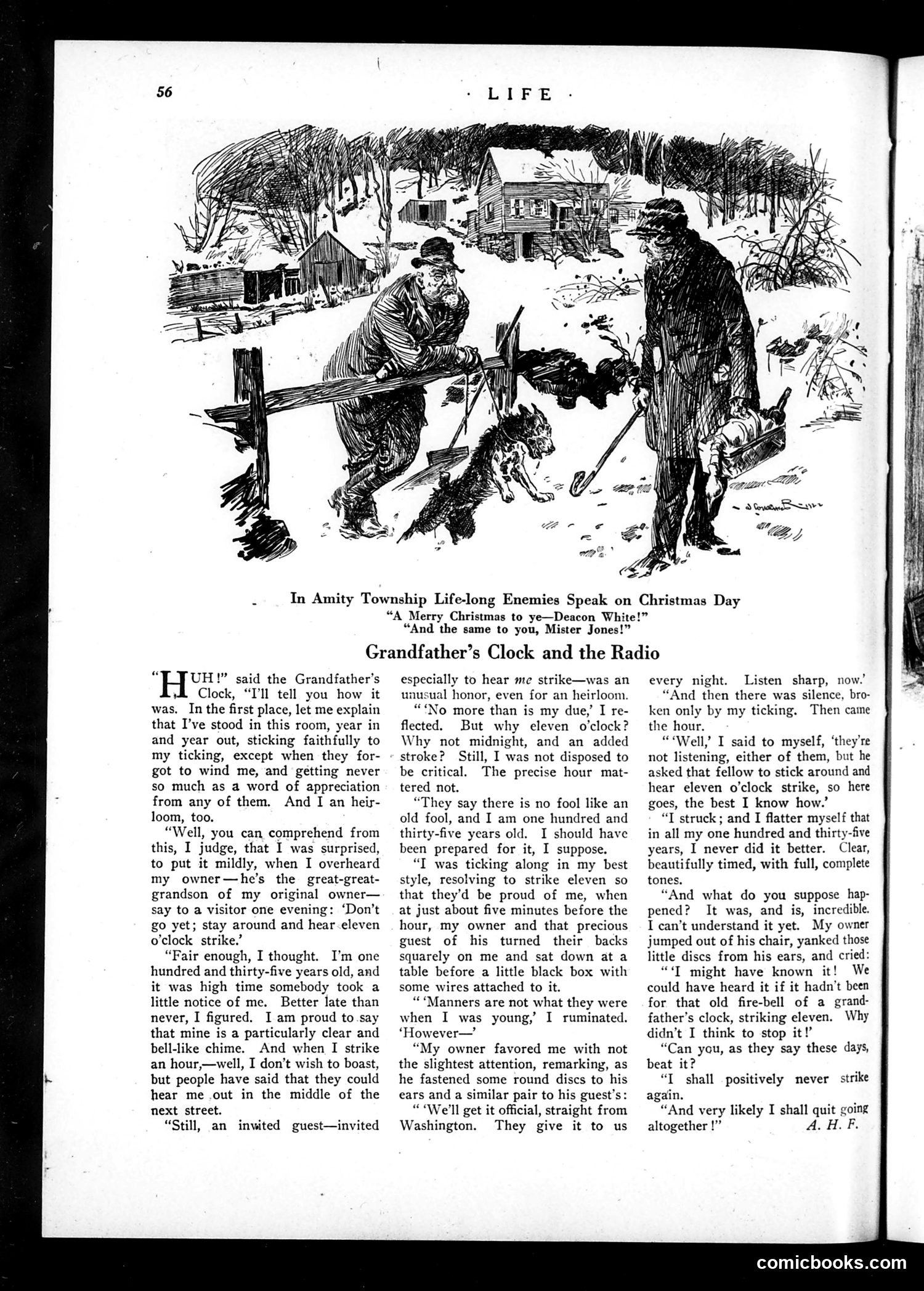
This satirical piece compares old and new technologies through personified objects. A 135-year-old grandfather clock, long ignored by its owners, finally expects appreciation when invited guests arrive specifically to "hear eleven o'clock strike." However, the owners instead gather around "a little black box with some wires attached to it"—a radio—to listen to an official broadcast "straight from Washington." The joke targets the rapid cultural shift toward radio in the early 20th century. The clock's proud, traditional chime is literally drowned out by the new medium; the owners frantically remove their headphones, blaming the clock's noise for ruining the broadcast. The satire mocks both generational obsolescence and society's wholesale abandonment of old customs for modern convenience. The clock's indignant vow "I shall positively never strike again" humorously expresses how technological disruption renders tradition not just unwanted but actively resented.
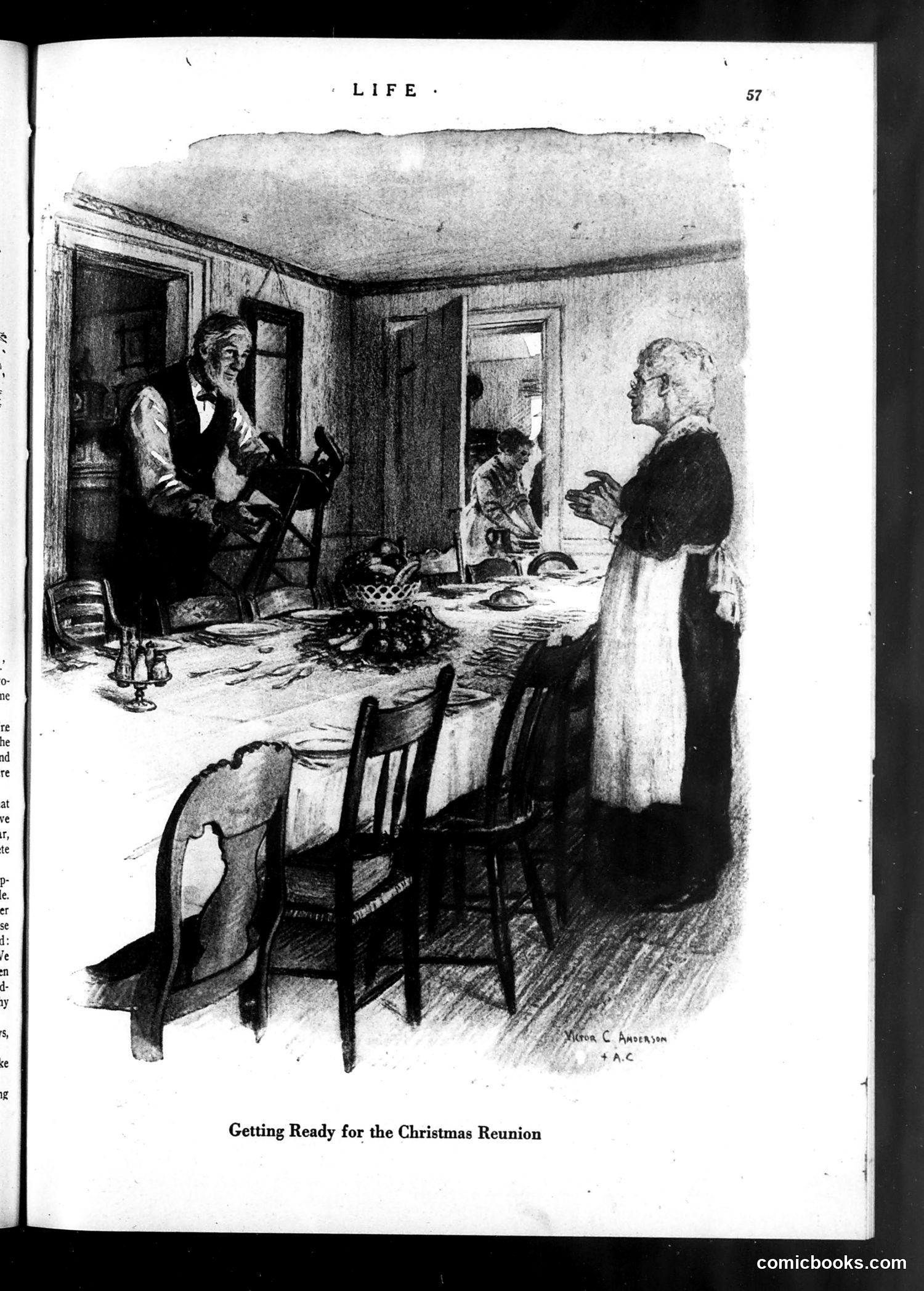
This illustration depicts a domestic scene of holiday preparation. A woman stands in a modest kitchen while a man sits at a table, both apparently readying themselves for a Christmas family gathering. The humble furnishings—simple chairs, basic table setting with bottles and dishes—suggest working-class circumstances. The satire likely comments on the social anxieties of holiday reunions, particularly regarding appearances and class status. The careful preparation visible in the scene may mock the effort people invest in presenting themselves respectably to family members, or the modest circumstances that make such gatherings potentially awkward. Without additional context about the specific historical period, the precise satirical target remains unclear, though the theme of holiday social performance is evident.
This story satirizes 1920s Hollywood's disconnection from traditional American values. Santa Claus, representing old-fashioned Christmas tradition, descends on a wealthy Hollywood villa expecting to find genuine childhood wonder. Instead, he discovers a precocious child surrounded by expensive, mechanized toys (electric trains, motion picture cameras, toy police dogs). The central joke: the child doesn't recognize Santa Claus and mistakes him for a movie "extra" or studio "interviewer." The boy's parents control even his conversations with visitors—he can't speak freely without parental approval. The satire mocks Hollywood's materialism, artificiality (the snowy mountain backdrop), and how the entertainment industry corrupts childhood innocence. The "painted landscape" and elaborate mechanical toys replace genuine Christmas spirit. The child's jaded, worldly attitude—treating Santa as just another industry functionary—illustrates how Hollywood wealth and show-business culture have replaced traditional values and authentic childhood.
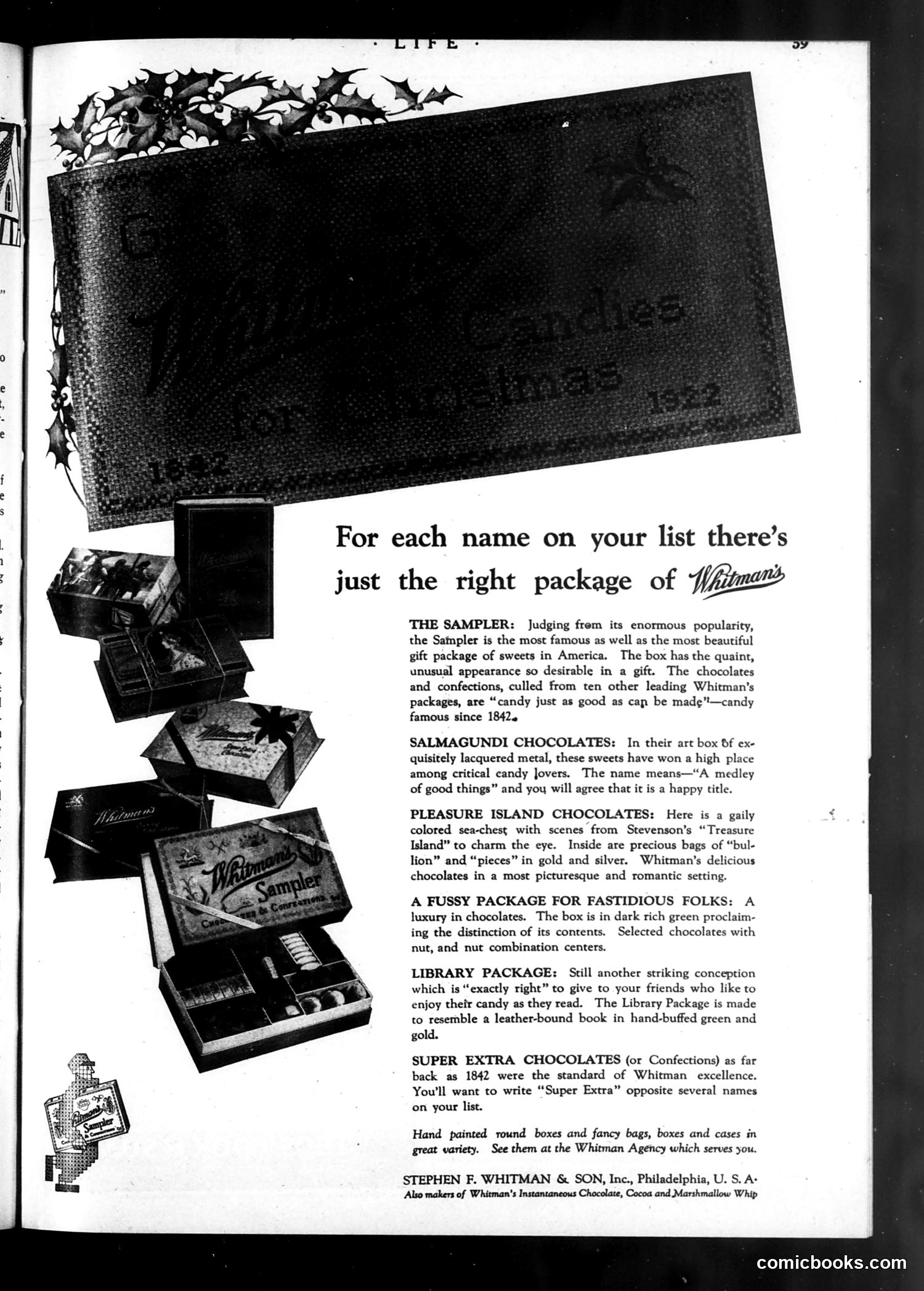
This is a **product advertisement**, not political satire. It promotes Whitman's chocolate gift packages for holiday shopping, likely Christmas given the holly decoration at top. The page showcases six different Whitman's candy box designs, each marketed to different consumer preferences: the classic "Sampler," the elegant "Salmagundi Chocolates," the literary "Pleasure Island" (referencing Stevenson), a luxury green box for discerning buyers, a "Library Package" designed to resemble a leather-bound book, and "Super Extra Chocolates" emphasizing the brand's century-old heritage (since 1842). The ad targets gift-givers by suggesting the "right package" exists for "each name on your list," appealing to 1920s-30s consumer culture and the growing tradition of commercial gift-giving.
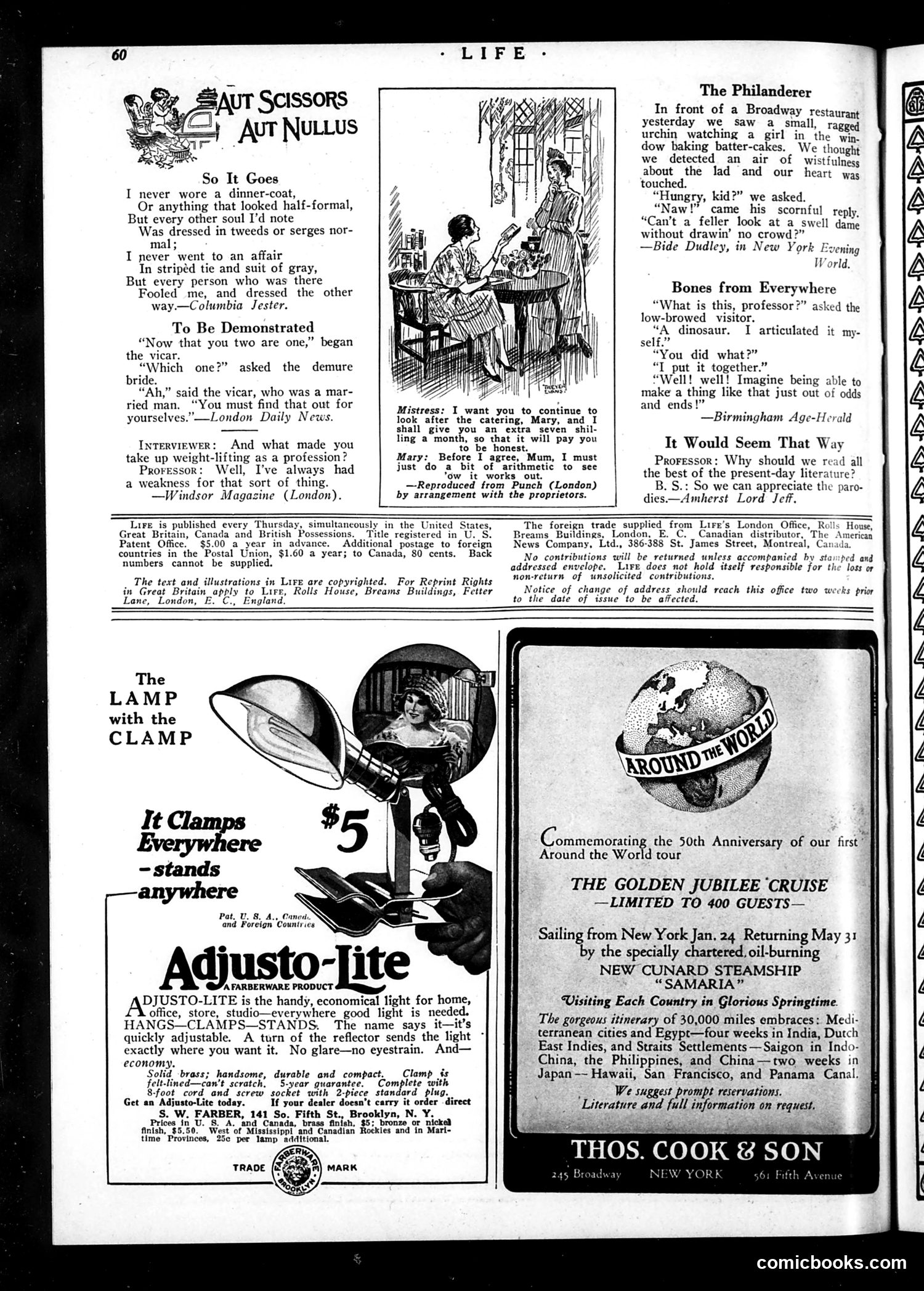
This page from *Life* contains several short satirical pieces and advertisements typical of early 20th-century humor magazines. **The Cartoons/Humor:** The page features five brief comic anecdotes mocking social conventions and human nature. "To Be Demonstrated" jokes about newlyweds' marital adjustments; "Bones from Everywhere" satirizes a professor's pretentious claim to have assembled a dinosaur skeleton himself; "The Philanderer" presents a street urchin's complaint about being mistaken for a romantic rather than simply hungry; "It Would Seem That Way" mocks students prioritizing modern literary parodies over original works. The opening poem "So It Goes" ironically describes always being dressed inappropriately for social occasions—wearing formal wear when others wear casual clothes, and vice versa. **The Advertisements:** The page also features product ads: the "Adjusto-Lite" lamp ($5) and a travel advertisement for Thomas Cook & Son's "Golden Jubilee Cruise" around the world, limited to 400 guests. The humor relies on gentle observational comedy and class-conscious social situations rather than political satire.
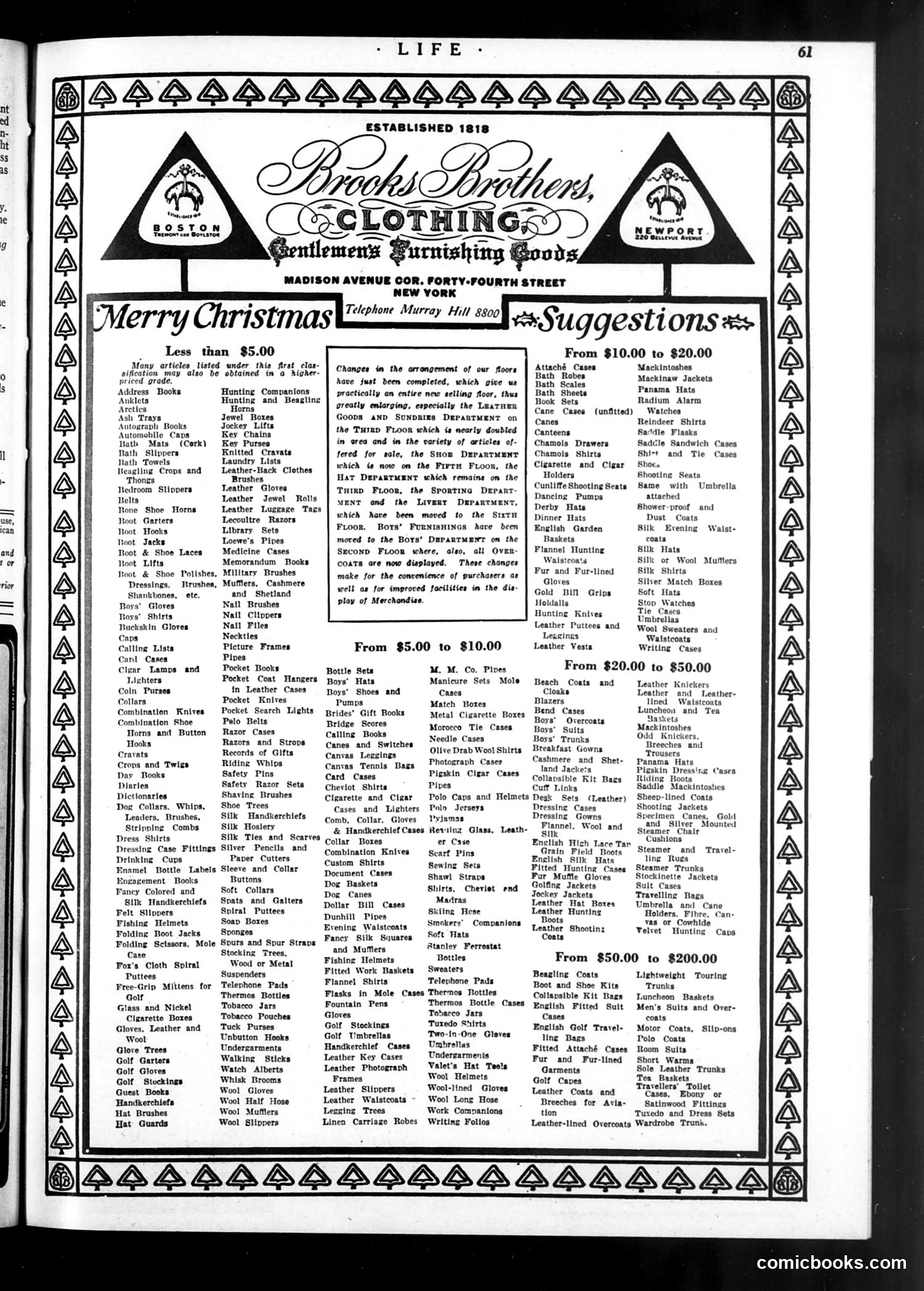
This is primarily a **Christmas gift advertisement**, not a political cartoon. It's a full-page ad from Brooks Brothers, the established clothing retailer (founded 1818), appearing in Life magazine. The page presents three price-tiered gift suggestion lists for gentlemen's furnishings: under $5, $5-$10, $10-$20, $20-$50, and $50-$200. Items range from practical (socks, handkerchiefs, gloves) to luxury goods (leather cases, hunting equipment, fine hats). The "Merry Christmas" heading and gift-listing format reflect early 20th-century consumer culture—this represents how department stores marketed seasonal shopping to affluent male consumers. The detailed inventory reflects the era's class distinctions: different price tiers target different buyer demographics, from modest gifts to high-end leather goods and sporting equipment. There is **no political satire or cartoon content** on this page—it's straightforward retail advertising.
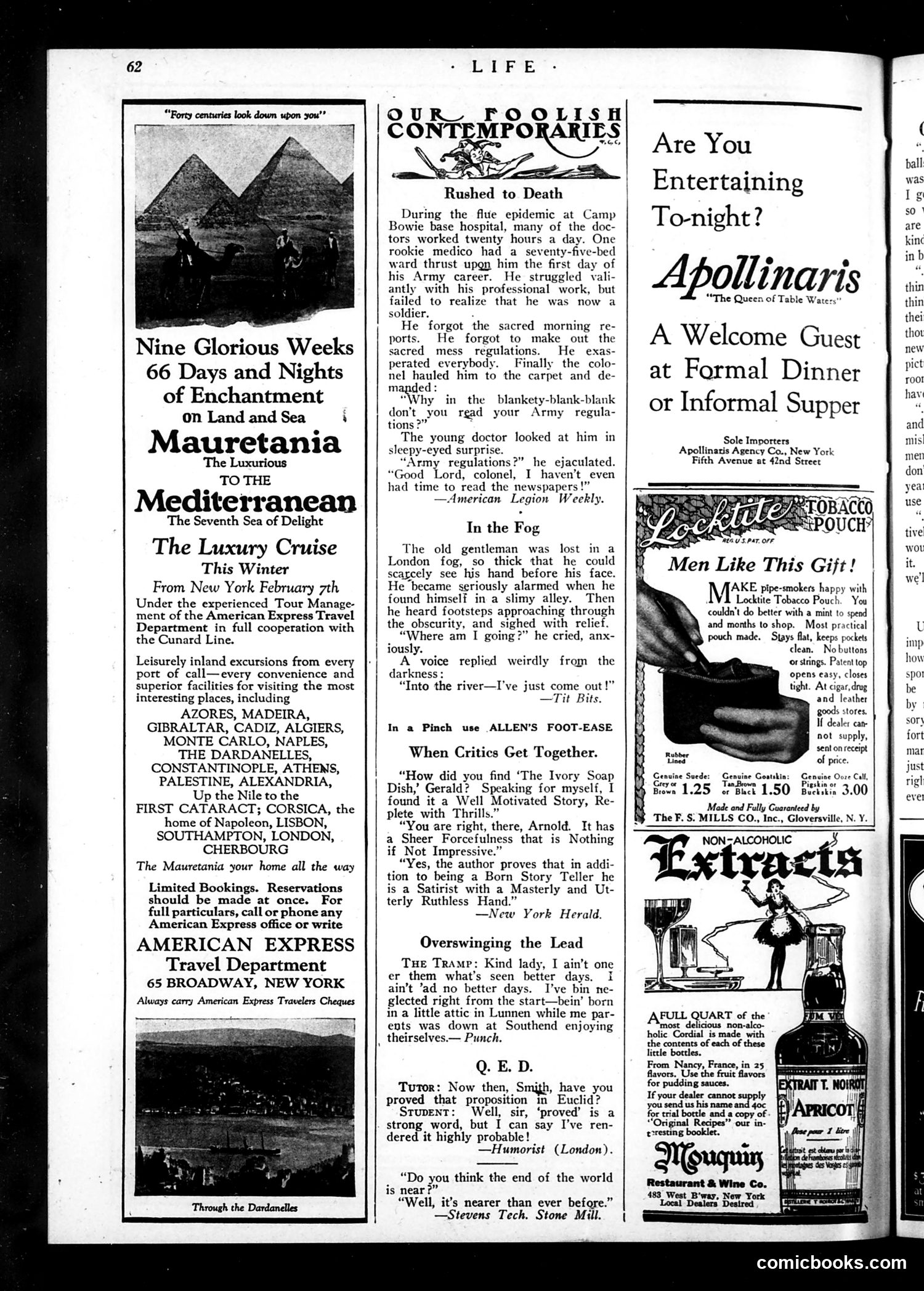
This page is **primarily advertising** with humor content serving as filler between ads. The main cartoons are brief, satirical anecdotes rather than visual political cartoons: 1. **"Rushed to Death"** (American Legion Weekly): Mocks military bureaucracy. A young Army doctor, overwhelmed with 75 patients during a flu epidemic, prioritizes Army regulations over actual medical work—satirizing rigid military hierarchy that ignores practical reality. 2. **"In the Fog"**: A London fog joke playing on lost travelers and the Thames River. 3. **"When Critics Get Together"**: Parodies pretentious theater critics using flowery, meaningless language to analyze trivial works like "The Ivory Soap Dish." 4. **"Overswinging the Lead"**: A tramp's exaggerated sob story claiming he was born in poverty—mockery of professional begging. The page otherwise advertises luxury cruises (Mauretania), tobacco pouches, and mineral water, reflecting 1920s consumer culture aimed at affluent readers.
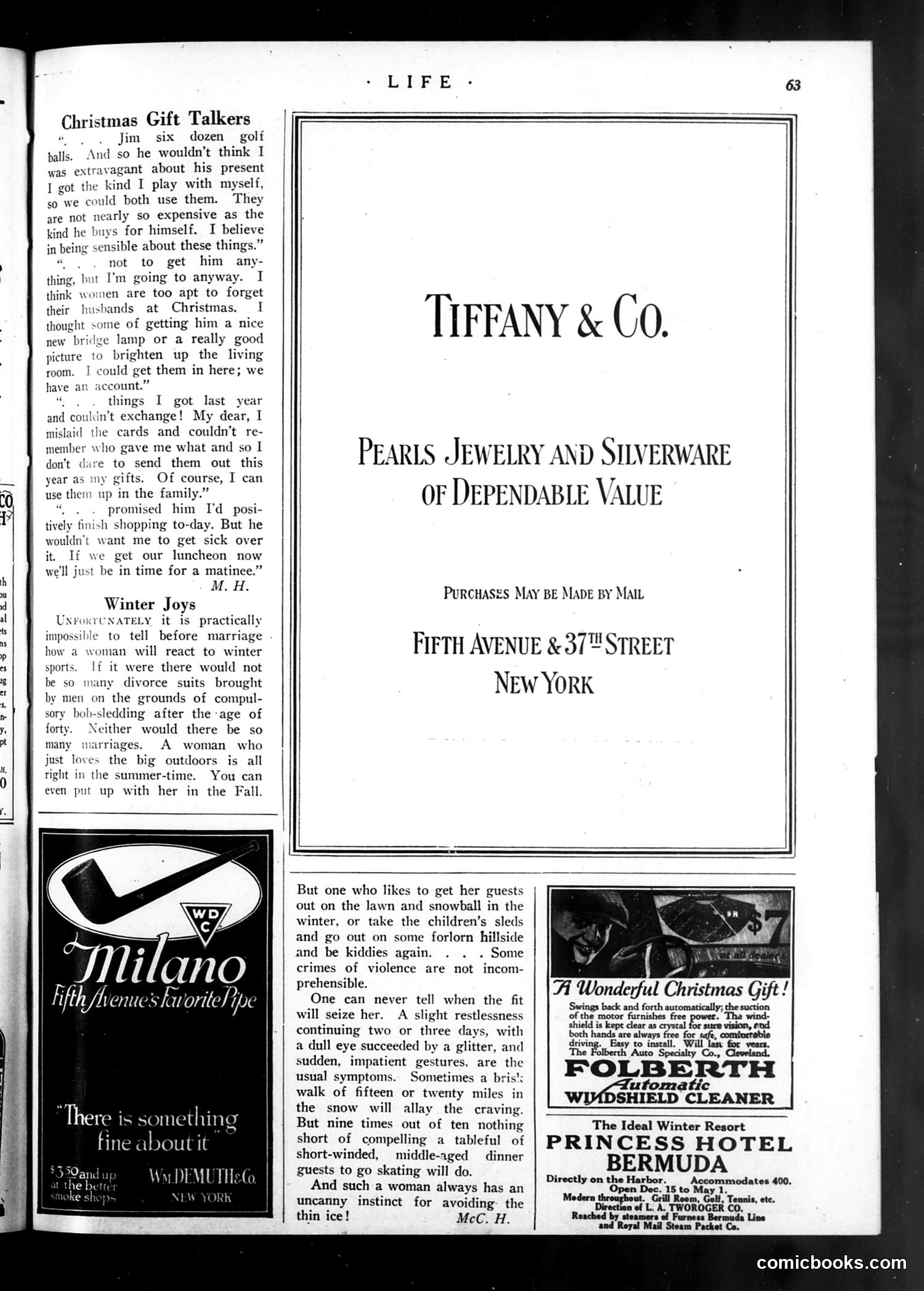
This page is primarily **advertising and advice columns** rather than political cartoons. The main content includes: **Left side:** Two advice columns—"Christmas Gift Talkers" (discussing gift-giving etiquette) and "Winter Joys" (about women's reactions to winter sports). There's also a Milano pipe advertisement. **Center/Right:** A full-page Tiffany & Co. luxury advertisement for pearls, jewelry, and silverware, plus smaller ads for a Folberth auto windshield cleaner and Princess Hotel Bermuda. **No political satire is present.** This appears to be a typical 1920s-era *Life* magazine page mixing consumer advice, lifestyle commentary, and high-end advertising—reflecting the magazine's shift toward lifestyle content and commercialism during this period.
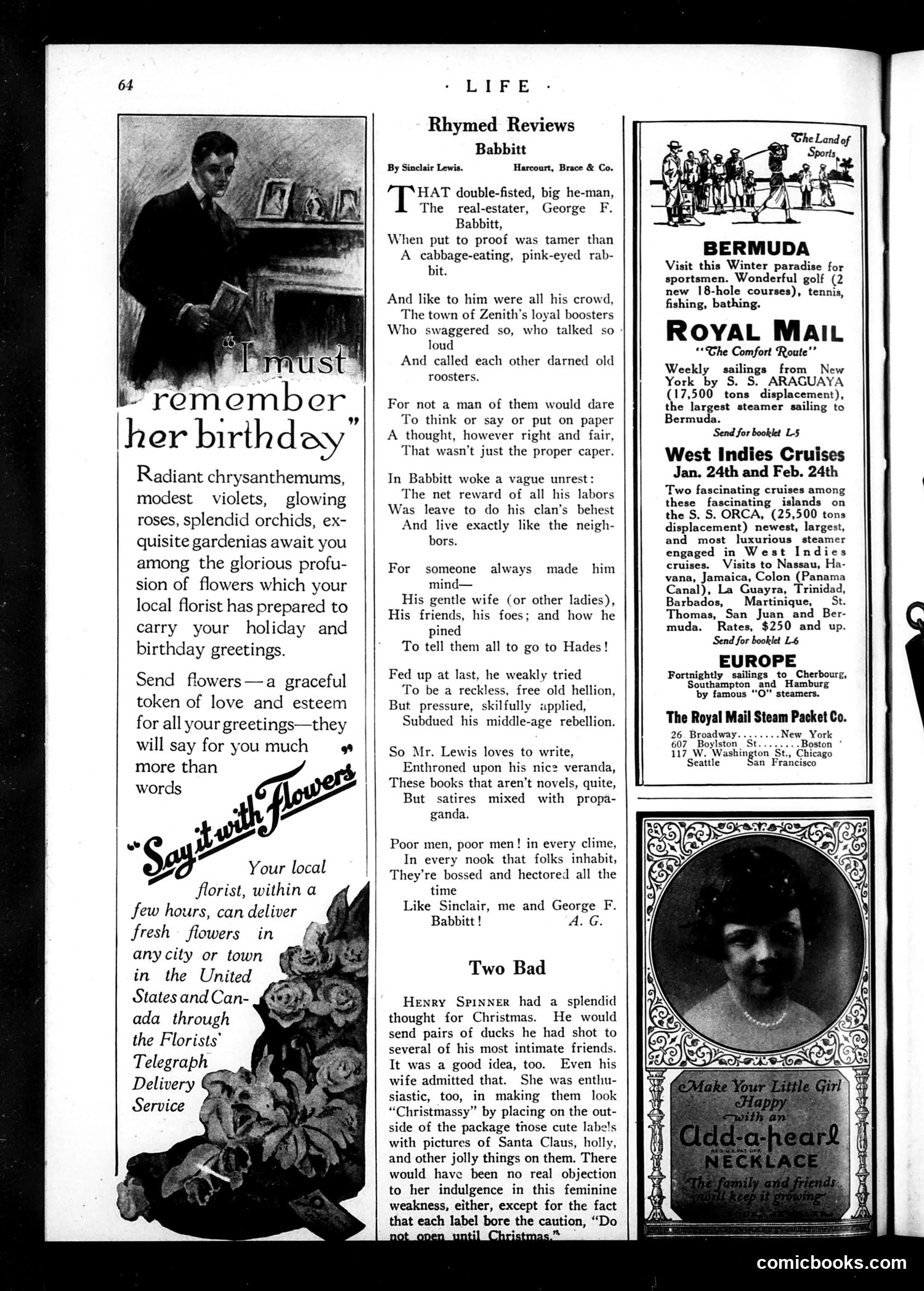
This page contains two distinct sections: **Left side:** A flower shop advertisement disguised as sentimental verse about sending flowers for birthdays and remembrance—a straightforward commercial appeal with no satirical content. **Center: "Rhymed Reviews—Babbitt"** critiques Sinclair Lewis's 1922 novel *Babbitt*. The reviewer (A.G.) summarizes the plot in verse: George F. Babbitt, a real-estate businessman in the fictional town of Zenith, appears confident but is actually conformist and timid. Though he yearns to rebel against social pressure from his wife, friends, and neighbors, he ultimately submits to middle-class convention. The review notes Lewis writes "satires mixed with propaganda" rather than pure novels—a common critique of Lewis's social commentary fiction. The satire targets not Lewis but American conformity itself: the "poor men" trapped by social control everywhere, unable to act authentically. **Right side:** Travel and cruise line advertisements (Bermuda, West Indies, Europe). This is primarily an advertising-heavy page with one literary review.
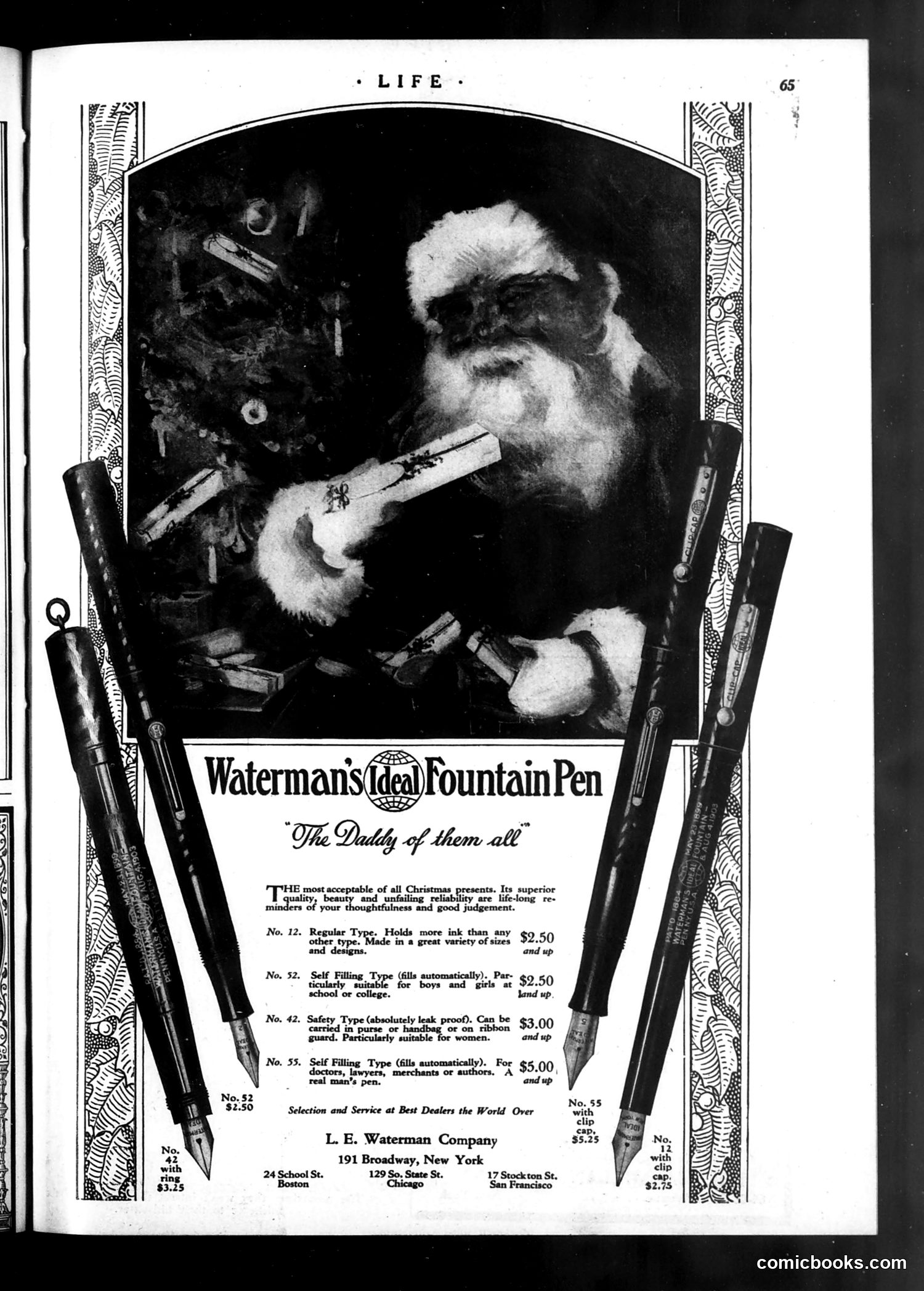
This is primarily a **Waterman's Ideal Fountain Pen advertisement**, not political satire. The image shows Santa Claus smoking a cigar while examining fountain pens, positioned as a Christmas gift endorsement. The ad's tagline—"The Daddy of them all"—plays on Santa's patriarchal gift-giving role. The copy emphasizes the pen as "the most acceptable of all Christmas presents," marketing it as a thoughtful, reliable luxury item. Four pen models are listed with prices ($2.50–$5.00), targeting different users: regular customers, students, women (the "Safety Type"), and professionals (doctors, lawyers, merchants). **For modern readers:** This reflects early 20th-century advertising conventions—using Santa and holiday sentiment to sell premium goods. Fountain pens were prestigious items then, making this a high-end Christmas gift pitch, not commentary on contemporary politics or social issues.
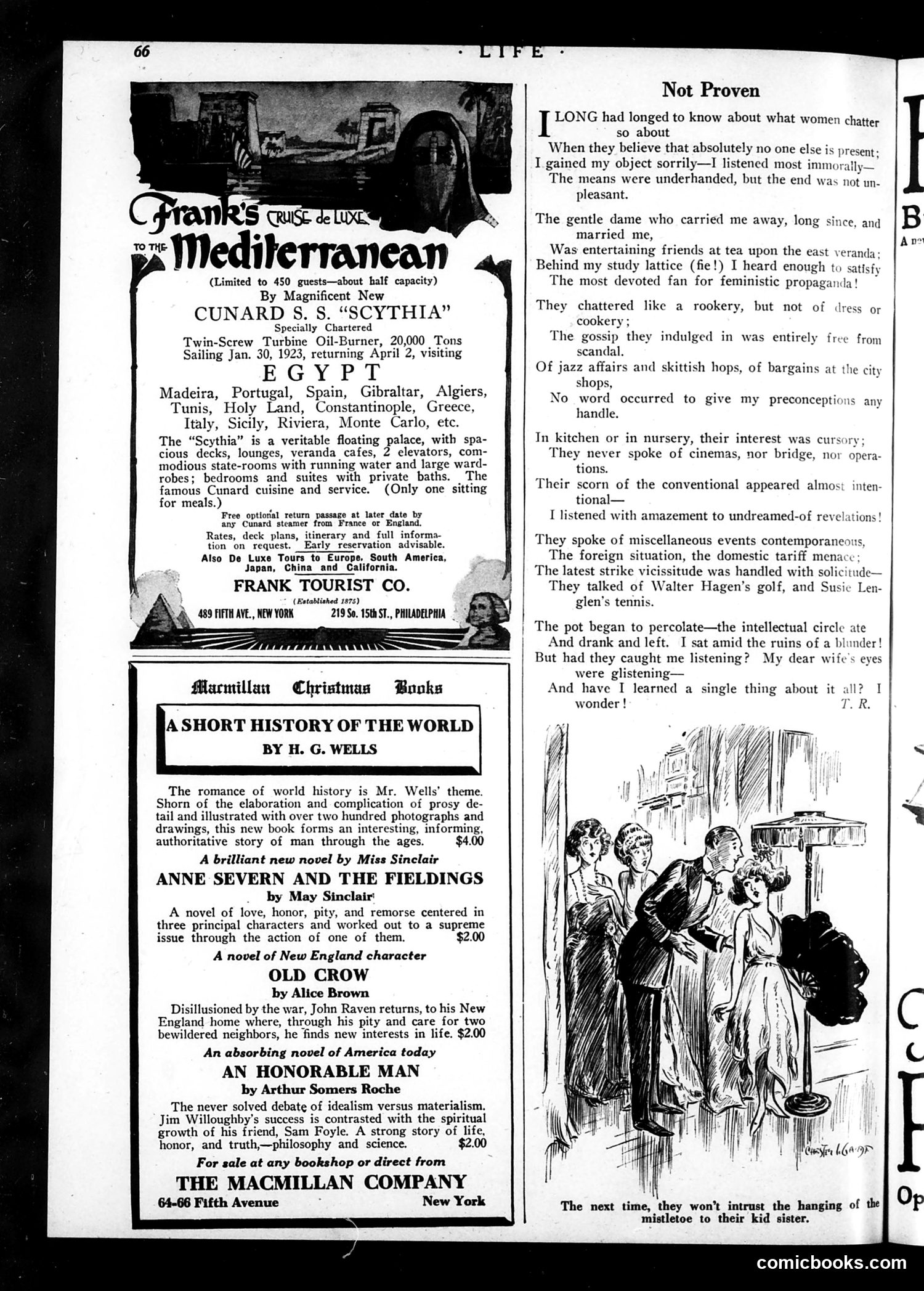
This is a humorous essay-poem (signed "T.R.") about a man eavesdropping on women's tea conversation, expecting gossip but finding something unexpected. **The Setup:** The narrator admits to listening from behind his study lattice while his wife entertains friends on the veranda—underhanded but amusing. **The Satire:** The piece gently mocks contemporary gender stereotypes. The man expects women to discuss "dress or cookery" and scandal, but instead they debate substantive topics: jazz, current events, the foreign situation, the domestic tariff, labor strikes, and sports figures like golfer Walter Hagen and tennis player Suzanne Lenglen. **The Point:** The title "Not Proven" suggests the author's hypothesis about women's shallow interests remains unproven. The joke subverts expectations—women emerge as intellectually engaged, discussing politics and current affairs seriously. The "blunder" at the end hints the narrator learned something humbling about women's minds. This reflects 1920s-era commentary on evolving women's roles post-suffrage, gently challenging male assumptions about female conversation.
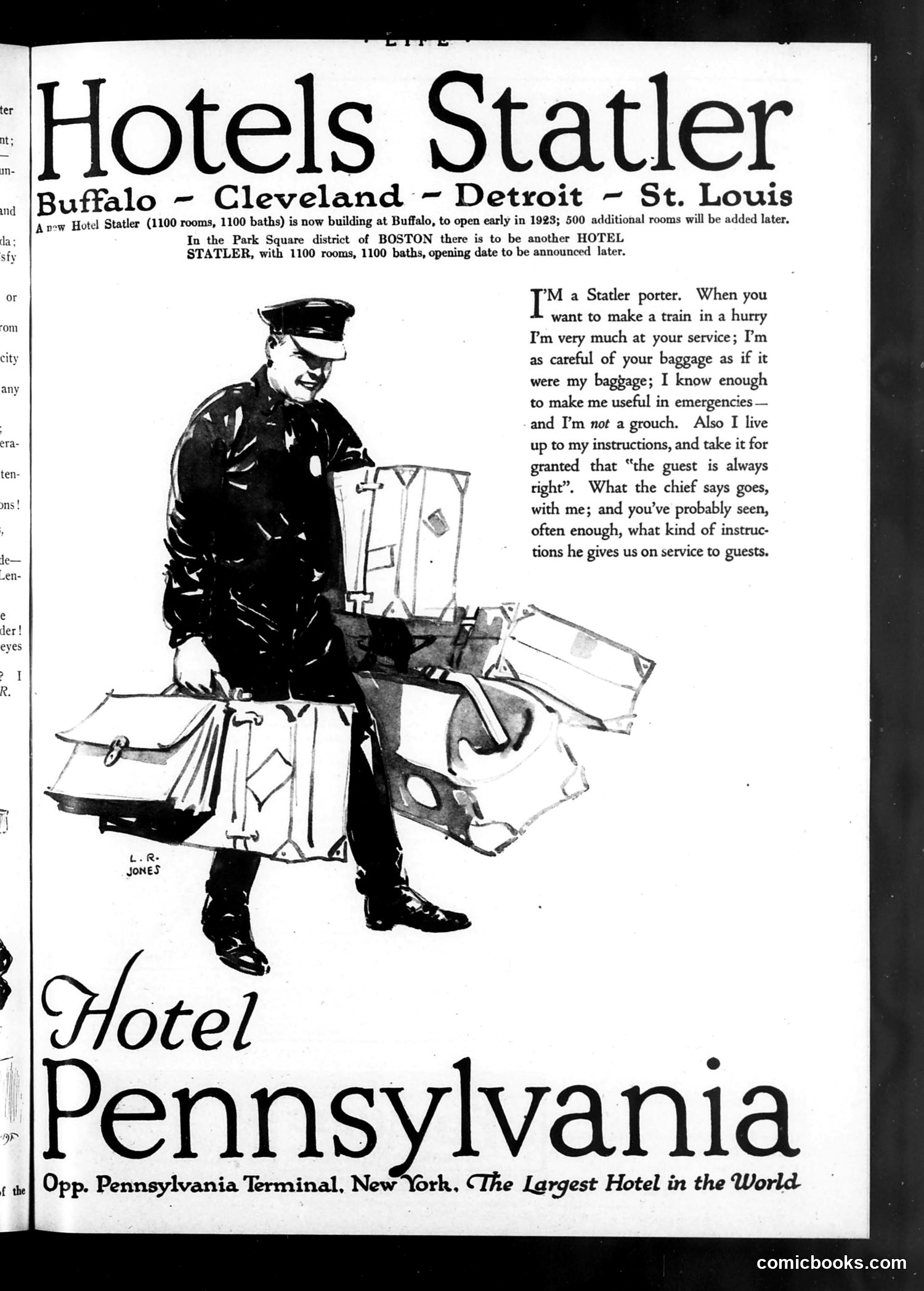
This is primarily **advertising**, not satire or political commentary. The page promotes two hotel chains: **Hotels Statler** (top) announces new locations opening in Buffalo, Cleveland, Detroit, and St. Louis, plus a Boston expansion. The accompanying illustration shows a uniformed porter with multiple suitcases, and the text—presented as the porter's first-person testimony—emphasizes Statler's service standards: promptness, careful baggage handling, usefulness in emergencies, and adherence to the "guest is always right" philosophy. **Hotel Pennsylvania** (bottom) advertises itself as "The Largest Hotel in the World," located opposite Pennsylvania Terminal in New York. Both ads use testimonial and boosterism typical of 1920s hospitality marketing. There is **no political satire or social commentary**—this is straightforward corporate promotion appearing in *Life* magazine, likely circa 1922-1923 based on the opening dates mentioned.
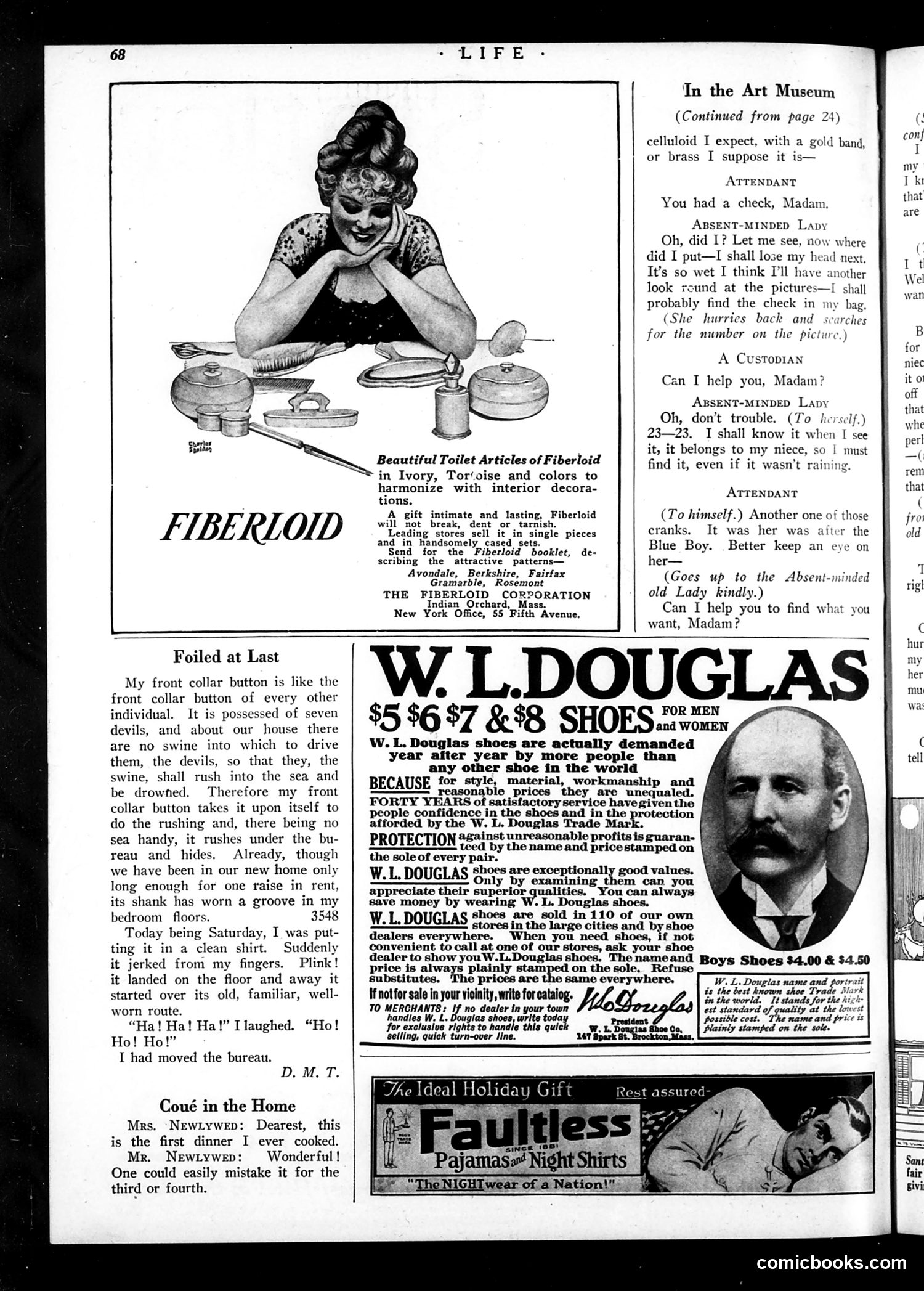
This page is primarily **advertising with two short humor pieces**. The main content includes: **Advertisements:** - **Fiberloid**: Promotes celluloid toilet articles (combs, brushes, mirrors) marketed as durable gifts - **W.L. Douglas Shoes**: A major shoe manufacturer emphasizing value, durability, and 40 years of customer trust - **Faultless Pajamas**: Holiday gift advertising **Humor Pieces:** 1. **"In the Art Museum"**: A dialogue sketch about an absent-minded woman who loses her museum coat check and wanders the galleries searching for it, treating it as a puzzle rather than asking for help directly. 2. **"Foiled at Last"**: A brief comedic anecdote about a recurring household annoyance—a front collar button that persistently escapes under the bureau. The narrator finally moves the furniture, only to have it continue its frustrating escape route anyway. Both humor pieces employ gentle, relatable domestic comedy typical of 1920s Life magazine's style.
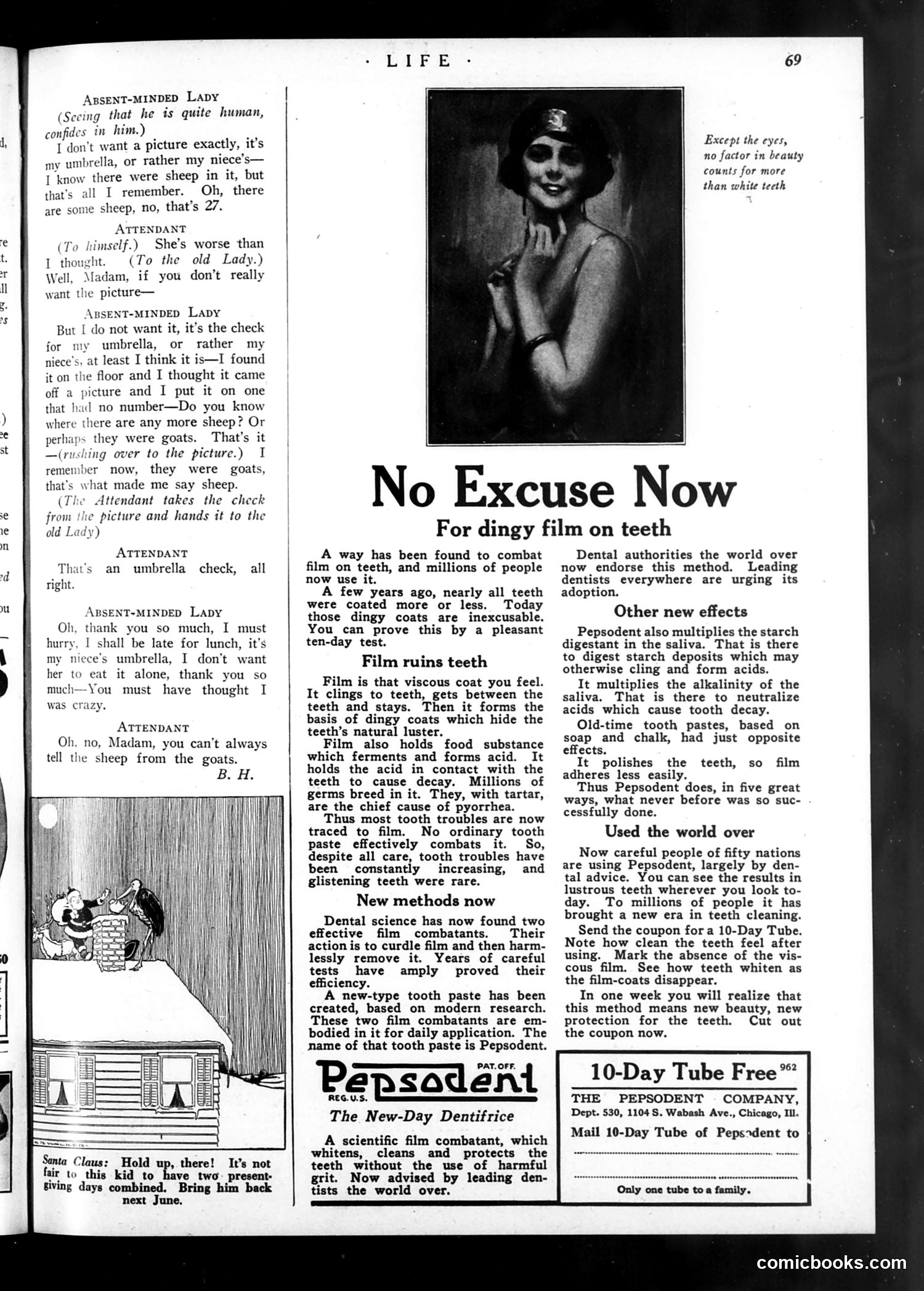
This page combines a satirical comic sketch with a substantial advertisement for Pepsodent toothpaste. **The Comic:** An absent-minded elderly woman confuses her umbrella check with a museum picture ticket, rambling confusedly about sheep versus goats in an artwork. The attendant humors her. The humor targets elderly forgetfulness and the woman's stream-of-consciousness confusion—a common stereotype in 1920s satire. **The Advertisement:** The main content promotes Pepsodent as a scientific solution to "film"—a viscous dental coating causing yellowing teeth. The ad emphasizes that modern dental science has discovered this problem and its solution, making dingy teeth now inexcusable. It claims Pepsodent uses two "film combatants" to remove buildup and improve oral health—positioning the product as cutting-edge science rather than mere cosmetic dentistry. This reflects 1920s marketing that leveraged scientific authority to sell personal hygiene products to increasingly self-conscious consumers.
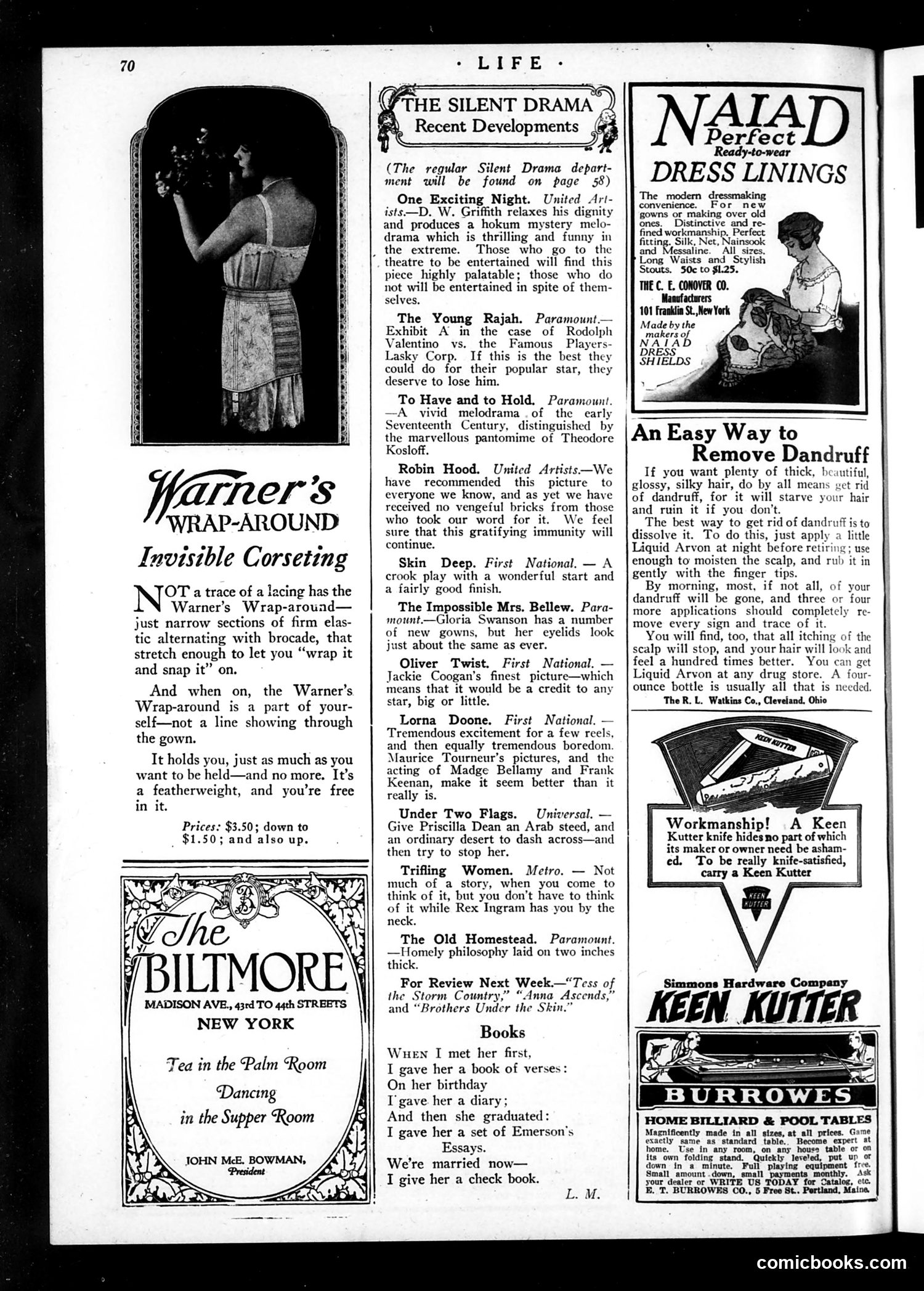
This page features a column reviewing contemporary silent films, alongside period advertisements. The reviews use sharp, witty criticism typical of Life magazine's satirical voice. Notable reviews include barbs at famous stars: D.W. Griffith is said to have "relaxed his dignity" making a lowbrow mystery; Rudolph Valentino's vehicle is criticized as unworthy of him; and Gloria Swanson's "eyelids look just about the same as ever" despite new gowns. Jackie Coogan receives genuine praise. The tone is irreverent—dismissing some films as "hokum" while acknowledging entertainment value for uncritical audiences. A witty poem about gift-giving concludes the page, humorously tracking a relationship's progression from poetry to checking accounts. The advertisements (corsets, dress linings, dandruff remedies) reflect 1920s women's consumer culture. This is primarily a review/advertisement page rather than political satire.
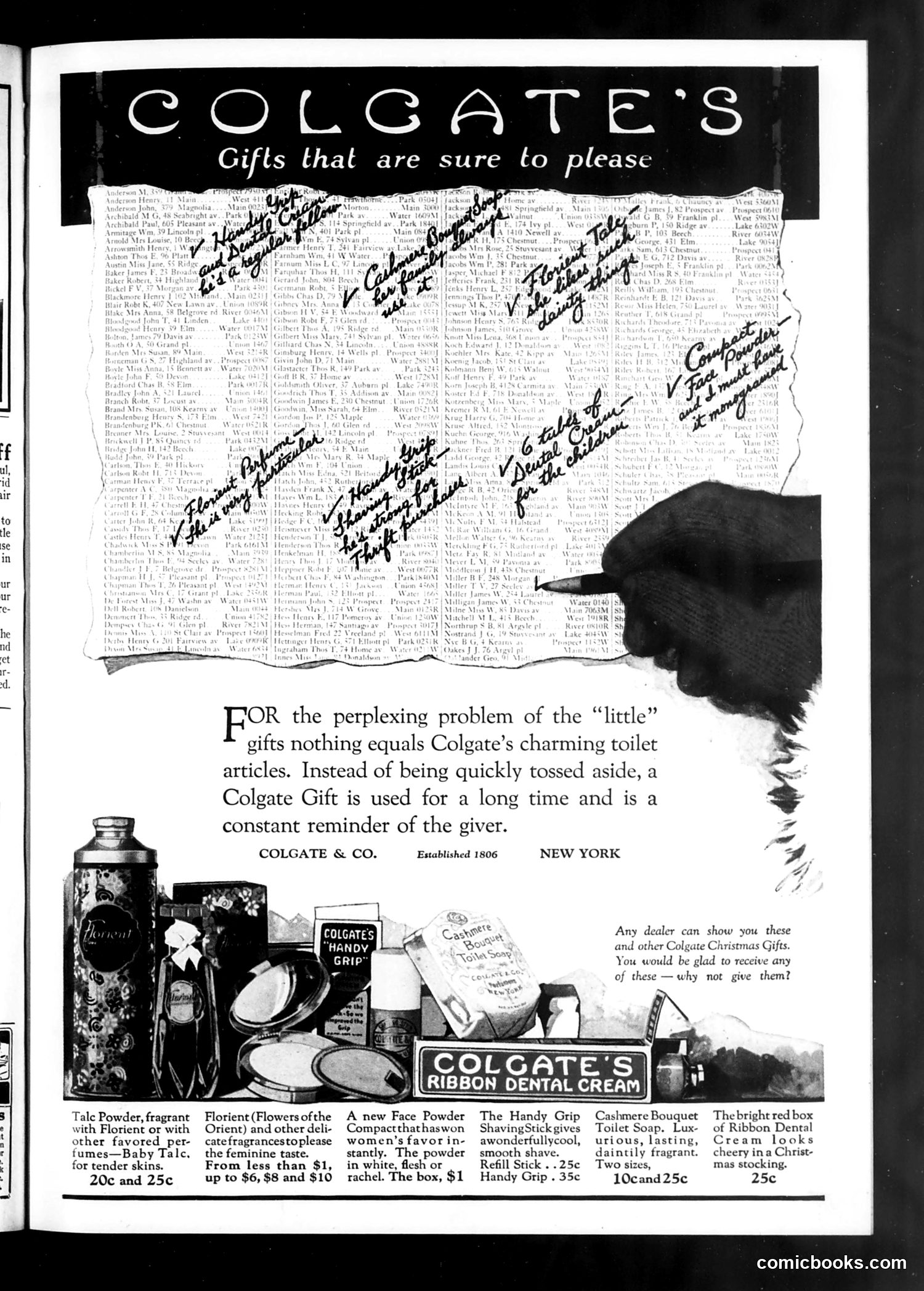
This is **not a cartoon or satire page** — it's a Colgate & Co. advertisement from Life magazine's editorial section. The page advertises holiday gift sets of toiletries (talc powder, face powder, shaving cream, dental cream, and soap). The handwritten signatures overlaid on a directory or mailing list appear to be **endorsements or testimonials**, though the specific individuals are illegible in this reproduction. The advertisement's "joke" is gentle marketing humor: it addresses the problem of giving small, practical gifts by arguing that Colgate products are better than typical "little gifts" because they're used repeatedly, making them constant reminders of the giver's thoughtfulness. The imagery shows product boxes arranged as gift suggestions, particularly pitched for Christmas stockings (note the "bright red box" language and stocking reference). This represents early-20th-century consumer advertising strategy: positioning branded toilet articles as tasteful, practical gifts for the holidays.
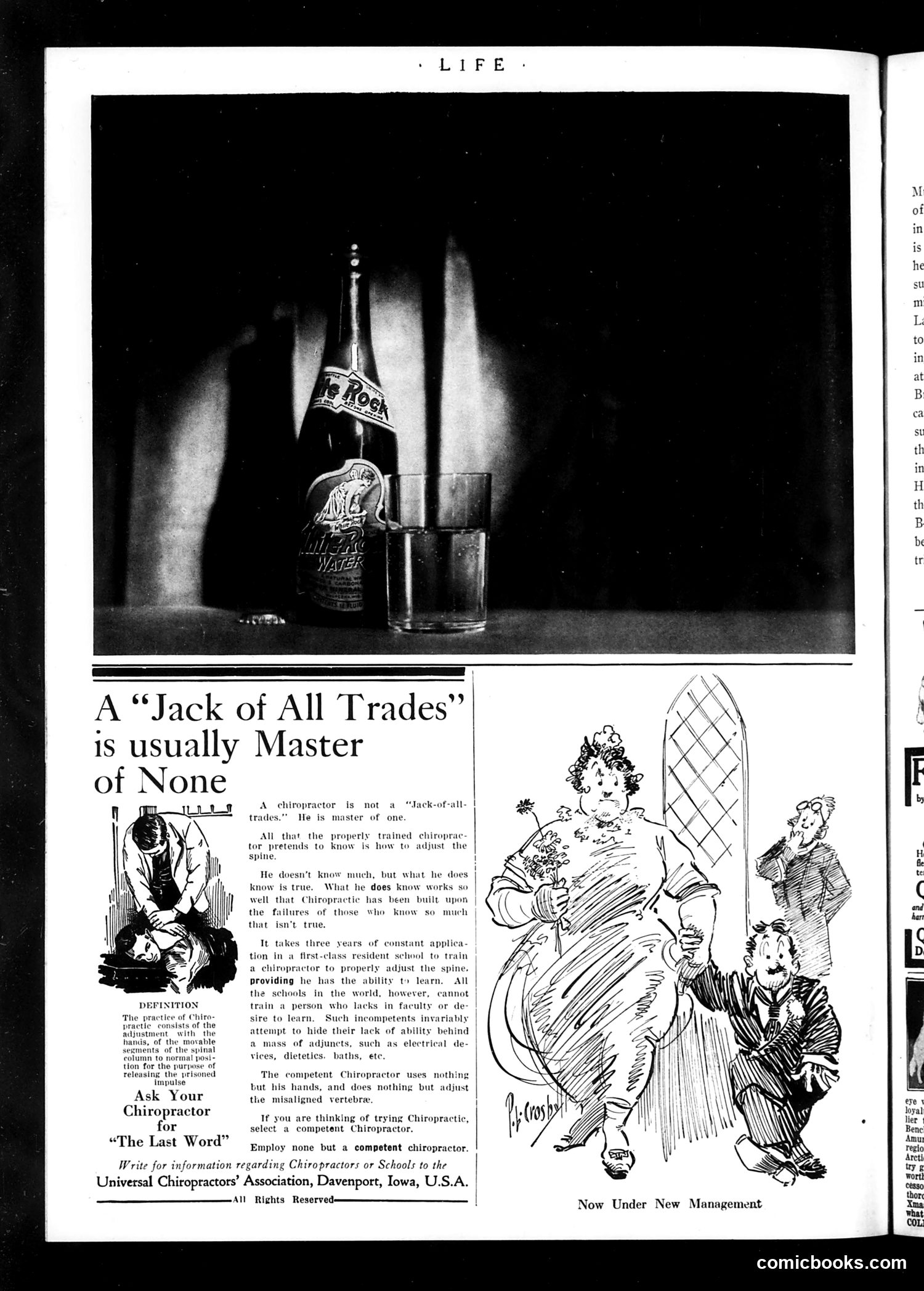
This page combines a chiropractor trade advertisement with satirical cartoons mocking incompetent practitioners. **The Advertisement (left):** The Universal Chiropractors' Association defends their profession against criticism that chiropractors are "jacks of all trades, masters of none." The ad argues that *competent* chiropractors specialize narrowly—using only their hands to adjust the spine—unlike untrained imposters who dabble in multiple treatments (electrical devices, diets, baths). The message: hire only certified practitioners. **The Cartoons (right):** The illustration labeled "Now Under New Management" appears to satirize a business or institution run by incompetent people. The caricatured figures suggest either financial mismanagement or leadership by unqualified individuals—likely commenting on broader 1920s concerns about fraudulent practitioners infiltrating various professions during a period of minimal regulation. Together, the page critiques how snake-oil operators damage legitimate fields, a common satirical theme in *Life* magazine during this era.
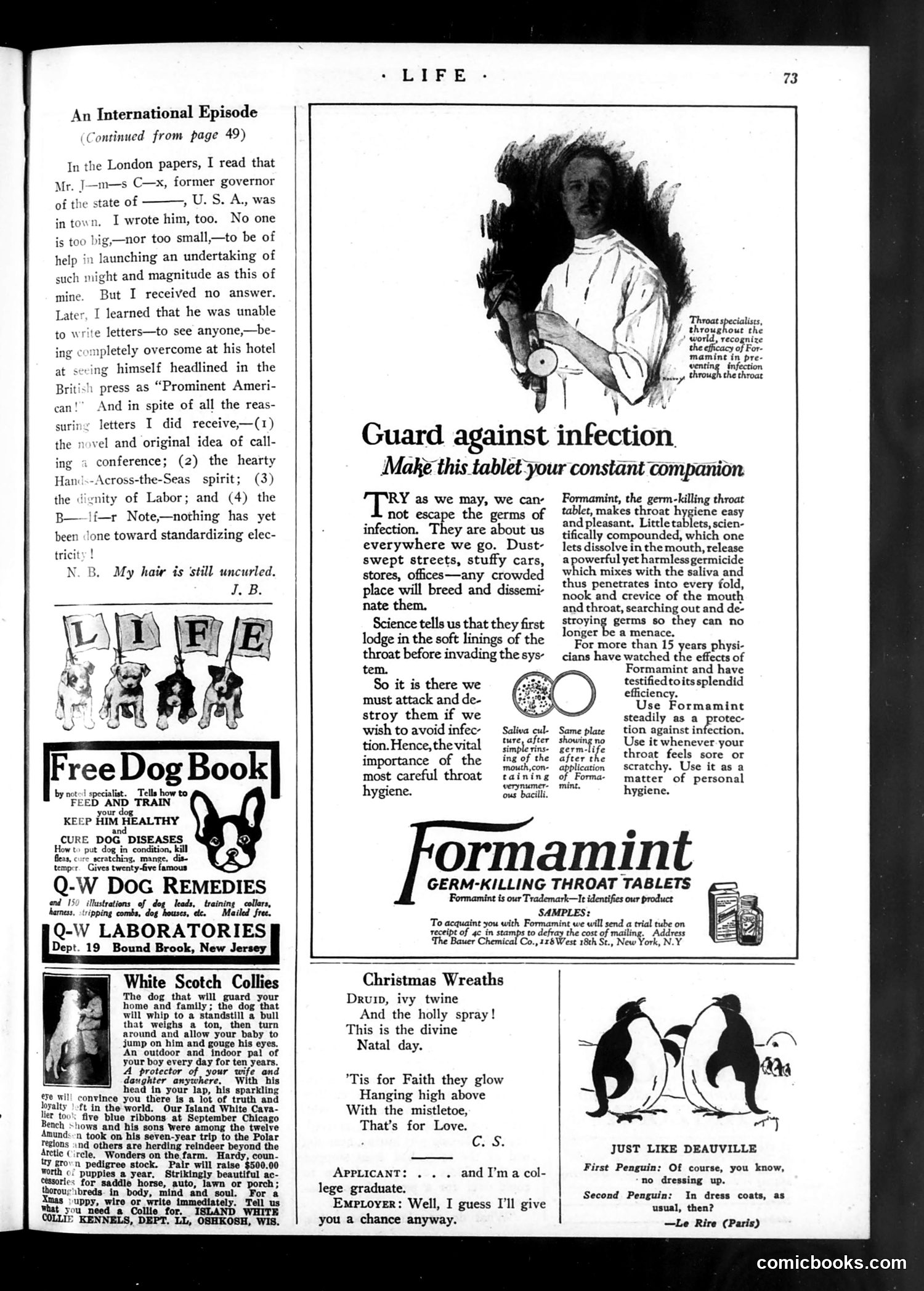
This page contains a satirical short story titled "An International Episode" (continued from an earlier section) about a writer attempting to organize some major undertaking—likely a conference or standardization effort. The humor centers on his failed attempt to secure support from a former U.S. governor named J——s C——x (name obscured), whom he learns was too overwhelmed by being called "Prominent American" in the British press to even write letters in response. The joke mocks both American vanity and international pretension. The remainder of the page consists of period advertisements: a dog training book, White Scotch Collie breeding services, and a Formamint throat tablet advertisement featuring medical endorsements. A humorous penguin cartoon about dressing appears at bottom. The obscured names and the note "My hair is still uncurled" suggest editorial redactions or inside jokes for contemporary readers that remain opaque today.
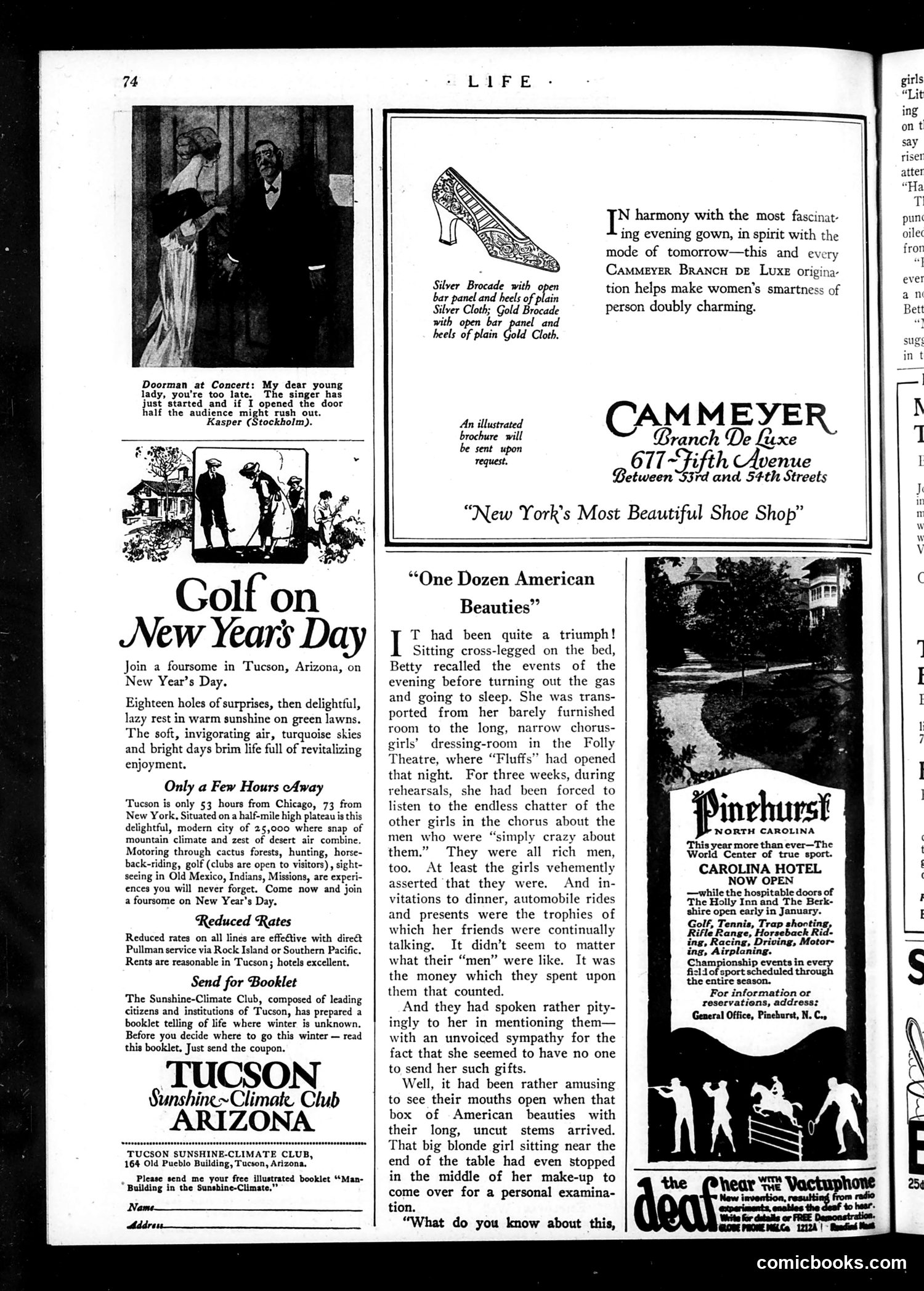
This page primarily contains **advertisements and a short humorous story**, rather than political satire. The small cartoon at top left is a music-hall joke: A doorman tells a late-arriving concertgoer she cannot enter because the singer has already started—if he opened the door, half the audience might rush out. The humor lies in the implied insult that the performance is so bad people would flee. The main text piece, "One Dozen American Beauties," is a social comedy about a chorus girl named Betty. She receives a bouquet of roses from an admirer, impressing her fellow chorus girls who are accustomed to receiving gifts from wealthy men. The story satirizes the materialistic attitudes of 1920s chorus girls, who measure male suitors primarily by spending power rather than character. Betty's flowers earn her unexpected social status among girls who previously pitied her lack of romantic attention. The remainder of the page consists of travel and luxury goods advertising (Tucson tourism, Cammeyer shoes, Carolina Hotel).
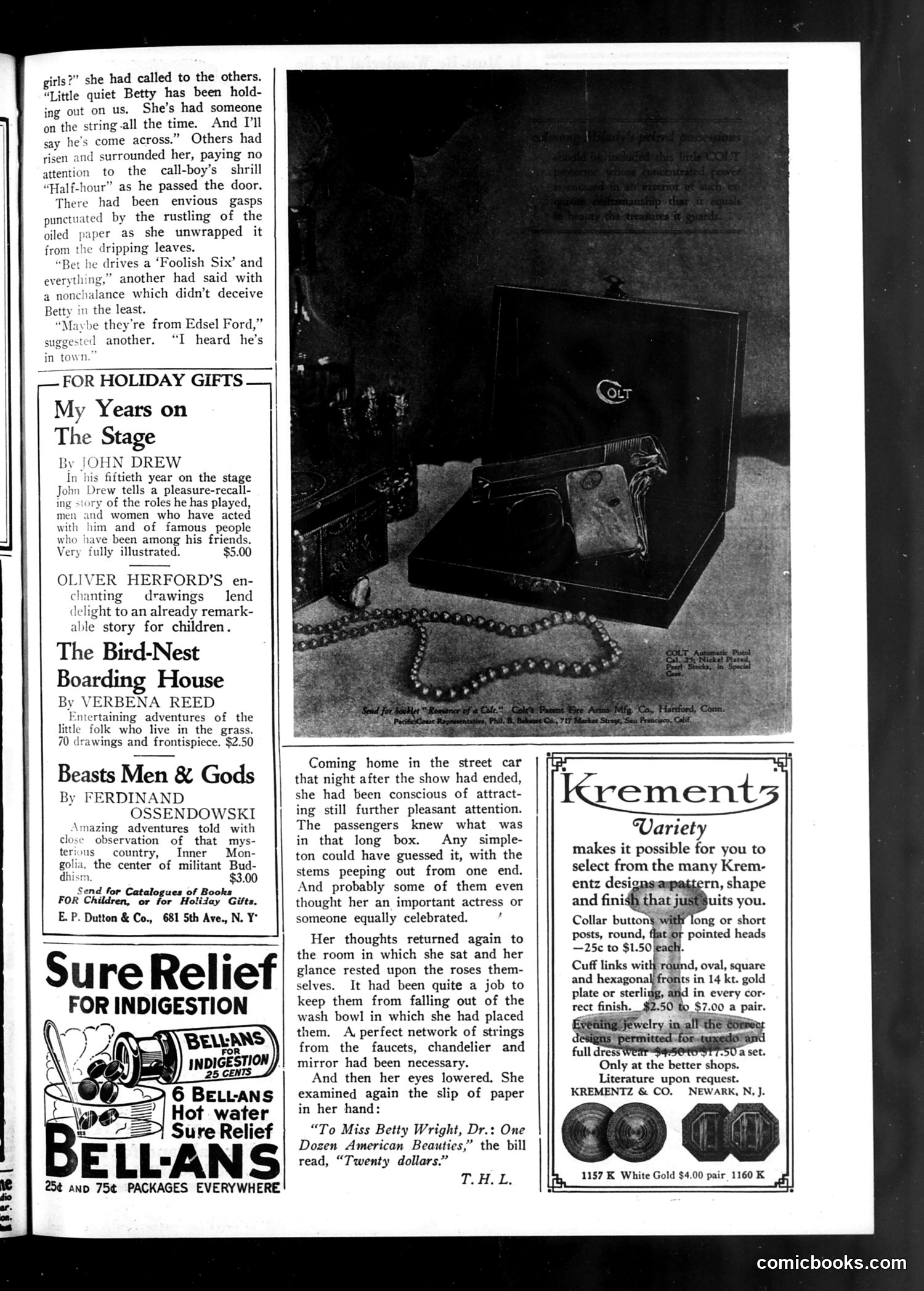
This page contains a narrative story excerpt about an actress named Betty who receives flowers (American Beauty roses) from an admirer, likely a wealthy or famous suitor. The other actresses speculate enviously about the sender's identity—guessing he drives a "Foolish Six" (a Ford Model T joke) or might be Edsel Ford himself, the automaker's son. The humor derives from the actresses' gossiping and the implication that Betty has attracted romantic attention from someone of considerable means or status. The remainder of the page consists of holiday book advertisements (including John Drew's theatrical memoir) and product ads (Krementz jewelry, Bell-ans indigestion remedy). These are typical of Life's mixed content format during this era. **Context for modern readers:** The "Foolish Six" reference is a period joke about Ford automobiles; Edsel Ford was a notable public figure. The scene reflects early 20th-century theatrical culture and romantic courtship rituals among performers.
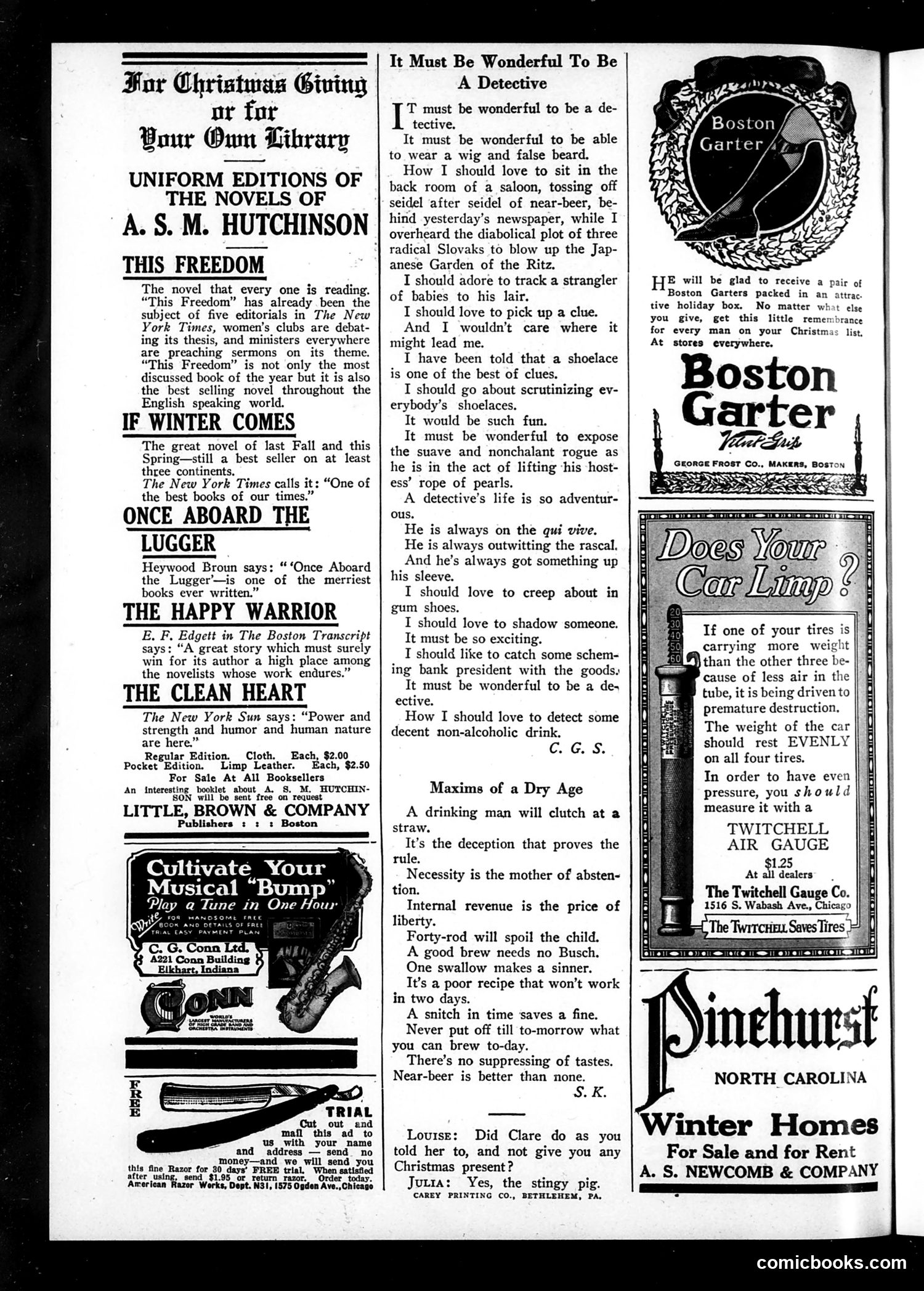
This page, primarily advertisements and short humor pieces, reflects early 1920s American life under Prohibition (1920-1933). **"It Must Be Wonderful To Be A Detective"** satirizes how Prohibition created a new detective industry to enforce alcohol laws. The author mockingly fantasizes about detective work—shadowing suspects, finding clues in shoelaces, catching criminals—but the joke's punch line reveals the real target: detecting "decent non-alcoholic drink." This mocks both the absurdity of Prohibition enforcement and the poor quality of legal substitutes like "near-beer." **"Maxims of a Dry Age"** directly lampoons Prohibition through wordplay. Phrases like "Necessity is the mother of abstention" and "Near-beer is better than none" are cynical reversals acknowledging that Prohibition failed—people still drank illegally ("Never put off till to-morrow what you can brew to-day"). The title "Dry Age" refers to Prohibition itself. Together, these pieces mock federal alcohol prohibition as unenforceable and ridiculous, a common satirical stance in *Life* during this era.
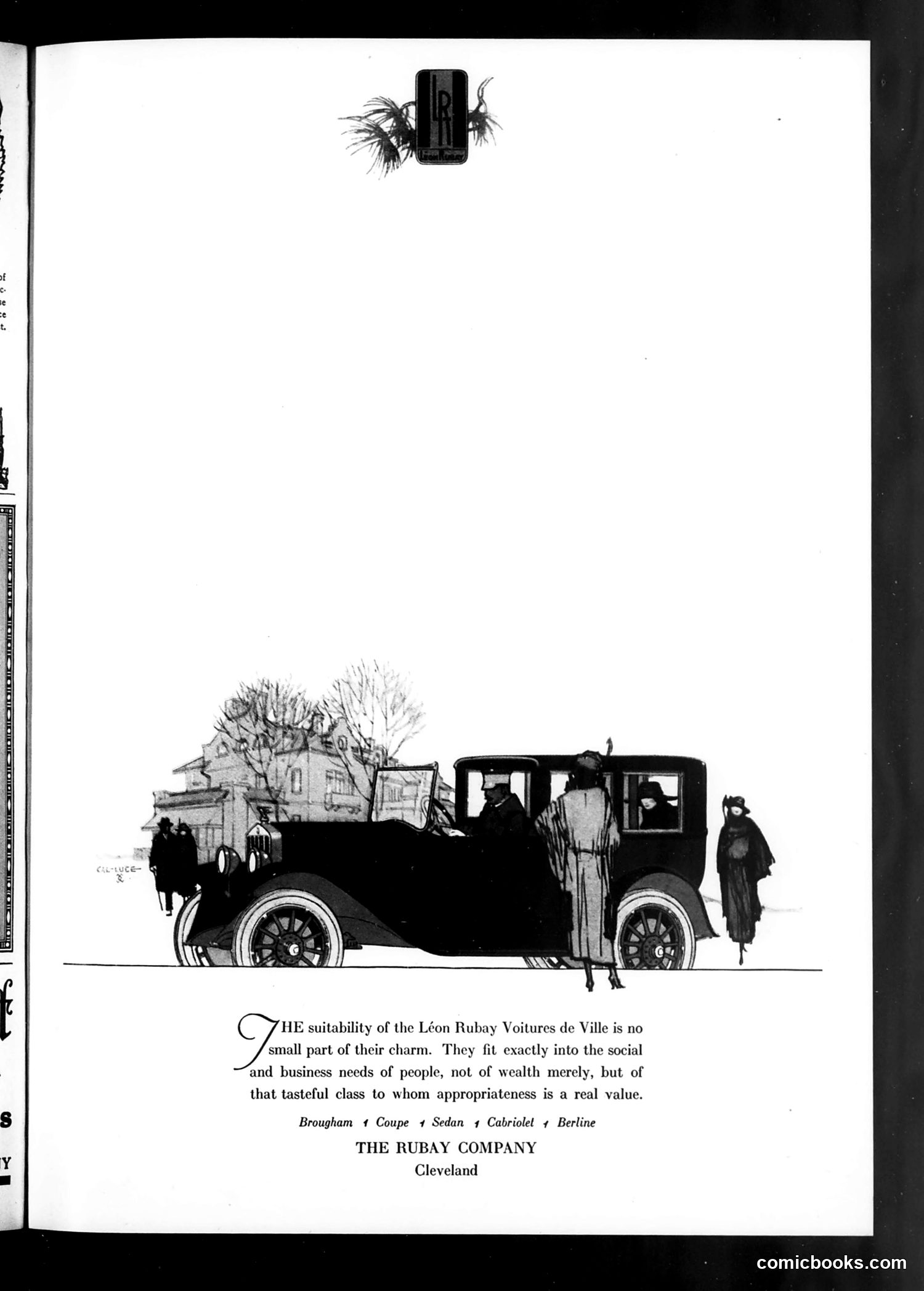
This is an advertisement for Léon Rubay automobiles, not political satire. The illustration shows a luxury car with well-dressed passengers and pedestrians, positioned as an aspirational lifestyle image. The text appeals to affluent, refined consumers by emphasizing that these vehicles suit the "social and business needs" of people of "tasteful class"—coded language targeting the wealthy elite who value propriety and status. The various body styles listed (Brougham, Coupe, Sedan, etc.) indicate different configurations for different occasions. The overall message is that owning a Rubay car signals one's belonging to a sophisticated, tasteful segment of society. This represents early-twentieth-century luxury marketing aimed at the upper class.
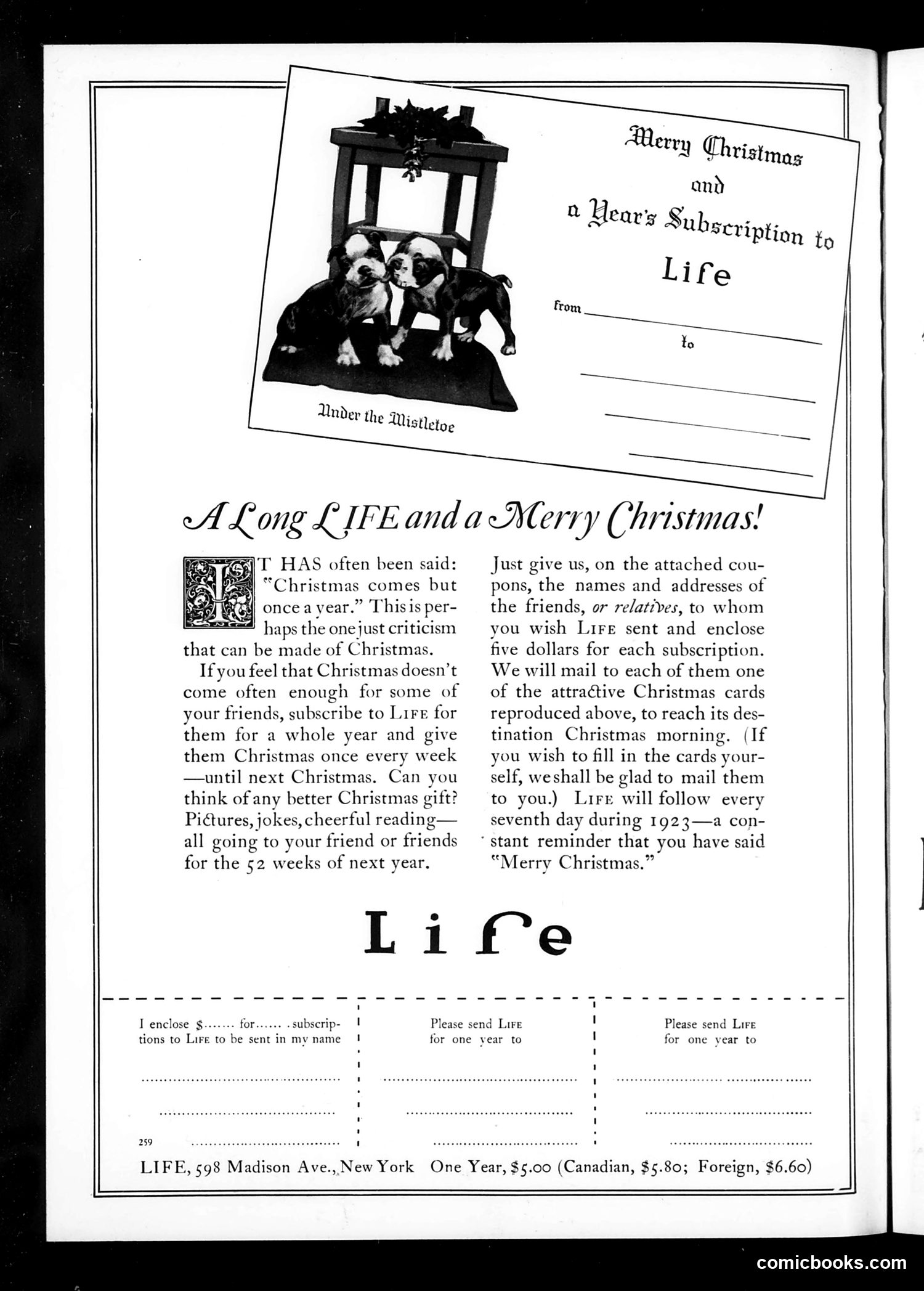
This is primarily a **gift subscription advertisement**, not political satire. The page promotes *Life* magazine subscriptions as Christmas presents. The charming illustration shows two bulldogs beneath mistletoe on a decorative chair—a sentimental, not satirical, image meant to appeal to readers' sentimentality about the holiday. The pitch is straightforward: since "Christmas comes but once a year," the ad argues that a year-long *Life* subscription provides weekly Christmas-like joy for 52 weeks. For $5 per subscription, a reader sends names and addresses; *Life* mails an attractive Christmas card to each recipient, then delivers the magazine every seventh day throughout 1923. This reflects early 20th-century magazine marketing that positioned weekly reading as an affordable luxury gift. The tone is cheerful and promotional rather than satirical—typical of the period's advertising copy blending sentiment with sales pitch.
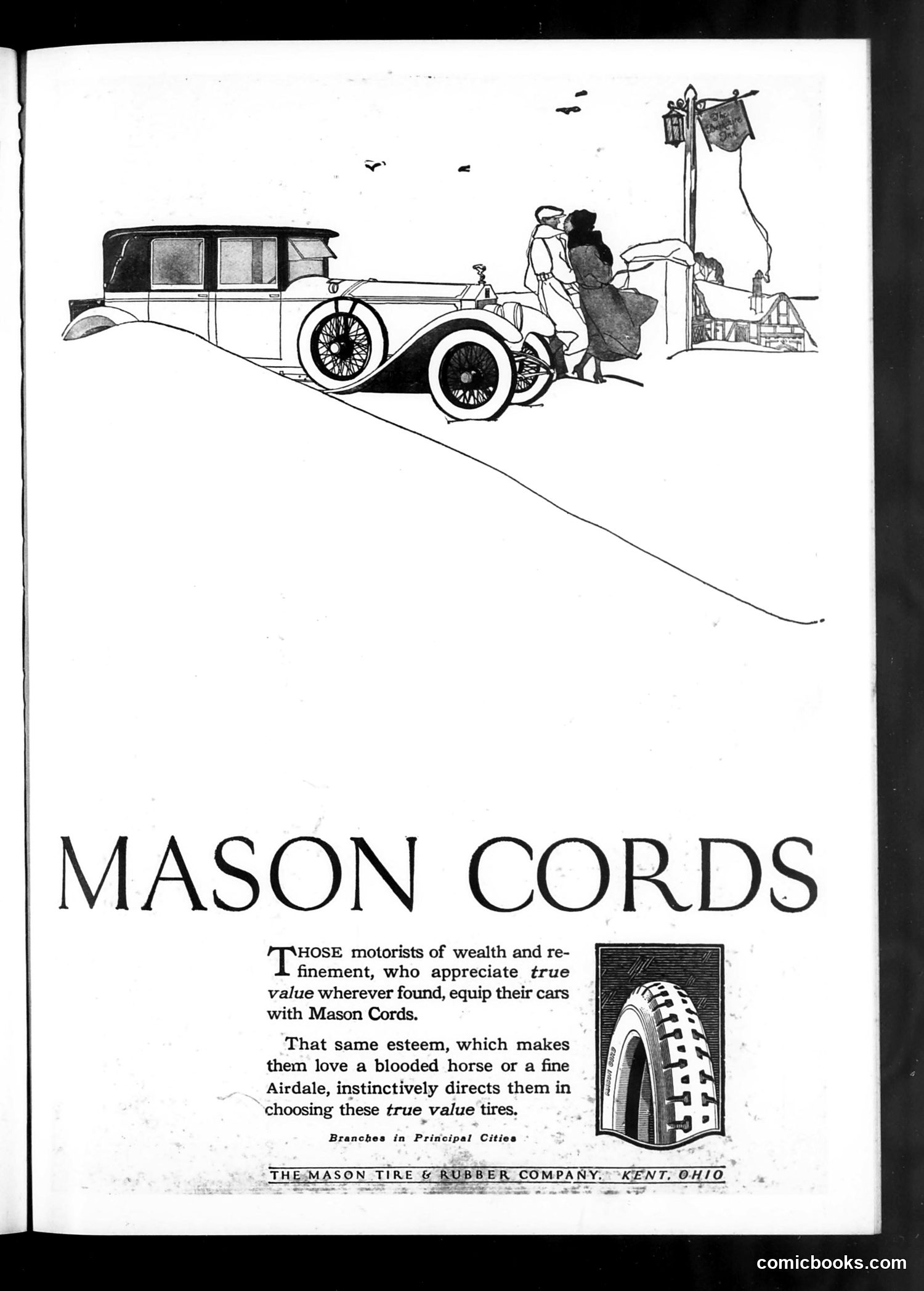
This is a **product advertisement**, not political satire. It's a Mason Tire & Rubber Company ad from Kent, Ohio, marketing Mason Cords tires to wealthy consumers. The ad uses a class-based appeal: it depicts affluent motorists (shown with a chauffeur and elegant companions at what appears to be a country club or resort) and argues that people who appreciate "true value" in luxury goods—fine horses, purebred dogs ("Airdale")—should naturally choose Mason Cords tires for their automobiles. The pitch is snobbish: quality taste in one domain (horses, dogs) supposedly translates to recognizing quality tires. It's essentially saying "discerning people choose Mason Cords," targeting Depression-era aspirational consumers. There's no satire here—Life magazine's pages contained substantial advertising alongside editorial content.
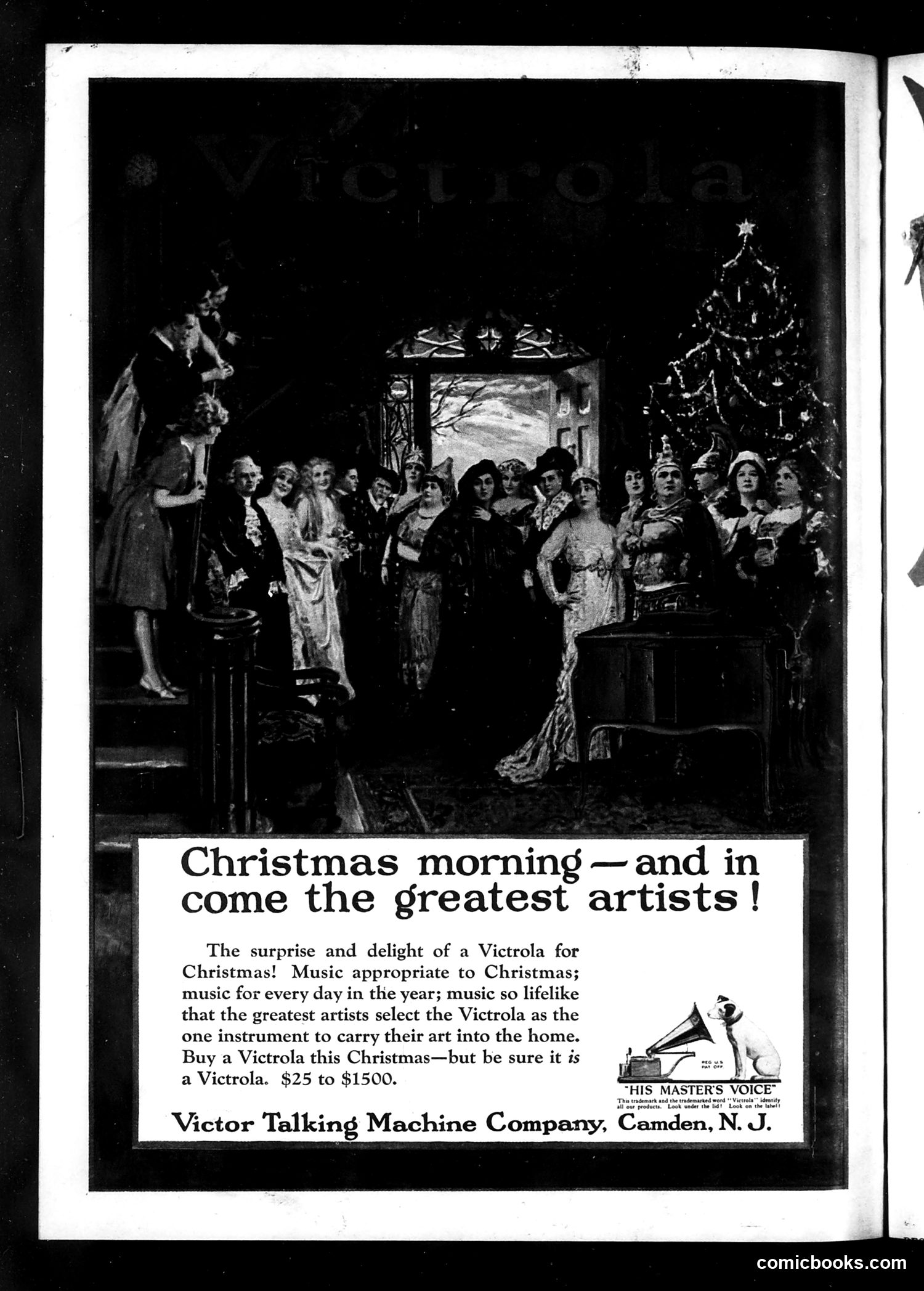
This is primarily a **Victrola phonograph advertisement**, not political satire. The image depicts an elegant Christmas morning scene where well-dressed guests gather around a decorated tree to hear recorded music from a Victrola player. The advertisement's appeal relies on the novelty and prestige of recorded music technology. It claims that "greatest artists select the Victrola," positioning the device as a luxury item that brings professional-quality performances into the home. The price range ($25-$1500) indicates it was marketed to middle and upper-class consumers. The satirical element, if any, is subtle—the ad gently mocks the aspirational desire to access "high culture" through consumer purchase, though this wasn't the advertisement's explicit intent. The Victrola was genuinely revolutionary technology for the era, and this represents straightforward product promotion rather than social commentary.