
Life, 1922-12-07 · page 30 of 80
Life — December 7, 1922 — page 30: what you’re looking at
What you’re looking at
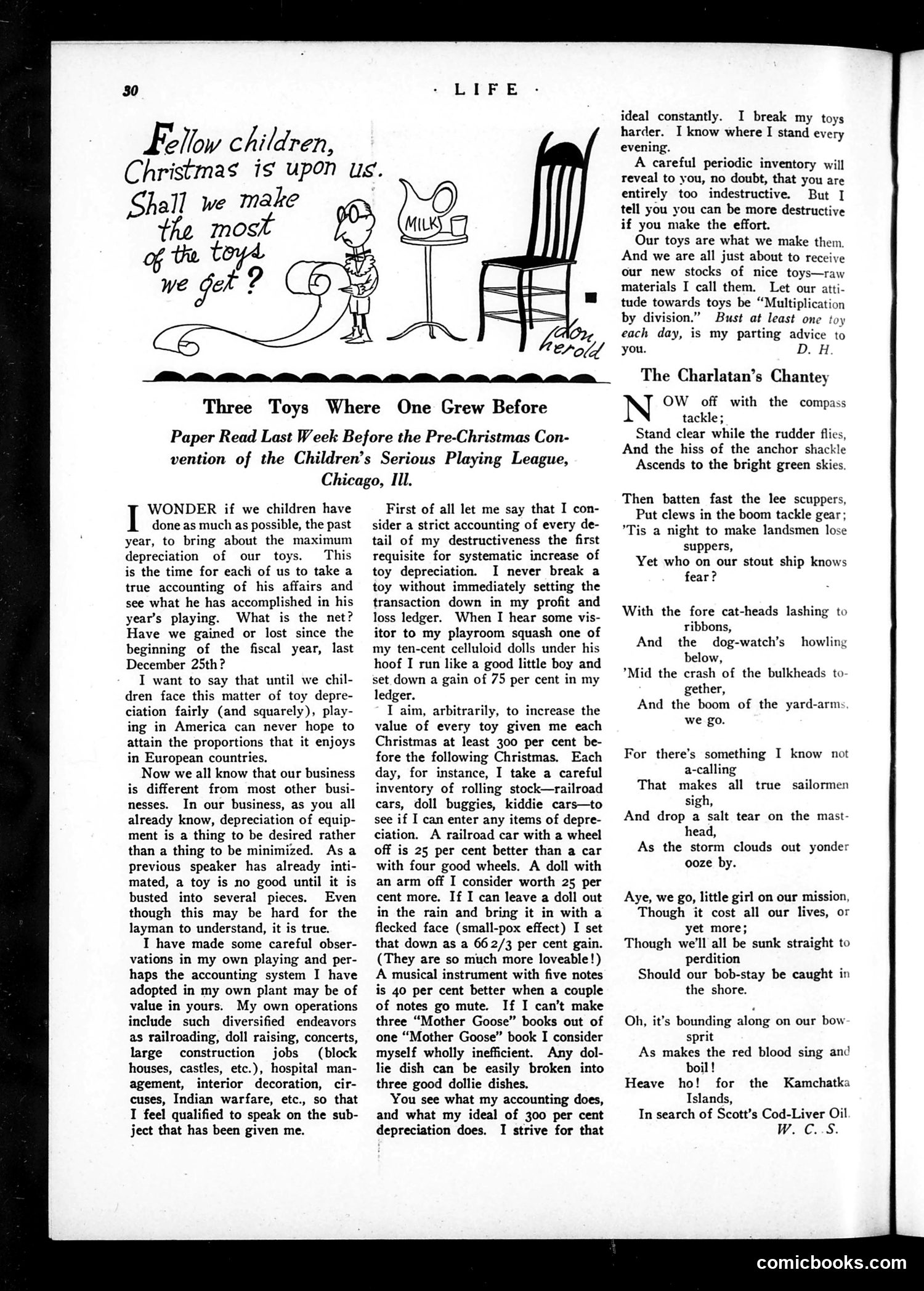
This page satirizes the American business culture of the early 20th century by having a child deliver a mock-corporate speech about toy destruction. The humor works through absurdist inversion: the speaker treats breaking toys as a legitimate accounting practice, using formal business language ("depreciation," "profit and loss ledger," "inventory") to describe what is actually just playing roughly. The satire targets American capitalism's obsession with systematic efficiency and cost accounting. By applying adult corporate logic to children's play—where "depreciation" is actually desirable—Life mocks the era's faith in quantifying and optimizing everything through ledgers and metrics. The accompanying poem "The Charlatan's Chantey" appears unrelated, suggesting this is a magazine page mixing editorial content. The title references a Chicago children's organization, grounding the satire in contemporary institutional culture.
📄 Transcribed text from this page (OCR, searchable)
Machine-transcribed from the original scan — historical spelling and the odd misread are preserved.
30 Fellow children, Christmas is upon us. Shall we make henty Three Toys Where One Grew Before Paper Read Last Week Before the Pre-Christmas Con- vention of the Children’s Serious Playing League, Chicago, Ill. WONDER if we children have done as much as possible, the past year, to bring about the maximum depreciation of our toys. This is the time for eacli of us to take a true accounting of his affairs and see what he has accomplished in his year’s playing. What is the net? Have we gained or lost since the beginning of the fiscal year, last December 25th? I want to say that until we chil- dren face this matter of toy depre- ciation fairly (and squarely), play- ing in America can never hope to attain the proportions that it enjoys in European countries. Now we all know that our business is different from most other busi- nesses. In our business, as you all already know, depreciation of equip- ment is a thing to be desired rather than a thing to be minimized. As a previous speaker has already inti- mated, a toy is no good until it is busted into several pieces. Even though this may be hard for the layman to understand, it is true. I have made some careful obser- vations in my own playing and per- haps the accounting system I have adopted in my own plant may be of value in yours. My own operations include such diversified endeavors as railroading, doll raising, concerts, large construction jobs (block houses, castles, etc.), hospital man- agement, interior decoration, cir- cuses, Indian warfare, etc., so that I feel qualified to speak on the sub- ject that has been given me. First of all let me say that I con- sider a strict accounting of every de- tail of my destructiveness the first requisite for systematic increase of toy depreciation. I never break a toy without immediately setting the transaction down in my profit and loss ledger. When I hear some vis- itor to my playroom squash one of my ten-cent celluloid dolls under his hoof I run like a good little boy and set down a gain of 75 per cent in my ledger. I aim, arbitrarily, to increase the value of every toy given me each Christmas at least 300 per cent be- fore the following Christmas. Each day, for instance, I take a careful inventory of rolling stock—railroad cars, doll buggies, kiddie cars—to see if I can enter any items of depre- ciation. A railroad car with a wheel off is 25 per cent better than a car with four good wheels. A doll with an arm off I consider worth 25 per cent more. If I can leave a doll out in the rain and bring it in with a flecked face (small-pox effect) I set that down as a 66 2/3 per cent gain. (They are so much more loveable!) A musical instrument with five notes is 40 per cent better when a couple of notes go mute. If I can’t make three “Mother Goose” books out of one “Mother Goose” book I consider myself wholly inefficient. Any dol- lie dish can be easily broken into three good dollie dishes. You see what my accounting does, and what my ideal of 300 per cent depreciation does. I strive for that ideal constantly. I break my toys harder. I know where I stand every evening. A careful periodic inventory will reveal to you, no doubt, that you are entirely too indestructive. But I tell you you can be more destructive if you make the effort. Our toys are what we make them, And we are all just about to receive our new stocks of nice toys—raw materials I call them. Let our atti- tude towards toys be “Multiplication by division.” Bust at least one toy each day, is my parting advice to you. D.#H The Charlatan’s Chantey OW off with the compass tackle; Stand clear while the rudder flies, And the hiss of the anchor shackle Ascends to the bright green skies. Then batten fast the lee scuppers, Put clews in the boom tackle gear; ’Tis a night to make landsmen lose suppers, ‘Yet who on our stout ship knows fear? With the fore cat-heads lashing to ribbons, the dog-watch’s below, ’Mid the crash of the bulkheads to gether, And the boom of the yard-arm we go. And howling For there’s something I know not a-calling That makes all sigh, And drop a salt tear on the mast- head, As the storm clouds out yonder ooze by. true sailormen Aye, we go, little girl on our mission, Though it cost all our lives, or yet more; Though we'll all be sunk straight to perdition Should our bob-stay be caught in the shore. Oh, it’s bounding along on our bow sprit As makes the red blood sing and boil! Heave ho! for Islands, In search of Scott’s Cod-Liver Oil W. C..S. the Kamchatka comicbooks.com