
Life, 1922-12-07 · page 36 of 80
Life — December 7, 1922 — page 36: what you’re looking at
What you’re looking at
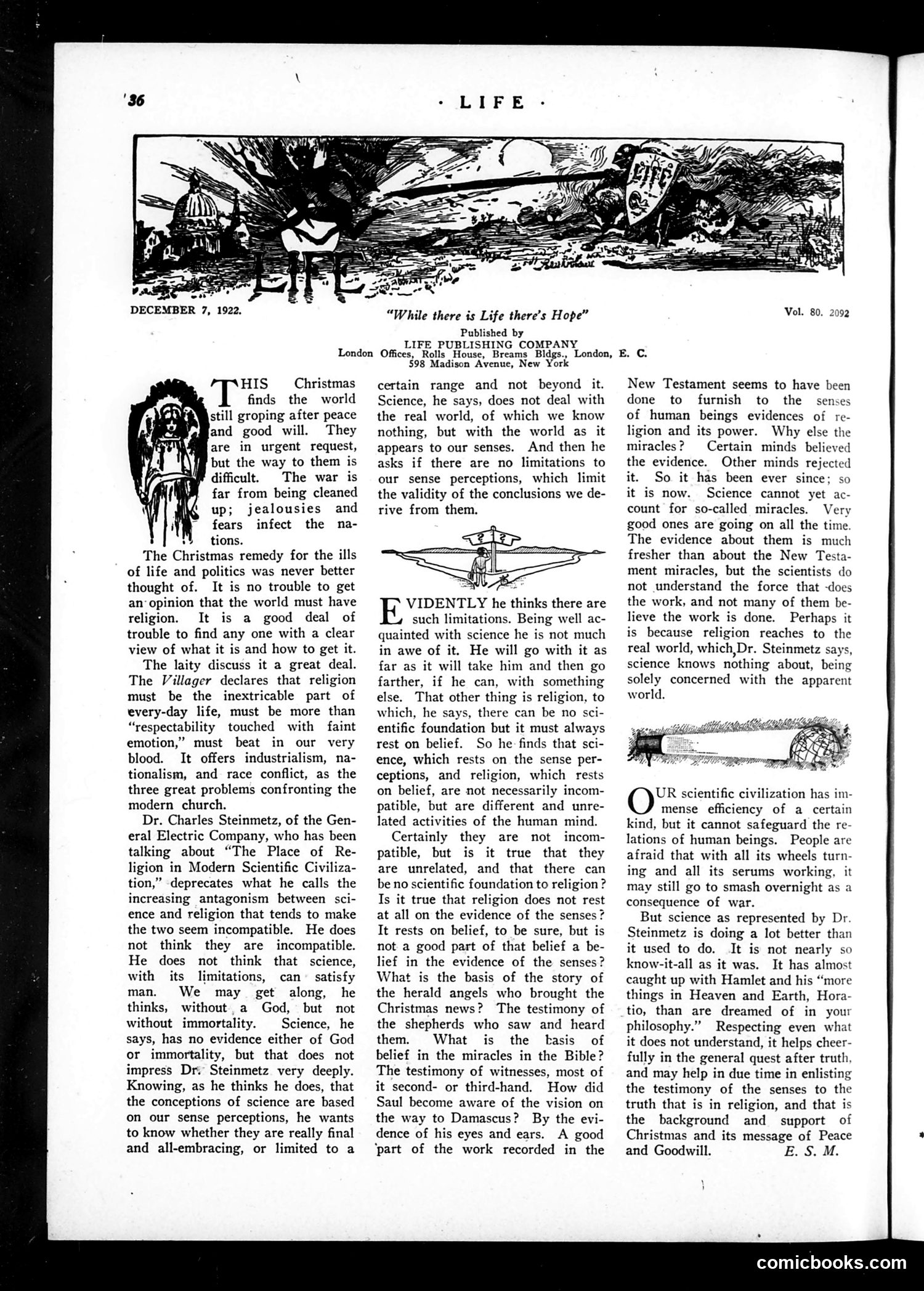
This editorial page discusses the tension between science and religion in post-WWI society. The article features commentary by Dr. Charles Steinmetz of General Electric, who argues that science and religion need not be incompatible—science addresses what our senses perceive, while religion rests on belief and addresses deeper questions like immortality that science cannot answer. The author challenges Steinmetz's neat separation, arguing that religion itself relies on sensory evidence: biblical miracles were witnessed by human eyes and ears, the Christmas story depends on shepherds' testimony. The piece reflects 1920s anxieties about modernism threatening traditional faith, presenting religion as necessary for addressing post-war social problems (industrialism, nationalism, racial conflict) that pure science cannot solve. The cartoon's meaning remains unclear from the image alone.
📄 Transcribed text from this page (OCR, searchable)
Machine-transcribed from the original scan — historical spelling and the odd misread are preserved.
DECEMBER 7, 1922. “While there is Life there’s Hope” Published by LIFE PUBLISHING COMPANY Vol. 80. 2092 London Offices, Rolls House, Breams Bldgs., London, E. C. HIS — Christmas finds the world still groping after peace and good will. They are in urgent request, but the way to them is difficult. The war is far from being cleaned up; jealousies and fears infect the na- +) — tions. The Christmas remedy for the ills of life and politics was never better thought of. It is no trouble to get an‘opinion that the world must have religion. It is a good deal of trouble to find any one with a clear view of what it is and how to get it. The laity discuss it a great deal. The Villager declares that religion must be the inextricable part of every-day life, must be more than “respectability touched with faint emotion,” must beat in our very blood. It offers industrialism, na- tionalism, and race conflict, as the three great problems confronting the modern church. Dr. Charles Steinmetz, of the Gen- eral Electric Company, who has been talking about “The Place of Re- ligion in Modern Scientific Civiliza- tion,” deprecates what he calls the increasing antagonism between sci- ence and religion that tends to make the two seem incompatible. He does not think they are incompatible. He does not think that science, with its limitations, can © satisfy man. We may get along, he thinks, without, a God, but not without immortality. Science, he says, has no evidence either of God or immortality, but that does not impress Dr. Steinmetz very deeply. Knowing, as he thinks he does, that the conceptions of science are based on our sense perceptions, he wants to know whether they are really final and all-embracing, or limited to a 598 Madison Avenue, New York certain range and not beyond it. Science, he says, does not deal with the real world, of which we know nothing, but with the world as it appears to our senses. And then he asks if there are no limitations to our sense perceptions, which limit the validity of the conclusions we de- rive from them. SUAS VIDENTLY he thinks there are such limitations. Being well ac- quainted with science he is not much in awe of it. He will go with it as far as it will take him and then go farther, if he can, with something else. That other thing is religion, to which, he says, there can be no sci- entific foundation but it must always rest on belief. So he-finds that sci- ence, which rests on the sense per- ceptions, and religion, which rests on belief, are not necessarily incom- patible, but are different and unre- lated activities of the human mind. Certainly they are not incom- patible, but is it true that they are unrelated, and that there can be no scientific foundation to religion ? Is it true that religion does not rest at all on the evidence of the senses? It rests on belief, to be sure, but is not a good part of that belief a be- lief in the evidence of the senses? What is the basis of the story of the herald angels who brought the Christmas news? The testimony of the shepherds who saw and heard them. What is the tasis of belief in the miracles in the Bible? The testimony of witnesses, most of it second- or third-hand. How did Saul become aware of the vision on the way to Damascus? By the evi- dence of his eyes and ears. A good ‘part of the work recorded in the New Testament seems to have been done to furnish to the senses of human beings evidences of re- ligion and its power. Why else the miracles? Certain minds believed the evidence. Other minds rejected it. So it has been ever since; so it is now. Science cannot yet ac- count for so-called miracles. Very good ones are going on all the time. The evidence about them is much fresher than about the New Testa- ment miracles, but the scientists do not understand the force that -does the work, and not many of them be- lieve the work is done. Perhaps it is because religion reaches to the real world, which,Dr. Steinmetz says, science knows nothing about, being solely concerned with the apparent world. UR scientific civilization has im- mense efficiency of a certain kind, but it cannot safeguard the re- lations of human beings. People are afraid that with all its wheels turn- ing and all its serums working, it may still go to smash overnight as a consequence of war. But science as represented by Dr. Steinmetz is doing a lot better than it used to do. It is not nearly so know-it-all as it was. It has almost caught up with Hamlet and his “more things in Heaven and Earth, Hora- tio, than are dreamed of in your philosophy.” Respecting even what it does not understand, it helps cheer- fully in the general quest after truth, and may help in due time in enlisting the testimony of the senses to the truth that is in religion, and that is the background and support of Christmas and its message of Peace and Goodwill. E. S. M. comicbooks.com