
Life, 1922-12-07 · page 58 of 80
Life — December 7, 1922 — page 58: what you’re looking at
What you’re looking at
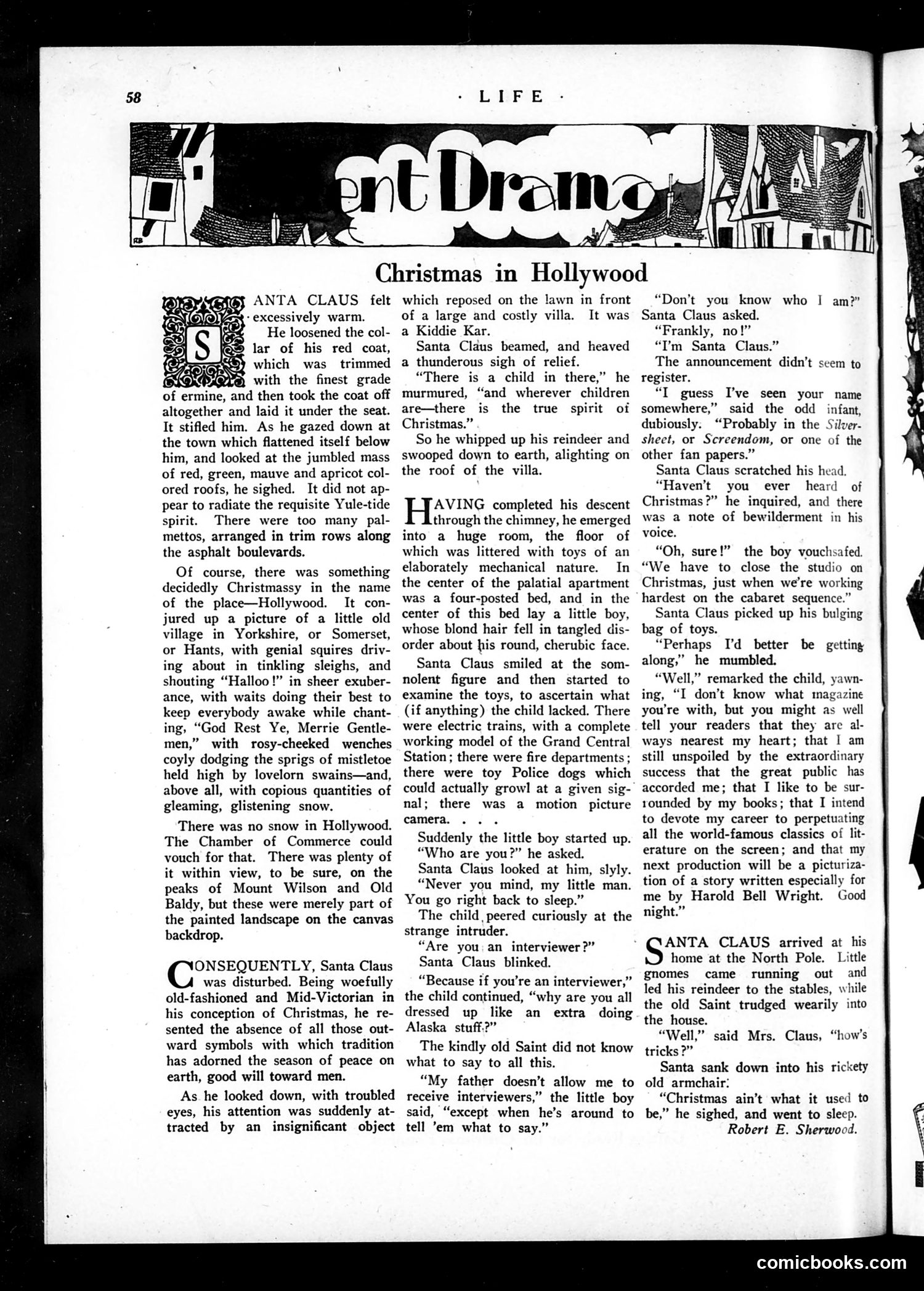
This story satirizes 1920s Hollywood's disconnection from traditional American values. Santa Claus, representing old-fashioned Christmas tradition, descends on a wealthy Hollywood villa expecting to find genuine childhood wonder. Instead, he discovers a precocious child surrounded by expensive, mechanized toys (electric trains, motion picture cameras, toy police dogs). The central joke: the child doesn't recognize Santa Claus and mistakes him for a movie "extra" or studio "interviewer." The boy's parents control even his conversations with visitors—he can't speak freely without parental approval. The satire mocks Hollywood's materialism, artificiality (the snowy mountain backdrop), and how the entertainment industry corrupts childhood innocence. The "painted landscape" and elaborate mechanical toys replace genuine Christmas spirit. The child's jaded, worldly attitude—treating Santa as just another industry functionary—illustrates how Hollywood wealth and show-business culture have replaced traditional values and authentic childhood.
📄 Transcribed text from this page (OCR, searchable)
Machine-transcribed from the original scan — historical spelling and the odd misread are preserved.
Christmas in Hollywood ANTA CLAUS felt ‘excessively warm. He loosened the col- lar of his red coat, which was trimmed with the finest grade of ermine, and then took the coat off altogether and laid it under the seat. It stifled him. As he gazed down at the town which flattened itself below him, and looked at the jumbled mass of red, green, mauve and apricot col- ored roofs, he sighed. It did not ap- pear to radiate the requisite Yule-tide spirit. There were too many pal- mettos, arranged in trim rows along the asphalt boulevards. Of course, there was something decidedly Christmassy in the name of the place—Hollywood. It con- jured up a picture of a little old village in Yorkshire, or Somerset, or Hants, with genial squires driv- ing about in tinkling sleighs, and shouting “Halloo!” in sheer exuber- ance, with waits doing their best to keep everybody awake while chant- ing, “God Rest Ye, Merrie Gentle- men,” with rosy-cheeked wenches coyly dodging the sprigs of mistletoe held high by lovelorn swains—and, above all, with copious quantities of gleaming, glistening snow. There was no snow in Hollywood. The Chamber of Commerce could vouch for that. There was plenty of it within view, to be sure, on the peaks of Mount Wilson and Old Baldy, but these were merely part of the painted landscape on the canvas backdrop. ONSEQUENTLY, Santa Claus was disturbed. Being woefully old-fashioned and Mid-Victorian in his conception of Christmas, he re- sented the absence of all those out- ward symbols with which tradition has adorned the season of peace on earth, good will toward men. As he looked down, with troubled eyes, his attention was suddenly at- tracted by an insignificant object which reposed on the lawn in front of a large and costly villa. It was a Kiddie Kar. Santa Claus beamed, and heaved a thunderous sigh of relief. “There is a child in there,” he murmured, “and wherever children are—there is the true spirit of Christmas.” So he whipped up his reindeer and swooped down to earth, alighting on the roof of the villa. AVING completed his descent through the chimney, he emerged into a huge room, the floor of which was littered with toys of an elaborately mechanical nature. In the center of the palatial apartment was a four-posted bed, and in the center of this bed lay a little boy, whose blond hair fell in tangled dis- order about his round, cherubic face. Santa Claus smiled at the som- nolent figure and then started to examine the toys, to ascertain what (if anything) the child lacked. There were electric trains, with a complete working model of the Grand Central Station ; there were fire departments ; there were toy Police dogs which could actually growl at a given sig- nal; there was a motion picture camera. . . . Suddenly the little boy started up. “Who are you?” he asked. Santa Claus looked at him, slyly. “Never you mind, my little man. You go right back to sleep.” The child peered curiously at the strange intruder. “Are you. an interviewer?” Santa Claus blinked. “Because if you’re an interviewer,” the child continued, “why are you all dressed up like an extra doing Alaska stuff?” The kindly old Saint did not know what to say to all this. “My father doesn’t allow me to receive interviewers,” the little boy said, “except when he’s around to tell ’em what to say.” “Don’t you know who | am?” Santa Claus asked. “Frankly, no!” “I’m Santa Claus.” The announcement didn’t seem to register. “I guess I’ve seen your name somewhere,” said the odd infant, dubiously. “Probably in the Silver- sheet, or Screendom, or one of the other fan papers.” Santa Claus scratched his head. “Haven't you ever heard of Christmas?” he inquired, and there was a note of bewilderment in his voice. “Oh, sure!” the boy vouchsafed. “We have to close the studio on Christmas, just when we're working hardest on the cabaret sequence.” Santa Claus picked up his bulging bag of toys. “Perhaps I’d better be getting along,” he mumbled. “Well,” remarked the child, yawn- ing, “I don’t know what magazine you’re with, but you might as well tell your readers that they are al- ways nearest my heart; that I am still unspoiled by the extraordinary success that the great public has accorded me; that I like to be sur- rounded by my books; that I intend to devote my career to perpetuating all the world-famous classics of lit- erature on the screen; and that my next production will be a picturiza- tion of a story written especially for me by Harold Bell Wright. Good night.” ANTA CLAUS arrived at his home at the North Pole. Little gnomes came running out and led his reindeer to the stables, while the old Saint trudged wearily into the house. “Well,” said Mrs. Claus, “how’s tricks ?” Santa sank down into his rickety old armchair: “Christmas ain’t what it used to be,” he sighed, and went to sleep. Robert E. Sherwood. comicbooks.com