
A complete issue · 70 pages · 1917
Life — April 5, 1917
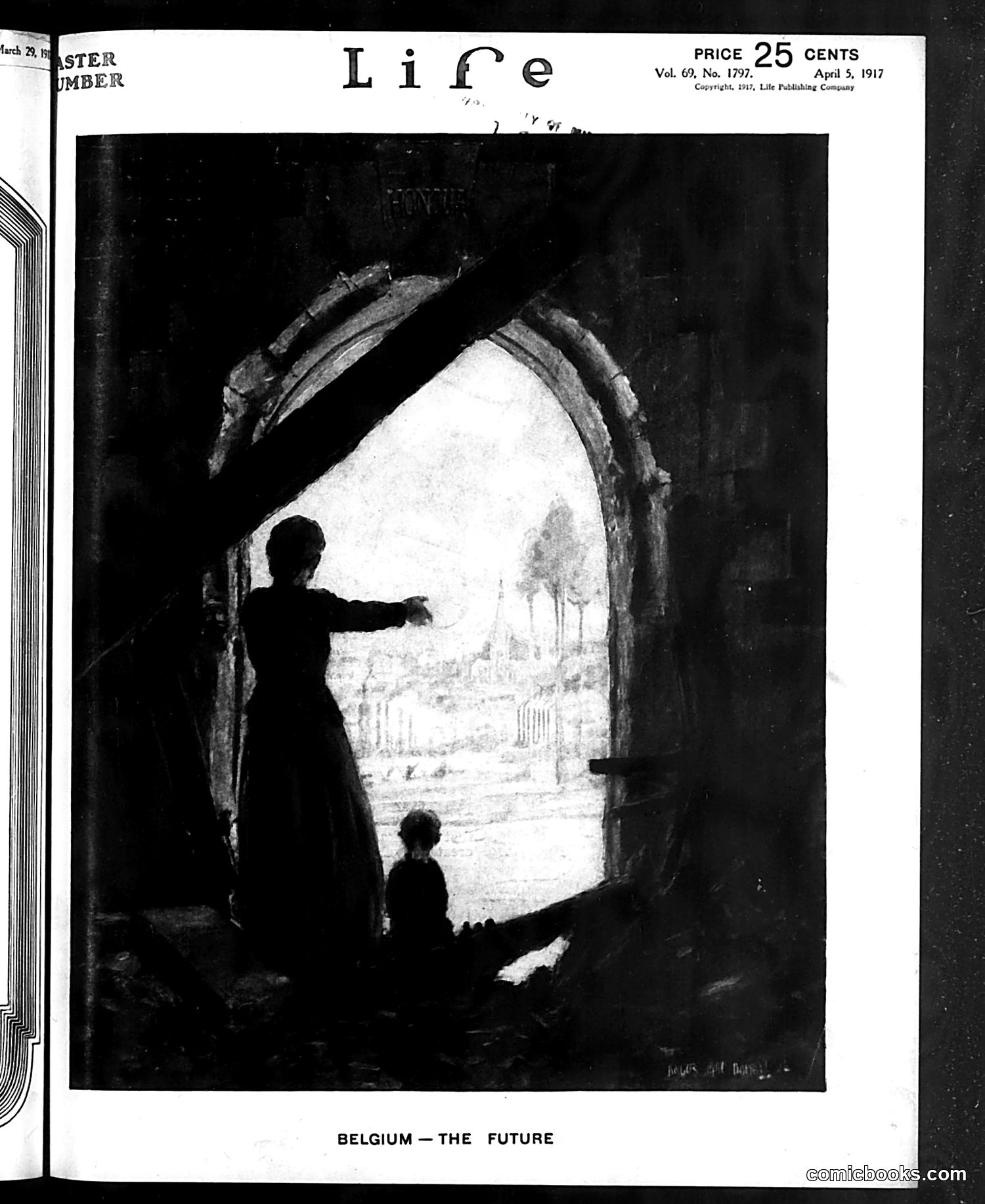
This illustration depicts two silhouetted figures—an adult and child—standing in a dark tunnel or bunker, gazing toward a bright but devastated landscape beyond. The title "Belgium — The Future" suggests commentary on Belgium's condition during World War I. Published just after America's April 1917 entry into WWI, this image likely reflects on Belgium's suffering under German occupation (1914-1918). The dark foreground represents the present darkness of occupation and war, while the bright but scarred landscape ahead symbolizes an uncertain future. The composition suggests cautious hope tempered by the reality of destruction, warning American readers of the war's devastating human costs on civilian populations.
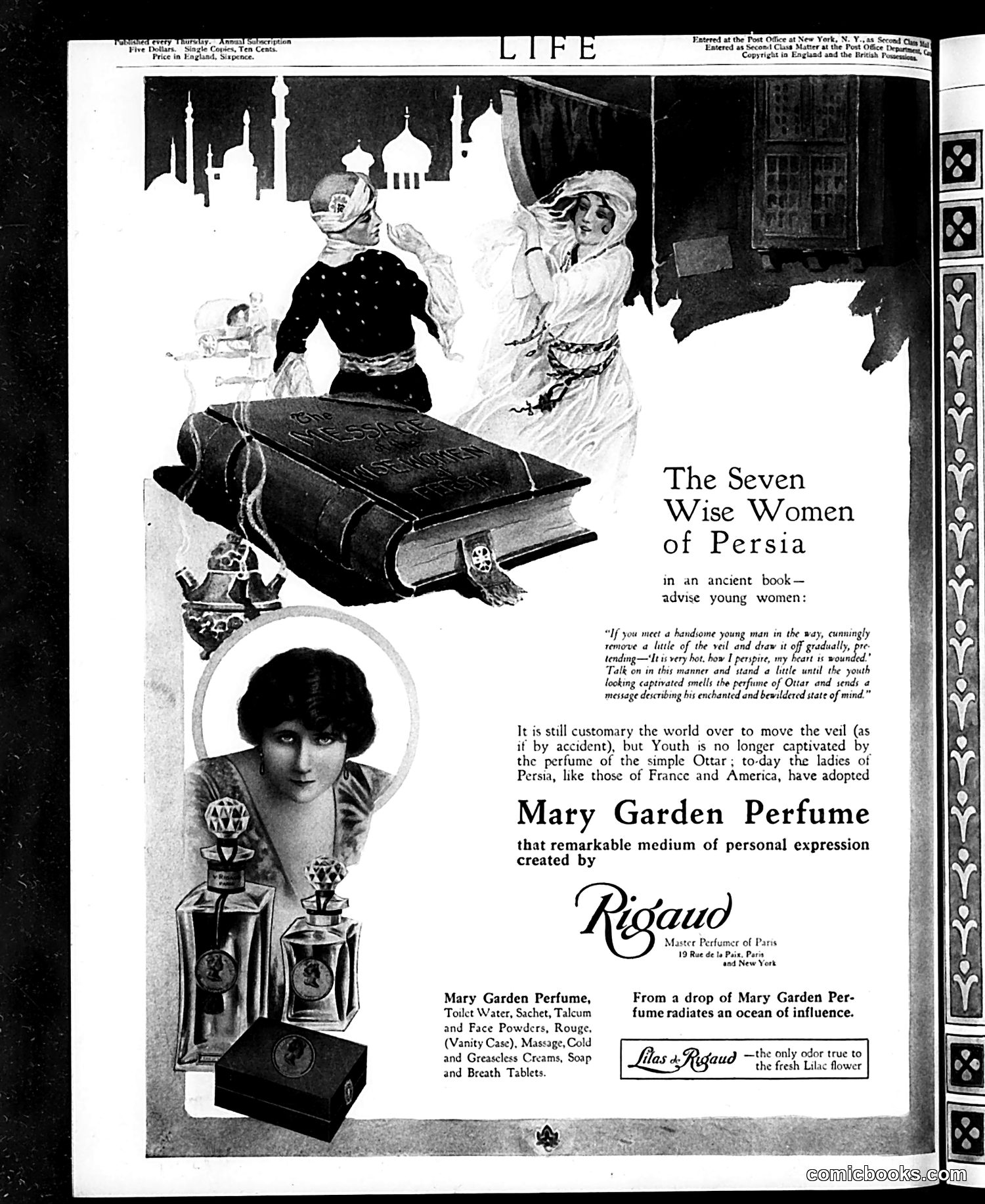
This page is primarily an **advertisement** for Mary Garden Perfume by Rigaud, not political satire. The ad uses "The Seven Wise Women of Persia" as a framing device—an ancient book supposedly advising young women on attracting men through veils and perfume. The satirical hook is the **social commentary**: the ad argues that modern women (particularly in France and America) have abandoned such old-fashioned tactics, replacing the "perfume of simple Ottar" with Mary Garden Perfume as their tool of personal expression and influence. The illustration shows two women in exotic dress above perfume bottles, playing on Orientalist fantasy rather than depicting actual Persian wisdom. The joke targets early 20th-century consumer culture and evolving gender dynamics—suggesting even "modern" women still use fragrance for social advantage, just packaged differently.
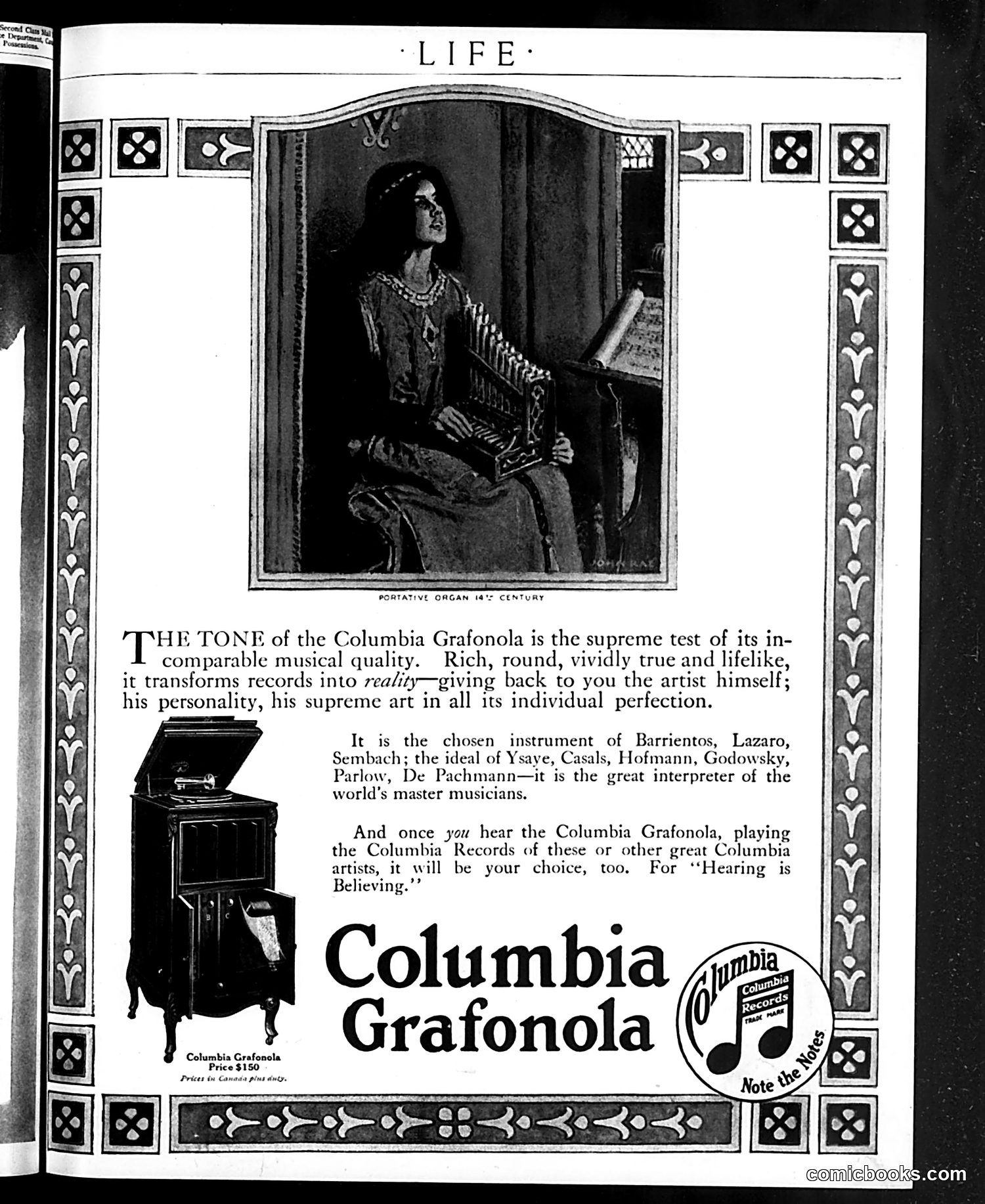
This is primarily a **Columbia Grafonola advertisement**, not political satire. The page features a glamorous photograph of a woman playing a portable organ (labeled "Portative Organ 14th Century"), positioned above promotional text for the grafonola—an early phonograph/record player priced at $150. The ad claims the Columbia Grafonola reproduces music with such fidelity that it "transforms records into *reality*," and cites famous classical musicians (Barrientos, Lazaro, Sembarch, and others) as endorsers. The tagline "Hearing is Believing" emphasizes audio quality. The decorative border and historical organ image appear designed to suggest the product's connection to classical musical tradition and sophistication. This is commercial marketing rather than political commentary.

This is a **straightforward product advertisement**, not a political cartoon. It promotes White Rock mineral water as "the leading mineral water because of its superiority." The ad uses decorative Art Nouveau styling with an ornate circular medallion (showing a classical female figure) surrounded by dark foliage. A bottle of White Rock appears in the lower right corner. There is **no satire or political commentary** here. This represents early 20th-century commercial advertising typical of *Life* magazine, which published both humor and paid advertisements. The botanical framing and classical imagery were common design conventions of the era, used to suggest naturalness, purity, and refined taste to appeal to consumers.
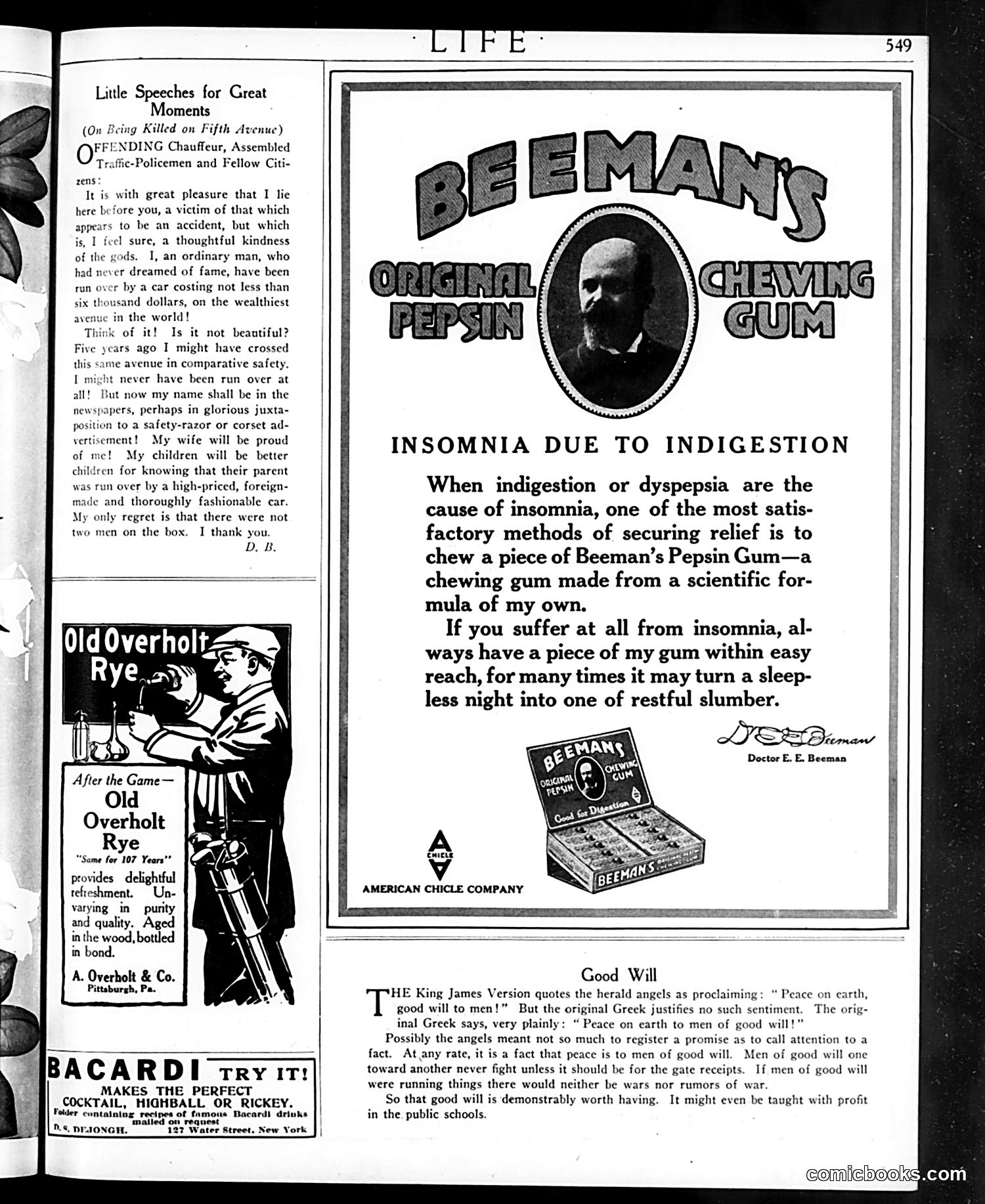
This page is primarily **advertising**, not political satire. The dominant content is a Beeman's Chewing Gum advertisement claiming the product cures insomnia caused by indigestion, endorsed by "Doctor E.L. Beeman." The left side contains two smaller ads: one for Old Overholt Rye whiskey (humor in the post-game drinking reference) and one for Bacardi cocktails. Above the main ad is a brief piece titled "Little Speeches for Great Moments"—a satirical vignette about an ordinary man hit by a car on Fifth Avenue, now famous and grateful. This is light social commentary on American celebrity culture, suggesting people achieve fame through misfortune. The "Good Will" essay below discusses biblical peace concepts, unrelated to the advertisements above.
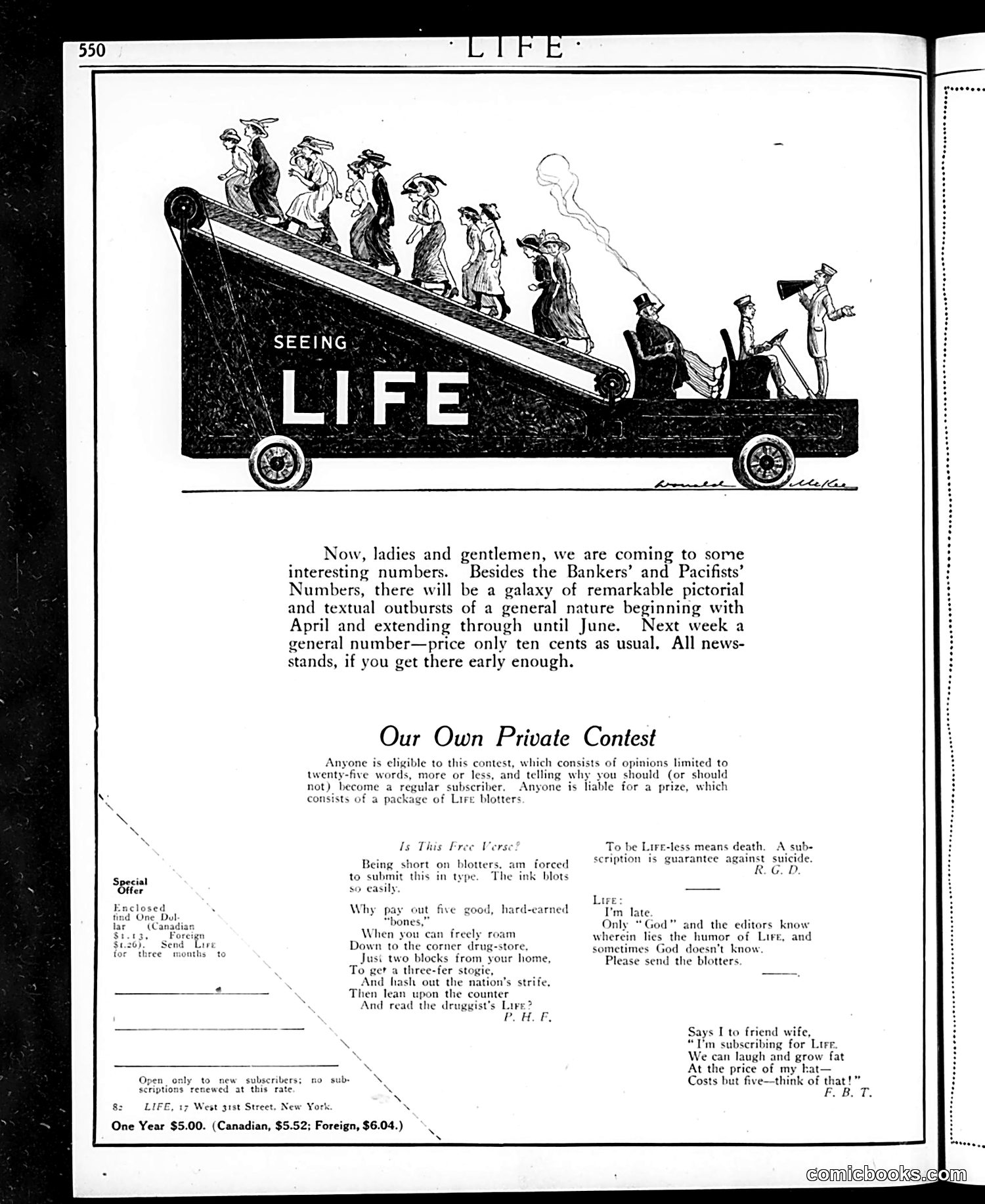
The illustration depicts a vehicle (resembling a touring car or float) labeled "SEEING LIFE" carrying multiple figures up an inclined plane or ramp. The composition suggests a satirical commentary on how people experience life—portrayed as a structured, managed journey rather than organic experience. The text references "Bankers' and Pacifists' Numbers," indicating this is from a period concerned with financial interests and peace activism, likely the WWI era or immediate aftermath. The accompanying contest solicits reader opinions on subscribing to LIFE magazine itself, making this largely a self-promotional page. The cartoon's central joke appears to satirize the commodification and packaged nature of experiencing "life" in modern America—suggesting it's become a commercial product to consume rather than live authentically.
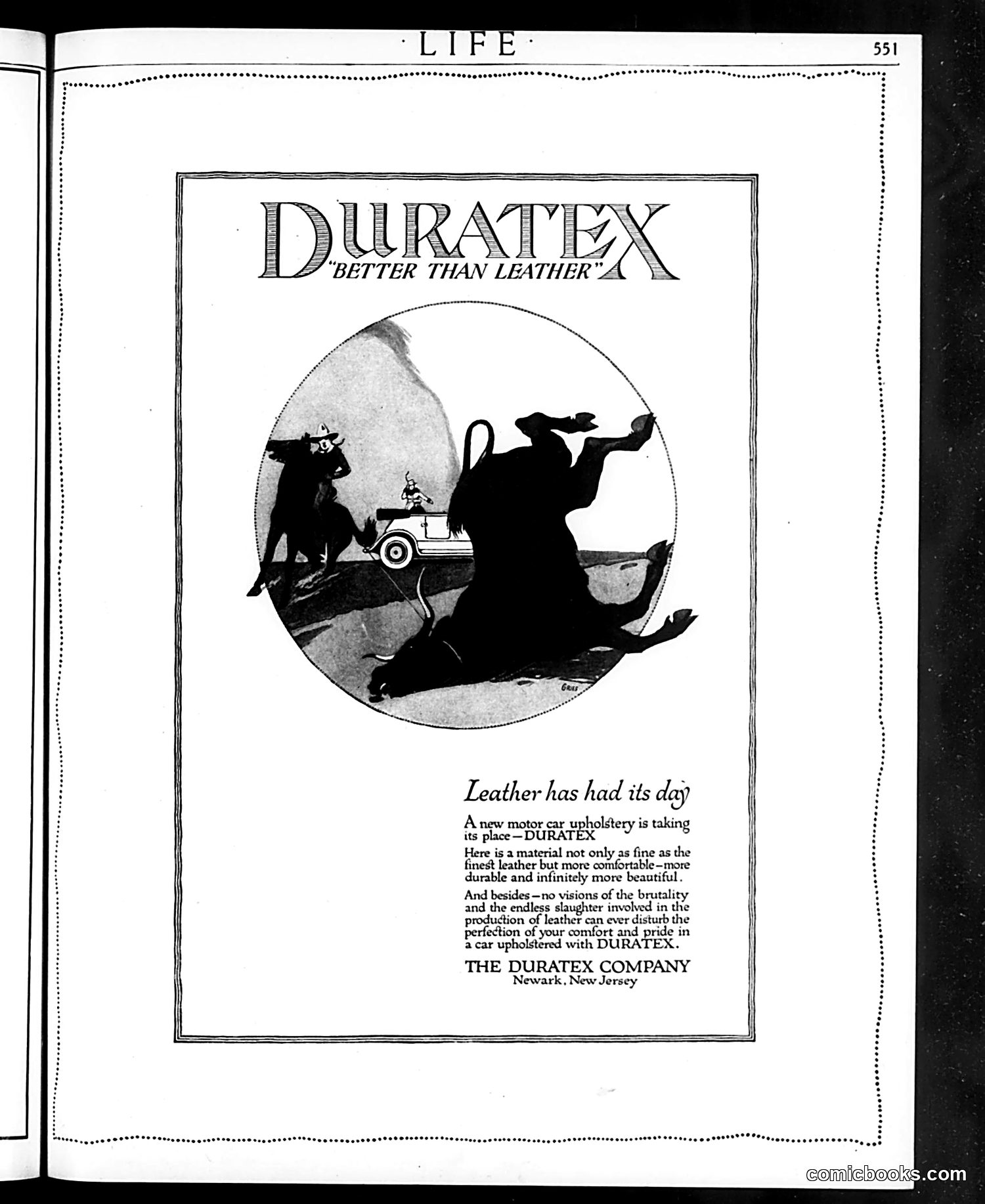
This is a **product advertisement** for Duratex, a synthetic car upholstery material marketed as superior to leather. The silhouette illustration shows a man in formal attire reclining luxuriously in an automobile, with what appears to be cattle in the background—a visual pun emphasizing the leather alternative. The ad's tagline, "Leather has had its day," positions Duratex as a modern replacement material that is "fine as the finest leather but more comfortable, more durable and infinitely more beautiful." The copy explicitly references "the brutality and the endless slaughter involved in the preparation of leather," appealing to both practical and ethical concerns. This represents early 20th-century marketing of synthetic materials as progressive improvements over natural products.
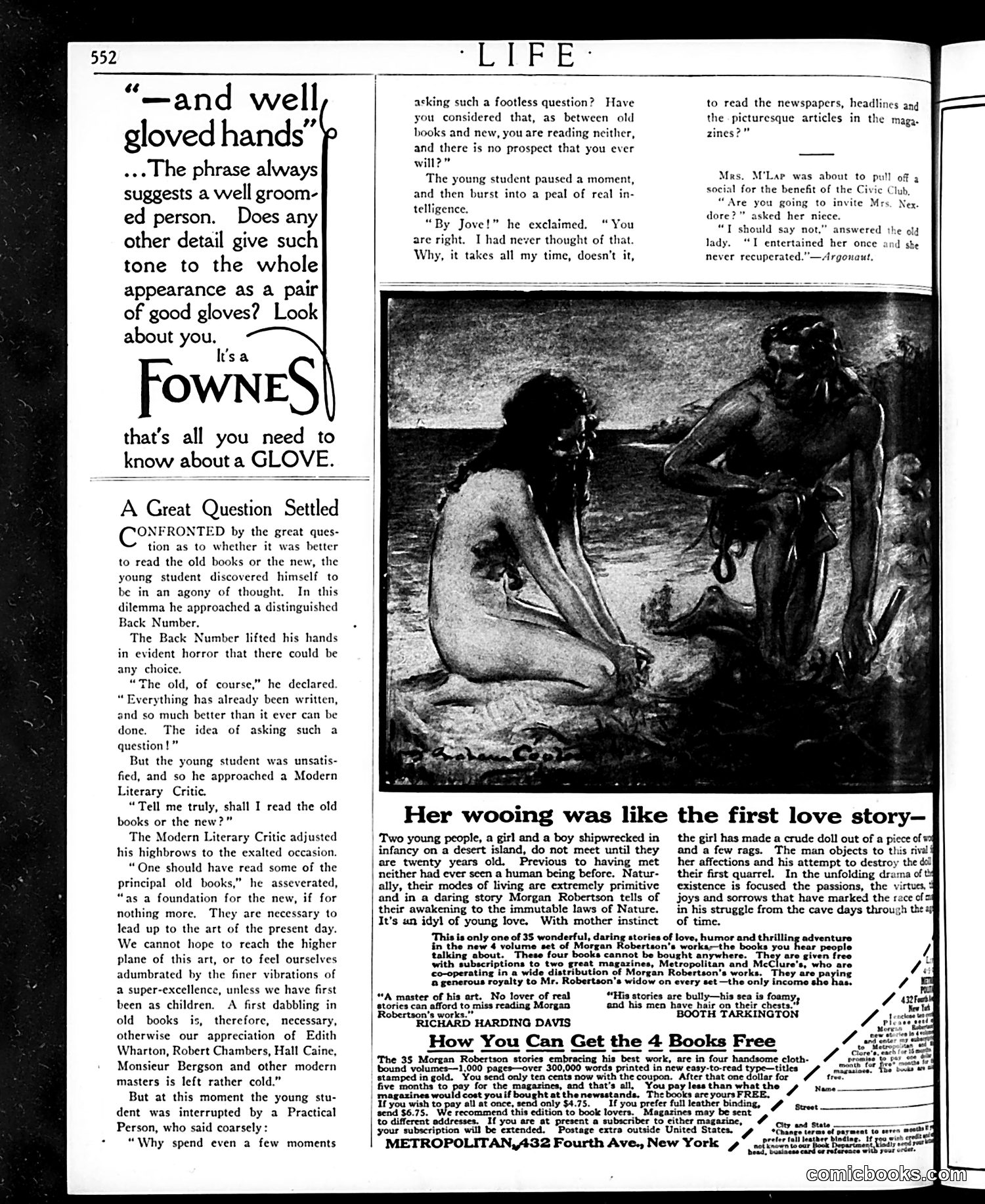
This page is primarily **advertising and literary promotion**, not political satire. The main content concerns a debate about whether students should read "old books or the new"—a commentary on literary taste and cultural modernism. The central illustration depicts a classical or mythological scene of figures by water, accompanying promotional text for **Morgan Robertson's love stories**. The advertisement emphasizes that Robertson's work offers timeless romantic narratives ("her wooing was like the first love story"). The left column presents a dialogue mocking both traditionalists ("Back Number") and modernists ("Modern Literary Critic") as equally dogmatic about reading preferences. The satire gently critiques rigid cultural positions from both camps—not a political cartoon, but rather commentary on contemporary debates about artistic merit and relevance.
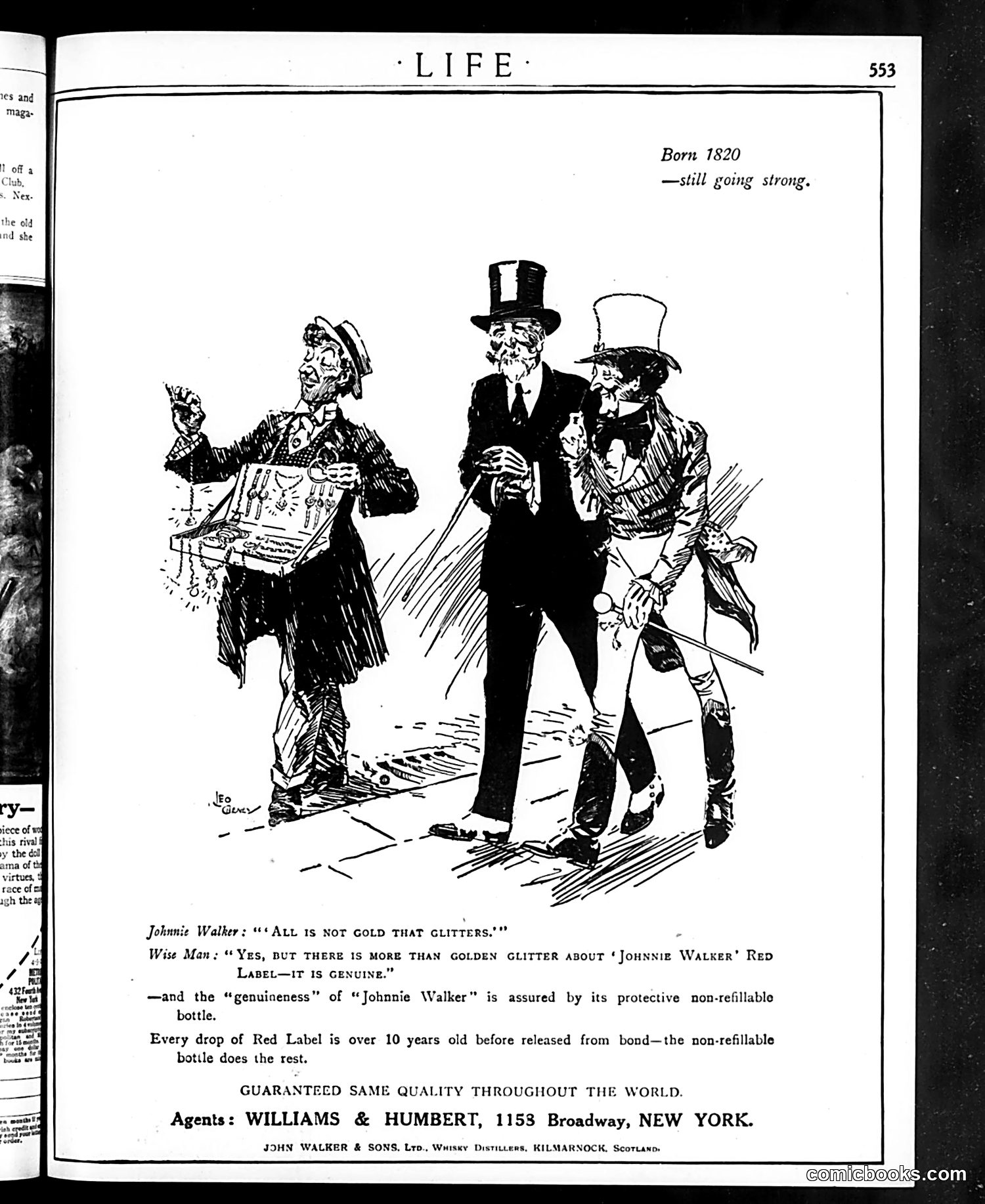
This page is primarily a **whiskey advertisement** for Johnnie Walker Red Label, presented as political/social satire rather than straightforward marketing. The cartoon depicts three figures in formal dress encountering a well-dressed man in a top hat (representing Johnnie Walker whiskey). The characters appear to be caricatured representations of skeptics or critics. The satirical dialogue frames the product as genuinely valuable ("not all that glitters is gold") while defending Johnnie Walker's reputation and quality. The advertisement emphasizes the product's age (10+ years), protective non-refillable bottle design, and worldwide consistency as markers of legitimacy and authenticity. The "Born 1820—still going strong" tagline positions the brand as enduring and reliable. The overall tone suggests responding to contemporary concerns about counterfeit spirits or quality assurance.
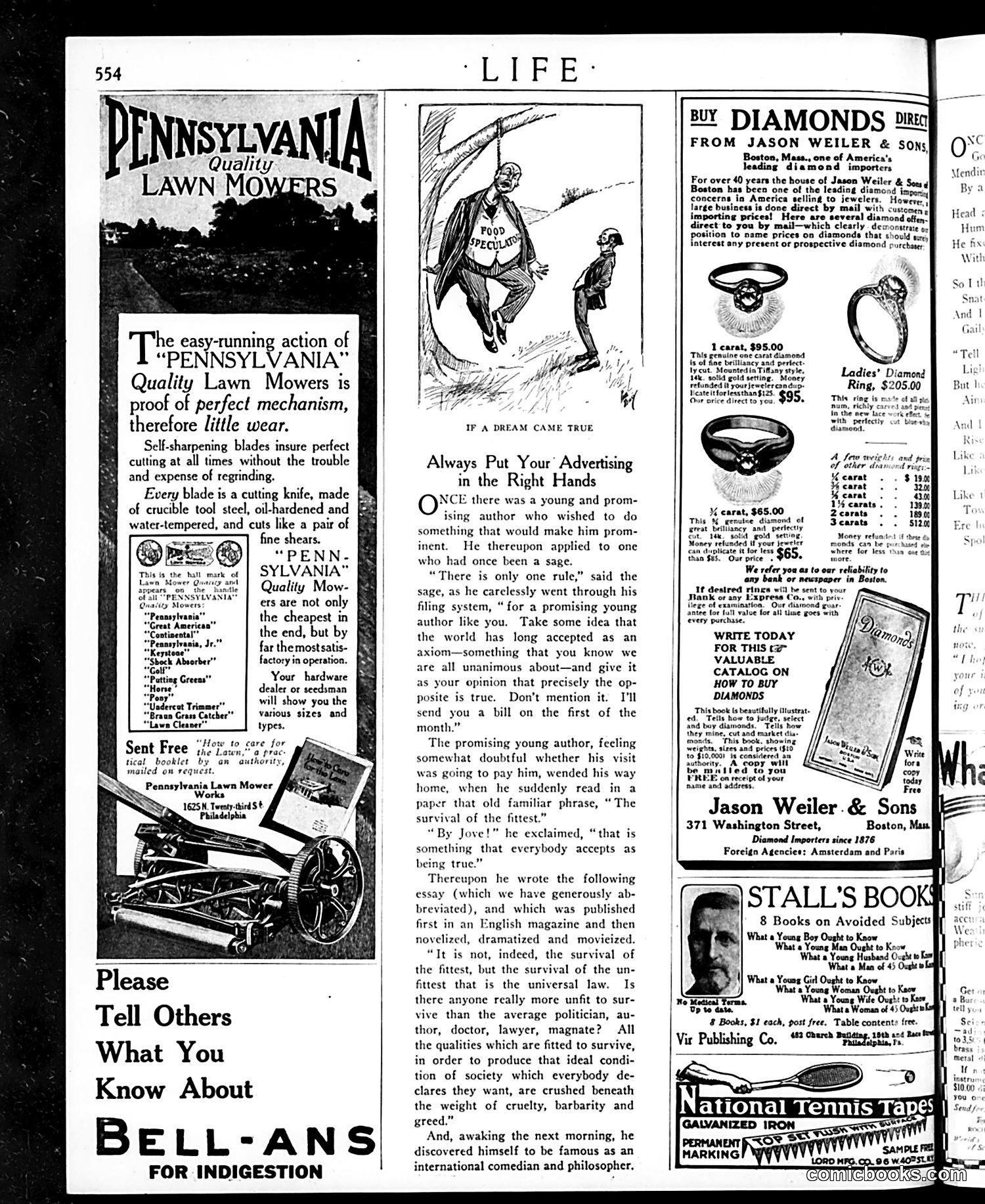
The cartoon depicts an older man labeled "Poor Preacher" encountering a younger man on a path. The title "If a Dream Came True" suggests this illustrates a fantasy scenario. The accompanying article discusses a promising young author who visits a sage seeking advice on becoming prominent. The sage tells him "There is only one rule"—that survival belongs to the fittest. The author later reads this phrase in a newspaper and becomes famous as a philosopher and comedian. The cartoon likely visualizes this narrative: the preacher (the humble sage) encounters the now-successful younger man (the aspiring author), depicting the ironic fulfillment of the sage's cryptic wisdom. The joke hinges on accidental success through misunderstanding rather than intentional effort.
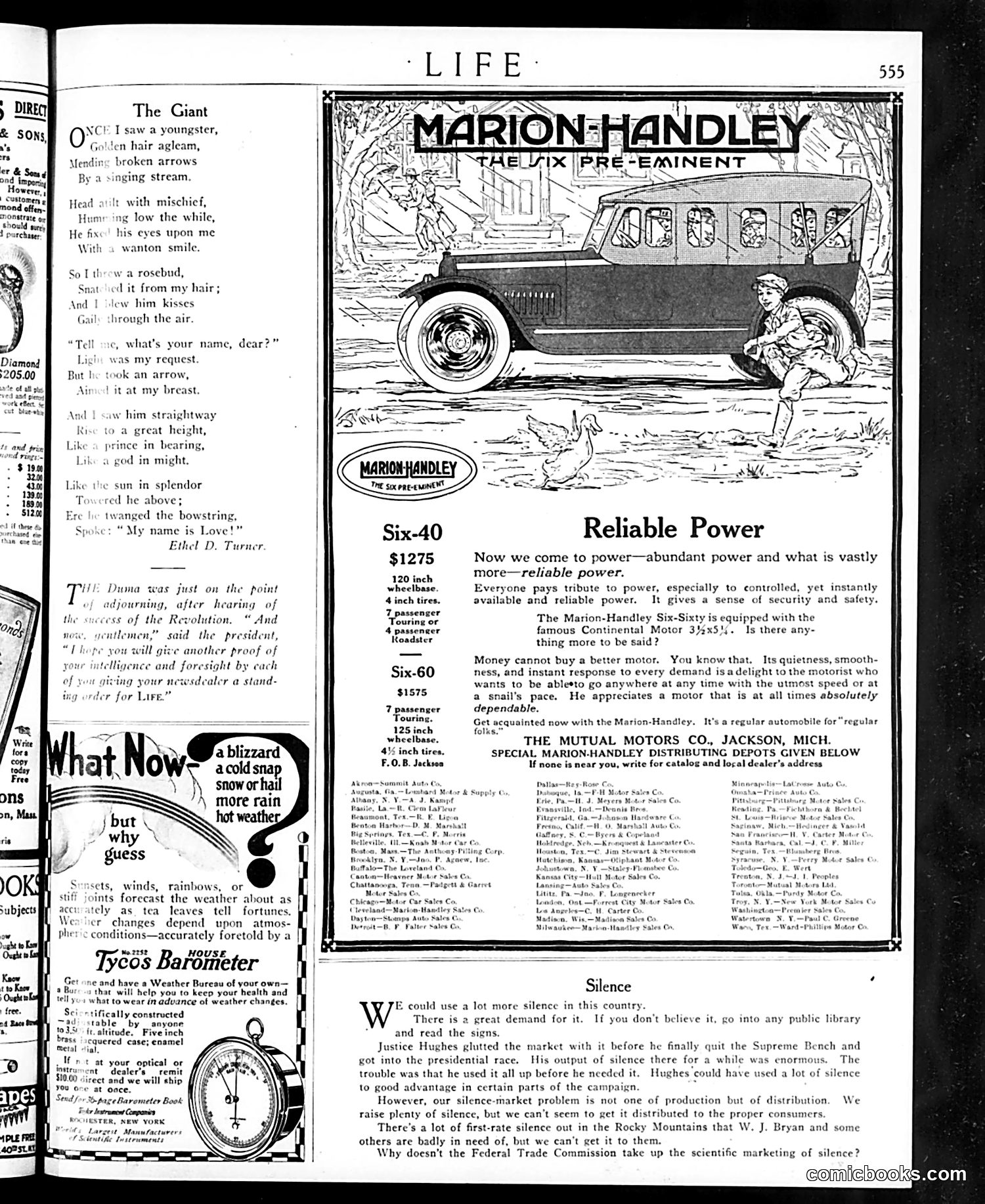
This page is primarily **advertising content** for Marion-Handley automobiles, featuring two car models (Six-40 and Six-60) with prices and specifications. The left column contains **"The Giant,"** an unrelated poem about a romantic encounter, followed by an advertisement for **Tycos House Thermometer** promoting weather prediction. At bottom right is an article titled **"Silence"** discussing American silence as a political/social problem. It references **Justice Hughes** and **W. J. Bryan**, appearing to critique how silence was used before Hughes left the Supreme Bench and during a presidential race. The piece suggests Americans have plenty of "first-rate silence" but struggle to distribute it effectively, humorously questioning why the Federal Trade Commission doesn't scientifically market silence. The page reflects early 1920s magazine format mixing commercial advertisements with social commentary.
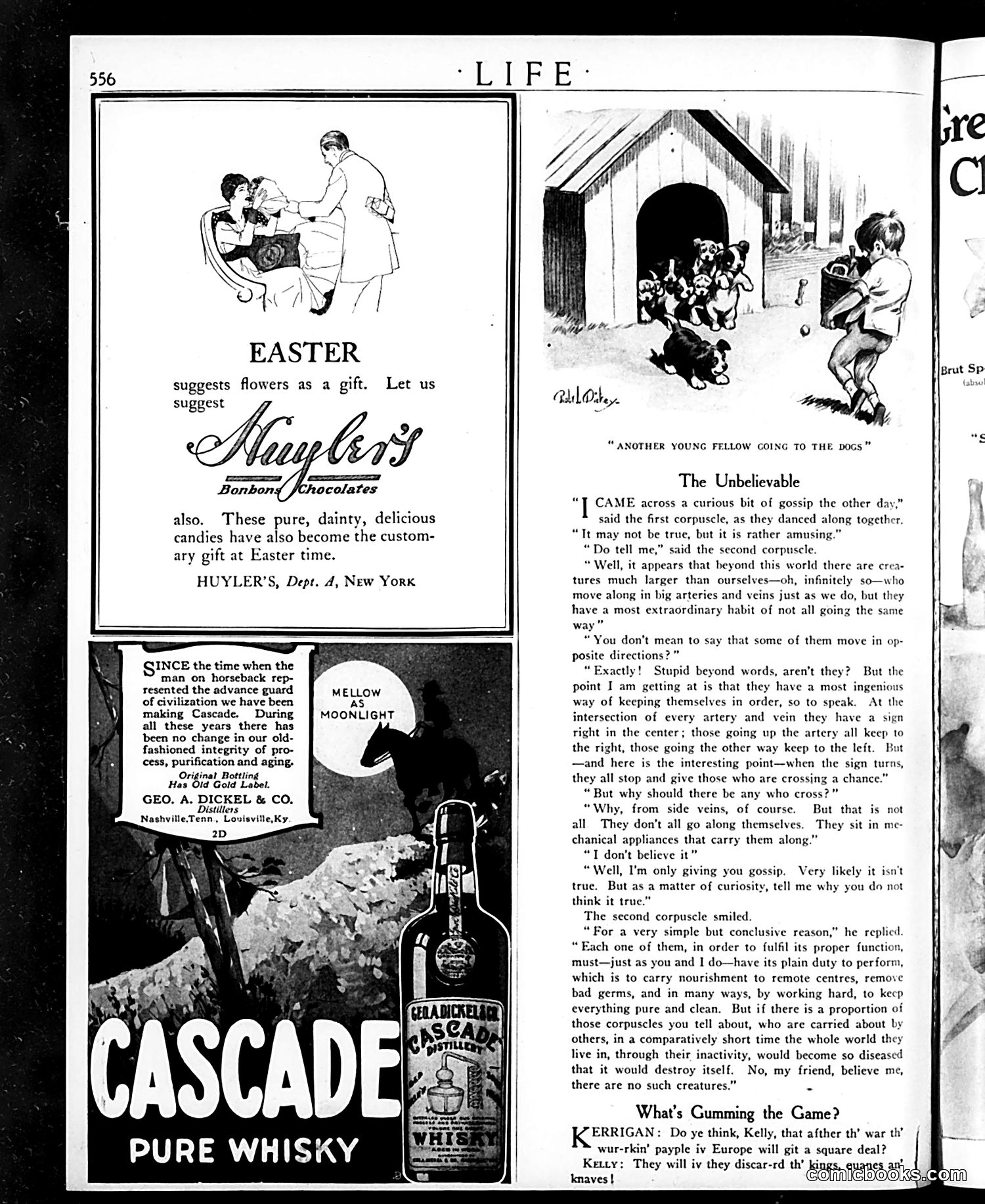
This is primarily an **advertising and light humor page** from Life magazine (page 556). **Left side:** Two ads—one for Huyler's Bonbons positioning Easter flowers and chocolates as gifts, the other for Cascade Pure Whisky, featuring a horse and rider in moonlight with text about civilization and purity. **Right side:** A short humorous story titled "The Unbelievable" depicts two corpuscles gossiping about human biology. One claims creatures larger than corpuscles exist and move through arteries and veins. The other dismisses this as implausible. The joke satirizes **skepticism about the invisible or unknown**—the irony being that corpuscles themselves are invisible to humans, yet they doubt larger unseen organisms exist. Below is a brief dialogue about post-war Europe ("What's Gumming the Game?").
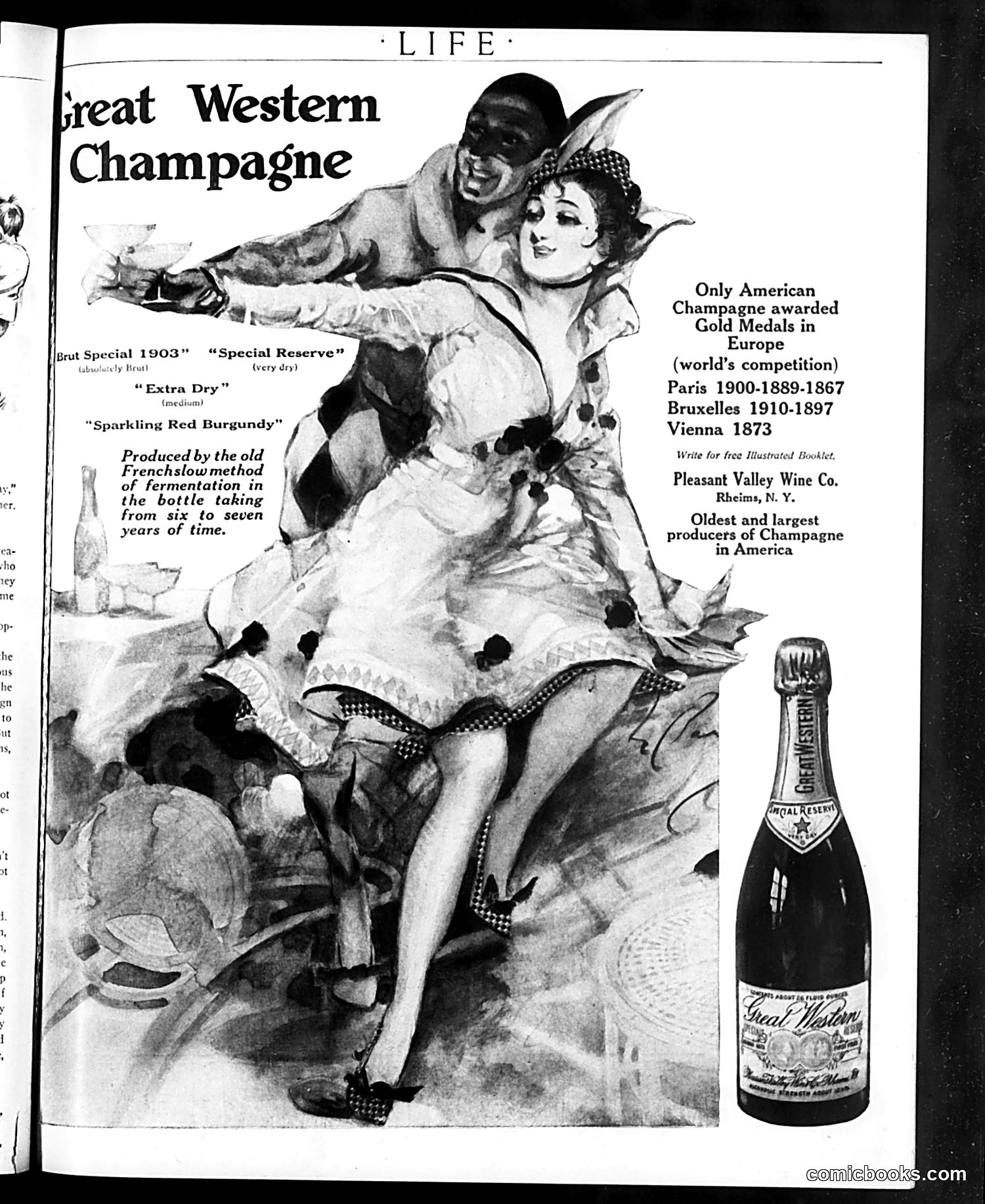
This is a **product advertisement**, not political satire. It promotes Pleasant Valley Wine Co.'s American champagne from Rheims, New York. The illustration depicts a playful, flirtatious scene: a man and woman in festive attire in what appears to be a champagne celebration, with the woman in a light dress and the man in darker clothing positioned behind her in a jovial pose. The ad emphasizes that this is the **only American champagne awarded Gold Medals in European competitions** (Paris, Bruxelles, Vienna—spanning 1867-1910), claiming it as "Oldest and largest producers of Champagne in America." The marketing strategy associates the product with luxury, celebration, and romance, targeting affluent readers of *Life* magazine.
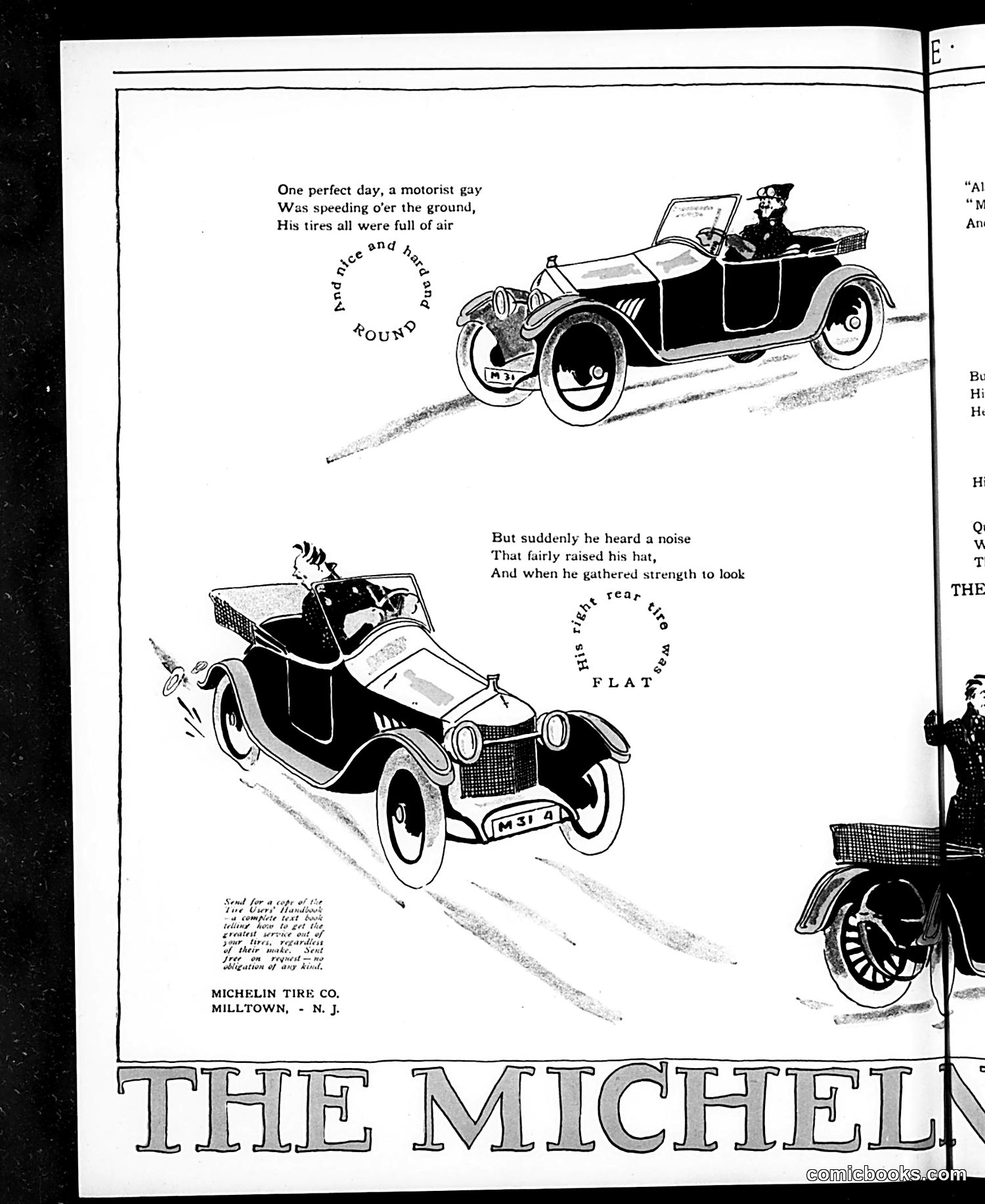
This is primarily a **Michelin Tire Company advertisement** from Life magazine, not a political cartoon. The narrative depicts a motorist speeding confidently in the top panel ("One perfect day, a motorist gay / Was speeding o'er the ground, / His tires all were full of air / And nice and hard and round"). The bottom panel shows his comeuppance: he's suffered a flat tire ("But suddenly he heard a noise / That fairly raised his hat, / And when he gathered strength to look / Right there the shift is FLAT"). The ad's message is straightforward product promotion: Michelin tires keep you safe and trouble-free when properly maintained. The humorous misfortune befalling the speeding driver serves as both entertainment and implicit endorsement—suggesting inferior tires would fail under similar conditions.
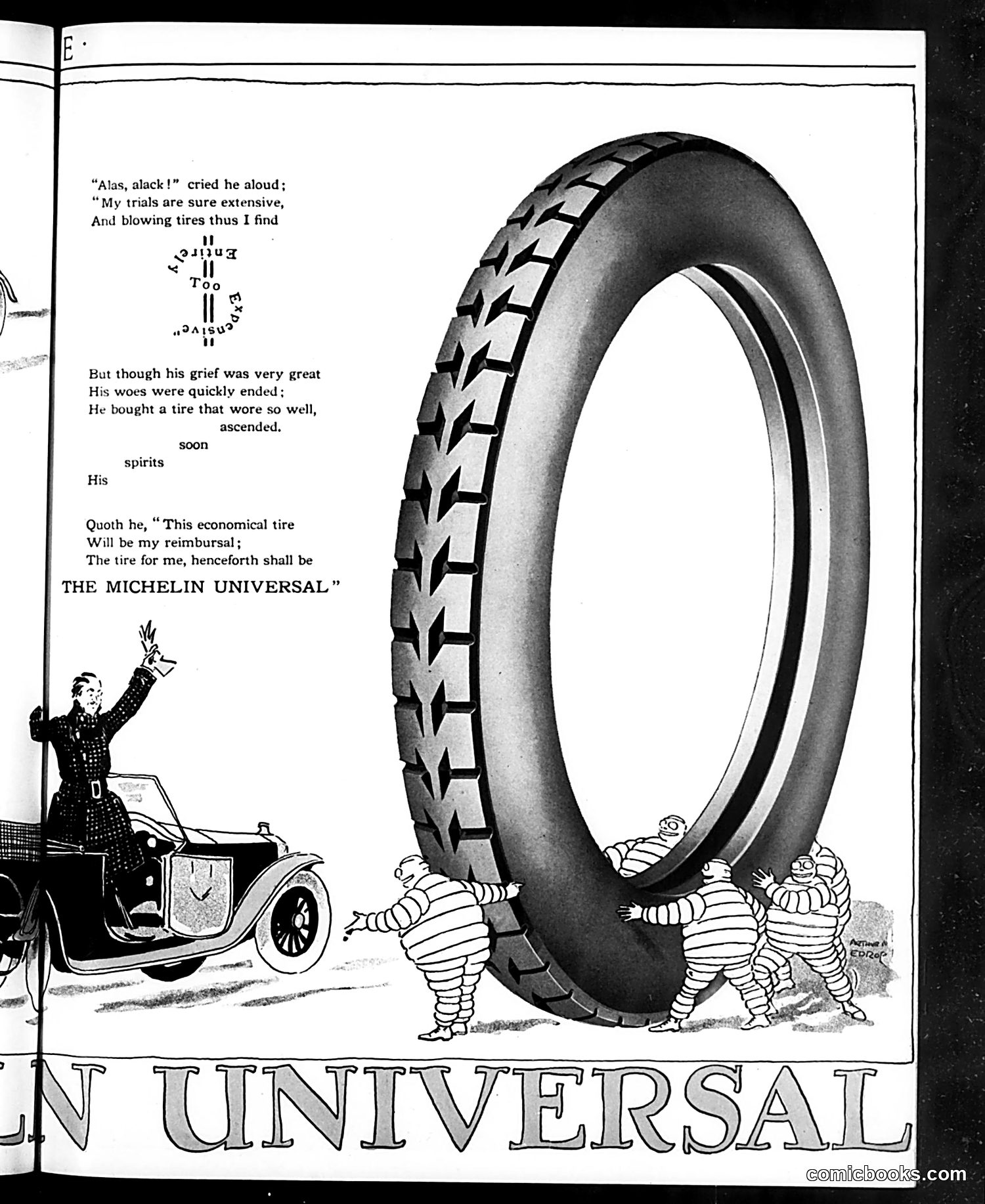
This is a Michelin tire advertisement disguised as humorous verse. The narrative presents a motorist experiencing tire troubles ("blowing tires thus I find / Expensive"), whose despair transforms when he purchases a Michelin Universal tire, declaring it "economical" and his "reimbursial." The illustrated scene shows the massive tire being held aloft by anthropomorphized Michelin mascots (the rotund "Bibendum" characters recognizable from the brand's logo), while a satisfied motorist in an early automobile gestures triumphantly. The satire targets tire-blowing, a common and costly problem for early motorists. By presenting product endorsement as whimsical poetry with theatrical dramatics, the ad mocks both the motorist's exaggerated emotional response and contemporary advertising's overwrought appeals to reason through entertainment rather than substantive claims.
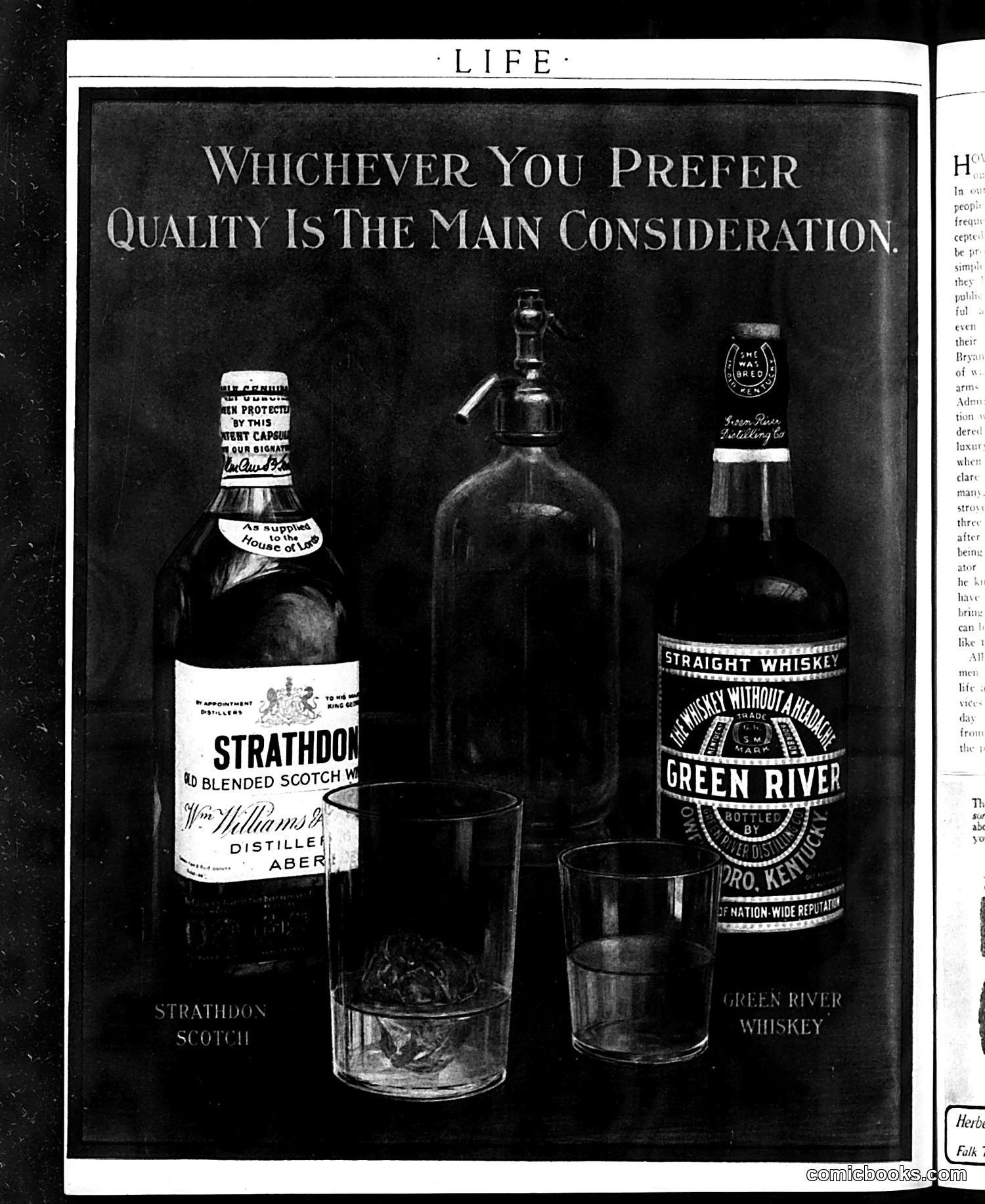
This is a **liquor advertisement**, not political satire. The page showcases two whiskey brands—Strathdon (a Scottish blended whisky from Aberdeen) and Green River (a straight whiskey from Kentucky)—positioned as quality alternatives for different consumer preferences. The headline "Whichever You Prefer Quality Is The Main Consideration" frames both products as premium options, emphasizing that regardless of which brand a drinker selects, quality remains paramount. The advertisement displays the bottles, glasses with ice, and detailed labeling to appeal to consumers' sense of sophistication and choice. This appears in *Life* magazine's advertising section and reflects early-to-mid 20th century liquor marketing before Prohibition (or possibly after its repeal). The ad assumes readers can freely purchase alcohol and positions whiskey consumption as a matter of refined taste rather than necessity.
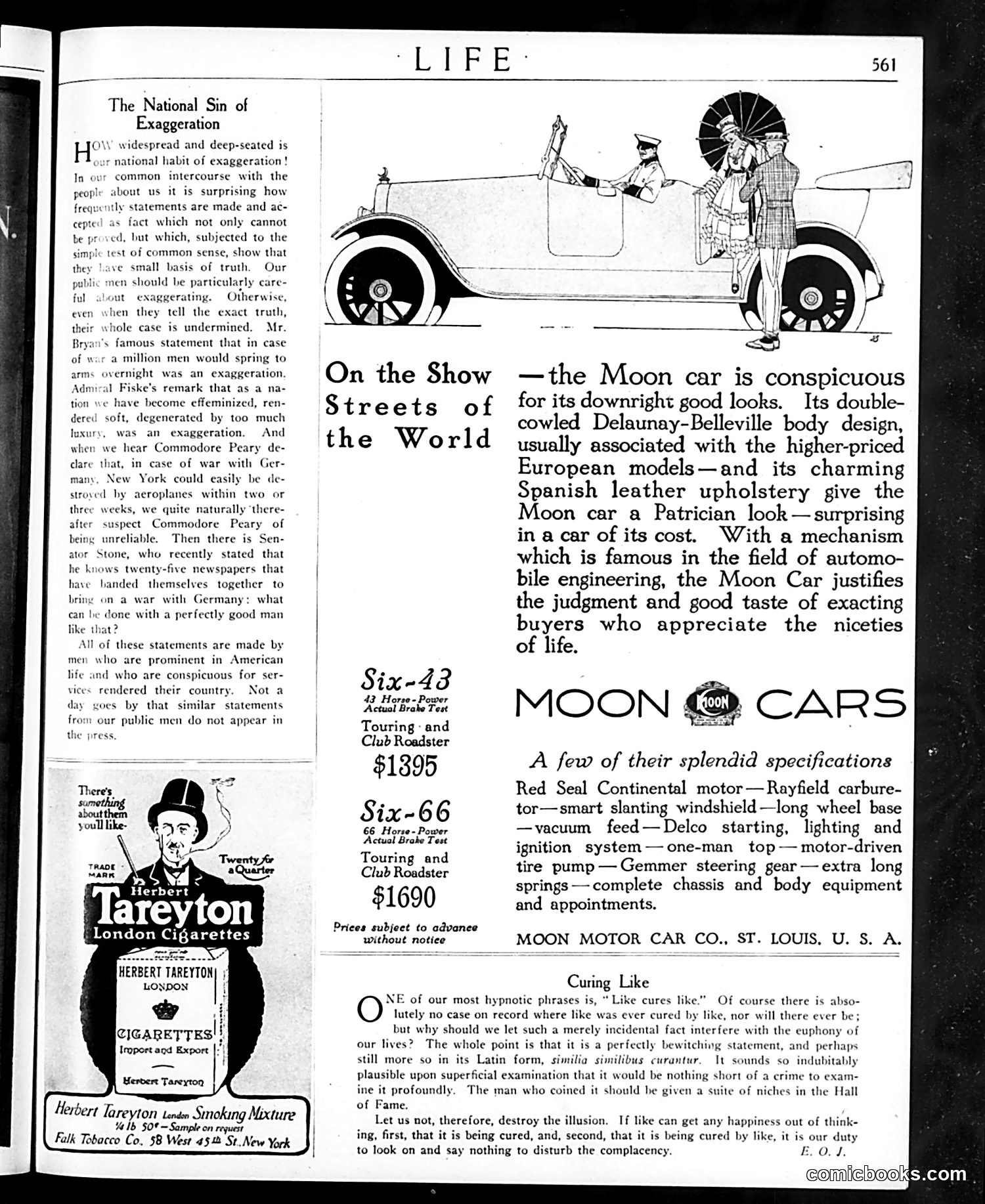
This page attacks **American public figures' habit of exaggeration**, using specific examples. The article criticizes prominent men—William Jennings Bryan, Admiral Fiske, Commodore Peary, and Senator Stone—for making inflated claims about military preparedness and national capacity that undermine public trust, even when they later speak truthfully. The satire's point: exaggeration by public figures damages credibility and national discourse. When leaders routinely overstate facts (Bryan claiming a million men would enlist overnight; Peary claiming New York could be destroyed by aircraft in weeks), citizens reasonably become suspicious of *all* their statements, even accurate ones. The page also includes a **Moon Cars advertisement** and a separate satirical piece titled "Curing Like," which mocks the medical maxim "like cures like" as plausible-sounding nonsense that people believe despite lacking evidence. The Tareyton cigarette advertisement appears incidental to the main content.
This is **not a political cartoon or satire**—it's a full-page **advertisement** for The Gorham Company, a silversmith manufacturer. The page appears in *Life* magazine (page 562) but contains commercial advertising rather than editorial content. The ad uses grandiose, quasi-philosophical language to market silverware, claiming that Gorham's name represents nearly a century of leadership in the silversmithing craft. It employs ornate Art Deco design with winged figures and decorative borders to convey luxury and prestige. The company advertised two New York locations: Fifth Avenue/36th Street and Maiden Lane. The text asserts that Gorham silverware—whether expensive or economical—is the industry standard sold by "leading jewelers everywhere." There is no satirical content here; this is straightforward luxury goods marketing using aspirational rhetoric.
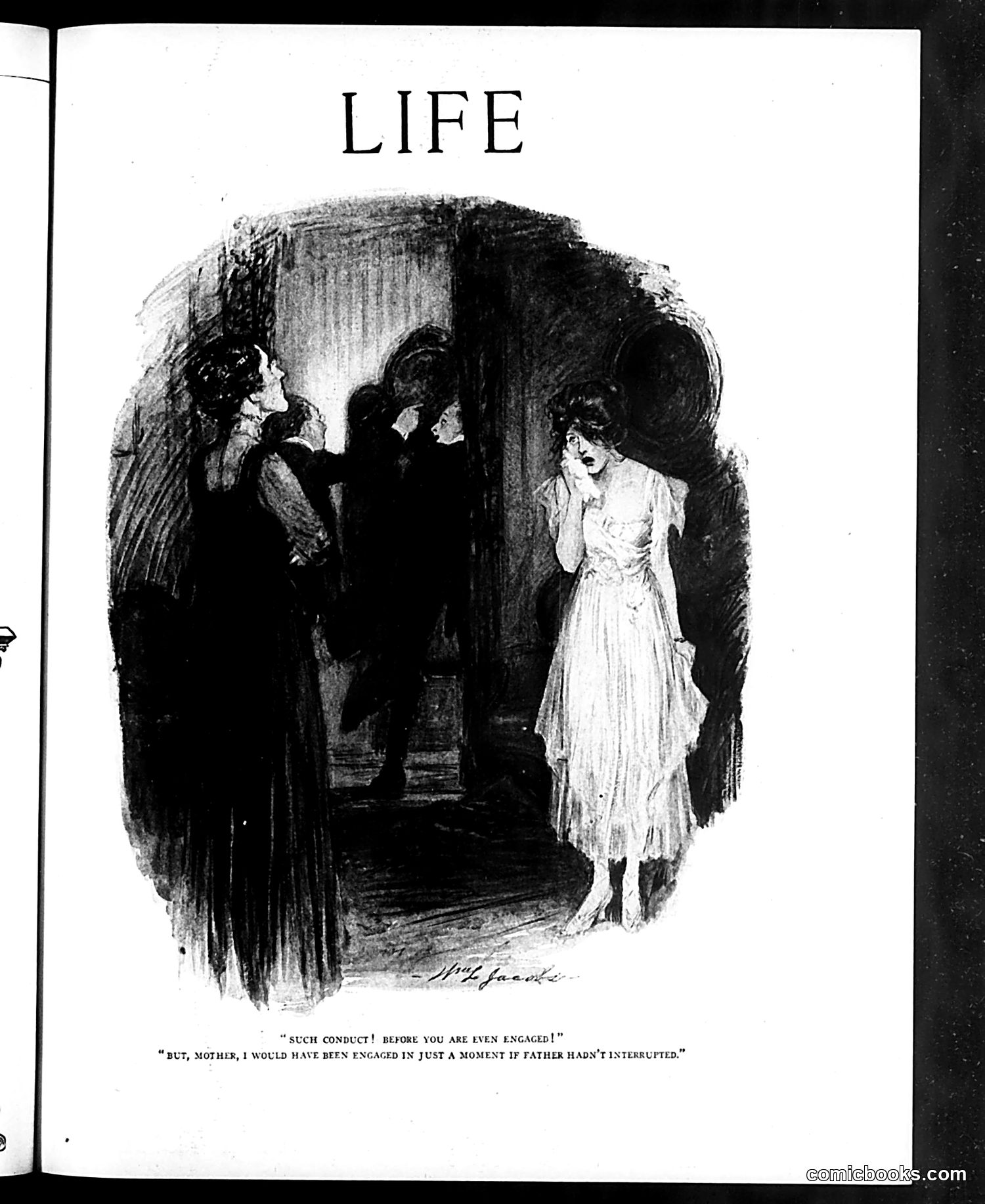
This is a satirical domestic scene from *Life* magazine depicting a generational conflict about courtship and parental authority. A young woman in a light dress stands apart while her parents (darkly sketched figures) confront her, with the father apparently having interrupted an engagement proposal. The mother expresses shock at the "conduct," while the daughter defends herself, suggesting the father's interruption prevented her from becoming engaged "in just a moment." The satire targets Victorian-era parental anxieties about unsupervised courtship and young women's independence, while mocking both the parents' prudish horror and the daughter's casual attitude toward such a significant life event. The humor lies in the clash between strict social conventions and the younger generation's more relaxed approach to romance and engagement.
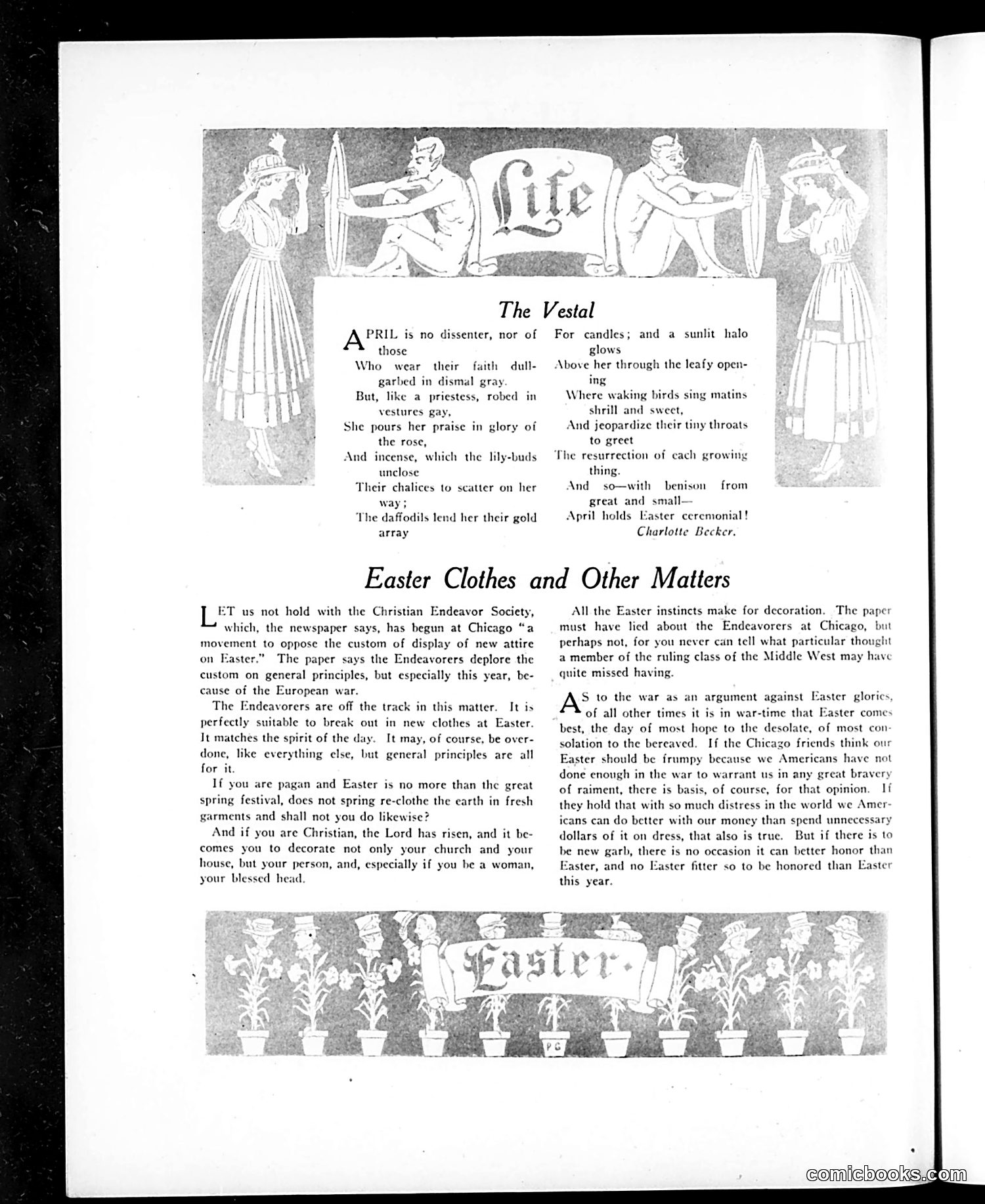
This editorial satirizes the Christian Endeavor Society's campaign against wearing new Easter clothes, reportedly begun in Chicago during World War I. The author argues the Society is mistaken on multiple grounds: **The argument:** Whether Easter is viewed as a pagan spring festival (where nature renews itself in fresh garments) or a Christian resurrection celebration, new clothes are spiritually appropriate. The editorial dismisses prudishness about display as misguided, especially given that Easter offers "hope to the desolate" during wartime. **The satire:** The author mocks the "ruling class of the Middle West" for their joyless moralizing while acknowledging a valid counterpoint—that wartime suffering makes lavish spending questionable. However, the piece concludes that *if* new clothes are to be purchased, Easter is the most honorable occasion for them. The poem "The Vestal" above reinforces this celebration of April's renewal and Easter's ceremonial beauty, contrasting with the Society's grim opposition to festive display.
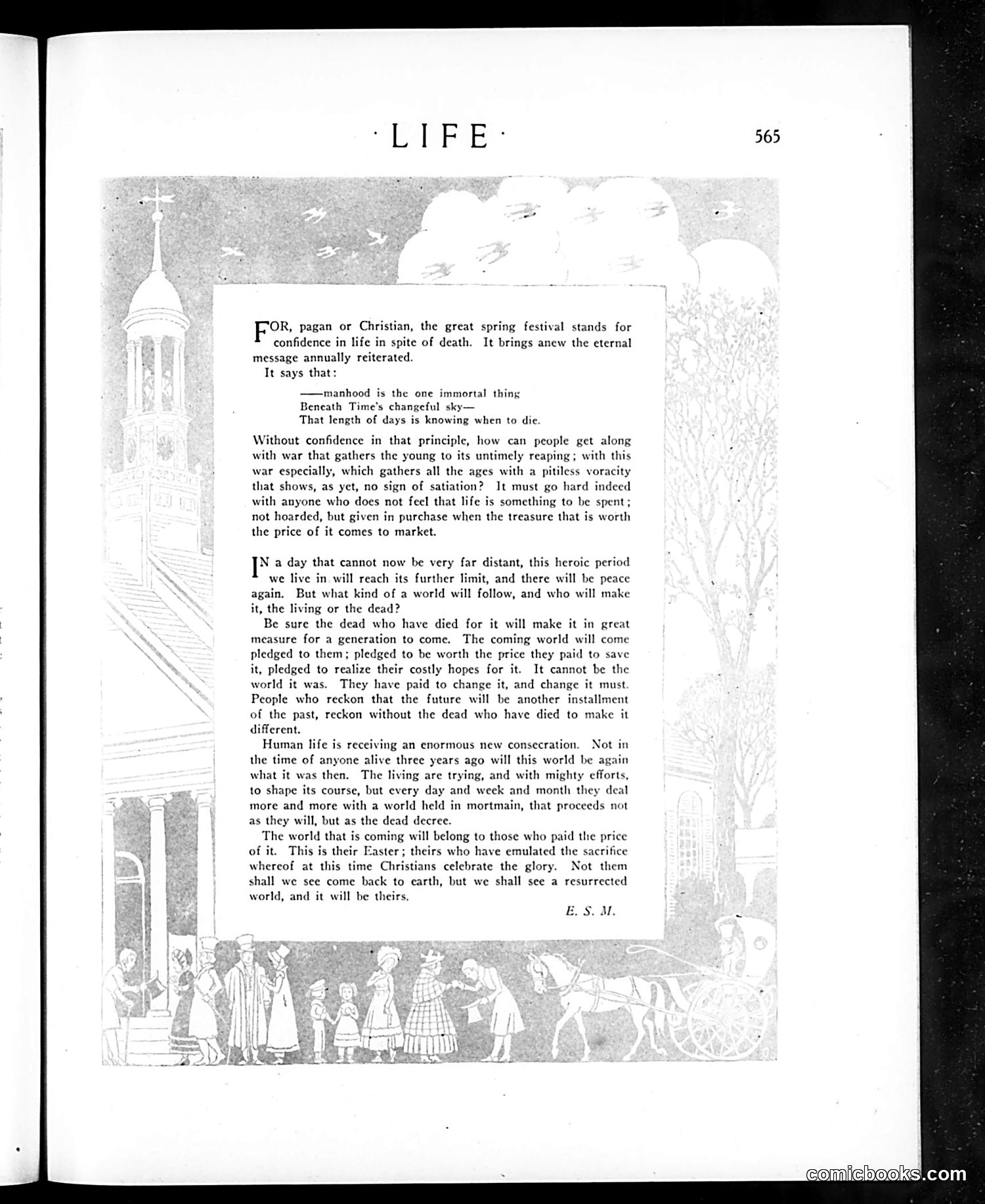
This is an Easter editorial essay (signed E.S.M.) from Life magazine, likely published during World War I, addressing spring festival traditions as symbols of hope despite wartime death. The text argues that Easter—for both pagan and Christian traditions—represents confidence in life persisting beyond death. However, the author pivots to a more somber point: the current war is indiscriminately harvesting young and old with "pitiless voracity." The central argument is that the dead who sacrifice themselves will spiritually shape the postwar world. The living must honor their sacrifice by building a fundamentally transformed society—not merely restoring what existed before. The essay presents the fallen as a moral force ("the dead decree") that will guide humanity's future. The decorative border illustrations show a church steeple and civilians, reinforcing themes of community and faith. This is propagandistic rhetoric: war sacrifice is reframed as sacred duty, and the resulting world becomes the soldiers' "Easter"—their spiritual resurrection through posterity's obligations to them.
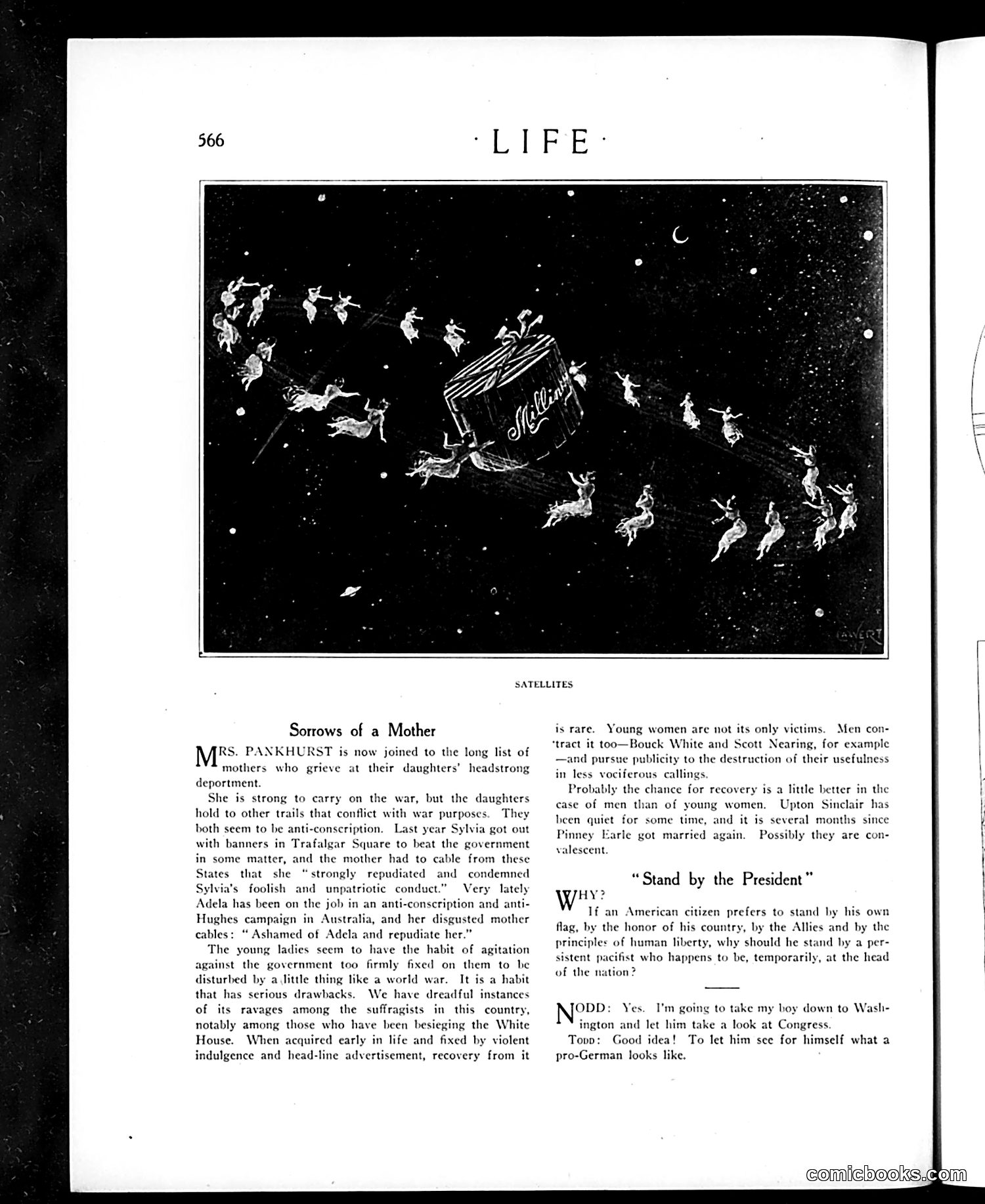
The top illustration depicts celestial bodies orbiting around a central object labeled "Militarism," using astronomy as a metaphor for unwanted social agitation. Below, the text mocks **Emmeline Pankhurst**, the famous British suffragist, whose daughters Sylvia and Adela pursued anti-conscription activism during World War I. Mrs. Pankhurst publicly disowned their pacifist positions, cabling her "shame" from America. Life's satire ridicules young women activists as habitually incapable of redirecting their energy toward patriotic war support. The piece compares such "agitation" to an infectious disease affecting suffragists, pacifists, and anti-war activists (naming Upton Sinclair and others). The dialogue below jokes that Congress itself embodies "pro-German" pacifism—sarcastically suggesting American political leadership obstructs the war effort. This reflects 1917-era hostility toward conscription opponents and pacifists during U.S. involvement in World War I.
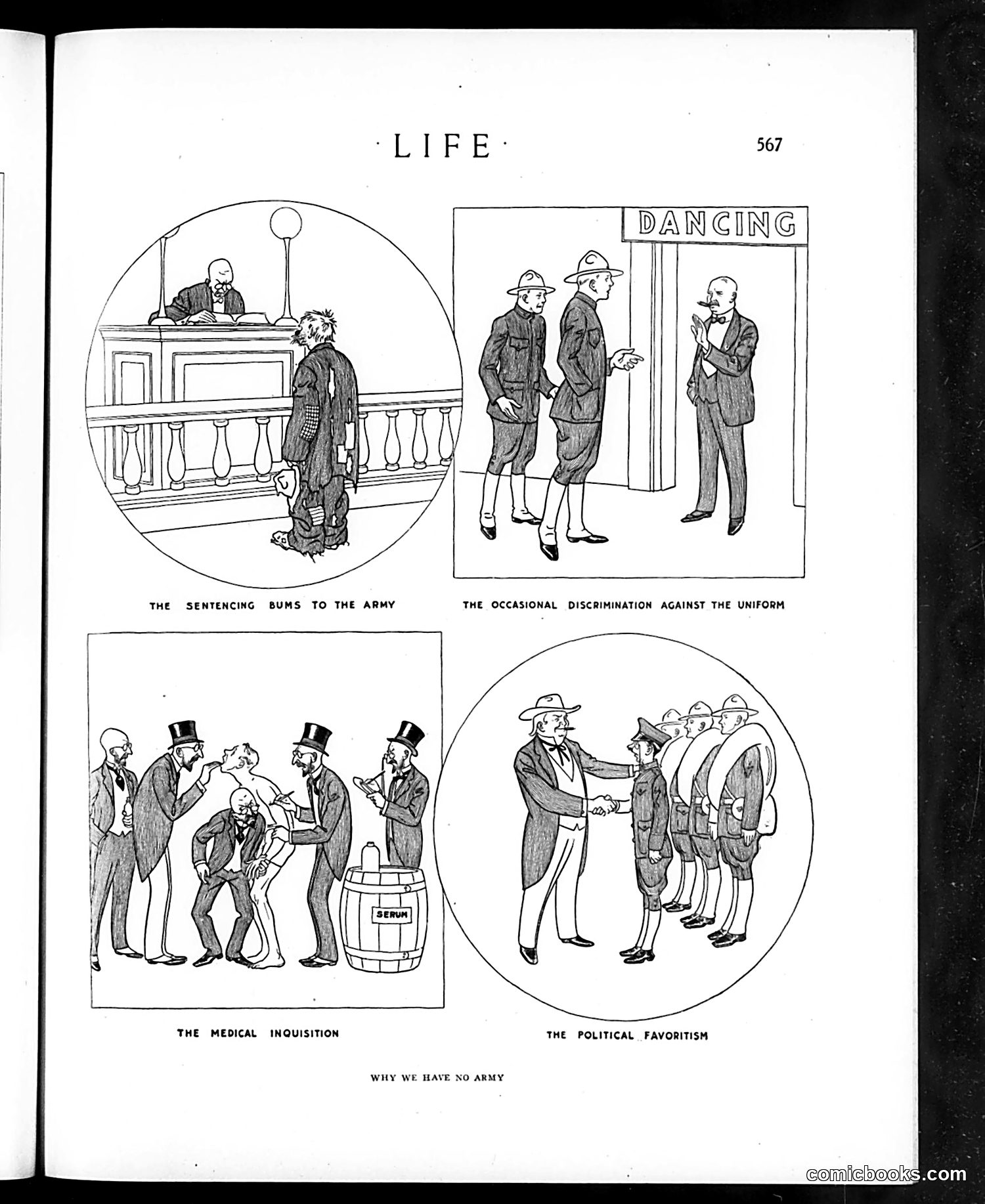
This page satirizes obstacles preventing effective military recruitment and organization in early 20th-century America. The four panels critique: 1. **"Sentencing Bums to the Army"**: Courts using military service as punishment for vagrants, creating an unwilling soldier base. 2. **"Discrimination Against the Uniform"**: Civilians refusing entry to uniformed soldiers at establishments (the "Dancing" hall), suggesting social prejudice against military personnel. 3. **"Medical Inquisition"**: Overly rigorous medical examinations with multiple doctors examining recruits, implying bureaucratic inefficiency. 4. **"Political Favoritism"**: Politicians selecting officers through connections rather than merit. The collective message: America's army fails due to corrupt recruitment practices, social stigma against soldiers, excessive red tape, and nepotism. The cartoonist argues these systemic problems explain military weakness, not lack of patriotism or available manpower.
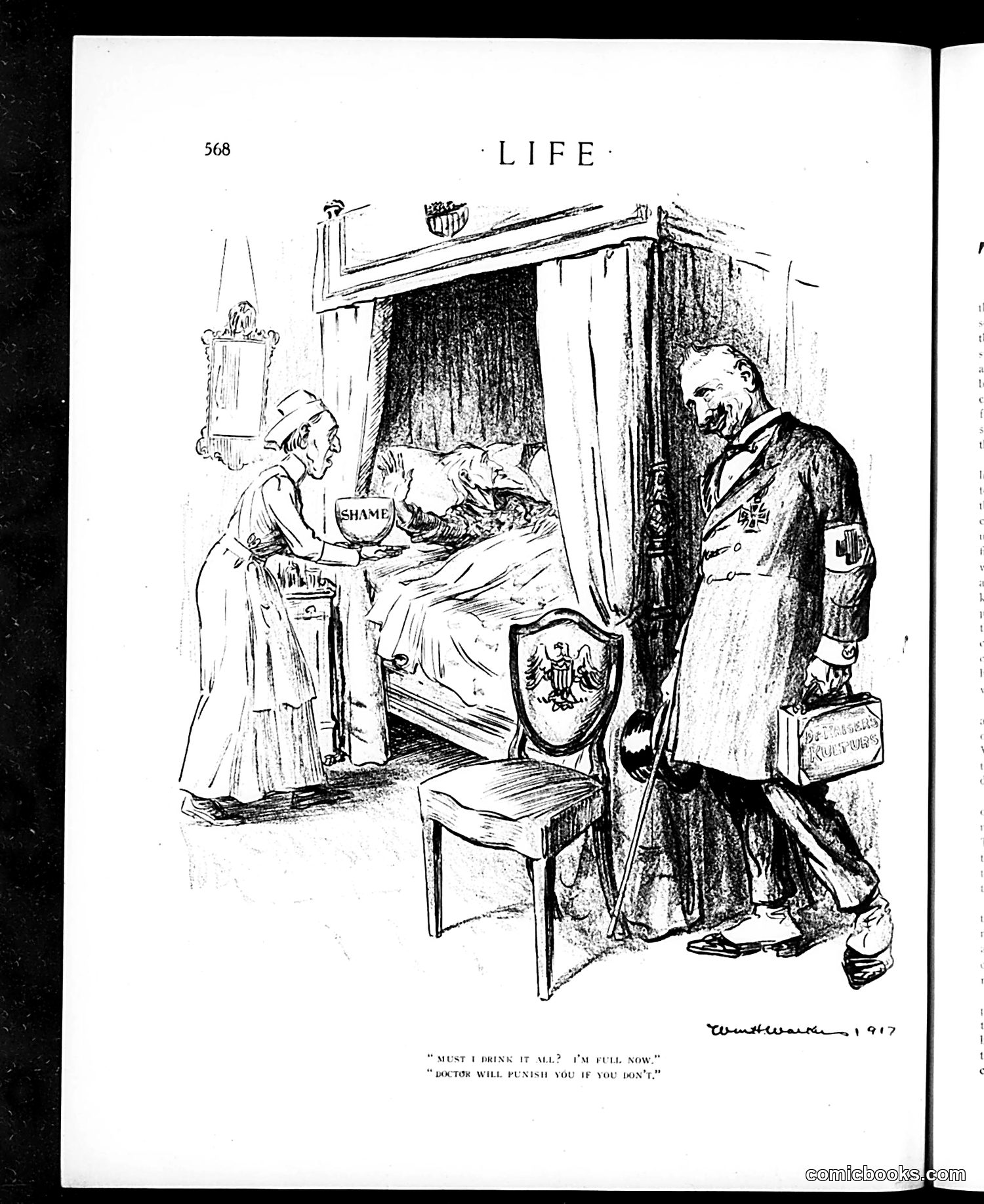
This 1917 Life magazine cartoon depicts a wartime scene. A military officer (likely German, suggested by the uniform and shield emblem) stands at a sickbed where a nurse tends to a patient. The caption reads: "Must I drink it all? I'm full now" / "Doctor will punish you if you don't." The cartoon appears to satirize forced compliance during WWI—possibly mocking German militarism or propaganda pressures. The "shame" label visible on the bedside suggests public humiliation as coercion. The doctor's threat implies authoritarian enforcement rather than voluntary participation in medical/civic duties. The satirical point likely critiques wartime compulsion, whether targeting German behavior or commenting on Allied pressure tactics. The 1917 date places this during America's active WWI involvement.
This is the opening of a serialized fictional story, not a political cartoon. It's a satirical adventure tale about a cowardly British Army officer in Afghanistan/Eastern Persia who becomes known as "The Tiger Eater." The satire centers on how a bullet wound to his head apparently *improved* his character by damaging his intellect, transforming him from a coward into a reckless daredevil. The narrator drily notes this could benefit many people. The story mocks both military incompetence and the notion that bravery stems from either moral superiority or simple stupidity—suggesting the officer's transformation proves the latter. The narrative then follows his quest (directed by a con-artist "Holy Man") to find a suitable wife, setting up an exotic adventure story typical of Life's satirical fiction. The humor lies in the officer's absurd character arc and the mockery of British colonial military culture.
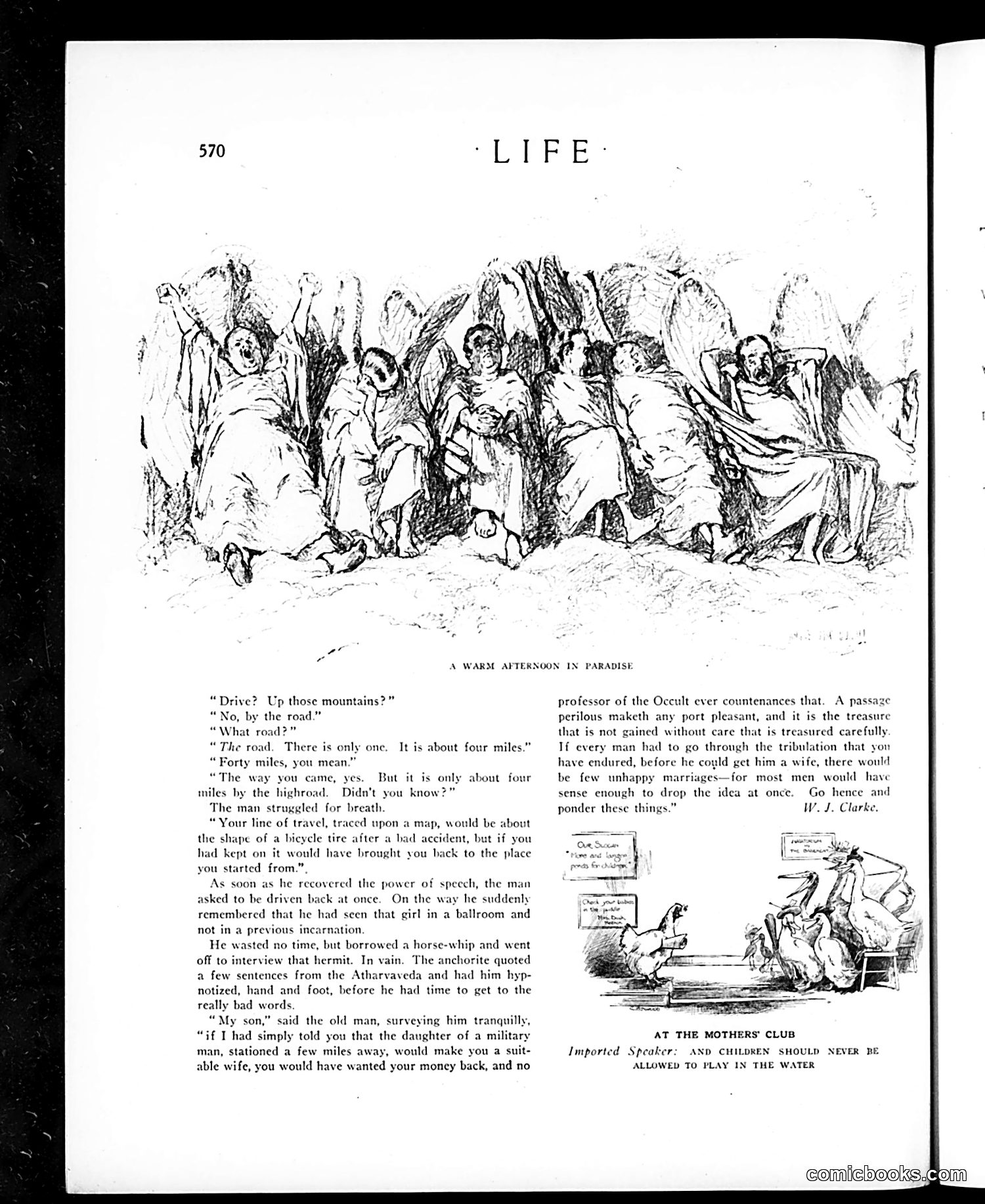
This satirical story mocks New Thought and occult movements popular in early 20th-century America. A man visits a hermit claiming mystical wisdom who deliberately misleads him about directions, then later manipulates him into pursuing a suitable wife through elaborate spiritual justification. The satire targets how occult practitioners used vague pseudo-philosophy to control clients. The hermit's hypnosis, references to reincarnation and Sanskrit texts (Atharvaveda), and flowery language about "passages perilous" parody the era's fascination with Eastern mysticism. The punchline—that the hermit was simply matchmaking while disguising it in spiritual mumbo-jumbo—exposes how charlatans exploited people's credulity. The second cartoon briefly mocks an "Imported Speaker" at a mothers' club making absurd claims about children and water safety, likely another jab at dubious foreign "experts" peddling questionable advice.
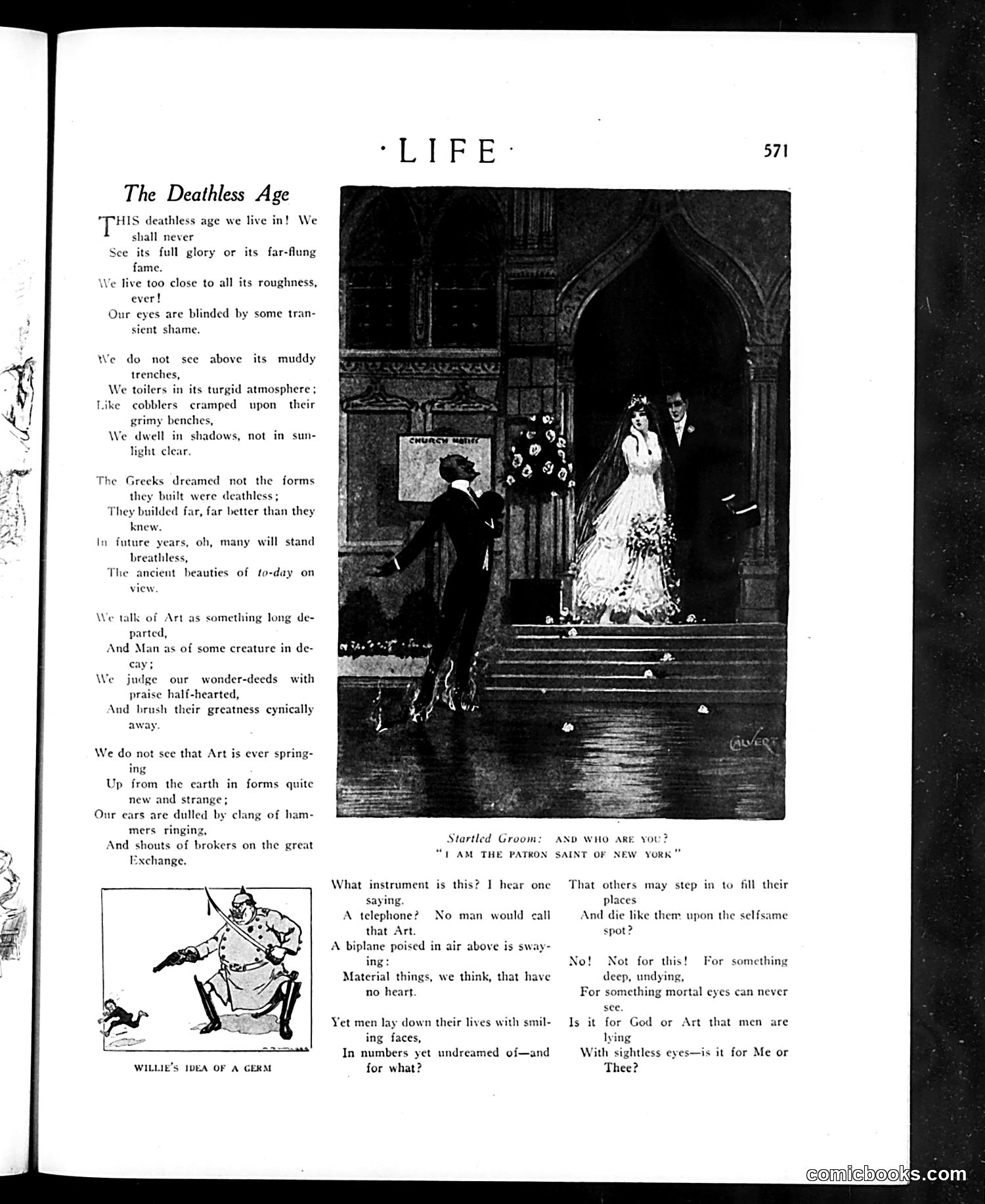
This page presents a philosophical poem critiquing modern society's inability to recognize its own cultural achievements. "The Deathless Age" argues that ordinary people—laborers, cobblers—live too immersed in daily drudgery to appreciate the era's greatness. The poem suggests future generations will admire what we dismiss today, just as the Greeks unknowingly built immortal works. The accompanying photograph shows a wedding scene at what appears to be a church entrance, captioned with a "Startled Groom" dialogue where the groom identifies himself as "the patron saint of New York." This appears satirical—juxtaposing an ordinary wedding with grandiose self-importance. The small cartoon "Willie's Idea of a Germ" offers comic relief. The page's core message: modernity's cynicism and materialism (telephone, airplane, stock exchange) blind us to genuine human values—the sacrifice and art transcending commercial life. We cannot see the sacred within our own time.
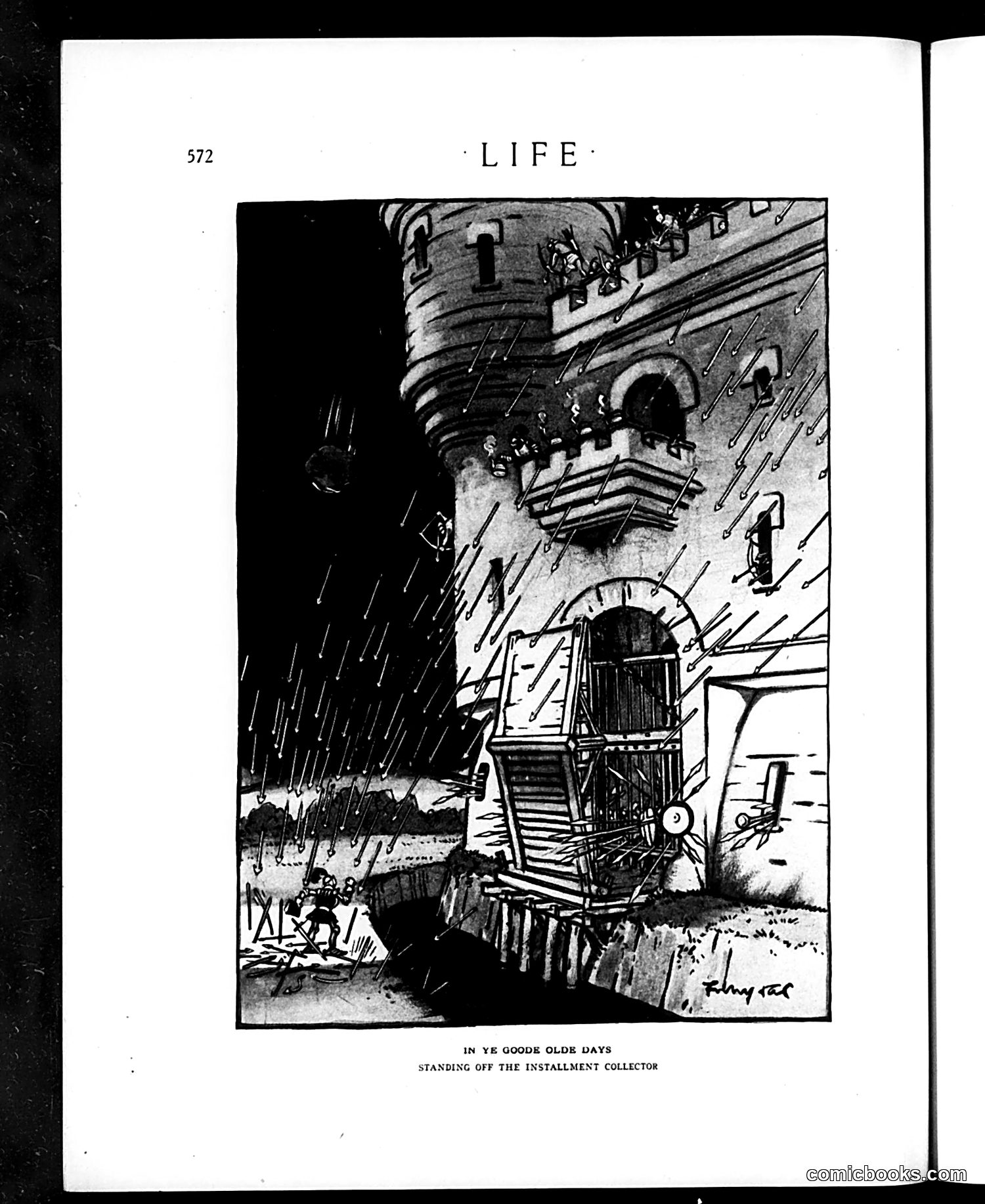
This satirical cartoon depicts a medieval castle tower being used as a refuge from debt collection. The humor relies on anachronism: a person appears to be hiding inside a fortified tower to avoid an "installment collector"—a figure who would come demanding payment for goods purchased on credit. The joke critiques modern consumer debt culture by imagining it transplanted to "ye goode olde days" of medieval times. It suggests that avoiding payment obligations is so difficult in contemporary society that one would need castle fortifications to escape creditors. The cartoon satirizes both the aggressive debt-collection practices of the era and consumers' desperation to evade financial responsibilities through any means necessary—even absurdly anachronistic ones.
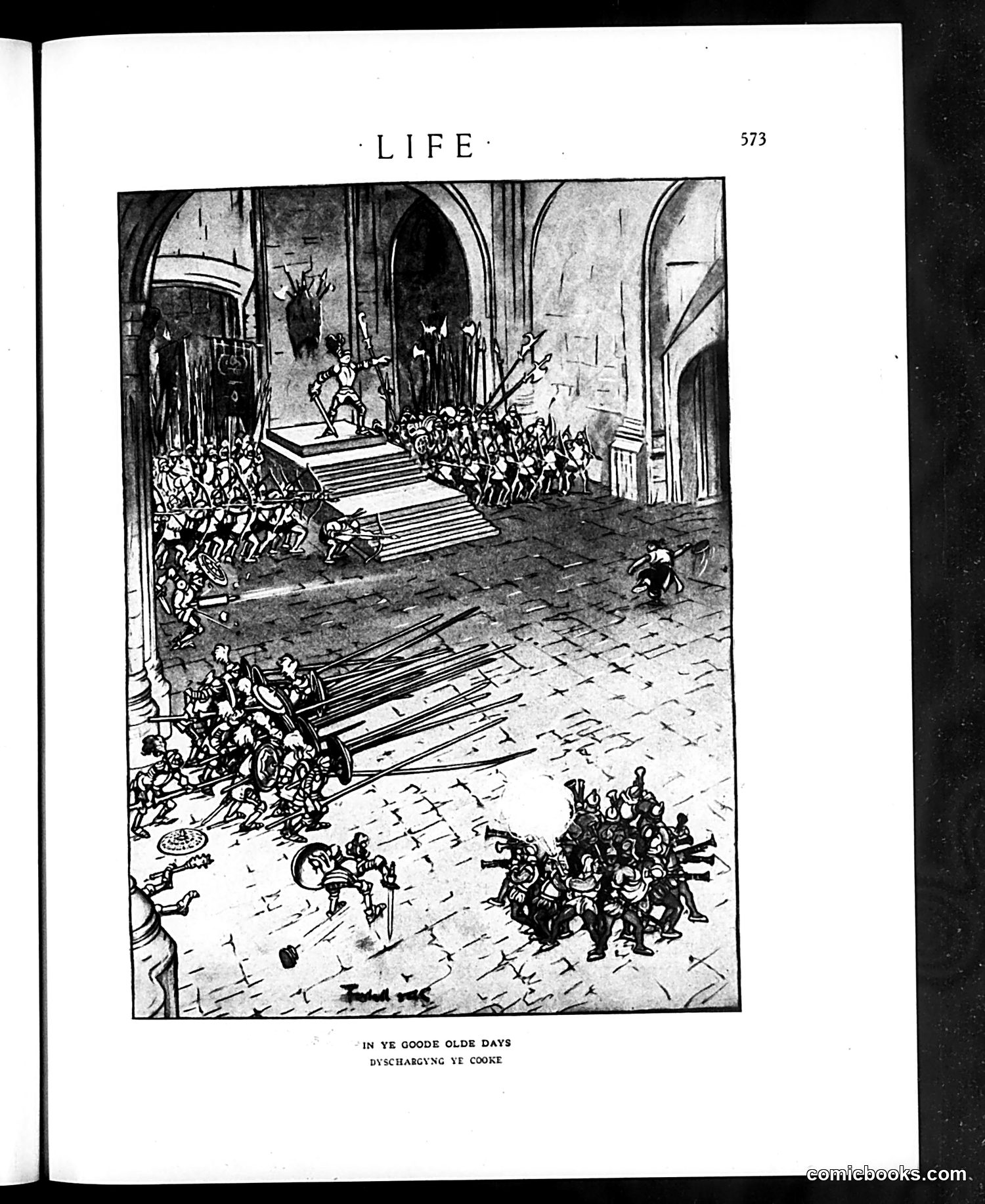
This is a satirical illustration titled "In Ye Goode Olde Days: Dyschargyng Ye Cooke" (Discharging the Cook), presented in mock-archaic language. The cartoon depicts a medieval or Renaissance cathedral interior where what appears to be a cook or servant is being violently expelled or executed by armed guards and nobility. Multiple figures with weapons surround the scene while onlookers watch from galleries above. The satire likely mocks the casual brutality of historical "good old days"—a common target of early 20th-century American humor. By presenting extreme violence against a servant in antiquated style, the cartoon critiques romanticized nostalgia for the past, suggesting that prior eras were actually far less civilized or humane than contemporary society. The joke plays on the contrast between nostalgic idealization and historical reality.
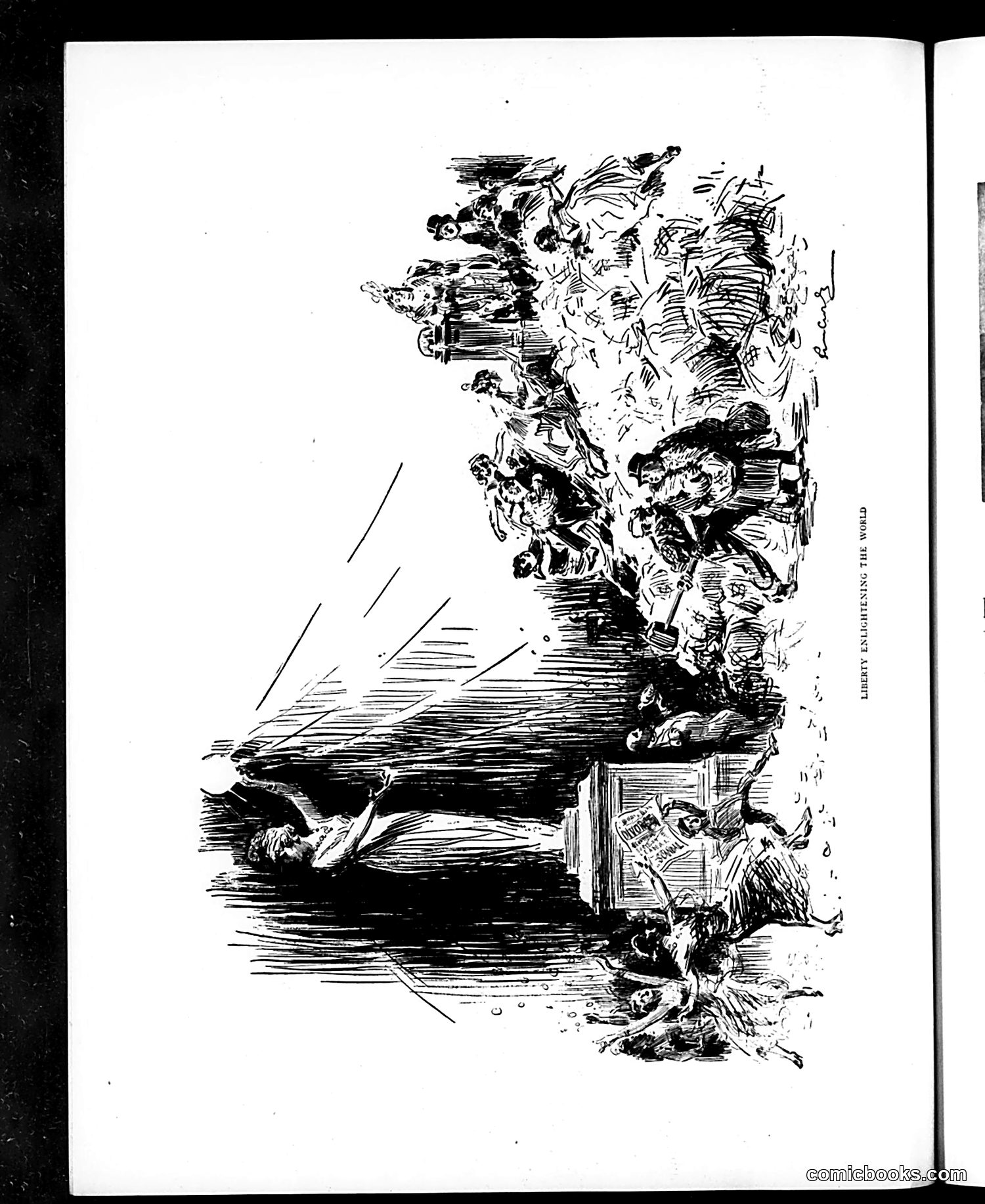
This page appears to be rotated 90 degrees, making full interpretation difficult. What's visible is a satirical ink illustration showing a chaotic scene with multiple figures in what appears to be an interior setting. There's a large central figure or form, surrounded by smaller characters in animated poses suggesting commotion or disturbance. The text header reads "LIBERTY EMBARGOES THE WORLD," indicating the cartoon comments on American trade or foreign policy restrictions—likely referencing an embargo or trade war. The Liberty reference suggests personification of American ideals or policy. However, without being able to read the full caption text clearly and given the image's orientation, I cannot confidently identify specific historical figures or provide the precise political context this satire addresses. The style appears consistent with early-to-mid 20th century Life magazine political cartoons.
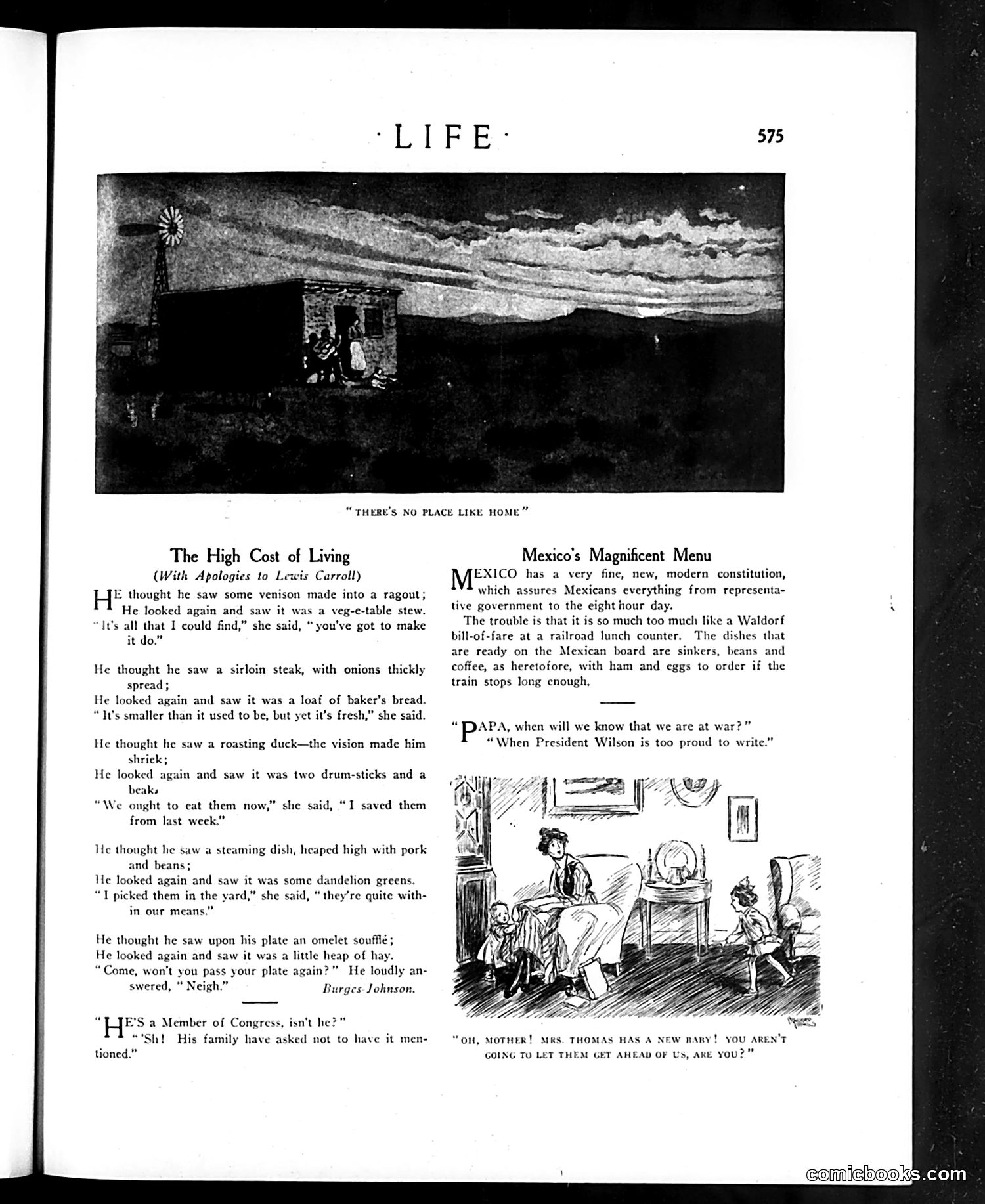
**Main Satire: "The High Cost of Living"** This parodies Lewis Carroll, depicting a husband repeatedly misperceiving meager wartime food as luxurious dishes. His wife reveals each "vision" is actually cheap substitutes—stew instead of venison, bread instead of steak, drumsticks instead of duck, dandelion greens instead of pork. The final joke: when offered an "omelet soufflé," he neighs like a horse, suggesting even he has become animal-like from deprivation. This satirizes severe food rationing and inflation during what appears to be World War I. **Secondary Satire: "Mexico's Magnificent Menu"** Mocks Mexico's new constitution as offering grand promises (representative government, eight-hour workday) while actual conditions remain primitive—only beans, coffee, and ham-and-eggs available. The joke about President Wilson being "too proud to write" references U.S.-Mexico tensions. **Bottom Cartoon** A domestic humor piece about competitive childbearing, unrelated to the political satire above.
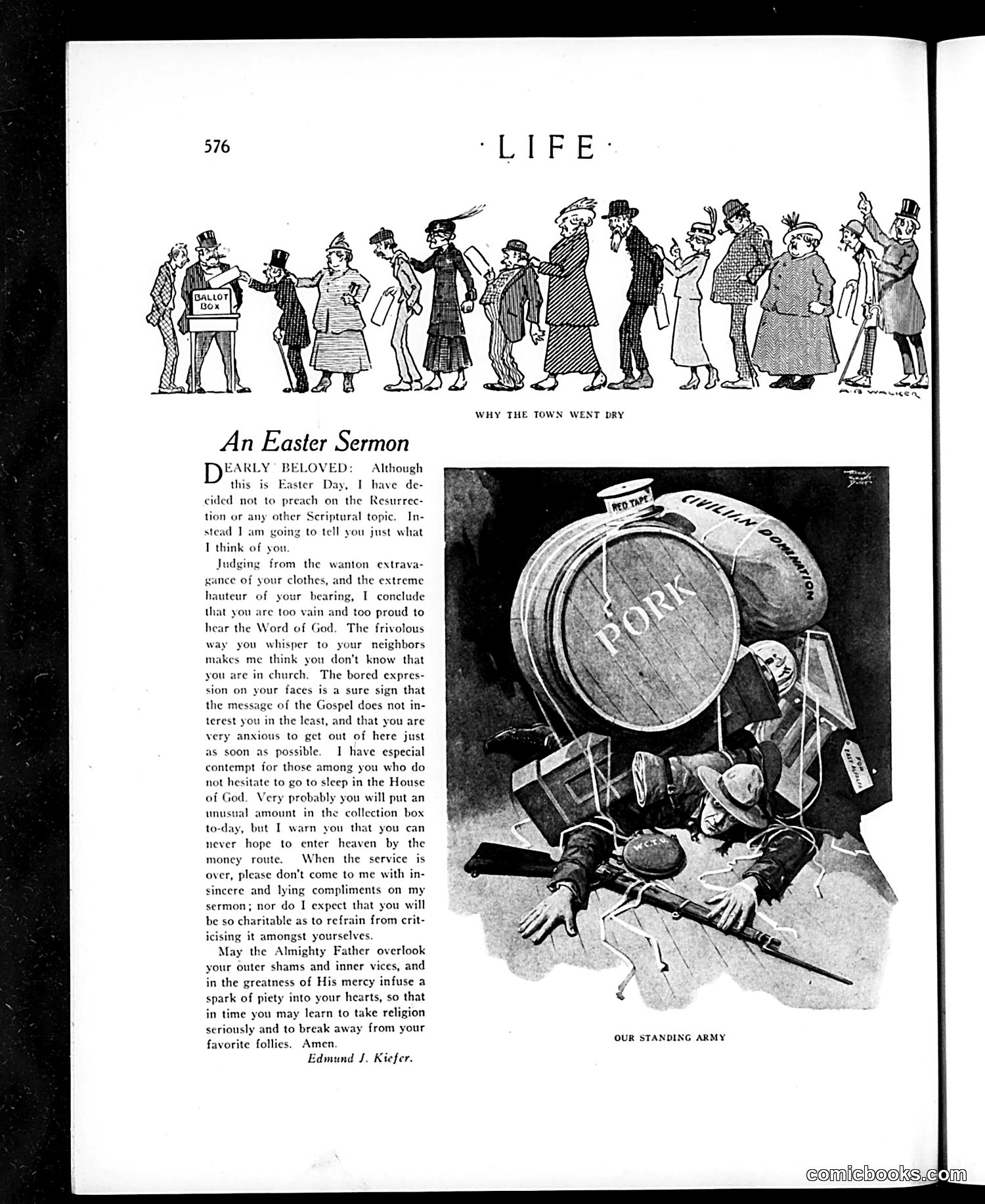
**"An Easter Sermon"** is a satirical piece by Edmund J. Kiefer attacking Easter churchgoers for superficial religious observance. The minister narrator condemns congregation members for vanity (extravagant clothing), inattention (whispering, sleeping), boredom, and hypocrisy—particularly contributing money while showing no genuine piety. The sermon mocks the "money route" to heaven, suggesting these Easter attendees treat church as a social obligation rather than spiritual practice. **"Why the Town Went Dry"** (top cartoon) depicts various townspeople lined up, appearing to show the consequences of Prohibition—the ban on alcohol enacted in 1920. The "Our Standing Army" illustration (bottom) shows a barrel labeled "PORRIDGE" surrounded by empty bottles and cans, likely satirizing how Prohibition affected food supplies or quality of life, or mocking substitutes for alcohol during the ban. Together, the page critiques both religious hypocrisy and Prohibition's social impact.
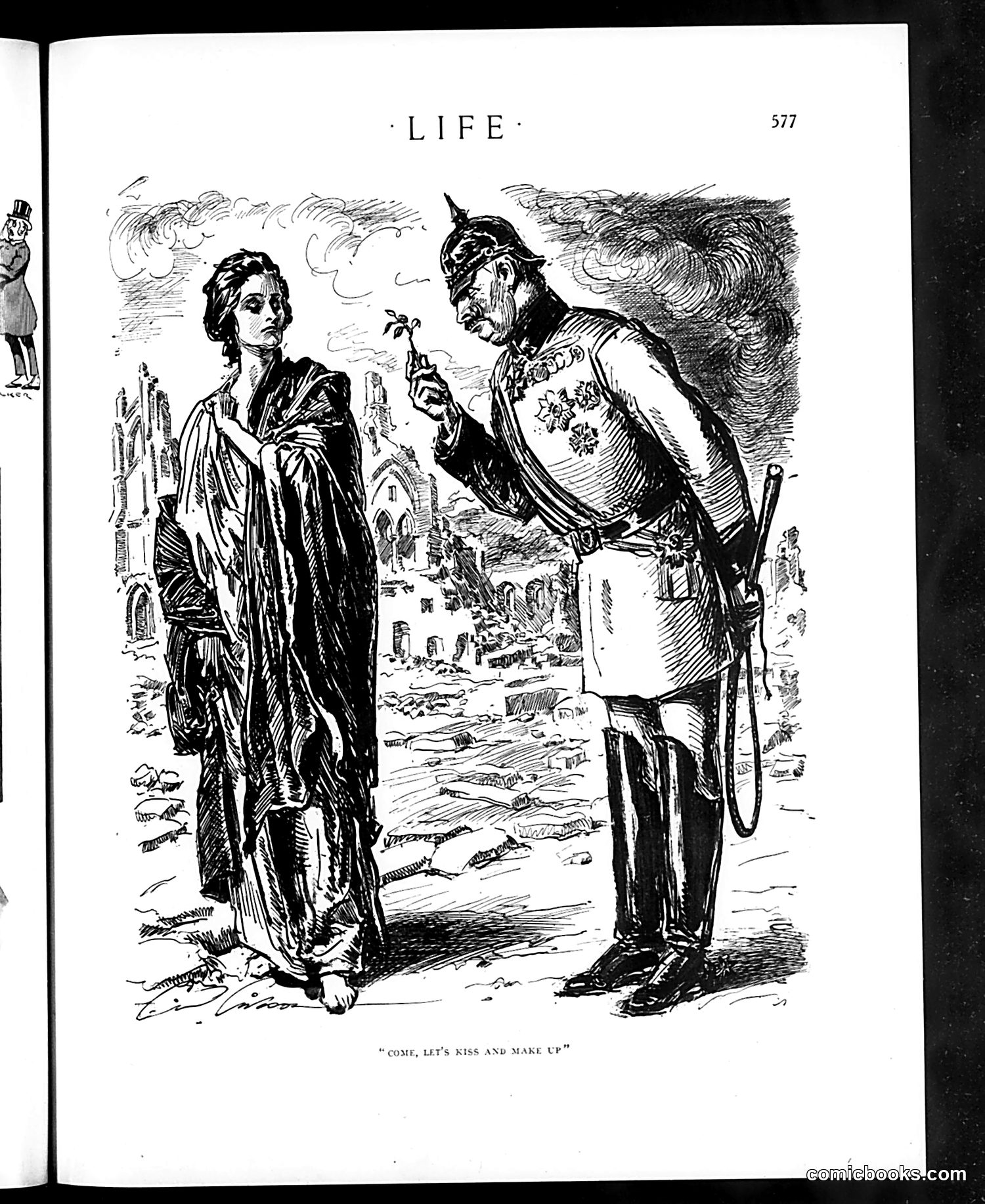
This single-panel cartoon depicts two figures in a war-torn landscape with destroyed buildings. On the left stands a woman in classical draped clothing; on the right, a military officer in uniform with decorations and a spiked helmet (suggesting German or Prussian military dress). The caption reads: "COME, LET'S KISS AND MAKE UP" **The satire**: This appears to be commentary on post-war reconciliation, likely following World War I. The woman likely represents a nation or civilian population, while the uniformed officer represents militarism or an aggressor nation. The ironic caption mocks the notion that warfare's devastation can be casually resolved through reconciliation, when the landscape behind them shows complete destruction—a bitter commentary on the naiveté of peace proposals or the difficulty of moving past such destruction.
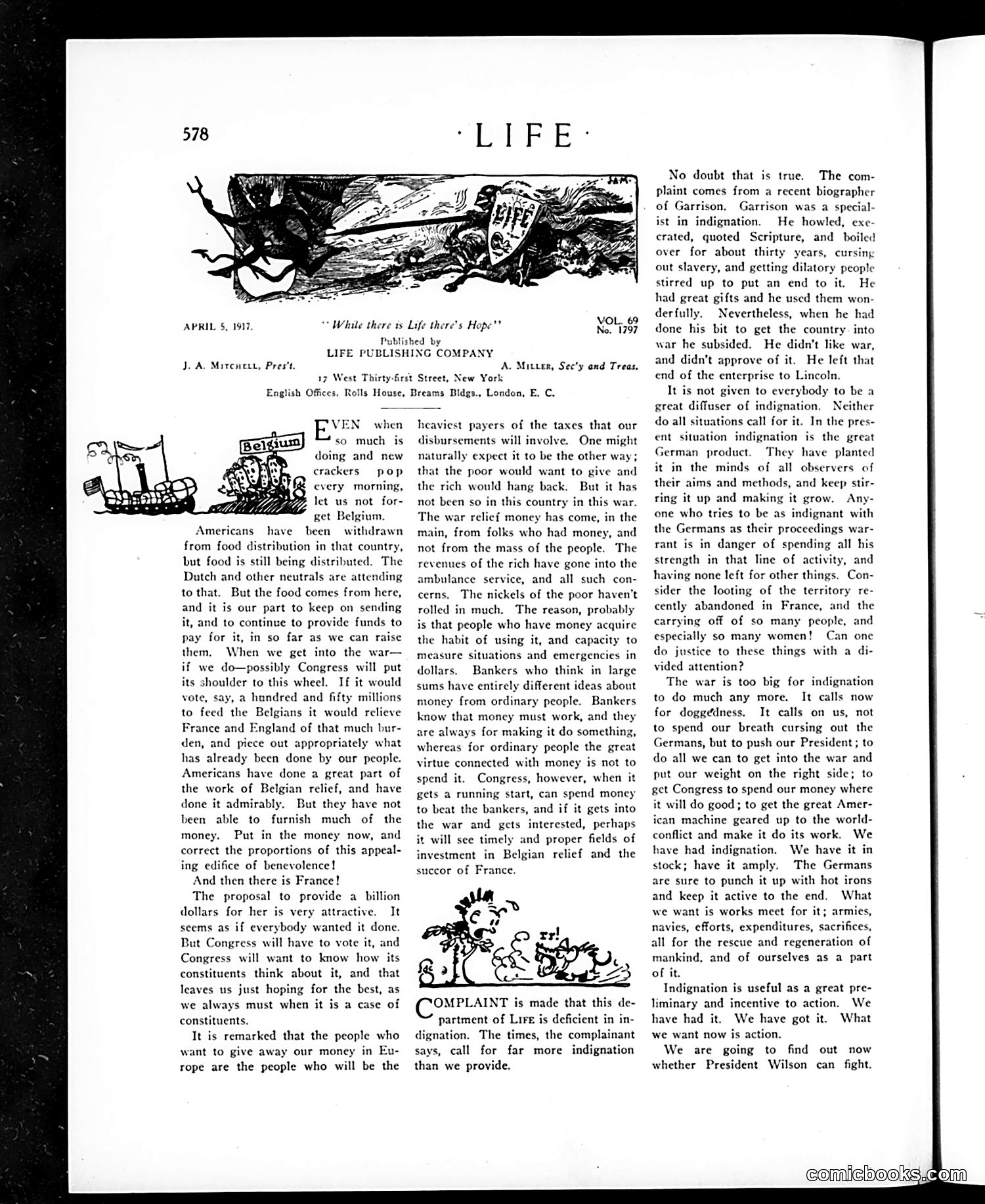
This page discusses American wartime charity and indignation during World War I. The main cartoon (top) depicts a sinking ship labeled "Belgium," illustrating the humanitarian crisis driving relief fundraising. The editorial argues that wealthy Americans have generously funded Belgian relief and proposed French aid, contrary to expectations—the rich, not poor, are donating. It urges Congress to appropriate funds ($150 million for Belgium, $1 billion for France) to share this burden. A secondary discussion addresses criticism that the magazine lacks sufficient "indignation." The author cites abolitionist William Lloyd Garrison as a historical example of righteous anger, but notes that even Garrison abandoned fiery rhetoric after slavery's abolition rather than pursue war matters further. The piece advocates for action over mere outrage, calling for Congressional funding to support Allied nations rather than relying solely on private American charity.
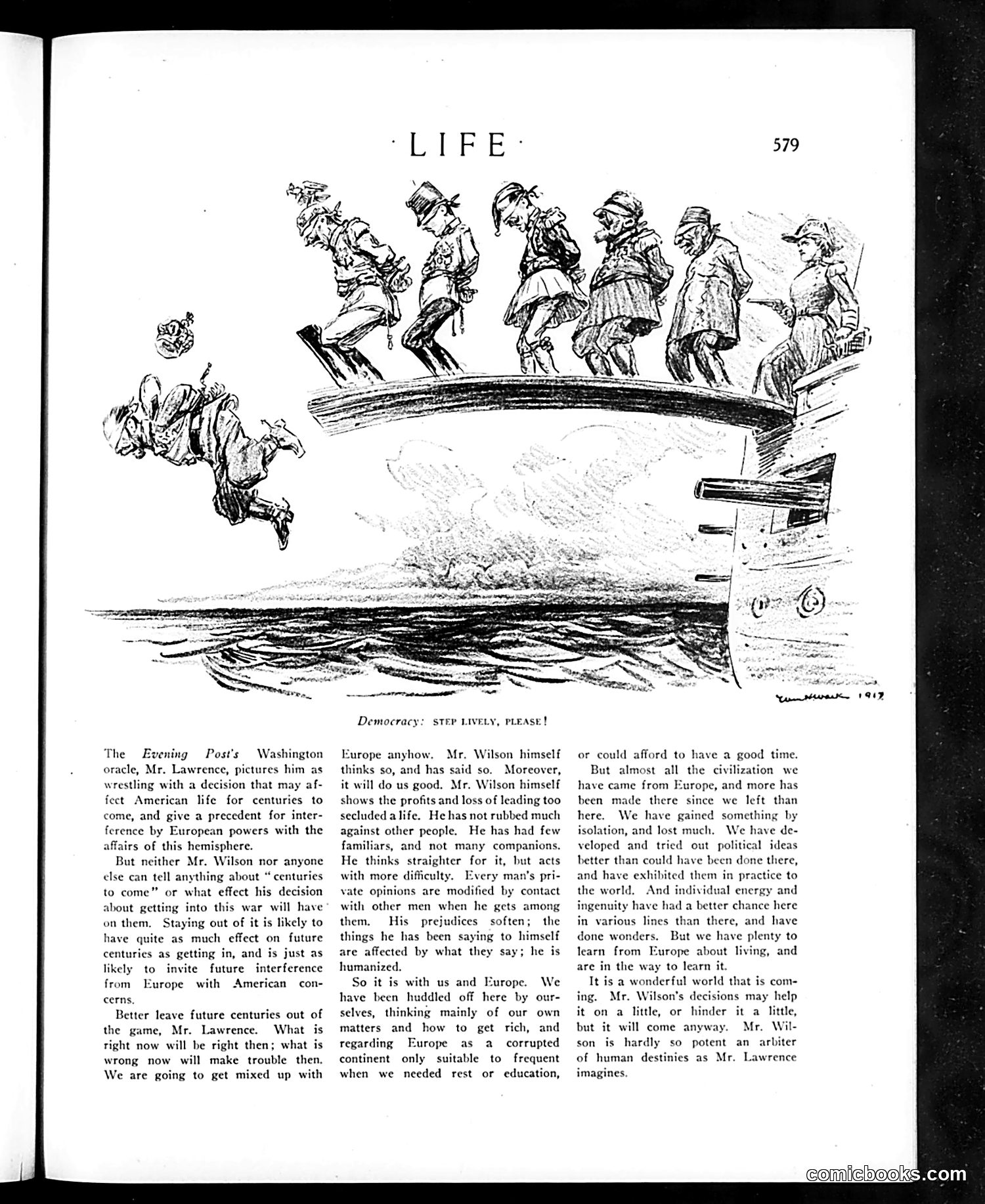
This 1917 cartoon satirizes the debate over American entry into World War I. The image shows six figures balanced precariously on a plank labeled "Democracy," teetering over water—representing the political establishment struggling with the decision to enter the war. The accompanying article critiques Mr. Lawrence's (likely of the *Evening Post*) argument against intervention. Lawrence claimed staying neutral would set a precedent protecting American interests for centuries. Life's editors counter that this argument is overly grandiose and that President Wilson—depicted as isolated and inexperienced with other nations—would actually benefit from European contact and influence. The cartoon's caption "Step lively, please!" suggests politicians must act carefully on this precipice. The satire mocks both isolationist concerns and the pretentious reasoning used to justify foreign policy decisions, implying America will inevitably enter the war regardless of philosophical arguments.
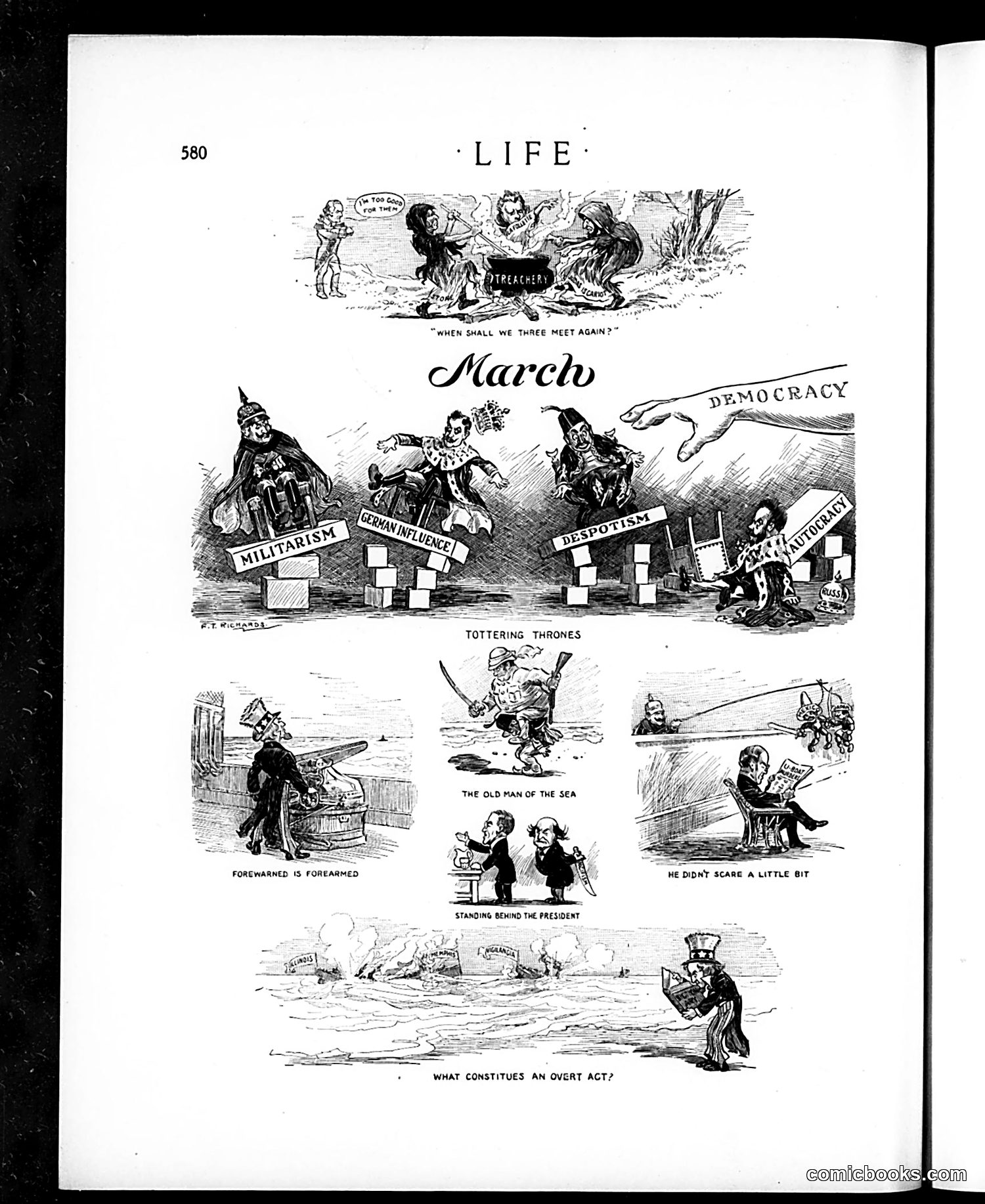
This page satirizes political instability during March (likely early 20th century). The top cartoon, "Tottering Thrones," depicts monarchs labeled Militarism, Sentimental Violence, and Despotism sitting on unstable thrones while Democracy's hand reaches down—suggesting European monarchies are collapsing under their own contradictions while democratic forces advance. Below are smaller vignettes using nautical and military metaphors: "The Old Man of the Sea" (burden of governance), "Forewarned is Forearmed" (military preparedness), and "Standing Behind the President" (political support). The final panel, "What Constitutes an Overt Act?," shows a figure in turbulent waters—likely commentary on defining aggressive military action during a period of international tension. The overall message critiques authoritarian regimes while championing democratic ideals.
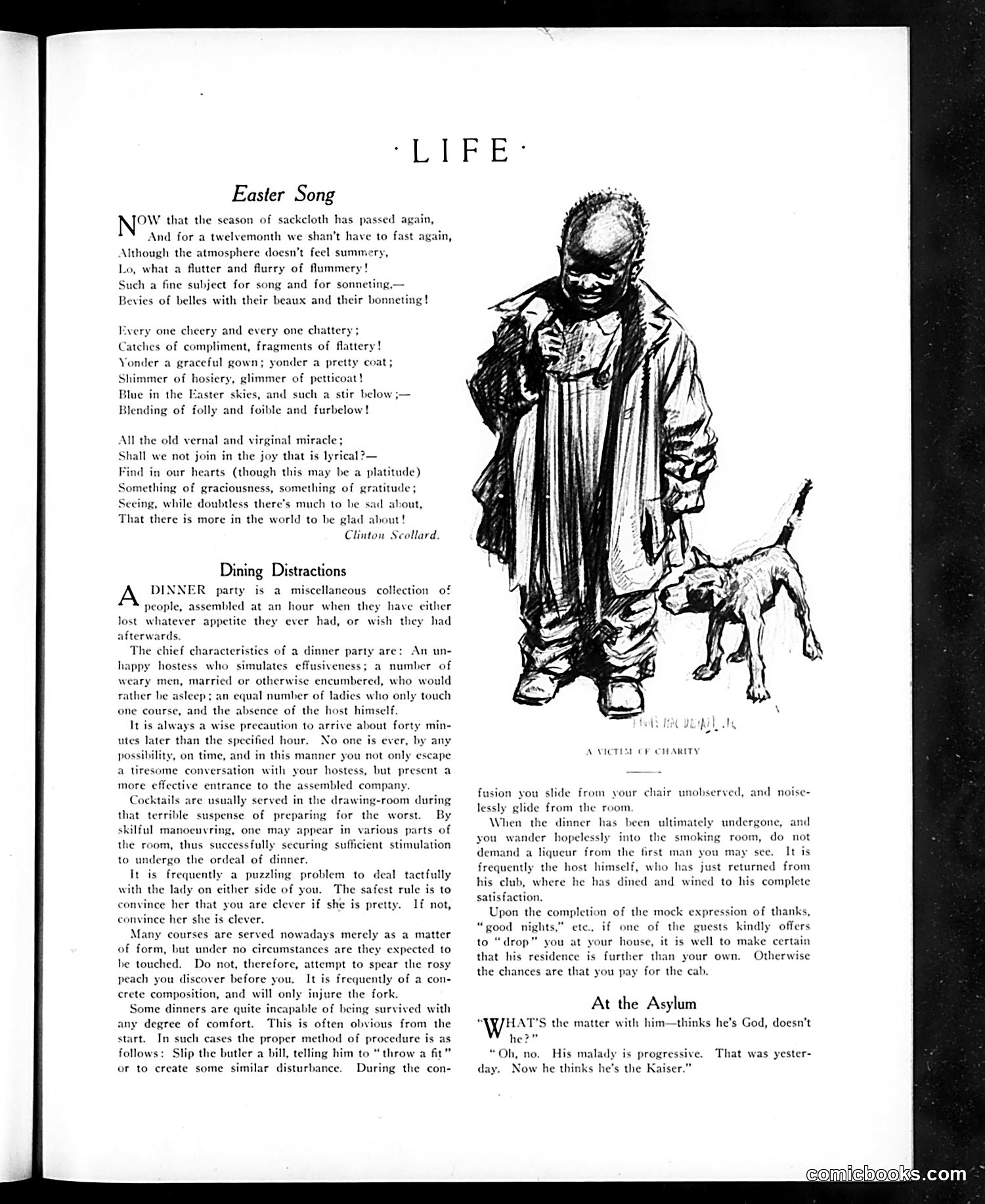
This page from early-20th-century *Life* contains three pieces of satirical content: **"Easter Song"** by Clinton Scollard celebrates Easter's end of Lenten fasting with lighthearted verse about spring fashions and social gaiety—typical upper-class concerns. **"Dining Distractions"** offers biting social satire about dinner parties: guests arrive late, pretend to enjoy themselves, women barely eat, men are exhausted, and hosts are absent. The advice to bribe a butler to fake a disturbance to escape is darkly humorous commentary on how tedious these social obligations were. **The illustration** labeled "Victim of Charity" depicts a raggedly-dressed poor man with a dog, presumably representing someone helped by charity efforts—possibly critiquing performative charity or the grim reality of poverty. **"At the Asylum"** is a brief joke about a mental patient's delusions progressing from thinking he's God to thinking he's the Kaiser—likely satirizing German imperial ambitions or war-era anxieties. The page satirizes upper-class social rituals, charity attitudes, and contemporary politics through humor.
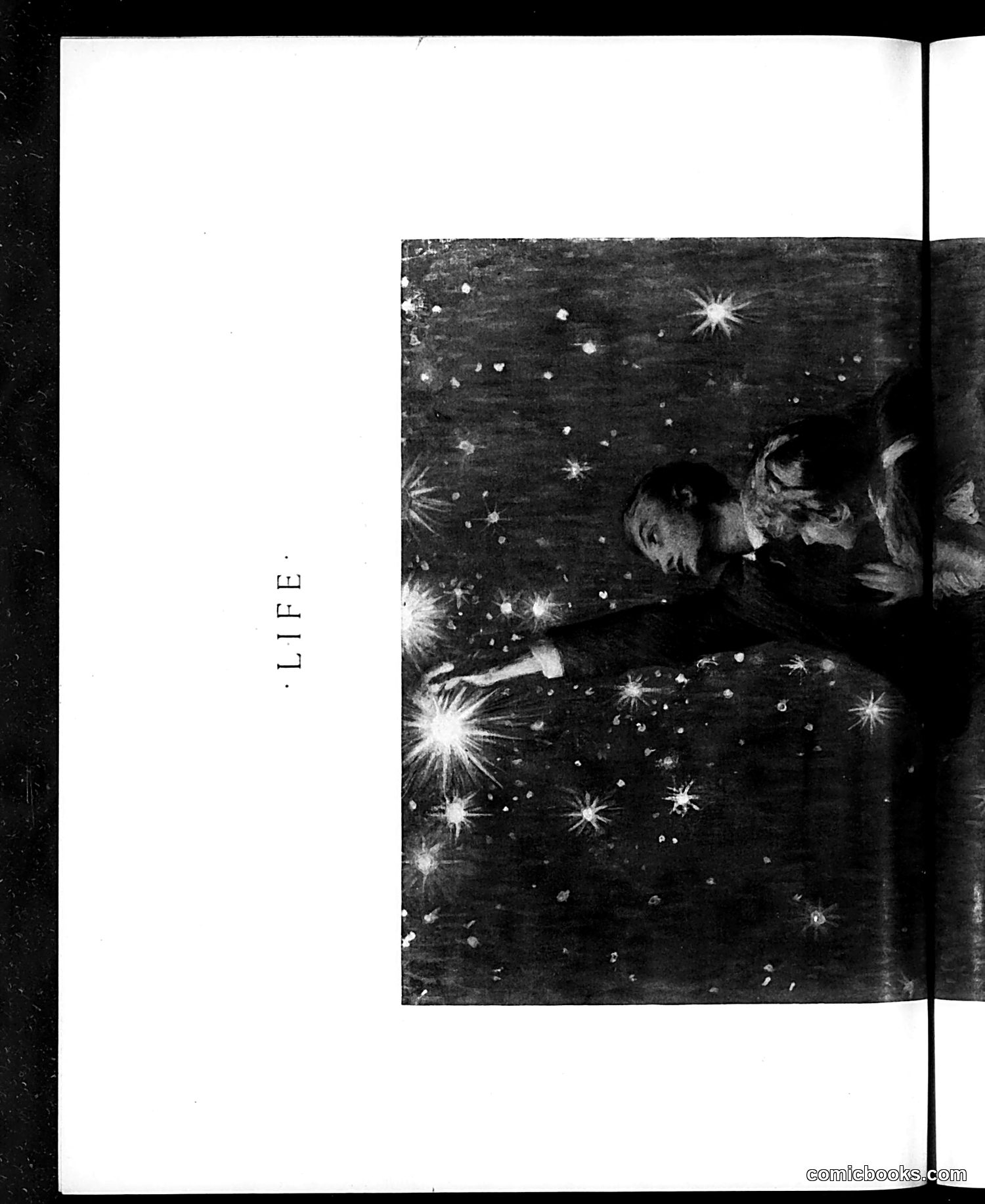
This appears to be a title page or section divider from *Life* magazine, marked simply with the word ".LIFE" on the left side. The right side contains a black and white photograph showing what appears to be children looking up at a night sky filled with stars and celestial imagery. The stars are rendered with bright, radiating lines creating a sense of wonder and magic. Rather than political satire or social commentary, this seems to be inspirational or poetic content—likely introducing a section about childhood wonder, astronomy, dreams, or aspirations. Without accompanying text or captions visible in the image, the specific satirical point (if any exists) remains unclear. This may simply be an artistic or editorial feature rather than a cartoon with explicit commentary.
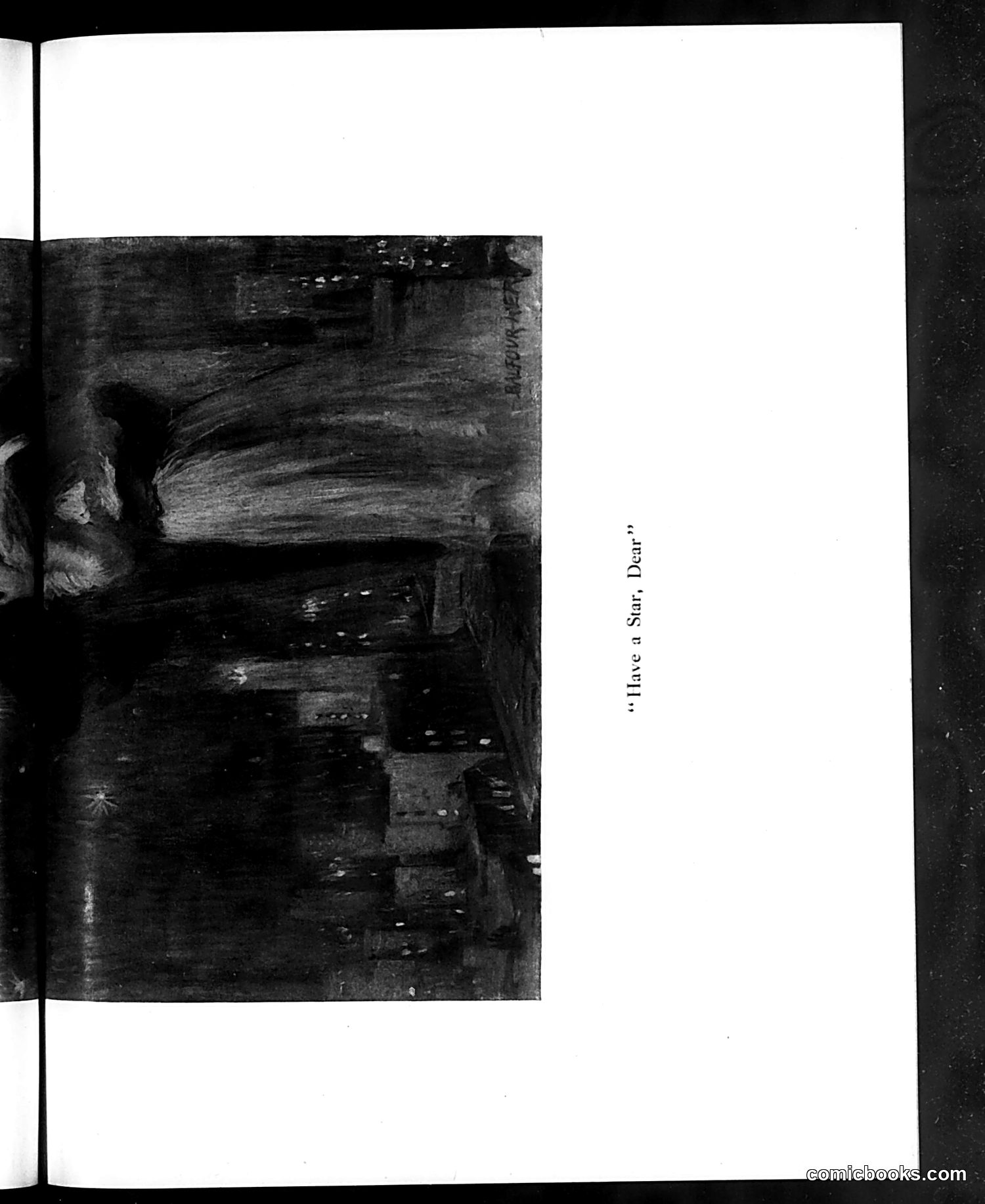
This page appears to be from Life magazine and shows a dark, atmospheric photograph or illustration titled "Hive a Sour, Dear" (text visible on the right side). The image itself is quite dark and unclear, showing what appears to be an interior architectural space with various structural elements, possibly stairs or platforms, rendered in high contrast black and white. Without clearer visibility of the image details or additional context clues, I cannot definitively identify the specific political or social satire intended. The OCR text at the bottom is largely illegible. To properly explain this cartoon's meaning to a modern reader, I would need either a clearer image or more legible accompanying text that provides historical context.
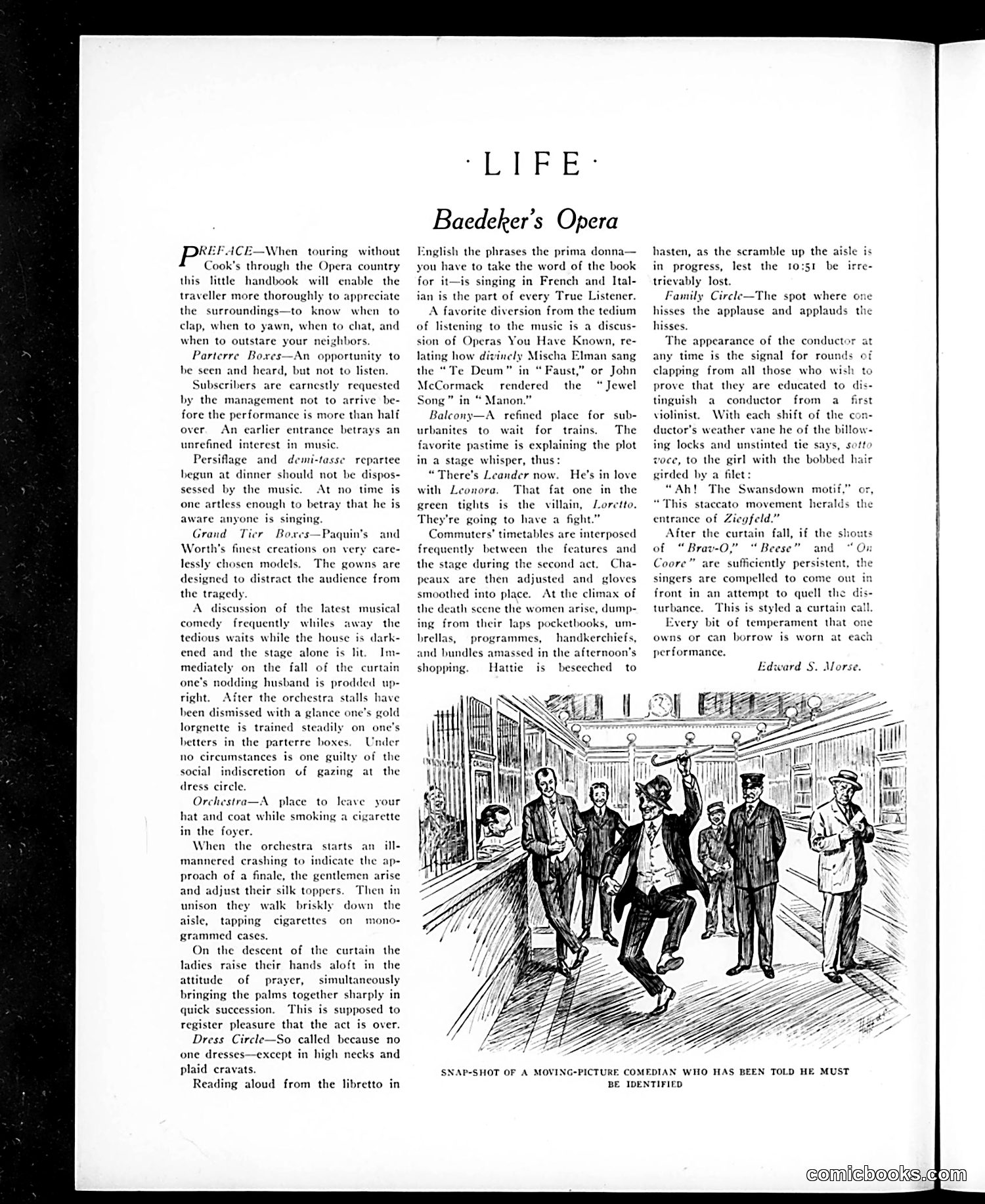
This piece is a humorous mock-guidebook mocking pretentious opera-goers and their affected behaviors. Each section ridicules different seating areas and the social posturing found there. The satire targets wealthy patrons in premium boxes who attend opera to be *seen* rather than to listen—arriving late, gossiping, and using lorgnettes to judge others' fashion. The "Dress Circle" attendees paradoxically ignore dress codes. The "Balcony" crowd are suburban commuters checking train schedules during performances. The accompanying illustration shows well-dressed men in the opera house corridors, likely depicting the social performance and networking that occurs. The piece mocks the pretension of music-lovers who recite opera trivia, applaud conductors to appear educated, and treat the opera as social theater rather than an artistic experience. The title references Baedeker's travel guides, framing opera attendance as just another tourist obligation to perform correctly in polite society.
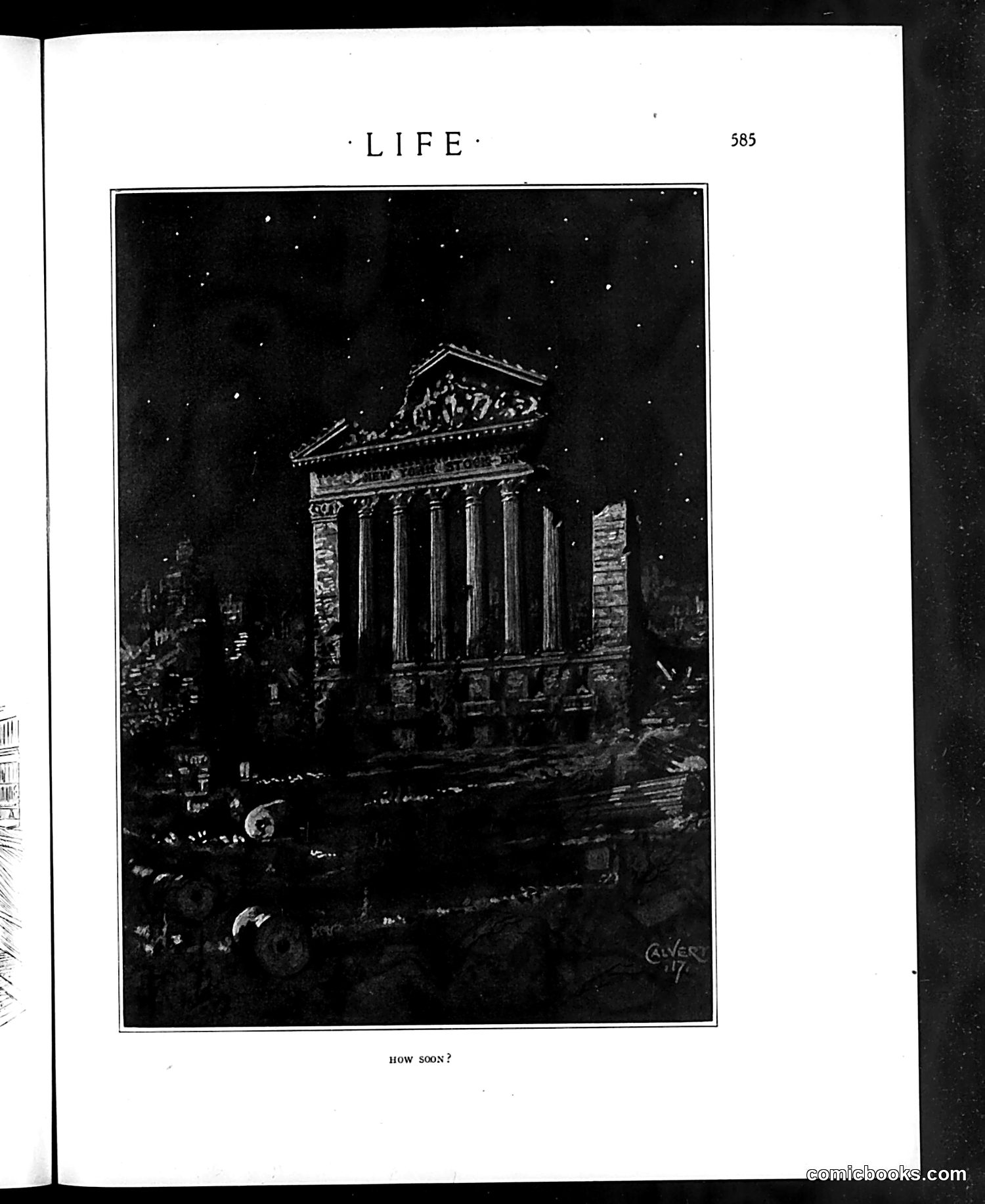
This dark cartoon depicts a Greek or Roman temple (with classical columns and triangular pediment) illuminated against a starry night sky, surrounded by what appears to be a threatening mob or army at ground level. The single caption—"HOW SOON?"—poses an ominous question. The image likely comments on the vulnerability of classical civilization, democratic institutions, or established order to destruction or overthrow. The temple symbolizes permanence and cultural/political stability, while the shadowy masses below represent an imminent threat. Without additional context about Life magazine's publication date, the specific historical moment remains unclear, but the tone suggests anxiety about social upheaval or institutional collapse.
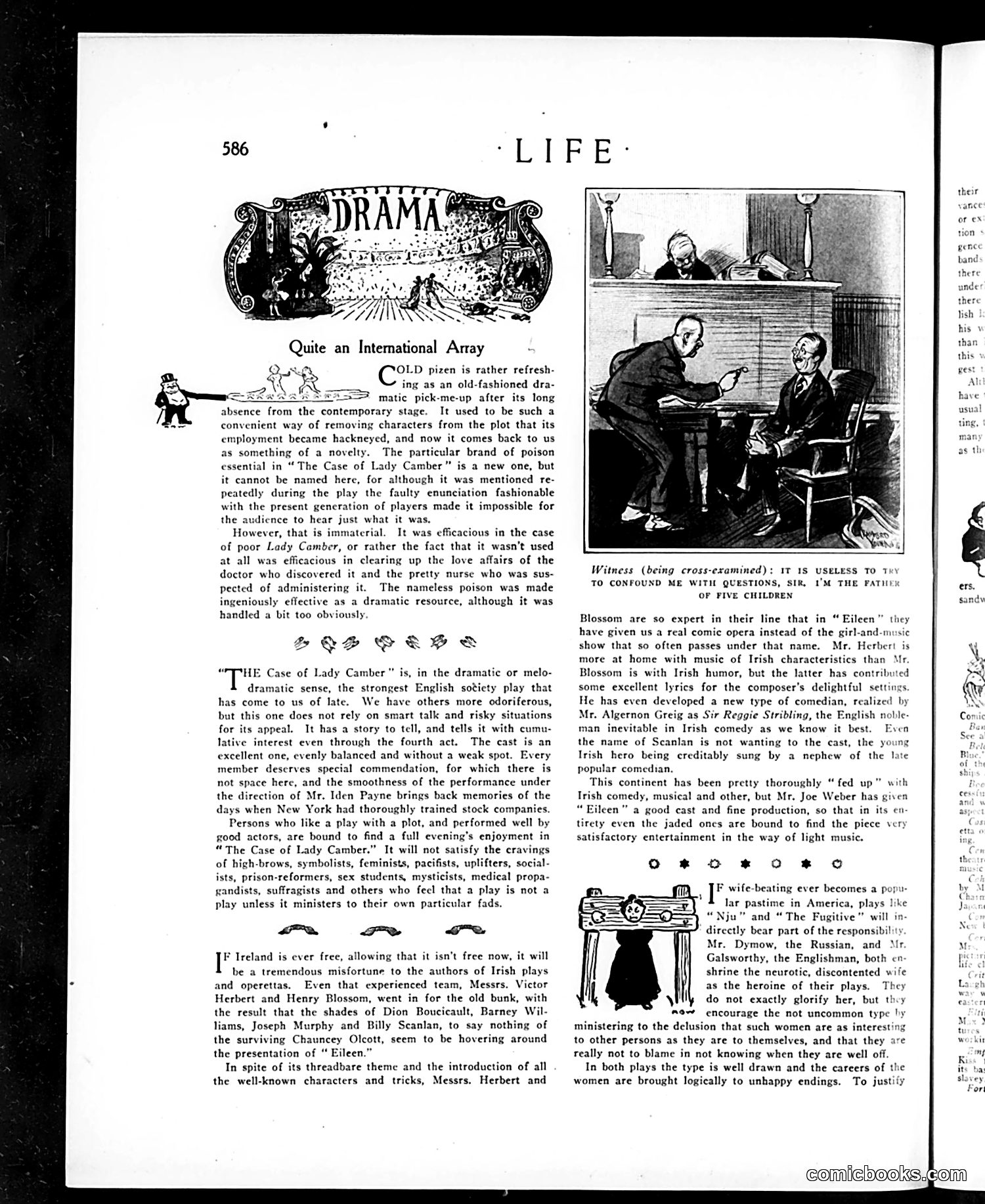
This page reviews two theatrical productions: "The Case of Lady Camber" and "Eileen." **The cartoon** (top right) shows a courtroom witness being cross-examined. The caption jokes that questioning this witness is pointless—he's "the father of five children," implying his parental authority makes him immune to intimidation or contradiction. It's a contemporary gag about paternal dignity superseding legal procedure. **The drama criticism** discusses a society play featuring poison as a plot device—a tired theatrical convention the reviewer notes has made a comeback. The review praises the cast and direction while sarcastically dismissing it won't appeal to "high-brows, symbolists, feminists, pacifists" and other ideological audiences. **The "Eileen" section** reviews an Irish-themed comic opera by Herbert and Blossom, praising their craftsmanship despite relying on stereotypical Irish characters and plots. The reviewer notes the genre's dependence on Irish settings as almost inevitable. The page reflects early 20th-century theatrical criticism and period attitudes toward Irish-American entertainment and gender roles.
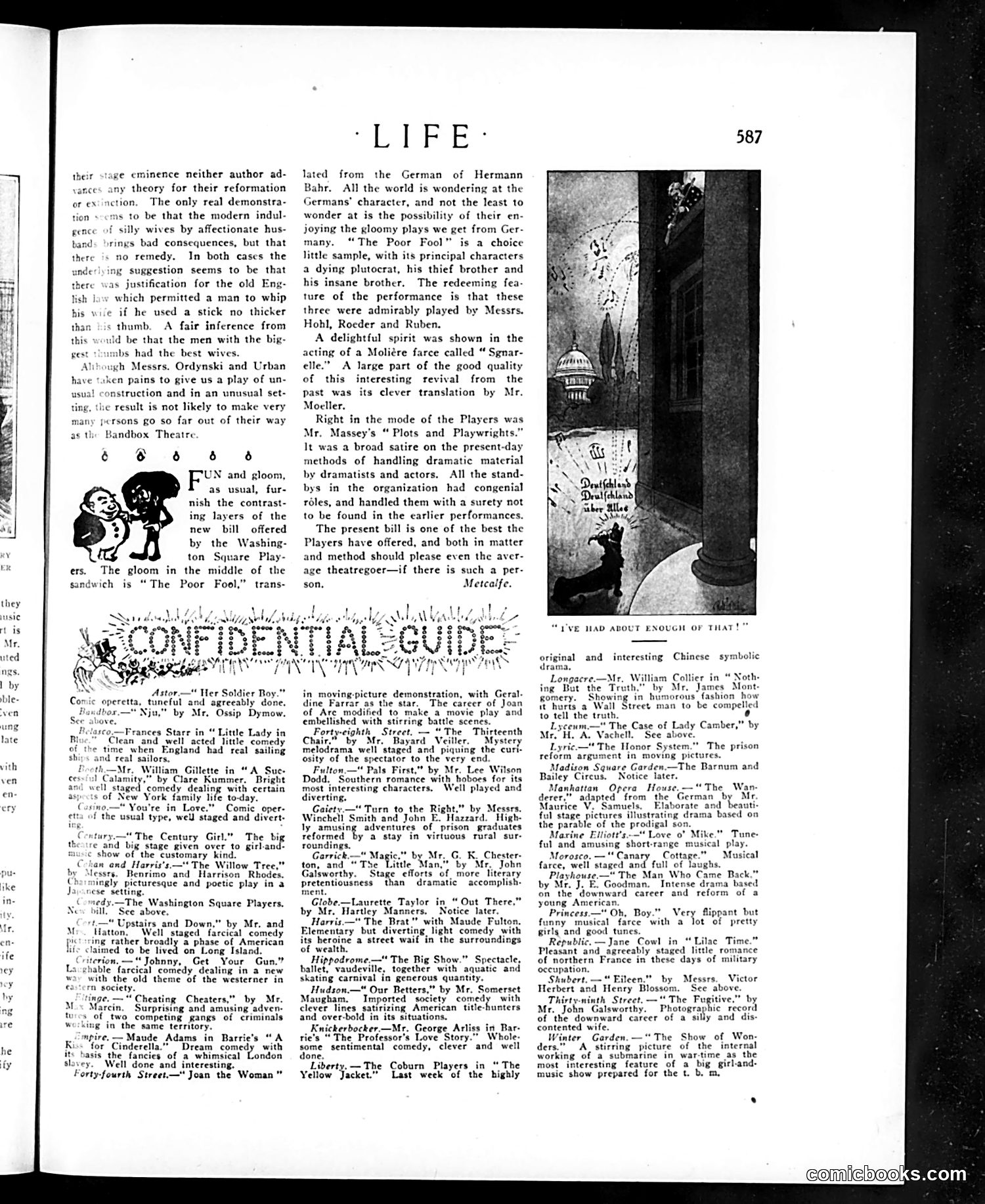
This page reviews current Broadway productions. The small cartoon (left) depicts a couple in conflict, illustrating the magazine's satirical commentary on modern marriage. The text discusses plays including "The Poor Fool" (translated from German), which features depressing characters: a dying plutocrat and his criminal/insane brothers. Life pokes fun at Germans' tolerance for gloomy drama. The review also covers lighter fare—a Molière farce and "Plots and Playwrights," a meta-theatrical satire about how dramatists and actors handle material. The cartoon's caption "I've Had About Enough of That!" references the text's discussion of "silly wives" and husbands, alluding to old English law permitting wife-beating with thin sticks. Life sarcastically suggests only men with "biggest limbs had the best wives"—dark humor mocking both domestic abuse and contemporary marriage dynamics.
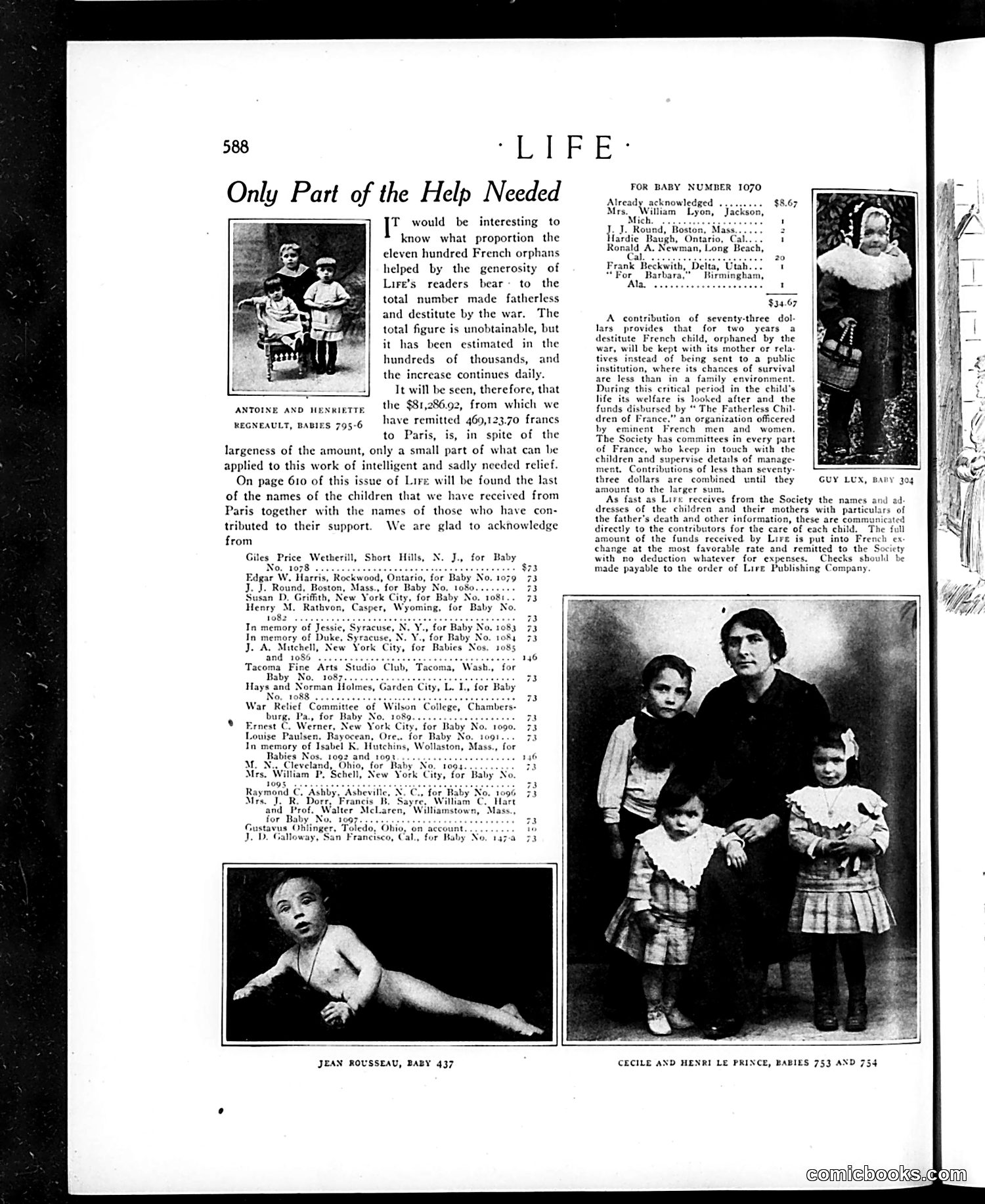
This page documents **Life magazine's fundraising campaign for French war orphans** following World War I. The article acknowledges donors who contributed to support orphaned children, noting that while readers have generously donated over $81,000, this represents "only a small part" of the hundreds of thousands of children made destitute by the war. The photographs show **representative orphans being aided**: Antoine and Henriette Regneault (ages 795-6, likely meaning their case numbers), Jean Rousseau, and Cecile and Henri Le Prince. The satirical point is implicit: **American charitable giving, however substantial, cannot solve a humanitarian crisis of this magnitude**. The magazine is both praising reader generosity and gently critiquing the inadequacy of private charity to address large-scale war devastation. The detailed accounting of contributions underscores Life's transparency while emphasizing the vastness of unmet need.
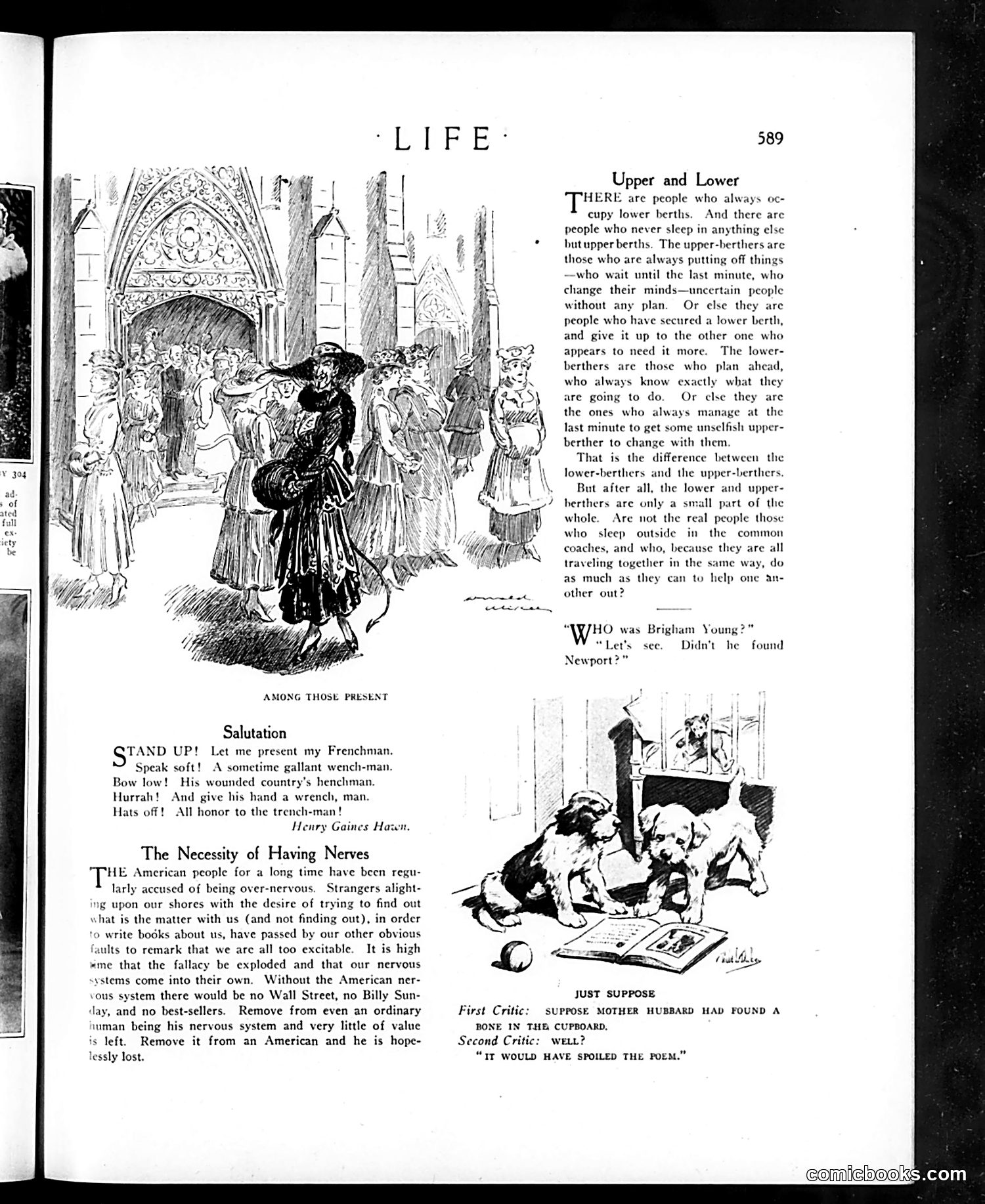
This page contains three distinct humor pieces: **"Upper and Lower"**: A philosophical essay contrasting train berth preferences as character types—upper-berth sleepers as indecisive procrastinators versus lower-berth sleepers as planners. The joke concludes that truly good people are those in common coaches who help fellow travelers. It's gentle social commentary on American character types, likely referencing the prevalence of train travel in this era. **"Who was Brigham Young?" joke**: A brief gag about confusing the Mormon founder with Newport (the wealthy Rhode Island city), suggesting cultural or geographical ignorance. **"Just Suppose"**: A cartoon showing dogs examining a book titled "Mother Hubbard," with critics debating whether finding a bone in the cupboard would ruin the nursery rhyme's narrative. It's meta-humor about literary criticism. The page reflects early-20th-century American satirical style, targeting everyday social pretensions and intellectual absurdity rather than specific political figures.
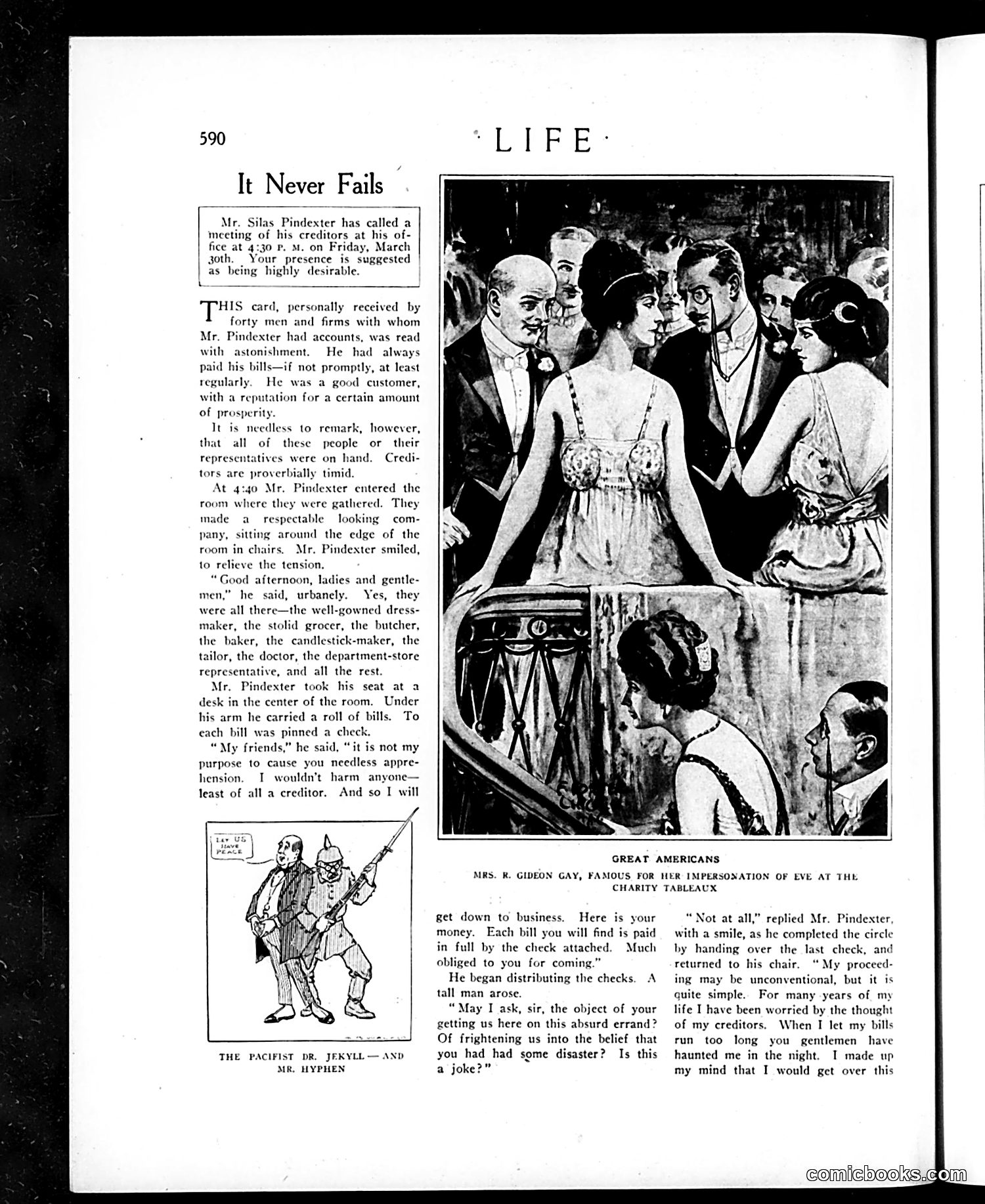
This satirical story mocks the anxiety businessmen felt about owing money. Mr. Pindexter, a merchant with a solid reputation, summons his creditors (people and businesses he owes money to) to his office, creating dread among them—creditors are "proverbially timid" and fear bad news. The joke: Pindexter has gathered them merely to *pay them in full*. His unconventional method reveals the absurdity of his own psychological burden. He's been haunted by guilt over debts, even though he always paid regularly. By dramatically assembling creditors and immediately settling accounts, he symbolically purges his anxiety about owing money. The small cartoon below shows "Dr. Jekyll and Mr. Hyphen"—a pacifist split personality, though its connection to the main story is unclear. The page also features a "Great Americans" portrait of Mrs. R. Gideon Gay, famous for theatrical performances.
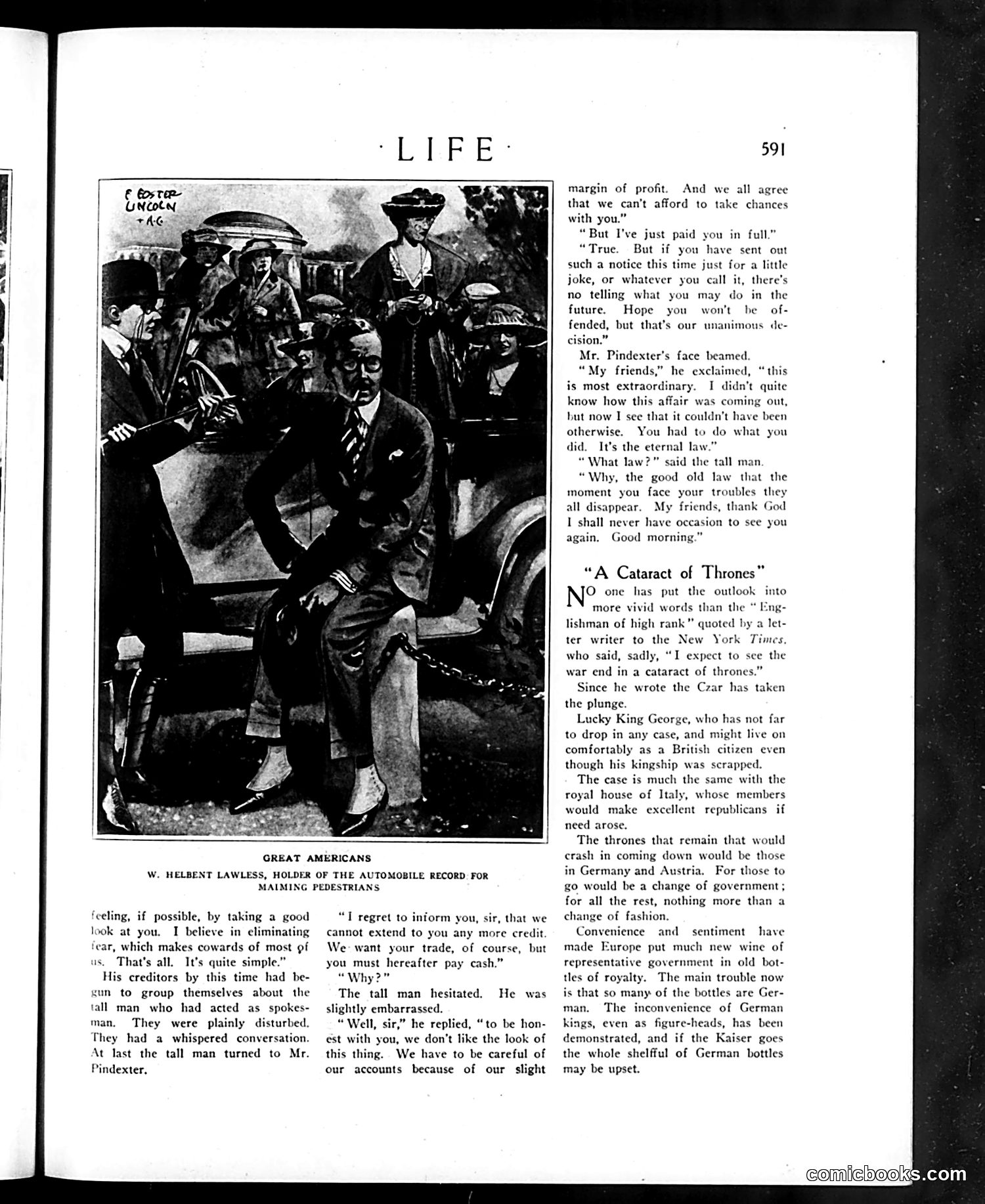
The page contains two distinct pieces satirizing early 20th-century American and European politics. **Top Section - "Great Americans":** A fictional account mocking W. Helburt Lawless, described as holder of the "automobile record for maiming pedestrians." The satire shows creditors confronting a man (presumably Lawless or a character) about unpaid debts. When he announces he's paid in full, they refuse further credit anyway, fearing his reckless behavior will continue. The joke exposes how wealth and bravado can mask genuine danger to society. **Bottom Section - "A Cataract of Thrones":** Commentary on World War I's destabilization of European monarchies. The piece quotes an unnamed British nobleman predicting thrones will fall "like a cataract." It notes the Czar has already abdicated ("taken the plunge") and suggests German and Austrian monarchies face genuine collapse—unlike Britain, Italy, or other nations where kings could survive as mere figureheads. The satire criticizes how European royalty persists as empty tradition despite political upheaval.
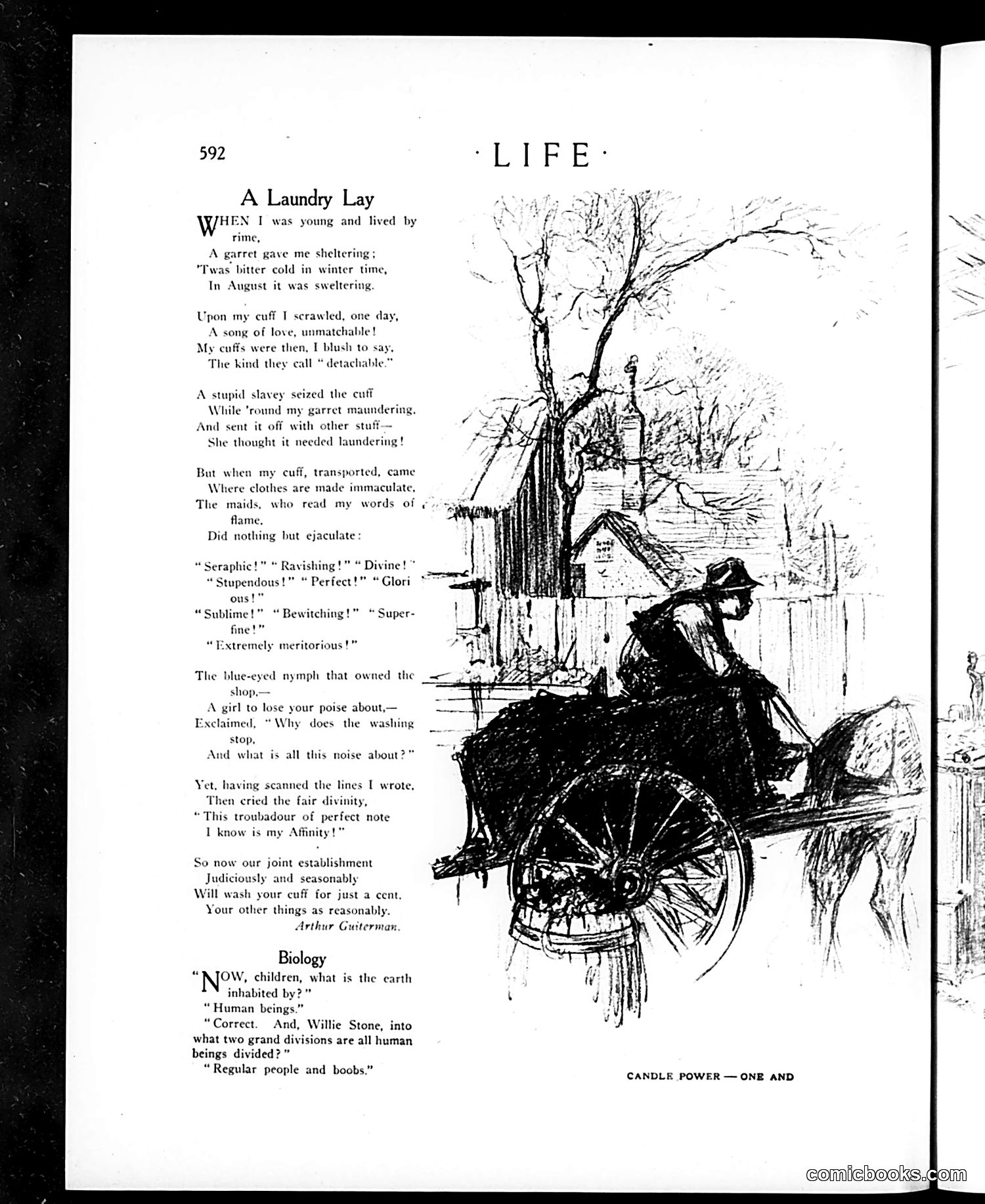
**"A Laundry Lay"** is a humorous poem by Arthur Guiterman about a young poet whose romantic verses, accidentally written on a *detachable collar cuff*, get sent to a laundry. The laundresses become so moved by his words they ejaculate praise ("Seraphic!" "Divine!" etc.). The shop owner—a "blue-eyed nymph"—reads the poem and declares him her "Affinity" (soulmate). The satire mocks the sentimentality of romantic poetry and the idea that flowery words can magically win hearts; it also jokes about the mundane reality of commercial laundry service, which will now wash your cuffs cheaply. **"Biology"** is a short joke: a teacher asks students what inhabits Earth, gets "Human beings," then asks Willie Stone into what divisions humans divide. His answer: "Regular people and boobs"—a class-based insult suggesting some people are foolish. The humor lies in the child's blunt social commentary breaking the lesson's formality. Both pieces use satire to mock pretension and social hypocrisy.
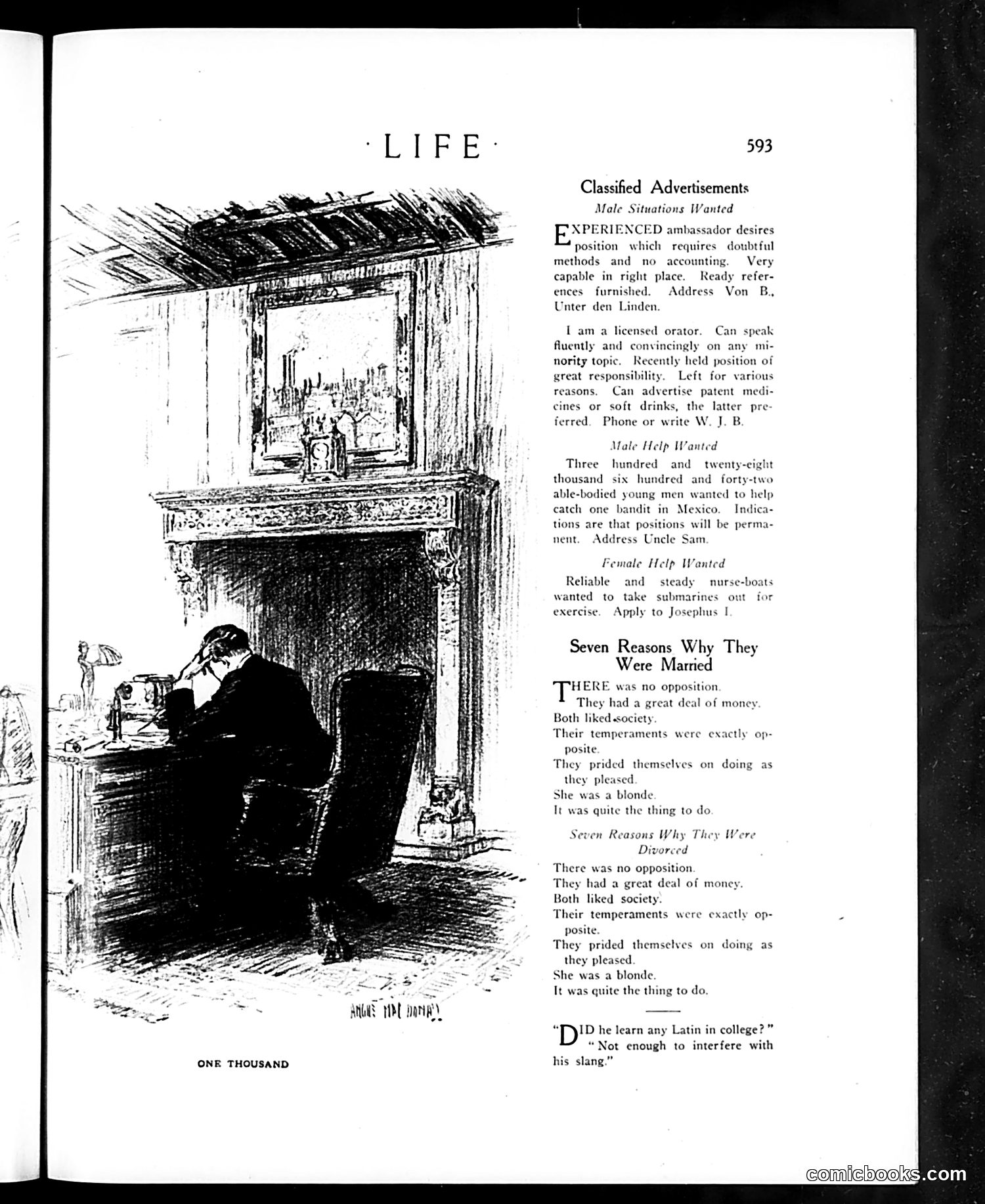
This page combines satirical classified ads with humorous commentary on early 20th-century society and politics. The ads mock contemporary figures and situations: - "Von B., Unter den Linden" (Berlin address) appears to reference German diplomacy with "doubtful methods" - "W.J.B." likely alludes to William Jennings Bryan, a famous orator known for promoting patent medicines - The Mexican bandit reference suggests Uncle Sam (the U.S. government) recruiting soldiers for military intervention - The submarine nursing ad satirizes Secretary of Navy Josephus Daniels's military expansion The cartoon "One Thousand" depicts a man writing at a fireplace, likely representing a writer or journalist. The marriage/divorce comparison is straightforward satire: identical reasons explain both union and dissolution, mocking how superficial and changeable marriage motivations are among the wealthy elite. The final joke mocks college education's ineffectiveness against crude speech patterns—a critique of educational pretension.
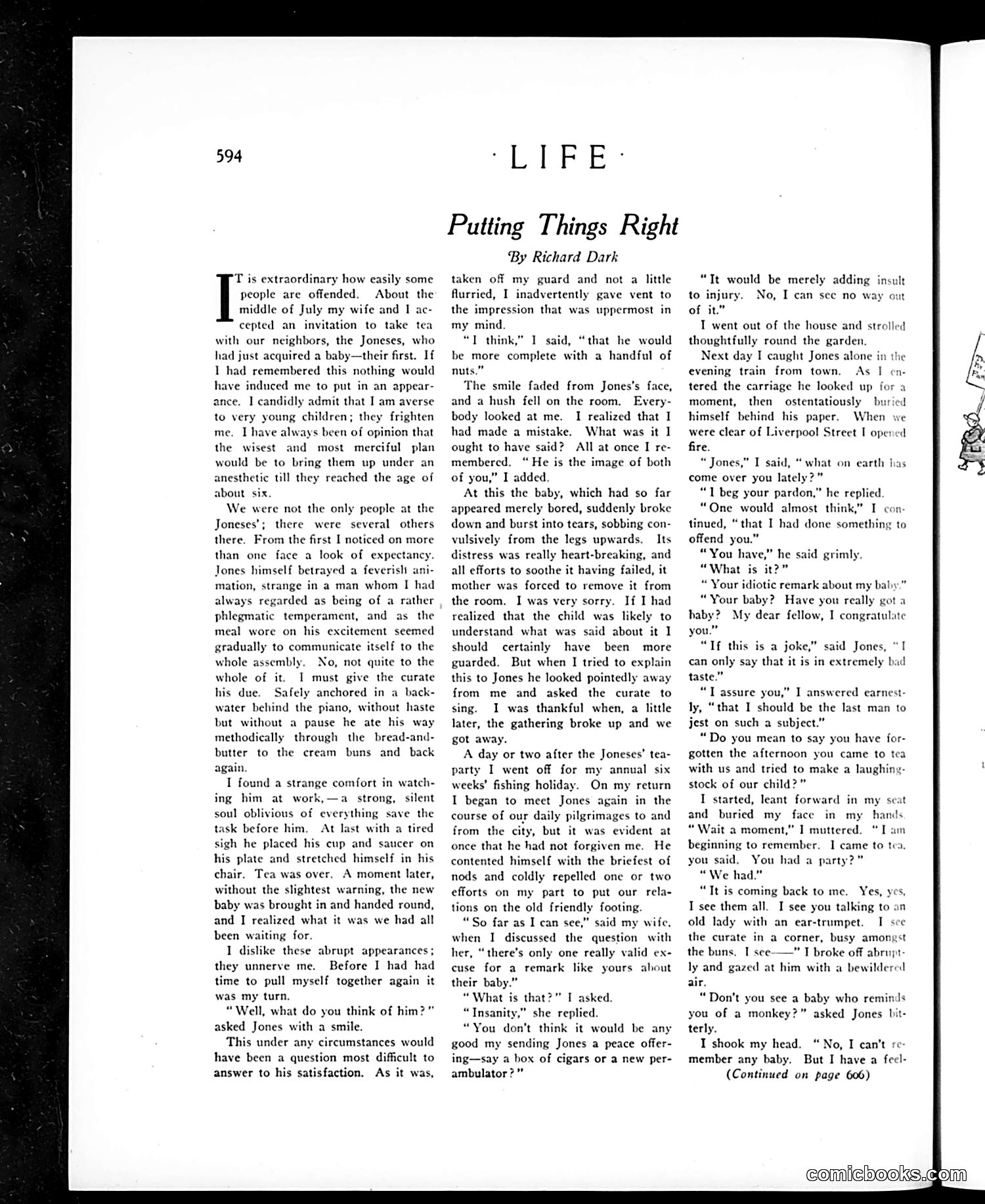
This is a humorous short story, not a political cartoon. The narrative satirizes social awkwardness and the absurd sensitivity of new parents. The plot: A narrator attends a tea party at neighbors' (the Joneses') home, where a new baby is ceremoniously presented to guests. When asked his opinion, the narrator carelessly remarks the baby "would be more complete with a handful of nuts"—implying the infant resembles a monkey or is incomplete. The baby bursts into tears; the narrator's hasty recovery ("He is the image of both of you") fails to repair damage. Jones subsequently refuses to forgive him, and the narrator's wife acidly suggests only insanity excuses such a tactless remark. The satire targets Victorian-era social conventions: the ritualized presentation of babies, the expectation of effusive praise, and how easily genteel relationships fracture over minor social missteps. The curate eating steadily, oblivious throughout, represents sensible detachment from social pretense.
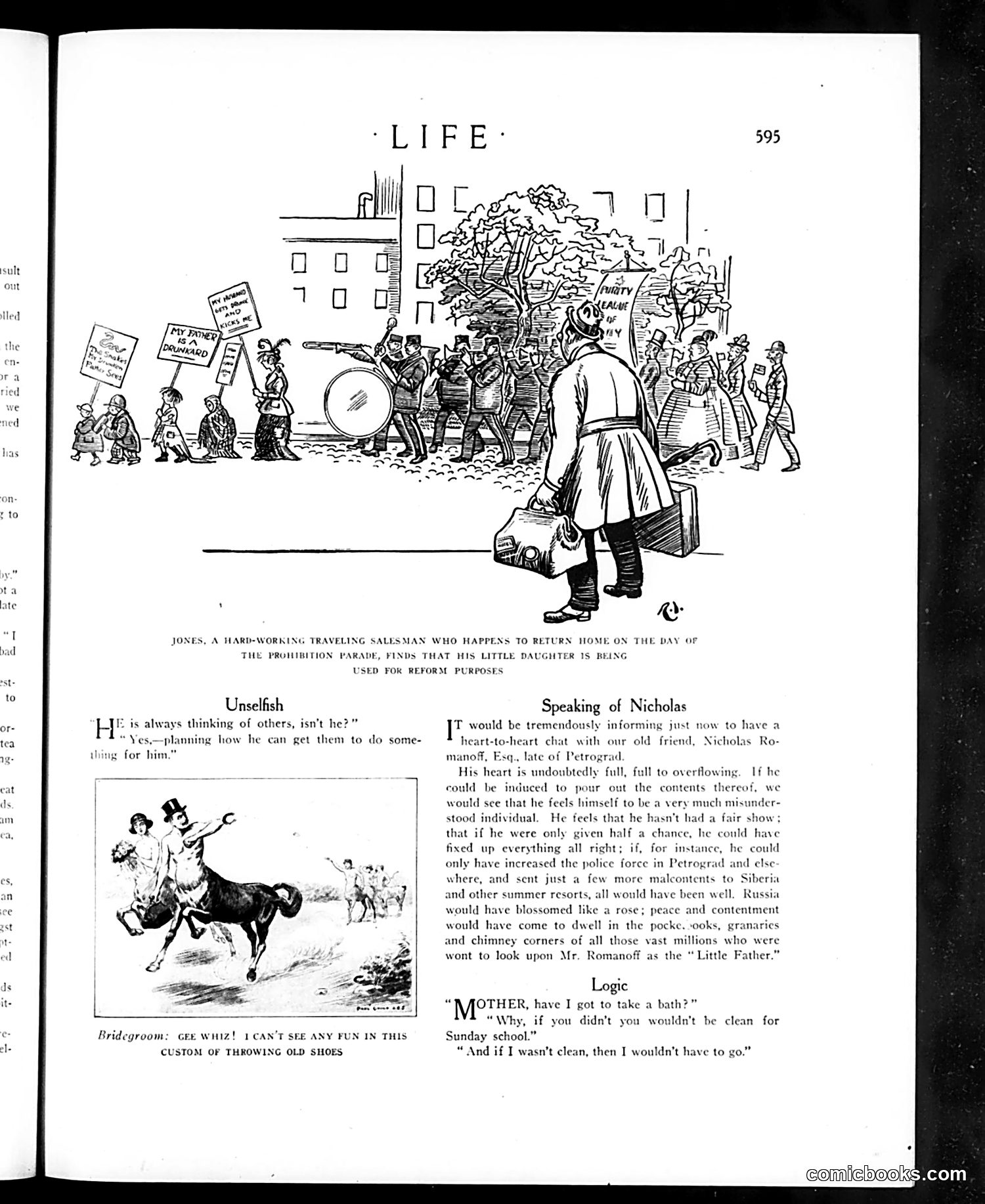
This *Life* magazine page satirizes early 20th-century American social issues through three distinct pieces: **Top cartoon:** A traveling salesman returns home during a "Prohibition Parade" to find his daughter being used as a prop for temperance reform—mocking how reformers exploited children for their causes. **"Unselfish":** A brief joke about self-centered people disguising selfish motives as concern for others. **"Speaking of Nicholas":** A sarcastic commentary on Tsar Nicholas II (deposed during the Russian Revolution). The piece mockingly suggests Nicholas believed he was misunderstood, implying if given more power, he could have fixed Russia by increasing police repression and Siberian exile—a dark joke about his autocratic failure. **"Logic":** A child's circular reasoning about bathing for Sunday school—typical humor about childhood absurdity. The page reflects post-WWI American attitudes: skepticism toward Prohibition reformers, and contempt for the recently-fallen Russian autocracy.
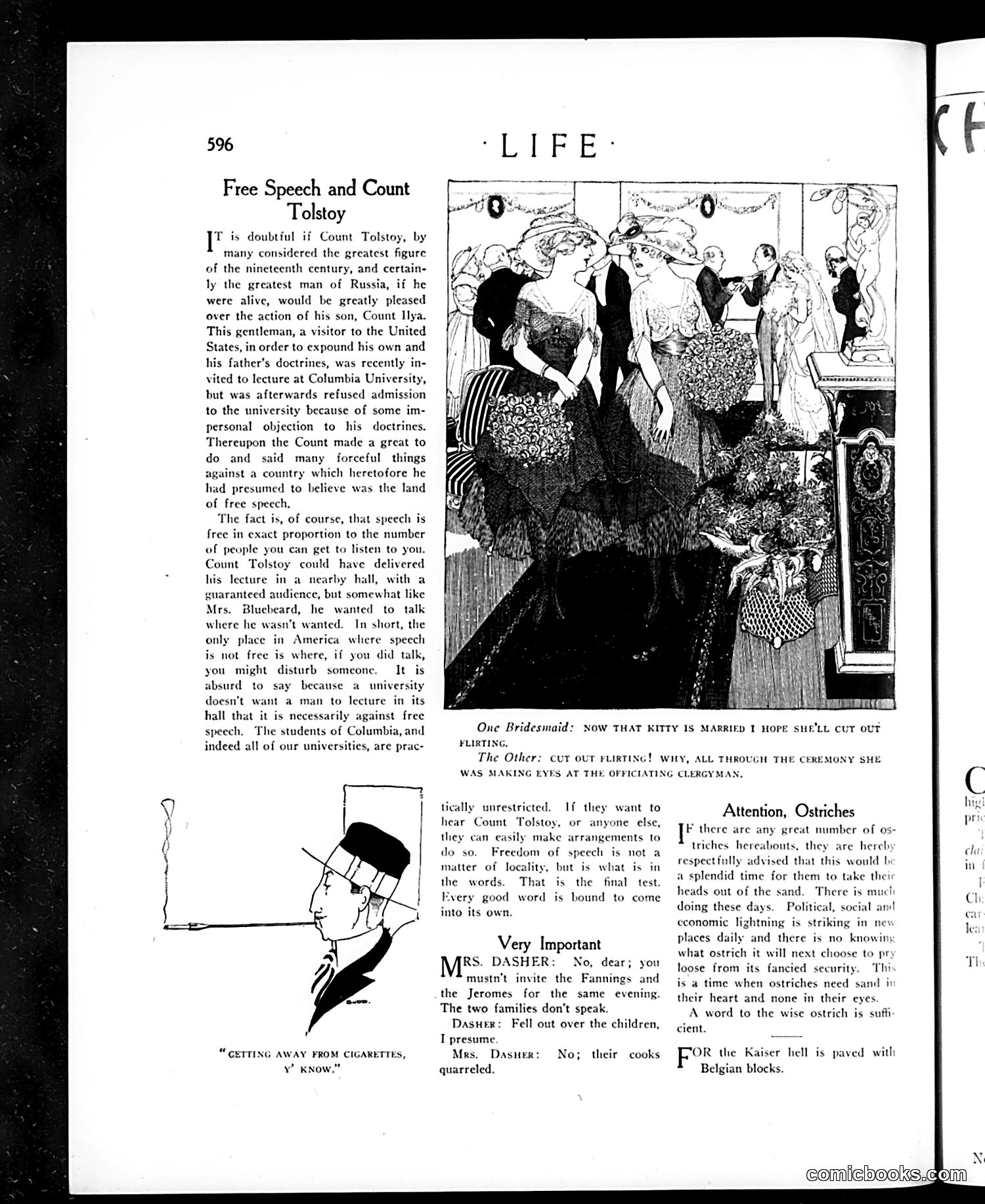
This page satirizes free speech and social hypocrisy in early 20th-century America. **Main Article:** Count Ilya Tolstoy (son of the famous Russian writer) visited the U.S. to lecture on his father's pacifist doctrines but was refused admission to Columbia University. He complained about America's supposed commitment to free speech. Life's editorial argues that "free speech" means the *right* to speak freely, not the *right* to a specific venue—universities can refuse speakers without violating free speech. The piece suggests Tolstoy was like "Mrs. Bluebeard," wanting what he couldn't have. **Small Cartoon:** A profile sketch with caption "Getting Away from Cigarettes, y' know"—likely mocking men's claims to quit smoking. **Wedding Cartoon:** Two bridesmaids joke that the bride "Kitty" flirted throughout the ceremony, even with the clergyman—satirizing superficial social behavior. **"Very Important" Dialogue:** Two society women discuss feuding families whose *cooks* quarreled—satirizing how trivial servants' disputes can cause upper-class social rifts. **"Attention, Ostriches":** Metaphorically criticizes people ignoring serious political/economic crises (likely WWI-era tensions).
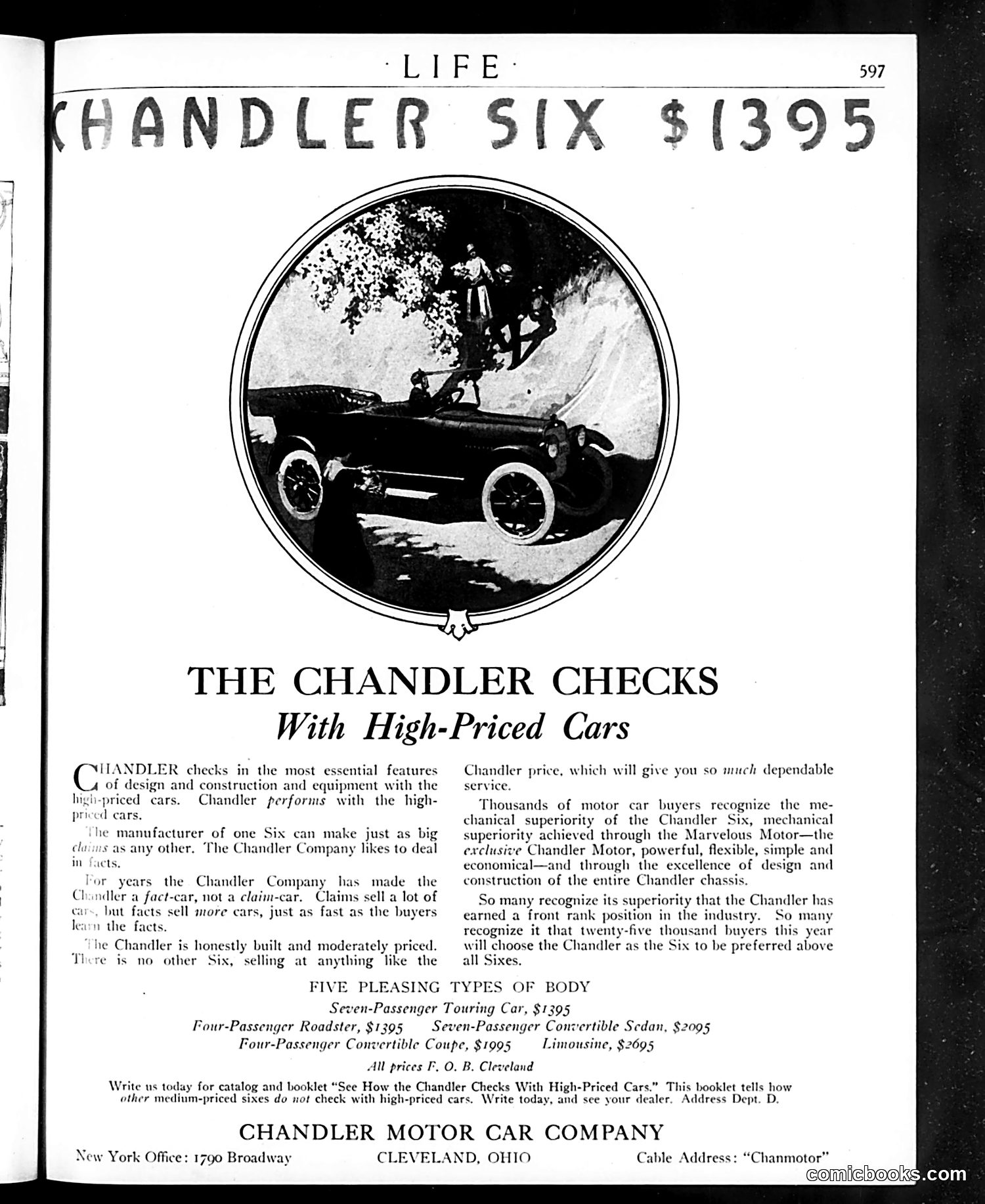
This is a **full-page automobile advertisement**, not political satire. It's a 1920s marketing pitch for the Chandler Motor Car Company's "Six" model, priced at $1,395. The circular photograph shows a luxury automobile with passengers, positioned beneath the headline "The Chandler Checks With High-Priced Cars"—the central claim being that this **moderately-priced mid-range vehicle performs as well as expensive luxury cars**. The text repeatedly emphasizes that Chandler is a "fact-car, not a claim-car," arguing that the vehicle's mechanical superiority (particularly its "Marvelous Motor") justifies its popularity. The ad promises that 25,000 buyers will choose Chandler over competing sixes. **For modern readers**: This reflects early automotive marketing strategy—positioning a mid-market product as comparable to luxury competitors to justify premium pricing within its category. There is no satire present; this is straightforward commercial advertising from the 1920s automobile boom.
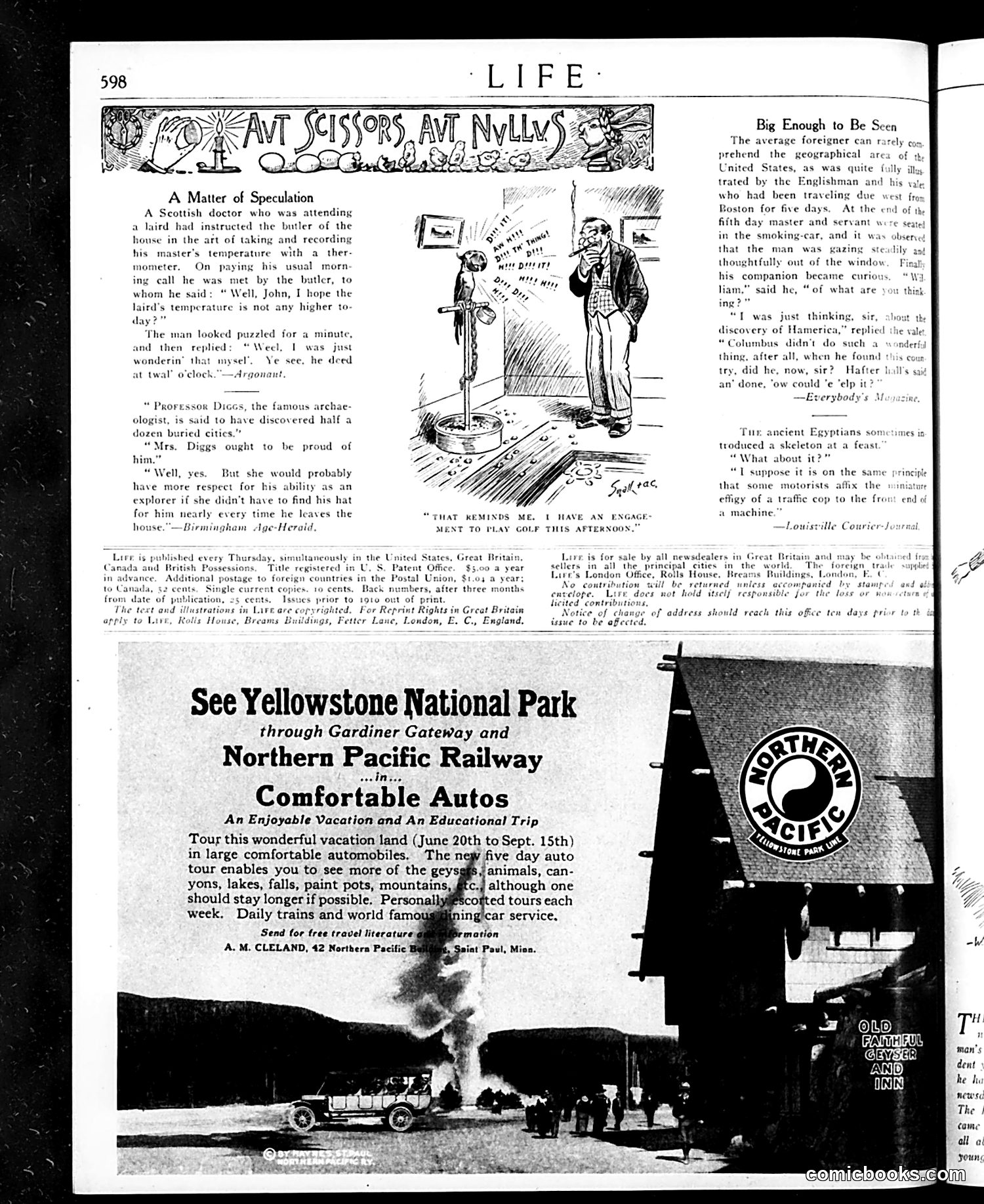
This Life magazine page (page 598) contains three brief humorous anecdotes and one advertisement. **The Cartoons/Stories:** The page features three short joke pieces typical of early 20th-century satirical magazines: 1. **"A Matter of Speculation"** mocks a Scottish butler's confusion about taking a patient's temperature—he reports the laird is dead, having misunderstood medical instructions. 2. **"Professor Diggs"** jokes that an archaeologist's wife would respect his abilities more if he could find his own hat. 3. An untitled piece satirizes Americans' geographical ignorance by depicting an Englishman amazed at discovering "Hameru" after traveling west from Boston for five days—implying Americans are oblivious to vast distances. **The Advertisement:** Below occupies the lower half: a Northern Pacific Railway ad promoting Yellowstone National Park vacations via automobile tours, featuring a geyser image and the company logo. The humor relies on period assumptions about Scottish dialect, bumbling intellectuals, and American provincial attitudes toward geography and scale.
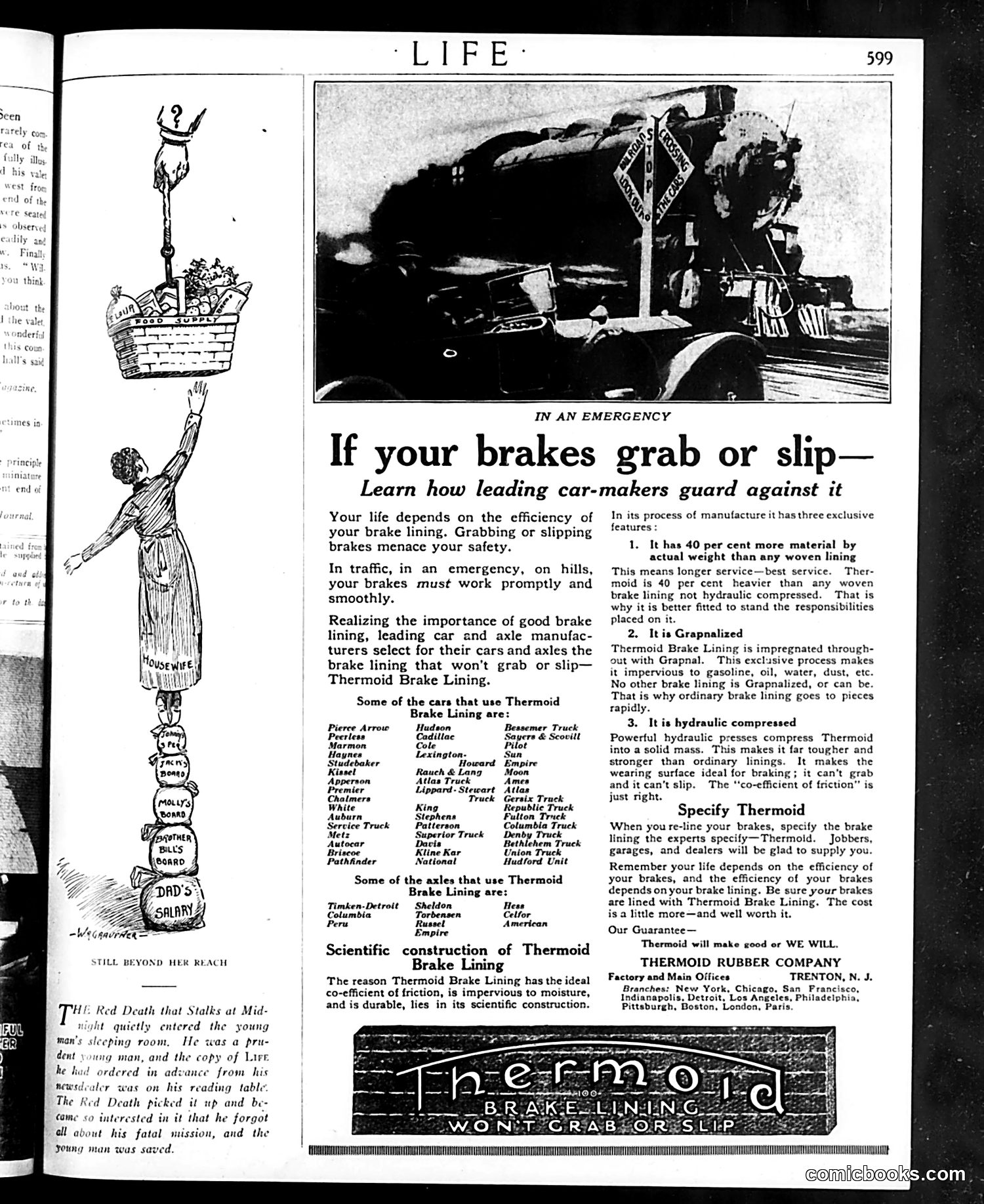
This page combines satirical editorial content with advertising. ## The Cartoon (Left Side) The sketch titled "Still Beyond Her Reach" depicts a woman reaching upward toward a basket labeled "Dad's Salary," unable to attain it. Below are stacked items representing household needs: "Rent," "Bills," "Groceries," and "Coal." This is social satire about economic hardship and the cost of living—likely referencing post-WWI inflation. The joke: a working family's wages cannot stretch to cover basic expenses; financial security remains tantalizingly out of reach. ## The Advertisement (Right Side) A full-page ad for Thermoid Brake Lining dominates the page, featuring a dramatic photograph of a speeding locomotive and discussing brake safety. The ad lists dozens of car and axle manufacturers using the product—essentially a prestigious endorsement strategy. This is typical 1920s industrial advertising emphasizing technical superiority and safety for automobile buyers. The stark juxtaposition—financial desperation versus consumer products—reflects the contradictions of 1920s American capitalism.
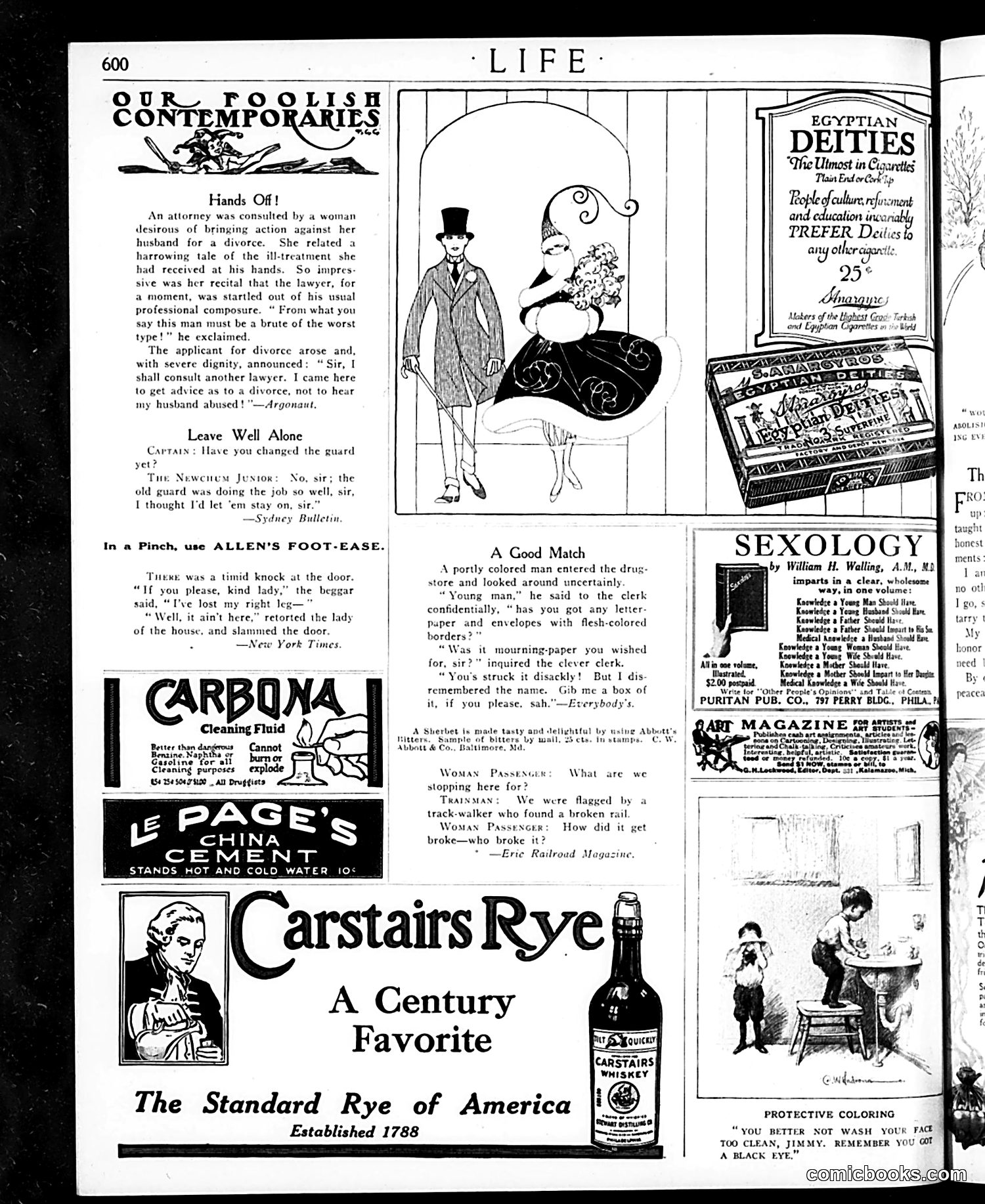
This page from *Life* magazine contains several satirical humor pieces typical of early-20th-century American wit: **"Hands Off!"** mocks a woman seeking divorce counsel who scolds her lawyer for criticizing her husband—she wants legal advice, not moral judgment. The joke satirizes the absurdity of her indignation. **"Leave Well Alone"** presents a military exchange where a junior officer admits he hasn't replaced the old guard because it's working well. It's gentle mockery of bureaucratic inefficiency and reluctance to change. **"A Good Match"** uses racial caricature and dialect to joke about a Black man asking for "flesh-colored" letter-paper borders—the clerk's misunderstanding creates the humor. This reflects the period's casual, offensive racial stereotyping. **"Good Match"** and the train anecdote are brief comedic vignettes about misunderstandings. The page is predominantly **advertising**—for cigarettes, cleaning products, rye whiskey, and instructional books. These ads, interspersed with humor, reflect *Life*'s revenue model from this era.
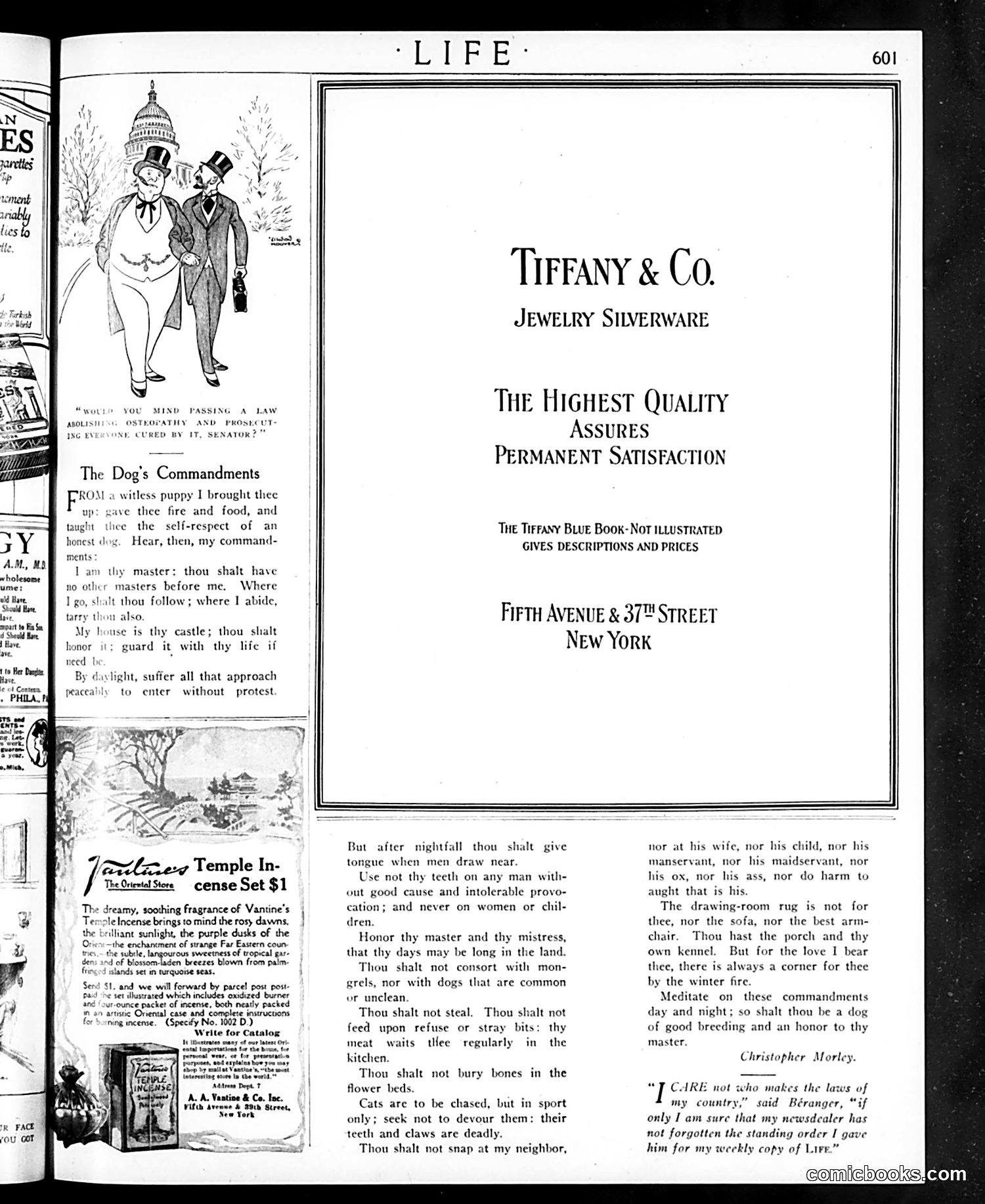
This page mixes satire with advertising. The cartoon at top depicts two rotund gentlemen in top hats near the Capitol building. One asks the other to pass a law "abolishing osteopathy and prosecuting everyone cured by it, Senator?" **The satire:** This mocks anti-osteopathy sentiment among medical establishment figures (likely doctors or politicians influenced by the American Medical Association, which opposed osteopathy in this era). The absurdity—prosecuting people for being healed—exposes the illogic of those opposing the emerging osteopathic profession on principle rather than merit. The rest of the page features "The Dog's Commandments," a humorous piece by Christopher Morley presenting pet-ownership ethics as biblical law, and advertisements for Tiffany & Co. and Oriental incense. The quote at bottom about newspaper subscriptions humorously invokes free speech ("I care not who makes the laws") while reducing citizenship to consumer loyalty—likely satirizing American materialism.
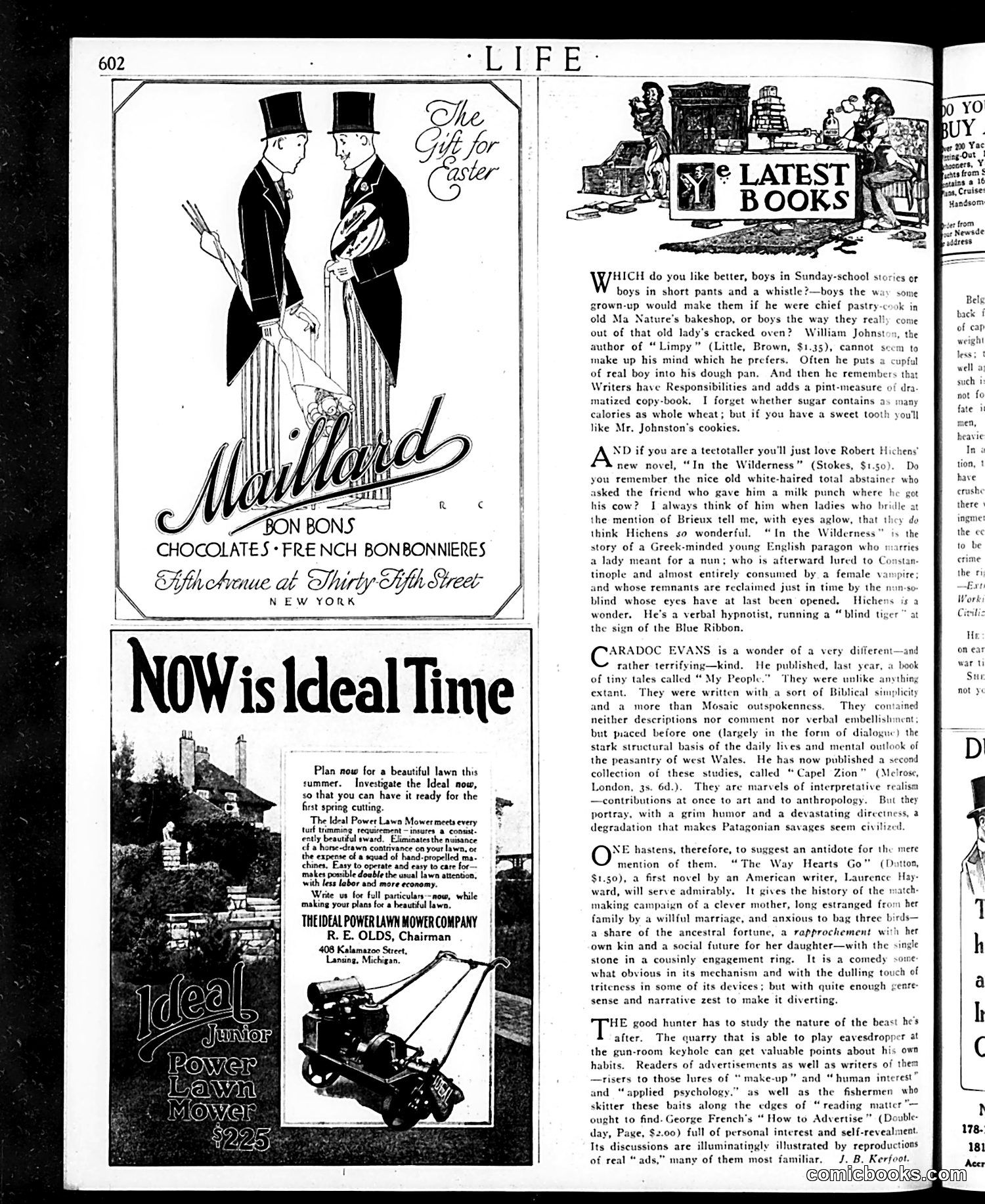
This is primarily an **advertising and book review page** from Life magazine, a satirical publication. The top features an **Maillard chocolate advertisement** showing two gentlemen in top hats—a conventional Easter gift promotion with no satirical intent. The main content is **book reviews** discussing four contemporary novels. The reviewer evaluates whether authors capture "real boys" versus idealized versions, praising William Johnston's *Limpy* for authenticity. Robert Hichens' *In the Wilderness* is discussed through a humorous anecdote about a teetotaler. Caradoc Evans' Welsh peasant tales (*My People*, *Capel Zion*) are praised as unflinching social realism. Laurence Hayward's *The Way Hearts Go* is recommended as light comedy counterbalance. The **Ideal Power Lawn Mower advertisement** occupies the lower left, promoting mechanized lawn care as modern convenience. The page reflects early 20th-century literary taste and consumer culture, with no political content or caricature.
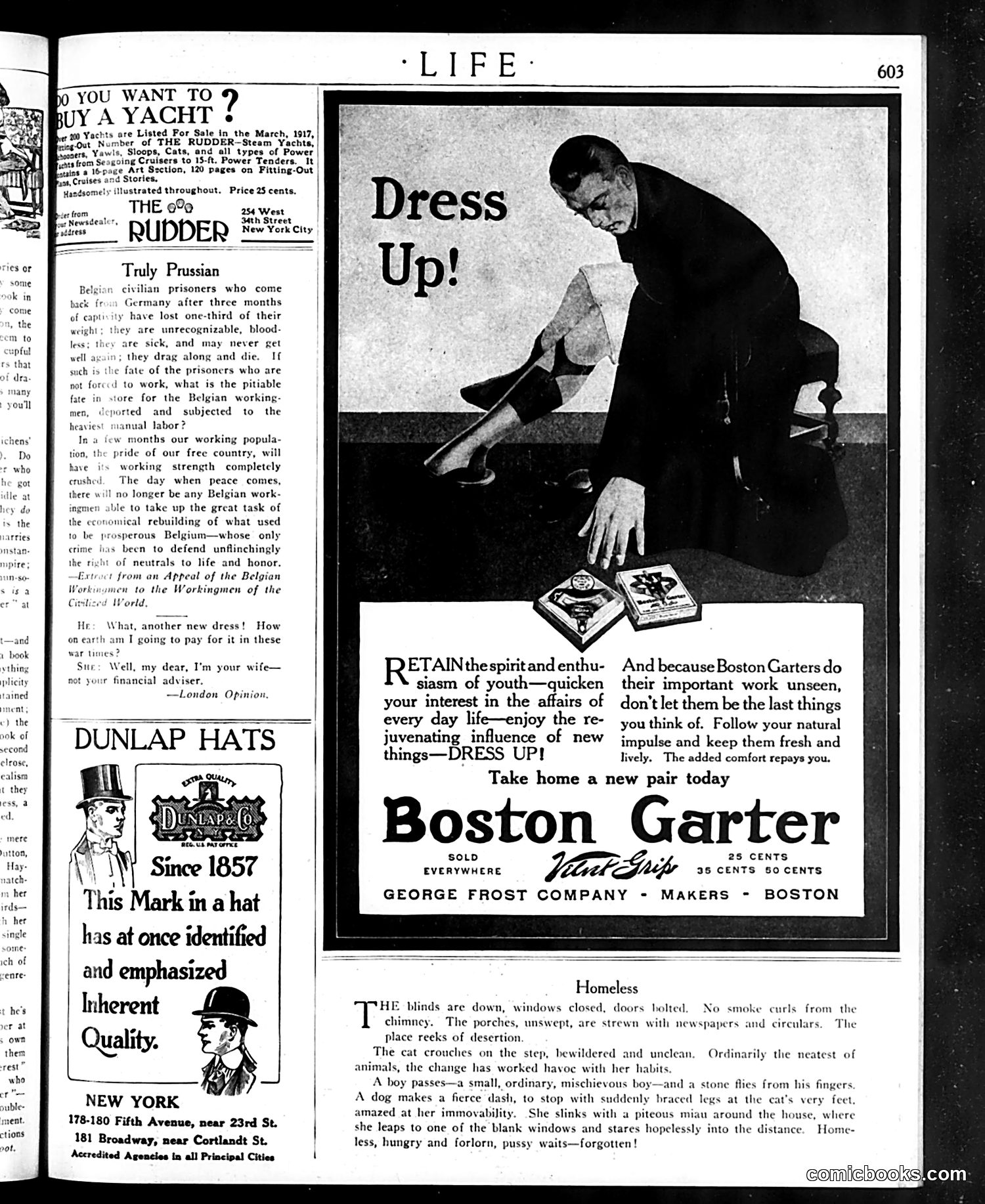
This page mixes advertisements with editorial content reflecting WWI-era concerns. **"Truly Prussian" Editorial**: A serious piece lamenting German treatment of Belgian civilian prisoners and deported workers, arguing their physical destruction will cripple Belgium's post-war recovery. This reflects actual Allied propaganda about German labor deportations during WWI. **"Dress Up!" Advertisement**: A Boston Garters ad using a domestic argument as its hook—a husband questions his wife's new dress purchase during wartime. The garter company responds that maintaining morale and "the spirit and enthusiasm of youth" justifies such purchases, even in economically strained times. **"Homeless" Story**: A brief narrative about an abandoned house where a neglected cat awaits her family's return, symbolizing the human and animal casualties of war displacement. The page juxtaposes commercial messaging with wartime pathos—the ads attempt to normalize consumer spending amid serious discussions of suffering, casualties, and social disruption.
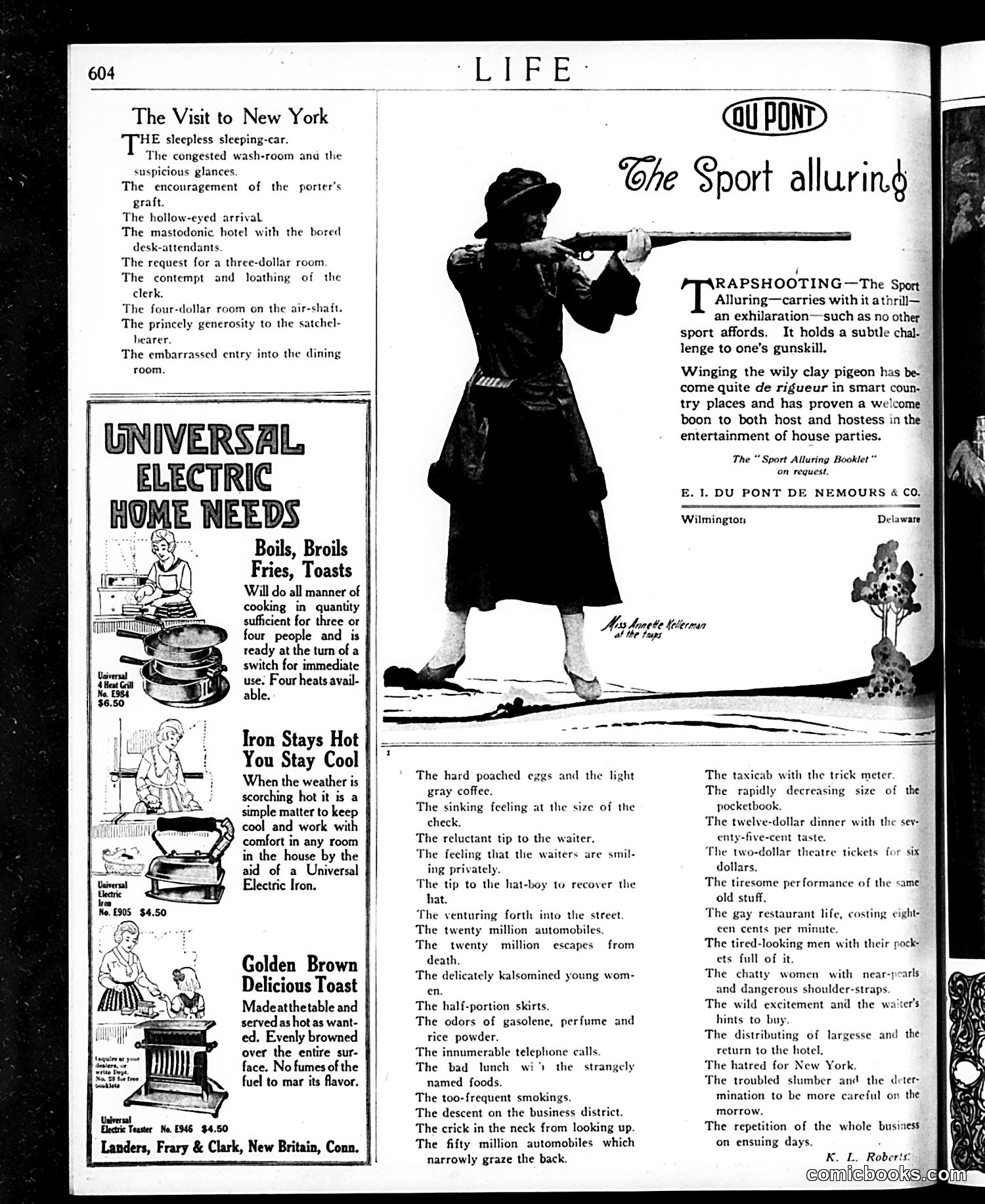
This satirical piece humorously catalogs the miserable experiences of a provincial visitor to New York City. The text lists indignities from arrival to departure: the sleepless train journey, the shabby hotel room on an air-shaft, the expensive meals with tiny portions, the aggressive taxi drivers with rigged meters, overpriced theater tickets, and the constant threat of traffic. The satire targets both the city's predatory service industry (porters, clerks, waiters all graphically exploiting visitors) and the visitor's own naïveté and social anxiety. The repeated mention of automobiles and near-death escapes reflects early-1920s anxieties about urban traffic. The concluding irony—that despite hating New York, the visitor repeats the whole ordeal "on ensuing days"—suggests an almost masochistic compulsion to the city despite its hostility and expense. This page also contains period advertisements for Universal Electric appliances and DuPont's trap-shooting promotion.
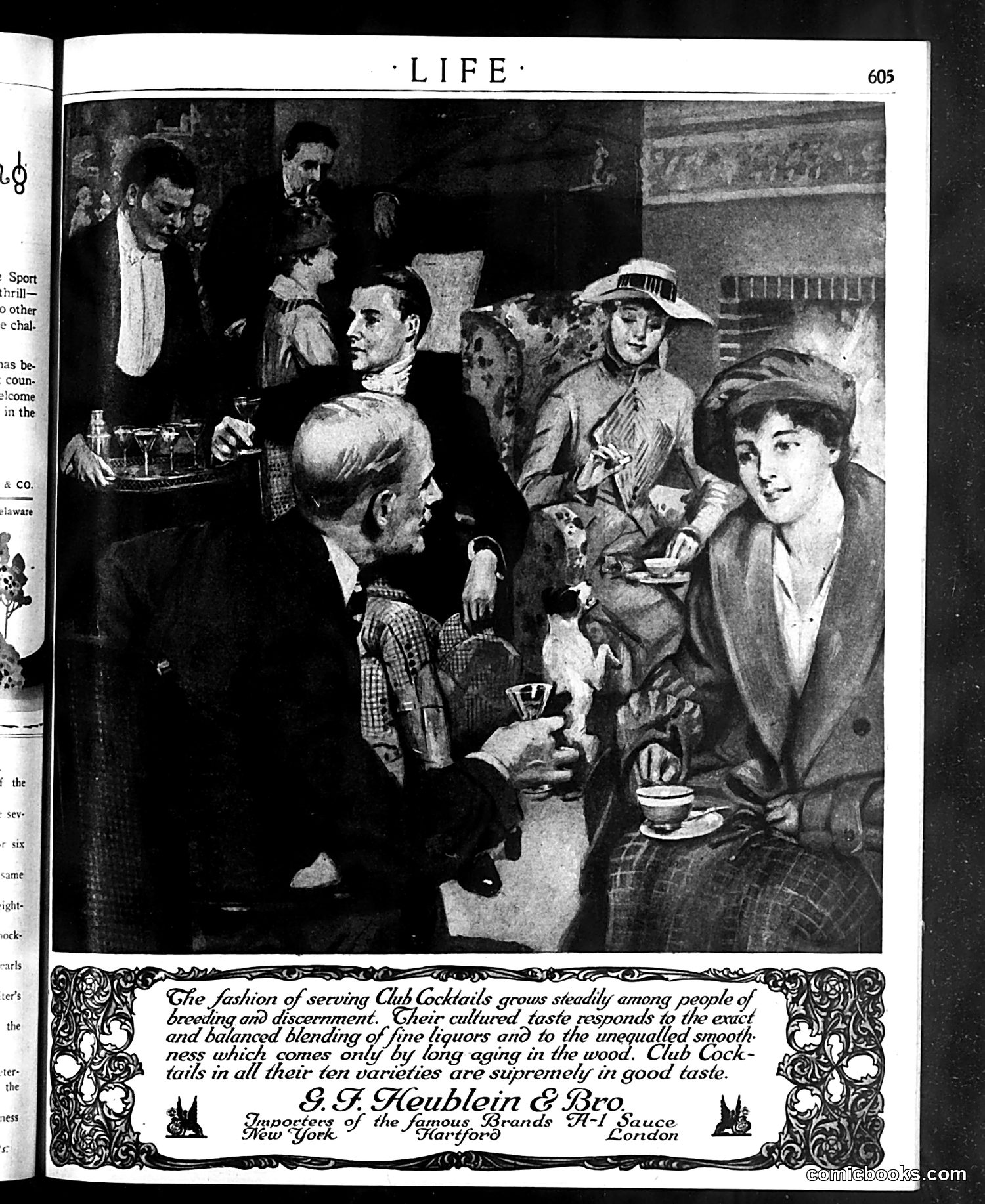
This page is primarily an **advertisement for G.F. Heublein & Bro. cocktail mixers**, not a political cartoon. The illustration depicts a **fashionable social gathering**, likely at a club or upscale venue during Prohibition era (suggested by the careful framing around "Club Cocktails"). The image shows well-dressed men and women in formal attire consuming beverages—a subtle reference to illegal drinking during Prohibition, when alcohol was theoretically banned but widely consumed in speakeasies and private clubs. The ad's rhetoric about "people of breeding and discernment" and "cultured taste" satirizes the pretense of the wealthy classes who flouted Prohibition laws while maintaining respectability. The sophisticated language masks the basic fact: the advertisement is marketing liquor during a period when such sales were illegal—a satire of how wealthy Americans circumvented laws the general public faced real penalties for breaking.
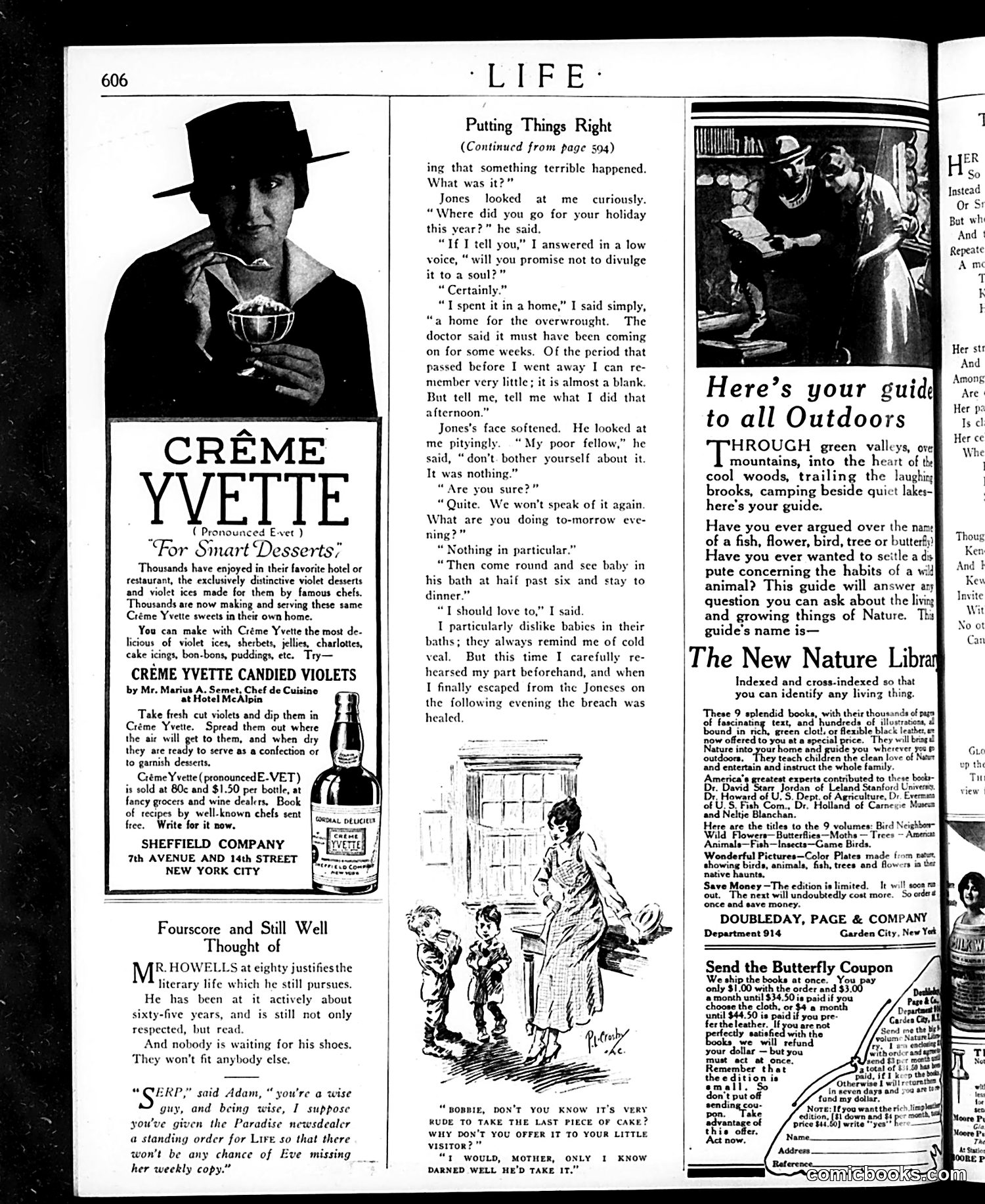
This page contains primarily **advertisements and light satirical content** rather than political cartoons. The main items are: 1. **Crème Yvette ad**: A luxury dessert product advertisement featuring candied violets, targeting affluent consumers who could purchase from fancy grocers. 2. **"Fourscore and Still Well Thought of"**: A brief satirical piece praising an elderly literary figure (identified only as "S.R.P.") still active after 65 years, suggesting his irreplaceability and enduring relevance. 3. **"Putting Things Right"**: A humorous domestic story about social awkwardness—a guest who suffered a nervous breakdown returns to visit friends, anxious about his previous behavior, only to learn his hosts remember nothing of consequence. The accompanying cartoon shows a child refusing to offer cake to a visitor, anticipating the visitor will take it anyway. 4. **Nature Library advertisement**: Promoting a nine-volume reference set for outdoor enthusiasts. The page reflects early 20th-century concerns with propriety, social anxiety, and consumer goods marketed to the middle-to-upper classes.
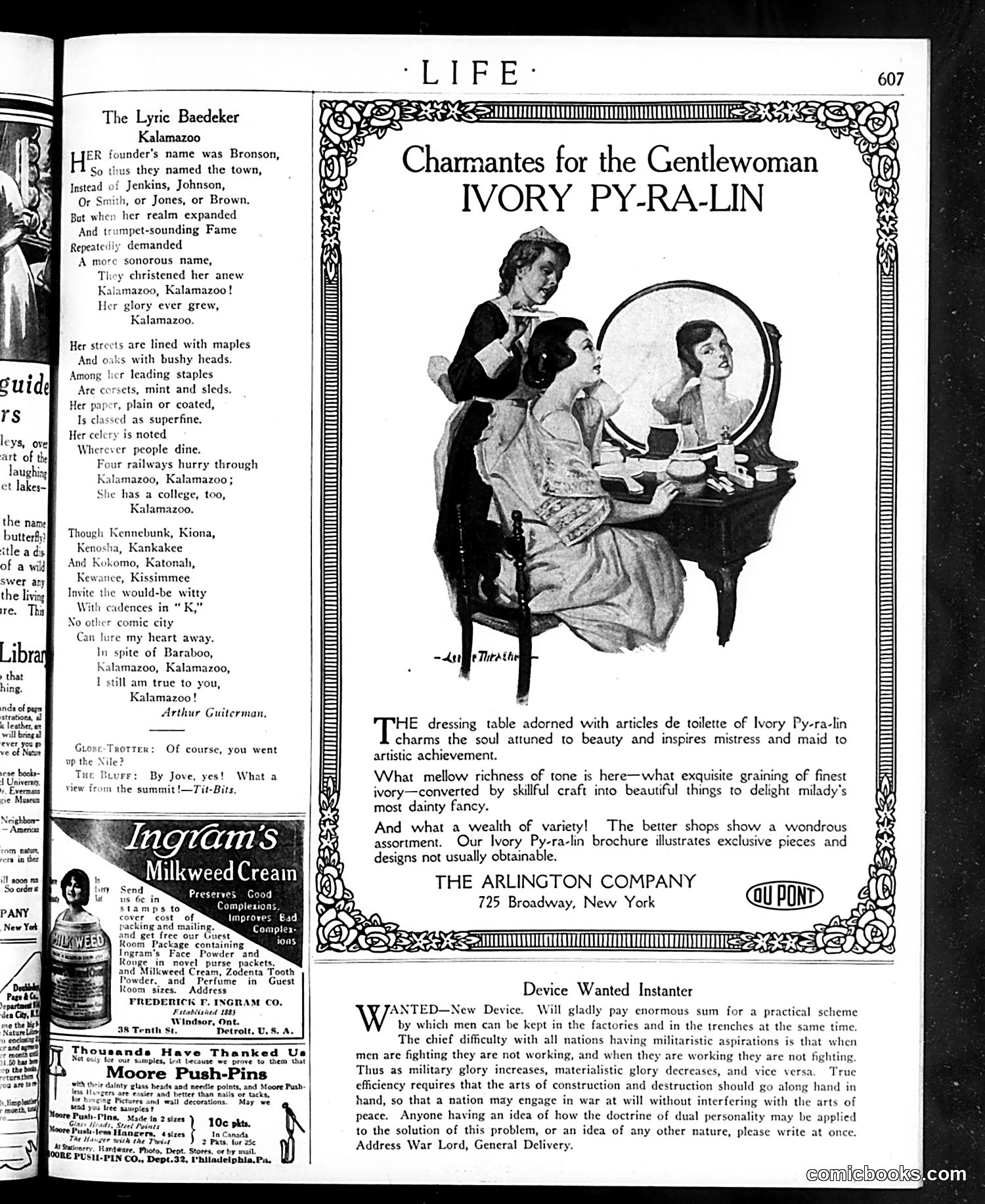
This page contains mixed advertising and satirical content from an early 20th-century Life magazine. **"The Lyric Baedecker: Kalamazoo"** is a humorous poem by Arthur Guiterman celebrating the Michigan city. It mocks the town's unglamorous origins (founder named Bronson) and its mundane products (corsets, celery, paper), while affectionately praising its "sonorous name" through repetition. The joke plays on how American cities with Native American names seem inherently more poetic than their actual commercial realities. **"Device Wanted Instanter"** is sharp wartime satire (likely WWI-era). It mock-advertises for a method to keep men simultaneously in factories *and* fighting trenches—exposing the contradiction between military and industrial production demands. The satirist argues nations waste resources switching between war and peacetime economies, sarcastically suggesting a "doctrine of dual personality" could solve this. The absurdist premise critiques militaristic inefficiency. The remaining content consists of period product advertisements (Ivory Py-ra-lin toiletries, Milkweed Cream, Moore Push-Pins).
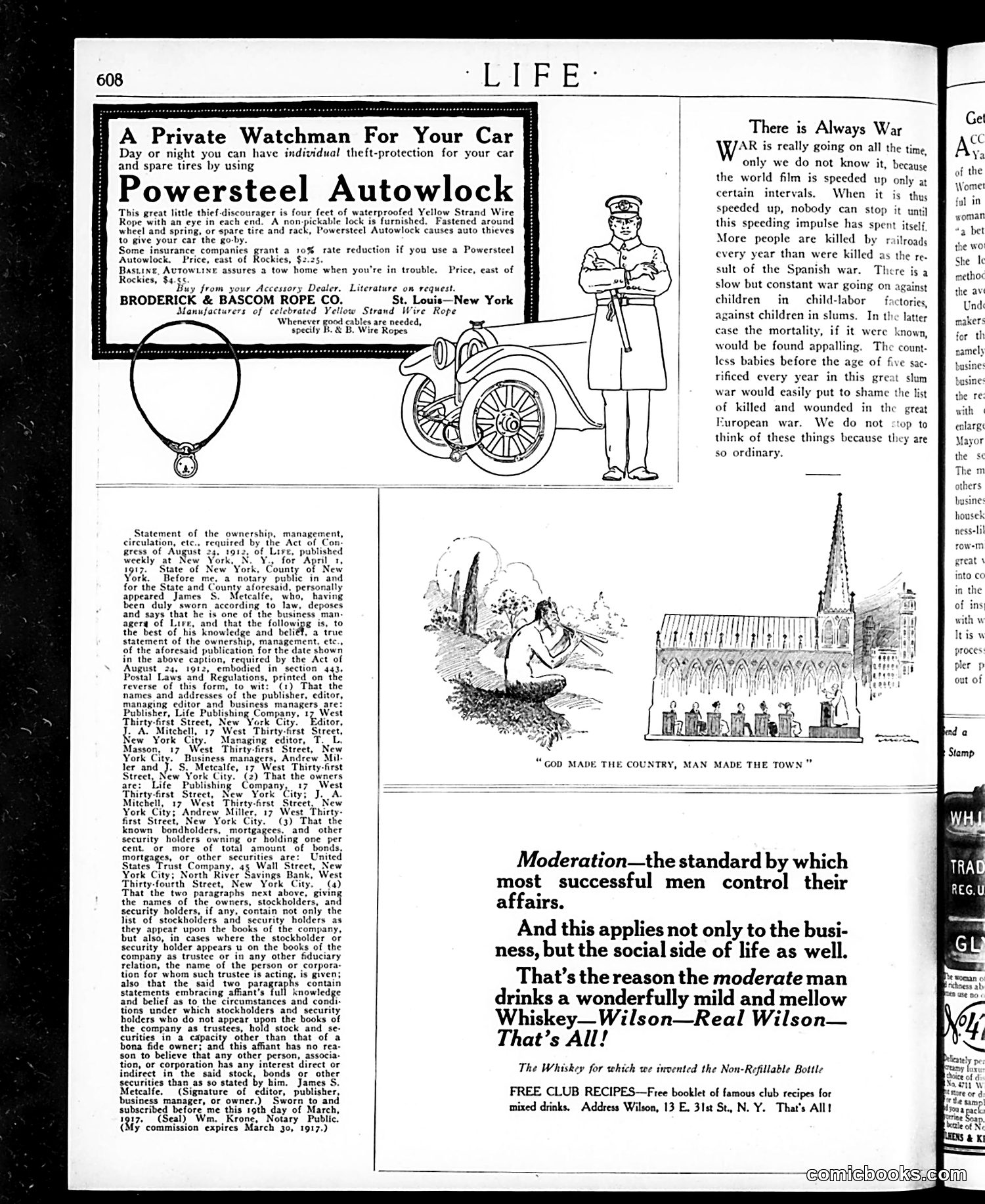
This page contains **primarily advertisements and legal notices**, not political satire. The main content includes: 1. **Powersteel Autowlock ad** (top): A car security device marketed to prevent theft—typical early automotive safety advertising. 2. **"God Made the Country, Man Made the Town"** (center illustration): A pastoral vs. urban contrast image, likely reflecting Progressive-era concerns about industrialization and rural decline. 3. **"There is Always War"** (right column): Editorial commentary comparing ongoing industrial deaths (railroads, child labor factories, slums) to combat casualties from the Spanish-American War and European conflicts. The piece argues society ignores ordinary peacetime tragedies. 4. **Wilson Whiskey ad** (bottom): Advertisement emphasizing "moderation" as a virtue for successful men. 5. **Legal ownership statement**: Required disclosure of Life Publishing Company's structure and stockholders. The page reflects 1917 concerns: automobile safety, rural-urban tensions, child labor, and social reform—typical Progressive Era themes for Life magazine.
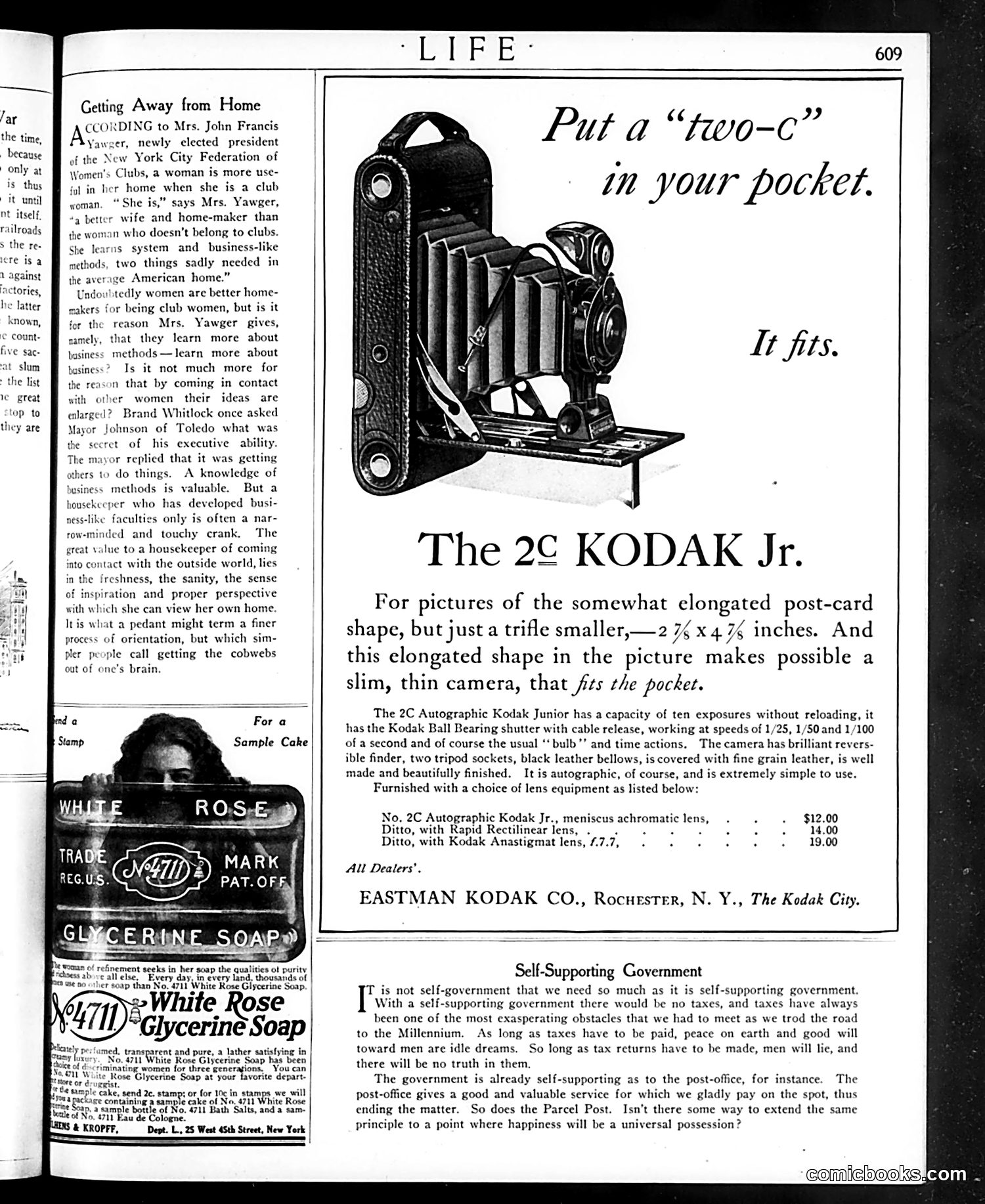
This page contains two distinct elements: **Main Article: "Getting Away from Home"** This satirical piece critiques women's club membership, quoting Mrs. John Francis Yawger (newly elected president of New York City's Women's Clubs) who claims clubwomen become better homemakers. The article argues Yawger misses the real benefit: exposure to outside perspectives and "proper perspective" for viewing one's own home. The satire suggests clubwomen gain sanity and inspiration from broader social contact, not just business methods—and that overly business-minded housekeepers often become "narrow-minded and touchy cranks." **Advertisement: Kodak 2C Junior Camera** A straightforward product advertisement promoting a pocket-sized camera (2⅞ × 4⅞ inches) that fits in a pocket, priced $12-19 depending on lens. **"Self-Supporting Government" Article** A brief editorial arguing government should be "self-supporting" like the post office—funded through fees for services rather than taxation, to eliminate tax evasion and dishonesty.
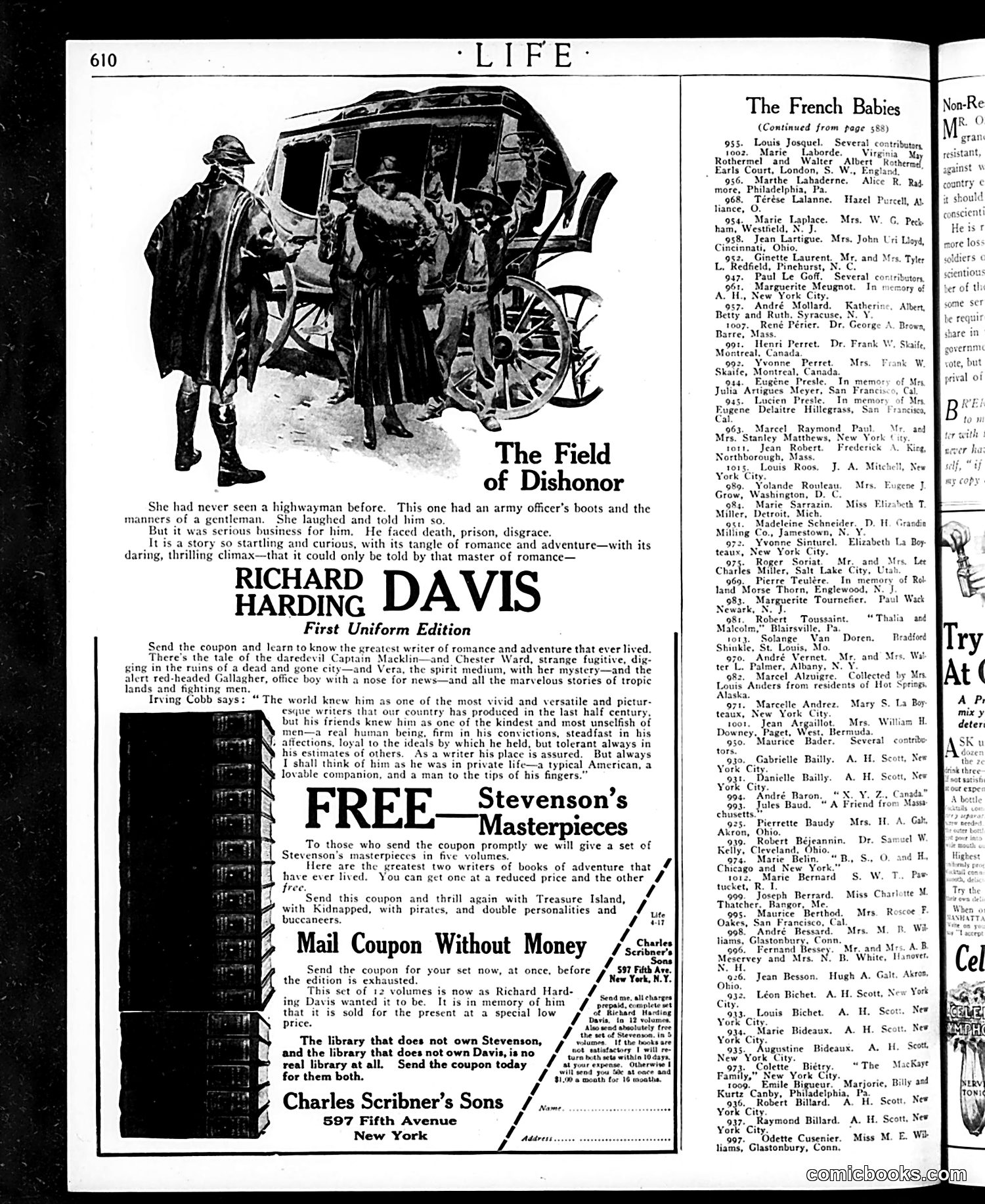
This page is primarily **advertising for books**, not political satire. The main feature advertises Richard Harding Davis's works—a celebrated romance and adventure author. The advertisement includes a praise quote from Irving Cobb describing Davis as "one of the most vivid and versatile" writers America produced, emphasizing his character as a loyal, principled man. The page also promotes a special offer: purchasers of Davis's 12-volume set receive Robert Louis Stevenson's *Treasure Island* and *Kidnapped* free. Both authors are positioned as masters of adventure literature. The right column lists "The French Babies"—apparently a charitable fundraising effort with contributors' names and donations, unrelated to the Davis promotion. **This is essentially a book-club advertisement**, not satire. No political commentary or caricature is present.
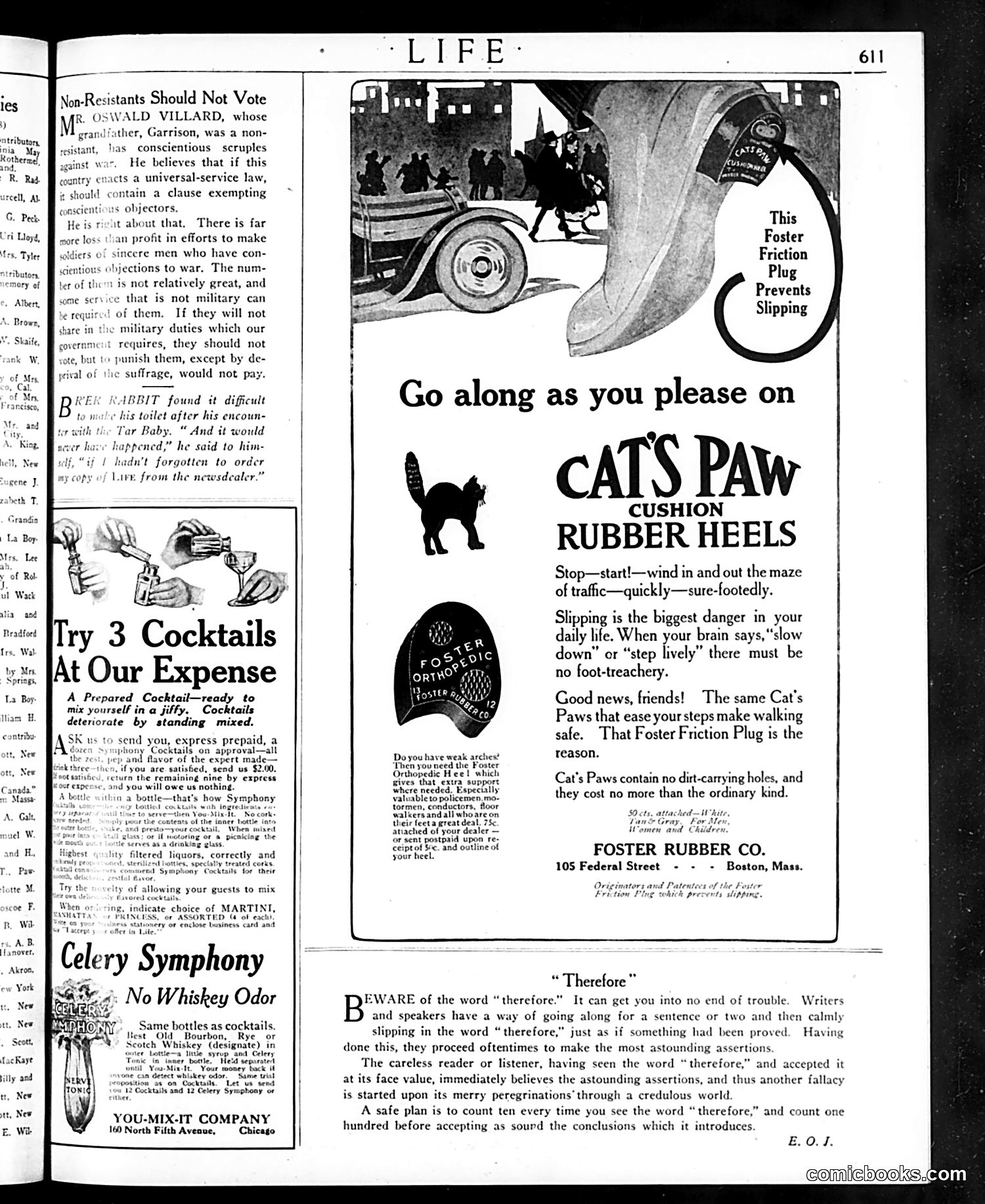
This page mixes political commentary with period advertising. The main editorial content addresses **Oswald Villard** (son of abolitionist William Lloyd Garrison), arguing that conscientious objectors to military service who refuse to fight should also forfeit voting rights—a pointed jab at pacifist positions during what appears to be WWI-era debates over conscription. A brief anecdote about **Brer Rabbit** follows, referencing the folklore character's encounter with the "Tar Baby." The bulk of the page consists of **advertisements typical of the 1910s-20s**: cocktail mixes ("You-Mix-It Company"), whiskey, and notably, **Cat's Paw rubber heels**—a shoe product marketed with emphasis on preventing slipping during daily urban traffic navigation. The final essay warns readers against the logical fallacy of accepting conclusions introduced by the word "therefore" without critical scrutiny—satirizing careless reasoning in public discourse. The page reflects early 20th-century concerns: military service debates, consumer product marketing, and satirical attacks on sloppy rhetoric.
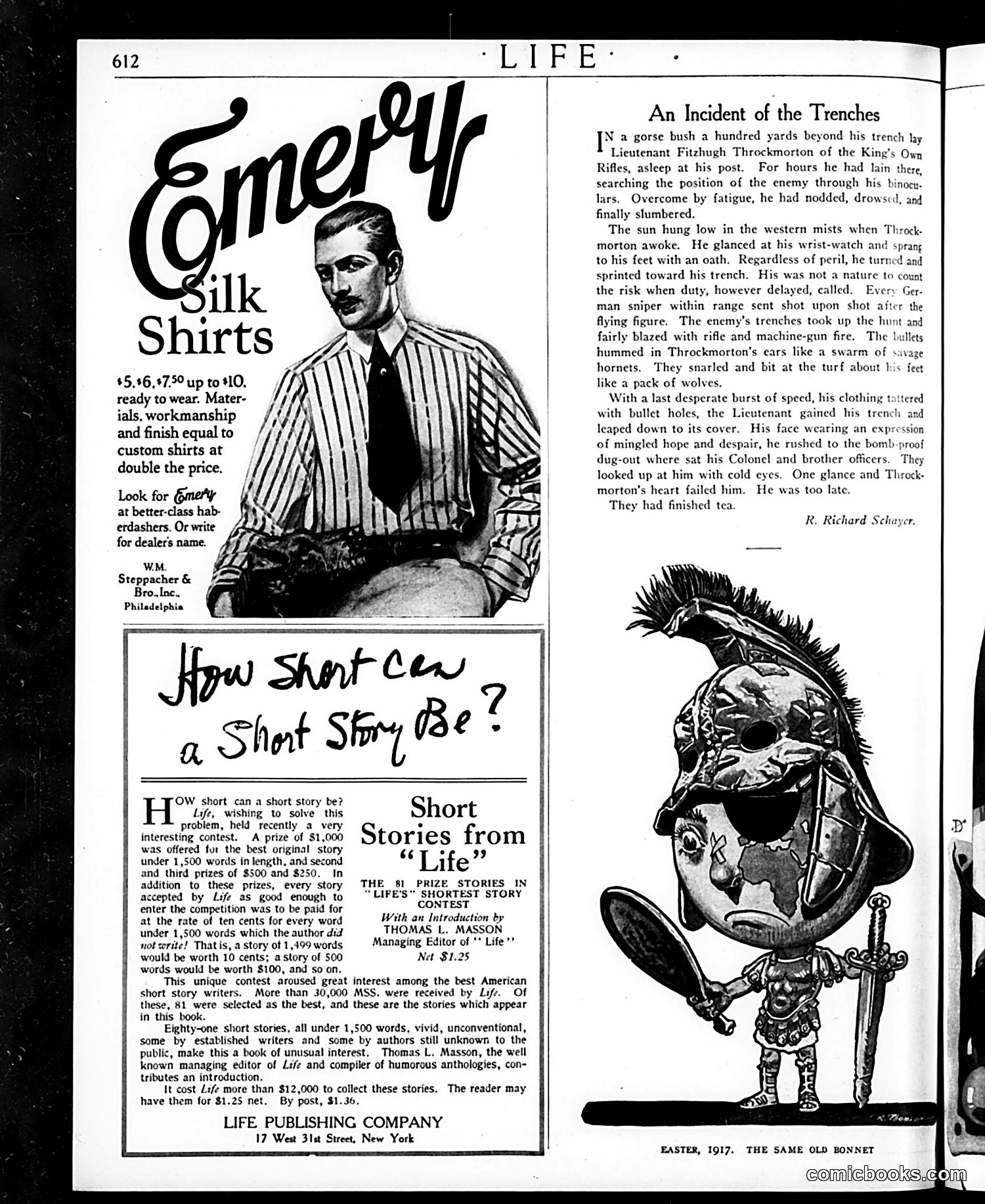
This page combines a WWI short story with advertising and literary promotion. **"An Incident of the Trenches"** is a satirical war story by R. Richard Schayer depicting Lieutenant Fitzhugh Throckmorton heroically sprinting through enemy fire back to his trench—only to discover his Colonel and fellow officers regard him coldly because "they had finished tea." The joke undercuts military heroics: despite his dramatic courage under fire, Throckmorton arrives *late to tea*, earning silent disapproval rather than commendation. This mocks both rigid military protocol and the contrast between battlefield danger and the trivial social conventions officers maintain. The page also advertises Eomeroy Silk Shirts ($5-$10) and promotes Life's "Shortest Story Contest," which received 30,000 submissions. Winners appear in an anthology selling for $1.25. The bottom illustration, "Easter 1917: The Same Old Bonnet," appears unrelated—likely a separate cartoon about Easter fashion.
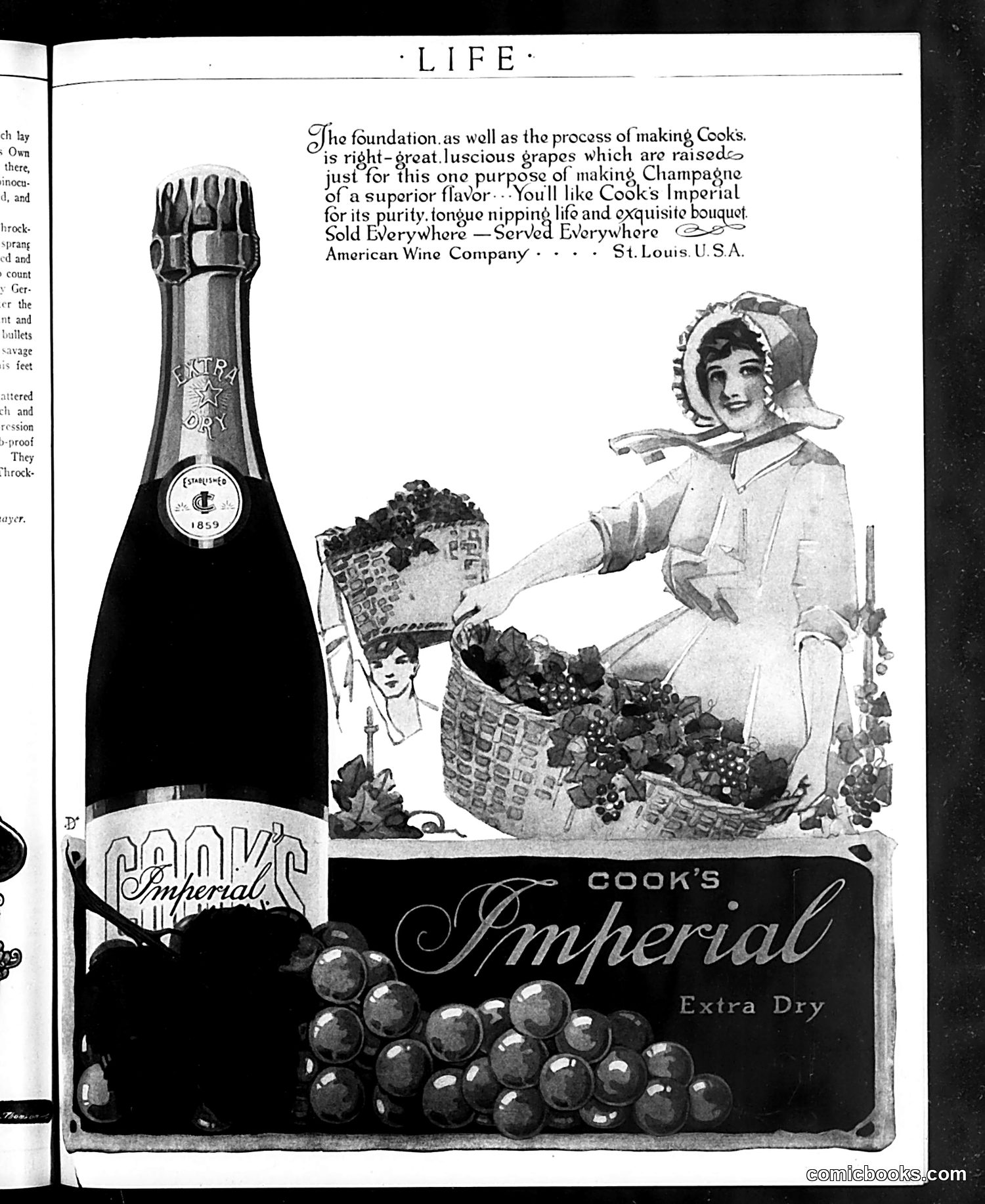
This is a **full-page advertisement**, not political satire. It promotes Cook's Imperial Extra Dry Champagne, made by the American Wine Company in St. Louis. The ad features an elegantly dressed woman in early 1900s attire holding baskets of grapes. The copy emphasizes that Cook's uses "great, luscious grapes" specifically grown for champagne-making, claiming superior purity and flavor. The imagery—a refined woman with abundant grape harvests—conveys luxury and quality. The text's slightly flowery language ("tongue nipping life and exquisite bouquet") reflects period advertising style. The notable detail: this advertises American wine competing as "champagne," terminology now legally restricted to French products. This reflects pre-regulation era American marketing practices.
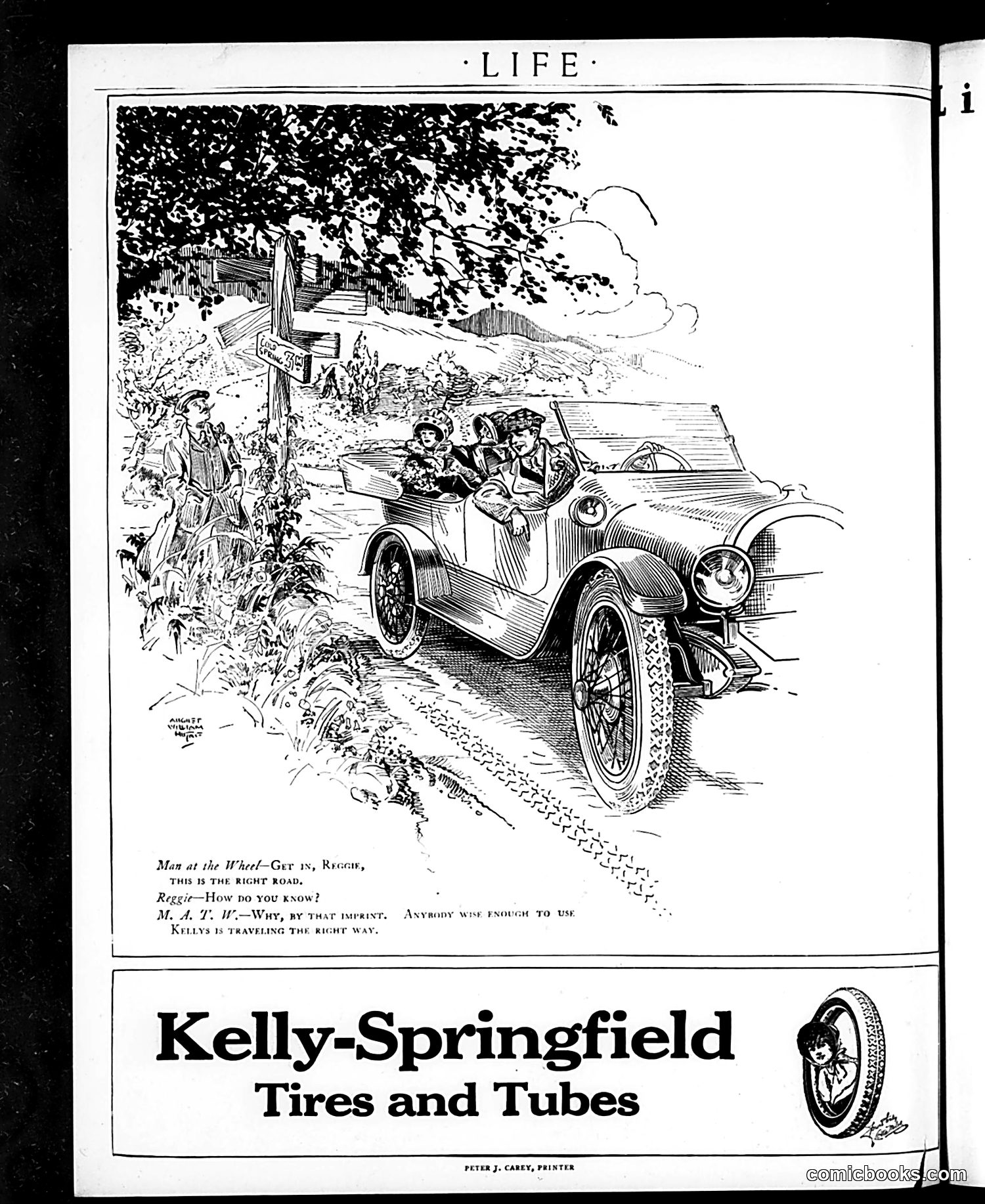
This page is primarily a **Kelly-Springfield Tires advertisement** disguised as editorial cartoon content in *Life* magazine. The illustration shows an early 1900s automobile with two men. One asks the driver ("Reggie") how he knows they're on the right road. The driver responds that they're using Kelly-Springfield tires—implying the quality tires indicate they're making good progress. The joke is a **pun on "the right road"**: the advertiser suggests that using Kelly-Springfield tires guarantees you're traveling correctly, conflating product quality with navigating properly. It's gentle satire of advertising claims that overstate what a product delivers. The cartoon lacks political or social commentary—it's purely commercial messaging wrapped in humorous dialogue, typical of early 20th-century magazine advertising that blurred lines between editorial and promotional content.