
Life, 1917-04-05 · page 37 of 70
Life — April 5, 1917 — page 37: what you’re looking at
What you’re looking at
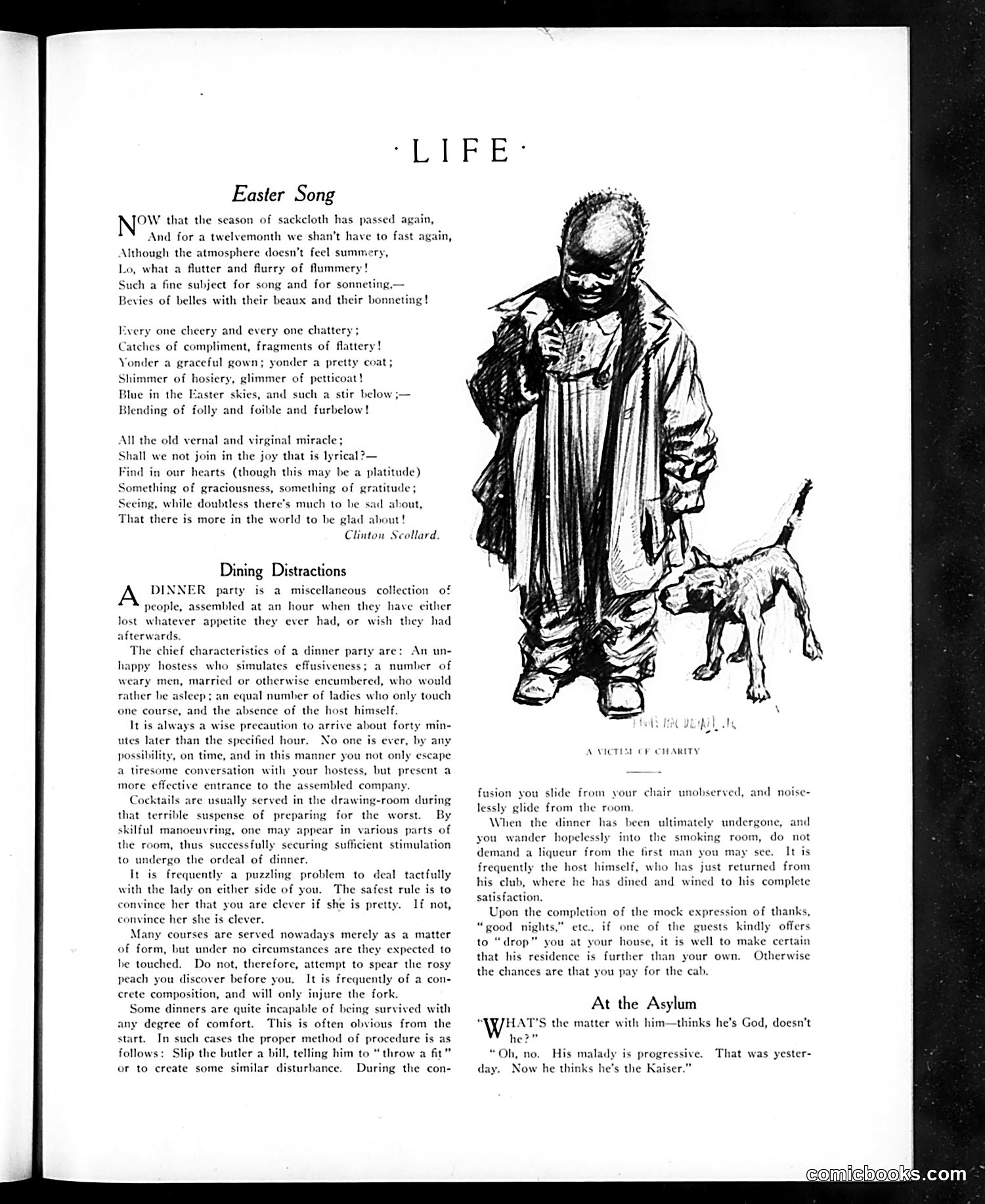
This page from early-20th-century *Life* contains three pieces of satirical content: **"Easter Song"** by Clinton Scollard celebrates Easter's end of Lenten fasting with lighthearted verse about spring fashions and social gaiety—typical upper-class concerns. **"Dining Distractions"** offers biting social satire about dinner parties: guests arrive late, pretend to enjoy themselves, women barely eat, men are exhausted, and hosts are absent. The advice to bribe a butler to fake a disturbance to escape is darkly humorous commentary on how tedious these social obligations were. **The illustration** labeled "Victim of Charity" depicts a raggedly-dressed poor man with a dog, presumably representing someone helped by charity efforts—possibly critiquing performative charity or the grim reality of poverty. **"At the Asylum"** is a brief joke about a mental patient's delusions progressing from thinking he's God to thinking he's the Kaiser—likely satirizing German imperial ambitions or war-era anxieties. The page satirizes upper-class social rituals, charity attitudes, and contemporary politics through humor.
📄 Transcribed text from this page (OCR, searchable)
Machine-transcribed from the original scan — historical spelling and the odd misread are preserved.
*LIPE: Easter Song OW that the season of sackcloth has passed again, And for a twelvemonth we shan't have to fast again, Although the atmosphere doesn’t feel summery, Lo, what a flutter and flurry of flummery! Such a fine subject for song and for sonneting,— Bevies of belles with their beaux and their bonneting! Every one cheery and every one chattery ; Catches of compliment, fragments of flattery! Yonder a graceful gown; yonder a pretty coat; Shimmer of hosiery, glimmer of petticoat! Blue in the Easter skies, and such a stir below ;— Blending of folly and foible and furbelow! All the old vernal and virginal miracl Shall we not join in the joy that is lyrical?— Find in our hearts (though this may be a platitude) Something of graciousness, something of gratitude; Seeing, while doubtless there’s much to be sad about, That there is more in the world to he glad about! Clinton Scollard. Dining Distractions A DINNER party is a miscellaneous collection of people, assembled at an hour when they have either lost whatever appetite they ever had, or wish they had afterwards. The chief characteristics of a dinner party are: An un- happy hostess who simulates effusiveness; a number of weary men, married or otherwise encumbered, who would rather he asleep; an equal number of ladies who only touch one course, and the absence of the host himself. It is always a wise precaution to arrive about forty min- utes later than the specified hour. No one is ever, by any possibility, on time, and in this manner you not only escape a tiresome conversation with your hostess, but present a more effective entrance to the assembled company. Cocktails are usually served in the drawing-room during that terrible suspense of preparing for the worst. By skilful manoeuvring, one may appear in various parts of the room, thus successfully securing sufficient stimulation to undergo the ordeal of dinner. It is frequently a puzzling problem to deal tactfully with the lady on either side of you. The safest rule is to convince her that you are clever if she is pretty. If not, convince her she is clever. Many courses are served nowadays merely as a matter of form, but under no circumstances are they expected to he touched. Do not, therefore, attempt to spear the rosy peach you discover before you, It is frequently of a con- crete composition, and will only injure the fork. Some dinners are quite incapable of being survived with any degree of comfort. This is often obvious from the start. In such cases the proper method of procedure is as follows: Slip the butler a bill, telling him to “ throw a fit” or to create some similar disturbance. During the con- NVICTEM CF CHARITY fusion you slide from your chair unobserved, and noise- lessly glide from the room When the dinner has been ultimately undergone, you wander hopelessly into the smoking room, do not demand a liqueur from the first man you may see. It is frequently the host himself, who has just returned from his club, where he has dined and wined to his complete satisfaction. Upon the completion of the mock expression of thanks, “good nights,” ete, if one of the guests kindly offers to “drop” you at your house, it is well to make certain that his residence is further than your own. Otherwise the chances are that you pay for the cab. At the Asylum HAT’S the matter with him—thinks he’s God, doesn’t he?” “Oh, no. His malady is progressive. day. Now he thinks he’s the Kaiser.” That was yester-