
Life, 1917-04-05 · page 25 of 70
Life — April 5, 1917 — page 25: what you’re looking at
What you’re looking at
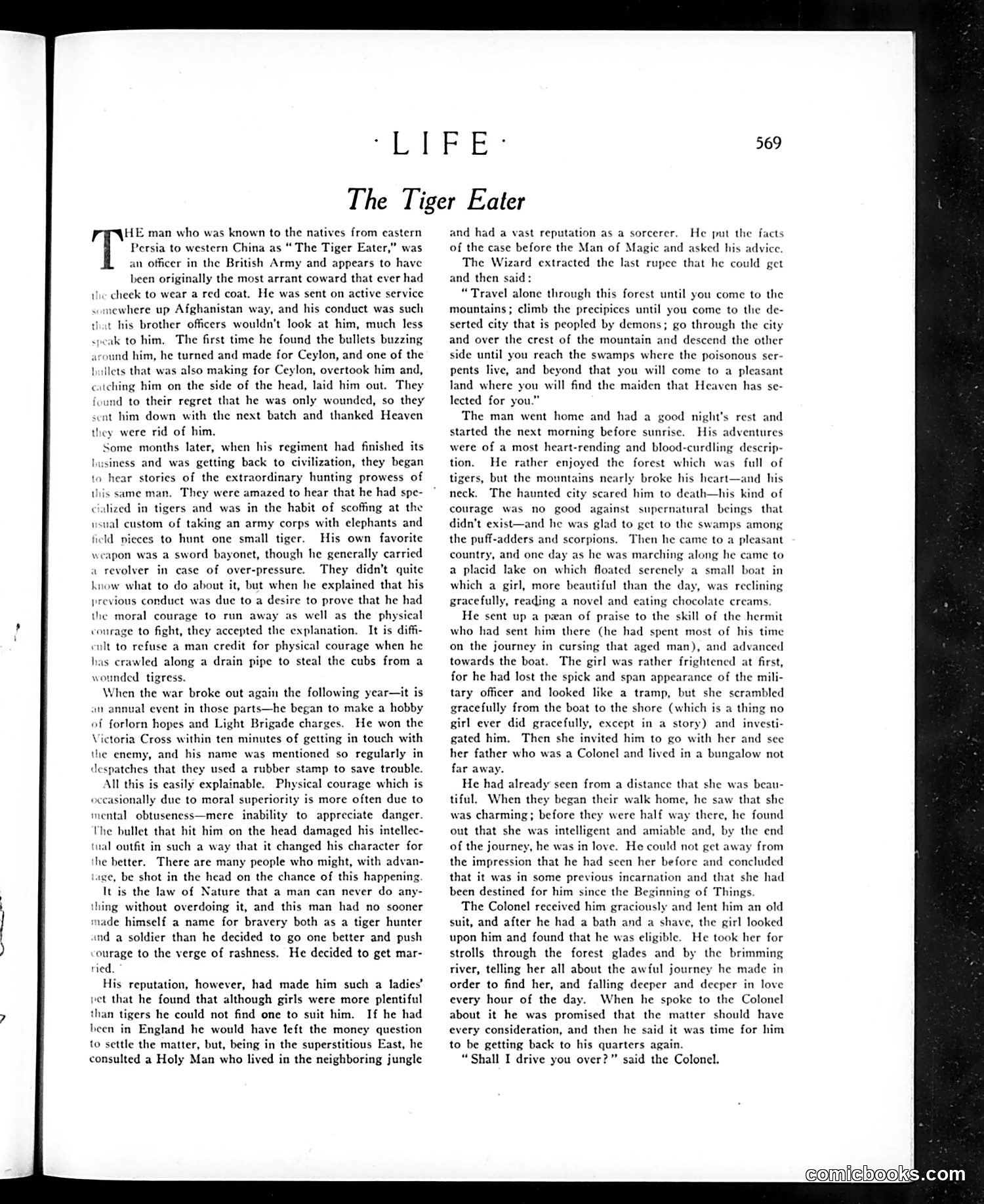
This is the opening of a serialized fictional story, not a political cartoon. It's a satirical adventure tale about a cowardly British Army officer in Afghanistan/Eastern Persia who becomes known as "The Tiger Eater." The satire centers on how a bullet wound to his head apparently *improved* his character by damaging his intellect, transforming him from a coward into a reckless daredevil. The narrator drily notes this could benefit many people. The story mocks both military incompetence and the notion that bravery stems from either moral superiority or simple stupidity—suggesting the officer's transformation proves the latter. The narrative then follows his quest (directed by a con-artist "Holy Man") to find a suitable wife, setting up an exotic adventure story typical of Life's satirical fiction. The humor lies in the officer's absurd character arc and the mockery of British colonial military culture.
📄 Transcribed text from this page (OCR, searchable)
Machine-transcribed from the original scan — historical spelling and the odd misread are preserved.
‘LIFE: The Tiger Eater HE man who was known to the natives from castern Persia to western China as “ The Tiger Eater,” was an officer in the British Army and appears to have been originally the most arrant coward that ever had the cheek to wear a red coat. He was sent on active service newhere up Afghanistan way, and his conduct was such that his brother officers wouldn't look at him, much less speak to him. The first time he found the bullets buzzing around him, he turned and made for Ceylon, and one of the bullets that was also making for Ceylon, overtook him and, catching him on the side of the head, laid him out. They found to their regret that he was only wounded, so they sent him down with the next batch and thanked Heaven they were rid of him. Some months later, when his regiment had finished its lusiness and was getting back to civilization, they began to hear stories of the extraordinary hunting prowess of this same man. They were amazed to hear that he had spe- cialized in tigers and was in the habit of scoffing at the ual custom of taking an army corps with elephants and ficld pieces to hunt one small tiger. His own favorite weapon was a sword bayonet, though he generally carried a revolver in case of over-pressure. They didn’t quite know what to do about it, but when he explained that his previous conduct was due to a desire to prove that he had the moral courage to run away as well as the physical courage to fight, they accepted the explanation. It is diffi- cult to refuse a man credit for physical courage when he has crawled along a drain pipe to steal the cubs from a ounded tigress. When the war broke out again the following year—it is 1) annual event in those parts—he began to make a hobby of forlorn hopes and Light Brigade charges. He won the Victoria Cross within ten minutes of getting in touch with the enemy, and his name was mentioned so regularly in despatches that they used a rubber stamp to save trouble. All this is easily explainable. Physical courage which is occasionally due to moral superiority is more often due to mental obtuseness—mere inability to appreciate danger. lhe bullet that hit him on the head damaged his intellec- tual outfit in such a way that it changed his character for the better. There are many people who might, with advan- tage, be shot in the head on the chance of this happening. It is the law of Nature that a man can never do any- thing without overdoing it, and this man had no sooner made himself a name for bravery both as a tiger hunter nd a soldier than he decided to go one better and push ourage to the verge of rashness. He decided to get mar- ried. His reputation, however, had made him such a ladies’ t that he found that although girls were more plentiful an tigers he could not find one to suit him. If he had been in England he would have left the money question to settle the matter, but, being in the superstitious East, he consulted a Holy Man who lived in the neighboring jungle and had a vast reputation as a sorcerer. He jnt the facts of the case before the Man of Magic and asked his advice The Wizard extracted the last rupee that he could get and then said “Travel alone through this forest until you come to the mountains ; climb the precipices until you come to the de- serted city that is peopled by demons; go through the city and over the crest of the mountain and descend the other side until you reach the swamps where the poisonous ser- pents live, and beyond that you will come to a pleasant land where you will find the maiden that Heaven has se- lected for you.” The man went home and had a good night started the next morning before sunrise. His adventures were of a most heart-rending and blood-curdling descrip- tion. He rather enjoyed the forest which was full of tigers, but the mountains nearly broke his heart—and his neck. The haunted city scared him to death—his kind of courage was no good ainst supernatural beings that didn’t exist—and he was glad to get to the swamps among the puff-adders and scorpions. Then he came to a pleasant country, and one day as he was marching along he came to a placid lake on which floated serenely a small boat in which a girl, more beautiful than the day, was reclining gracefully, reading a novel and eating chocolate creams. He sent up a pxan of praise to the skill of the hermit who had sent him there (he had spent most of his time on the journey in cursing that aged man), and advanced towards the boat. The girl was rather frightened at first, for he had lost the spick and span appearance of the mili- tary officer and looked like a tramp, but she scrambled gracefully from the boat to the shore (which is a thing no girl ever did gracefully, except in a story) and investi- gated him. Then she invited him to go with her and see her father who was a Colonel and lived in a bungalow not far aw: s rest and He had already seen from a distance that she was beau- tiful. When they began their walk home, he saw that she was charming; before they were half way there, he found out that she was intelligent and amiable and, by the end of the journey, he was in love. He could not get away from the impression that he had seen her before and concluded that it was in some previous incarnation and that she had been destined for him since the Beginning of Things The Colonel received him g ously and Jent him an old suit, and after he had a bath and a shave, the girl looked upon him and found that he was eligible. He took her for strolls through the forest glades and by the brimming river, telling her all about the awful journey he made in order to find her, and falling deeper and deeper in love every hour of the day. When he spoke to the Colonel about it he was promised that the matter should have every consideration, and then he said it was time for him to be getting back to his quarters again. “Shall I drive you over?” said the Colonel.