
Life, 1917-04-05 · page 58 of 70
Life — April 5, 1917 — page 58: what you’re looking at
What you’re looking at
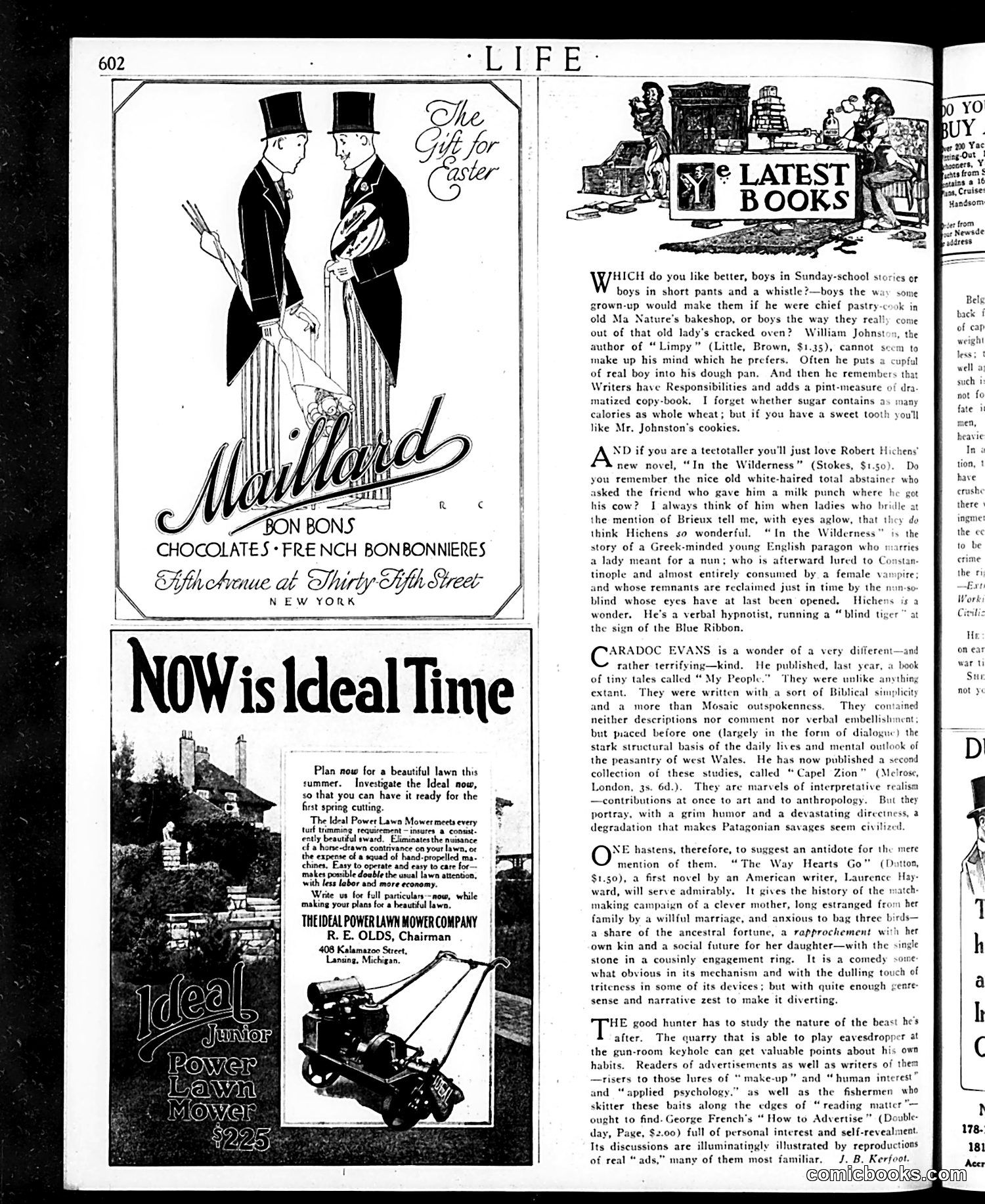
This is primarily an **advertising and book review page** from Life magazine, a satirical publication. The top features an **Maillard chocolate advertisement** showing two gentlemen in top hats—a conventional Easter gift promotion with no satirical intent. The main content is **book reviews** discussing four contemporary novels. The reviewer evaluates whether authors capture "real boys" versus idealized versions, praising William Johnston's *Limpy* for authenticity. Robert Hichens' *In the Wilderness* is discussed through a humorous anecdote about a teetotaler. Caradoc Evans' Welsh peasant tales (*My People*, *Capel Zion*) are praised as unflinching social realism. Laurence Hayward's *The Way Hearts Go* is recommended as light comedy counterbalance. The **Ideal Power Lawn Mower advertisement** occupies the lower left, promoting mechanized lawn care as modern convenience. The page reflects early 20th-century literary taste and consumer culture, with no political content or caricature.
📄 Transcribed text from this page (OCR, searchable)
Machine-transcribed from the original scan — historical spelling and the odd misread are preserved.
CHOCOLATES * FRENCH BONBONNIERES Sifthctiaue at Shirty Tipth Sea NEW YORK is ldeal Time Plan now for a beautiful lawn this summer. Investigate the Ideal now, so that you can have it ready for the first spring cutting. The Ideal Power Lawa Mower meets every turf trimming requirement - insures a consist. ently beautiful sward. Eliminates the nuisance € vorse-drawn contrivance on your lawn, or the expense of a squad of hand-propelled ma- beaorp Easy te, cocsets and ce to care for— make posible double wn attention, ‘with less labor and more economy. Write us foe full particulars--now, while making your plans for a beautiful lawn. THEIDEAL POWER LAWN MOWER COMPANY R. E. OLDS, Chairman 408 Kalamazoo Street, Lansing, Michigan. HICH do you like better, boys in Sunday-school stories or boys in short pants and a whistle?—boys the way some grown-up would make them if he were chief pastry-cook in old Ma Nature's bakeshop, or boys the way they really come out of that old lady's cracked oven? William Johnst author of “Limpy” (Little, Brown, $1.35), cannot se make up his mind which he prefers. Often he puts a cu of real boy into his dough pan. And then he remem Writers have Responsibilities and adds a pint-measure matized copy-book, I forget whether sugar contains a calories as whole wheat; but if you have a sweet tooth you'll like Mr. Johnston's cookies. ND if you are a tectotaller you'll just love Robert Hichens’ new novel, “In the Wilderness” (Stokes, $1.50). Do you remember the nice old white-haired total abstainer who asked the friend who gave him a milk punch where he got his cow? I always think of him when ladies who bridle at the mention of Brieux tell me, with eyes aglow, that they do think Hichens so wonderful. “In the Wilderness” is the story of a Greek-minded young English paragon who marries a lady meant for a nun; who is afterward lured to € ane tinople and almost entirely consumed by a female vampire; and whose remnants are reclaimed just in time by the nun-so- blind whose eyes have at last been opened. Hichens is a wonder. He's a verbal hypnotist, running a “ blind tiger” at the sign of the Blue Ribbon. ARADOC EVANS is a wonder of a very different—and rather terrifying—kind. He published, last year, a book of tiny tales called “ My People.” They were unlike anythi extant. They were written with a sort of Biblical simplicity and a more than Mosaic outspokenness. They contained neither descriptions nor comment nor verbal embellishinent but praced before one (largely in the form of dialoguc) the stark structural basis of the daily lives and mental outlook of the peasantry of west Wales, He has now published a second collection of these studies, called “Capel Zion” (Melrose, London, 3s. 6d.). They are marvels of interpretative realism —contributions at once to art and to anthropology. But they portray, with a grim humor and a devastating directness, a degradation that makes Patagonian savages seem civilized E hastens, therefore, to suggest an antidote for the mere mention of them. he Way Hearts Go” (Dutton, $1.50), a first novel by an American writer, Laurence Hay- ward, will serve admirably. It gives the history of the match: making campaign of a clever mother, long estranged from her family by a willful marriage, and anxious to bag three birds— a share of the ancestral fortune, a rapprochement w own kin and a social future for her daughter— stone in a cousinly engagement ring. It is a comedy so: what obvious in its mechanism and with the dulling tov triteness in some of its devices; but with quite enough gente sense and narrative zest to make it diverting. HE good hunter has to study the nature of the beast he's after. The quarry that is able to play eavesdropper at the gun-room keyhole can get valuable points about his own habits. Readers of advertisements as well as writers of them —risers to those lures of “make-up” and “ human interest” and “applied psychology.” as well as the fishermen who skitter these baits along the edges of “reading matter" ought to find. George French's “ How to Advertise” (Double- day, Page, $2.00) full of personal interest and self-revealment Its discussions are illuminatingly illustrated by reproductions of real “ads,” many of them most familiar. J.B. Kerfoot. comichooks.com there) ingme: the ec Acer