
Life, 1917-04-05 · page 40 of 70
Life — April 5, 1917 — page 40: what you’re looking at
What you’re looking at
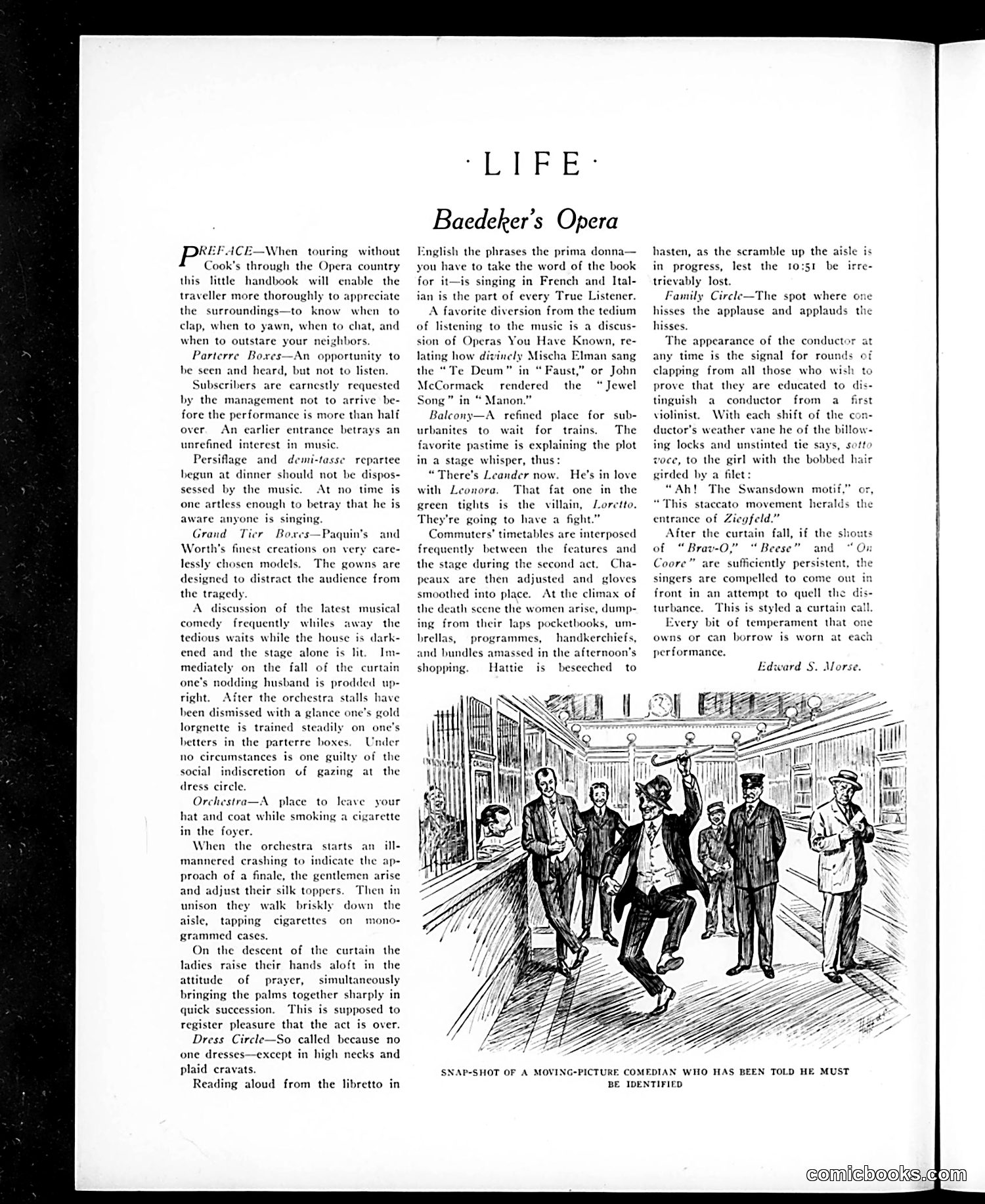
This piece is a humorous mock-guidebook mocking pretentious opera-goers and their affected behaviors. Each section ridicules different seating areas and the social posturing found there. The satire targets wealthy patrons in premium boxes who attend opera to be *seen* rather than to listen—arriving late, gossiping, and using lorgnettes to judge others' fashion. The "Dress Circle" attendees paradoxically ignore dress codes. The "Balcony" crowd are suburban commuters checking train schedules during performances. The accompanying illustration shows well-dressed men in the opera house corridors, likely depicting the social performance and networking that occurs. The piece mocks the pretension of music-lovers who recite opera trivia, applaud conductors to appear educated, and treat the opera as social theater rather than an artistic experience. The title references Baedeker's travel guides, framing opera attendance as just another tourist obligation to perform correctly in polite society.
📄 Transcribed text from this page (OCR, searchable)
Machine-transcribed from the original scan — historical spelling and the odd misread are preserved.
REF ACE—When touring without Cook's through the Opera country little handbook will enable the traveller more thoroughly to appreciate the surroundings—to know when to clap, when to yawn, when to chat, and when to outstare your neighbors. Parterre Boxes—An opportunity to be seen and heard, but not to listen. Subscribers are earnestly requested hy the management not to arrive be- fore the performance is more than half over An earlier entrance betrays an unrefined interest in music. Persiflage begun at dinner should not be dispos- sessed by the music. At no time is one artless enough to betray that he is aware anyone is singing. Grand Tier Boa Worth's finest crea lessly chosen models. The gowns are designed to distract the audience from the tragedy. A discussion of the latest musical comedy frequently whiles away the tedious waits while the house is dark- ened and the stage alone is lit. Im- mediately on the fall of the curtain one’s nodding husband is prodded up- right. After the orchestra stalls have heen dismissed with a glance one’s gold lorgnette is trained steadily on one’s betters in the parterre boxes. Under this and demi-tasse repartee s—Paquin’s and ions on very care- no circumstances is one guilty of the social indiscretion of gazing at the dress circle. Orchestra—A_ place to Icave your hat and coat while smoking a cigarette in the foyer. When the orchestra starts an ill- mannered crashing to indicate the ap- proach of a finale, the gentlemen arise and adjust their silk toppers. Then in unison they walk briskly down the aisle, tapping cigarettes on grammed cases. On the descent of the curtain the ladies raise their hands aloft in the attitude of prayer, simultancously bringing the palms together sharply in quick succession. This is supposed to register pleasure that the act is over. Dress Circle—So called because no one dresses—except in high necks and plaid cravats. Reading aloud from the libretto in mono- *LIFE> Baedeker’s Opera English the phrases the prima donna— you have to take the word of the book for it—is singing in French and Ital- ian is the part of every True Listener. A favorite diversion from the tedium of listening to the music is a discus- sion of Operas You Have Known, re- lating how divinely Mischa Elman sang the “Te Deum” in “ Faust,” or John McCormack rendered the“ Jewel Song” in “ Manon.” Baleony—A refined place for sub- urbanites to it for trains. The favorite pastime is explaining the plot in a stage whisper, thus: “There’s Leander now. He's in love with Leonora. That fat one in the green tights is the villain, Loretto. They're going to have a fight.” Commuters’ timetables are interposed frequently between the features and the sta Cha- peaux are then adjusted and gloves smoothed into place. At the climax of the death scene the women arise, dump- ing from their laps pocketbooks, um- hrellas, programmes, handkerchiefs, and bundles amassed in the afternoon's shopping. Hattie is beseeched to e during the second act. hasten, as the scramble up the aisle is in progress, lest the 10:51 be trievably lost. Family Circle—The spot where hisses the applause and applauds hisses. The appearance of the conductor any time is the signal for rounc f clapping from all those who wish to prove that they are educated to dis- tinguish a conductor from a fi violinist. With each shift of the con- ductor’s weather vane he of the billow- ing locks and unstinted tie says, sotto voce, to the girl with the bobbed hair girded by a filet: “Ah! The Swansdown motif,” c “This staccato movement hera entrance of Ziegfeld.” After the curtain fall, if the sho of “Brav-O,” “Beese” and Coore” are sufficiently persistent, th singers are compelled to come out i front in an attempt to quell the di nce. This is styled a curta Every bit of temperament that one irre- call owns or can borrow is worn at each performance. yard S. Morse. SNAP-SHOT OF A MOVING-PICTURE COMEDIAN WHO HAS BEEN TOLD HE MUST BE IDENTIFIED comichooks.qom