
Life, 1917-04-05 · page 43 of 70
Life — April 5, 1917 — page 43: what you’re looking at
What you’re looking at
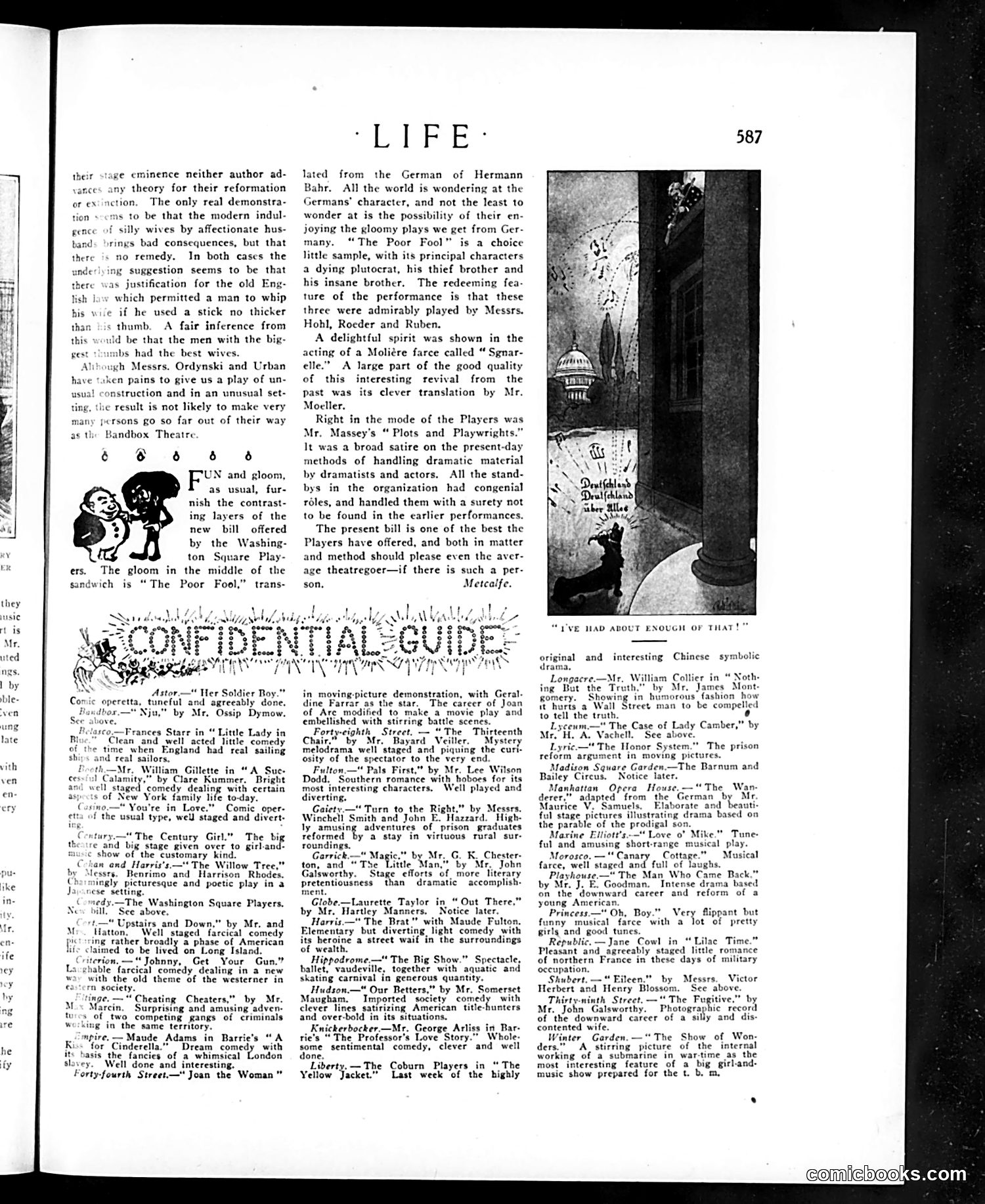
This page reviews current Broadway productions. The small cartoon (left) depicts a couple in conflict, illustrating the magazine's satirical commentary on modern marriage. The text discusses plays including "The Poor Fool" (translated from German), which features depressing characters: a dying plutocrat and his criminal/insane brothers. Life pokes fun at Germans' tolerance for gloomy drama. The review also covers lighter fare—a Molière farce and "Plots and Playwrights," a meta-theatrical satire about how dramatists and actors handle material. The cartoon's caption "I've Had About Enough of That!" references the text's discussion of "silly wives" and husbands, alluding to old English law permitting wife-beating with thin sticks. Life sarcastically suggests only men with "biggest limbs had the best wives"—dark humor mocking both domestic abuse and contemporary marriage dynamics.
📄 Transcribed text from this page (OCR, searchable)
Machine-transcribed from the original scan — historical spelling and the odd misread are preserved.
their stage eminence neither author ad- vances any theory for their reformation or exinction, The only real demonstra- tion s cms to be that the modern indul- gence of silly wives by affectionate hus- band: brings bad consequences, but that s no remedy. In both cases the ing Suggestion seems to be that as justification for the old Eng. + which permitted a man to whip e if he used a stick no thicker than tis thumb. A fair inference from this would be that the men with the big- gest slimbs had the best wi ugh Messrs. Ordynski and Urban have taken pains to give us a play of un- onstruction and in an unusual set- ting, the result is not likely to make very many persons go so far out of their way Bandbox Theatre é é é 'UN and gloom, as usual, fur- nish the contrast- ing layers of the new bill offered by the Washing- Q ton Square Play- The gloom in the middle of the wich is “The Poor Fool,” trans- usual as Uh Her Soldier Roy ful and agreeably done, by Mr. Ossip Dymow. Belasco.—Frances Starr in “ Little Lady in Ry Clean and well acted little comedy of the time when England had real sailing sh: nd real sailors, Pocth —Mr, William, Gillette in “A. Suce cessful Calamity,” by Clare Kummer, Bright and well staged ‘comedy dealing with certain s of New York family life to-day. sino.—" You're in Love.” Comic oper- f the usual type, well staged and divert: ntury.—" The Century Girl.” re ar The big big stage given over to girl-ani © show of the customary kind. ian and Harris’s—" The Willow Tree,” lessrs. Benrimo and Harrison Rhodes. bormingly picturesque and poetic play in a nese setting. sedy.— The Washington Square Players. I. See above, —" Upstairs and Down,” by Mr. and Hatton, Well staged. farcical. comedy ing rather broadly a phase of American claimed to be lived on Long Island, terion, —“‘ Johnny, Get Your Gun.” sghable farcical comedy dealing in a new with the old theme of the westerner in a society. inge. — “Cheating Cheaters," by Mr. Marcin, Surprising and amusing adven- s of two competing gangs of criminals hing in the same territory. npire. — Maude Adams in Barrie's “A for Cinderella.” Dream comedy with basis the fancies of a whimsical London vey. Well done and interesting. Forty-fourth Street,—* Joan the Woman" “LIPE- lated from the German of Hermann Bahr. All the world is wondering at the Germans’ character, and not the least to wonder at is the possibility of their en- joying the gloomy plays we get from Ger- many. “The Poor Fool” is a choice little sample, with its principal characters a dying plutocrat, his thief brother and his insane brother. The redeeming fea: ture of the performance is that these three were admirably played by Messrs. Hohl, Roeder and Ruben. A delightful spirit was shown in the acting of a Moliére farce called “ Sgnar- elle.” A large part of the good quality of this interesting revival from the past was its clever translation by Mr. Moeller. Right in the mode of the Players was Mr. Massey's “ Plots and Playwrights.” It was a broad satire on the present-day methods of handling dramatic material by dramatists and actors. All the stand- bys in the organization had congenial roles, and handled them with a surety not to be found in the earlier performances. The present bill is one of the best the Players have offered, and both in matter and method should please even the aver- age theatregoer—if there is such a per- Metcalfe. in moving-picture demonstration, with Geral- dine Farrar as the star. The career of Joan of Are modified to make a movie play’ and embellished with stirring battle scenes. Fortyeighth, Street, — “The Thirteenth Chair.” by Mr. Bayard Veiller. Mystery melodrama well ‘staged and piquing the curi- osity of the spectator to the very end. Fulton.—"' Pals First,” by, Mr. Lee Wilson Dodd. Southern romance with hoboes for its most interesting characters. Well played and diverting. Gaiety —" Turn to the Right,” by Messrs. Winchell Smith and John E. Hazzard. High: ly amusing adventures of prison graduates reformed by a stay in virtuous rural sur: roundings. Garrick, —"" Magic." by Mr, G. K. Chester- ton, and” Tye Little Man? by ‘Mr. Jobn Galsworthy. Stage efforts of more literary pretentiousness than dramatic accomplish- ment. Globe—Laurette Taylor in “ Out There,” by Mr. Hartley Manners. Notice later. Harris.—" The Brat" with Maude Fulton. Elementary but diverting light comedy with its heroine a street waif in the surroundings of wealth. Hippodrome.—" The Big Show." Spectacle, ballet, vaudeville, together with aquatic and skating carnival in generous quantity. Hudson.—" Our Betters,” by Mr. Somerset Maugham. Imported society comedy with clever lines satirizing American title-hunters and over-bold in its situations. Knickerbocker —Mr. George Arliss in Bar- rie’s “The Professor's Love Story.” Whole. ome sentimental comedy, clever “and well done. Liberty. — The Coburn Players in “The Yellow Jacket.” Last week of the highly “V'VE MAD ADOUT ENOUGH OF THAT!” riginal and interesting Chinese symbolic drama, Longacre.—Mr, William Collier in Noth. ing Bat the Troth.” by Mr. James Mont- gomery. Showing in humorous fashion how it hurts a Wall Street man to be compelled to tell the truth. 0 Lycenm.—" The Case of Lady Camber," by Mr. H. A. Vachell, See above Lyric—" The Honor System.” The prison reform argument in moving pictures. Madison Square Garden.—The Barnum and Bailey Circus, Notice later. Manhattan Opera House. —‘ The Wan- derer.” adapted from the German by Mr Maurice V. Samuels. Elaborate and beauti- ful stage pictures illustrating drama based oa the parable of the prodigal s Marine Elliott’s—" Love o° Mike." Tune: ful and amusing short-range musical play. Morosco. —"* Canary Cottage.” Musical farce, well staged and full of laughs. Playhouse.— The Man Who Came Back.” by Mr. J. E. Goodman. Intense drama based on the downward career and reform of a young American. Princess —" Oh, Boy.” Very flippant but funny musical farce with a lot of pretty girls and good tunes. Republic, —Jane Cowl in “Lilac Ti Pleasant and agreeably staged little roma of northern France in these days of military ‘occupation, Shubert. —“ Eileen.” by Messrs. V Herbert and Henry Blossom. See above. Thirty-ninth Street. —" The Fugitive.” by Mr. John Galsworthy. Photographic record of the downward carcer of a silly and dis- contented wife. Winter, Garden. —" The Show of Won- ders.” A_ stirring picture of the internal working of a submarine in war-time as the most interesting feature of a big gitland- music show prepared for the t. b, m, comichoo! ks.com