
Life, 1917-04-05 · page 45 of 70
Life — April 5, 1917 — page 45: what you’re looking at
What you’re looking at
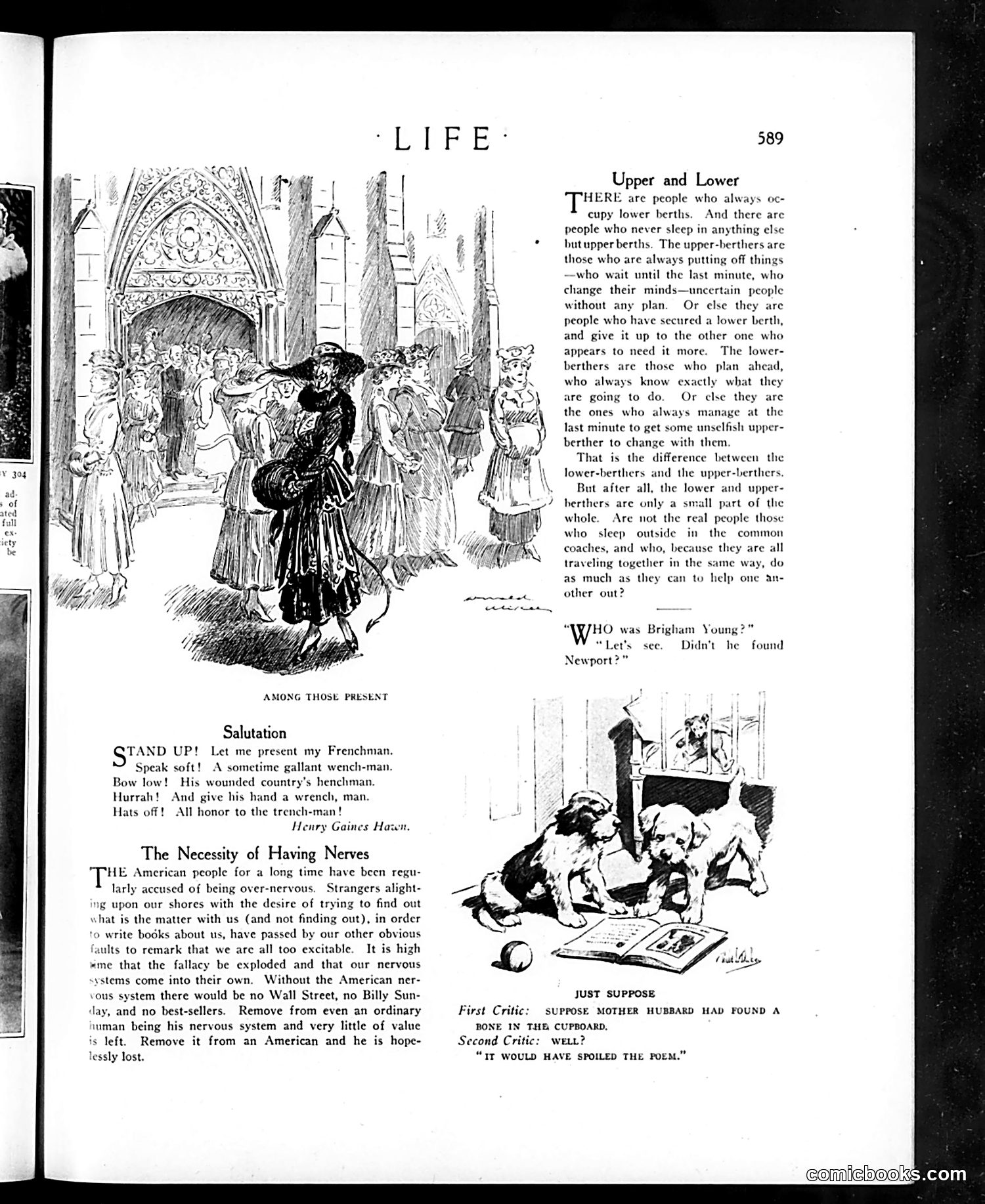
This page contains three distinct humor pieces: **"Upper and Lower"**: A philosophical essay contrasting train berth preferences as character types—upper-berth sleepers as indecisive procrastinators versus lower-berth sleepers as planners. The joke concludes that truly good people are those in common coaches who help fellow travelers. It's gentle social commentary on American character types, likely referencing the prevalence of train travel in this era. **"Who was Brigham Young?" joke**: A brief gag about confusing the Mormon founder with Newport (the wealthy Rhode Island city), suggesting cultural or geographical ignorance. **"Just Suppose"**: A cartoon showing dogs examining a book titled "Mother Hubbard," with critics debating whether finding a bone in the cupboard would ruin the nursery rhyme's narrative. It's meta-humor about literary criticism. The page reflects early-20th-century American satirical style, targeting everyday social pretensions and intellectual absurdity rather than specific political figures.
📄 Transcribed text from this page (OCR, searchable)
Machine-transcribed from the original scan — historical spelling and the odd misread are preserved.
589 Upper and Lower HERE are people who always oc- cupy lower berths. And there are people who never sleep in anything else butupper berths. The upper-herthers are those who are always putting off things who wait until the last minute, who change their minds—uncertain people without any plan. Or else they are people who have secured a lower berth, and give it up to the other one who appears to need it more. The lower- berthers are those who plan ahead, who always know exactly what they are going to do. Or clse they are the ones who always manage at the last minute to get some unselfish upper- berther to change with them. That is the difference between the lower-berthers and the upper-berthers. But after all, the lower and upper- herthers are only a small part of the whole. Are not the real people those who sleep outside in the common coaches, and who, because they are all traveling together in the same way, do as much as they can to help one an- other out? “VYJHO was Brigham Young?” “Let's see. Didn't. he found Newport?” AMONG THOSE PRESENT Salutation GTAND UP! Let me present my Frenchman. Speak soft! A sometime gallant wench-man. Bow low! His wounded country’s henchman. Hurrah! And give his hand a wrench, man. Hats off! All honor to the trench-man! Henry Gaines Hawn. The Necessity of Having Nerves HE American people for a long time have been regu- larly accused of being over-nervous. gers alight- ng upon our shores with the desire of trying to find out what is the matter with us (and not finding out), in order to write books about us, have passed by our other obvious faults to remark that we are all too excitable. It is high “me that the fallacy be exploded and that our nervous systems come into their own. Without the American ner- ous system there would be no Wall Street, no Billy Sun- JUST SUPPOSE day, and no best-sellers. Remove from even an ordinary First Critic: SUPPOSE MOTHER HUBBARD HAD FOUND A man being his nervous system and very little of value BONE IN THE CUPBOARD. is left. Remove it from an American and he is hope- Second Critic: weit? lessly lost. “IT WOULD HAVE SPOILED THE POEM.”