
Life, 1917-04-05 · page 34 of 70
Life — April 5, 1917 — page 34: what you’re looking at
What you’re looking at
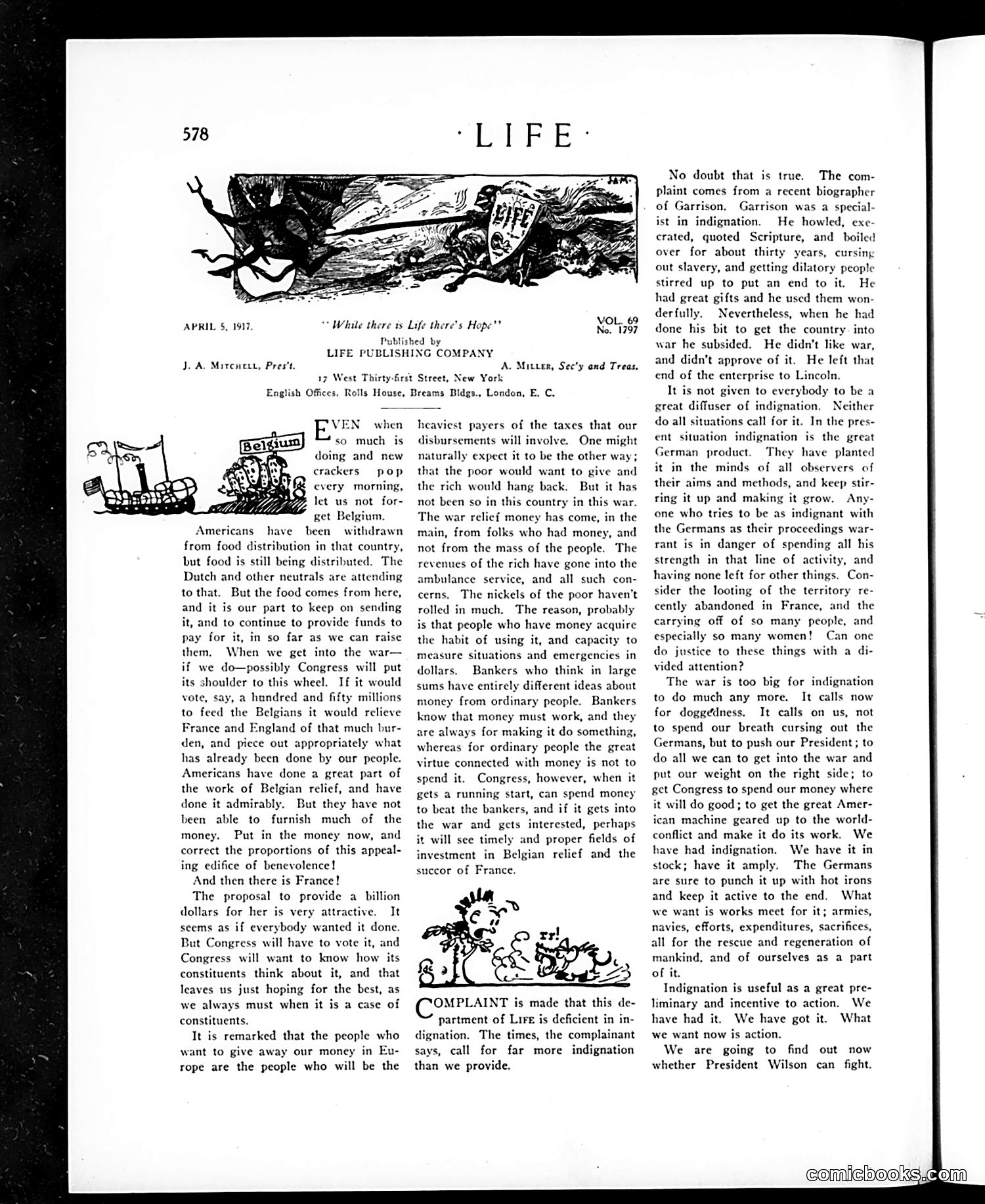
This page discusses American wartime charity and indignation during World War I. The main cartoon (top) depicts a sinking ship labeled "Belgium," illustrating the humanitarian crisis driving relief fundraising. The editorial argues that wealthy Americans have generously funded Belgian relief and proposed French aid, contrary to expectations—the rich, not poor, are donating. It urges Congress to appropriate funds ($150 million for Belgium, $1 billion for France) to share this burden. A secondary discussion addresses criticism that the magazine lacks sufficient "indignation." The author cites abolitionist William Lloyd Garrison as a historical example of righteous anger, but notes that even Garrison abandoned fiery rhetoric after slavery's abolition rather than pursue war matters further. The piece advocates for action over mere outrage, calling for Congressional funding to support Allied nations rather than relying solely on private American charity.
📄 Transcribed text from this page (OCR, searchable)
Machine-transcribed from the original scan — historical spelling and the odd misread are preserved.
“* Whale there ts Life there's Hops VOL. 69 No, 1797 Published by LIFE PUBLISHING COMPANY J. A. Mitenent, Pres’t. A. Mitten, Sec’y and Treas, 17 West Thirty-first Street, New York English Offices, Rolls House, Breams Bldgs., London, E, C. EY iN when so much is doing and new crackers pop every morning, let us not for- get Belgium. withdrawn Mid! ills WH, Americans have been from food distribution in that country but food is still being distributed. The Dutch and other neutrals are attending to that. But the food comes from here, and it is our part to keep on sending it, and to continue to provide funds to pay for it, in so far as we can raise them. When we get into the war— if we do—possibly Congress will put its shoulder to this wheel. If it would vote, say, a hundred and fifty millions to feed the Belgians it would relieve France and England of that much bur- den, and piece out appropriately what has already been done by our people. Americans have done a great part of the work of Belgian relief, and have done it admirably. But they have not been able to furnish much of the money. Put in the money now, and correct the proportions of this appeal- ing edifice of benevolence! And then there is France! The proposal to provide a billion dollars for her very attractive. It seems as if everybody wanted it done. But Congress will have to vote it, and Congress will want to know how its constituents think about it, and that leaves us just hoping for the best, as we always must when it is a case of constituents. It is remarked that the people who want to give away our money in Eu- rope are the people who will be the heaviest ers of the taxes that our disbursements will involve. One might naturally expect it to be the other way; that the poor would want to give and the rich would hang back. But it has not been so in this country in this war. The war relief money has come, in the main, from folks who had money, and not from the mass of the people. The revenues of the rich have gone into the ambulance service, and all such con- cerns. The nickels of the poor haven't rolled in much. The reason, probably is that people who have money acquire the habit of using it, and capacity to measure situations and emergencies in dollars. Bankers who think in large sums have entirely different ideas about money from ordinary people. Bankers know that money must work, and they are always for making it do something, whereas for ordinary people the great virtue connected with money is not to spend it. Congress, however, when it gets a running start, can spend money to beat the bankers, and if it gets into the war and gets interested, perhaps it will see timely and proper fields of investment in Belgian relief and the succor of France OMPLAINT is made that this de- partment of Lire is deficient in in- dignation. The times, the complainant says, call for far more indignation than we provide. No doubt that is true. The com- plaint comes from a recent biographer of Garrison, Garrison was a special- ist in indignation. He howled, exe- crated, quoted Scripture, and_ boiled over for about thirty years, cursing out slavery, and getting dilatory people stirred up to put an end to it. He had great gifts and he used them won- derfully. Nevertheless, when he had done his bit to get the country. into war he subsided. He didn’t like war, and didn't approve of it. He left that end of the enterprise to Lincoln. It is not given to everybody to be a great diffuser of indignation. Neither do all situations call for it. In the pres- ent situation indignation is the great German product. They have planted it in the minds of all observers of their aims and methods, and keep stir- ring it up and making it grow. Any- one who tries to be as indignant with the Germans as their proceedings war- rant is in danger of spending all his strength in that line of activity, and having none left for other things. Con- sider the looting of the territory re- cently abandoned in France, and the carrying off of so many people, and especially so many women! one do justice to these things with a di- vided attention? The war is too big for indignation to do much any more. It calls now for doggddness, It calls on us, not to spend our breath cursing out the Germans, but to push our President ; to do all we can to get into the war and put our weight on the right side; to gct Congress to spend our money where it will do good; to get the great Amer- ican machine geared up to the world- conflict and make it do its work, We have had indignation. We have it in have it amply. The Germans are sure to punch it up with hot irons and keep it active to the end. What we want is works meet for it; armies, navies, efforts, expenditures, sacrifices, all for the rescue and regeneration of mankind, and of ourselves as a part of it. Indignation is useful as a great pre- liminary and incentive to action. We have had it. We have got it. What we want now is action. We are going to find out now whether President Wilson can fight.