
Life, 1917-04-05 · page 42 of 70
Life — April 5, 1917 — page 42: what you’re looking at
What you’re looking at
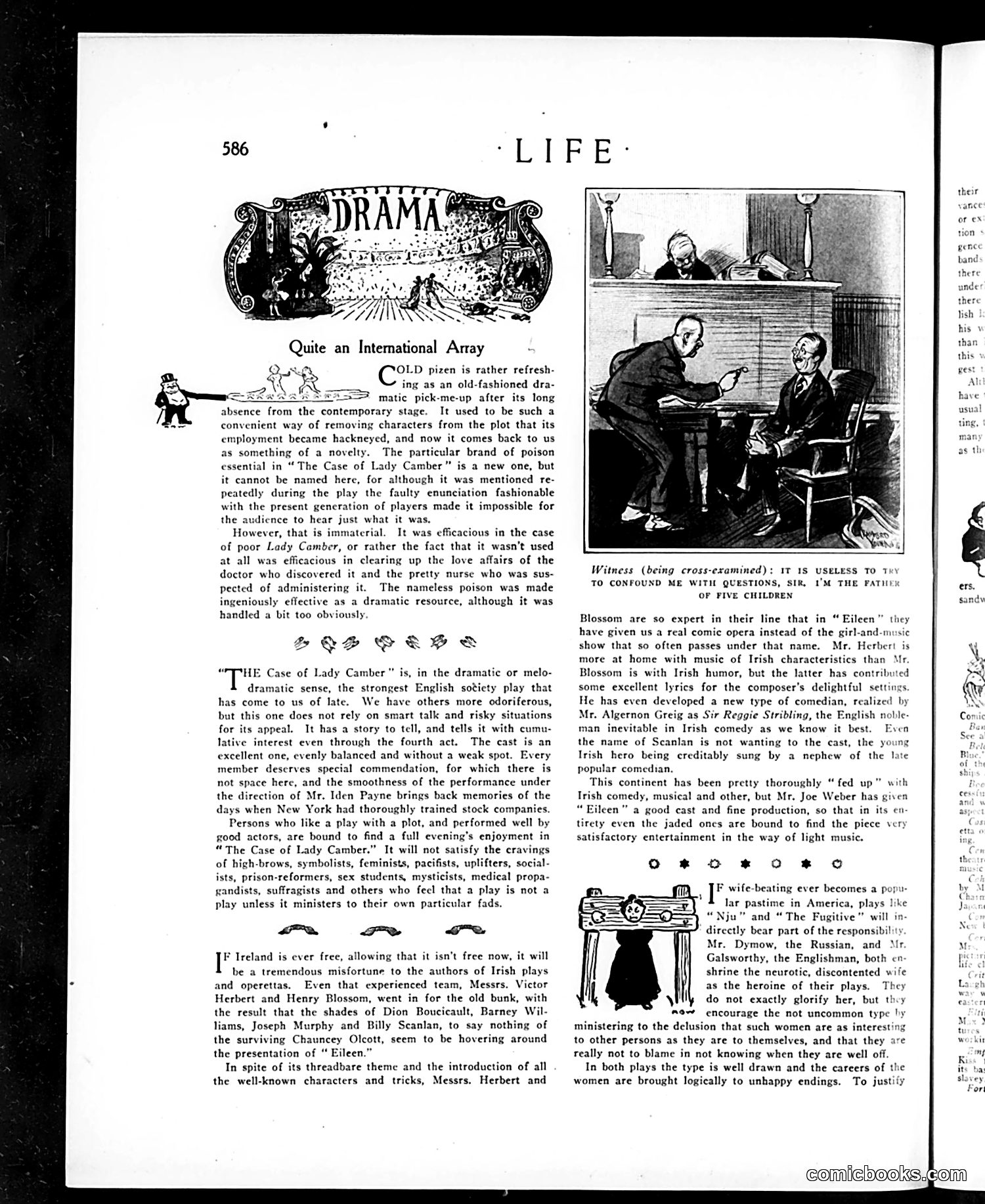
This page reviews two theatrical productions: "The Case of Lady Camber" and "Eileen." **The cartoon** (top right) shows a courtroom witness being cross-examined. The caption jokes that questioning this witness is pointless—he's "the father of five children," implying his parental authority makes him immune to intimidation or contradiction. It's a contemporary gag about paternal dignity superseding legal procedure. **The drama criticism** discusses a society play featuring poison as a plot device—a tired theatrical convention the reviewer notes has made a comeback. The review praises the cast and direction while sarcastically dismissing it won't appeal to "high-brows, symbolists, feminists, pacifists" and other ideological audiences. **The "Eileen" section** reviews an Irish-themed comic opera by Herbert and Blossom, praising their craftsmanship despite relying on stereotypical Irish characters and plots. The reviewer notes the genre's dependence on Irish settings as almost inevitable. The page reflects early 20th-century theatrical criticism and period attitudes toward Irish-American entertainment and gender roles.
📄 Transcribed text from this page (OCR, searchable)
Machine-transcribed from the original scan — historical spelling and the odd misread are preserved.
Quite an International Array foun OLD pizen is rather refresh- ok R, ____ © ing as an old-fashioned dra- 3=> matic pick-me-up after its long Bhicnce ence from ¢ the contemporary stage. It used to be such a convenient way of removing characters from the plot that its employment became hackneyed, and now it comes back to us as something of a novelty. The particular brand of poison essential in “The Case of Lady Camber” is a new one, but it cannot be named here, for although it was mentioned re- peatedly during the play the faulty enunciation fashionable with the present generation of players made it impossible for the audience to hear just what it wa However, that is immaterial. It was efficacious in the case of poor Lady Camber, or rather the fact that it wasn’t used at all was efficacious in clearing up the love affairs of the doctor who discovered it and the pretty nurse who was sus- pected of administering it. The nameless poison was made ingeniously effective as a dramatic resource, although it was handled a bit too obviously Bee SBS HE Case of Lady Camber" is, in the dramatic or melo- dramatic sense, the strongest English sotiety play that has come to us of late. We have others more odoriferous, but this one does not rely on smart talk and risky situations for its appeal. It has a story to tell, and tells it with cumu- lative interest even through the fourth act. The cast is an excellent one, evenly balanced and without a weak spot. Every member deserves special commendation, for which there is not space here, and the smoothness of the performance under the direction of Mr. Iden Payne brings back memories of the days when New York had thoroughly trained stock companies. Persons who like a play with a plot, and performed well by good actors, are bound to find a full evening's enjoyment in “The Case of Lady Camber.” It will not satisfy the cravings of high-brows, symbolists, feminists, pacifists, uplifters, social- ists, prison-reformers, sex students, mysticists, medical propa- gandists, suffragists and others who feel that a play is not a play unless it ministers to their own particular fads. Uw FR OS F Ireland is ever free, allowing that it isn't free now, it will be a tremendous misfortune to the authors of Irish plays and operettas. Even that experienced team, Messrs. Victor Herbert and Henry Blossom, went in for the old bunk, with the result that the shades of Dion Boucicault, Barney Wil- liams, Joseph Murphy and Billy Scanlan, to say nothing of the surviving Chauncey Olcott, seem to be hovering around the presentation of “ Eileen.” In spite of its threadbare theme and the introduction of all the well-known characters and tricks, Messrs. Herbert and Witness (being cross-examined): 1T 18 USELESS TO THY TO CONFOUND ME WITH QUESTIONS, SIR, I'M THE FATEH OF FIVE CHILDREN Blossom are so expert in their line that in “Eileen” they have given us a real comic opera instead of the girl-and-music show that so often passes under that name. Mr. Herbert is more at home with music of Irish characteristics than Blossom is with Irish humor, but the latter has co: some excellent lyrics for the composer's delightful settings. He has even developed a new type of comedian, realized by Mr. Algernon Greig as Sir Reggie Stribling, the English noble- man inevitable in Irish comedy as we know it best. Even the name of Scanlan is not wanting to the cast, the young Irish hero being creditably sung by a nephew of the late popular comedian. This continent has been pretty thoroughly “fed up” with Irish comedy, musical and other, but Mr. Joe Weber has given “Eileen” a good cast and fine production, so that in its en tirety even the jaded ones are bound to find the piece very satisfactory entertainment in the way of light music. oO *# 0 *® O * © F wife-beating ever becomes a popu- lar pastime in America, plays like “Nju” and “The Fugitive” will in directly bear part of the responsibility Mr. Dymow, the Russian, and Mr. Galsworthy, the Englishman, both en shrine the neurotic, discontented wife as the heroine of their plays. They do not exactly glorify her, but they mew encourage the not uncommon type hy ministering to the delusion that such women are as interesting to other persons as they are to themselves, and that they are really not to blame in not knowing when they are well off. In both plays the type is well drawn and the careers of the women are brought logically to unhappy endings. To justily comichooks.,