
Life, 1917-04-05 · page 8 of 70
Life — April 5, 1917 — page 8: what you’re looking at
What you’re looking at
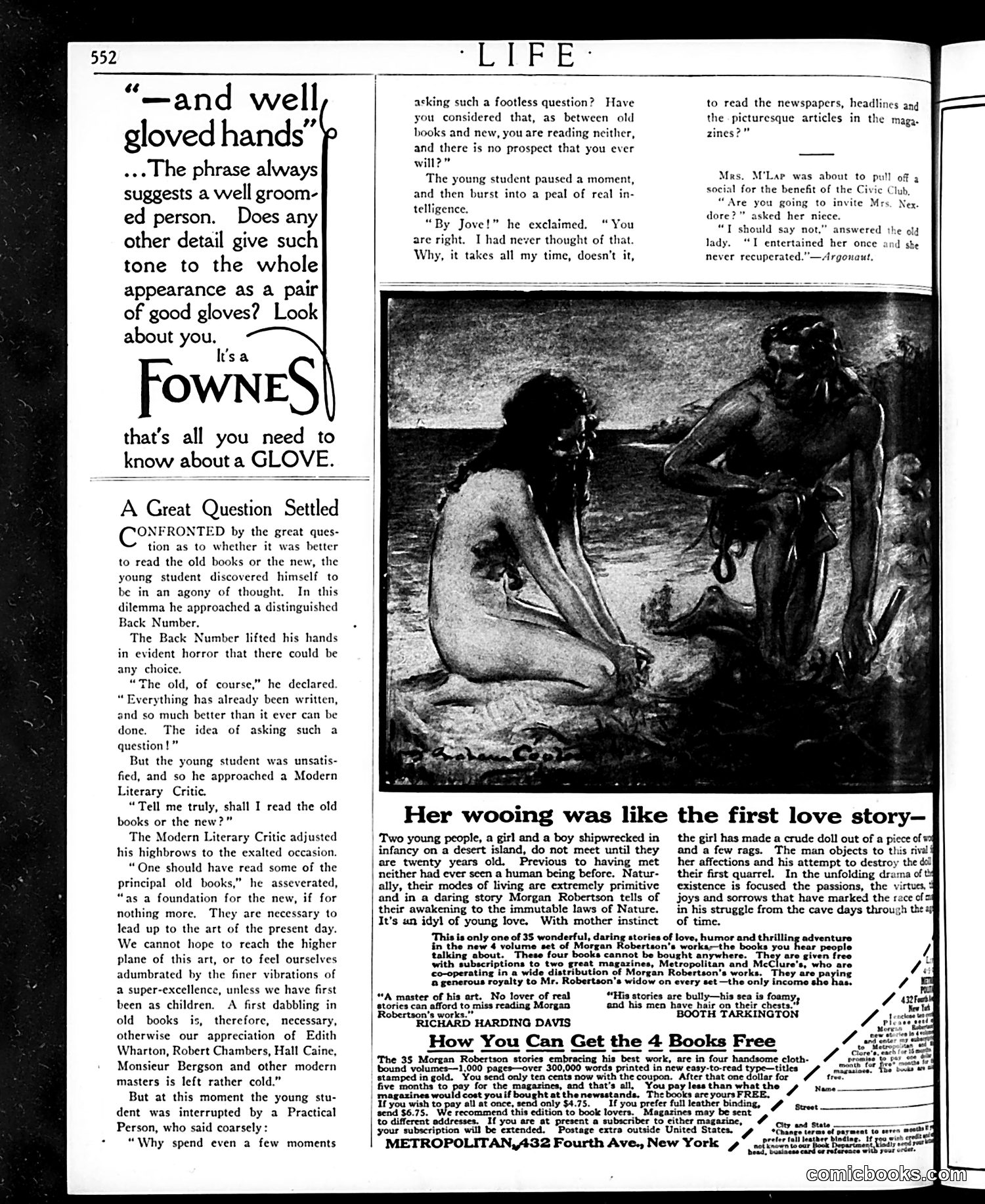
This page is primarily **advertising and literary promotion**, not political satire. The main content concerns a debate about whether students should read "old books or the new"—a commentary on literary taste and cultural modernism. The central illustration depicts a classical or mythological scene of figures by water, accompanying promotional text for **Morgan Robertson's love stories**. The advertisement emphasizes that Robertson's work offers timeless romantic narratives ("her wooing was like the first love story"). The left column presents a dialogue mocking both traditionalists ("Back Number") and modernists ("Modern Literary Critic") as equally dogmatic about reading preferences. The satire gently critiques rigid cultural positions from both camps—not a political cartoon, but rather commentary on contemporary debates about artistic merit and relevance.
📄 Transcribed text from this page (OCR, searchable)
Machine-transcribed from the original scan — historical spelling and the odd misread are preserved.
“—and well gloved hands” . The phrase always suggests a well groom- ed person. Does any other detail give such tone to the whole appearance as a pair of good gloves? Look about you. I'sa TOWNES that’s all you need to know about a GLOVE. IRESE asking such a footless question? Have you considered that, as between old books and new, you are reading neither, to read the newspapers, headlines and the picturesque articles in the maga. zines?” A Great Question Settled (CONFRONTED by the great ques- tion as to whether it was better to read the old books or the new, the young student discovered himself to be in an agony of thought. In this dilemma he approached a distinguished Back Number. The Back Number lifted his hands in evident horror that there could be any choice. “The old, of course,” he declared. “Everything has already been written, and so much better than it ever can be done. The idea of asking such a question!” But the young student was unsatis- fied, and so he approached a Modern Literary Critic. “Tell me truly, shall I read the old books or the new?” The Modern Literary Critic adjusted his highbrows to the exalted occasion. “One should have read some of the principal old books,” he asseverated, “as a foundation for the new, if for nothing more, They are necessary to lead up to the art of the present day. We cannot hope to reach the higher plane of this art, or to feel ourselves adumbrated by the finer vibrations of a super-excellence, unless we have first been as children. A first dabbling in old books is, therefore, necessary, otherwise our appreciation of Edith Wharton, Robert Chambers, Hall Caine, Monsieur Bergson and other modern masters is left rather cold.” But at this moment the young stu- dent was interrupted by a Practical Person, who said coarsely : “Why spend even a few moments and there is no prospect that you ever will?” The young student paused a moment, and then burst into a peal of real in- telligence, . " dore?" asked her niece. “By Jove!” he exclaimed. “You “T should say not,” answered the old are right. I had never thought of that. lady. “I entertained her once and she Why, it takes all my time, doesn’t it, never recuperated.”—Argonaut. Mrs. M'Lap was about to pull off a social for the benefit of the Civic Club, “Are you going to invite } Nex. Her wooing was like the first love story— Two young people, a girl and a boy shipwrecked in _ the girl has made a crude doll out of a piece of infancy on a desert island, do not meet until they and a few rags. The man objects to this rival g are twenty years old. Previous to having met her affections and his attempt to destroy the dél| neither had ever seen a human being before. Natur- their first quarrel. In the unfolding drama of ally, their modes of living are extremely primitive existence is focused the passions, the and in a daring story Morgan Robertson tells of joys and sorrows that have marked the race cf their awakening to the immutable laws of Nature. _ in his struggle from the cave days through the It’s un idyl of young love. With mother instinct of time. ‘This is only one of 35 wonderful, daring stories of love, humor and thrilling adventure in the new 4 volume set of Morgan Robertson's worka-the books you hear people talking about. These four books cannot be bought anyw' siven free with subscriptions to two great magazines, Metropolitan and McClure'ss who are Coroperating in a wide distribution of Morgan Robertson's works, They are pay! f generous royalty to Mr. Robertson's widow on every set —the only income she ha: master of his art. No lover of real “His stories are bully—his sea is foamy, stories can afford to miss reading Morgan and his men have hair on their chests.” Robertson's works.”* BOOTH TARKINGTON RICHARD HARDING DAVIS How You Can Get the 4 Books Free ‘The 35 Morgan Robertson stories embracing his best work, are in four handsome ¢ bound volumes—1,000 pages—over 300,000 words printed in new easy-to-read ‘itlea es See Re stamped in gold. You send only ten cents now with the coupon. After that one dollar for 7 tro five months to pay for the magazines, and that's all. You pay less than what the 7 "Name azines would cost youif bought at thenewsstands. The books are yours FREE. only $4.75. If you prefer full leather binding, Qf sureet send $6.75. We recommend this edition to book lovers. ‘Magazines may be be sent to different addresses. If you are at present a sul subscriber to either magazine, your subscription will be txtended. ‘Postage extra outside United States, METROPOLITAN, 482 Fourth Ave., New York 7“ ~/ st sie tee ae comichooks.gol Ef you wish to pay all at once, <Q, and, State