
Life, 1917-04-05 · page 35 of 70
Life — April 5, 1917 — page 35: what you’re looking at
What you’re looking at
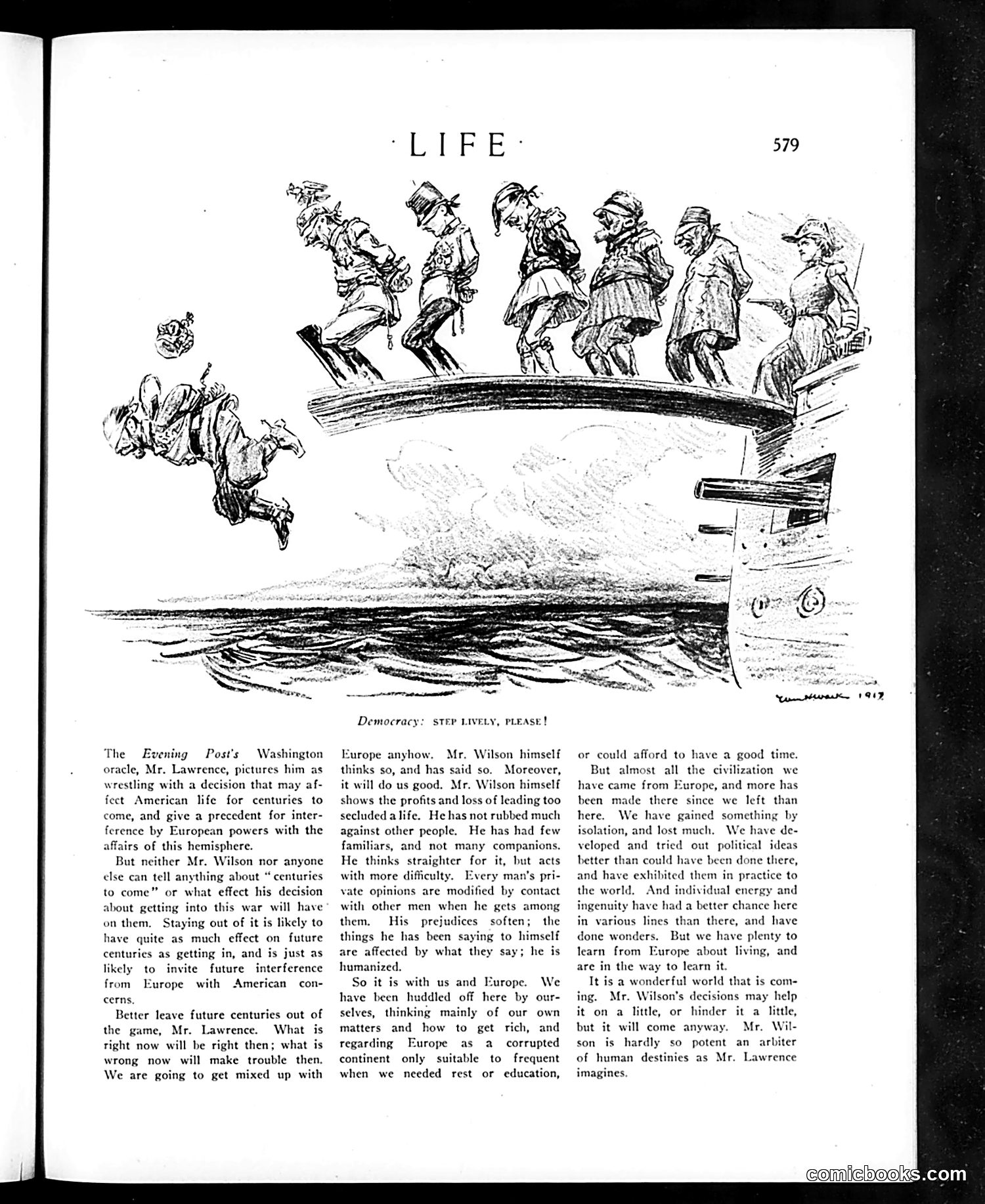
This 1917 cartoon satirizes the debate over American entry into World War I. The image shows six figures balanced precariously on a plank labeled "Democracy," teetering over water—representing the political establishment struggling with the decision to enter the war. The accompanying article critiques Mr. Lawrence's (likely of the *Evening Post*) argument against intervention. Lawrence claimed staying neutral would set a precedent protecting American interests for centuries. Life's editors counter that this argument is overly grandiose and that President Wilson—depicted as isolated and inexperienced with other nations—would actually benefit from European contact and influence. The cartoon's caption "Step lively, please!" suggests politicians must act carefully on this precipice. The satire mocks both isolationist concerns and the pretentious reasoning used to justify foreign policy decisions, implying America will inevitably enter the war regardless of philosophical arguments.
📄 Transcribed text from this page (OCR, searchable)
Machine-transcribed from the original scan — historical spelling and the odd misread are preserved.
The Evening Post's oracle, Mr. Lawrence, pictures him as Washington wrestling with a decision that may af- fect American life for centuries to come, and give a precedent for inter- ference by European powers with the affairs of this hemisphere. But neither Mr. Wilson nor anyone else can tell anything about “ centuries to come” or what effect his decision about getting into this war will have on them. Staying out of it is likely to have quite as much effect on future centuries as getting in, and is just as likely to invite future interference from Europe with American cerns, Better leave future centuries out of the game, Mr. Lawrence. What is right now will be right then; what is wrong now will make trouble then, We are going to get mixed up with con- Democracy: STE LAVELY, PLEASE! Europe anyhow. Mr. Wilson himself thinks so, and has said so. Moreover, it will do us good. Mr. Wilson himself shows the profits and loss of leading too secluded a life. He has not rubbed much against other people. He has had few familiars, and not many companions. He thinks straighter for it, but acts with more difficulty. ery man’s pri- vate opinions are modified by contact with other men when he gets among them. His prejudices soften; the things he has been saying to himself are affected by what they say; he is humanized, So it is with us and Europe. We have been huddled off here by our- selves, thinking mainly of our own matters and how to get rich, and regarding Europe as a corrupted continent only suitable to frequent when we needed rest or education, or could afford to have a good time. But almost all the civilization we have came from Europe, and more has been made there since we left than here. We have gained something by isolation, and lost much. We have de- veloped and tricd out political ideas better than could have been done there, and have exhibited them in practice to the world, And individual energy and ingenuity have had a better chance here in various lines than there, and have done wonders. But we have plenty to learn from Europe about living, and are in the way to learn it. It is a wonderful world that is com- ing. Mr. Wilson's decisions may help it on a little, or hinder it a little, but it will come anyway. Mr. Wil- son is hardly so potent an arbiter of human destinies as Mr. Lawrence imagines.