
A complete issue · 56 pages · 1915
Life — May 6, 1915
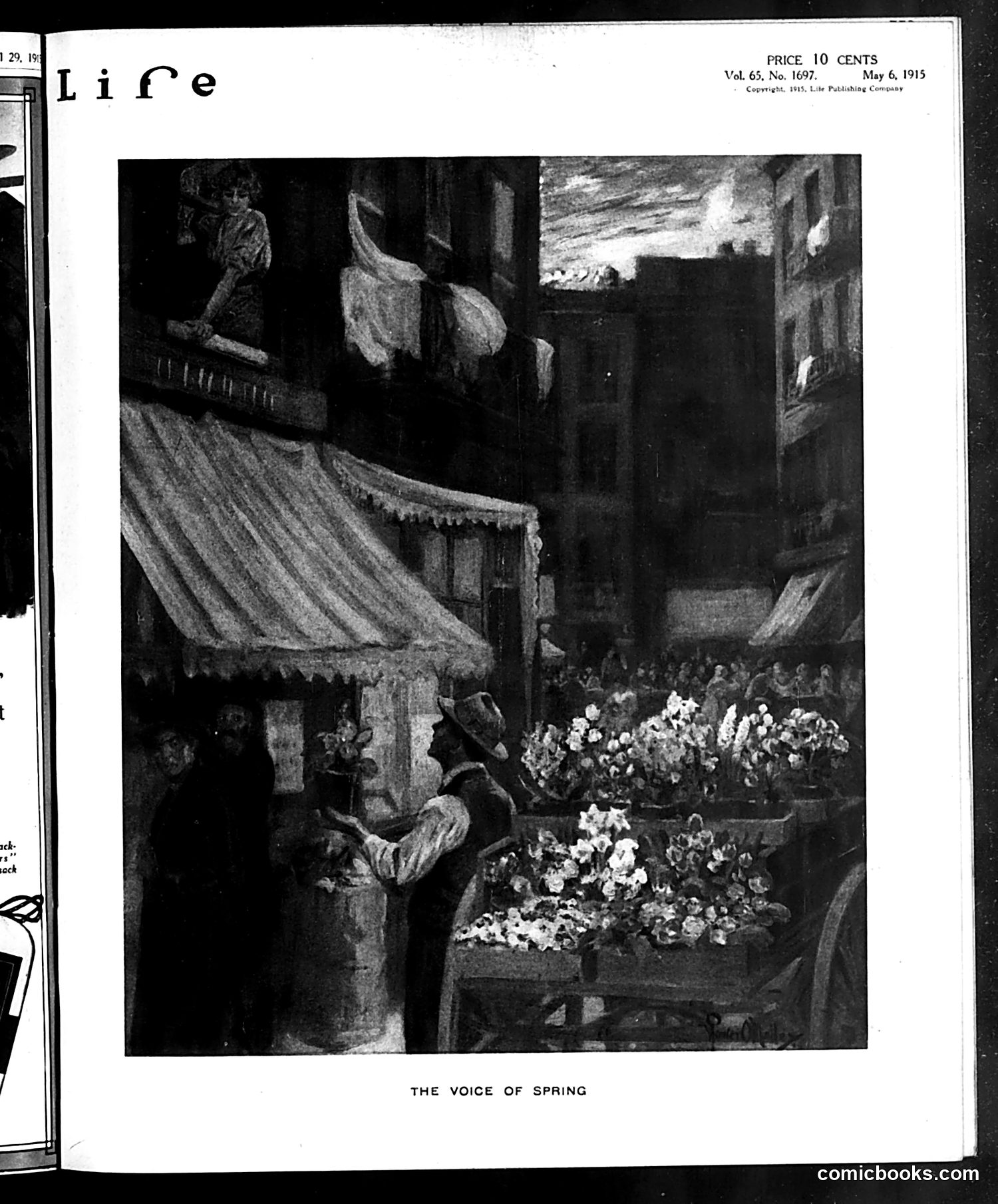
This illustration from Life magazine (May 6, 1915) appears to be a romantic or allegorical artwork rather than political satire. The image depicts an urban nighttime scene with flowering plants in the foreground and figures observing them. The title "The Voice of Spring" suggests the artwork celebrates seasonal renewal and nature's emergence. The composition shows architectural elements (buildings, awnings) and what appears to be everyday citizens encountering blooming flowers in an urban setting. Rather than satirizing specific political figures or events, this seems to be sentimental commentary on spring's universal appeal—nature's voice reaching people even in city environments. The piece reflects early 20th-century artistic sensibilities about nature and urban life.
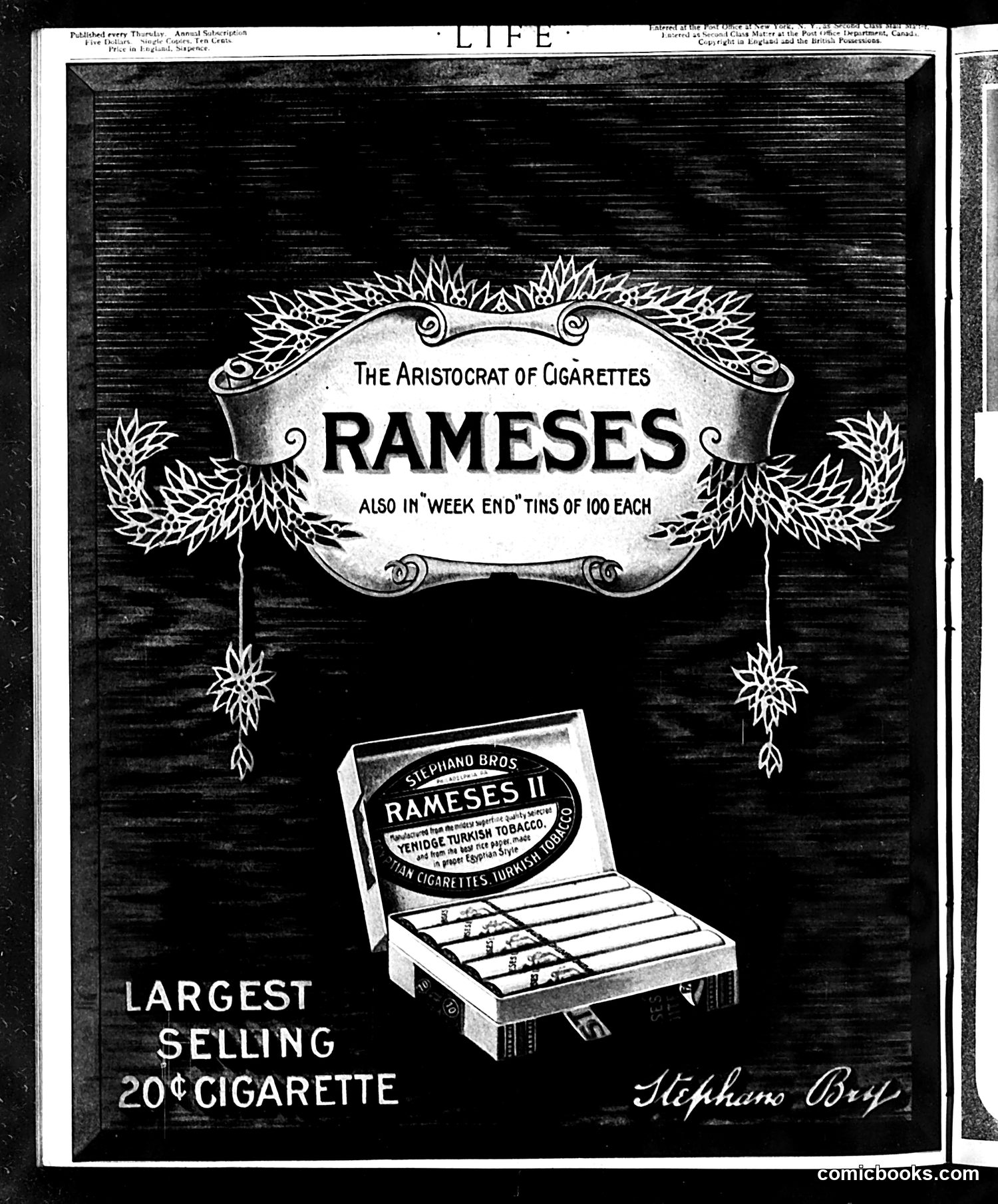
This page is primarily **advertising, not satire or editorial content**. It features a full-page advertisement for Rameses II cigarettes by Stephano Bros, describing them as "The Aristocrat of Cigarettes" and "Largest Selling 20¢ Cigarette." The advertisement includes decorative Egyptian-style imagery (palm fronds, ornamental frames) referencing the product name "Rameses II"—the famous ancient Egyptian pharaoh. A product box is prominently displayed. The page also notes that cigarettes come in "Week End" tins of 100 each. There is **no political cartoon or satire present**—this is straightforward commercial advertising from an era when cigarette marketing in magazines was standard and unregulated.
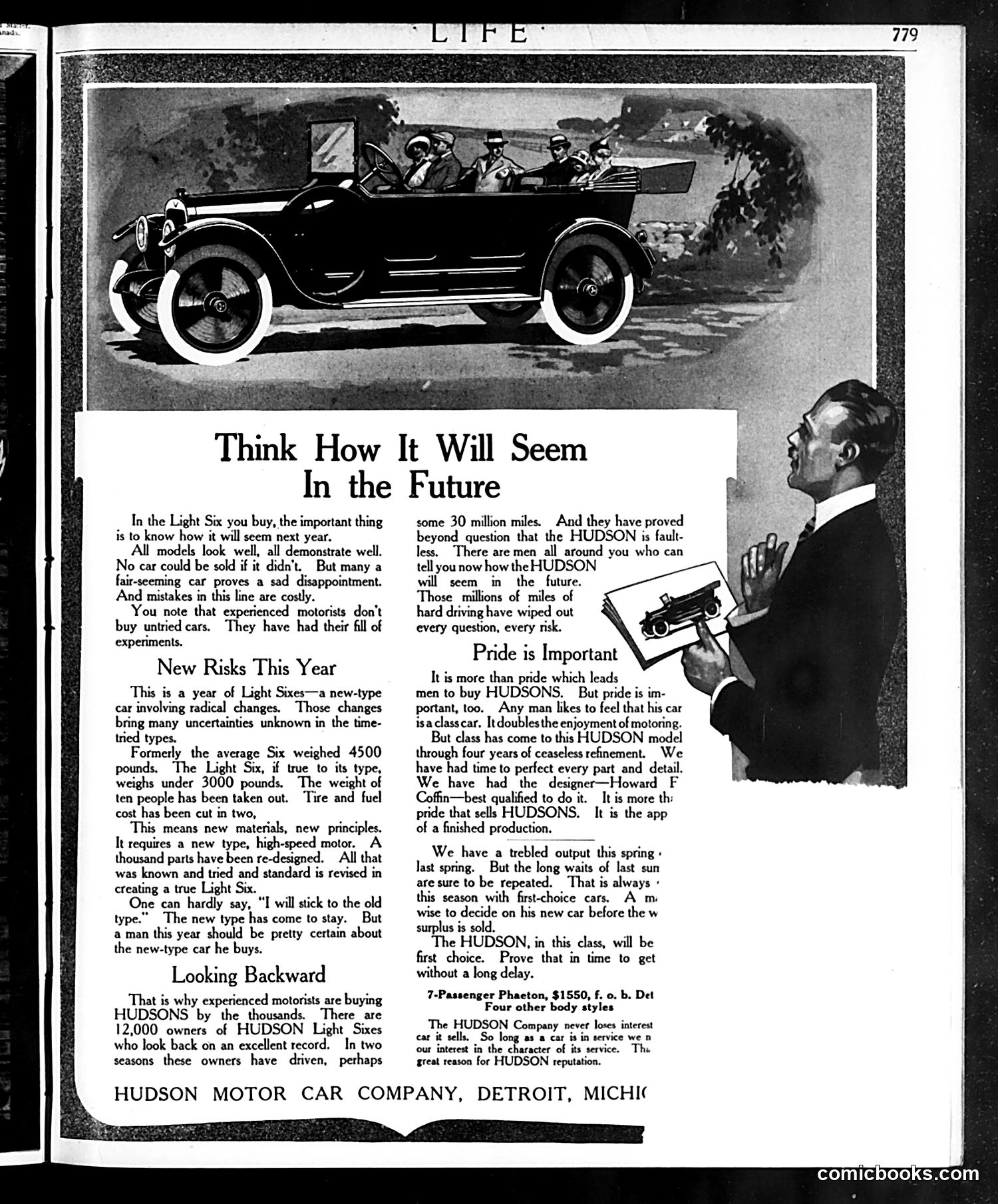
This page is primarily a **product advertisement**, not political satire. It promotes Hudson's "Light Six" automobile to potential buyers. The ad argues that buying a Hudson represents a sound investment despite the car's "new risks this year"—radical design changes including a lighter weight (under 3000 pounds versus the former 4500) and a redesigned high-speed motor. The advertisement uses reassurance as its sales strategy, emphasizing that 12,000 existing Hudson owners have logged approximately 30 million miles, proving the vehicle's reliability. It appeals to buyers' pride, suggesting that owning a Hudson demonstrates good judgment and class. The image shows a well-dressed man examining a car blueprint while a touring car full of passengers is pictured above—illustrating the product's practical family utility and aspirational lifestyle appeal.
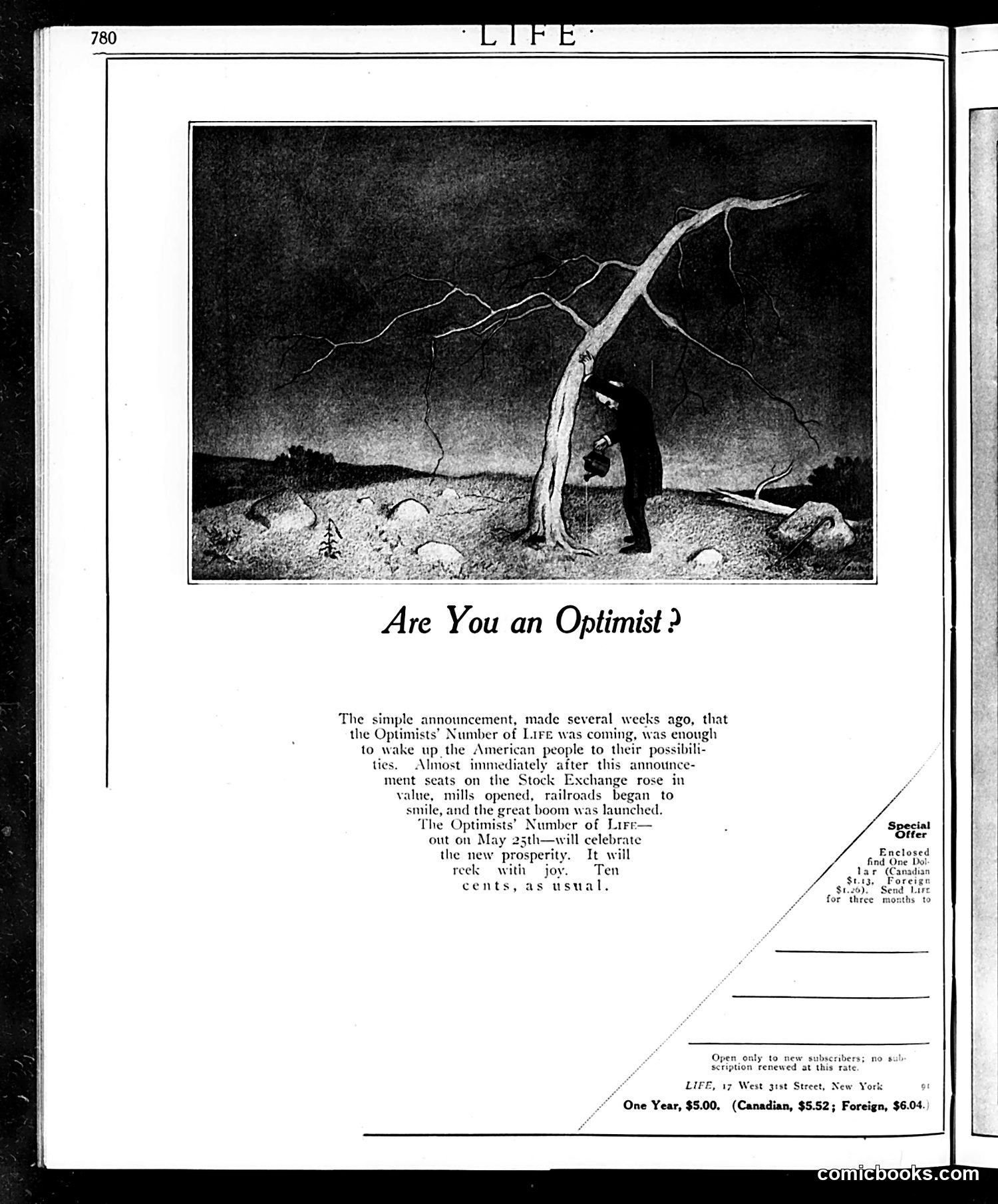
This is primarily a **subscription advertisement** for *Life* magazine, not a political cartoon. The illustration shows a silhouetted figure standing beside a gnarled, nearly-dead tree in a barren landscape—a visual metaphor for optimism confronting harsh reality. The text announces the "Optimists' Number of LIFE" coming May 25th, celebrating "new prosperity." The advertisement plays on contemporary optimism (likely post-WWI or during an economic boom period) by ironically juxtaposing the cheerful announcement against the bleak imagery of the dead tree and desolate terrain. The satire suggests skepticism about claims of prosperity—the cartoon implies that optimism may be misplaced given actual conditions. The price listed is 10 cents, with annual subscription at $5.00.
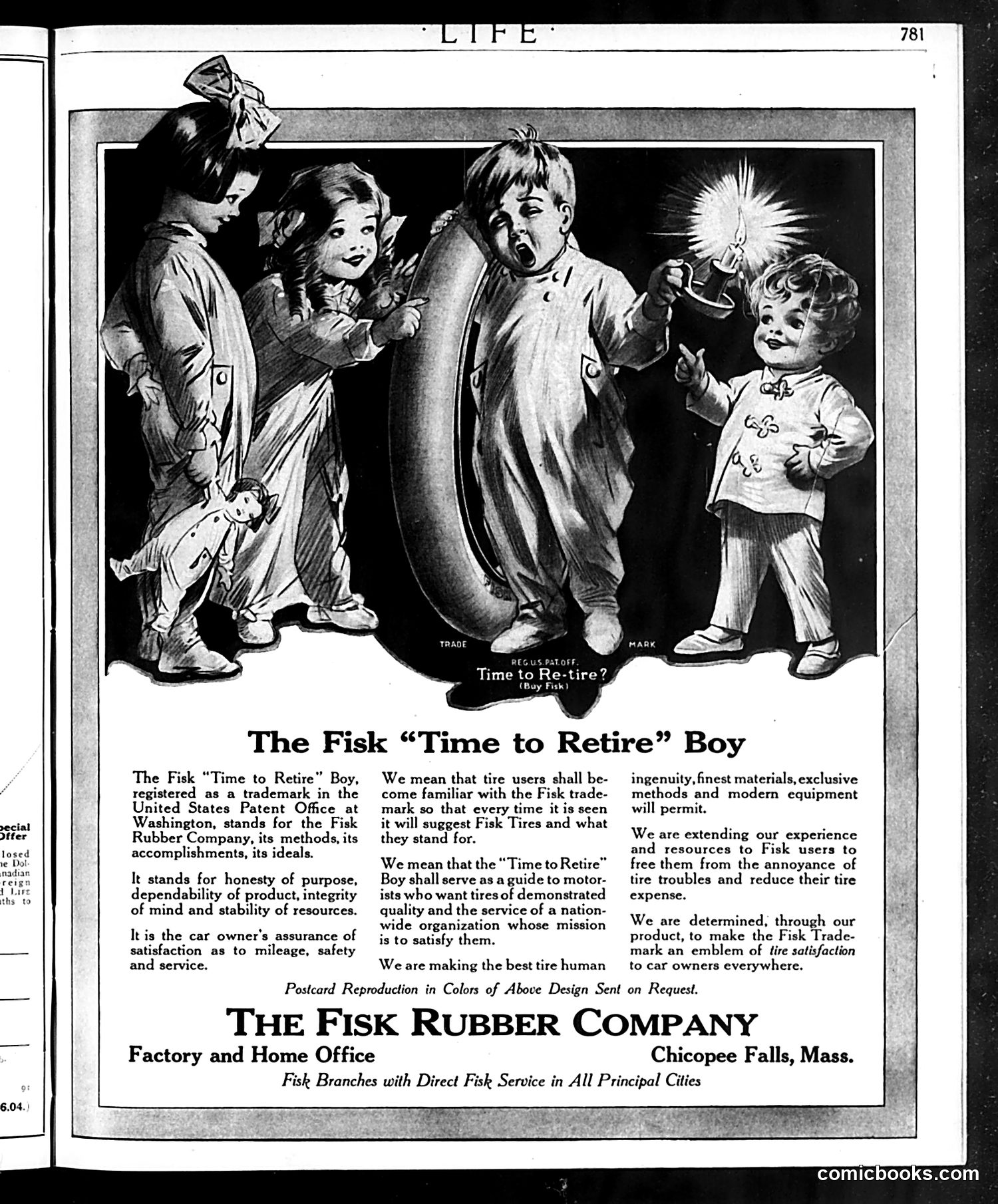
This is primarily **advertising copy**, not satire or political commentary. The Fisk Rubber Company of Chicopee Falls, Massachusetts uses an illustrated mascot—the "Time to Retire" Boy—to promote tire quality and customer service. The cartoon shows children examining an anthropomorphic tire character, reinforcing the brand's messaging about reliability and trustworthiness. The "Time to Retire" name cleverly plays on the phrase "time to retire," suggesting that Fisk tires last so long, retirement comes before the tires fail. The advertisement emphasizes Fisk's commitment to quality materials, nationwide service, and reducing customer tire expenses—standard early-20th-century marketing appeals to automobile owners concerned with tire dependability and value.
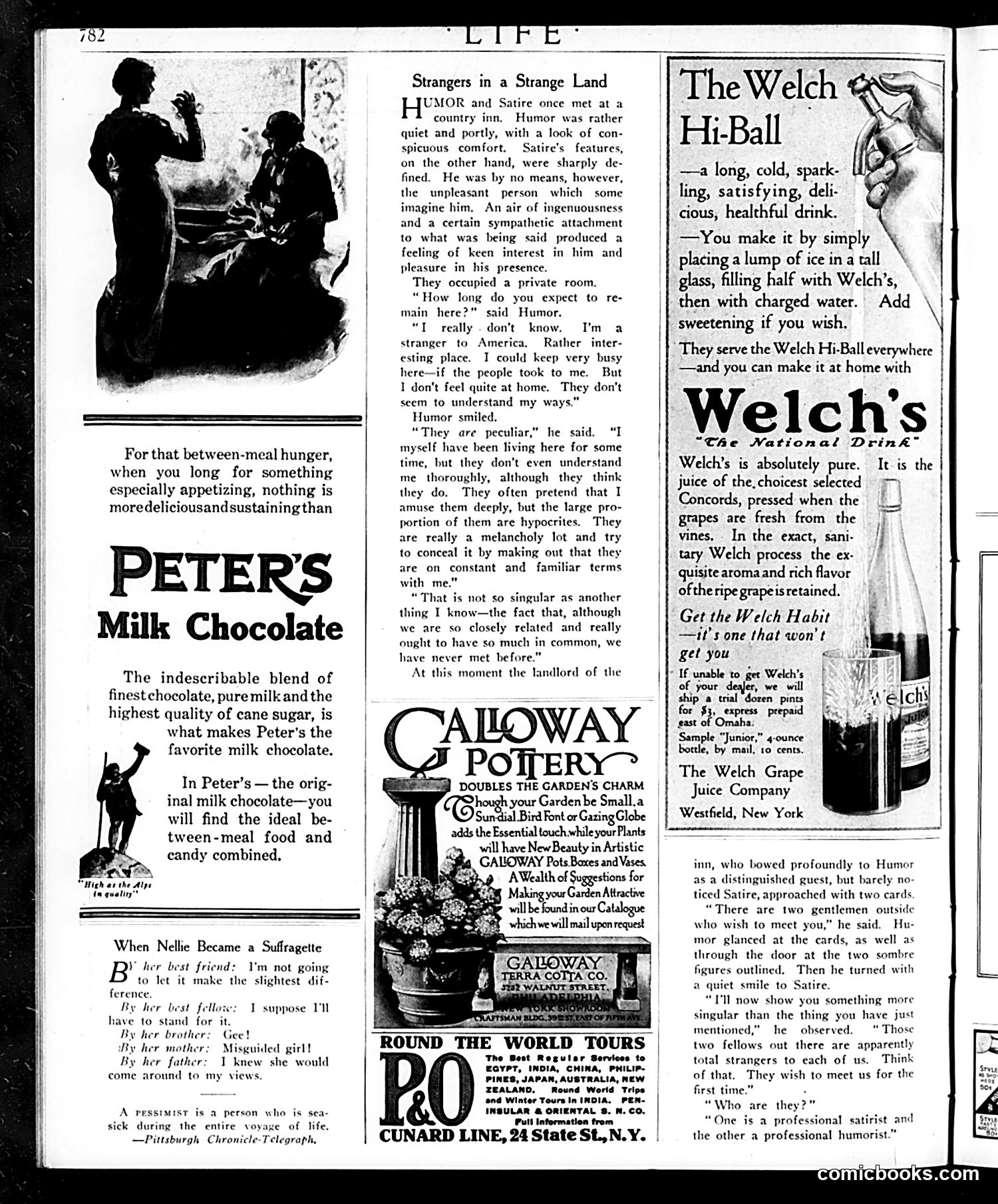
This page is primarily **advertising with a brief story excerpt**. The main content is "Strangers in a Strange Land," a humorous dialogue between two characters—Humor (described as "quiet and portly") and Satire (with "sharply defined" features)—meeting at a country inn. Humor complains about being a stranger in America, saying people don't understand his ways. The advertisements dominate: Peter's Milk Chocolate, Galloway Pottery garden ornaments, Welch's Hi-Ball drink, and P&O steamship tours. The story's satire appears gentle—poking fun at Americans' incomprehension of English humor and social peculiarities—but without specific political references. It's primarily entertainment advertising rather than political commentary.
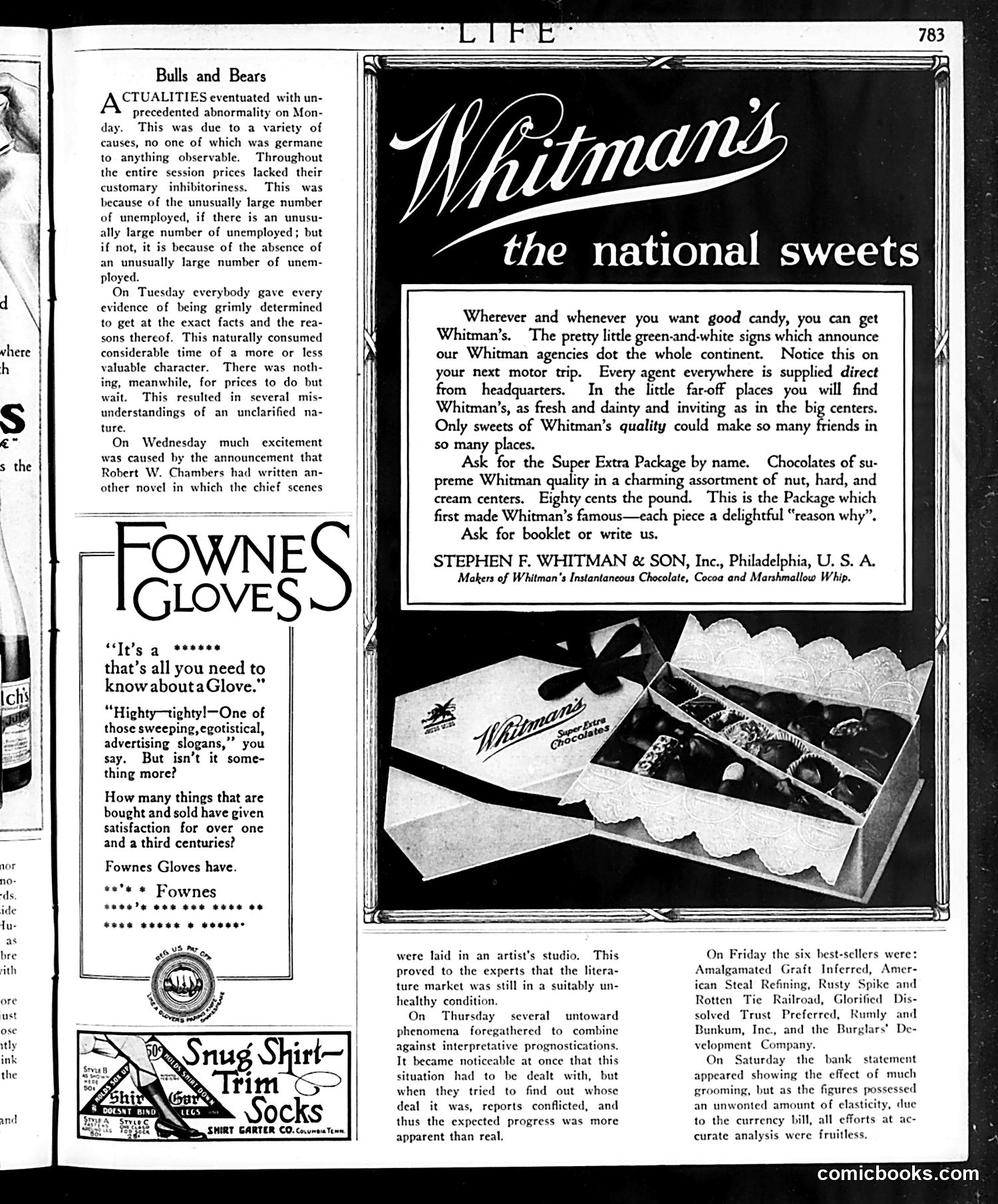
This page is primarily **advertising**, not political satire. The main content consists of three commercial advertisements: 1. **Whitman's Chocolates** (large center ad): Promotes their "Super Extra Package" of quality candies available through nationwide agents and retailers. 2. **Fownes Gloves** (left sidebar): Highlights their century-plus history of customer satisfaction, using the tagline "It's all you need to know about a Glove." 3. **Snug Shirt-Trim Socks** (bottom left): Markets their shirt garter product. The left column contains a brief article titled "Bulls and Bears" discussing stock market activity and unemployment, unrelated to the advertisements. This is a typical Life magazine layout mixing editorial content with advertising revenue.
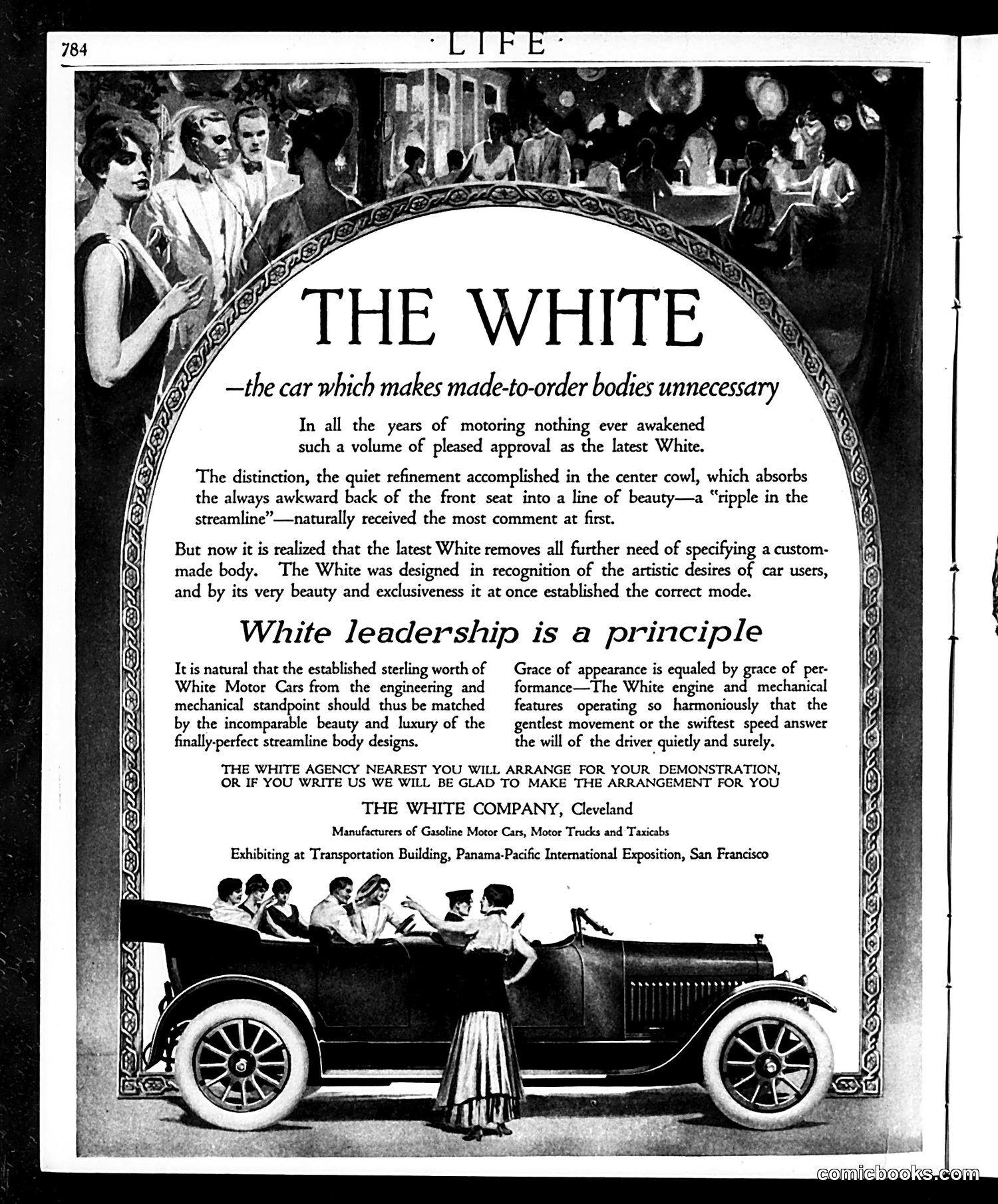
This is a **full-page advertisement** for White Motor Cars, not satirical content or a political cartoon. The ad promotes the "White" automobile, emphasizing that its design is so aesthetically superior it eliminates the need for custom-made car bodies—a luxury option wealthy buyers used to pursue. The ad features illustrated scenes of well-dressed people admiring the car and includes a detailed automobile drawing at the bottom. The messaging positions the White as a status symbol, arguing that its inherent elegance establishes "the correct mode" for discerning motorists. The text mentions the company is exhibiting at the Panama-Pacific International Exposition in San Francisco, suggesting an early 20th-century publication date.
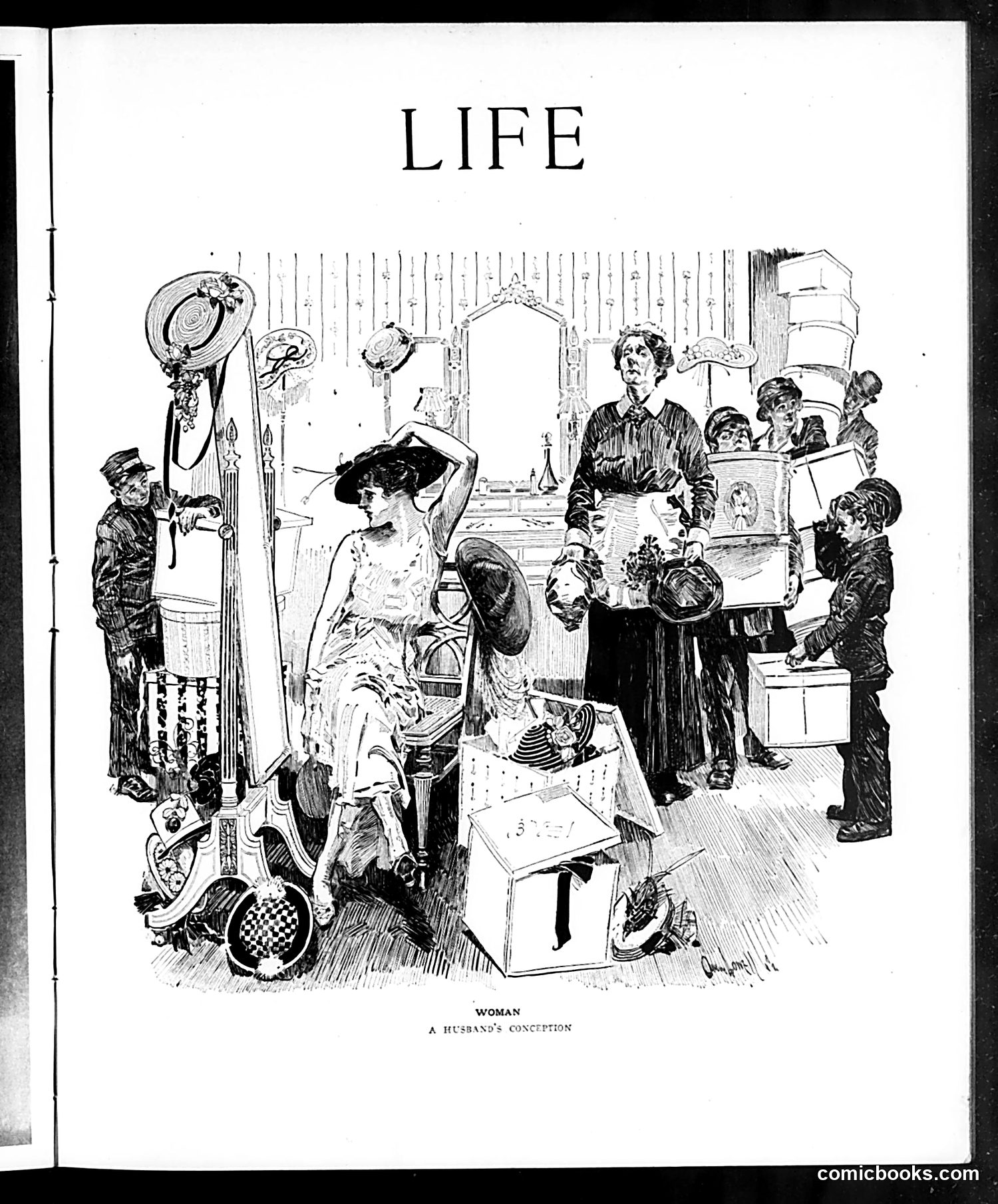
This satirical illustration depicts a woman as a literal collection of objects and interests, viewed through a husband's perspective. The central female figure is surrounded by various items representing stereotypical female pursuits: hats, fashion accessories, a chess board, musical instruments, books, and domestic items. Men in the background appear to be observing or managing these elements. The satire critiques how husbands (and society broadly) reduced women to superficial consumer interests and frivolous hobbies rather than recognizing them as complete persons. By visualizing a woman as a mere assemblage of objects and pastimes, the cartoon mocks the reductive male gaze of the era while implicitly critiquing women's limited social roles and constrained opportunities for meaningful intellectual or professional engagement.
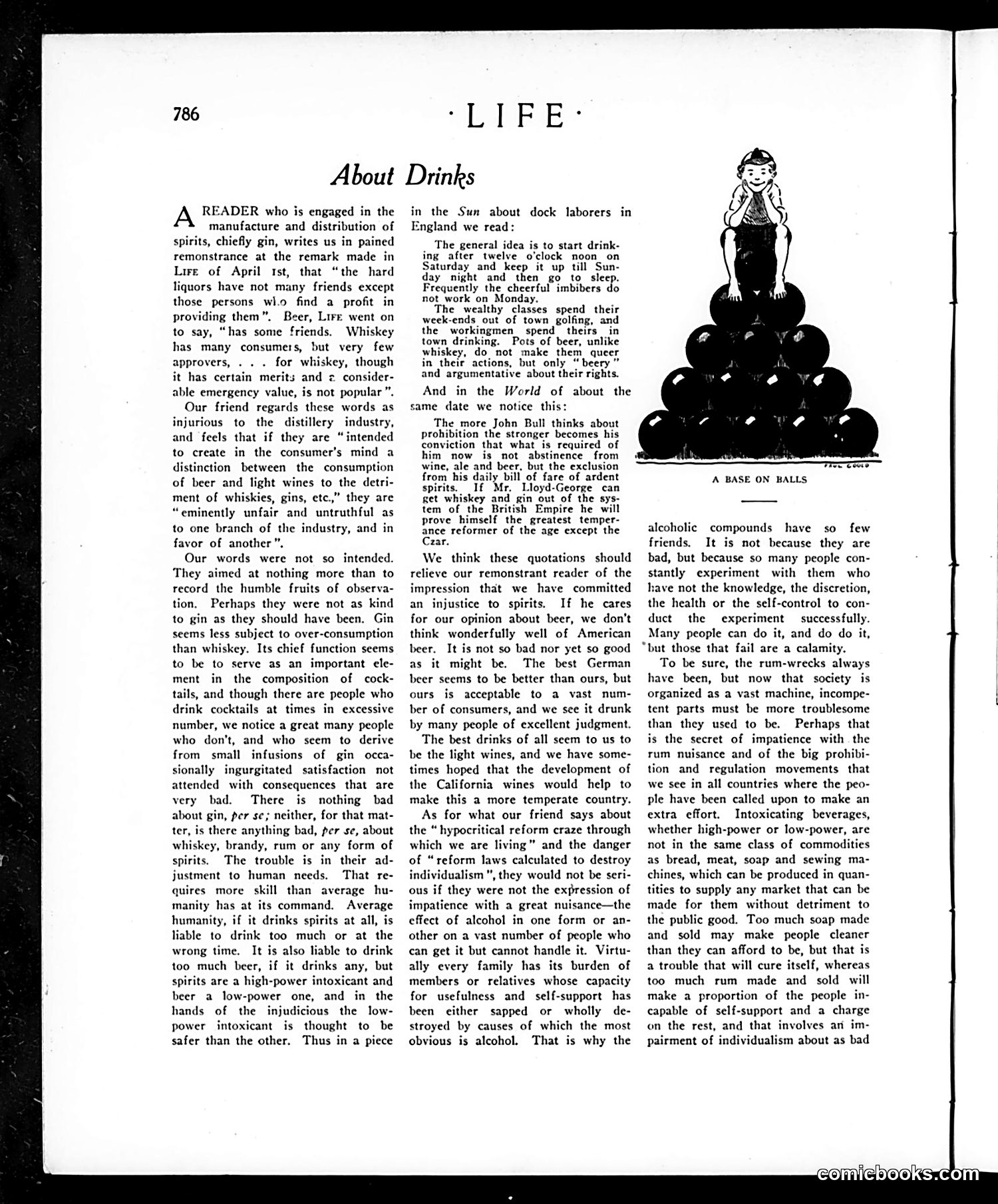
This page contains a satirical article criticizing spirits (hard liquor) while defending beer and wine. The accompanying cartoon, titled "A Base on Balls," shows a figure balanced precariously atop stacked round objects (likely meant to represent alcohol bottles or the intoxicating effects of drinking). The article argues that alcoholic beverages have "so few friends" not because they're inherently bad, but because excessive consumption causes social problems. The satire targets both prohibitionists and heavy drinkers, suggesting that the real issue is *impatience with alcohol's effects*—people who can't handle moderate drinking responsibly. The cartoon visually reinforces this message: the unstable, precarious balance suggests the danger of losing equilibrium through intoxication. The piece advocates for temperance rather than total prohibition, positioning beer and wine as more "temperate" alternatives to spirits.
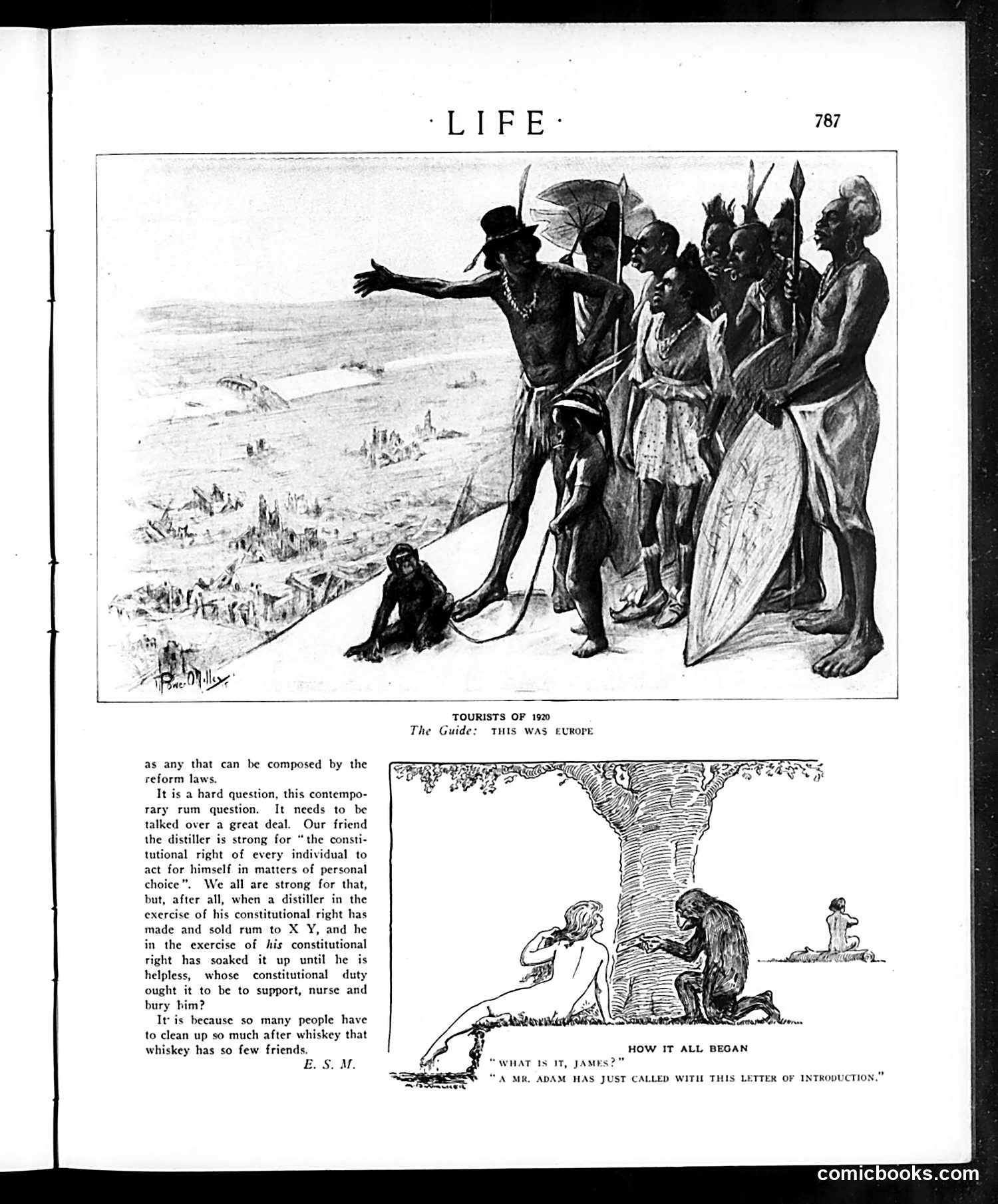
The top illustration depicts a colonial-era scene where a European guide gestures toward indigenous people and settlements below, captioned "THIS WAS EUROPE." This is satirical role-reversal: it imagines non-European peoples as tourists observing European civilization as a historical curiosity—reversing the typical colonial power dynamic of European tourists studying "primitive" societies. The bottom cartoon, titled "HOW IT ALL BEGAN," shows Adam receiving a letter of introduction, likely referencing humanity's origins in Genesis. This appears to be setup for subsequent satirical commentary. The accompanying essay discusses prohibition and rum distilling, suggesting the page combines visual satire about colonialism with commentary on contemporary American alcohol policy—a major political issue in 1920.
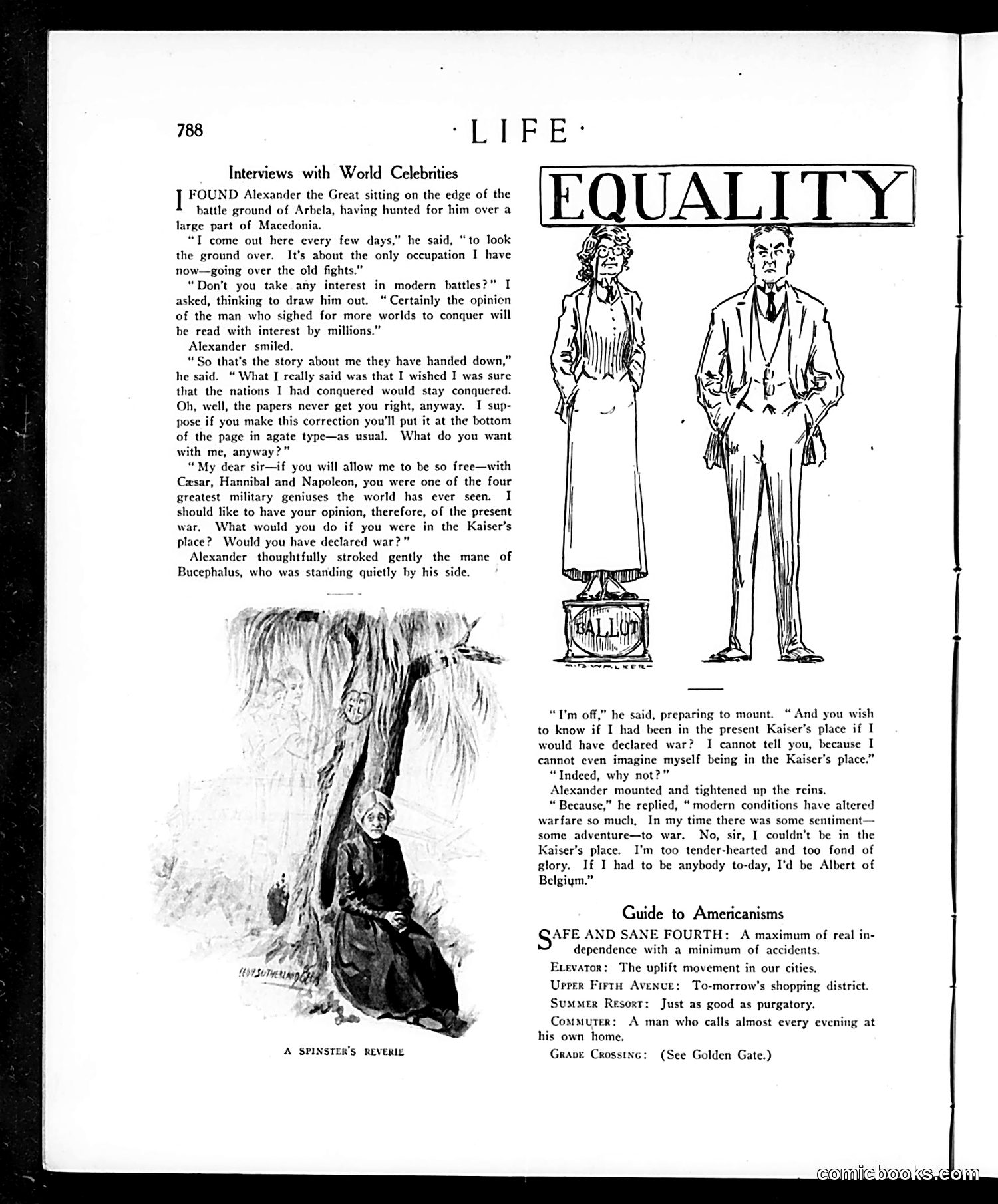
This page satirizes Alexander the Great through an "Interview with World Celebrities" feature. The text shows Alexander defending his military conquests while dismissing modern warfare as sentiment-driven. The "EQUALITY" cartoon (right) depicts two figures of drastically different heights standing on a ballot box, satirizing the idea that democracy creates equality—the visual joke being that formal equality doesn't erase fundamental differences. Below is "A Spinster's Reverie," a sketch of a woman daydreaming by a tree, likely commenting on unmarried women's romantic fantasies. The "Guide to Americanisms" section defines contemporary American terms humorously (e.g., "Safe and Sane Fourth" as maximum independence with minimum accidents). The page combines political satire, social commentary on gender and democracy, and contemporary Americana humor typical of Life's satirical approach.
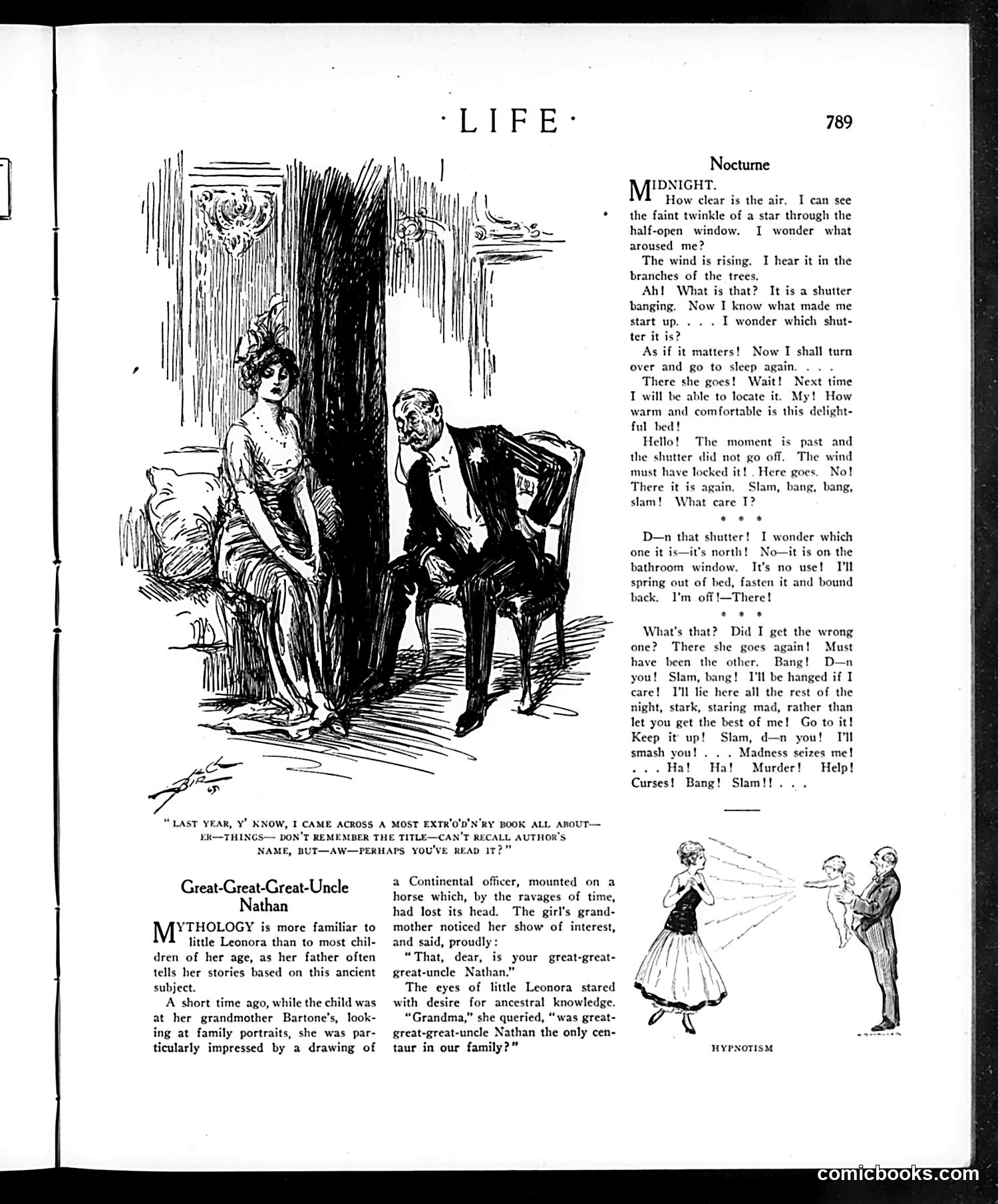
This page contains two separate pieces: **Top section**: A narrative titled "Nocturne" depicting someone kept awake by noise—a shutter banging in the wind. The character's increasingly frantic internal monologue (with "Slam, bang, bang!" repeated) satirizes how minor annoyances can escalate into manic obsession during sleepless nights. The accompanying sketch shows a bedroom scene with two figures. **Bottom section**: An article titled "Great-Great-Great-Uncle Nathan" about mythology and family genealogy. It humorously discusses how children learn about ancestors through family stories and portraits. A young girl named Leonora asks her grandmother about "great-great-uncle Nathan," treating ancestral history as curiosity-fodder. The small illustration labeled "Hypnotism" appears unrelated, showing a hypnosis demonstration. Both pieces use gentle domestic humor typical of early 20th-century Life magazine satire.
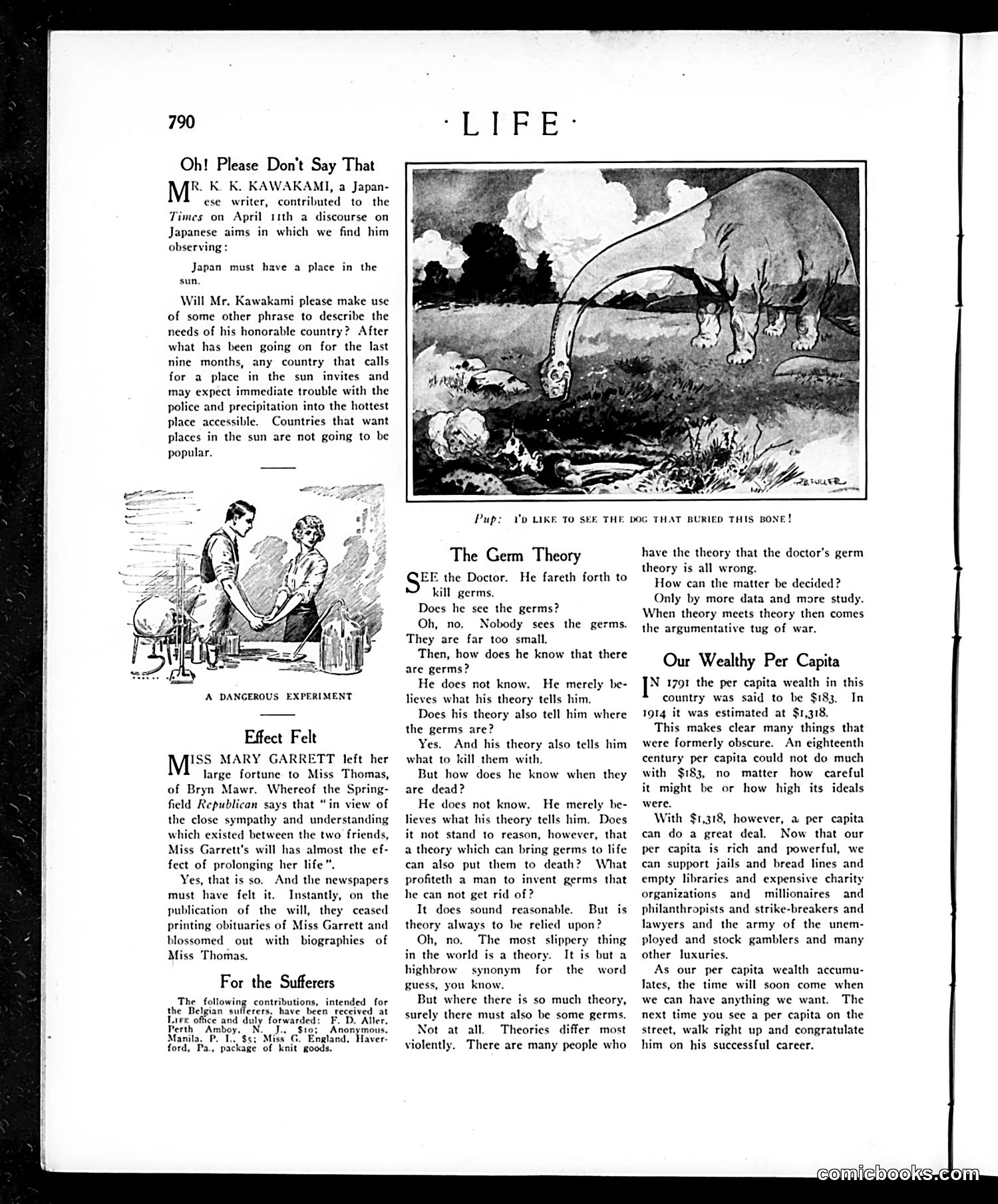
This page contains several opinion pieces and illustrations rather than political cartoons. **"Oh! Please Don't Say That"** critiques a Japanese writer (K.R. Kawakami) who claimed Japan needs "a place in the sun"—a euphemism for imperial expansion. The editor argues that after nine months of conflict, any nation demanding territorial expansion should expect international trouble, not sympathy. **"A Dangerous Experiment"** illustration shows two figures conducting what appears to be a medical or scientific procedure, likely satirizing experimental theories. **"The Germ Theory"** and **"Our Wealthy Per Capita"** are essays discussing medical theory limitations and economic statistics respectively. The bone-burying dog illustration is unrelated humor. Overall, this page reflects early 20th-century American skepticism toward Japanese expansionism and contemporary scientific debates.
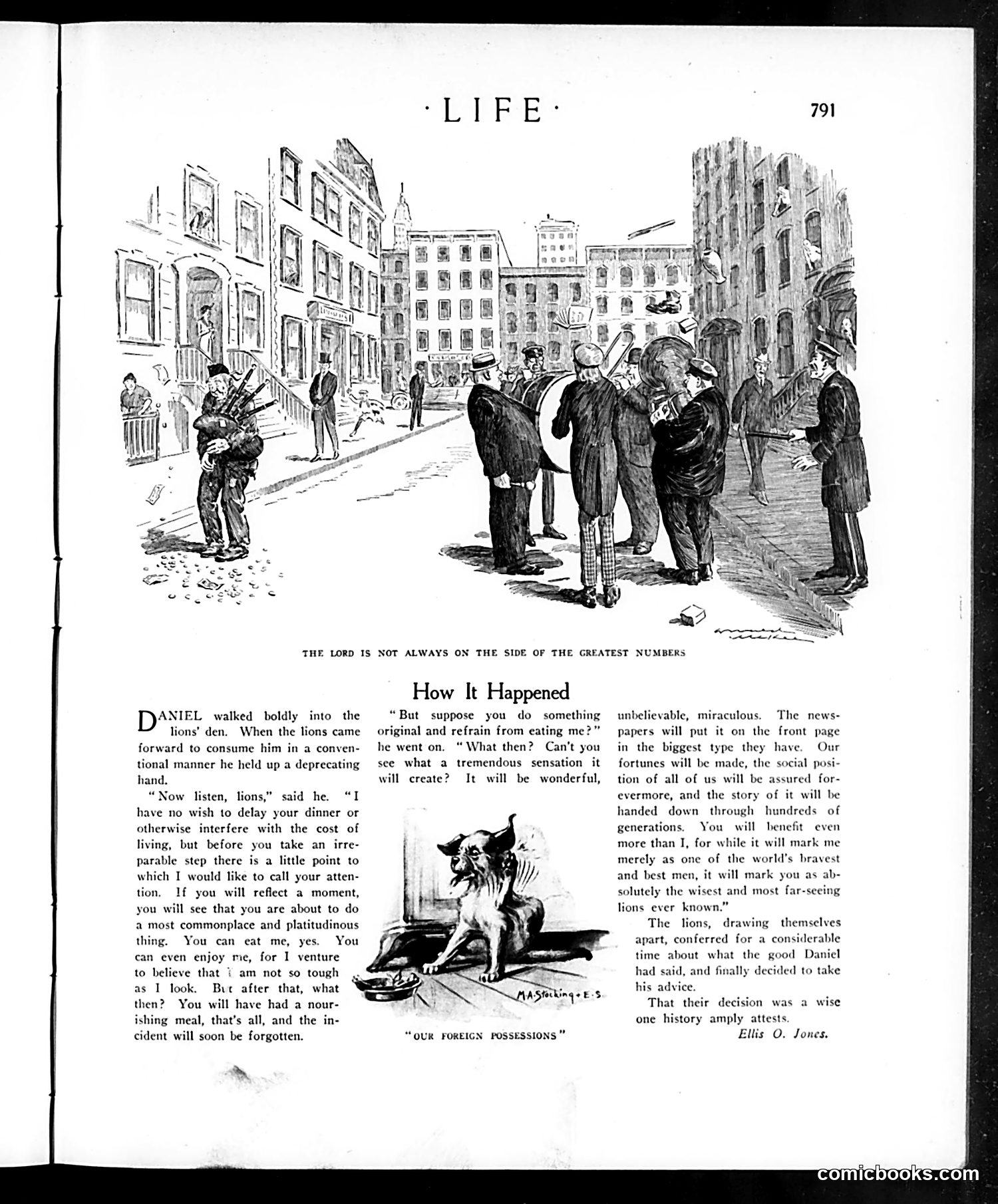
This satirical story uses the Biblical tale of Daniel in the lions' den as an allegory for colonial or imperial relations. Daniel represents a colonial power persuading the "lions"—likely depicting colonized peoples or foreign nations—to act against their own immediate interests by appealing to concepts of progress, publicity, and historical legacy. The satire critiques how imperial powers convince others to accept their dominance by framing it as mutually beneficial or historically significant. Daniel's argument—that restraint will bring greater rewards through fame and moral standing—mirrors rhetoric used to justify colonialism as "civilizing" or beneficial. The cartoon's caption, "Our Foreign Possessions," makes the political allegory explicit. The point: imperial powers manipulate others into servitude through flattery and false promises of shared benefit, when the real advantage flows entirely to the colonizer. History, the text suggests ironically, validates this "wise" arrangement.
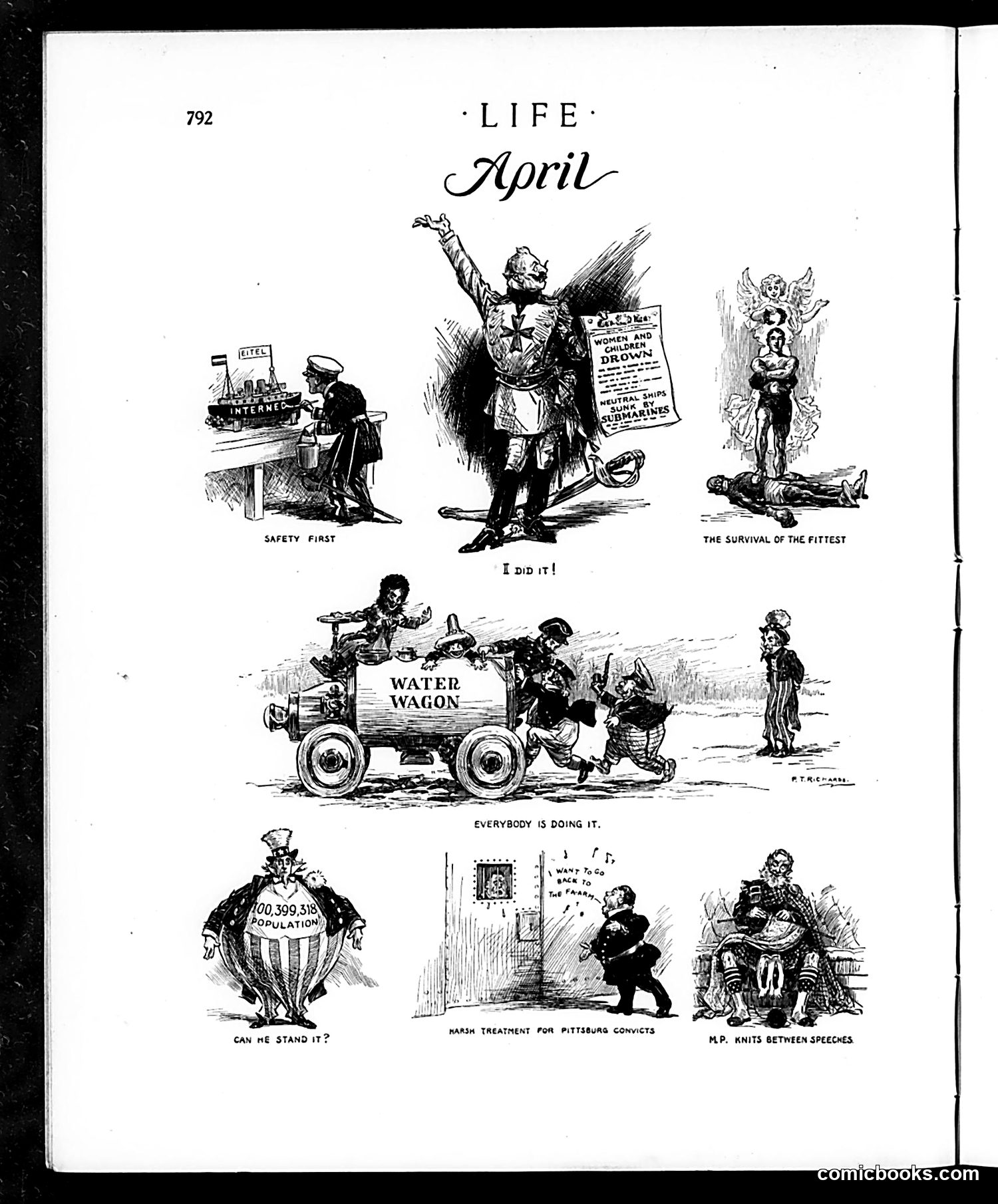
This page presents six political cartoons satirizing various early 20th-century issues: 1. **"Safety First"** and **"The Survival of the Fittest"** mock WWI-era safety rhetoric versus actual casualties. 2. **"I Did It!"** shows a military figure boasting while holding what appears to be casualty lists, labeled with references to neutral ships and submarines—likely criticizing warmongering. 3. **"Everybody Is Doing It"** depicts a water wagon (presumably alcohol-related, given Prohibition-era context) as commonplace. 4. **"Can He Stand It?"** references population growth concerns with a globe figure. 5. **"Harsh Treatment for Pittsburg Convicts"** criticizes prison conditions. 6. **"M.P. Knits Between Speeches"** appears to mock a politician's theatrical performative activism versus substantive action. The overall tone satirizes political hypocrisy, wartime policies, and social contradictions of the era.
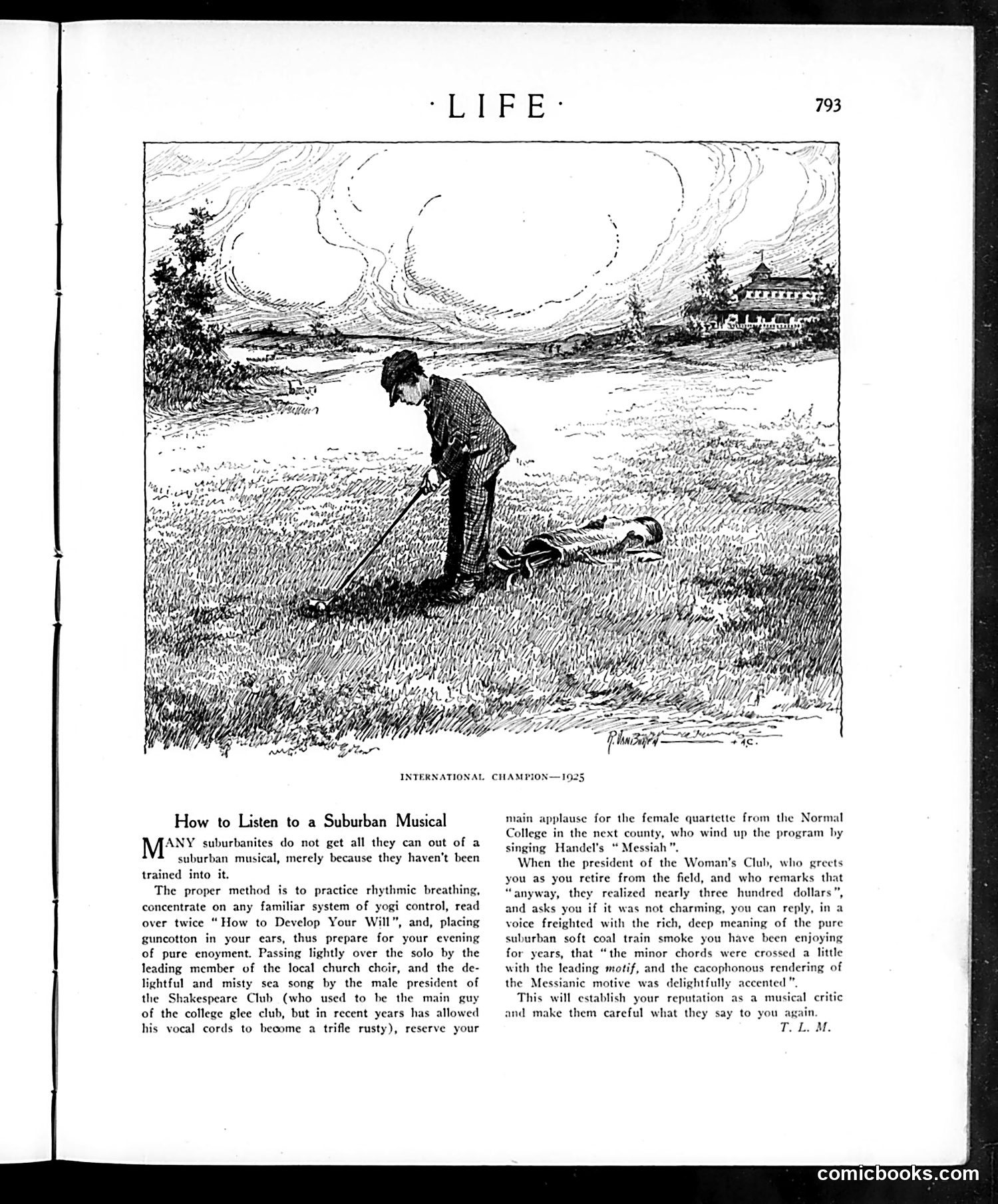
This is a satirical article (not a political cartoon) mocking suburban cultural pretension from 1925. The illustration shows a man with a golf club and dog on a suburban landscape—establishing the leisurely, affluent setting. The satire targets suburbanites who attend amateur musical performances but lack genuine musical knowledge. The "joke" is that attendees can fake sophistication by using pseudo-intellectual jargon ("minor chords were crossed," "Messianic motive") borrowed from actual musical criticism, impressing the Woman's Club president while having endured mediocre performances. The text humorously suggests preparatory tactics—"rhythmic breathing," "yogi control," even "guncotton in your ears"—to survive the event. It specifically mocks the church choir soloist and the rusty ex-glee club president, implying suburban amateur talent is genuinely poor. The satire reflects 1920s class anxiety: newly wealthy suburbanites aspiring to cultural refinement while actually lacking taste or understanding, using pretentious language as social camouflage.
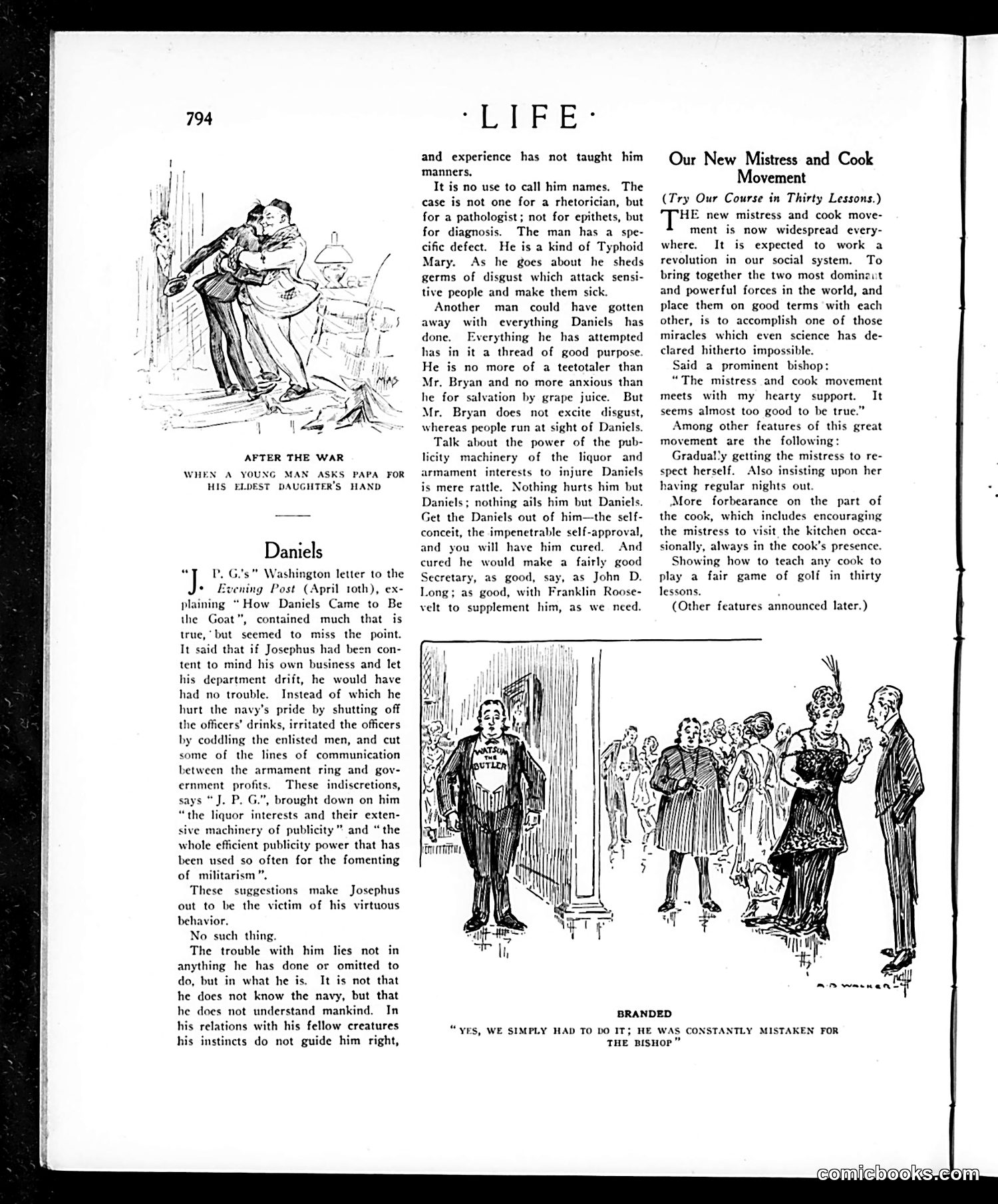
**"Daniels" (Left Column):** This attacks Secretary of the Navy Josephus Daniels, a real historical figure. The piece criticizes him not for his specific policy actions (which were virtuous—he cut off officers' drinks, treated enlisted men fairly, disrupted corrupt armament profiteering), but for his personality. The author claims Daniels is a "Typhoid Mary"—someone whose mere presence causes disgust in others, making people reject his reforms regardless of merit. The satire suggests Daniels is so personally off-putting that even good intentions fail because people instinctively dislike him. **"Our New Mistress and Cook Movement" (Right):** This satirizes a supposed social movement promoting better relations between wealthy mistresses (female employers) and their household cooks. The humor mocks an absurdly optimistic proposal: teaching cooks to "play fair golf" to close class gaps, getting mistresses to occasionally visit kitchens, and granting cooks "regular nights out." The cartoon below shows a woman mistaken for a bishop—likely satirizing class confusion or social pretension.
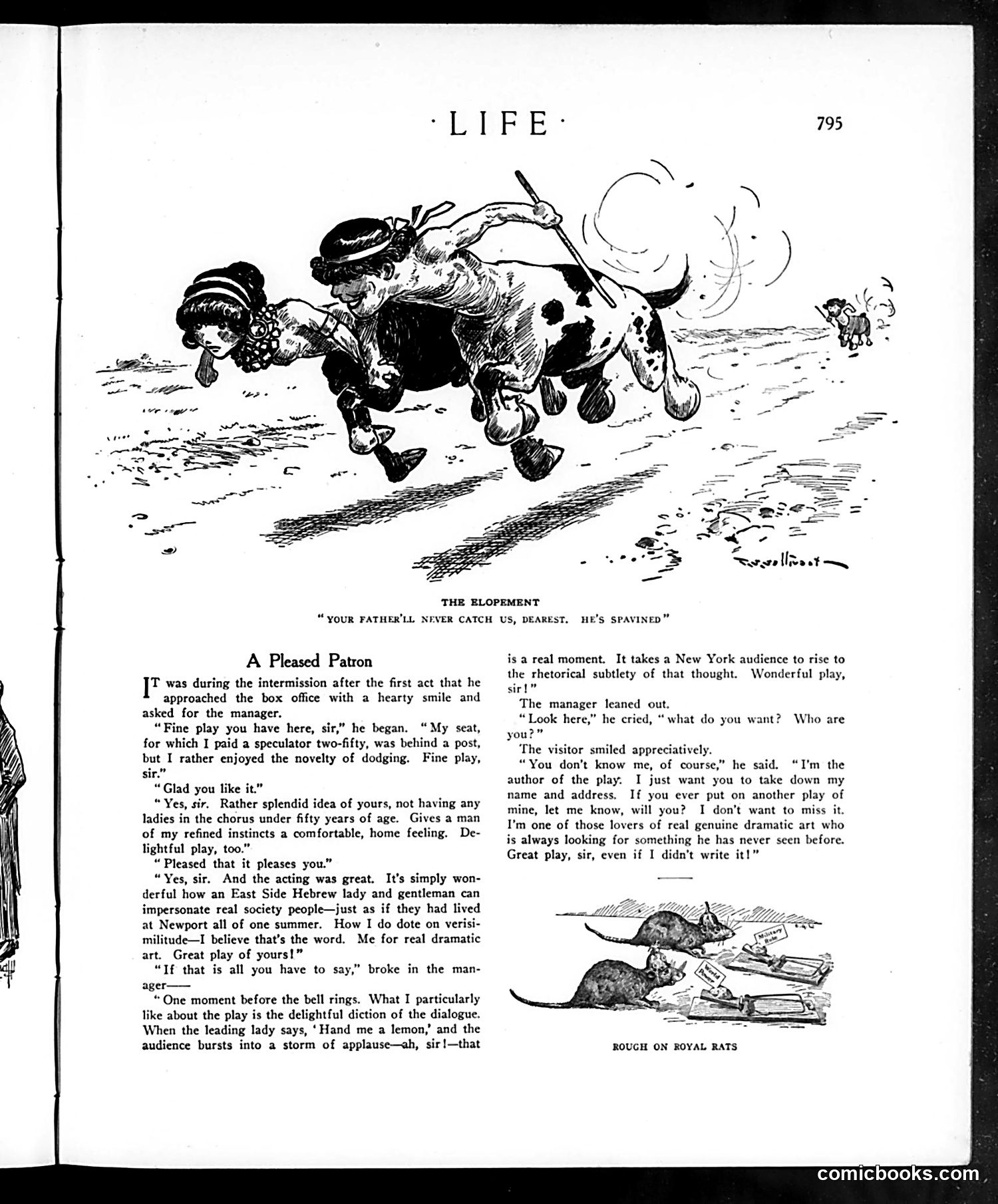
**Top Cartoon ("The Elopement"):** A comedic illustration showing a couple eloping on a donkey while being chased. The caption's reference to the father never catching them satirizes typical melodramatic elopement plots common in theater of the era. **Main Article ("A Pleased Patron"):** This is satire about theater criticism and artistic pretension. A theater patron approaches the manager with backhanded compliments: praising the play while admitting he sat behind a post, complimenting actors for convincingly "impersonating real society people" (implying they're actually lower-class immigrants from the East Side), and lavishing praise on simplistic dialogue. The punchline: he reveals himself as the playwright—someone who loves "real genuine dramatic art" yet failed to recognize his own work's mediocrity. The satire targets both pretentious amateur playwrights and audiences who mistake simple dialogue for wit. The repeated irony emphasizes how the author lacks self-awareness about his play's actual quality. **Bottom Illustration:** "Rough on Royal Rats"—a separate humorous sketch with minimal context provided.
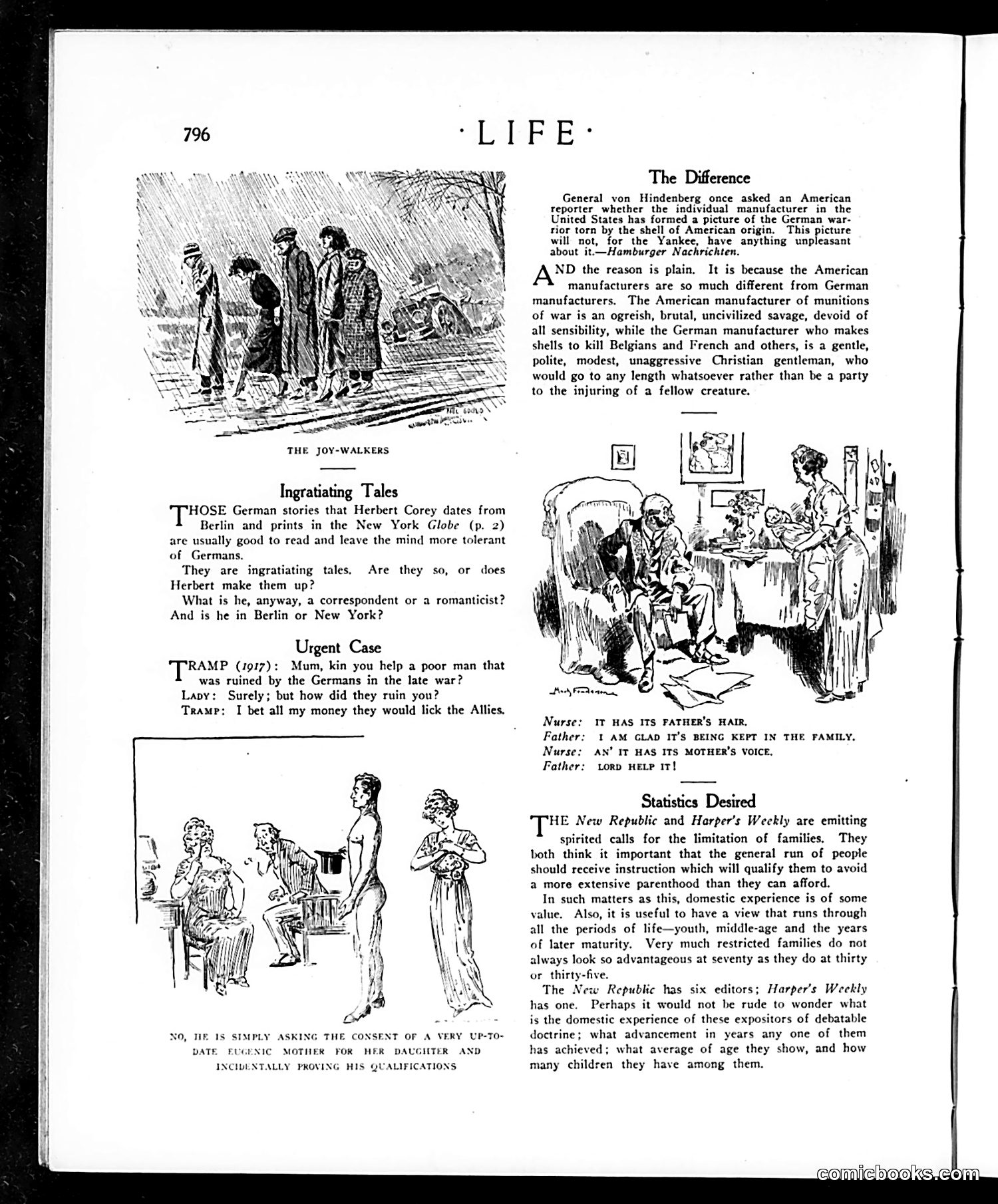
This satirical page uses humor to critique American attitudes toward Germany during and after World War I. **"The Difference"** sarcastically inverts a German general's question about American munitions manufacturers. Life mocks German propaganda claiming their shell-makers are "gentle, polite" Christians, while portraying American manufacturers as "ogreish, brutal" savages. The irony exposes the absurdity of Germany's self-serving moral superiority while producing weapons that killed Belgian and French civilians. **"Urgent Case"** shows a tramp claiming he lost money betting Germans would defeat the Allies—satirizing those who underestimated American military power. **"Statistics Desired"** criticizes *The New Republic* and *Harper's Weekly* for advocating family limitation without demonstrating personal domestic experience. Life challenges their editorial credibility by questioning their actual ages and number of children—implying their prescriptions ring hollow. The cartoon depicting a nurse, father, and child humorously references inheriting family traits, supporting this critique of unsupported social engineering advice.
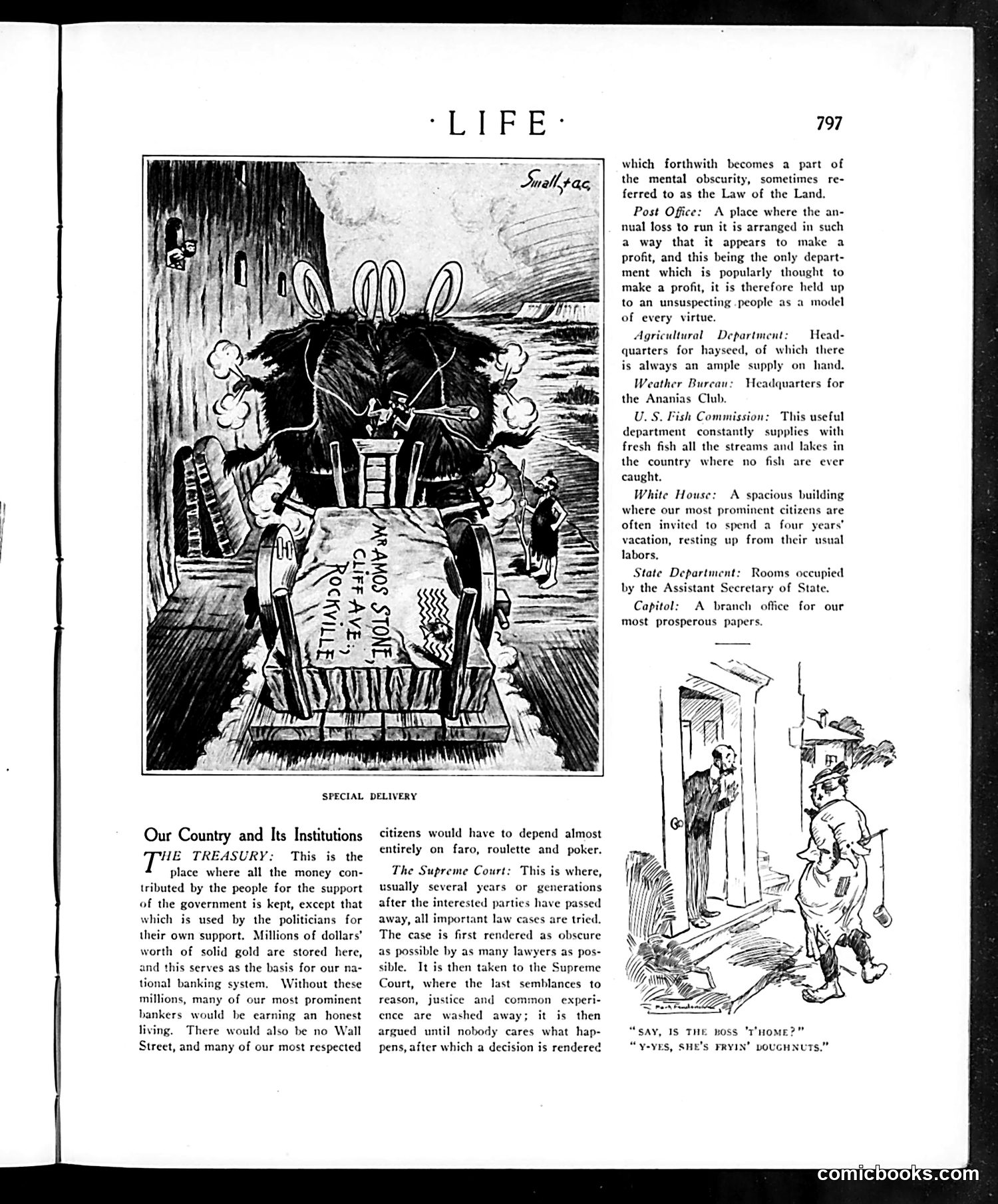
This page satirizes American government institutions through mock-serious definitions. The main cartoon depicts "Special Delivery"—a grotesque figure representing government bureaucracy, literally bursting with papers and complexity. The text mockingly describes Treasury as dependent on gold reserves, while bankers would otherwise resort to gambling. The Supreme Court is portrayed as deliberately obscuring justice through excessive lawyers and argumentation until outcomes become meaningless. The Post Office supposedly loses money while appearing profitable—held as a virtue through public deception. Other departments receive similar treatment: Agriculture housed "hayseed," the Weather Bureau serves the "Ananias Club" (liars), Fish Commission stocks empty waters, the White House functions as a vacation home for politicians, and the Capitol as merely a "branch office." The lower cartoon jokes about a boss's wife frying doughnuts—likely commentary on working-class domestic life or incompetent management. The satire attacks governmental inefficiency, corruption, and the gap between official purpose and actual function—a common Progressive Era critique.
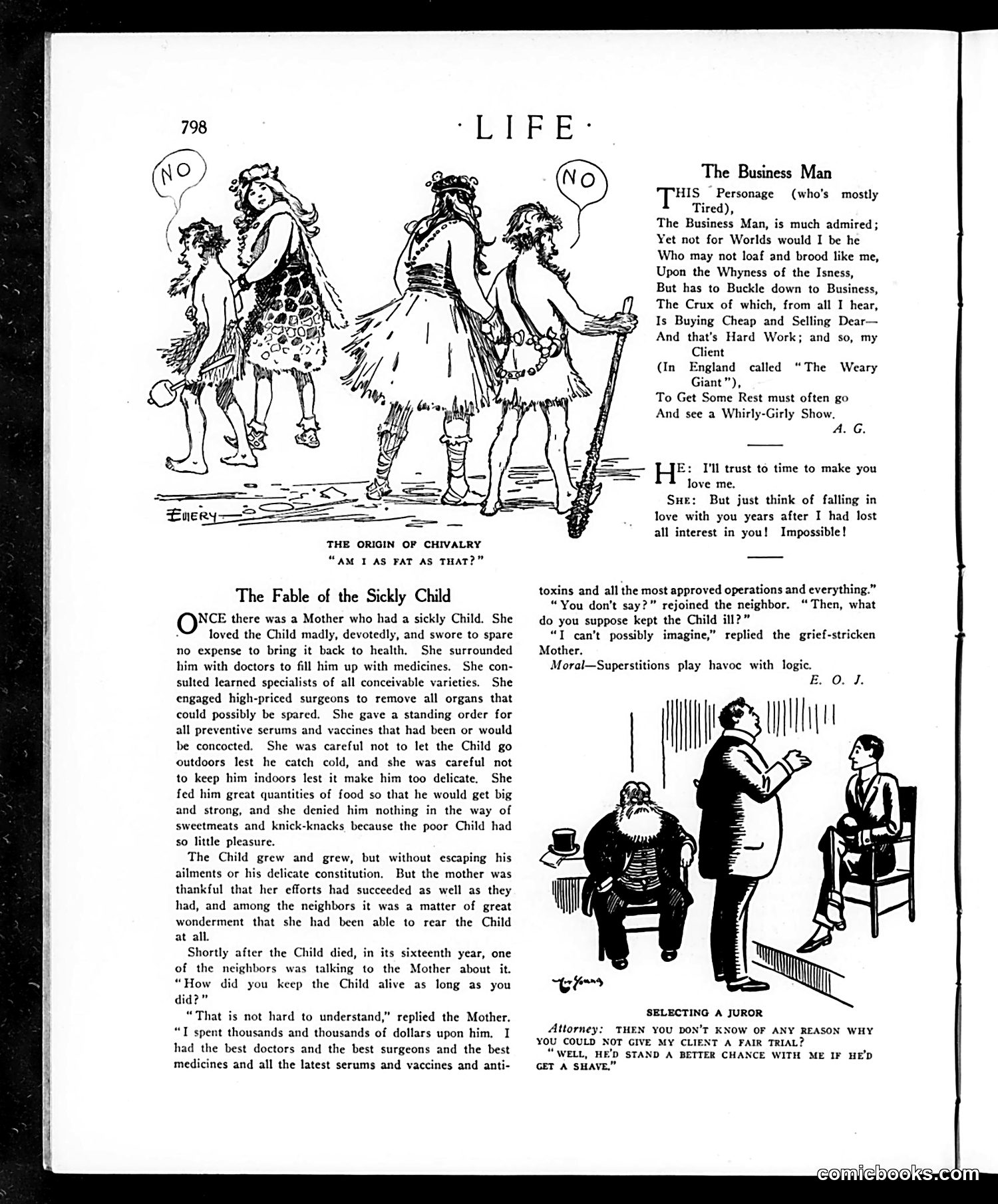
**"The Origin of Chivalry"** cartoon depicts women rejecting suitors with "NO" — a visual gag about courtship standards, likely mocking either excessive female pickiness or the absurdity of romantic pursuit. **"The Fable of the Sickly Child"** is a moral critique of misguided overprotection. A wealthy mother spends fortunes on doctors, surgeries, vaccines, and restrictions to keep her sickly child alive, yet he dies at sixteen anyway. The satire targets the era's obsessive medical interventionism and parental anxiety — the irony being that her expensive, excessive care ironically may have weakened rather than strengthened the child. The moral explicitly states: superstitions harm logic. **Other pieces** include light social commentary on businessmen needing entertainment to escape work stress, romantic misunderstandings, and a courthouse joke about juror bias based on appearance. The page reflects early 20th-century anxieties about modern medicine, parenting, and social behavior through satirical humor.
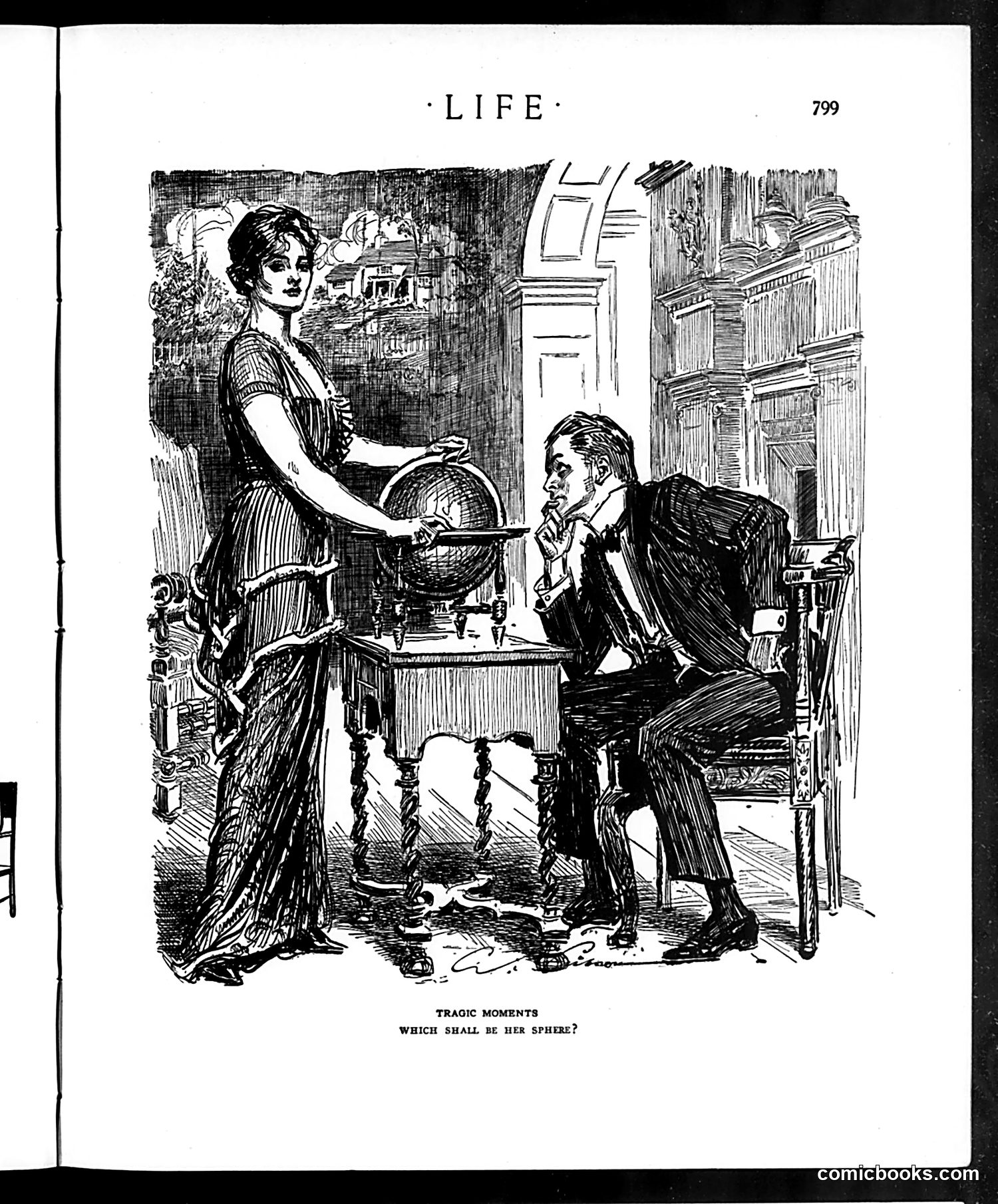
This cartoon depicts a domestic scene titled "Tragic Moments: Which Shall Be Her Sphere?" A woman stands holding a globe while a man sits at a desk, hand to his chin in contemplation. The setting suggests an educated household with books and refined furnishings. The satire addresses the late 19th/early 20th-century "Woman Question"—debates about women's proper role in society. The globe she holds symbolizes global knowledge or ambition, while the domestic interior represents traditional domestic duty. The man's troubled expression suggests anxiety about which sphere the woman should occupy: the domestic realm or the wider world of education, travel, and intellectual engagement. The cartoon satirizes social tension over expanding women's aspirations beyond homemaking.
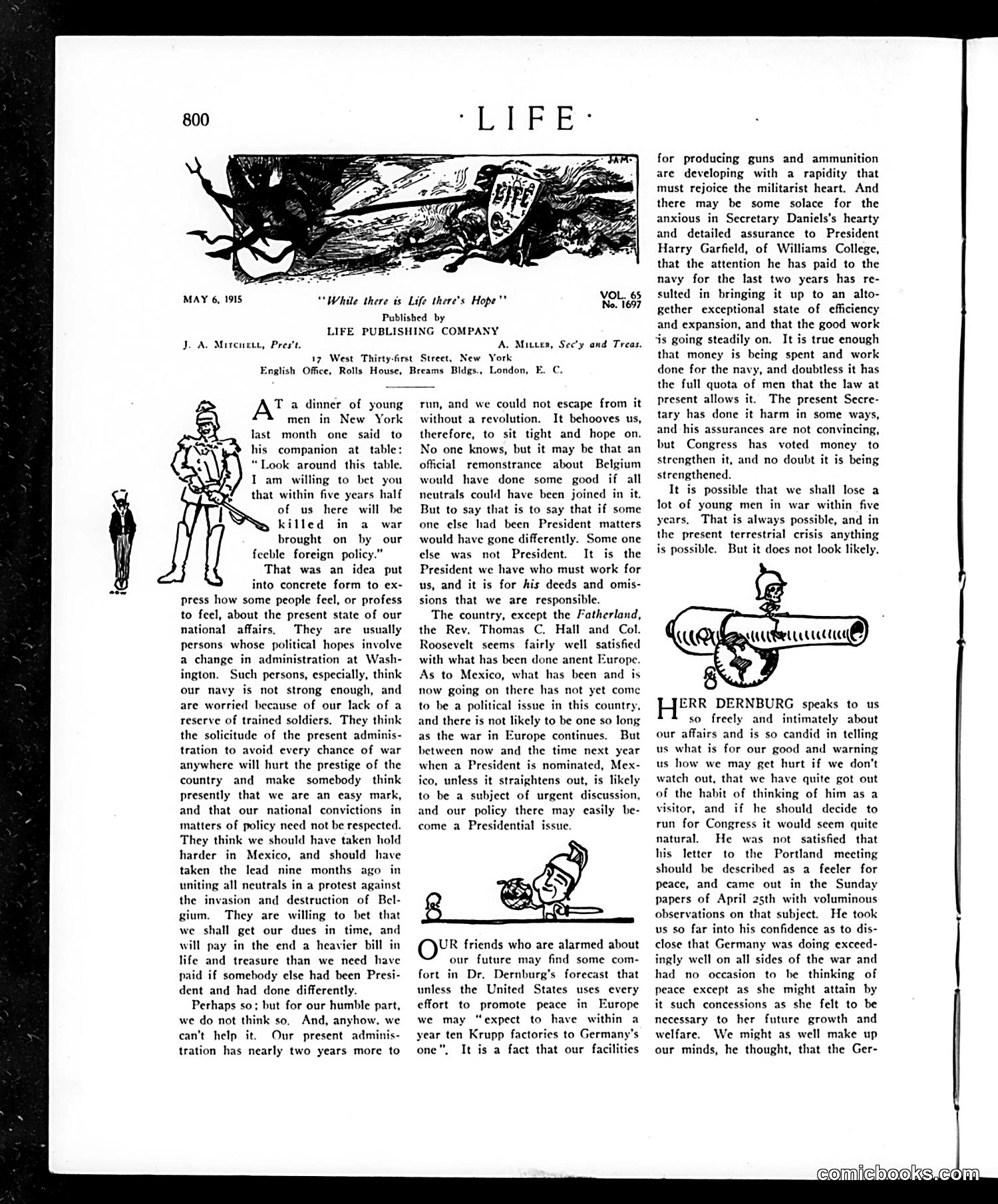
This page satirizes American anxiety about military preparedness during World War I. Written when the war was underway in Europe but the U.S. remained neutral, the article mocks those demanding stronger armed forces and more aggressive foreign policy. The text references a dinner conversation where young men worry half will die in war caused by "feeble foreign policy." The satirist dismisses such alarmism, noting President Wilson's administration (serving until 1917) cautiously avoids war involvement. The piece defends this restraint while acknowledging critics—including Theodore Roosevelt and pacifist Rev. Thomas C. Hall—who demand stronger military action, particularly regarding Belgium's invasion and Mexico's instability. The illustrations appear to be decorative military figures. The satire's point: anxious hawks overestimate danger and underestimate current leadership's competence. Dr. Dernburg's warning about German war production is cited ironically as "solace" rather than genuine reassurance.
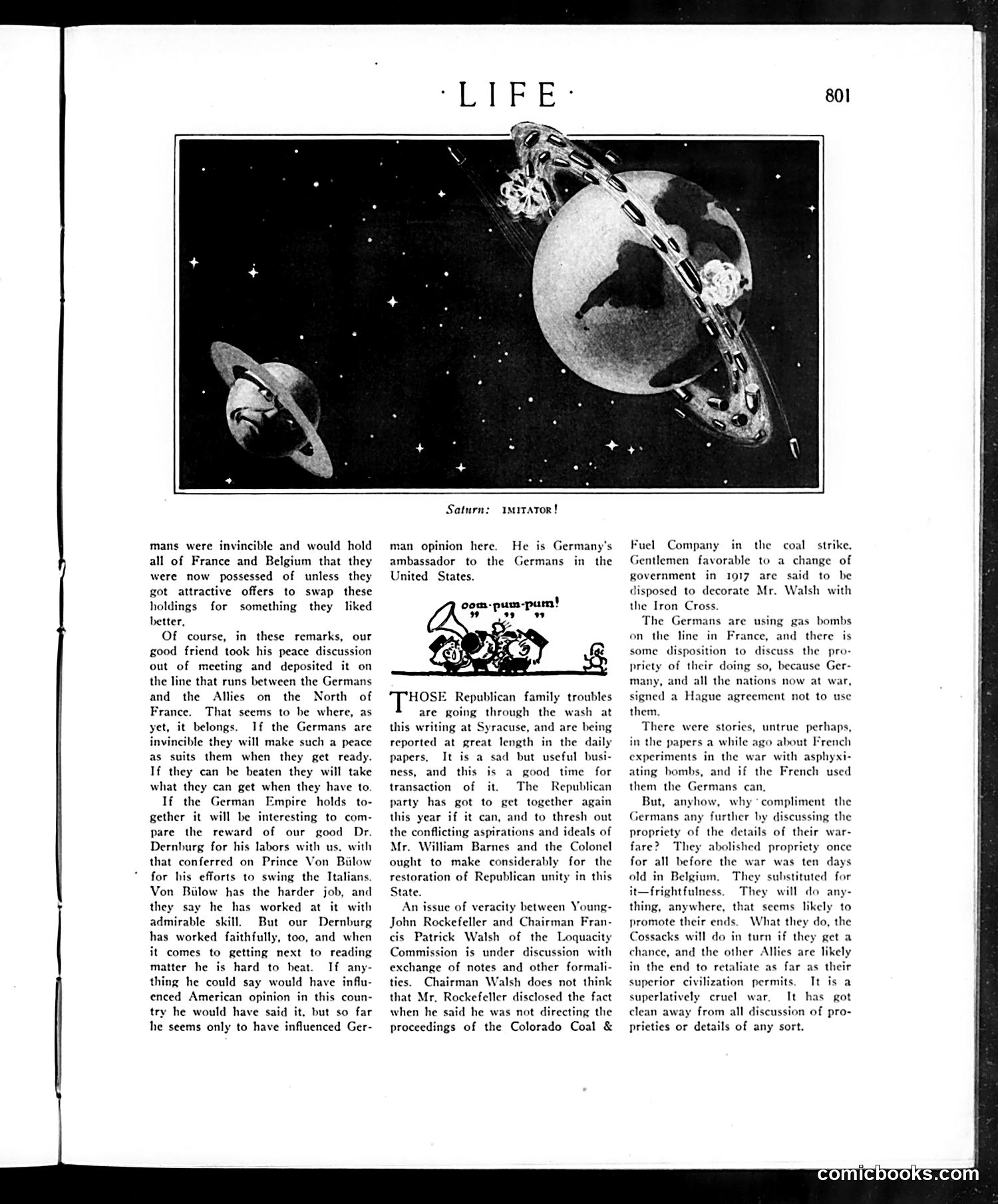
The top illustration titled "Saturn: Imitator!" shows two planets in space—Saturn on the left and Earth on the right, connected by a chain. This is political satire about **German diplomatic efforts to influence American public opinion during World War I**. The text identifies the target: **Dr. Dernburg**, Germany's unofficial ambassador tasked with swaying American opinion toward Germany. The satire's point: Dernburg has failed utterly. He's only influenced German opinion *within* America—preaching to the converted among German-Americans. The chain-link imagery suggests he's tethered uselessly to his own world, unable to bridge the gap to American thinking. The "imitator" label likely mocks his ineffectual mimicry of successful diplomacy. The remaining text discusses Republican Party infighting and criticizes the hypocrisy of debating whether Germany violated agreements about chemical weapons in France—arguing Germany abandoned all propriety in Belgium, making further moral arguments pointless.
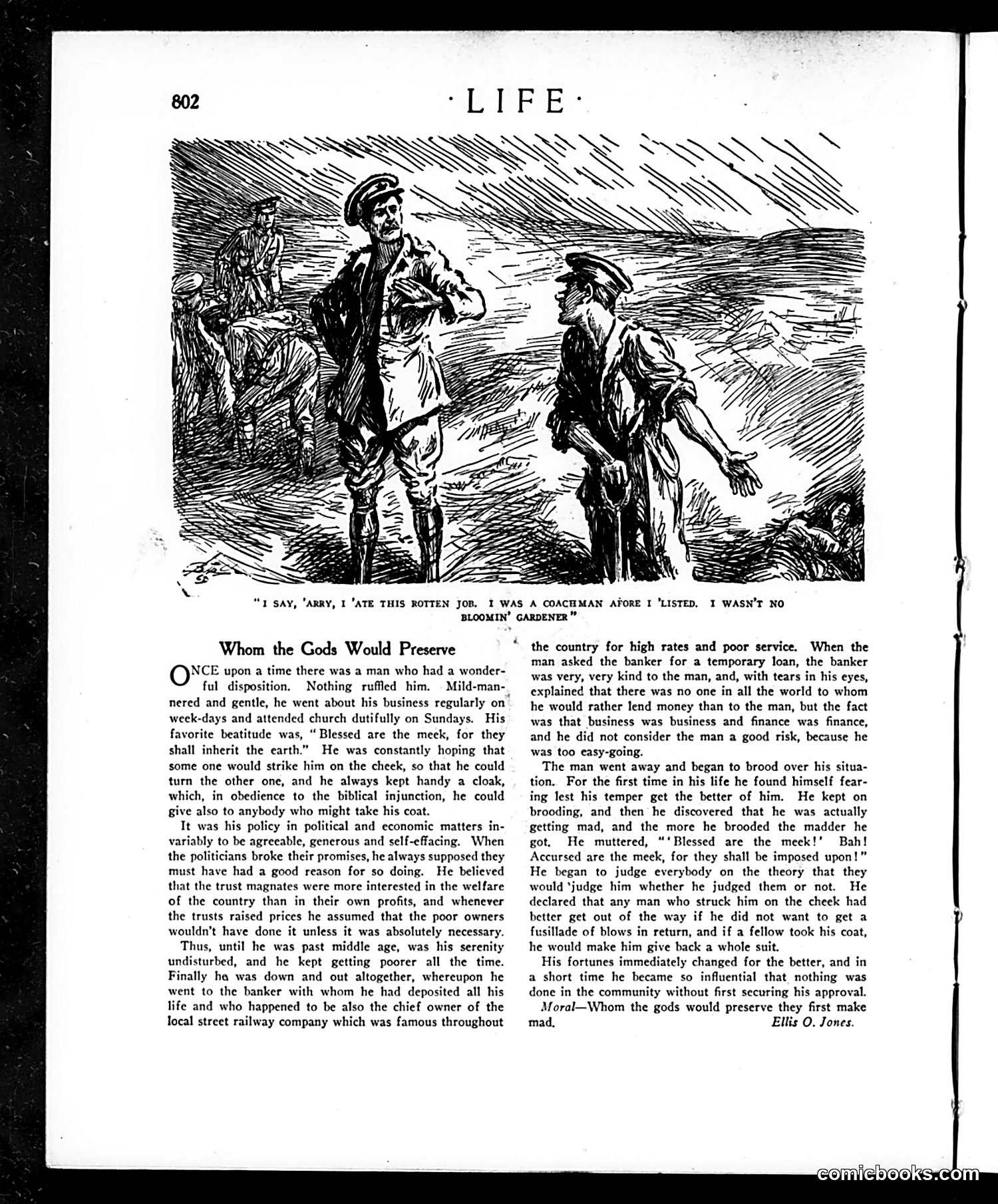
This satirical story critiques excessive meekness and passivity in the face of economic exploitation. The protagonist embodies Christian virtues of gentleness and trust—he believes in turning the other cheek, assumes politicians and trust magnates act benevolently, and accepts corporate price-gouging as necessary. The moral collapse comes when a banker refuses him a loan despite their long relationship, claiming the man is "too easy-going." This rejection awakens the protagonist to reality: his niceness has made him economically vulnerable and socially powerless. Only when he becomes angry and assertive—adopting a combative worldview and refusing to be exploited—does he gain influence and prosperity. The story satirizes both naive faith in the goodwill of the wealthy and the societal reward system that punishes meekness while elevating aggression and self-interest. The title's irony suggests that anger and self-preservation, not virtue, are what gods (or society) actually favor.
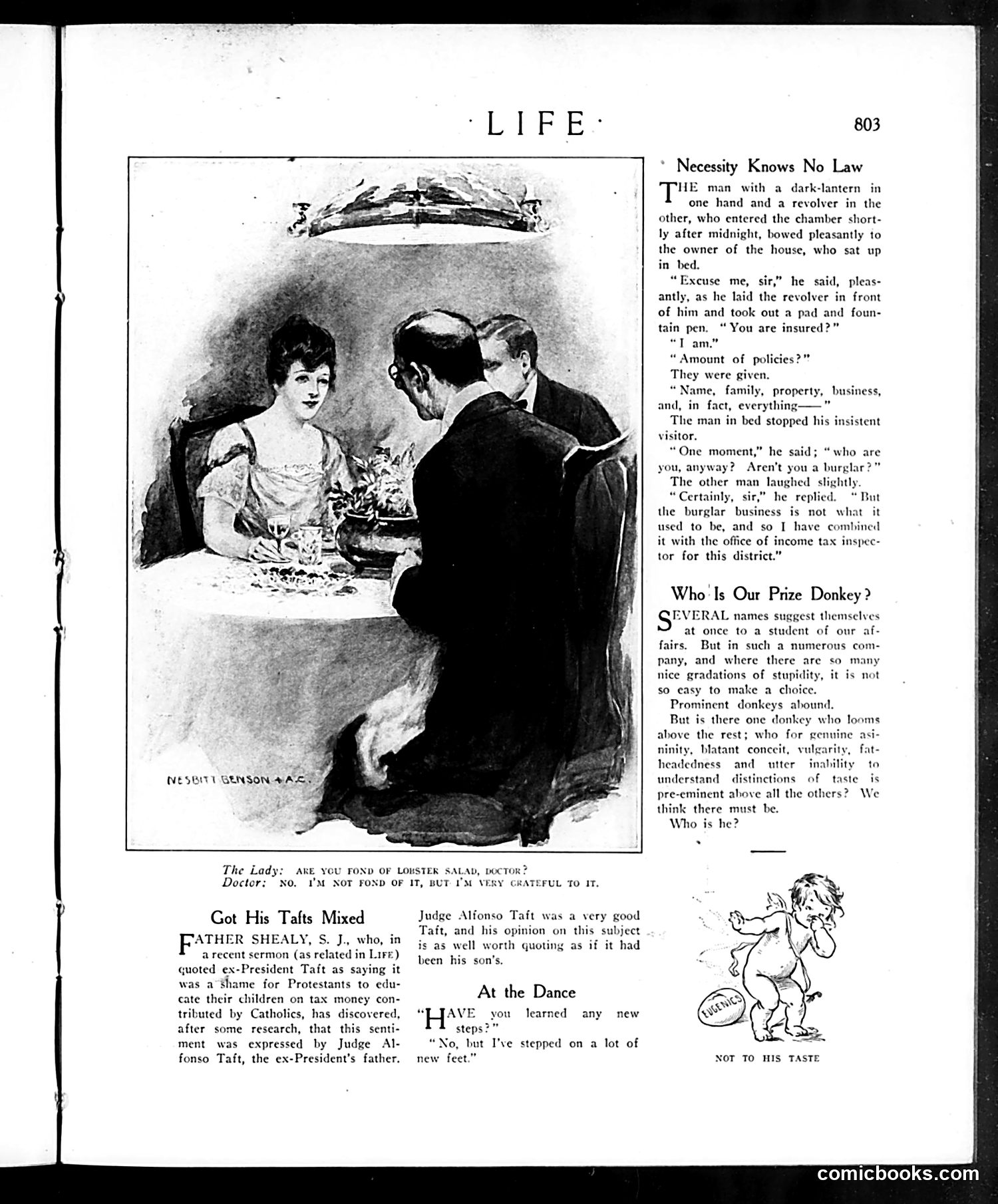
**Main Cartoon ("Necessity Knows No Law"):** A burglar enters a bedroom at midnight but politely asks the homeowner about insurance before stealing. The burglar reveals he's now a combination burglar and *income tax inspector*. The satire mocks the invasiveness and authority of tax collection—suggesting government taxation is as aggressive and unwelcome as burglary, yet cloaked in official legitimacy. This reflects early 20th-century American skepticism toward expanding federal income tax powers. **"Who Is Our Prize Donkey?":** A rhetorical editorial questioning which prominent public figure deserves the title based on stupidity, conceit, and vulgarity. The page doesn't identify the target, inviting readers to suggest candidates. **"Got His Tafts Mixed":** A brief anecdote about Father Shealy misattributing a quote to President William Howard Taft when it actually came from his father, Judge Alfonso Taft—a gentle joke about genealogical confusion. **Minor item "At the Dance":** A short joke about stepping on feet while dancing.
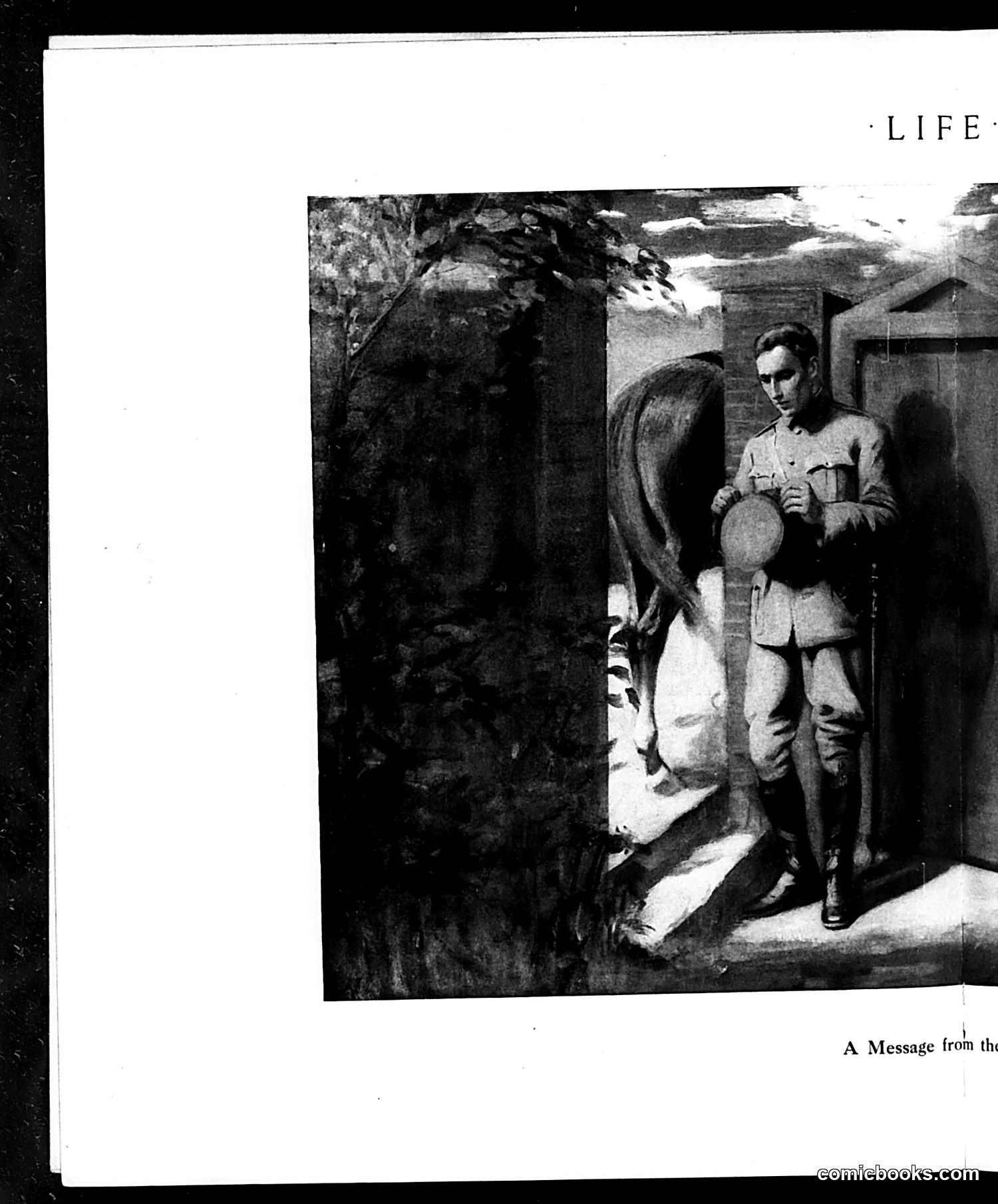
This appears to be a page from *Life* magazine featuring what's labeled "A Message from the..." (text cut off at bottom). The black and white illustration shows a soldier in military uniform holding what appears to be a round object, standing near a doorway with classical architecture visible. Without the complete caption and given the partial text, I cannot definitively identify the specific historical context, the identity of the figure depicted, or the satirical point being made. The military setting and formal composition suggest this relates to wartime messaging or military service, but determining the exact political or social commentary would require the complete caption text that's not fully visible in this image.
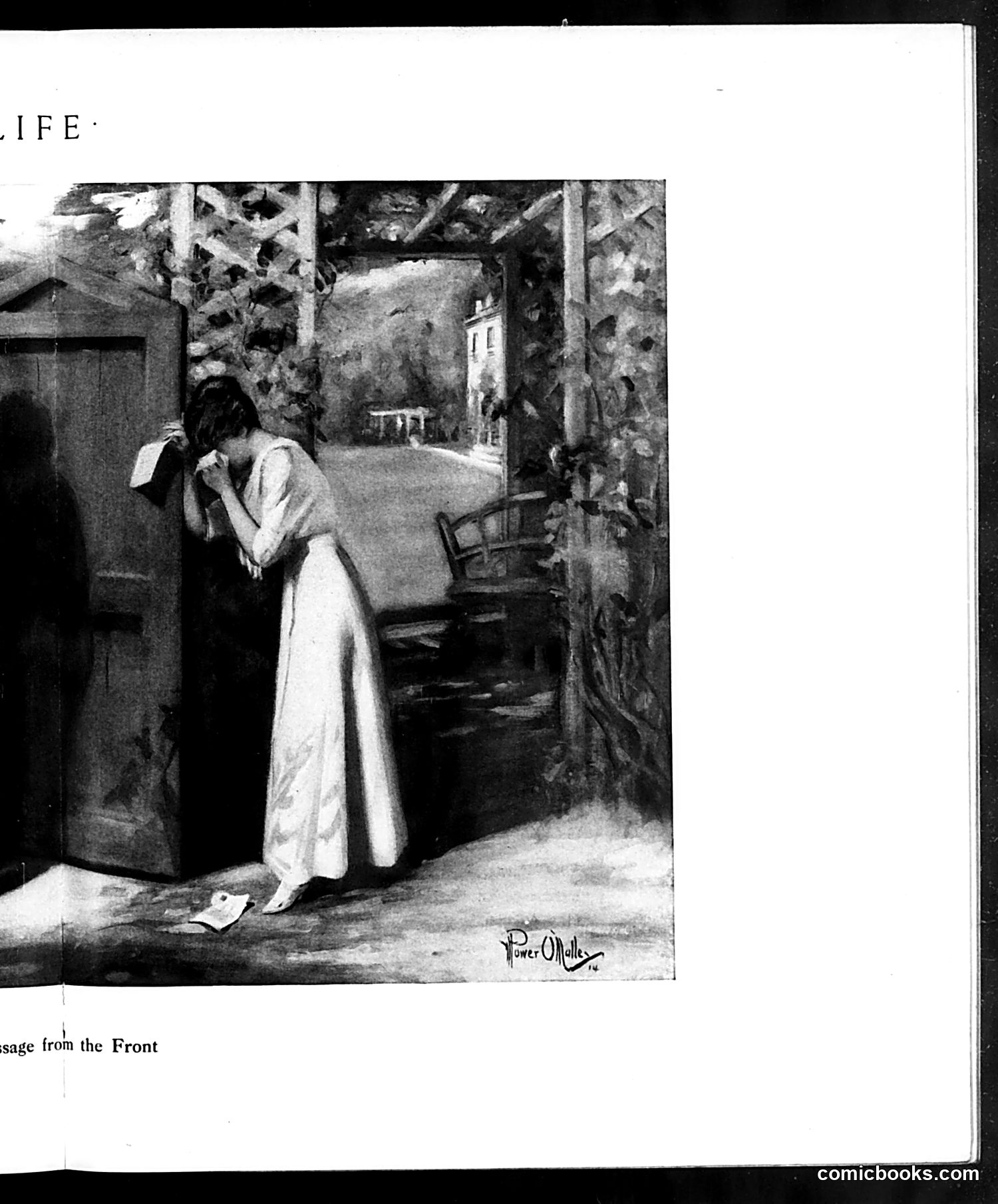
This page from *Life* magazine shows a black and white photograph credited to "Power O'Malley" (visible in the signature). The image depicts a woman in a long dress standing in an archway, appearing emotional or distressed, with her hand to her face. The caption references "Message from the Front." Given the title's reference to "the Front," this likely depicts a woman receiving war news—possibly from World War I or II based on the photographic style. The emotional pose suggests she's reacting to correspondence from a soldier at the front lines. The satire appears to commentary on the home front experience during wartime, particularly the anxiety and emotional toll on those waiting for news from combat zones. Without additional context from surrounding pages, the specific satirical point remains unclear.
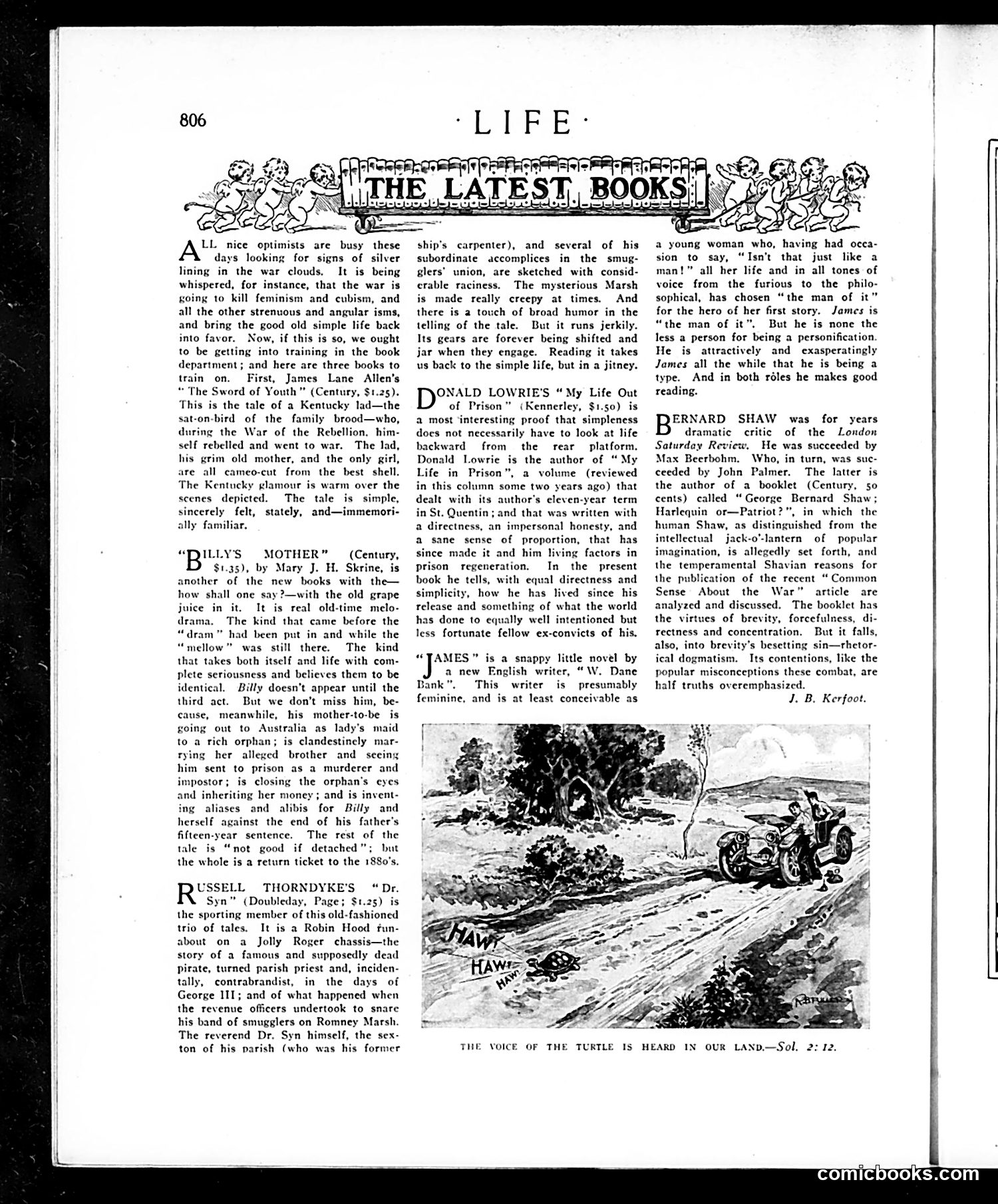
This is a book review section from *Life* magazine's "Latest Books" feature. The page reviews five new publications, all positioned as returns to simpler, older storytelling traditions—a cultural response to World War I's anxieties. The reviews emphasize nostalgia: James Lane Allen's *The Sword of Youth* offers Kentucky Civil War romance; Mary J. H. Skrine's *Dilly's Mother* is melodrama in the 1880s style; Russell Thorndyke's *Dr. Syn* is a Robin Hood adventure about smuggling; Donald Lowrie's *My Life Out of Prison* continues his prison reform memoir; and a novel by "W. Dane Bank" (noted as "presumably feminine"). The illustration shows a vintage racing car in a desert landscape with the caption "THE VOICE OF THE TURTLE IS HEARD IN OUR LAND"—a biblical reference suggesting spiritual or natural renewal, likely reinforcing the page's theme that wartime anxieties drive readers toward escapist, traditional narratives.
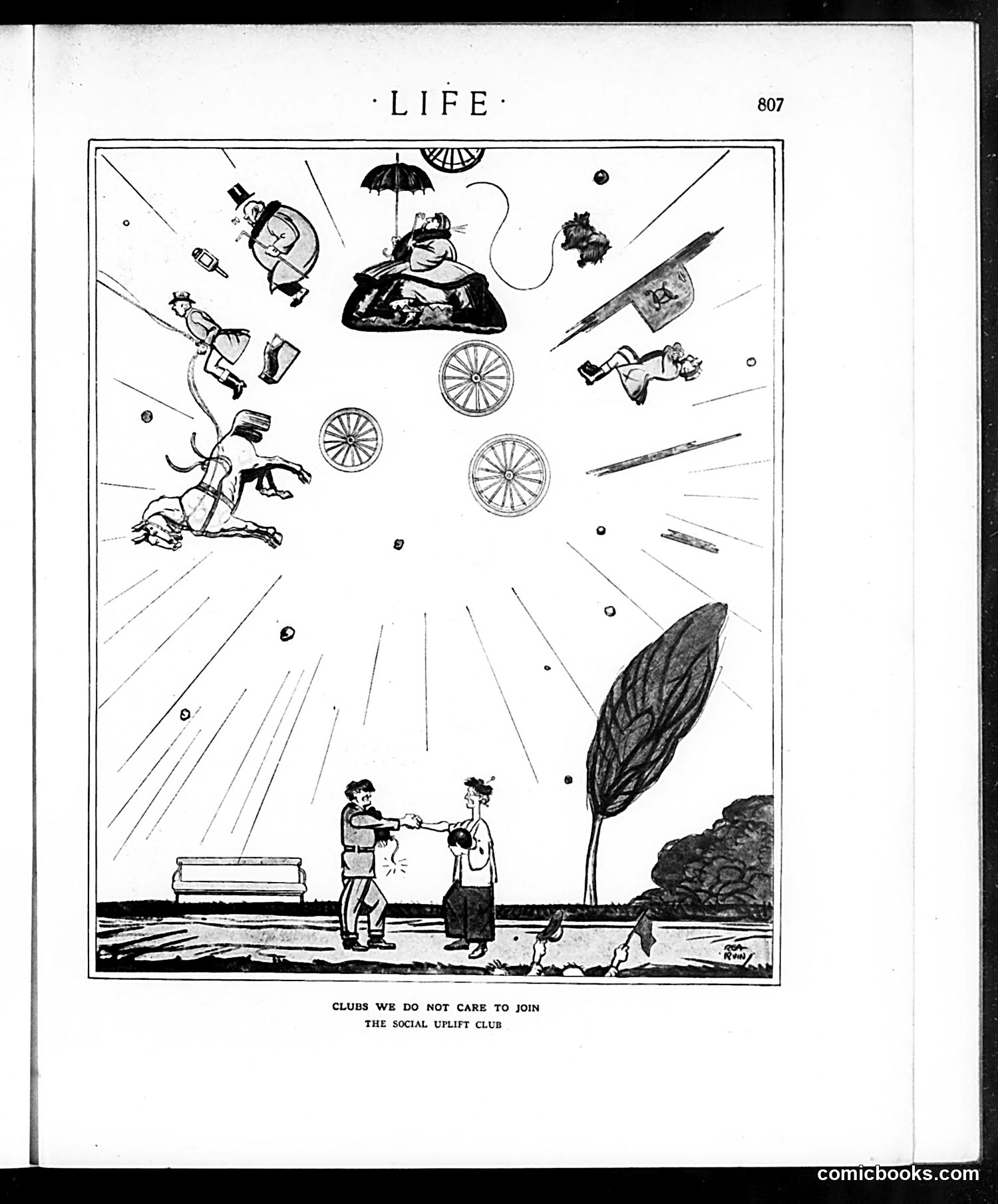
This satirical cartoon depicts "The Social Uplift Club" as a chaotic, surreal gathering of absurd objects and figures raining down from above—including umbrellas, wheels, bottles, flags, and various people in disarray—onto two bewildered men below who appear to be shaking hands or greeting each other. The title's caption suggests this is a club the magazine's readers should avoid joining. The cartoon satirizes what appears to be a progressive "social uplift" or reform organization as an incoherent, nonsensical movement flinging random chaos rather than meaningful improvement. The implied joke: such do-good clubs are ridiculous and their activities amount to meaningless commotion rather than genuine social benefit. This reflects early 20th-century skepticism toward reform movements and activist organizations.
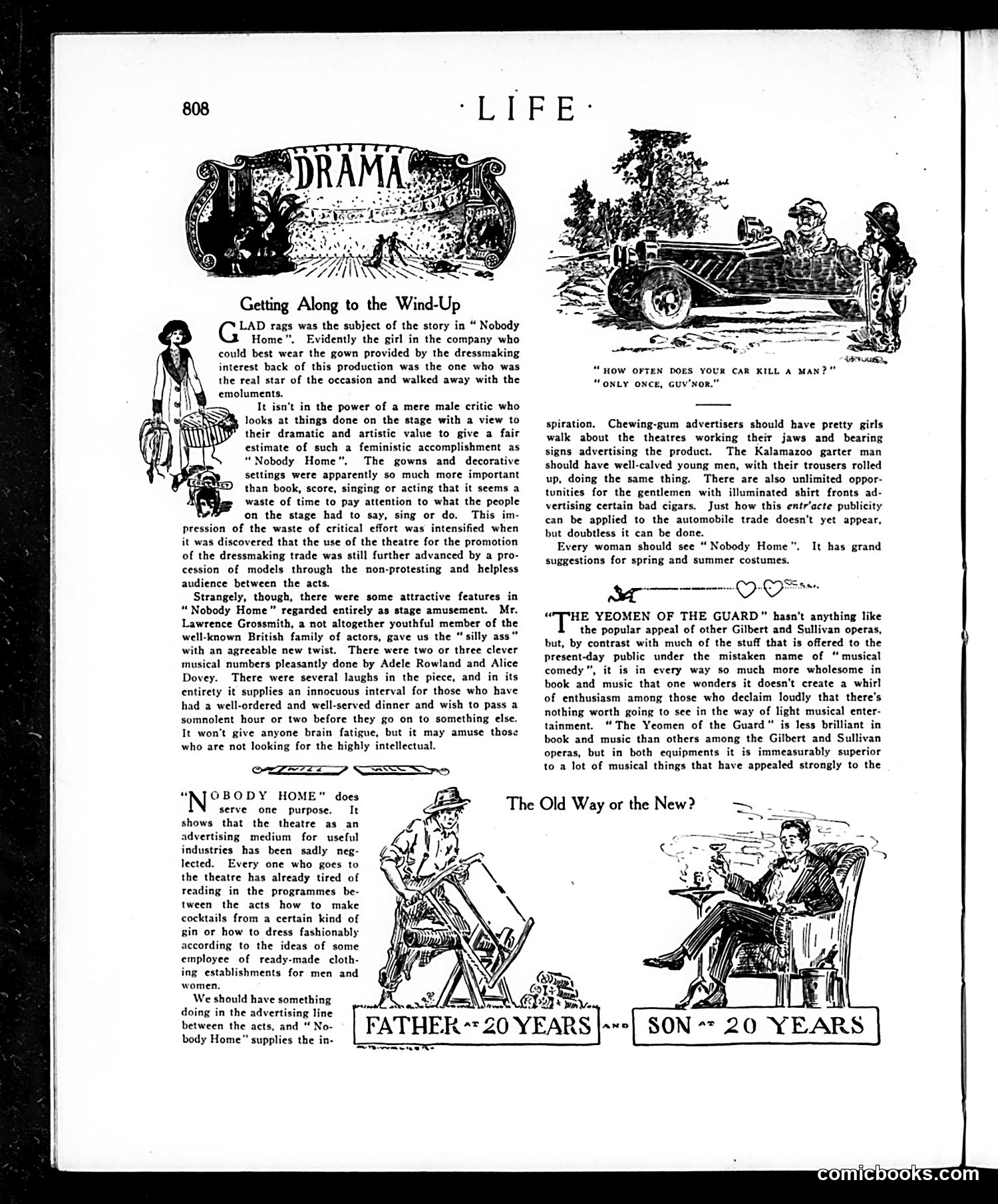
This page reviews theatrical productions while satirizing early 20th-century advertising practices. The main review critiques "Nobody Home," a musical where fashion display apparently overshadowed dramatic merit. The critic—a male—ironically notes he cannot fairly judge a show designed primarily to showcase dresses, and points out that models paraded through the audience between acts, essentially turning the theatre into a commercial venue for the dressmaking industry. The satire extends to a proposal: if theatres can advertise clothing, why not other products? The author humorously suggests chewing-gum companies, garter manufacturers, and cigar makers could use similar tactics. Notably, he admits automobiles present an advertising challenge. The bottom cartoon contrasts "Father—20 Years" (older man with bicycle) and "Son—20 Years" (younger man in car), with the caption joke about cars killing people, reflecting contemporary concerns about automobile safety as vehicles became common.
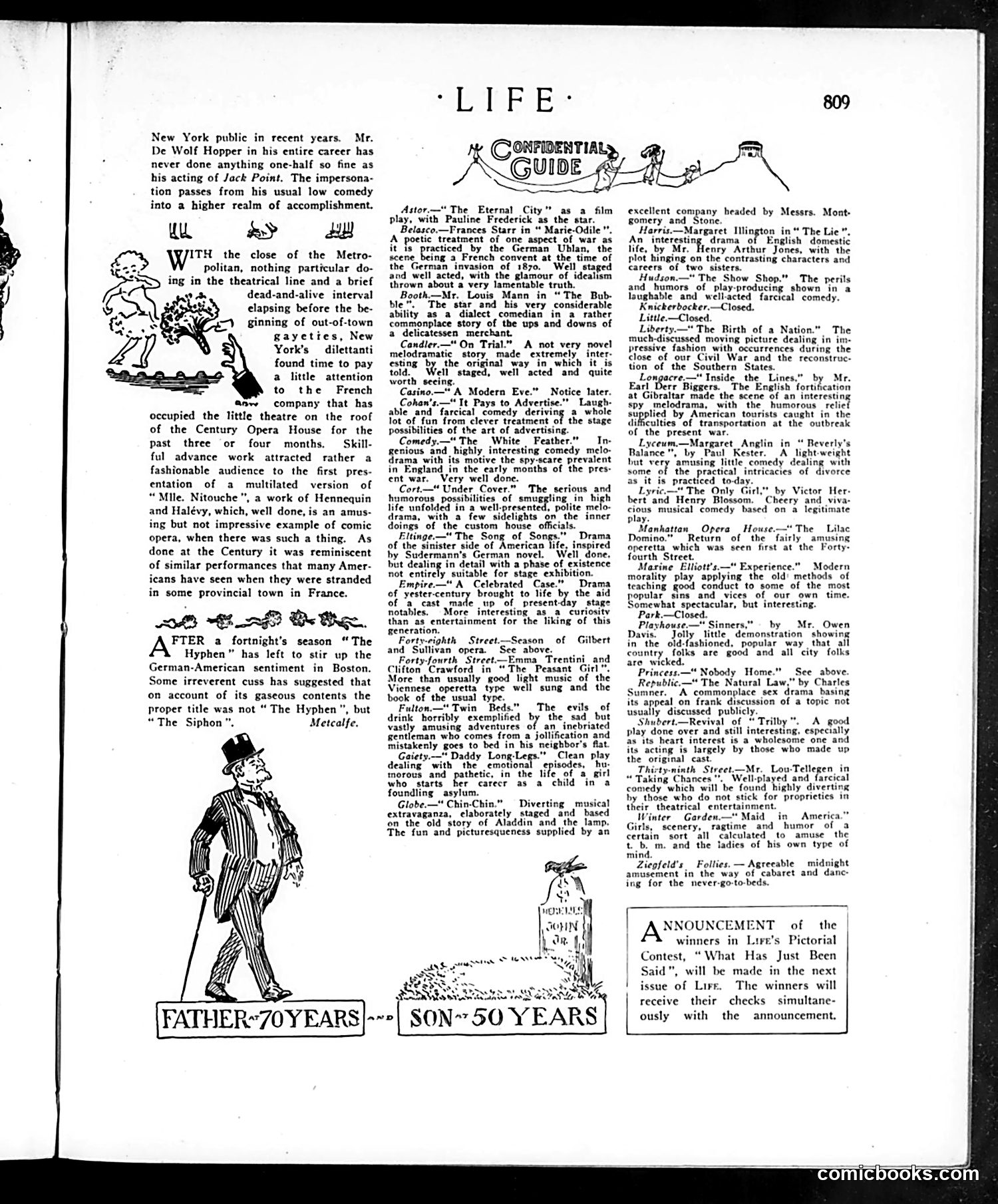
This single-panel cartoon depicts an elderly man labeled "Father—70 Years" alongside a grave marker labeled "Son—50 Years," illustrating the morbid irony of a son dying before his father. The joke plays on the reversal of natural life expectancy—the father has outlived his son, an occurrence that was genuinely tragic and noteworthy enough to merit satirical commentary in early 20th-century Life magazine. The cartoon likely comments on mortality rates or social conditions of the era (possibly referencing wartime casualties, given the theatrical reviews mention WWI themes). The simple visual juxtaposition creates dark humor through the unexpected outcome: the "stronger" generation (father) survives while the younger does not. Without additional context, the specific trigger for this cartoon remains unclear, but it exemplifies Life's use of pointed visual satire on life's misfortunes.
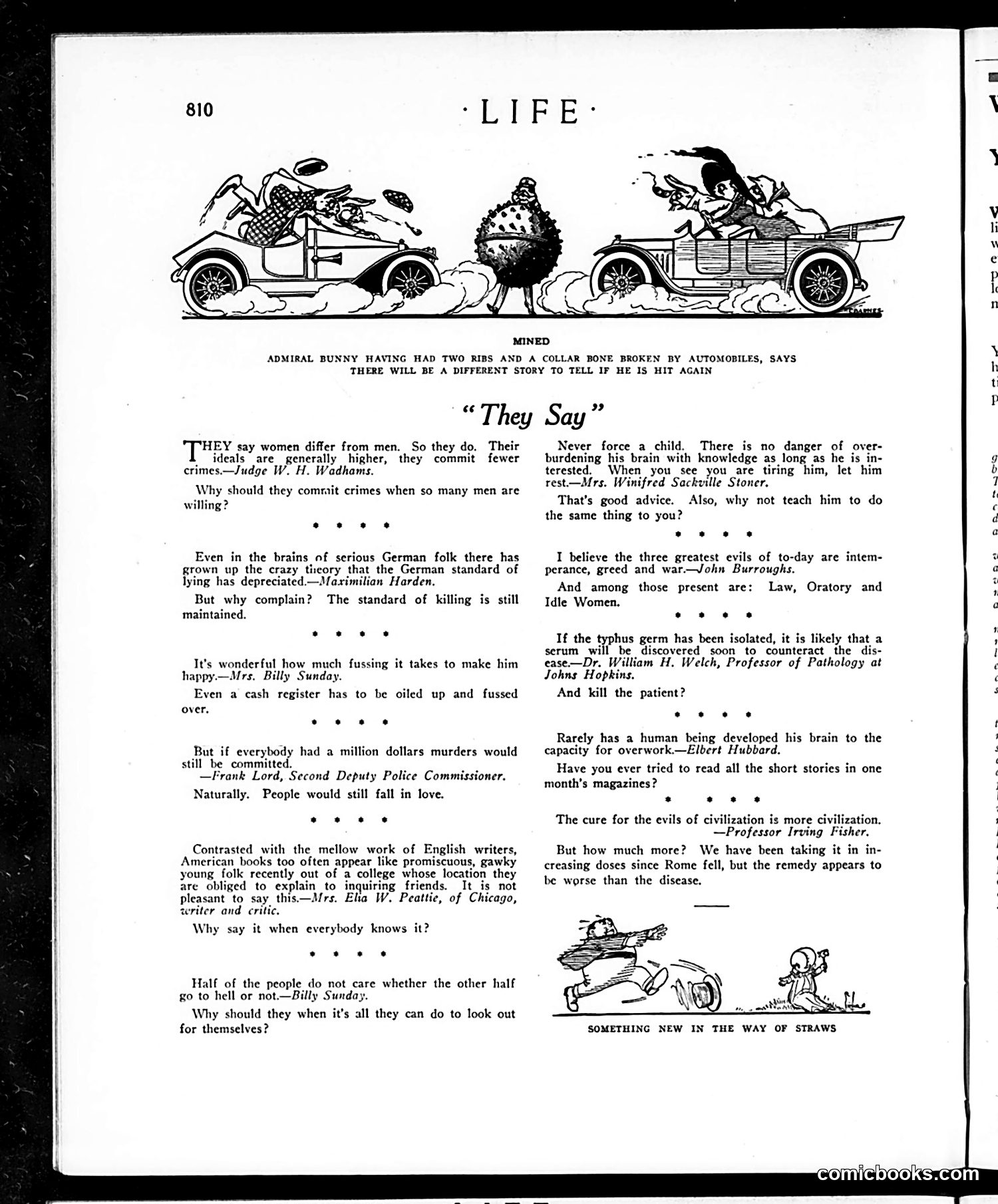
This page presents Life's signature format: a witty cartoon and series of brief, sardonic quotes with responses that puncture pomposity through absurdist logic. **The Cartoon**: Shows "Admiral Bunny" (a anthropomorphic rabbit) injured by automobiles, threatening future retaliation—a visual joke about animals learning to fight back against technology. **The Satire**: The quotes are attributed to real public figures (Judge Wadhams, Billy Sunday's wife, etc.) and respond with logical inversions. Examples: - When a judge claims women commit fewer crimes because they have higher ideals, Life counters: "Why should they when so many men are willing?" - A doctor's optimism about typhus treatment is met with: "And kill the patient?" - Professor Fisher's claim that "more civilization" cures civilization's ills draws the response that this remedy has worsened since Rome's fall. **The Point**: Early 20th-century American satire mocking contemporary self-help wisdom, moral pronouncements, and technological optimism by exposing logical contradictions and unintended consequences—suggesting the era's solutions created as many problems as they solved.
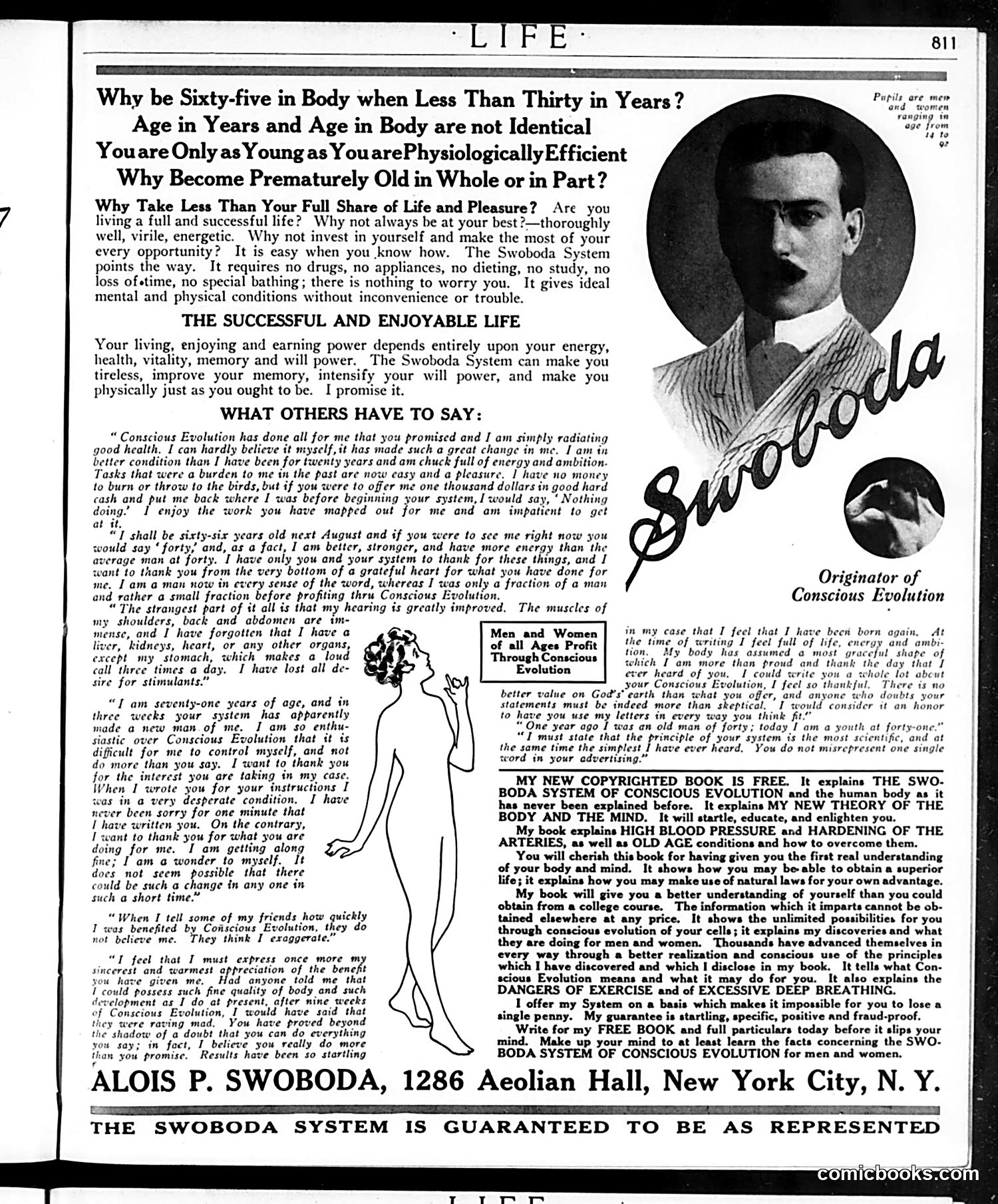
This is a 1920s-era **health product advertisement**, not satire—though modern readers would recognize it as fraudulent pseudoscience. **The Product:** Alois P. Swoboda's "Conscious Evolution" system, claimed to reverse aging and improve physical vitality without drugs, diet, or exercise. **The Pitch:** The headline promises that chronological age needn't match "body age"—you're only as old as your physiological efficiency. Testimonials from satisfied customers (likely fabricated) claim dramatic rejuvenation: 71-year-old men feeling young again, improved hearing, muscular development. **Historical Context:** This reflects early 20th-century pseudoscientific wellness movements that preyed on anxieties about aging and vitality. Such mail-order "systems" were common before FDA regulation. The breathless promises and vague methodology are red flags today but were persuasive marketing then. **The Satire:** This *itself* might be Life magazine's satirical mockery of such dubious health schemes, though the presentation is ambiguous.
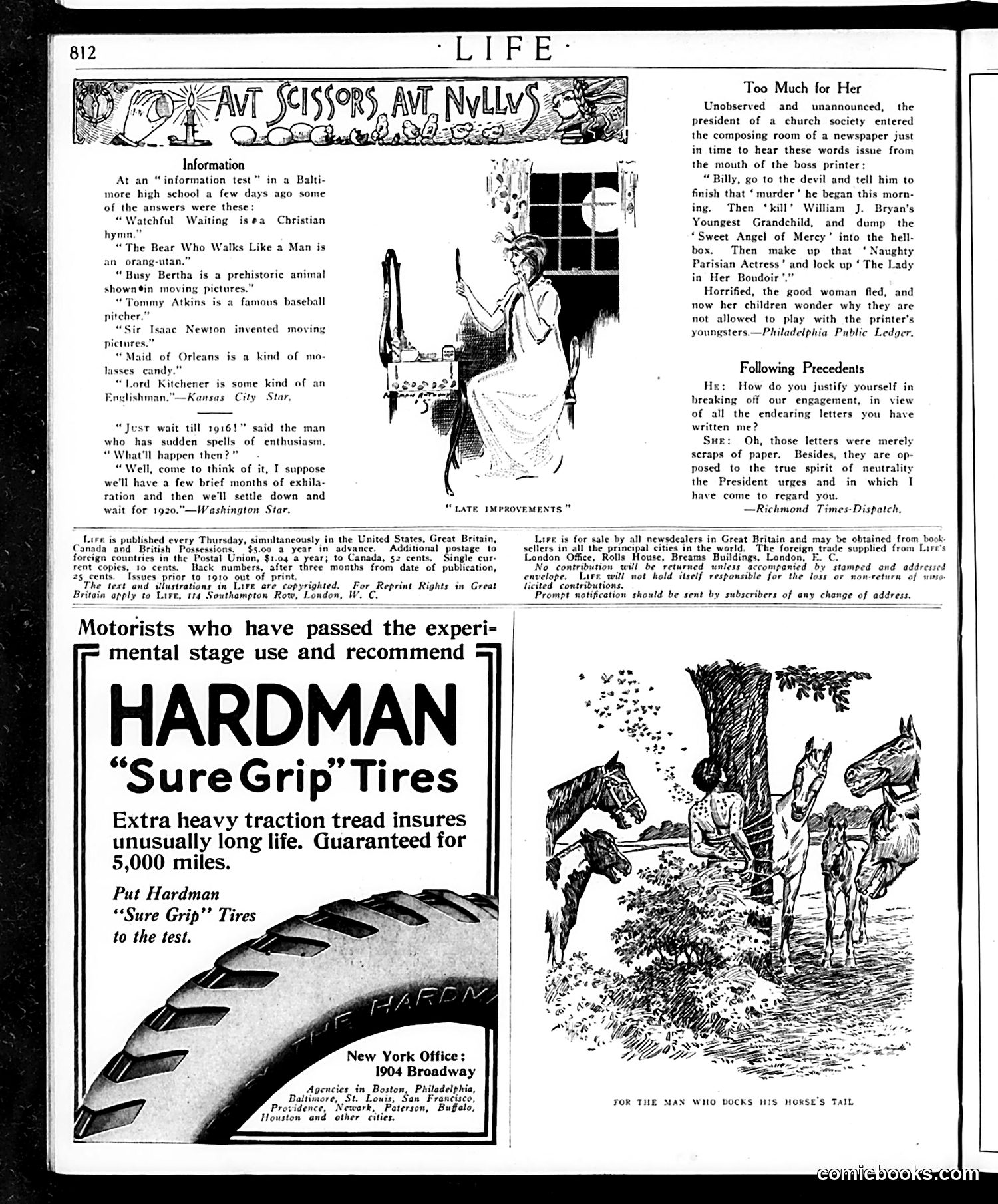
This Life magazine page (page 812) contains several humor pieces satirizing early 1900s American society and politics: **"Information Test"**: A comedic column mocking students' ignorance. Answers conflate famous figures and phrases—"Watchful Waiting" (President Wilson's foreign policy) mistaken for a hymn; "Lord Kitchener" (British military leader) for "some kind of Englishman." The satire targets inadequate education. **"Too Much for Her"**: A church lady overhears a newspaper printer using vulgar slang (sending people to "the devil," "killing" public figures like Bryan's grandson). Newspaper jargon—where "kill" means delete copy and "hell-box" holds rejected type—sounds profane to innocent ears. The joke: pious people misunderstanding workplace language. **"Following Precedents"**: A man breaks an engagement by citing President Wilson's neutrality policy, treating love letters like international relations. Dark satire on how pre-WWI political rhetoric infiltrated personal life. The page also advertises Hardman tires and includes an unrelated illustration about horses.
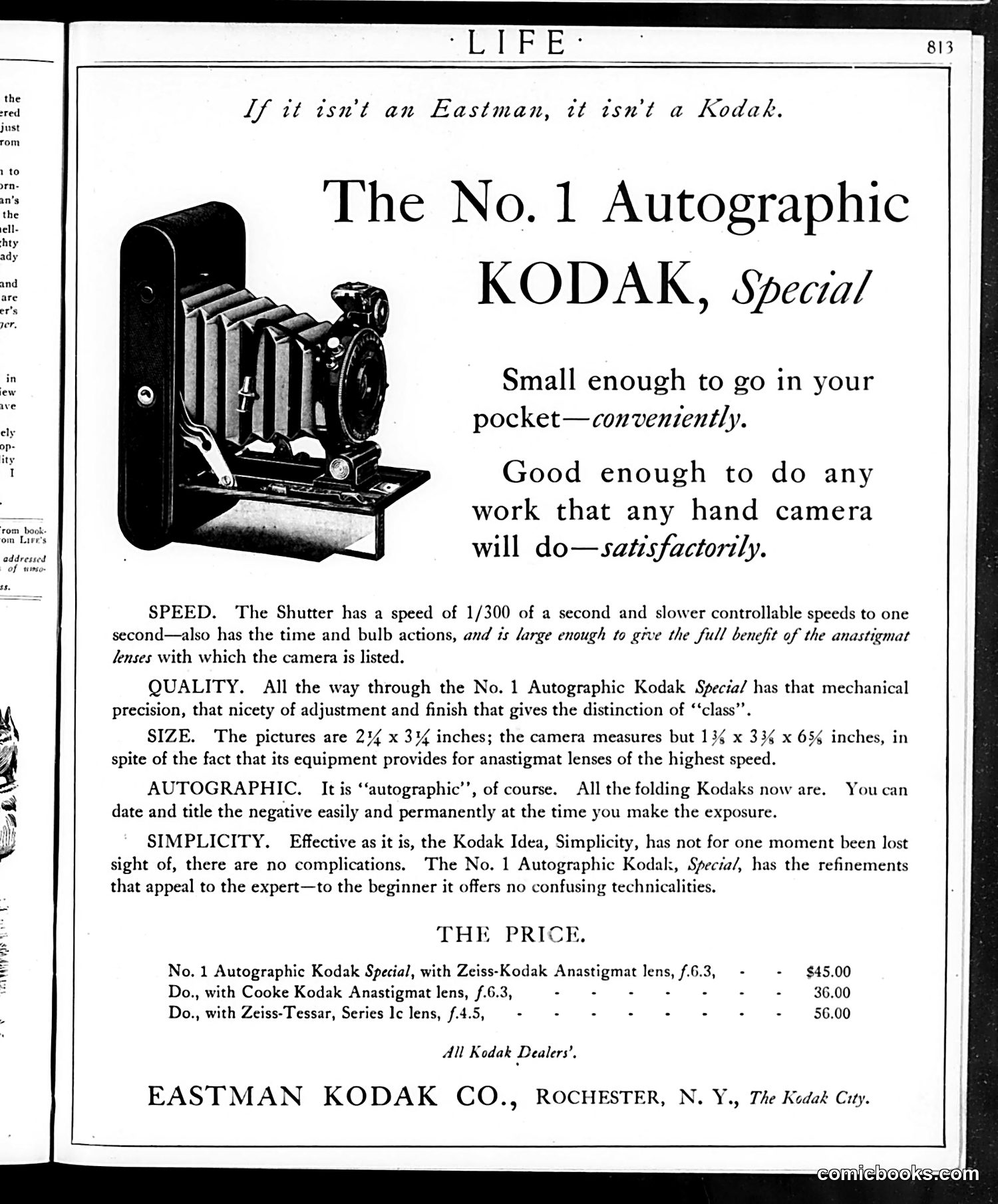
This page is primarily a **Kodak camera advertisement**, not political satire. It appears in *Life* magazine (page 813) and promotes the No. 1 Autographic Kodak Special. The famous slogan "If it isn't an Eastman, it isn't a Kodak" references **George Eastman**, founder of Eastman Kodak Company, establishing brand authority and market dominance. This was legitimate advertising language, not satire—Eastman Kodak essentially *owned* the consumer camera market in this era. The ad emphasizes portability, quality, ease of use, and the "autographic" feature (allowing photographers to write captions directly on negatives). Prices range from $36–$56 depending on lens configuration. For modern readers: this represents early 20th-century consumer photography marketing, when Kodak monopolized the market. The tone is straightforward corporate promotion, not humorous commentary.
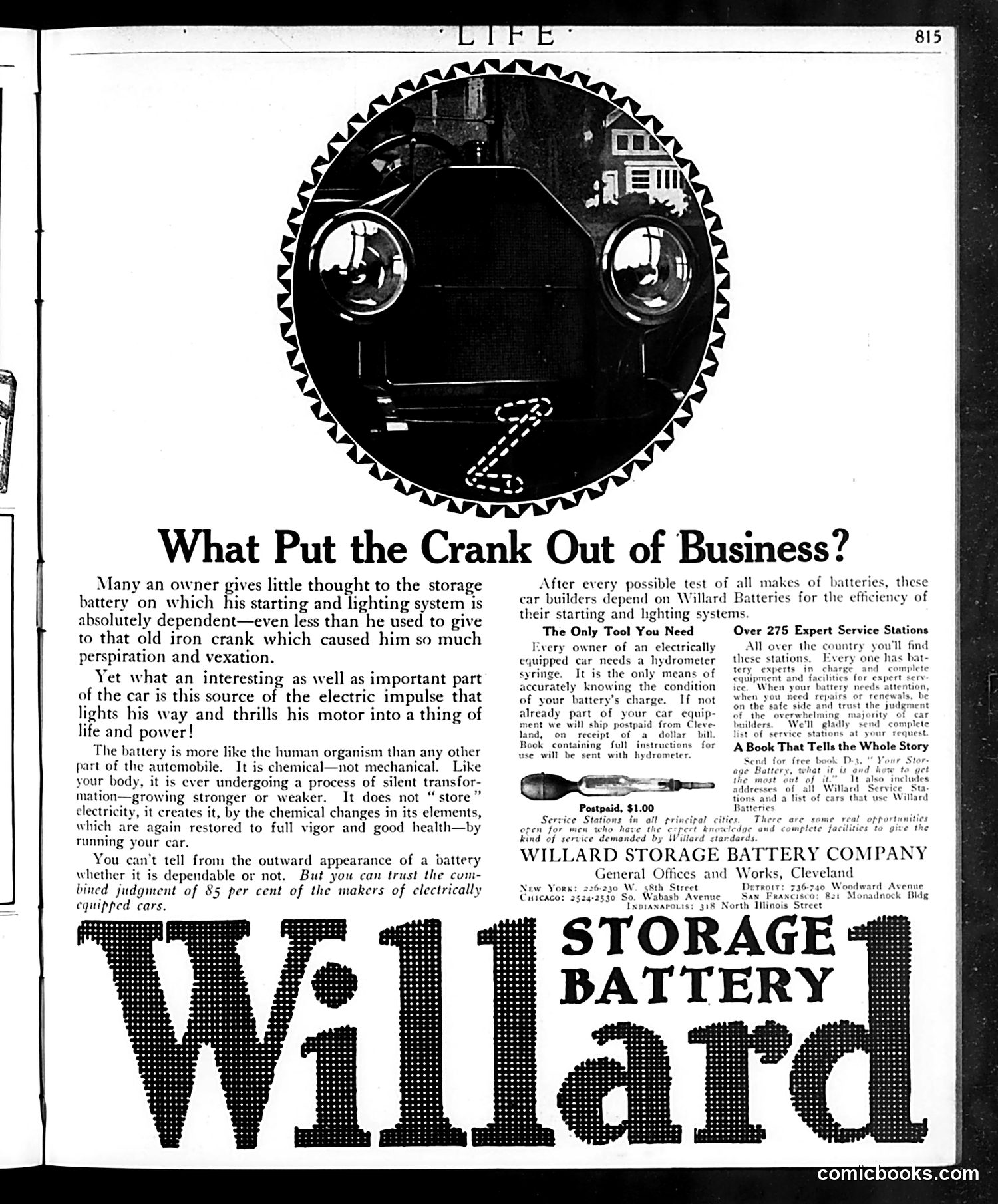
This is primarily an **advertisement**, not political satire. The page promotes Willard Storage Batteries by addressing a specific technological transition. **The Context:** Early automobiles required hand-cranking to start—a physically demanding, sometimes dangerous task. By the 1920s, electric starters powered by storage batteries replaced this method, making cars more user-friendly. **The "Joke":** The headline "What Put the Crank Out of Business?" refers to the literal hand-crank, now obsolete. The car illustration shows a cartoon face where the crank would have been, humorously personifying the car's relief at no longer needing manual starting. **The Sales Pitch:** The ad argues that while owners ignore their batteries, 85% of car manufacturers trust Willard batteries for reliability. It promotes their hydrometer tool and 275 service stations nationwide. **Why It Matters Today:** This ad documents a major automotive innovation—the shift from mechanical to electrical starting systems—presented as consumer-friendly progress. The tone assumes readers understand the old crank-starting method's inconvenience.
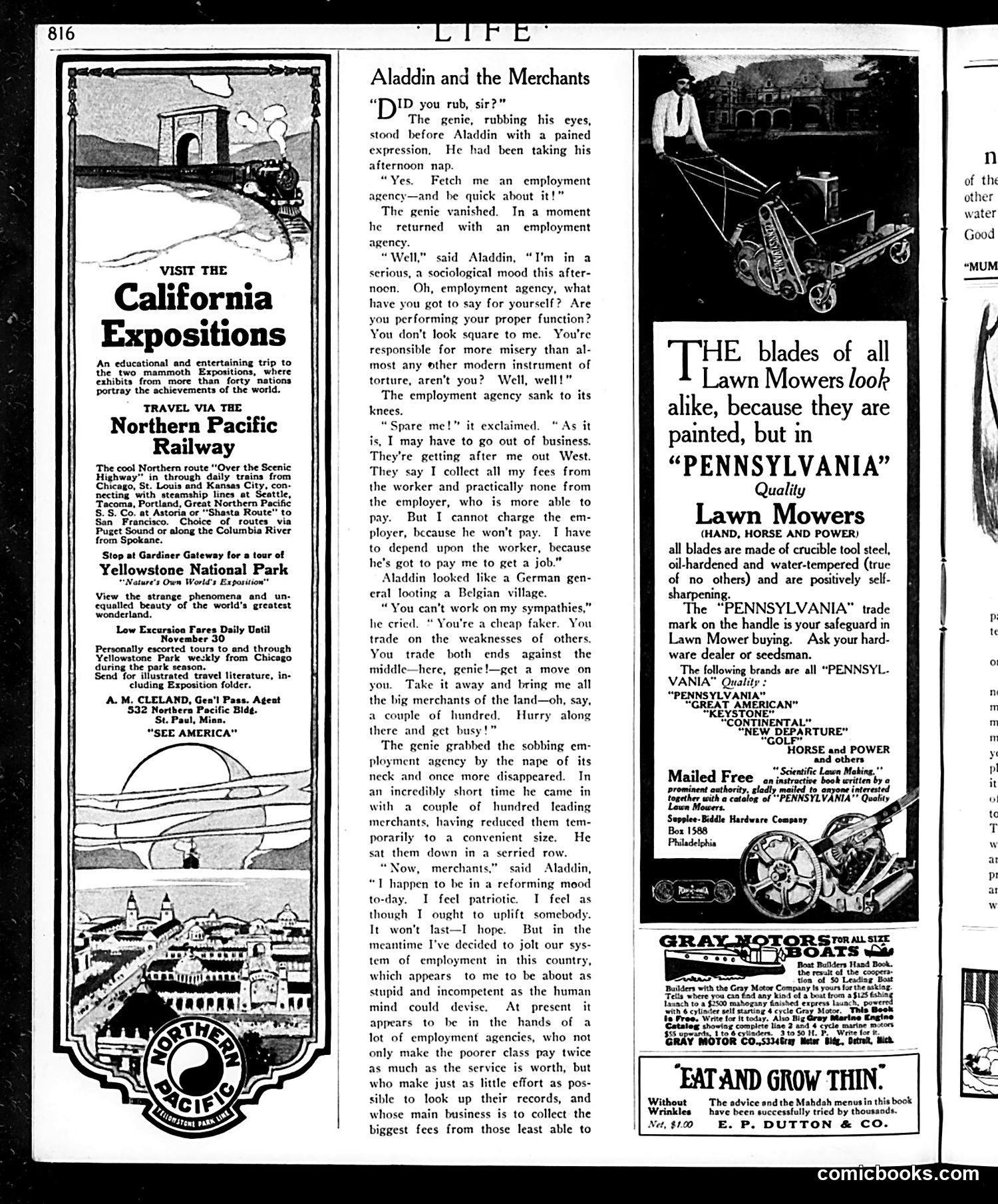
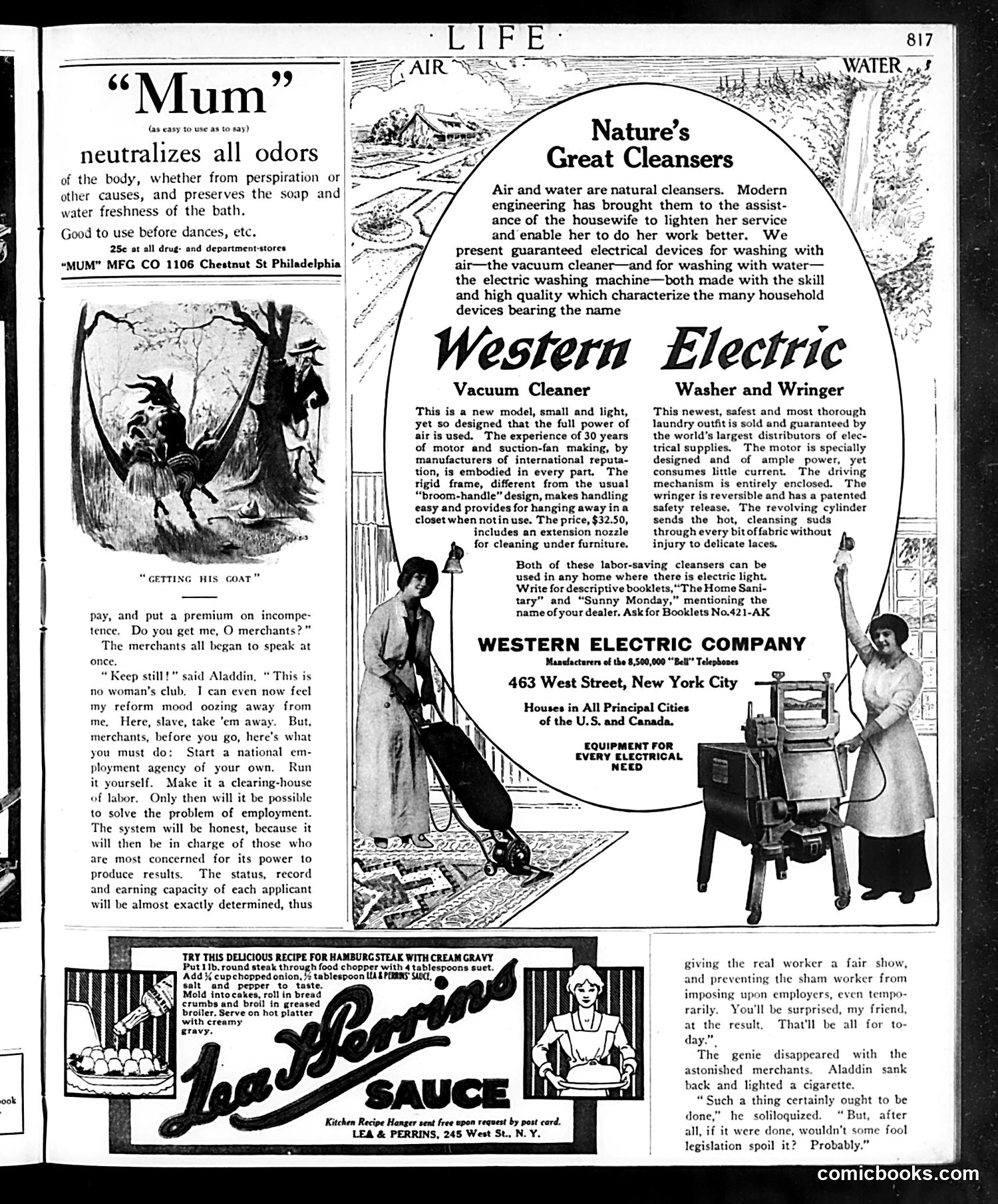
This page is primarily **advertising** with one integrated satirical story. The main narrative is an Aladdin-themed parable where a genie lectures merchants about employment reform. The genie argues that merchants must establish their own employment agencies—honest, transparent systems run by those invested in actual worker productivity—rather than relying on external labor sources. The moral: proper worker vetting and fair compensation solve unemployment better than government intervention. The advertisements themselves reinforce this era's optimism about **electrical appliances solving domestic labor**. Western Electric promotes vacuum cleaners and washing machines as liberating housewives from drudgery. A Mum deodorant ad and Lea & Perrins sauce round out the page. **Historical context**: This reflects 1920s American attitudes—skepticism of government programs, faith in technology and private enterprise, and the emerging consumer culture around electrical home goods. The Aladdin frame suggests magical solutions exist if employers simply behave responsibly.
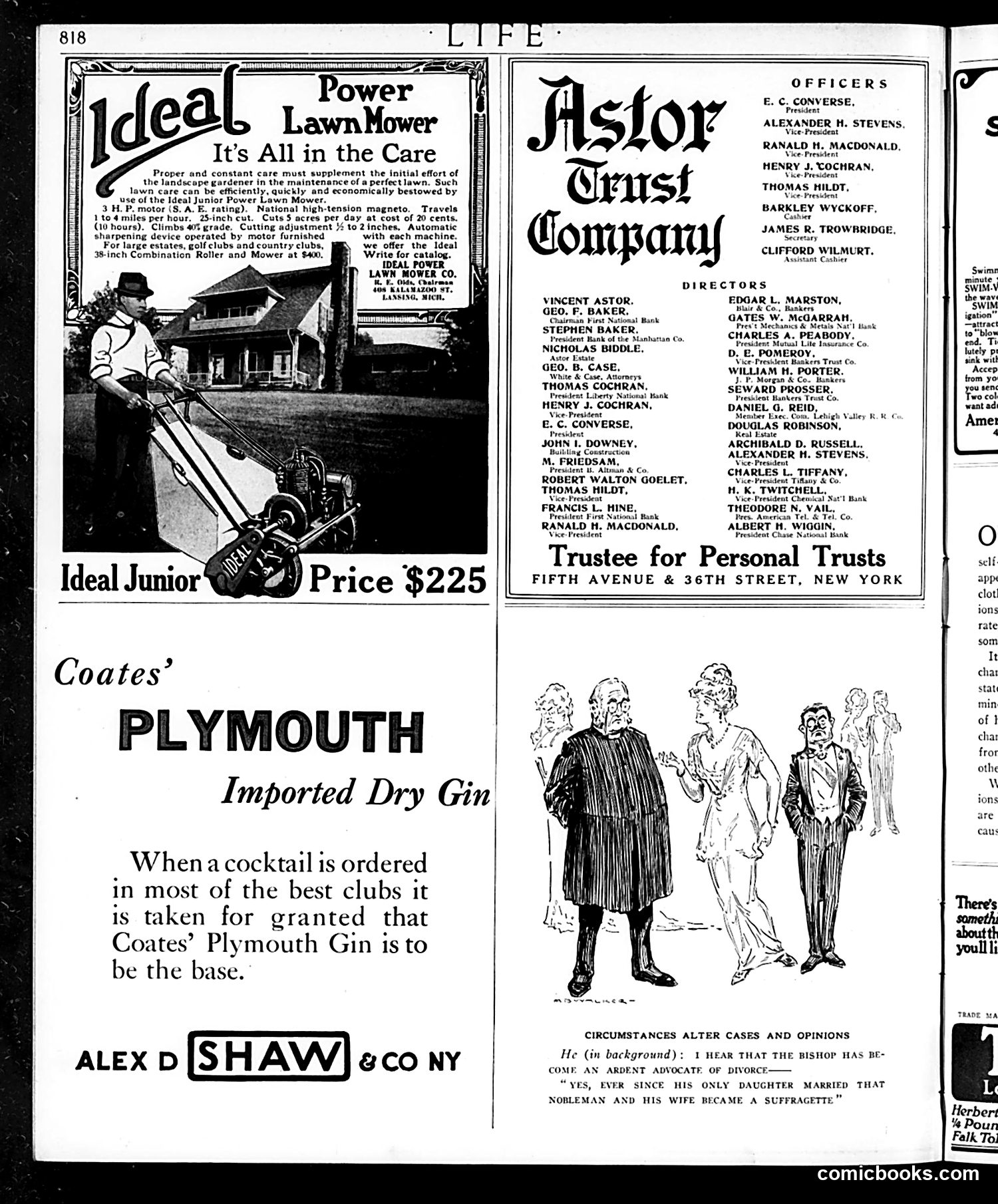
This page is primarily **advertising and corporate information** for the Astor Trust Company, interspersed with product ads. The small cartoon at bottom depicts a social satire: a man's opinions have shifted because his daughter married a nobleman and his wife became a suffragette (women's voting rights activist). The joke reflects early 20th-century anxiety about women's suffrage and class mobility—the implication being that the man's perspective changed due to these "radical" domestic developments. The cartoon mocks how people's supposedly firm convictions can reverse when personal circumstances change. The page also advertises lawn mowers, gin, and other luxury goods to wealthy audiences, featuring names of prominent New York financiers and industrialists (Vanderbilt, Astor, etc.) as officers and directors. The overall context shows this was a magazine for affluent readers concerned with estates, country clubs, and social status.
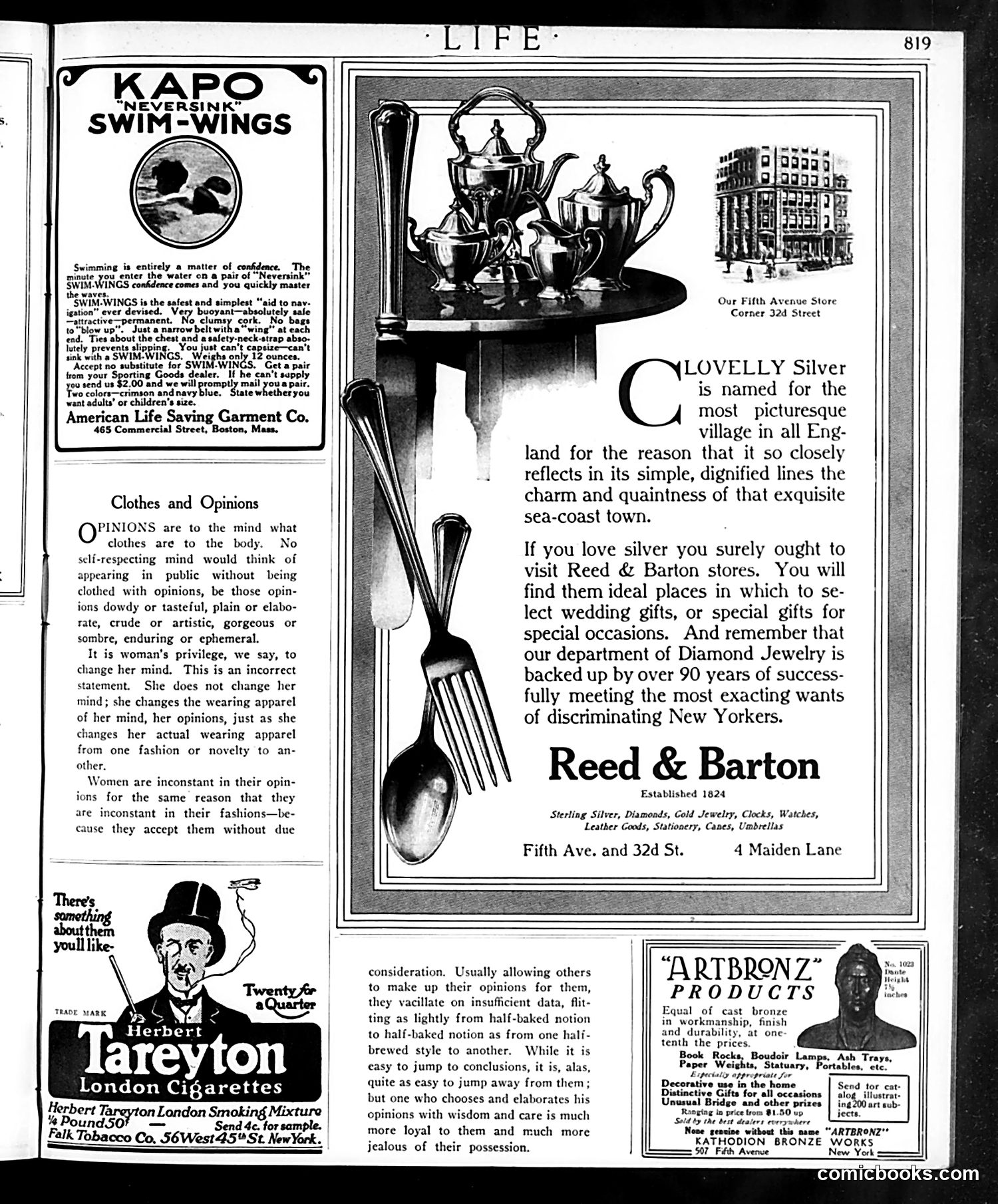
This page is primarily **advertisements and lifestyle content** rather than political satire. The main editorial piece, "Clothes and Opinions," uses the metaphor of clothing to critique women's inconstancy—arguing that women change their minds as frivolously as they change fashions, accepting opinions from others without careful deliberation. By modern standards, this reflects the **era's sexist assumptions** about women's intellectual capacity and independence. The piece treats women's changing opinions as inherently shallow, contrasting them with those who "choose and elaborate" opinions "with wisdom and care." The page also advertises **swimming safety equipment** (Kapo Swim-Wings), **luxury goods** (Reed & Barton silver), and **smoking products** (Herbert Tareyton cigars)—typical of Life magazine's advertising-heavy format in this period. The social commentary, while present, is relatively gentle and focused on gender stereotypes rather than political issues.
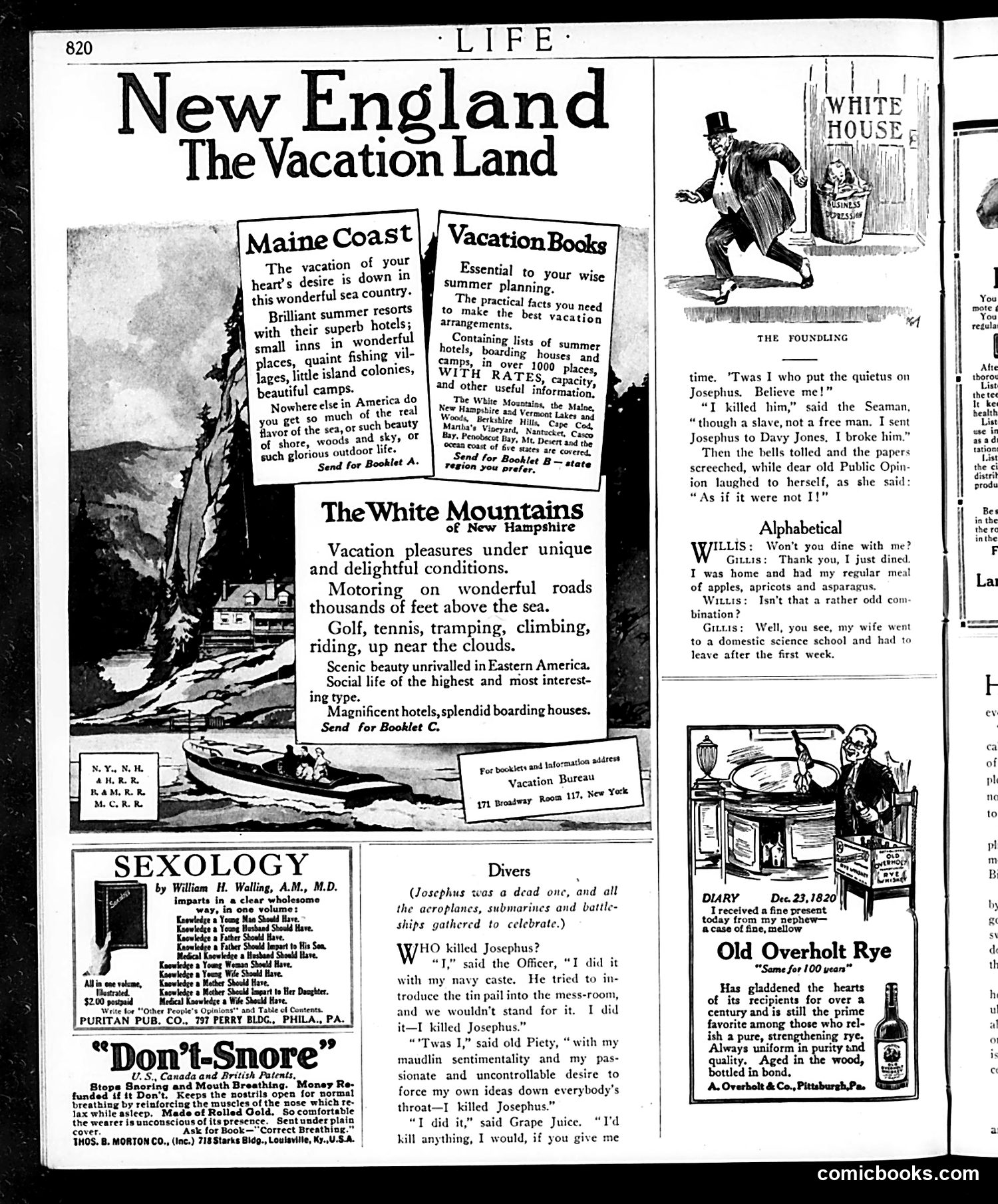
This satirical comic depicts a debate over who "killed Josephus." The figures represent different social forces claiming responsibility: the Officer (military/authority), Piety (religious hypocrisy), and Grape Juice (Prohibition/temperance movement). The joke targets early 20th-century American reform movements. Each character boasts of destructive influence—the military's brutality, organized religion's moralizing oppression, and the temperance movement's intrusiveness—all claiming they "killed" something (likely American freedom or individualism, symbolized by the doomed Josephus). "Public Opinion" laughs at the irony: these forces blame each other while collectively destroying what they claim to protect. The cartoon satirizes how various establishment institutions, despite their different agendas, all contribute to restricting personal liberty—and none will accept responsibility for the damage. The surrounding advertisements for vacation destinations and remedies provide ironic contrast to this darker social commentary.
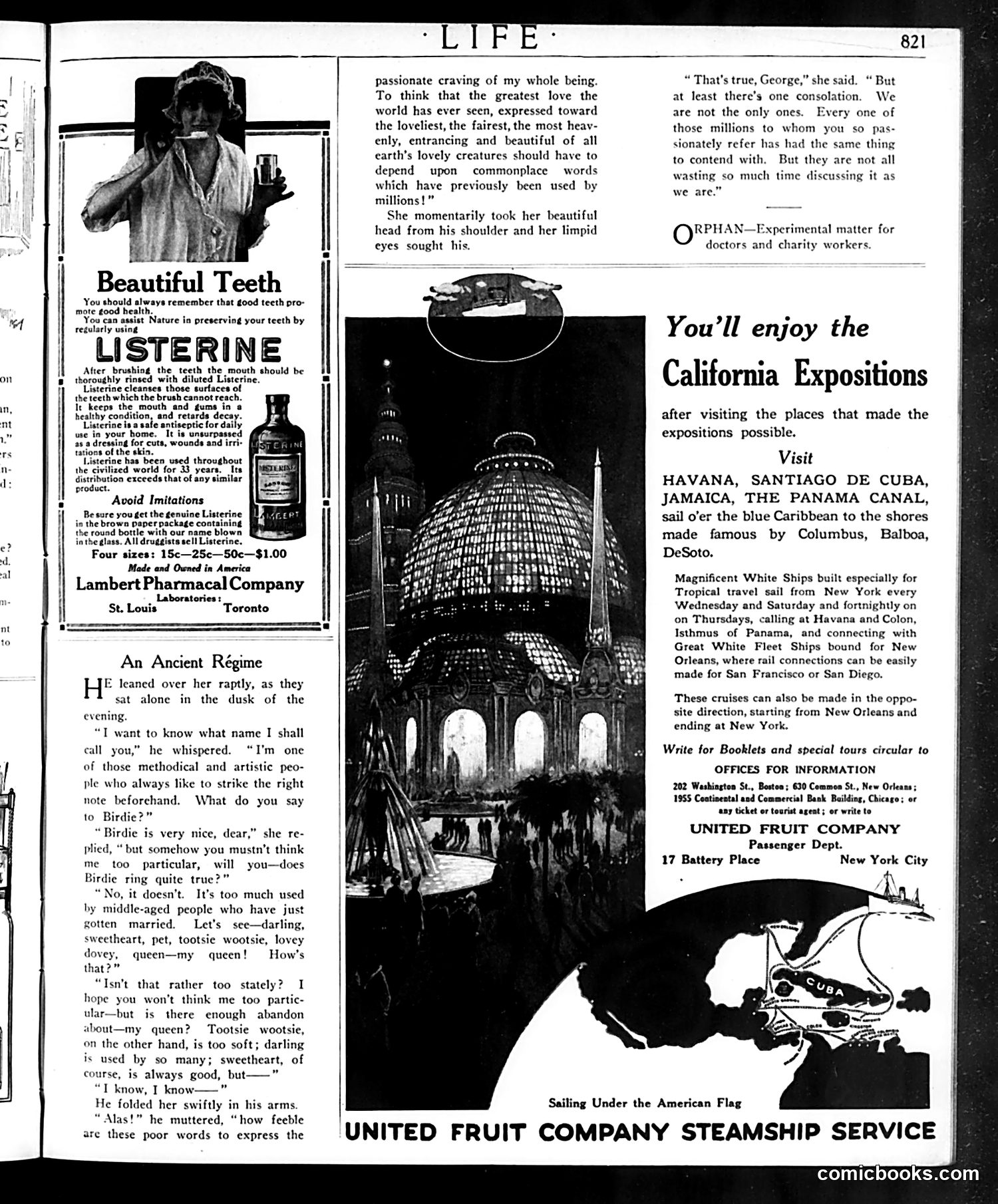
This short story excerpt satirizes overwrought romantic sentimentality. A man and woman debate what pet name to call each other, with him proposing increasingly elaborate terms ("queen," "my queen") while she critiques each for being either too common, too formal, or insufficiently passionate. The satire peaks when he dramatically laments that language itself is inadequate to express their love—to which she delivers the punchline: everyone in love faces this same problem, but most people don't waste time *discussing* it endlessly. The joke targets the self-indulgent verbosity of romantic discourse, particularly among educated couples who mistake philosophical overthinking for genuine emotion. The title "An Ancient Régime" suggests this type of affected courtship is outdated pretension. The page is otherwise filled with period advertisements (Listerine, cruise ships to the Panama Canal and Caribbean).
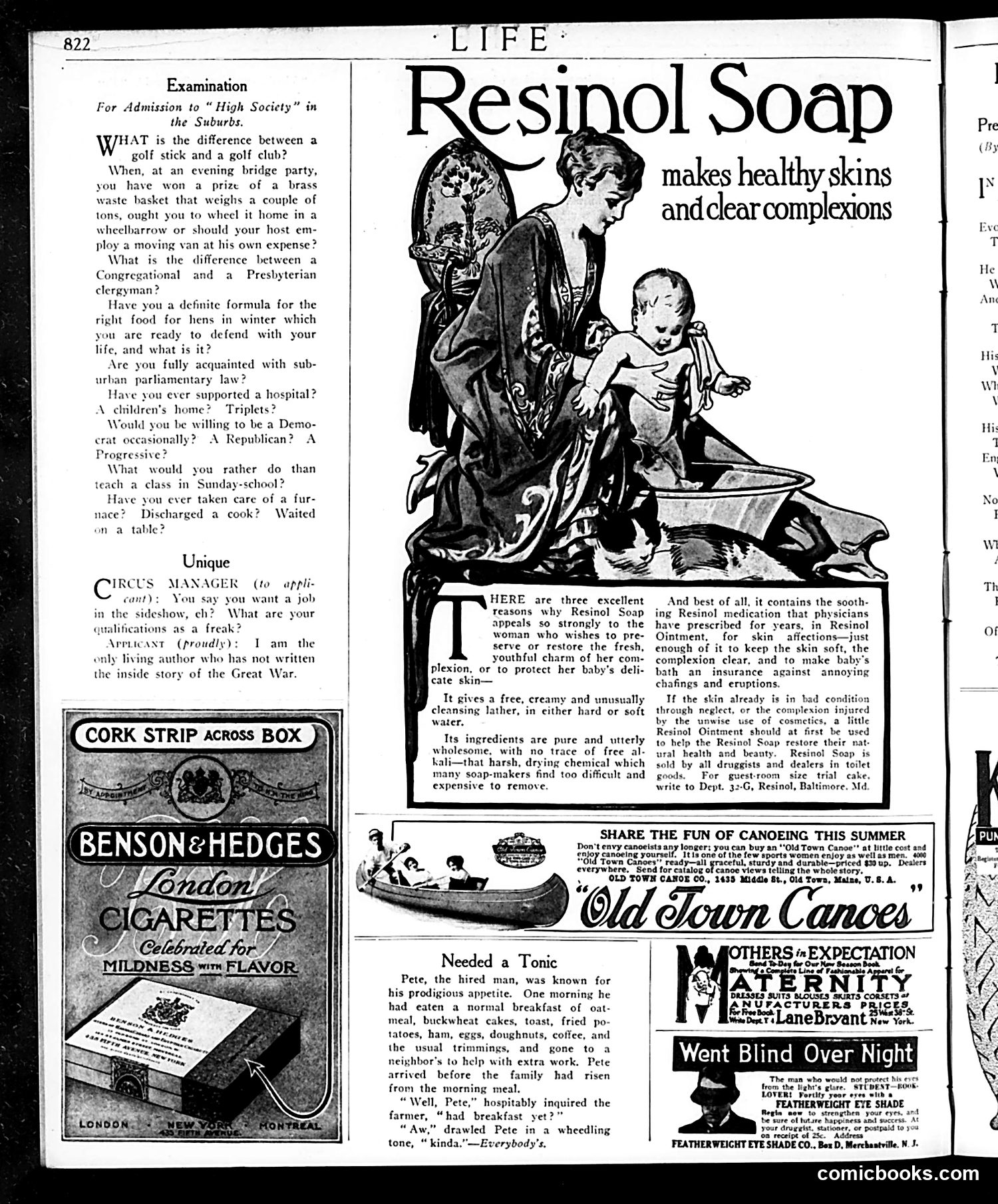
This page from *Life* magazine (a satirical publication) combines humor with period advertising. The main satirical content includes: **"Examination for Admission to 'High Society' in the Suburbs"**: A mock questionnaire mocking suburban pretensions—asking absurd distinctions (golf stick vs. club) and trivial concerns (proper hen food, parlor etiquette) to satirize the shallow social-climbing anxieties of suburban middle-class aspirants trying to appear refined. **"Unique" Circus Manager Joke**: Satirizes post-WWI publishing trends by presenting an author who *hasn't* written a sensationalized "inside story of the Great War" as a circus freak—mocking the flood of such exploitative war memoirs flooding the market at that time. **"Needed a Tonic"**: A gentle joke about Pete the hired man's enormous appetite—he's eaten breakfast but claims he needs "a tonic" (likely alcohol) to complete it. The page is otherwise dominated by period advertisements (Resinol Soap, Old Town Canoes, cigarettes, eye shades) typical of 1920s magazines. The satirical content reflects Jazz Age anxieties about class, commercialism, and postwar cultural trends.
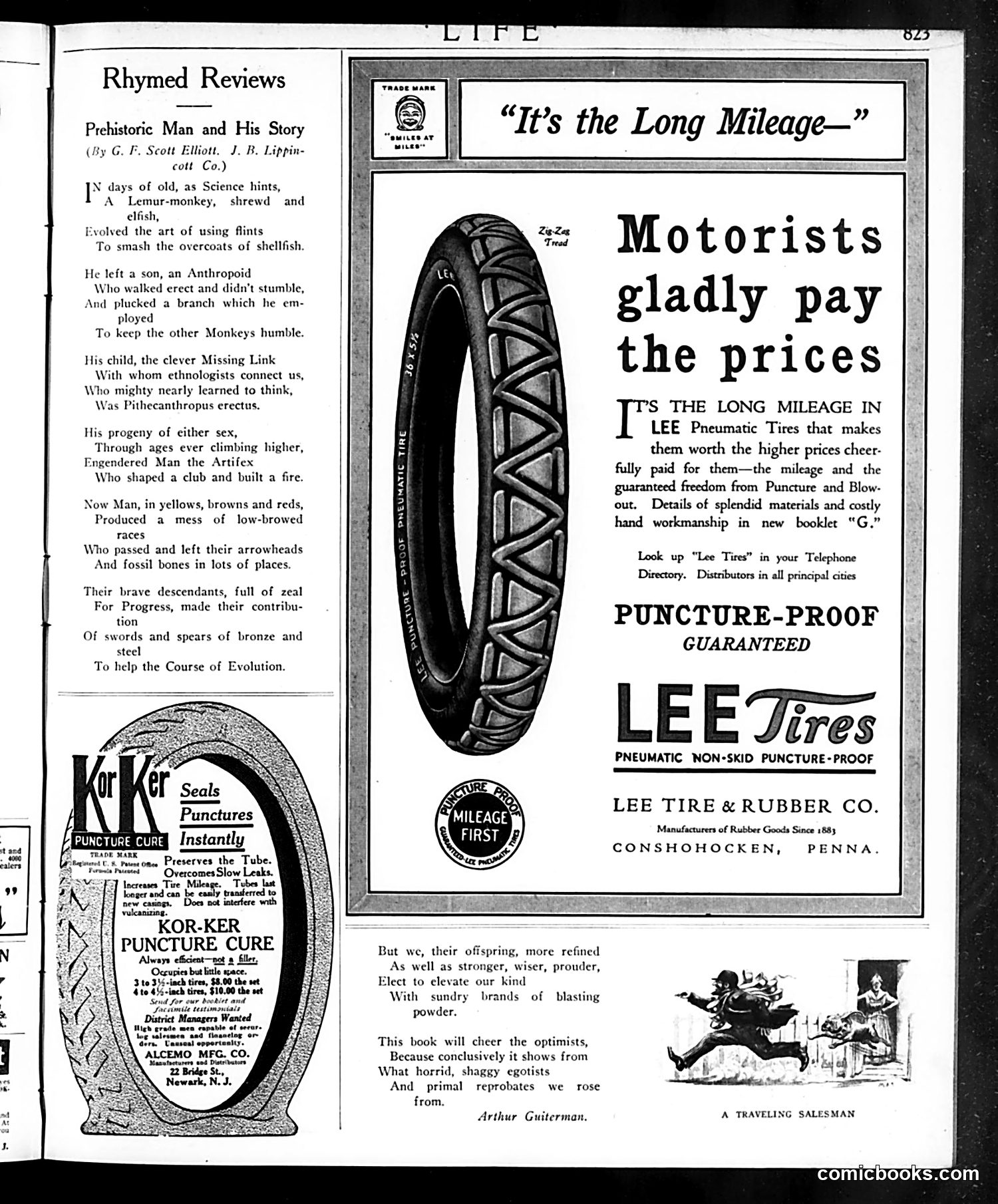
This page presents a **book review in verse form** by Arthur Guiterman, satirizing the optimistic narrative of human progress through evolution. **The Satire's Point:** Guiterman traces mankind's supposed advancement from primitive lemurs through increasingly sophisticated ancestors (anthropoids, the "Missing Link," tool-makers, bronze-workers) to modern civilization. However, the final stanza delivers the punch: modern humans, despite claiming refinement and wisdom, use their evolutionary achievements not for noble purposes but to develop "blasting powder"—weapons of mass destruction. **The Joke:** The reviewer mocks both evolutionary optimists and the book itself by arguing that if we examine our origins honestly, we've only inherited our ancestors' brutish nature, merely perfecting instruments of violence. Our "progress" is illusory moral regression dressed in technological advancement. **Context:** This reflects pre-WWI (or interwar) anxieties about modern weaponry and questions whether civilization genuinely improves humanity or merely enables more efficient destruction. The page also contains period advertisements for tire and puncture-cure products—typical magazine filler.
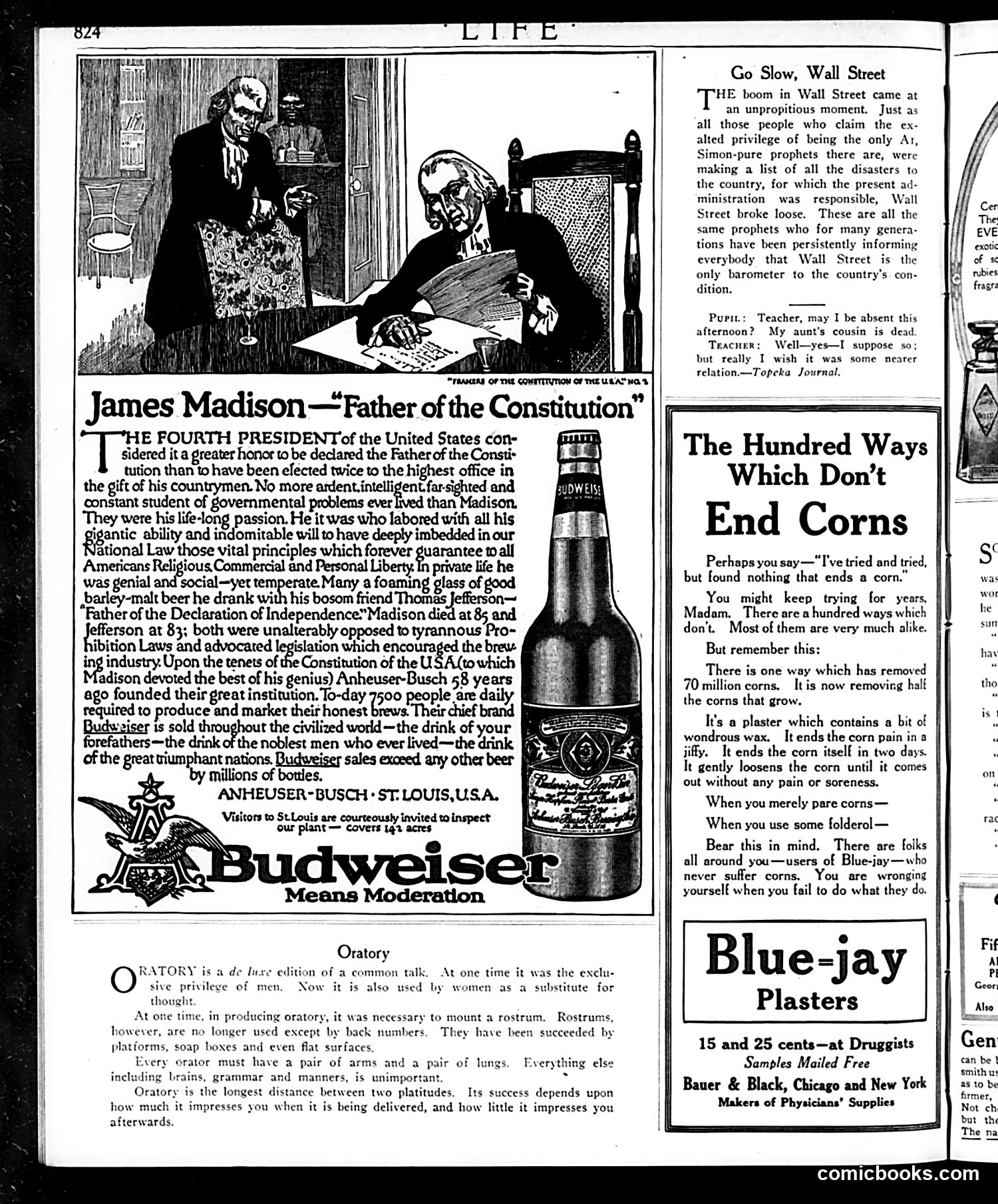
## Main Content **The Budweiser Advertisement** (disguised as editorial praise for James Madison): This is satirical advertising that cynically claims Founding Fathers Madison and Jefferson opposed Prohibition and drank beer, therefore Budweiser represents American patriotism. The ad absurdly credits Anheuser-Busch with embodying the Constitution's ideals. **"Go Slow, Wall Street"** (top right): A satirical piece mocking self-proclaimed economic "prophets" who blame the government for all disasters, then claim Wall Street's health proves their predictions. The joke: these same people contradict themselves—they said Wall Street was the country's barometer, yet now blame government when the market drops. **Oratory Definition & Other Content**: Satirical definitions of oratory as hollow speechmaking; corn remedy advertising; and a joke about a student's dead relative. The page blends genuine satire criticizing both corporate propaganda and financial hypocrisy with period advertising.
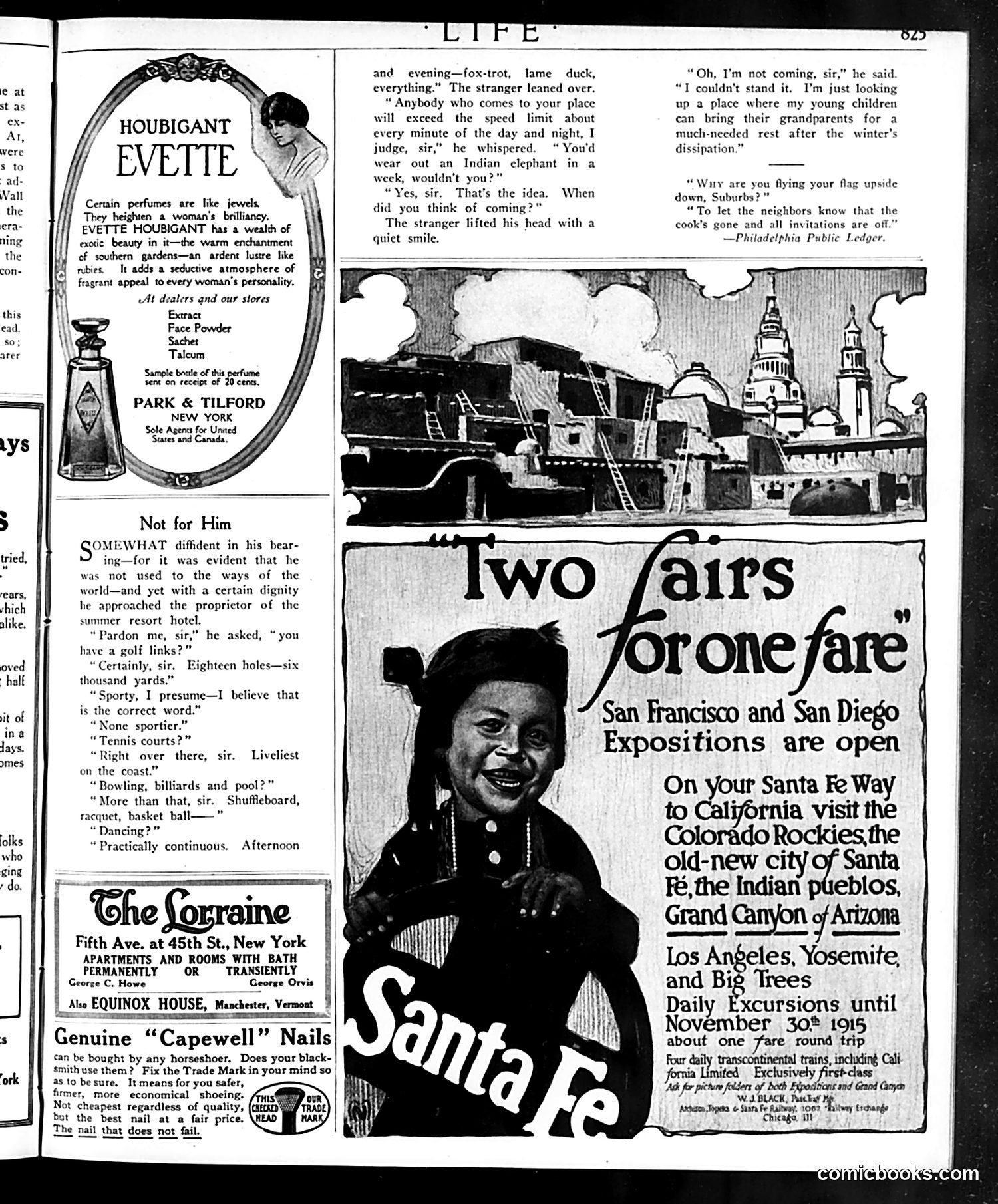
This page contains three distinct pieces: 1. **"Not for Him"** — A humorous short story satirizing the leisure culture and excess of wealthy Americans. A modest gentleman inquires about resort amenities (golf, dancing, billiards) at a hotel, then reveals he's actually scouting a place where his *grandchildren* can recuperate from "the winter's dissipation" — mocking how indulgent and exhausting the leisure class lifestyle has become, even for the young. 2. **Two brief jokes** about social conventions: one about flying a flag upside-down to signal "the cook's gone," poking fun at suburban pretension and neighbor-watching. 3. **Advertisements** — Including Evette Houbigant perfume, The Lorraine hotel, horseshoe nails, and Santa Fe railway promotions to California expositions. The satire targets upper-class excess and the performance of respectability in early 20th-century American society.
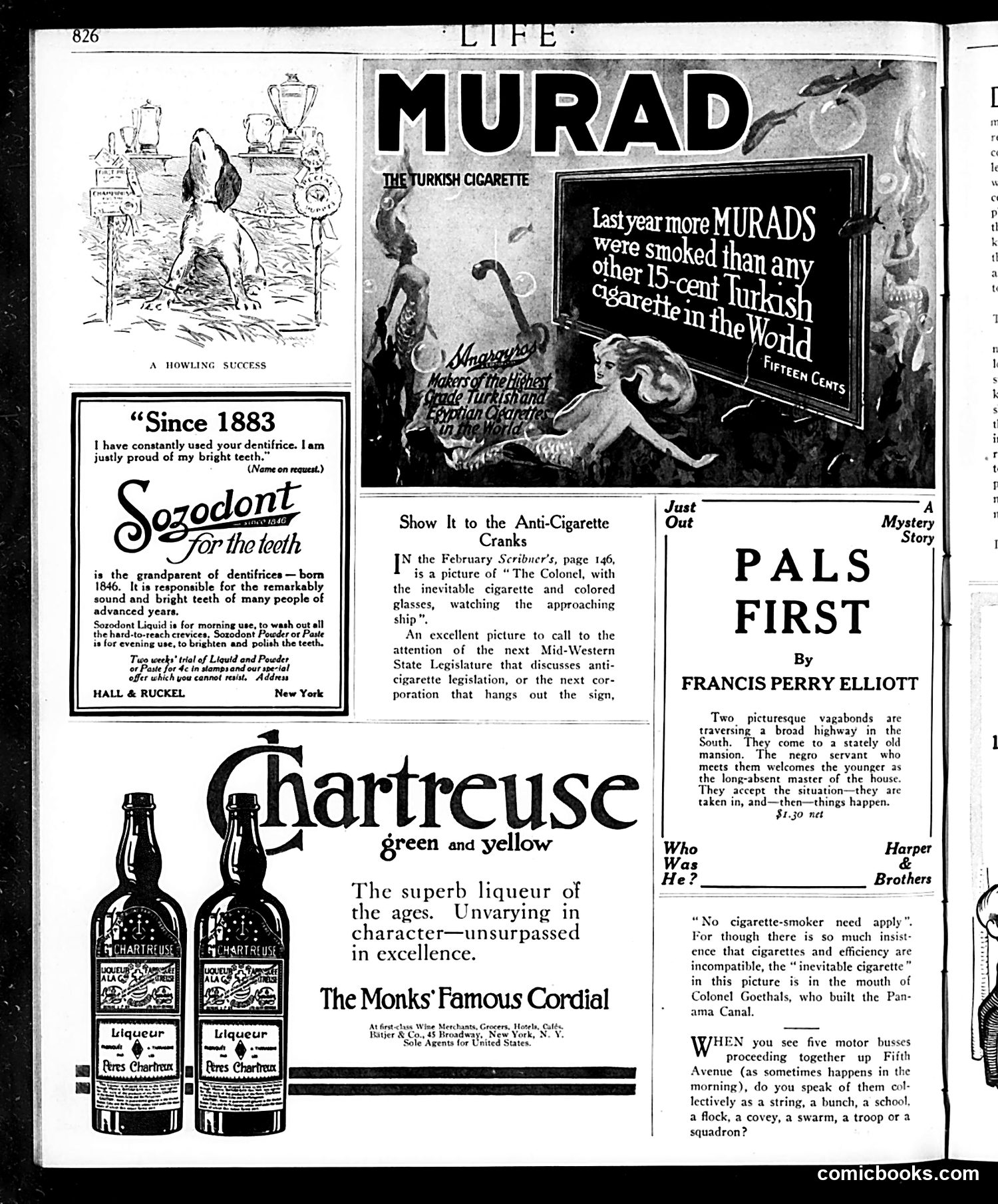
This page mixes advertisements with editorial content critiquing anti-cigarette sentiment. The main satirical point appears in the "Show It to the Anti-Cigarette Cranks" section, which references a *Scribner's* magazine illustration of "The Colonel" smoking cigarettes. The editors mock anti-smoking advocates by noting that Colonel Goethals—the renowned engineer who built the Panama Canal—smoked cigarettes despite widespread claims that smoking undermines efficiency. The implicit argument: if a major public achievement like the Panama Canal was accomplished by a smoker, anti-cigarette activists' claims about incompatibility between smoking and productivity are unfounded. The page also advertises Murad Turkish cigarettes, Sozodont toothpaste, and Chartreuse liqueur—typical early 20th-century Life magazine content where editorial matter and advertising blended seamlessly.
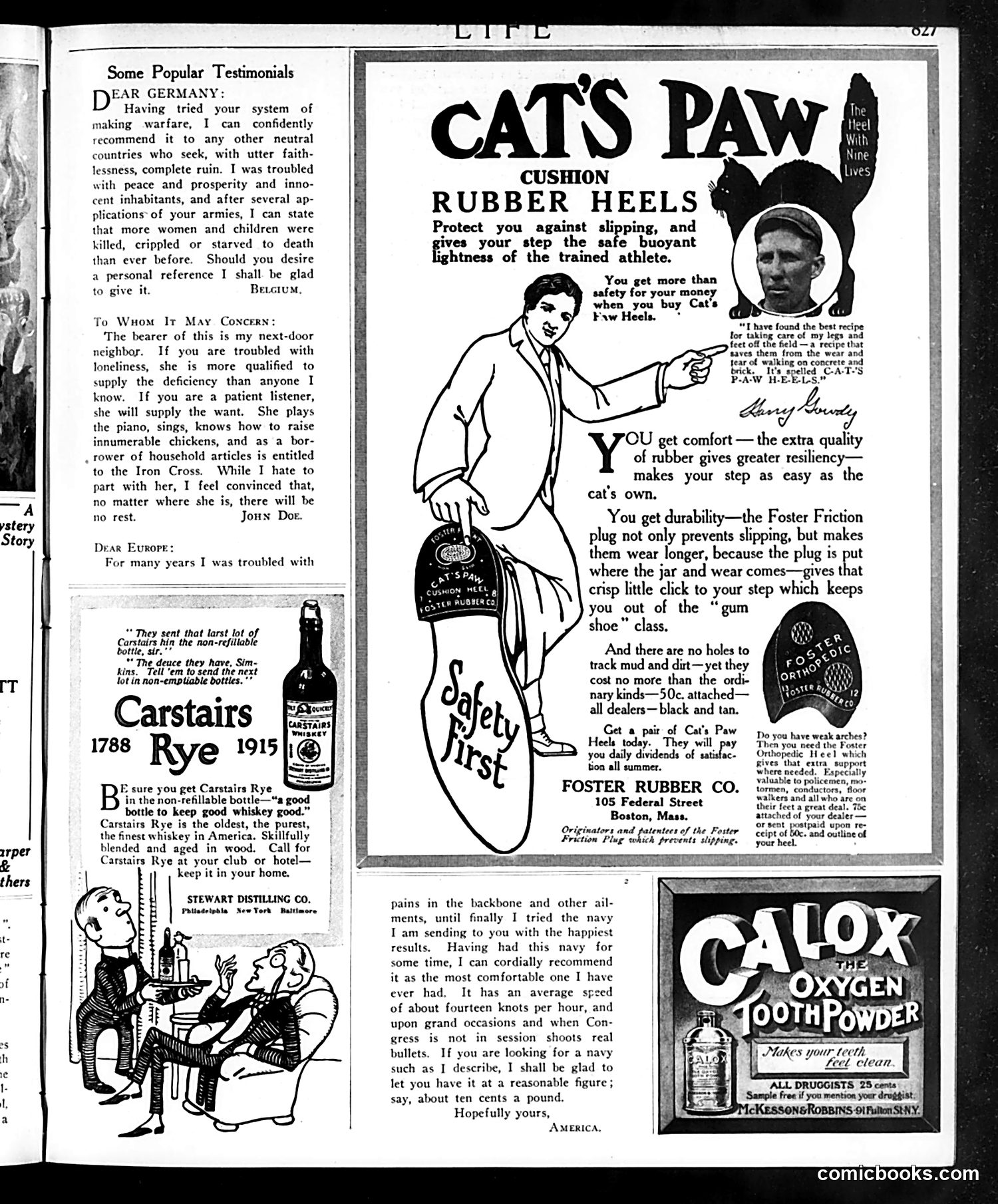
This page uses **fake testimonials** to satirize Germany's conduct in World War I. The first letter, signed "Belgium," sarcastically "recommends" Germany's warfare system to other neutral countries, noting it effectively kills women and children and destroys peaceful nations—a bitter reference to Belgium's devastation after German invasion in 1914. A second letter, signed "America," humorously offers to sell Germany a "navy" for a reasonable price, mocking both American neutrality and the absurdity of the situation. These testimonials frame Germany as ruthless and destructive, using dark humor typical of *Life* magazine's anti-German propaganda during America's WWI period. The page also includes standard product advertisements (Cat's Paw rubber heels, Carstairs Rye whiskey, Calox tooth powder), which were typical filler for magazines of this era. The satire reflects American public opinion shifting against Germany before U.S. entry into the war (April 1917).
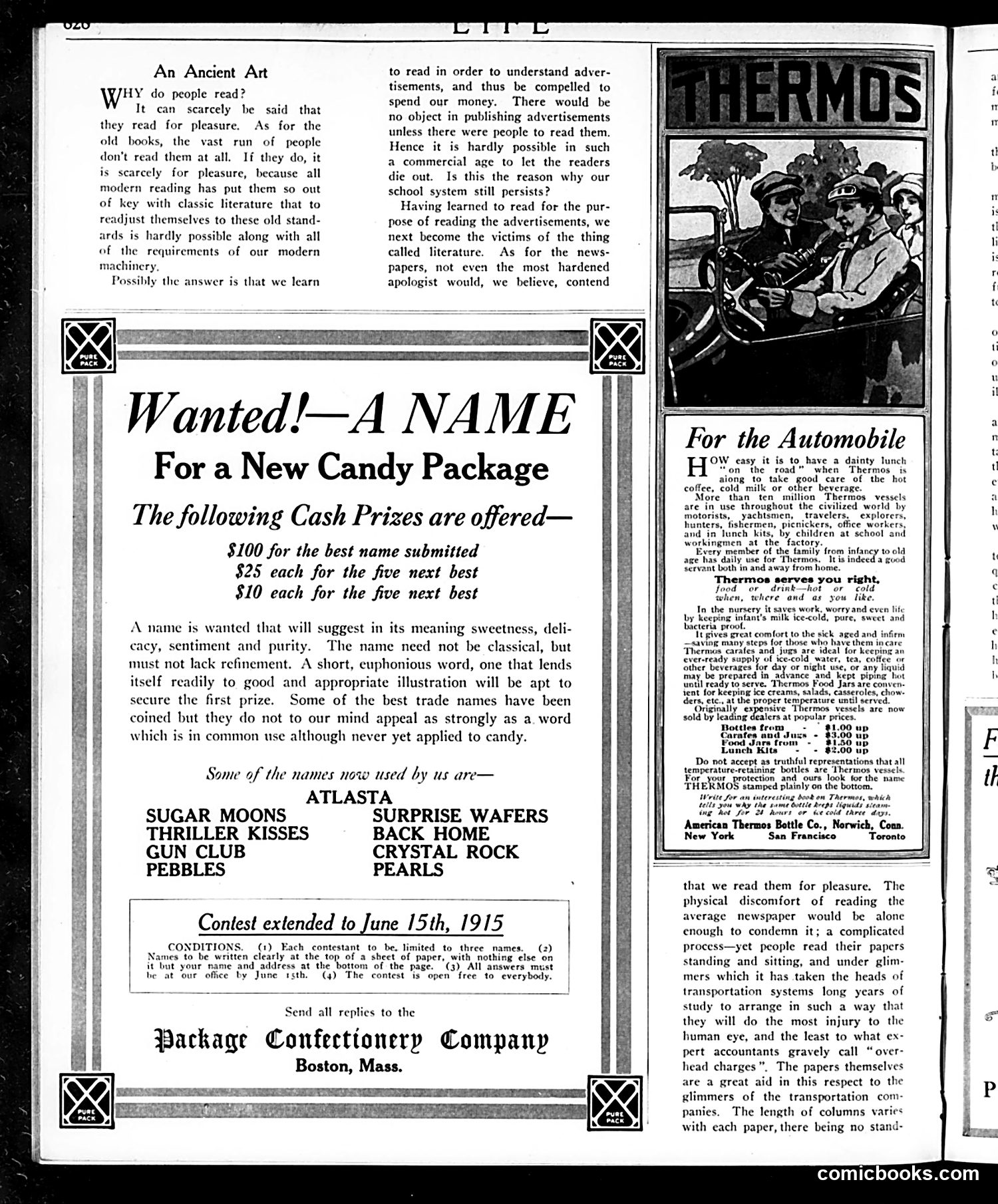
This page combines satirical editorial content with period advertisements, revealing early 20th-century consumer culture anxieties. **"An Ancient Art" essay:** The piece sarcastically argues that modern people don't read for genuine pleasure or learning, but rather because advertisers *compel* them to read commercial messages to spend money. It suggests the school system persists primarily to maintain a literate consumer base. This reflects contemporary concerns about commercialism's grip on American society and education. **Advertisements:** The page ironically demonstrates the essay's point through two prominent ads—a candy-naming contest and a Thermos bottle promotion. Both use sophisticated appeals to modern convenience and family welfare to drive consumption. The juxtaposition is intentional: the essay criticizes advertising's manipulative power while the very advertisements it critiques occupy the same page, proving its thesis. This was characteristic of *Life* magazine's satirical approach to American consumer capitalism in the 1910s.
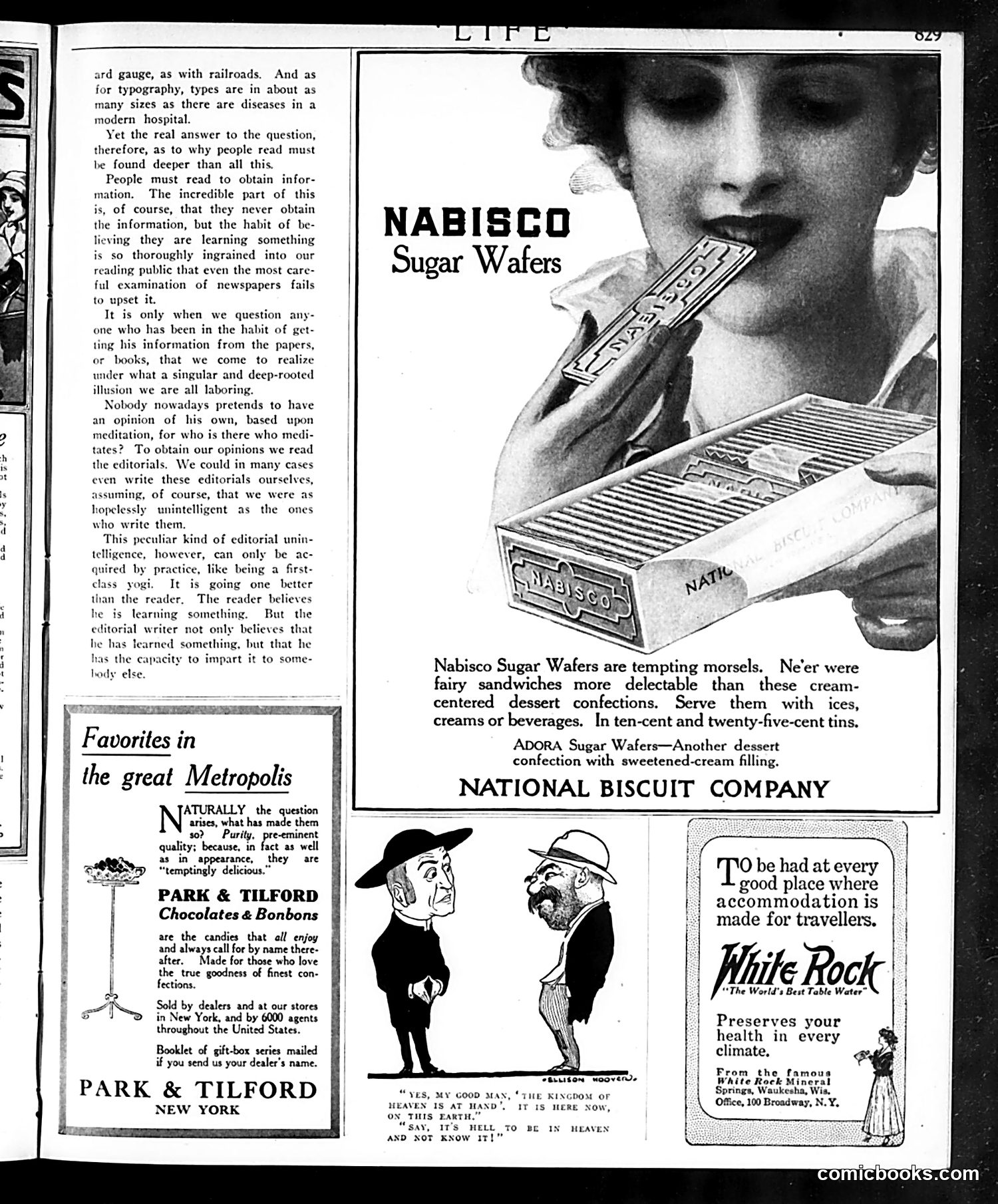
This page is primarily **advertising** with one small political cartoon by Ellison Mooney (lower center). The main content is editorial text criticizing reader passivity, followed by product advertisements. **The Cartoon**: Two working-class men in conversation. One says "The kingdom of heaven is at hand—it is here now," to which the other replies, "Say, it's hell to be in heaven and not know it!" **The Satire**: This likely mocks **religious revival movements** or utopian promises popular in early 20th-century America. The joke suggests that even if paradise existed, ordinary people wouldn't recognize it—a commentary on either religious fraud or public gullibility. The lower-class dialect emphasizes who such promises typically target. **Context**: The cartoon fits the page's editorial theme about how people obtain beliefs uncritically from external sources (newspapers, editorials, presumably sermons) rather than through independent thought.
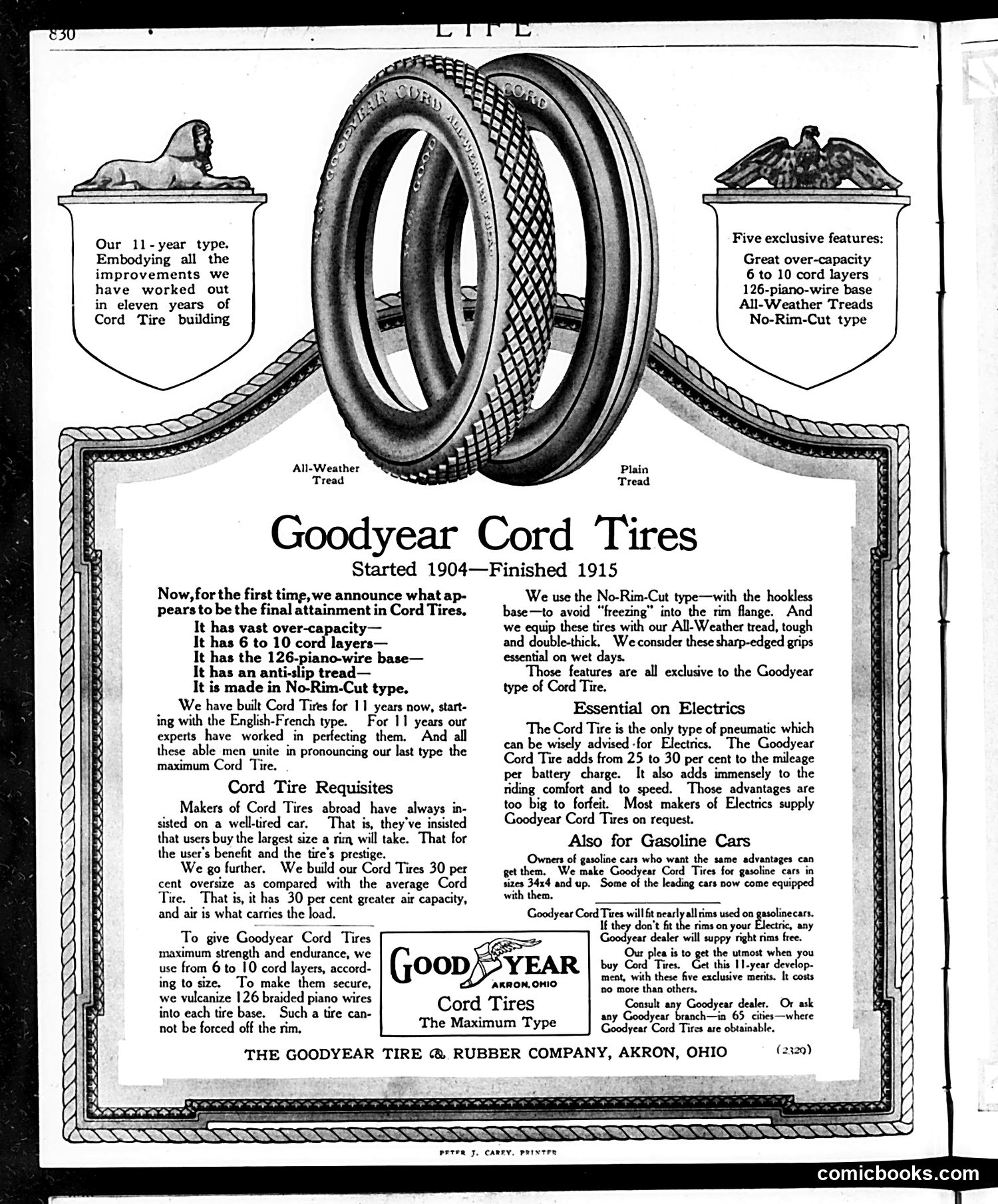
This is **not a cartoon or satire**—it's a straightforward **automobile tire advertisement** from Goodyear, appearing in *Life* magazine circa 1915. The page advertises Goodyear's "Cord Tire," emphasizing eleven years of development (started 1904, finished 1915). The visual centerpiece shows two tire cross-sections displaying the product's internal construction. Key marketing claims include: 6-10 cord layers, a 126-piano-wire reinforced base, all-weather tread, and a "No-Rim-Cut" design. The ad stresses the tire's suitability for both electric vehicles (which were common luxury cars then) and gasoline automobiles. The decorative heraldic shields flanking the tire imagery are purely ornamental, lending prestige to the product. There is no political satire, caricature, or social commentary present. This represents how *Life*'s pages mixed humorous editorial content with paid advertising.
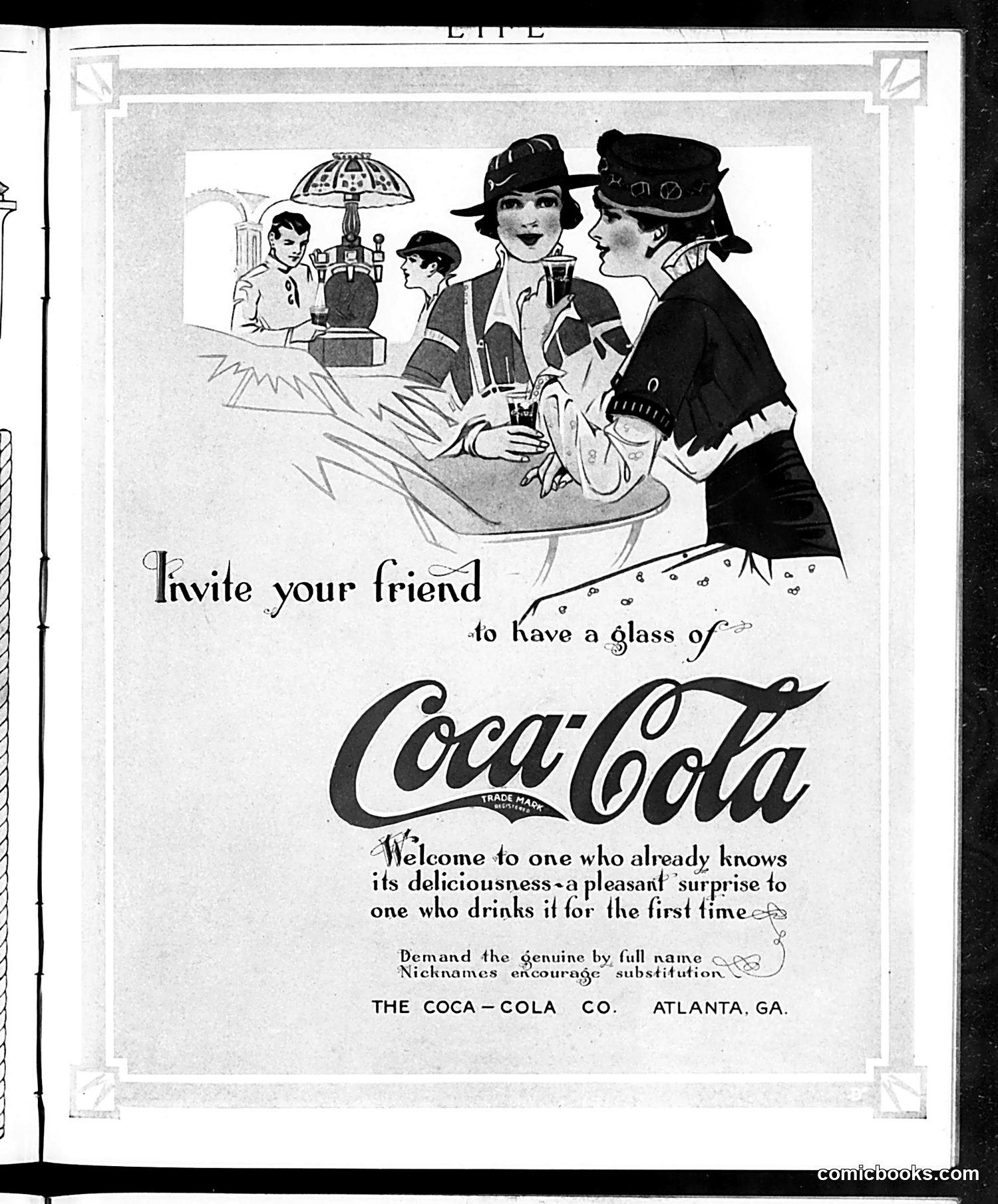
This is a Coca-Cola advertisement, not political satire. The illustration shows well-dressed women in 1920s fashion at what appears to be a social gathering, with one woman offering Coca-Cola to a friend. The ad's message emphasizes hospitality and social inclusion: inviting friends to share the beverage creates pleasant experiences for both experienced drinkers and newcomers. The tagline warns against using nicknames or asking for generic "cola," instead demanding "the genuine by full name"—a marketing strategy to prevent substitution with competitor products. This reflects early 20th-century concerns about brand imitation and counterfeit beverages. The page serves as a straightforward commercial pitch positioning Coca-Cola as a refined social beverage for genteel company.
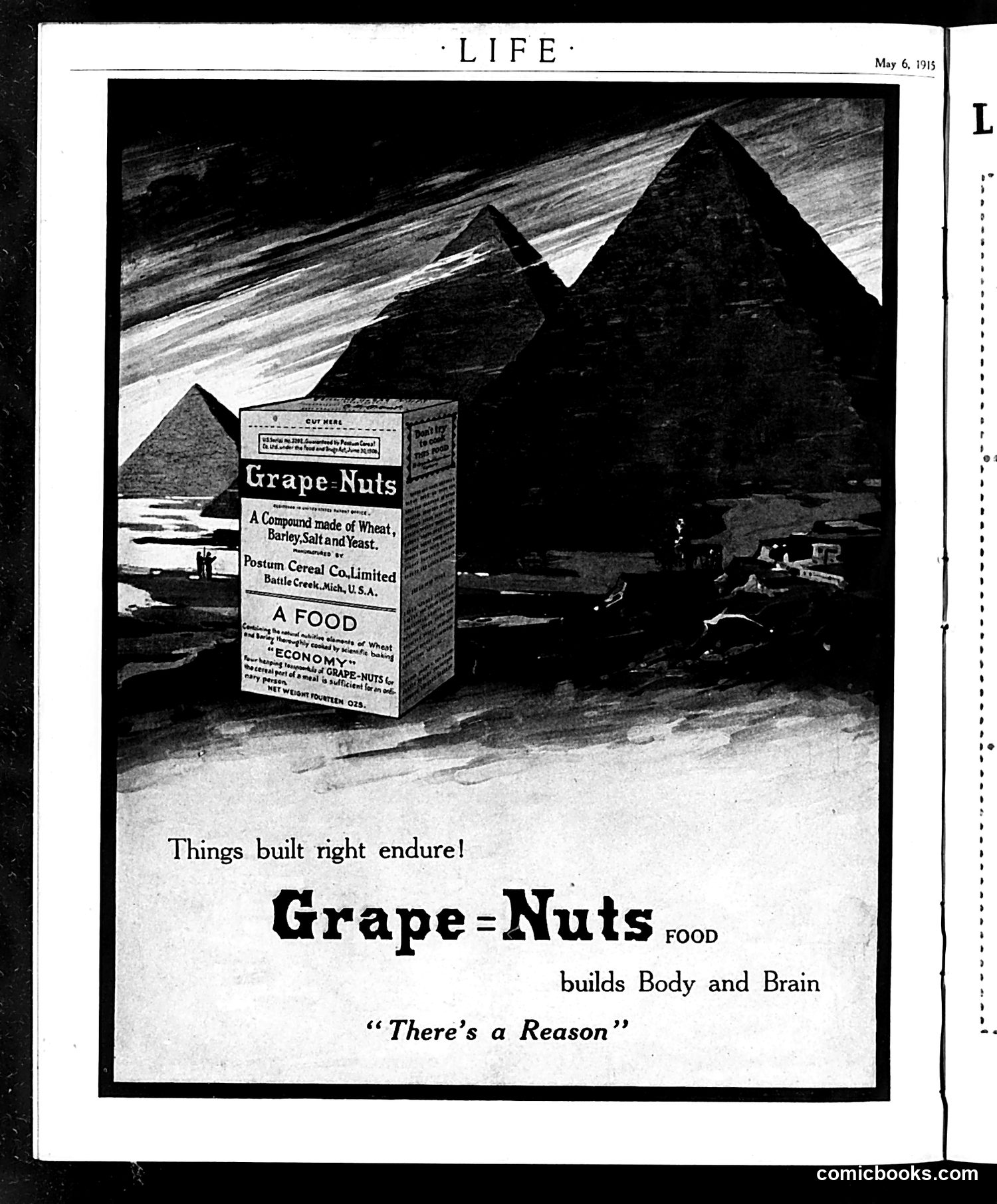
This is primarily a **product advertisement**, not political satire. It's a full-page ad for Grape-Nuts cereal from the Postum Cereal Co., appearing in *Life* magazine on May 6, 1915. The ad uses an architectural metaphor: a photograph of three stone/brick house structures of increasing size creates a visual pun on "things built right endure." The copywriting claims Grape-Nuts—made from wheat, barley, salt, and yeast—similarly "builds Body and Brain." The phrase "There's a Reason" was the product's actual slogan during this era. The marketing strategy appeals to early 20th-century concerns about nutrition and bodily development, positioning the cereal as a scientifically-formulated food rather than mere sustenance. There is no political cartoon or satirical commentary visible on this page.