
Life, 1915-05-06 · page 20 of 56
Life — May 6, 1915 — page 20: what you’re looking at
What you’re looking at
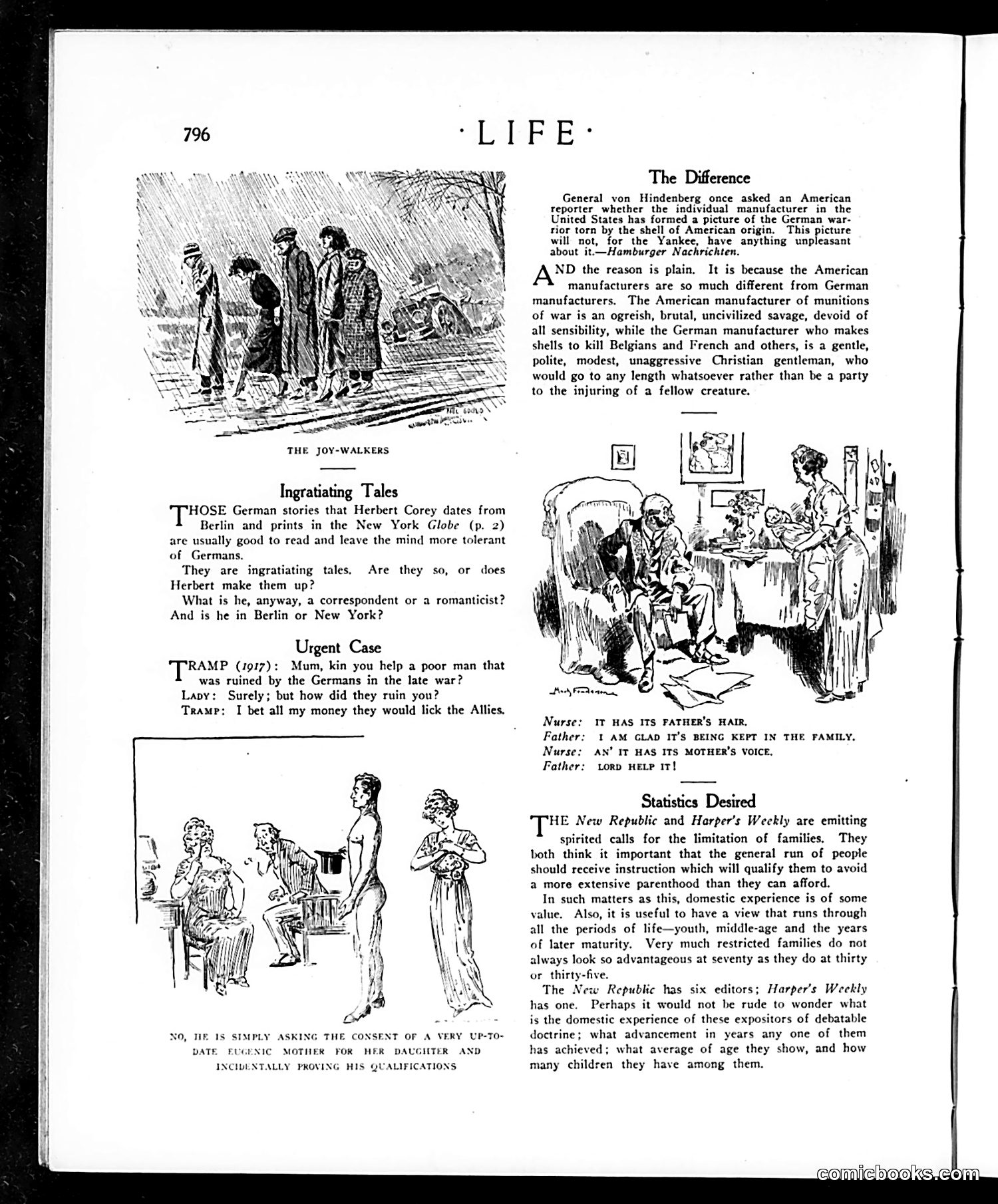
This satirical page uses humor to critique American attitudes toward Germany during and after World War I. **"The Difference"** sarcastically inverts a German general's question about American munitions manufacturers. Life mocks German propaganda claiming their shell-makers are "gentle, polite" Christians, while portraying American manufacturers as "ogreish, brutal" savages. The irony exposes the absurdity of Germany's self-serving moral superiority while producing weapons that killed Belgian and French civilians. **"Urgent Case"** shows a tramp claiming he lost money betting Germans would defeat the Allies—satirizing those who underestimated American military power. **"Statistics Desired"** criticizes *The New Republic* and *Harper's Weekly* for advocating family limitation without demonstrating personal domestic experience. Life challenges their editorial credibility by questioning their actual ages and number of children—implying their prescriptions ring hollow. The cartoon depicting a nurse, father, and child humorously references inheriting family traits, supporting this critique of unsupported social engineering advice.
📄 Transcribed text from this page (OCR, searchable)
Machine-transcribed from the original scan — historical spelling and the odd misread are preserved.
THE JOY-WALKERS Ingratiating Tales HOSE German stories that Herbert Corey dates from Berlin and prints in the New York Globe (p. 2) are usually good to read and leave the mind more tolerant of Germans. They are ingratiating tales. Herbert make them up? What is he, anyway, a correspondent or a romanticist? And is he in Berlin or New York? Urgent Case RAMP (1917): Mum, kin you help a poor man that was ruined by the Germans in the late war? Lavy: Surely; but how did they ruin you? Tramp: I bet all my money they would lick the Allies, Are they so, or does NO, HE IS SIMPLY ASKING THE CONSENT OF A VERY UP-TO- DATE FUGENIC MOTHER FOR HER DAUGHTER AND INCIDENTALLY PROVING HIS QUALIFICATIONS The Difference General von Hindenberg once asked an American reporter whether the individual manufacturer in the United States has formed a picture of the German war- rior torn by the shell of American origin. This picture will not, for the Yankee, have anything unpleasant about it.—Hamburger Nachrichten. A®? the reason is plain. It is because the American manufacturers are so much different from German manufacturers. The American manufacturer of munitions of war is an ogreish, brutal, uncivilized savage, devoid of all sensibility, while the German manufacturer who makes shells to kill Belgians and French and others, is a gentle, polite, modest, unaggressive Christian gentleman, who would go to any length whatsoever rather than be a party to the injuring of a fellow creature. IT HAS ITS FATHER'S HAIR. I AM GLAD IT’S BEING KEPT IN THE FAMILY. AN’ IT HAS ITS MOTHER'S VOICE, LORD HELP IT! Statistics Desired HE New Republic and Harper's Weekly are emitting spirited calls for the limitation of families, They both think it important that the general run of people should receive instruction which will qualify them to avoid a more extensive parenthood than they can afford. In such matters as this, domestic experience is of some value. Also, it is useful to have a view that runs through all the periods of life—youth, middle-age and the years of later maturity. Very much restricted families do not always look so advantageous at seventy as they do at thirty or thirty-five. The New Republic has six editors; Harper's Weekly has one. Perhaps it would not be rude to wonder what is the domestic experience of these expositors of debatable doctrine; what advancement in years any one of them has achieved; what average of age they show, and how many children they have among them. Nurse: Father: Nurse: Father: