
Life, 1915-05-06 · page 24 of 56
Life — May 6, 1915 — page 24: what you’re looking at
What you’re looking at
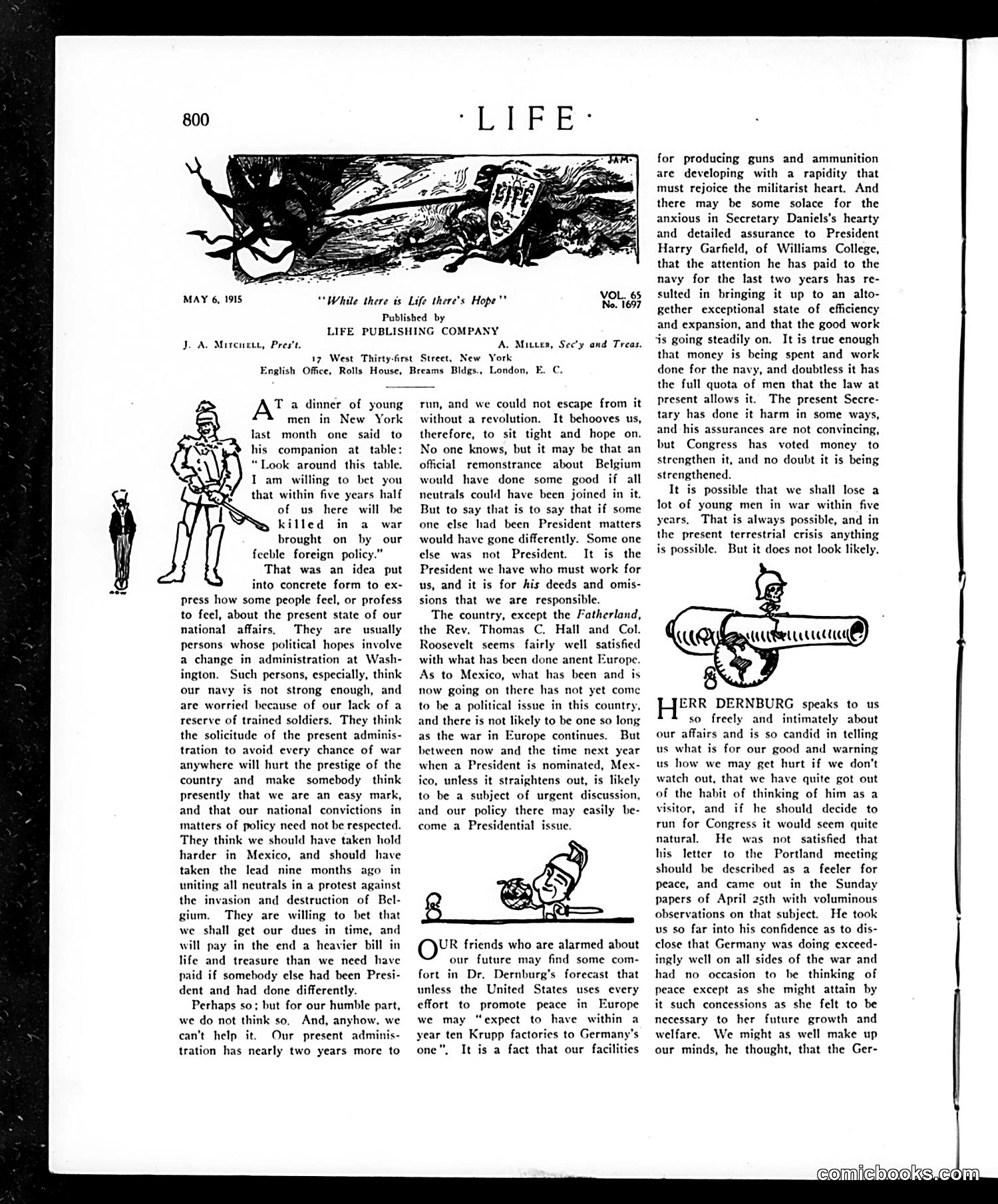
This page satirizes American anxiety about military preparedness during World War I. Written when the war was underway in Europe but the U.S. remained neutral, the article mocks those demanding stronger armed forces and more aggressive foreign policy. The text references a dinner conversation where young men worry half will die in war caused by "feeble foreign policy." The satirist dismisses such alarmism, noting President Wilson's administration (serving until 1917) cautiously avoids war involvement. The piece defends this restraint while acknowledging critics—including Theodore Roosevelt and pacifist Rev. Thomas C. Hall—who demand stronger military action, particularly regarding Belgium's invasion and Mexico's instability. The illustrations appear to be decorative military figures. The satire's point: anxious hawks overestimate danger and underestimate current leadership's competence. Dr. Dernburg's warning about German war production is cited ironically as "solace" rather than genuine reassurance.
📄 Transcribed text from this page (OCR, searchable)
Machine-transcribed from the original scan — historical spelling and the odd misread are preserved.
MAY 6, 1915 “While there is Life there's Hope"* No, 1697 Published by LIFE PUBLISHING COMPANY J. A. Murcnett, Pres’t, A. Mittra, Sec’y and Treas. 17 West Thirty-first Street, New York English Office, Rolls House, Breams Bldgs., London, E AT 2 Binner of young men in New York last month one said to eps his companion at table: “Look around this table. I am willing to bet you that within five years half of us here will be killed in a war brought on by our feeble foreign policy.” That was an idea put into concrete form to ex- press how some people feel, or profess to feel, about the present state of our national affairs, They are usually persons whose political hopes involve a change in administration at Wash- ington. Such persons, especially, think our navy is not strong enough, and are worried because of our lack of a reserve of trained soldiers. They think the solicitude of the present adminis- tration to avoid every chance of war anywhere will hurt the prestige of the country and make somebody think presently that we are an easy mark, and that our national convictions in matters of policy need not be respected. They think we should have taken hold harder in Mexico, and should have taken the lead nine months ago in uniting all neutrals in a protest against the invasion and destruction of Bel- gium. They are willing to bet that we shall get our dues in time, and will pay in the end a heavier bill in life and treasure than we need have paid if somebody else had been Presi- dent and had done differently. Perhaps so; but for our humble part, we do not think so, And, anyhow, we can't help it. Our present adminis- tration has nearly two years more to run, and we could not escape from it without a revolution. It behooves us, therefore, to sit tight and hope on. No one knows, but it may be that an official remonstrance about Belgium would have done some good if all neutrals could have been joined it. But to say that is to say that if some one else had been President matters would have gone differently. Some one else was not President. It is the President we have who must work for us, and it is for his deeds and omis- sions that we are responsible. The country, except the Fatherland, the Rev. Thomas C. Hall and Col. Roosevelt seems fairly well satisfied with what has been done anent Europe. As to Mexico, what has been and is now going on there has not yet come to be a political issue in this country and there is not likely to be one so long as the war in Europe continues. But between now and the time next year when a President is nominated, Mex- ico, unless it straightens out, to be a subject of urgent discussion, and our policy there may easily be- come a Presidential issue. UR friends who are alarmed about our future may find some com- fort in Dr. Dernburg’s forecast that unless the United States uses every effort to promote peace in we may “expect to have within a year ten Krupp factories to Germany's one”, It is a fact that our facilities for producing guns and ammunition are developing with a rapidity that must rejoice the militarist heart. And there may be some solace for the anxious in Secretary Daniels’s hearty and detailed assurance to President Harry Garfield, of Williams College, that the attention he has paid to the navy for the last two years has re- sulted in bringing it up to an alto- gether exceptional state of efficiency and expansion, and that the good work ‘is going steadily on. It is true enough that money is being spent and work done for the navy, and doubtless it has the full quota of men that the law at present allows it. The present Secre- tary has done it harm in some ways, and his assurances are not convincing, but Congress has voted money to strengthen it, and no doubt it is being strengthened. It is possible that we shall lose a lot of young men in war within five years, That is always possible, and in the present terrestrial crisis anything is possible. But it does not look likely, HER DERNBURG speaks to us so freely and intimately about our affairs and is so candid in telling us what is for our good and warning us how we may get hurt if we don’t watch out, that we have quite got out of the habit of thinking of him as a or, and if he should decide to run for Congress it would seem quite natural. He was not satisfied that his letter to the Portland meeting should be described as a feeler for peace, and came out in the Sunday papers of April 25th with voluminous observations on that subject. He took us so far into his confidence as to di: close that Germany was doing exceed- ingly well on all sides of the war and had no occasion to be thinking of peace except as she might attain by it such concessions as she felt to be necessary to her future growth and welfare. We might as well make up our minds, he thought, that the Ger-