
Life, 1915-05-06 · page 10 of 56
Life — May 6, 1915 — page 10: what you’re looking at
What you’re looking at
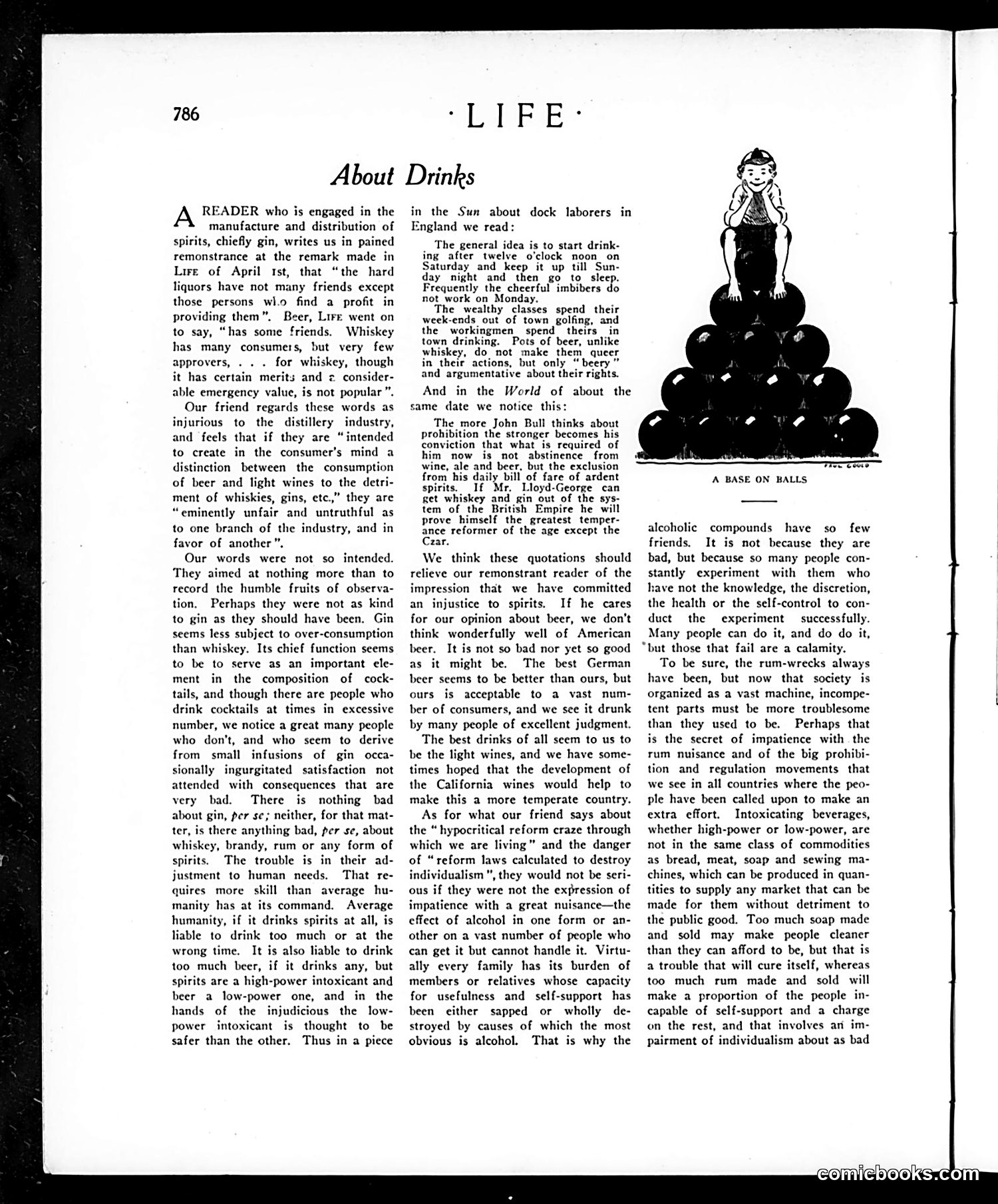
This page contains a satirical article criticizing spirits (hard liquor) while defending beer and wine. The accompanying cartoon, titled "A Base on Balls," shows a figure balanced precariously atop stacked round objects (likely meant to represent alcohol bottles or the intoxicating effects of drinking). The article argues that alcoholic beverages have "so few friends" not because they're inherently bad, but because excessive consumption causes social problems. The satire targets both prohibitionists and heavy drinkers, suggesting that the real issue is *impatience with alcohol's effects*—people who can't handle moderate drinking responsibly. The cartoon visually reinforces this message: the unstable, precarious balance suggests the danger of losing equilibrium through intoxication. The piece advocates for temperance rather than total prohibition, positioning beer and wine as more "temperate" alternatives to spirits.
📄 Transcribed text from this page (OCR, searchable)
Machine-transcribed from the original scan — historical spelling and the odd misread are preserved.
“ESD EsE About Drinks A READER who is engaged in the manufacture and distribution of spirits, chiefly gin, writes us in pained remonstrance at the remark made in Lire of April rst, that “the hard liquors have not many friends except those persons wi.o find a profit in providing them”. Beer, Lire went on to say, “has some friends. Whiskey has many consumers, but very few approvers, for whiskey, though it has certain merits and 2 consider- able emergency value, is not popular”. Our friend regards these words as injurious to the distillery industry, and feels that if they are “intended to create in the consumer's mind a distinction between the consumption of beer and light wines to the detri- ment of whiskies, gins, etc,” they are “eminently unfair and untruthful as to one branch of the industry, and in favor of another”. Our words were not so intended. They aimed at nothing more than to record the humble fruits of observa- tion. Perhaps they were not as kind to gin as they should have been. Gin seems less subject to over-consumption than whiskey. Its chief function seems to be to serve as an important ele- ment in the composition of cock- tails, and though there are people who drink cocktails at times in excessive number, we notice a great many people who don't, and who seem to derive from small infusions of gin occa- sionally ingurgitated satisfaction not attended with consequences that are very bad. There is nothing bad about gin, per se; neither, for that mat- ter, is there anything bad, per se, about whiskey, brandy, rum or any form of spirits. The trouble is in their ad- justment to human needs. That re- quires more skill than average hu- manity has at its command. Average humanity, if it drinks spirits at all, is liable to drink too much or at the wrong time. It is also liable to drink too much beer, if it drinks any, but spirits are a high-power intoxicant and beer a low-power one, and in the hands of the injudicious the low- power intoxicant is thought to be safer than the other. Thus in a piece in the Sun about dock laborers in England we read: The general idea is to start drink- ing after twelve o'clock noon on Saturday and keep it up till Sun- day night and then go to sleep. Frequently the cheerful imbibers do not work on Monday. The wealthy classes spend their week-ends out of town golfing, and the workingmen_ spend theirs in town drinking. Pots of beer, unlike whiskey, do not make them queer in their actions, but only “ beery” and argumentative about their rights. And in the World of about the same date we notice this: The more John Bull thinks about prohibition the stronger becomes his conviction that what is required of him now is not abstinence from wine, ale and beer, but the exclusion from his daily bill of fare of ardent spirits. If Mr, Lloyd-George can get whiskey and gin out of the sys- tem of the British Empire he will prove himself the greatest temper- gace reformer of the age except the Czar. We think these quotations should relieve our remonstrant reader of the impression that we have committed an injus If he cares for our opinion about beer, we don’t think wonderfully well of American beer. It is not so bad nor yet so good as it might be. The best German beer seems to be better than ours, but ours is acceptable to a vast num- ber of consumers, and we see it drunk by many people of excellent judgment. The best drinks of all seem to us to be the light wines, and we have some- times hoped that the development of the California wines would help to make this a more temperate country. As for what our friend says about the “ hypocritical reform craze through which we are living” and the danger of “reform laws calculated to destroy individualism ", they would not be seri- ous if they were not the expression of impatience with a great nuisance—the effect of alcohol in one form or an- other on a vast number of people who can get it but cannot handle it. Virtu- ally every family has its burden of members or relatives whose capacity for usefulness and self-support has been either sapped or wholly de- stroyed by causes of which the most obvious is alcohol. That is why the A BASE ON BALLS alcoholic compounds have so few friends. It is not because they are bad, but because so many people con- stantly experiment with them who have not the knowledge, the discretion, the health or the self-control to con- duct the experiment successfully. Many people can do it, and do do it, “but those that fail are a calamity. To be sure, the rum-wrecks always have been, but now that society is organized as a vast machine, incompe- tent parts must be more troublesome than they used to be. Perhaps that is the secret of impatience with the rum nuisance and of the big prohibi- tion and regulation movements that we see in all countries where the peo- ple have been called upon to make an extra effort. Intoxicating beverages, whether high-power or low-power, are not in the same class of commodities as bread, meat, soap and sewing ma- chines, which can be produced in quan- tities to supply any market that can be made for them without detriment to the public good. Too much soap made and sold may make people cleaner than they can afford to be, but that is a trouble that will cure itself, whereas too much rum made and sold will make a proportion of the people in- capable of self-support and a charge on the rest, and that involves an im- pairment of individualism about as bad