
Life, 1915-05-06 · page 33 of 56
Life — May 6, 1915 — page 33: what you’re looking at
What you’re looking at
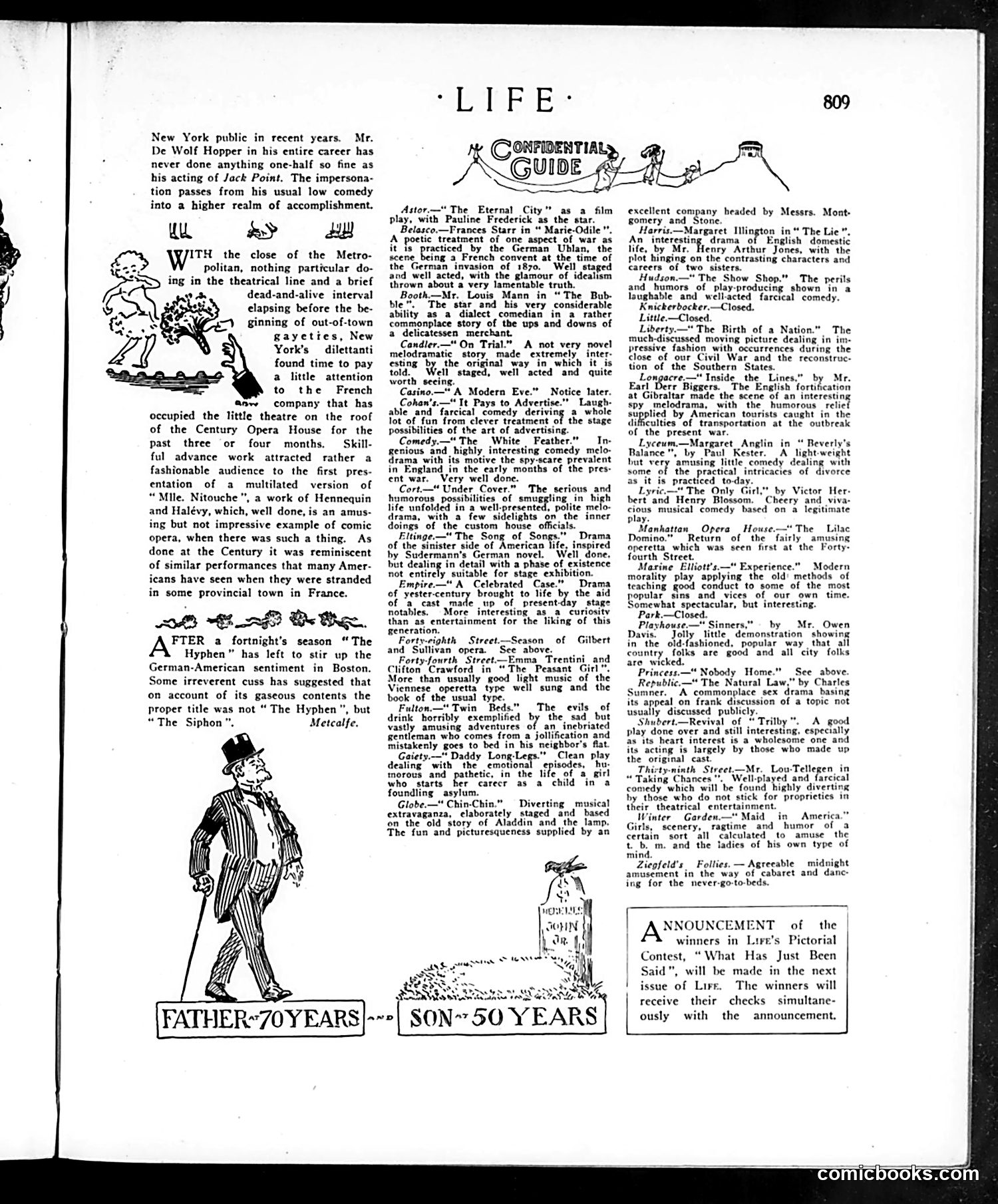
This single-panel cartoon depicts an elderly man labeled "Father—70 Years" alongside a grave marker labeled "Son—50 Years," illustrating the morbid irony of a son dying before his father. The joke plays on the reversal of natural life expectancy—the father has outlived his son, an occurrence that was genuinely tragic and noteworthy enough to merit satirical commentary in early 20th-century Life magazine. The cartoon likely comments on mortality rates or social conditions of the era (possibly referencing wartime casualties, given the theatrical reviews mention WWI themes). The simple visual juxtaposition creates dark humor through the unexpected outcome: the "stronger" generation (father) survives while the younger does not. Without additional context, the specific trigger for this cartoon remains unclear, but it exemplifies Life's use of pointed visual satire on life's misfortunes.
📄 Transcribed text from this page (OCR, searchable)
Machine-transcribed from the original scan — historical spelling and the odd misread are preserved.
New York public in recent years. Mr. De Wolf Hopper in his entire career has never done anything one-half so fine as his acting of Jack Point. The impersona- tion passes from his usual low comedy into a higher realm of accomplishment. Mu ay a ITH the close of the Metro- politan, nothing particular do- ing in the theatrical line and a brief dead-and-alive interval elapsing before the be- i) ginning of out-of-town gayeties, New York’s dilettanti found time to pay a little attention to the French company that has occupied the little theatre on the roof of the Century Opera House for the past three or four months. Skill- ful advance work attracted rather a fashionable audience to the first pres- entation of a multilated version of “Mile. Nitouche", a work of Hennequin and Halévy, which, well done, is an amus- ing but not impressive example of comic opera, when there was such a thing. As done at the Century it was reminiscent of similar performances that many Amer- icans have seen when they were stranded in some provincial town in France. VO} EAS Bx Shee. FTER a fortnight’s season “The Hyphen” has left to stir up the German-American sentiment in Boston. Some irreverent cuss has suggested that on account of its gaseous contents the proper title was not “ The Hyphen", but “The Siphon Metcalfe. “ES Astor.—“The Eternal City as a film play, with Pauline Frederick as the star. Belasco.—Frances Starr in “ Marie-Odile " A poetic treatment of one aspect of war as it 1s practiced by the German Ublan, the scene being a French convent at the time of the German invasion of 1870. Well staged and well acted, with the glamour of idealism thrown about a very lamentable truth. Booth.—Mr. Louis Mann in “The Bub- ble". The star and his very considerable ability as a dialect comedian in a rather commonplace story of the ups and downs of a delicatessen merchant. Candler.—" On Trial.” A not very novel melodramatic story made extremely inter- esting by the original way in which it is told. Well staged, well acted and quite worth seeing. i ‘A Modern Eve.” "s.—" It Pays to Advertise.” Laugh- farcical comedy deriving a whole lot of fun from clever treatment of the stage ‘bilities of the art of advertising. Comedy.— The White Feather." In- genious and highly interesting comedy melo- drama with its motive the spy-scare prevalent in England in the early months of the pres: ent war. Very well done. Cort.—" Under Cover.” The serious and humorous possiblities of smuggling in high life unfolded in a well-presented, polite melo- drama, with a few sidelights on the inner doings of the custom house officials. "The Song of Songs.” - Drama jer side of American life, inspired by Sudermann's German novel. Well, done, but dealing in detail with a phase of existence not entirely suitable for stage exhibition. Empire—" A Celebrated Cai Drama of yester-century brought to life by the aid of a cast made up of present-day stage notables. More interesting as_a curiosity than as entertainment for the liking of this generation. Fortv-eighth Street.—Season of and Sullivan opera. See above. Forty-fourth Street—Emma_ Trentini_ and Clifton Crawford in “The Peasant Girl”. More than usually good light music of the Viennese operetta type well sung and the book of the usual type. Fulton.—" Twin Beds." The evils of drink horribly exemplified by the sad but vastly amusing adventures of an_inebriated gentleman who comes from a jollification and mistakenly goes to bed in his neighbor's fat Gaiety.—" Daddy Long-Le Clean play dealing with the emotional episodes, hu- morous and pathetic, in the of a girl who starts her carecr as a child in a foundling asylum. Globe.—" Chin-Chin.” Diverting musical extravaganza, claborately staged and based on the old story of Aladdin and the lamp. The fun and picturesqueness supplied by an Notice later. Gilbert ai ery SON’~S50 YEA Se, RUS excellent company headed by Messrs. Mont gomery and Stone. Harris.—Margaret Illington in“ The Lie”. English domestic An interesting drama life, by Mr. Henry Arthur Jones, with the plot hinging on the contrasting characters and careers of two sisters. Hudson.—" The Show Shop.” The perils and humors of play-producing shown in a laughable and well-acted farcical comedy. Knickerbocker.—Closed. Little.—Closed. Liberty.—* The Birth of a Nation.” The much-discussed moving picture dealing in im- pressive fashion with occurrences during the close of our Civil War and the reconstruc- tion of the Southern States. Longacre.—" Inside the Lines.” by Mr. Earl Derr Biggers. The English fortification at Gibraltar made the scene of an interestin spy melodrama, with the humorous relie supplied by American tourists caught in the difficulties of transportation at the outbreak of the present war. Lyceum.—Margaret Anglin in“ Beverly's Ralance", by Paul Kester. A light-weight hut very ‘amusing little comedy dealing with some of the practical intricacies of divorce as it is practiced to-day L The Only Girl," by Victor Her- bert and Henry Blossom. "Cheery and viva- cious musical comedy based on a legitimate play. Manhatten Opera House.—" The Lilac Domino.” Return of the fairly amusing operetta. which was seen first at the Forty- fourth Street. Marine Elliott's. rience.” Modern morality play applying the old’ methods of teaching good conduct to some of the most popular sins and vices of our own time. Somewhat spectacular, but interesting. Park.—Closed. Playhouse —" Sinners,” by — Mr. Owen Davis. Jolly little demonstration showing in the old-fashioned, popular way that all country folks are good and all city folks are wicked. Princess.—“ Nobody Home." See above. Republi The Natural Law.” by Charles Sumner. A commonplace sex drama basing its appeal on frank discussion of a topic not usually discussed publicly. Shubert—Revival of “Trilby”. A good play done over and still interesting, especially as its heart interest is a wholesome one and its acting is largely by those who made up the original cast. Thirty-ninth Street—Mr. Lou-Tellegen. in “Taking Chances". Well-played and farcical comedy which will be found highly diverting hy those who do not stick for proprieties in ir theatrical entertainment. inter Garden.—" Maid in America.” Girls, scenery, ragtime and humor of a certain sort all calculated to amuse the tb. m. and the ladies of his own type of mind. le Zicgfeld’s Follies. — Agrecable _ midnight amusement in the way of cabaret and danc- ing for the never-go-to-beds. | A NNOUNCEMENT of | the | winners in Live's Pictorial Contest, “What Has Just Been Said", will be made in the next issue of Lire. The winners will receive their checks simultane- ously with the announcement. comicbooks.com