
Life, 1915-05-06 · page 14 of 56
Life — May 6, 1915 — page 14: what you’re looking at
What you’re looking at
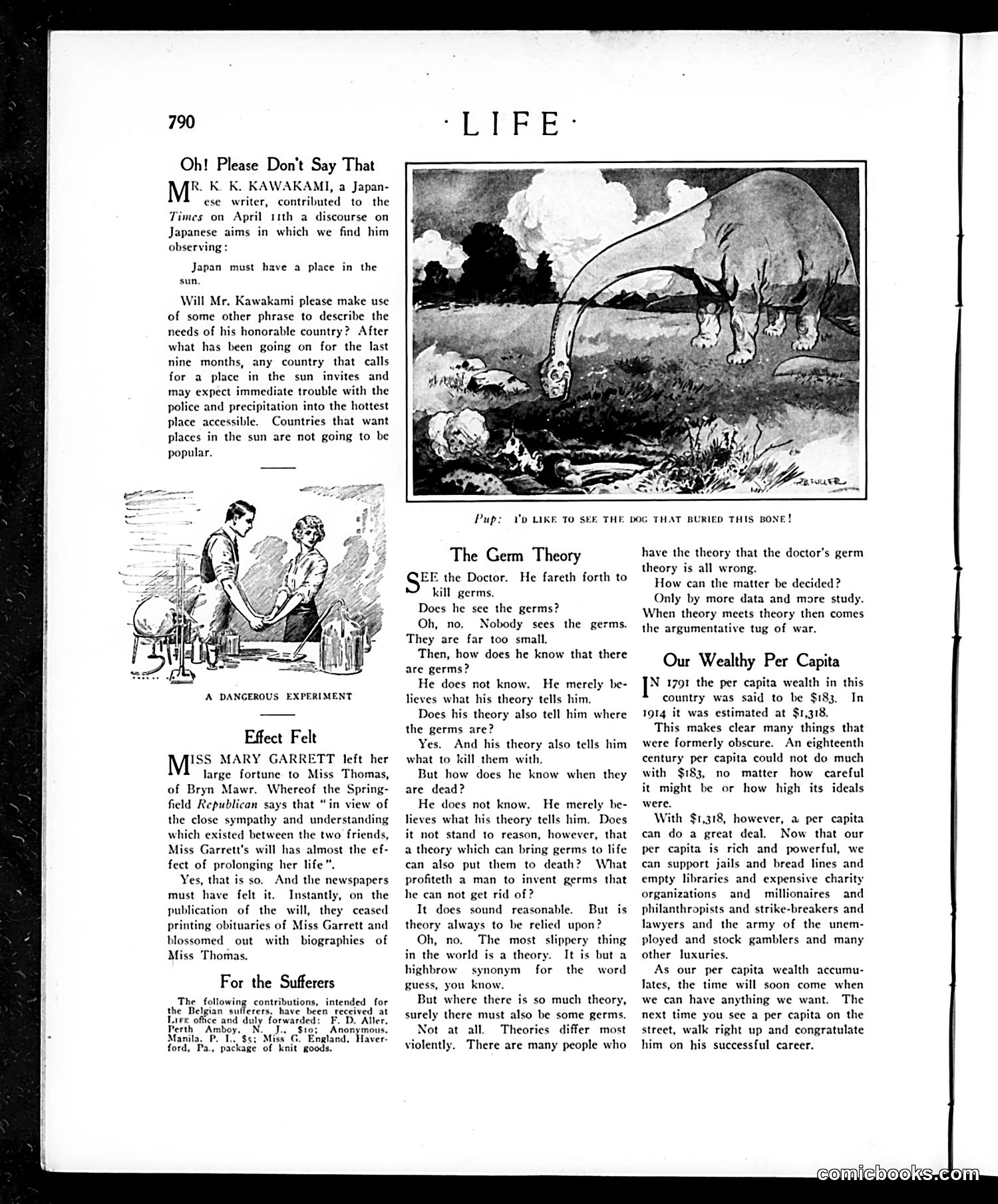
This page contains several opinion pieces and illustrations rather than political cartoons. **"Oh! Please Don't Say That"** critiques a Japanese writer (K.R. Kawakami) who claimed Japan needs "a place in the sun"—a euphemism for imperial expansion. The editor argues that after nine months of conflict, any nation demanding territorial expansion should expect international trouble, not sympathy. **"A Dangerous Experiment"** illustration shows two figures conducting what appears to be a medical or scientific procedure, likely satirizing experimental theories. **"The Germ Theory"** and **"Our Wealthy Per Capita"** are essays discussing medical theory limitations and economic statistics respectively. The bone-burying dog illustration is unrelated humor. Overall, this page reflects early 20th-century American skepticism toward Japanese expansionism and contemporary scientific debates.
📄 Transcribed text from this page (OCR, searchable)
Machine-transcribed from the original scan — historical spelling and the odd misread are preserved.
790 Oh! Please Don’t Say That R. K. K. KAWAKAMI, a Japan- ese writer, contributed to the Times on April 11th a discourse on Japanese aims in which we find him observing : Japan must have a place in the sun. Will Mr, Kawakami please make use of some other phrase to describe the needs of his honorable country? After what has been going on for the last nine months, any country that calls for a place in the sun invites and may expect immediate trouble with the police and precipitation into the hottest place accessible. Countries that want places in the sun are not going to be popular. A DANGEROUS EXPERIMENT Effect Felt MARY GARRETT left her large fortune to Miss Thomas, M of Bryn Mawr. Whereof the Spring- field Republican says that “in view of the close sympathy and understanding which existed between the two friends, Miss Garrett's will has almost the ef- fect of prolonging her life”. Yes, that is so. And the newspapers must have felt it. Instantly, on the publication of the will, they ceased printing obituaries of Miss Garrett and blossomed out with biographies of Miss Thomas. For the Sufferers The following contributions, intended for the Belgian sufferers, have been received at Lire office and duly forwarded: F. D. Aller, Perth Amboy, N. J. $10; Anonymous, Manila. P. 1..'$s; Miss G. England, Haver: ford, Pa., package of knit goods. Pup: The Germ Theory EE the Doctor. He fareth forth to kill germs, Does he see the germs? Oh, no. Nobody sees the germs. They are far too small. Then, how does he know that there are germs? He does not know. He merely be- lieves what his theory tells him. Does his theory also tell him where the germs are? Yes. And his theory also tells him what to kill them with, But how does he know when they are dead? He does not know. He merely be- lieves what his theory tells him. Does it not stand to reason, however, that a theory which can bring germs to life can also put them to death? What profiteth a man to invent germs that he can not get rid of ? It does sound reasonable. But is theory always to be relied upon? Oh, no. The most slippery thing in the world is a theory. It is but a highbrow synonym for the word guess, you know. But where there is so much theory, surely there must also be some germs. Not at all. Theories differ most violently. There are many people who I'D LIKE TO SEE THE DOG THAT BURIED THIS BONE! have the theory that the doctor’s germ theory is all wrong. How can the matter be decided? Only by more data and more study. When theory meets theory then comes the argumentative tug of war. Our Wealthy Per Capita N 1701 the per capita wealth in this country was said to be $183, In 1914 it was estimated at $1,318. This makes clear many things that were formerly obscure. An eighteenth century per capita could not do much with $183, no matter how careful it might be or how high its ideals were. With $1,318, however, a per capita can do a great deal. Now that our per capita is rich and powerful, we can support jails and bread lines and empty libraries and expensive charity organizations and millionaires and philanthropists and strike-breakers and lawyers and the army of the unem- ployed and stock gamblers and many other luxuries. As our per capita wealth accumu- lates, the time will soon come when we can have anything we want. The next time you see a per capita on the street, walk right up and congratulate him on his successful career.