
Life, 1915-05-06 · page 19 of 56
Life — May 6, 1915 — page 19: what you’re looking at
What you’re looking at
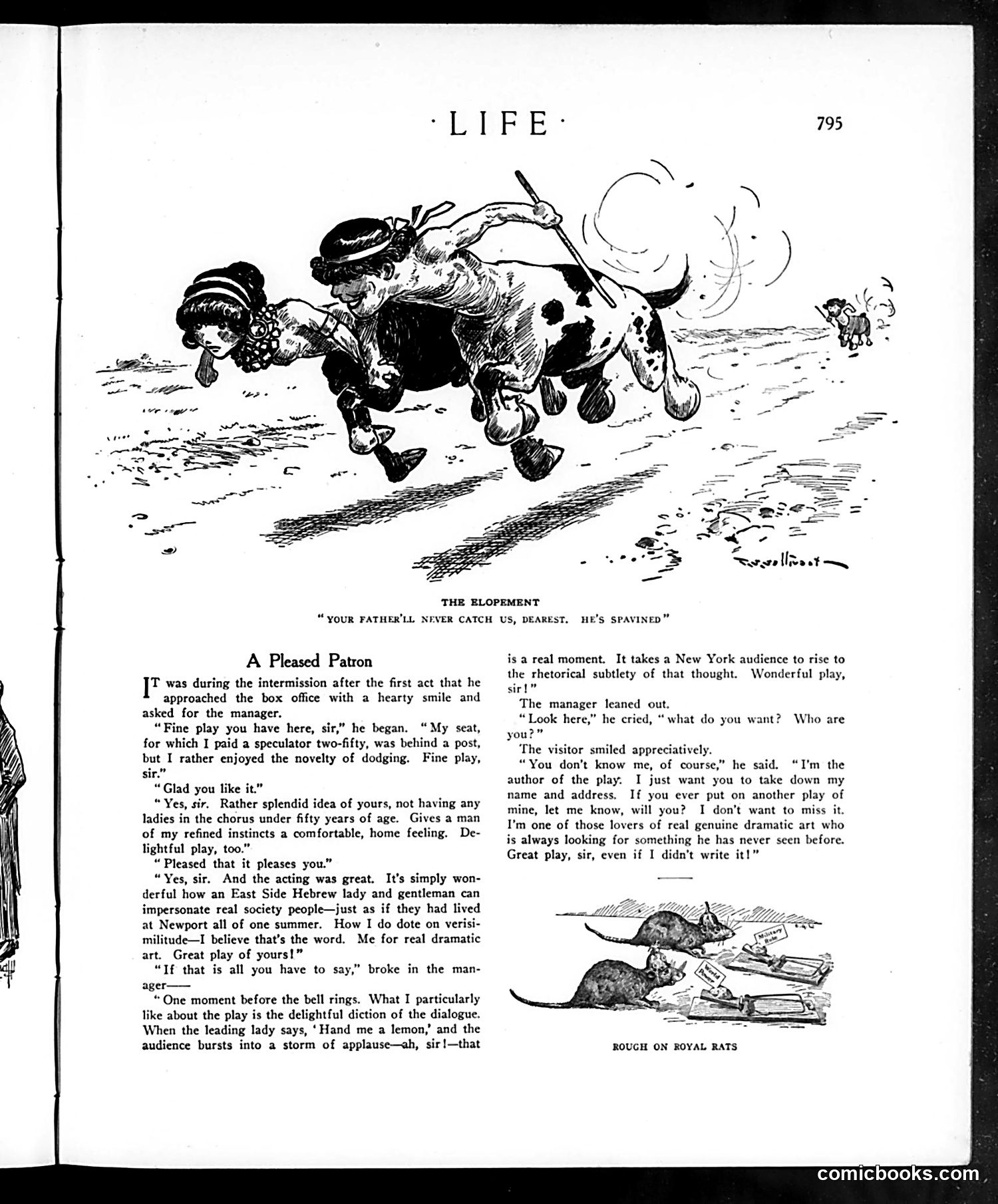
**Top Cartoon ("The Elopement"):** A comedic illustration showing a couple eloping on a donkey while being chased. The caption's reference to the father never catching them satirizes typical melodramatic elopement plots common in theater of the era. **Main Article ("A Pleased Patron"):** This is satire about theater criticism and artistic pretension. A theater patron approaches the manager with backhanded compliments: praising the play while admitting he sat behind a post, complimenting actors for convincingly "impersonating real society people" (implying they're actually lower-class immigrants from the East Side), and lavishing praise on simplistic dialogue. The punchline: he reveals himself as the playwright—someone who loves "real genuine dramatic art" yet failed to recognize his own work's mediocrity. The satire targets both pretentious amateur playwrights and audiences who mistake simple dialogue for wit. The repeated irony emphasizes how the author lacks self-awareness about his play's actual quality. **Bottom Illustration:** "Rough on Royal Rats"—a separate humorous sketch with minimal context provided.
📄 Transcribed text from this page (OCR, searchable)
Machine-transcribed from the original scan — historical spelling and the odd misread are preserved.
THE ELOPEMENT “YOUR FATHER'LL NEVER CATCH US, DEAREST. A Pleased Patron I" was during the intermission after the first act that he approached the box office with a hearty smile and asked for the manager. “Fine play you have here, sir,” he began. “My seat, for which I paid a speculator two-fifty, was behind a post, but I rather enjoyed the novelty of dodging. Fine play, sir.” “Glad you like it.” “Yes, sir. Rather splendid idea of yours, not having any ladies in the chorus under fifty years of age. Gives a man of my refined instincts a comfortable, home feeling. De- lightful play, too.” “Pleased that it pleases you.” “Yes, sir. And the acting was great. It's simply won- derful how an East Side Hebrew lady and gentleman can impersonate real society people—just as if they had lived at Newport all of one summer. How I do dote on verisi- militude—I believe that’s the word. Me for real dramatic art. Great play of yours!” “If that is all you have to say,” broke in the man- ager— “One moment before the bell rings. What I particularly like about the play is the delightful diction of the dialogue. When the leading lady says, ‘Hand me a lemon,’ and the audience bursts into a storm of applause—ah, sir!—that HE'S SPAVINED” is a real moment. It takes a New York audience to rise to the rhetorical subtlety of that thought. Wonderful play, sir!” The manager leaned out. “Look here,” he cried, “ what do you want? you?” ‘The visitor smiled appreciatively. “You don’t know me, of course,” he said, “I'm the author of the play. I just want you to take down my name and address, If you ever put on another play of mine, let me know, will you? I don’t want to miss it. I'm one of those lovers of real genuine dramatic art who is always looking for something he has never seen before. Great play, sir, even if I didn't write it!” Who are ROUGH ON ROYAL RATS comicbooks.com ,