
Life, 1915-05-06 · page 22 of 56
Life — May 6, 1915 — page 22: what you’re looking at
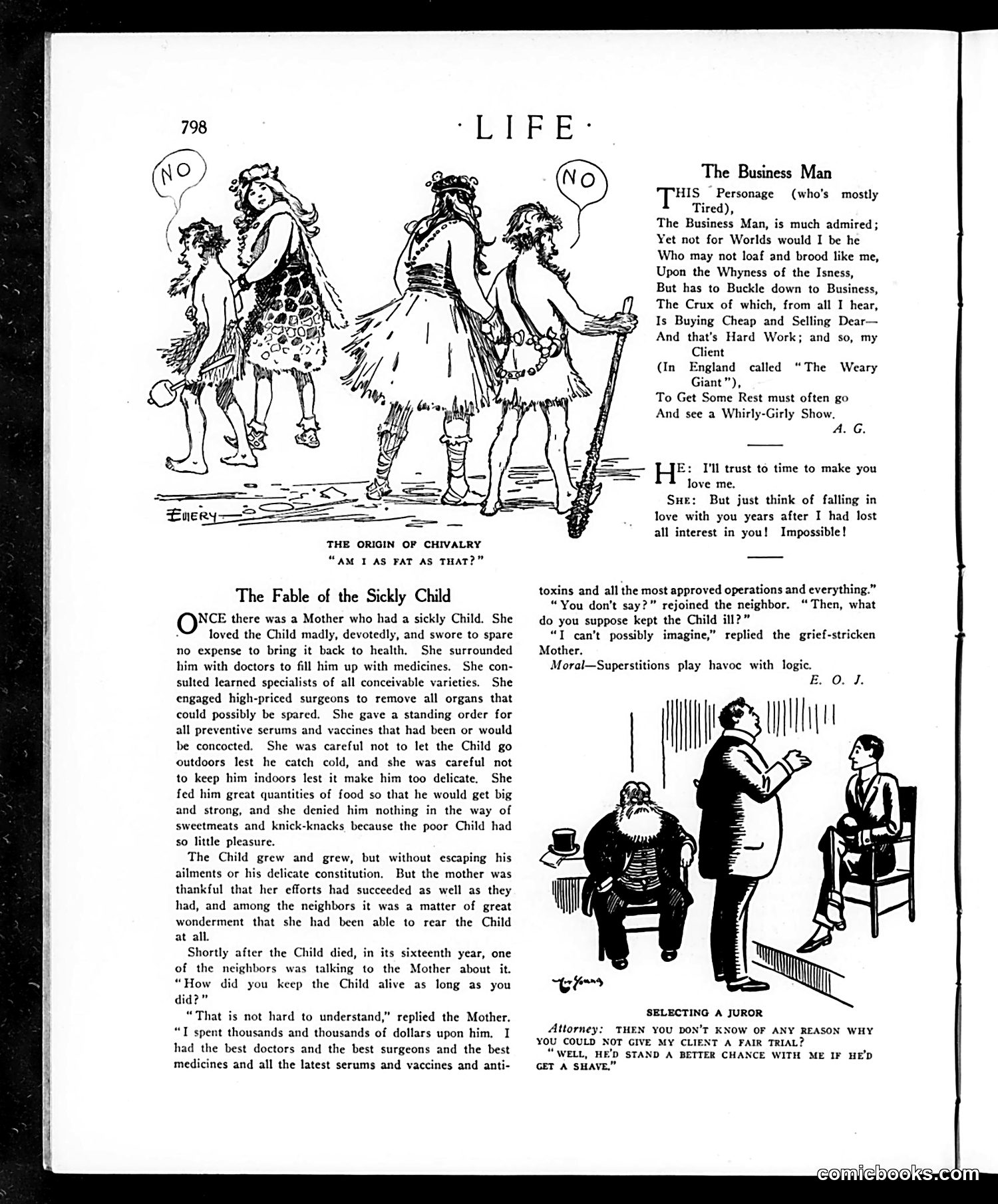
What you’re looking at
**"The Origin of Chivalry"** cartoon depicts women rejecting suitors with "NO" — a visual gag about courtship standards, likely mocking either excessive female pickiness or the absurdity of romantic pursuit. **"The Fable of the Sickly Child"** is a moral critique of misguided overprotection. A wealthy mother spends fortunes on doctors, surgeries, vaccines, and restrictions to keep her sickly child alive, yet he dies at sixteen anyway. The satire targets the era's obsessive medical interventionism and parental anxiety — the irony being that her expensive, excessive care ironically may have weakened rather than strengthened the child. The moral explicitly states: superstitions harm logic. **Other pieces** include light social commentary on businessmen needing entertainment to escape work stress, romantic misunderstandings, and a courthouse joke about juror bias based on appearance. The page reflects early 20th-century anxieties about modern medicine, parenting, and social behavior through satirical humor.
📄 Transcribed text from this page (OCR, searchable)
Machine-transcribed from the original scan — historical spelling and the odd misread are preserved.
THE ORIGIN OF CHIVALRY “AM I AS FAT AS THAT?” The Fable of the Sickly Child ONCE there was a Mother who had a sickly Child. She loved the Child madly, devotedly, and swore to spare no expense to bring it back to health, She surrounded him with doctors to fill him up with medicines. She con- sulted learned specialists of all conceivable varieties. She engaged high-priced surgeons to remove all organs that could possibly be spared, She gave a standing order for all preventive serums and vaccines that had been or would be concocted. She was careful not to let the Child go outdoors lest he catch cold, and she was careful not to keep him indoors lest it make him too delicate. She fed him great quantities of food so that he would get big and strong, and she denied him nothing in the way of sweetmeats and knick-knacks because the poor Child had so little pleasure. The Child grew and grew, but without escaping his ailments or his delicate constitution. But the mother was thankful that her efforts had succeeded as well as they had, and among the neighbors it was a matter of great wonderment that she had been able to rear the Child at all. Shortly after the Child died, in its sixteenth year, one of the neighbors was talking to the Mother about it. “How did you keep the Child alive as long as you did?” “That is not hard to understand,” replied the Mother. “TI spent thousands and thousands of dollars upon him, I had the best doctors and the best surgeons and the best medicines and all the latest serums and vaccines and anti- The Business Man 'HIS ~ Personage Tired), The Business Man, is much admired; Yet not for Worlds would I be he Who may not loaf and brood like me, Upon the Whyness of the Isness, But has to Buckle down to Business, The Crux of which, from all I hear, Is Buying Cheap and Selling Dear— And that's Hard Work; and so, my Client (In England called Giant”), To Get Some Rest must often go And see a Whirly-Girly Show. A. G. (who's mostly “The Weary E: I'll trust to time to make you love me. Sue: But just think of falling in love with you years after I had lost all interest in you! Impossible! toxins and all the most approved operations and everything.” “You don’t say?” rejoined the neighbor. “Then, what do you suppose kept the Child ill?” “I can’t possibly imagine,” replied the grief-stricken Mother. Moral—Superstitions play havoc with logic. E., 0: J, ULL rae SELECTING A JUROR Attorney: THEN YOU DON’T KNOW OF ANY REASON WHY YOU COULD NOT GIVE MY CLIENT A FAIR TRIAL? “WELL, HE'D STAND A BETTER CHANCE WITH ME IF HE'D GET A SHAVE.”