
Life, 1915-05-06 · page 30 of 56
Life — May 6, 1915 — page 30: what you’re looking at
What you’re looking at
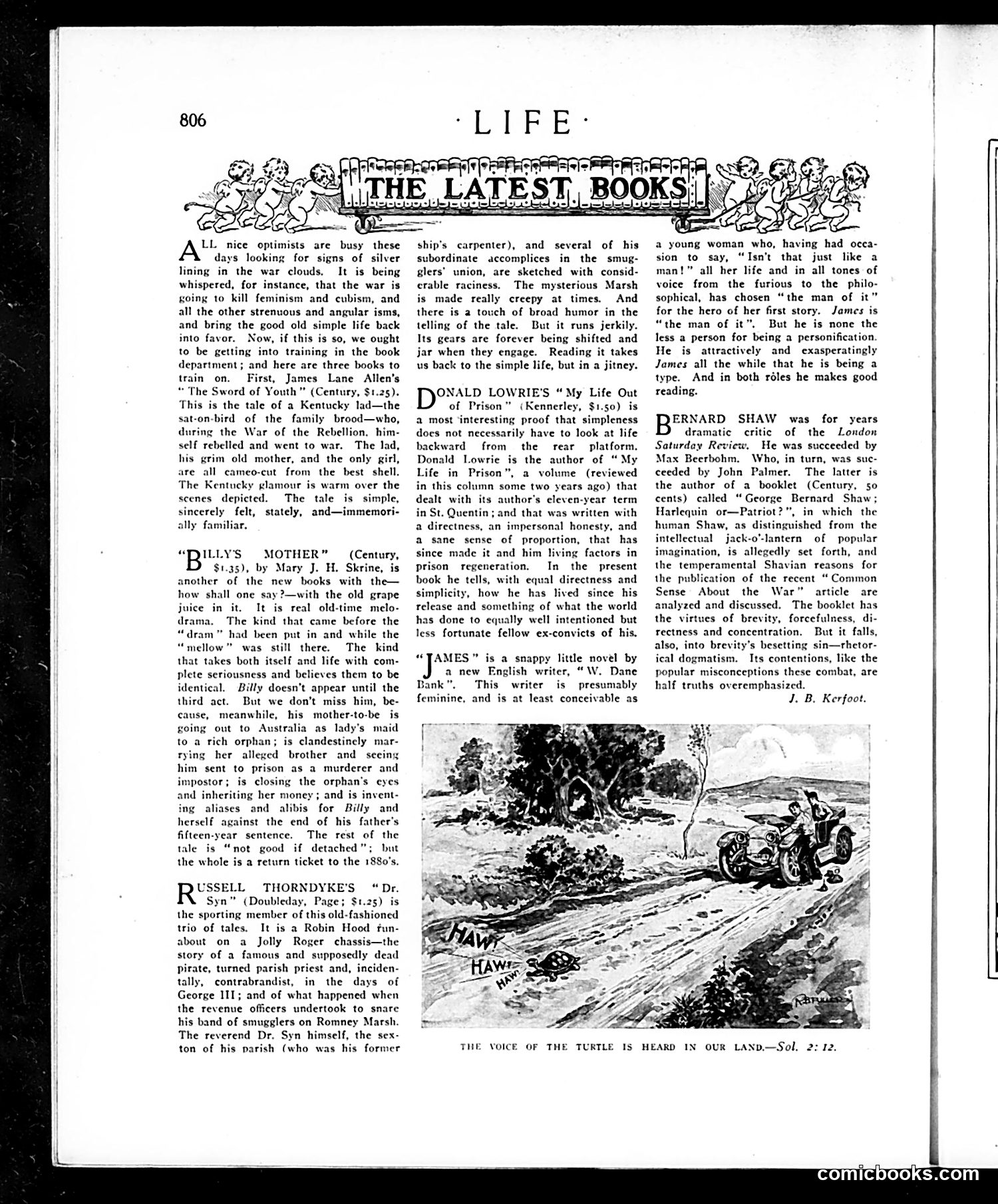
This is a book review section from *Life* magazine's "Latest Books" feature. The page reviews five new publications, all positioned as returns to simpler, older storytelling traditions—a cultural response to World War I's anxieties. The reviews emphasize nostalgia: James Lane Allen's *The Sword of Youth* offers Kentucky Civil War romance; Mary J. H. Skrine's *Dilly's Mother* is melodrama in the 1880s style; Russell Thorndyke's *Dr. Syn* is a Robin Hood adventure about smuggling; Donald Lowrie's *My Life Out of Prison* continues his prison reform memoir; and a novel by "W. Dane Bank" (noted as "presumably feminine"). The illustration shows a vintage racing car in a desert landscape with the caption "THE VOICE OF THE TURTLE IS HEARD IN OUR LAND"—a biblical reference suggesting spiritual or natural renewal, likely reinforcing the page's theme that wartime anxieties drive readers toward escapist, traditional narratives.
📄 Transcribed text from this page (OCR, searchable)
Machine-transcribed from the original scan — historical spelling and the odd misread are preserved.
LL nice optimists are busy these days looking for signs of silver lining in the war clouds. It is being whispered, for instance, that the war is going to kill feminism and cubism, and all the other strenuous and angular isms, and bring the good old simple life back into favor. Now, if this is so, we ought to be getting into training in the book department; and here are three books to train on. First, James Lane Allen’s he Sword of Youth” (Century, $1.25). This is the tale of a Kentucky lad—the sat-on-bird of the family brood—who, during the War of the Rebellion, him- self rebelled and went to war, The lad, his grim old mother, and the only girl, are all cameo-cut from the best shell. The Kentucky glamour is warm over the scenes depicted. The tale is simple, sincerely felt, stately, and—immemori- ally familiar, “DILLY'S MOTHER” = (Century, $1.35), by Mary J. H. Skrine, is another of the new books with the— how shall one say ?—with the old grape juice in it. It is real old-time melo- drama, The kind that came before the “dram” had been put in and while the “mellow” was still there. The kind that takes both itself and life with com- plete seriousness and believes them to be identical. Billy doesn’t appear until the third act. But we don’t miss him, be. cause, meanwhile, his mother-to-be going out to Australia as lady’s maid to a rich orphan; is clandestinely mar- rying her alleged brother and seeing him sent to prison as a murderer and impostor; is closing the orphan’s eyes and inheriting her money ; and is invent- ing aliases and alibis for Billy and herself against the end of his father’s fifteen-year sentence. The rest of the tale is “not good if detached"; but the whole is a return ticket to the 1880's, USSELL THORNDYKE’S “Dr. Syn” (Doubleday, Page; $1.25) is the sporting member of this old-fashioned trio of tales. It is a Robin Hood fun- about on a Jolly Roger chassis—the story of a famous and supposedly dead Pirate, turned parish priest and, inciden- tally, contrabrandist, in the days of George III; and of what happened when the revenue officers undertook to snare his band of smugglers on Romney Marsh. The reverend Dr. Syn himself, the sex- ton of his parish (who was his former ship's carpenter), and several of his subordinate accomplices in the smug- glers’ union, are sketched with consid- erable raciness, The mysterious Marsh is made really creepy at times. And there is a touch of broad humor in the telling of the tale. But it runs jerkily. Its gears are forever being shifted and jar when they engage. Reading it takes us back to the simple life, but in a jitney. ONALD LOWRIE'S “ My Life Out of Prison” (Kennerley, $1.50) is a most ‘interesting proof that simpleness does not necessarily have to look at life backward from the rear platform. Donald i¢ is the author of “My Life in Prison”, a volume (reviewed in this column some two years ago) that dealt with its author's eleven-year term in St. Quentii ind that was written with a directness, an impersonal honesty, and a sane sense of proportion, that has since made it and him living factors in prison regeneration. In the present book he tells, with equal directness and simplicity, how he has lived since his release and something of what the world has done to equally well intentioned but less fortunate fellow ex-convicts of his. “JAMES” is a snappy little novel by a new English writer, “W. Dane Bank". This writer is presumably feminine, and is at least conceivable as a young woman who, having had occa- sion to say, “Isn't that just like a man!” all her life and in all tones of voice from the furious to the philo- sophical, has chosen “the man of it” for the hero of her first story. James is “the man of it”, But he is none the less a person for being a personification He is attractively and exasperatingly James all the while that he is being a type. And in both rdles he makes good reading. RNARD SHAW was for years dramatic critic of the London Saturday Review. He was succeeded by Max Beerbohm. Who, in turn, was suc- ceeded by John Palmer, The latter is the author of a booklet (Century, so cents) called “George Bernard Shaw; Harlequin or—Patriot?", in which the human Shaw, as distinguished from the intellectual jack-o'-lantern of popular imagination, is allegedly set forth, and the temperamental Shavian reasons for the publication of the recent “ Common Sense About the War” article are analyzed and discussed. The booklet has the virtues of brevity, forcefulness, di- rectness and concentration. But it falls, also, into brevity’s besetting sin—rhetor- ical dogmatism. Its contentions, like the popular misconceptions these combat, are half truths overemphasized. J. B. Kerfoot. THE VOICE OF THE TURTLE IS HEARD IN OUR LAND.—Sol. 2: 12. comicbooks.com