
Life, 1915-05-06 · page 25 of 56
Life — May 6, 1915 — page 25: what you’re looking at
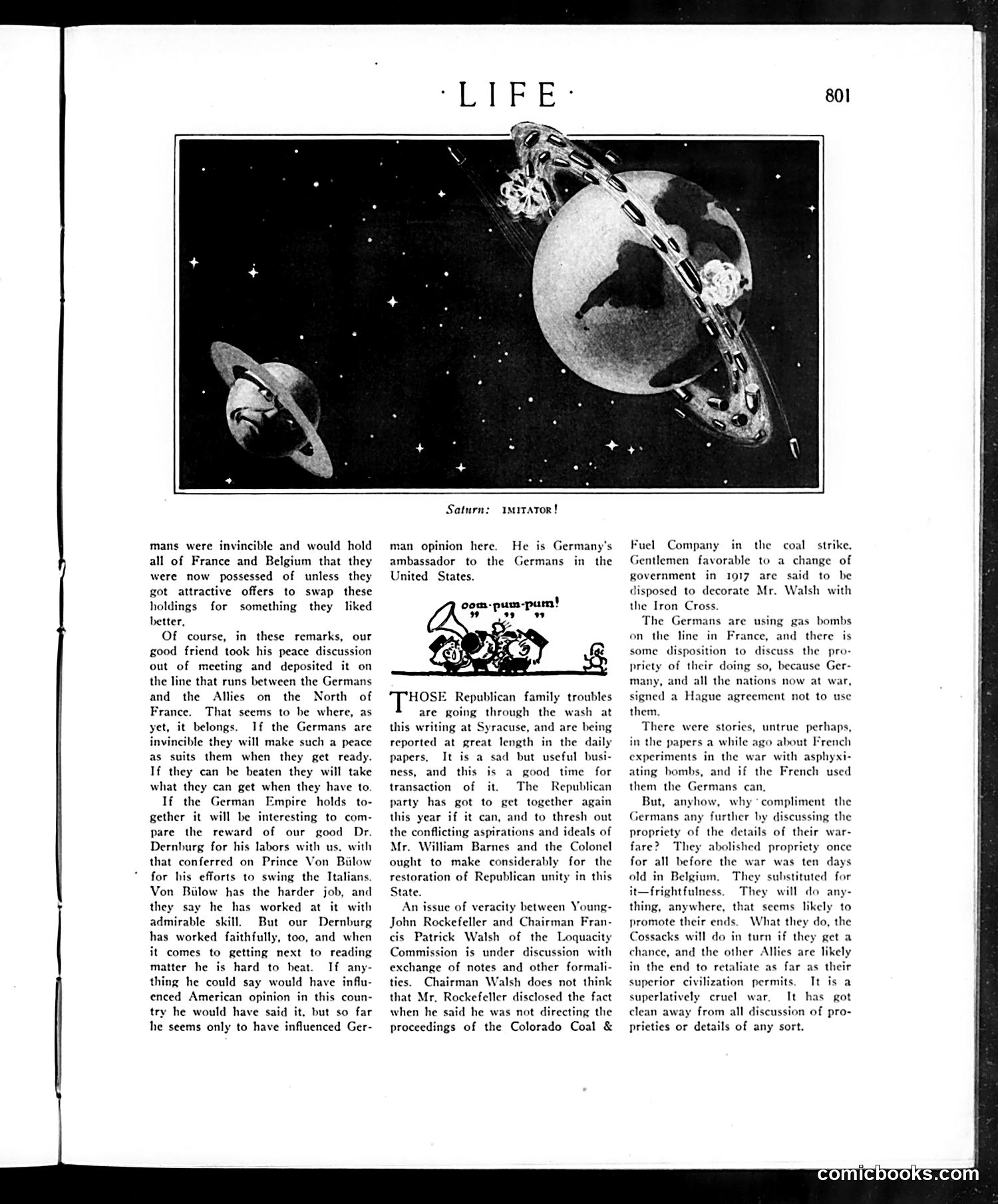
What you’re looking at
The top illustration titled "Saturn: Imitator!" shows two planets in space—Saturn on the left and Earth on the right, connected by a chain. This is political satire about **German diplomatic efforts to influence American public opinion during World War I**. The text identifies the target: **Dr. Dernburg**, Germany's unofficial ambassador tasked with swaying American opinion toward Germany. The satire's point: Dernburg has failed utterly. He's only influenced German opinion *within* America—preaching to the converted among German-Americans. The chain-link imagery suggests he's tethered uselessly to his own world, unable to bridge the gap to American thinking. The "imitator" label likely mocks his ineffectual mimicry of successful diplomacy. The remaining text discusses Republican Party infighting and criticizes the hypocrisy of debating whether Germany violated agreements about chemical weapons in France—arguing Germany abandoned all propriety in Belgium, making further moral arguments pointless.
📄 Transcribed text from this page (OCR, searchable)
Machine-transcribed from the original scan — historical spelling and the odd misread are preserved.
mans were invincible and would hold all of France and Belgium that they were now possessed of unless they got attractive offers to swap these holdings for something they liked better, Of course, in these remarks, our good friend took his peace discussion out of meeting and deposited it on the line that runs between the Germans and the Allies on the North of France. That seems to be where, as yet, it belongs. If the Germans are invincible they will make such a peace as suits them when they get ready. If they can be beaten they will take what they can get when they have to. If the German Empire holds to- gether it will be interesting to com- pare the reward of our good Dr Dernburg for his labors with us, with that conferred on Prince Von Biilow for his efforts to swing the Italians. Von Biilow has the harder job, and they say he has worked at it with admirable skill. But our Dernburg has worked faithfully, too, and when it comes to getting next to reading matter he is hard to beat. If any- thing he could say would have influ- enced American opinion in this coun- try he would have said it, but so far he seems only to have influenced Ger- Saturn: isatator! man opinion here. He is Germany's ambassador to the Germans in the United States. com-pum-pum! w 89 HOSE Republican family troubles are going through the wash at this writing at Syracuse, and are being reported at great length in the daily papers, It is a sad but useful busi- ness, and this is a good time for transaction of it. The Republican party has got to get together again this year if it can, and to thresh out the conflicting aspirations and ideals of Mr. William Barnes and the Colonel ought to make considerably for the restoration of Republican unity in this State. An issue of veracity between Young- John Rockefeller and Chairman Fran- cis Patrick Walsh of the Loquacity Commission is under discussion with exchange of notes and other forma ties. Chairman Walsh does not think that Mr, Rockefeller disclosed the fact when he said he was not directing the proceedings of the Colorado Coal & Fuel Company in the coal strike. Gentlemen favorable to a change of government in 1917 are said to be disposed to decorate Mr. Walsh with the Iron Cross. The Germans are using gas bombs on the line in France, and there is some disposition to discuss the pro- pricty of their doing so, because Ger- many, and all the nations now at war, signed a Hague agreement not to use them, There were stories, untrue perhaps, in the papers a while ago about French experiments in the war with asphyxi- ating hombs, and if the French used them the Germans can, But, anyhow, why ‘compliment the Germans any further by discussing the propriety of the details of their war- fare? They abolished propriety once for all before the war was ten days old in Belgium, They substituted for it—frightfulness. They will do any- thing, anywhere, that seems likely to promote their ends. What they do, the Cossacks will do in turn if they get a chance, and the other Allies are likely in the end to retaliate as far as their superior civilization permits, It is a superlatively cruel war, It has got clean away from all discussion of pro- prieties or details of any sort.