
Life, 1915-05-06 · page 32 of 56
Life — May 6, 1915 — page 32: what you’re looking at
What you’re looking at
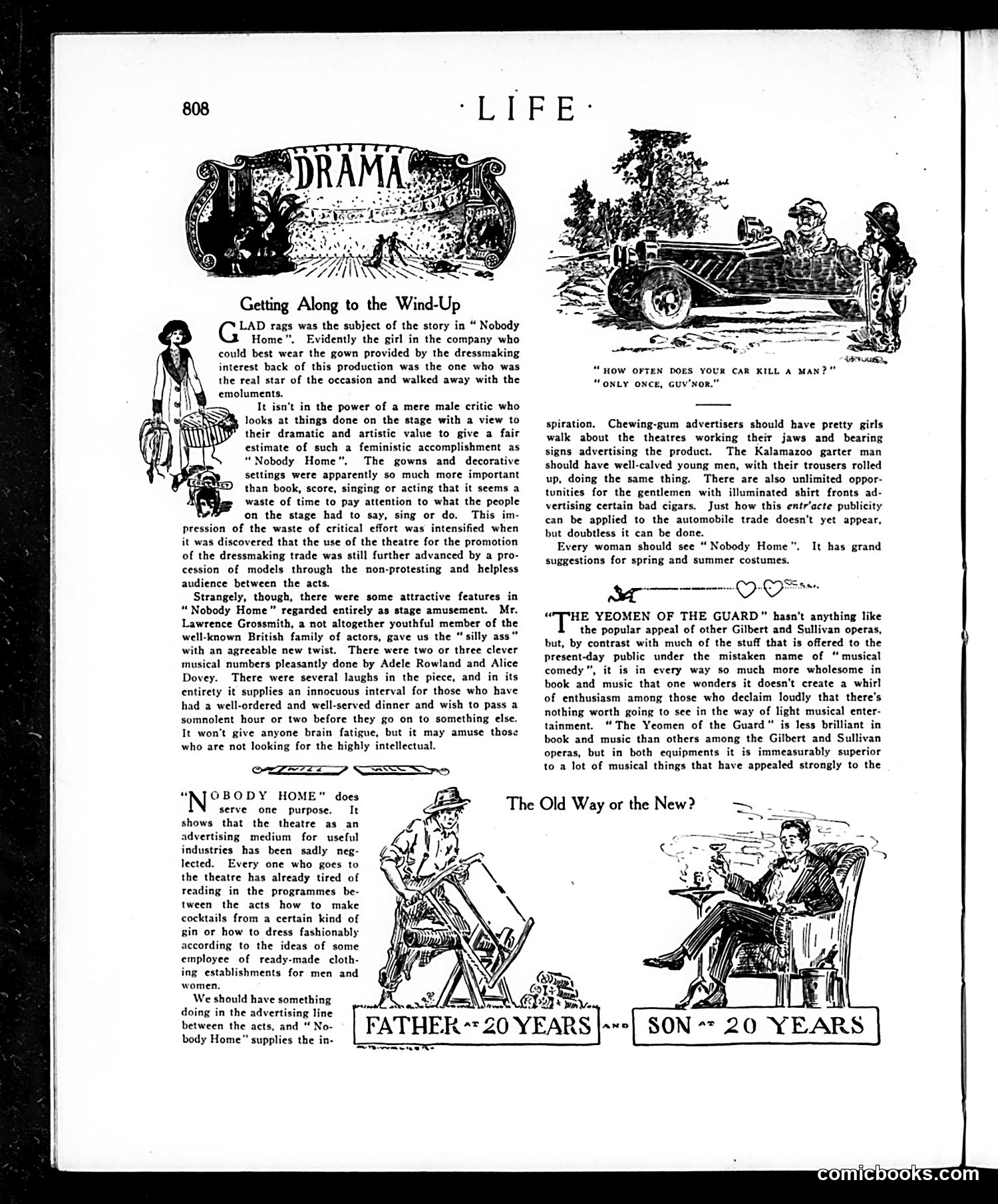
This page reviews theatrical productions while satirizing early 20th-century advertising practices. The main review critiques "Nobody Home," a musical where fashion display apparently overshadowed dramatic merit. The critic—a male—ironically notes he cannot fairly judge a show designed primarily to showcase dresses, and points out that models paraded through the audience between acts, essentially turning the theatre into a commercial venue for the dressmaking industry. The satire extends to a proposal: if theatres can advertise clothing, why not other products? The author humorously suggests chewing-gum companies, garter manufacturers, and cigar makers could use similar tactics. Notably, he admits automobiles present an advertising challenge. The bottom cartoon contrasts "Father—20 Years" (older man with bicycle) and "Son—20 Years" (younger man in car), with the caption joke about cars killing people, reflecting contemporary concerns about automobile safety as vehicles became common.
📄 Transcribed text from this page (OCR, searchable)
Machine-transcribed from the original scan — historical spelling and the odd misread are preserved.
Getting Along to the Wind-Up LAD rags was the subject of the story in “ Nobody Home”. Evidently the girl in the company who could best wear the gown provided by the dressmaking interest back of this production was the one who was the real star of the occasion and walked away with the emoluments. It isn't in the power of a mere male critic who looks at things done on the stage with a view to their dramatic and artistic value to give a fair estimate of such a feministic accomplishment as “Nobody Home”. The gowns and decorative settings were apparently so much more important than book, score, singing or acting that it seems a waste of time to pay attention to what the people on the stage had to say, sing or do. This im- Pression of the waste of critical effort was intensified when it was discovered that the use of the theatre for the promotion of the dressmaking trade was still further advanced by a pro- cession of models through the non-protesting and helpless audience between the acts. Strangely, though, there were some attractive features in “Nobody Home” regarded entirely as stage amusement. Mr. Lawrence Grossmith, a not altogether youthful member of the well-known British family of actors, gave us the “silly ass” with an agreeable new twist. There were two or three clever musical numbers pleasantly done by Adele Rowland and Alice Dovey. There were several laughs in the piece, and in its entirety it supplies an innocuous interval for those who have had a well-ordered and well-served dinner and wish to pass a somnolent hour or two before they go on to something else. It won't give anyone brain fatigue, but it may amuse those who are not looking for the highly intellectual. oma SS S=—=rr> OBODY HOME” does Ee serve one purpose. It shows that the theatre as an advertising medium for useful industries has been sadly neg- lected. Every one who goes to the theatre has already tired of reading in the programmes be- tween the acts how to make cocktails from a certain kind of gin or how to dress fashionably according to the ideas of some employee of ready-made cloth- ing establishments for men and women. We should have something doing in the advertising line between the acts, and “ No- body Home” supplies the in- FATHER ~= 20 YEARS |~- “HOW OFTEN DOES YOUR CAR KILL A MAN?” “ONLY ONCE, GUV’NOR.” spiration. Chewing-gum advertisers should have pretty girls walk about the theatres working their jaws and bearing signs advertising the product. The Kalamazoo garter man should have well-calved young men, with their trousers rolled up, doing the same thing. There are also unlimited oppor- tunities for the gentlemen with illuminated shirt fronts ad- vertising certain bad cigars. Just how this entracte publicity can be applied to the automobile trade doesn't yet appear, but doubtless it can be done. Every woman should see “ Nobody Home”. suggestions for spring and summer costumes. “—CCC - CDE aa. 'HE YEOMEN OF THE GUARD” hasn’t anything like the popular appeal of other Gilbert and Sullivan operas, but, by contrast with much of the stuff that is offered to the present-day public under the mistaken name of “musical comedy”, it is in every way so much more wholesome in book and music that one wonders it doesn’t create a whirl of enthusiasm among those who declaim loudly that there's nothing worth going to see in the way of light musical enter- tainment. “The Yeomen of the Guard” is less brilliant in book and music than others among the Gilbert and Sullivan operas, but in both equipments it is immeasurably superior to a lot of musical things that have appealed strongly to the It has grand SON = 20 YEARS