
A complete issue · 44 pages · 1915
Life — April 15, 1915
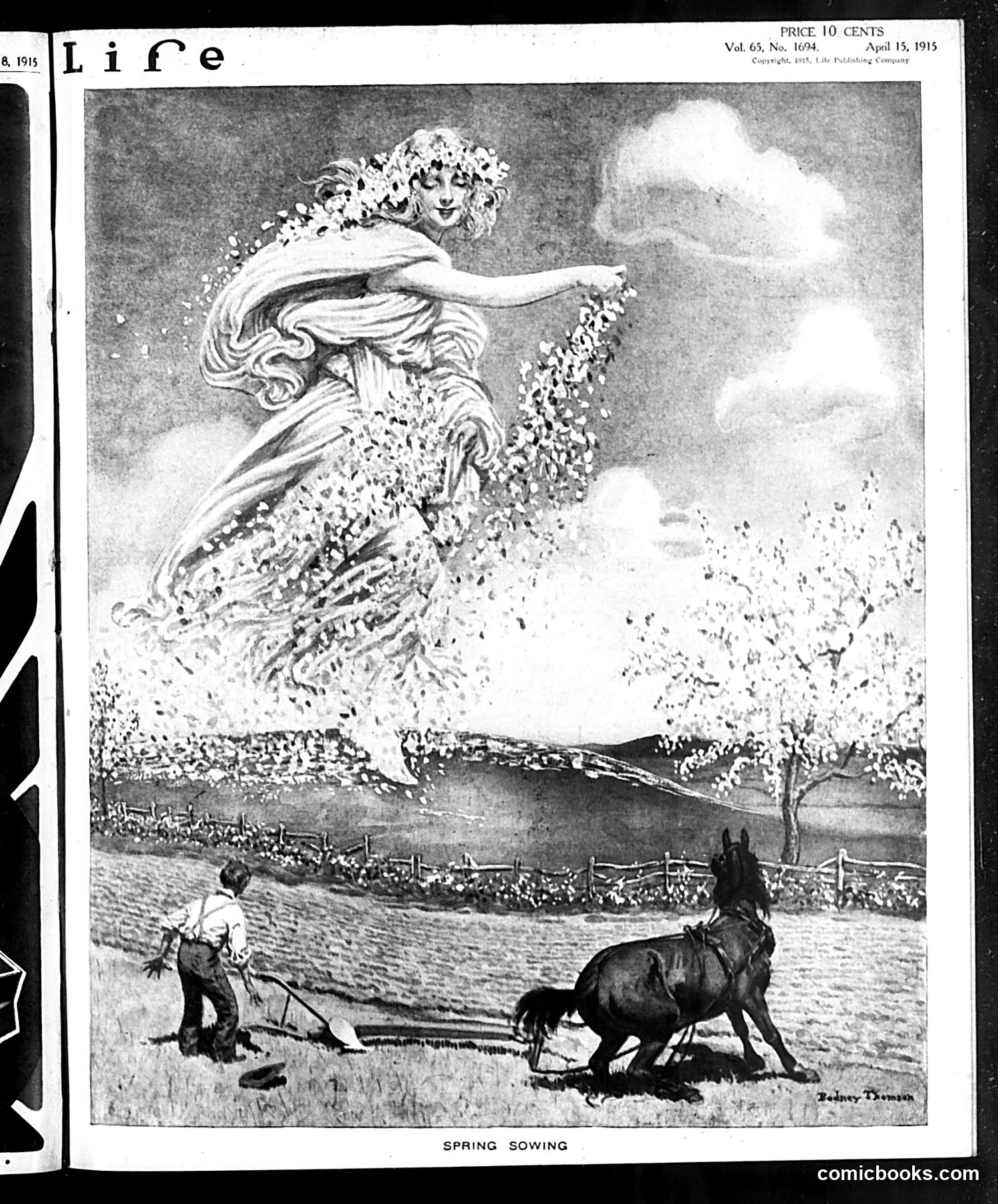
This allegorical illustration depicts **Spring as a classical female figure** scattering seeds across farmland while a farmer and horse work below. The image appears to be a straightforward agricultural/seasonal metaphor rather than political satire. Published during World War I (April 1915), the peaceful farm scene and emphasis on planting and cultivation likely carried **hopeful symbolism about American agricultural prosperity and continuity** during a period when the war dominated headlines. The contrast between the ethereal, idealized Spring goddess and the grounded labor of farming suggests themes about nature's renewal and the importance of domestic agricultural work to the nation. The artist is credited as "Sidney Darrason" at bottom.
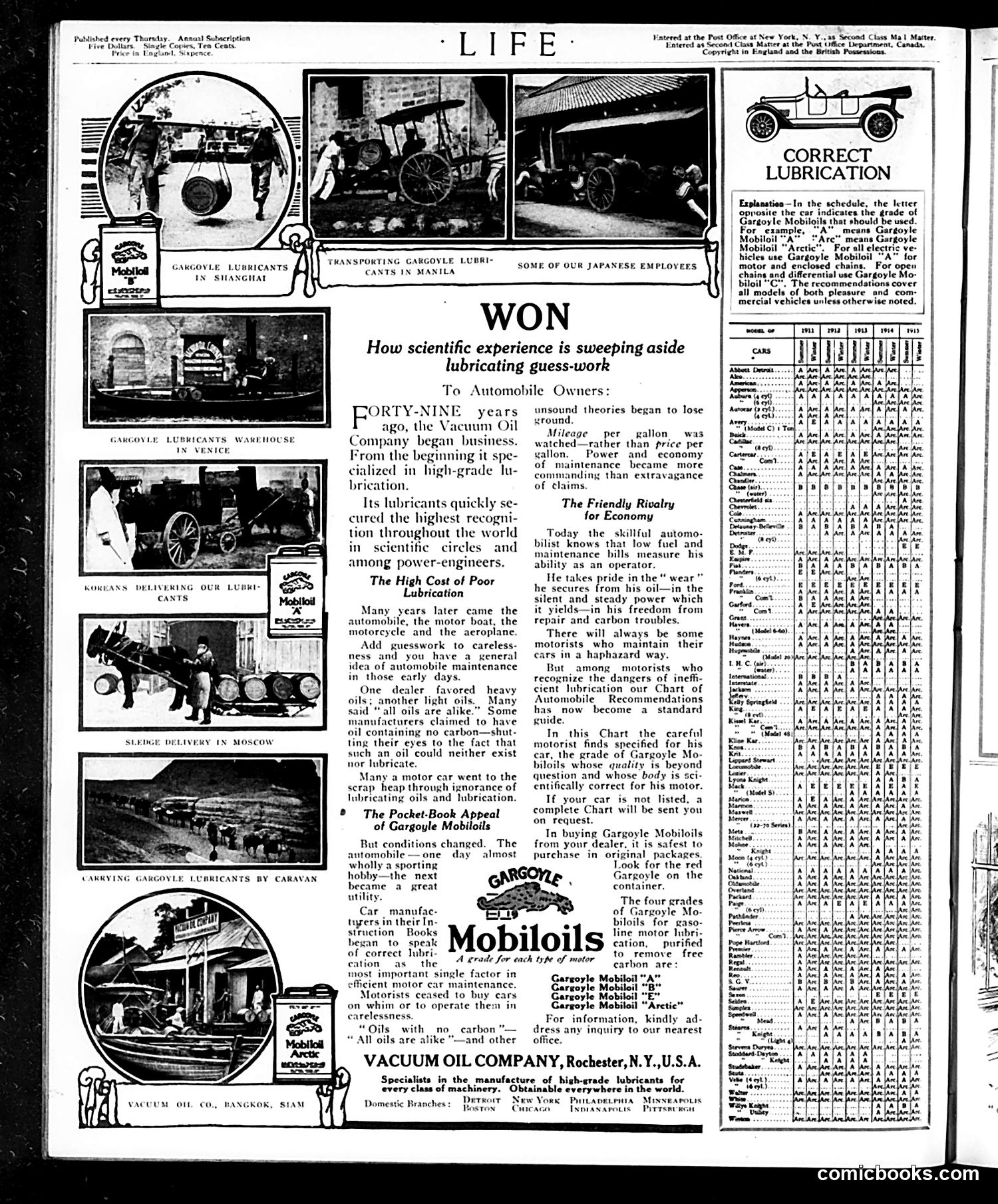
This page is **primarily advertising**, not satire or political commentary. It's a Gargoyle Mobiloils motor oil advertisement from the Vacuum Oil Company (Rochester, N.Y.). The content consists of: 1. **Multiple photographs** showing Gargoyle lubricant distribution globally—in Shanghai, Manila, Venice, Moscow, and via caravan transport—establishing the product's worldwide reach. 2. **A central article** titled "WON: How scientific experience is sweeping aside lubricating guess-work," arguing that modern oil science has replaced older, unreliable lubrication methods. 3. **A detailed lubrication chart** (right side) specifying which Gargoyle oil grade suits different car models and years. The "satire" is gentle corporate messaging: the ad positions scientific standardization as having defeated automotive ignorance. No political figures or events are referenced.
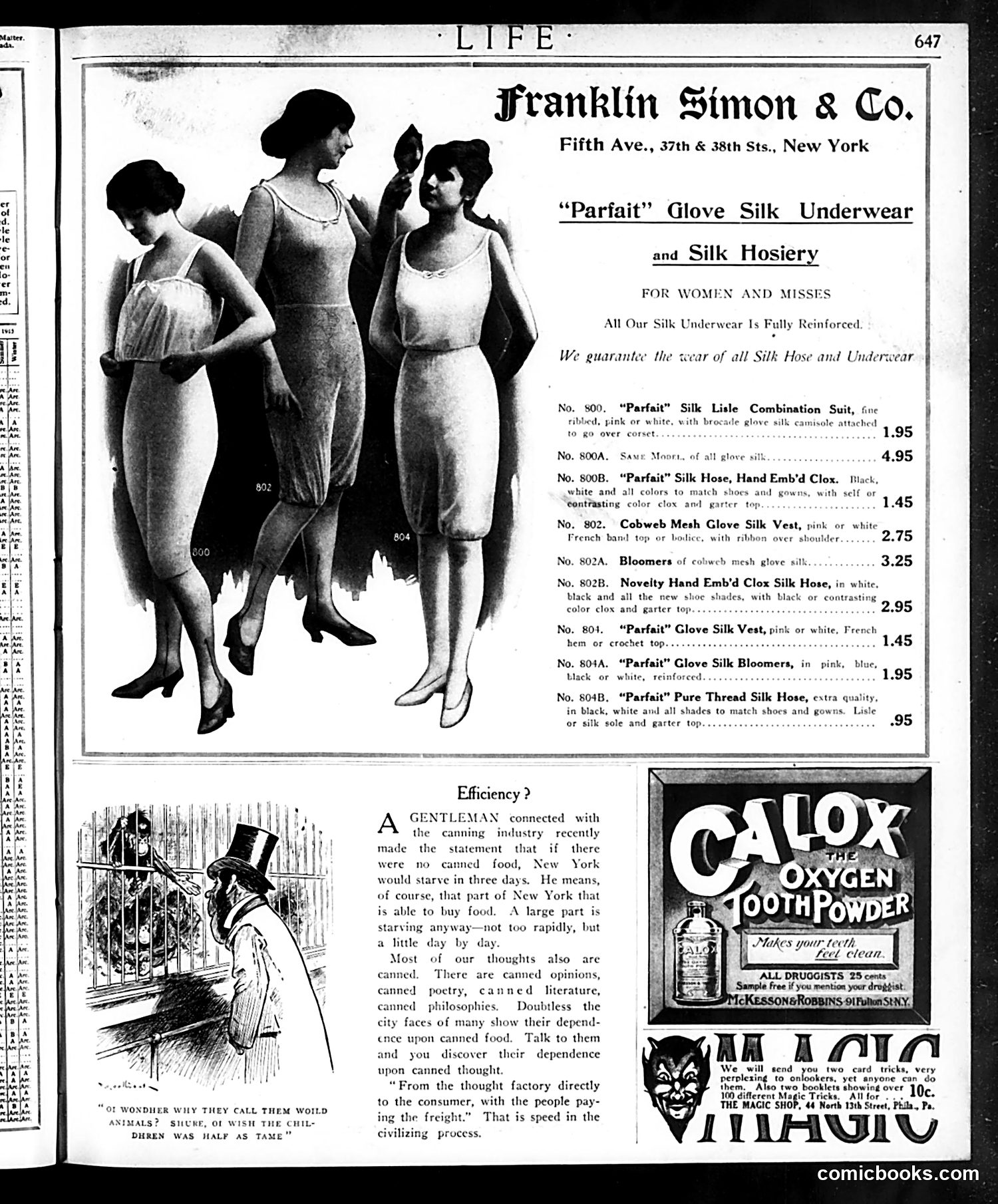
This page is primarily **advertising and commercial content**, not political satire. The top two-thirds features a Franklin Simon & Co. advertisement for women's undergarments and silk hosiery, with product listings and prices. The lower portion contains two distinct elements: 1. **"Efficiency?" cartoon**: A social commentary depicting a well-dressed gentleman observing canned goods in a store window. The accompanying text critiques urban food dependency—arguing that canned foods represent "civilizing" efficiency but create unhealthy reliance. The caption sarcastically questions why people call canned goods "wild animals." 2. **Product advertisements** for Callox Tooth Powder and a Magic Card Trick offer round out the page. This reflects early-20th-century anxieties about industrialized food production and urbanization.
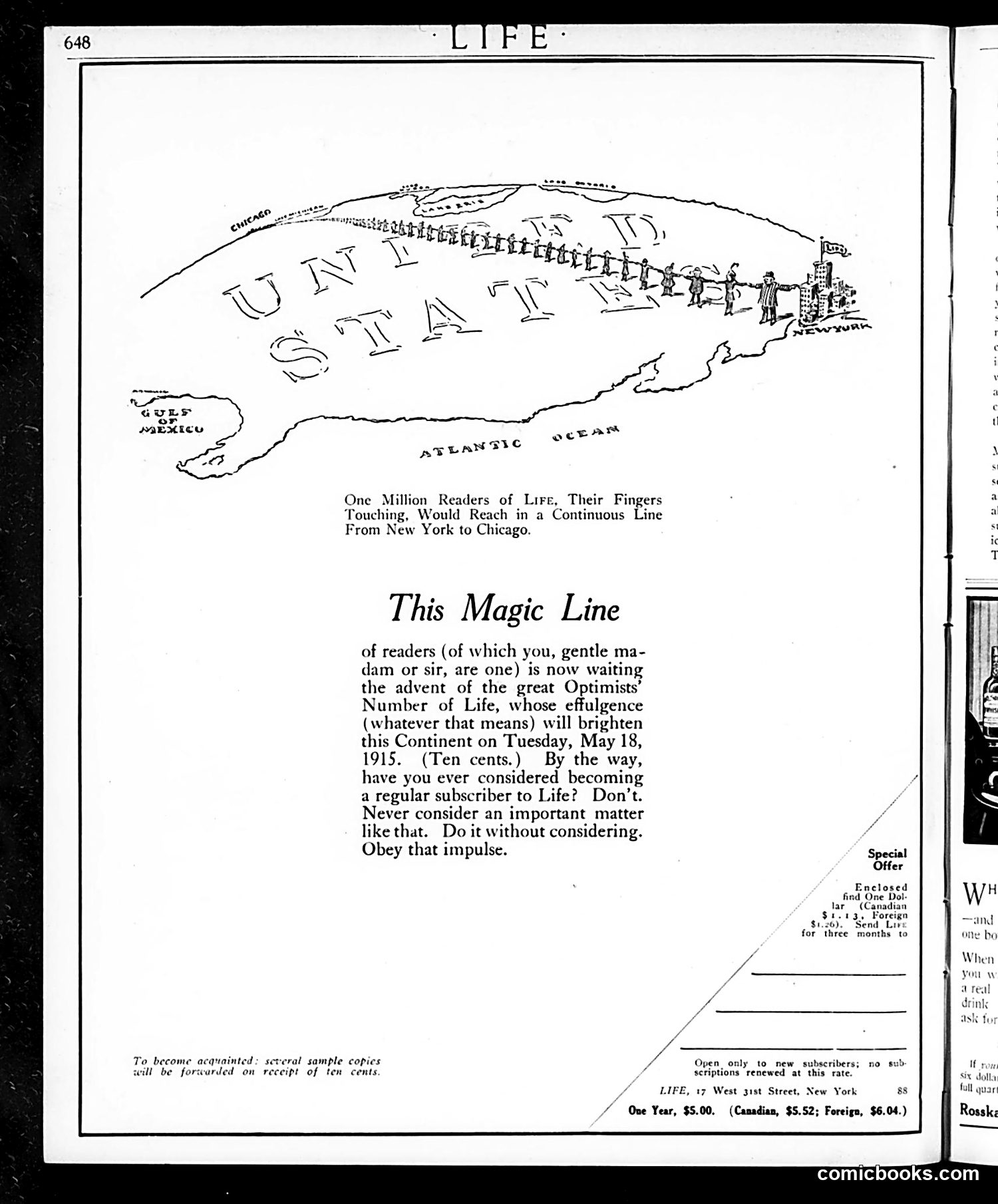
This page is primarily **advertising** for Life magazine's subscription promotion, dated May 18, 1915. The cartoon depicts the United States as a long landmass stretching from New York to Chicago, with text reading "UNITY" overlaid. Tiny figures of readers are drawn in a continuous line across the country, illustrating Life's circulation claim: one million readers whose "fingers touching" would form an unbroken chain coast-to-coast. The satire is subtle—the "magic line" concept humorously exaggerates Life's reach and influence. The advertisement uses this fanciful visual metaphor to market subscriptions, appealing to readers' sense of belonging to a vast, unified national readership. The tone is lighthearted and promotional rather than politically pointed.
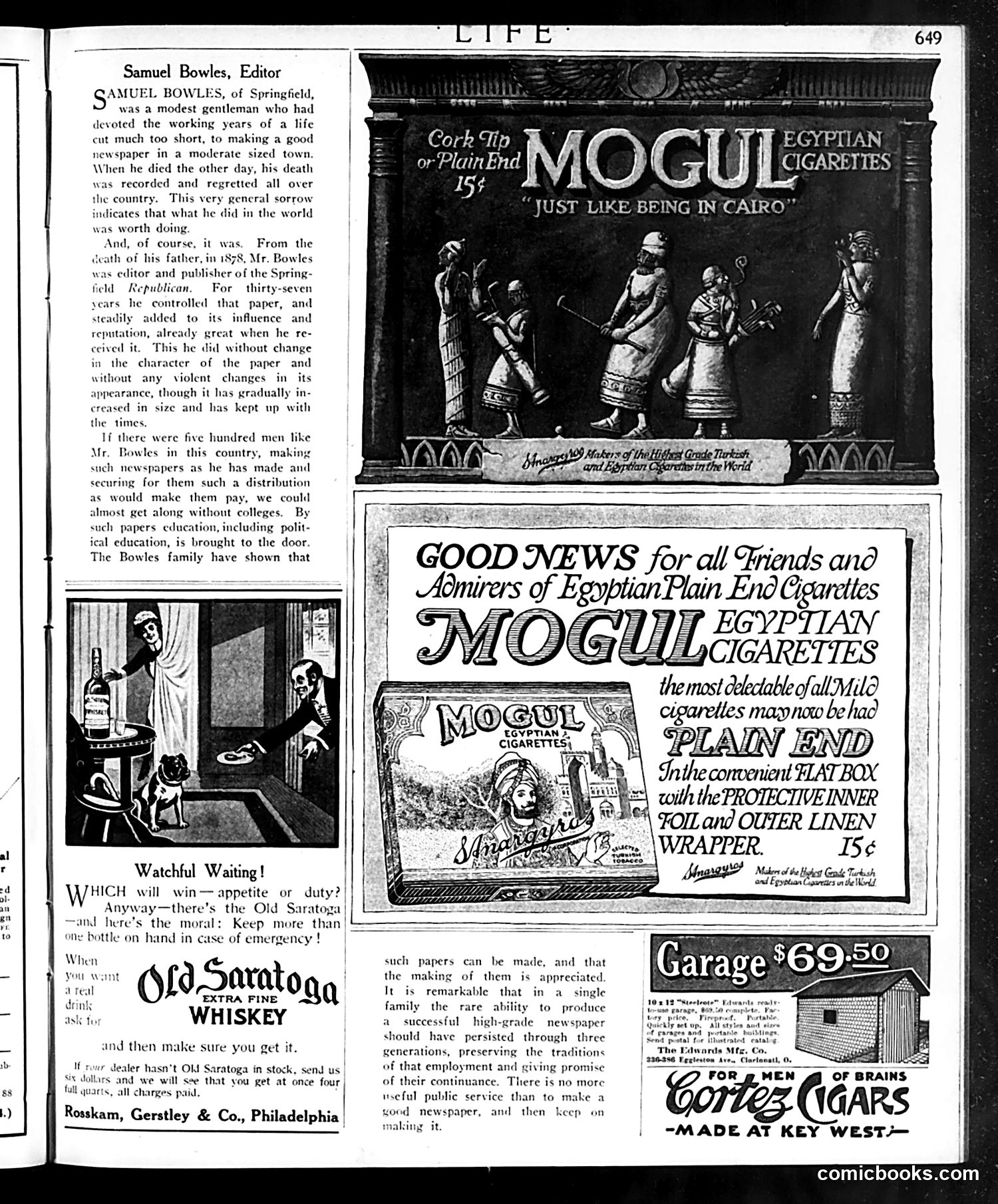
This page is primarily **advertising**, not satire or political commentary. The main content features ads for **Mogul Egyptian Cigarettes** (with Egyptian-themed imagery and the slogan "Just Like Being in Cairo") and **Old Saratoga Whiskey**. There's also a small illustration titled "Watchful Waiting!" showing a dog and person with a bottle—a domestic safety joke about keeping alcohol on hand for emergencies. The editorial text discusses **Samuel Bowles**, a Springfield newspaper editor who died, praising his journalism career and the newspaper profession generally. It concludes that educated newspapers strengthen democracy. The remaining ads promote a garage ($69.50) and Cortez cigars. This is a typical early 20th-century magazine page mixing editorial content with commercial advertising.
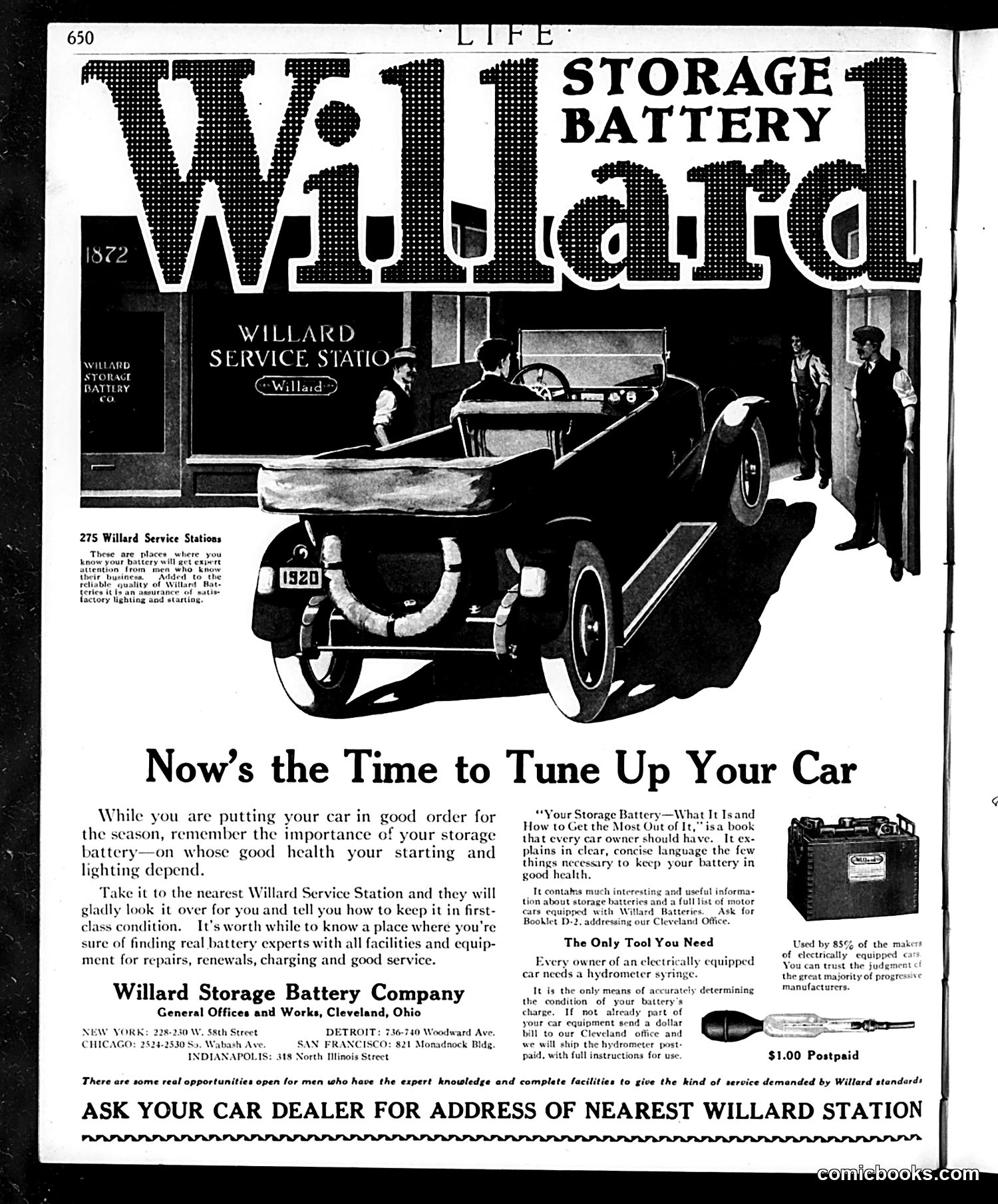
This is primarily an **advertisement, not a cartoon or satirical content**. It promotes Willard Storage Batteries, featuring an illustration of a 1920s automobile service station where mechanics service a customer's vehicle. The ad emphasizes seasonal car maintenance ("Now's the Time to Tune Up Your Car"), encouraging owners to visit one of 275 Willard Service Stations to maintain their storage batteries—essential for engine starting and lighting in early automobiles. The only potentially satirical element is subtle: the ad implies car owners might neglect battery maintenance, positioning Willard stations as trustworthy experts. However, this is standard advertising rhetoric rather than satire. The page reflects 1920s automotive culture, when battery maintenance was genuinely critical to vehicle operation, and service stations were nascent business concepts.
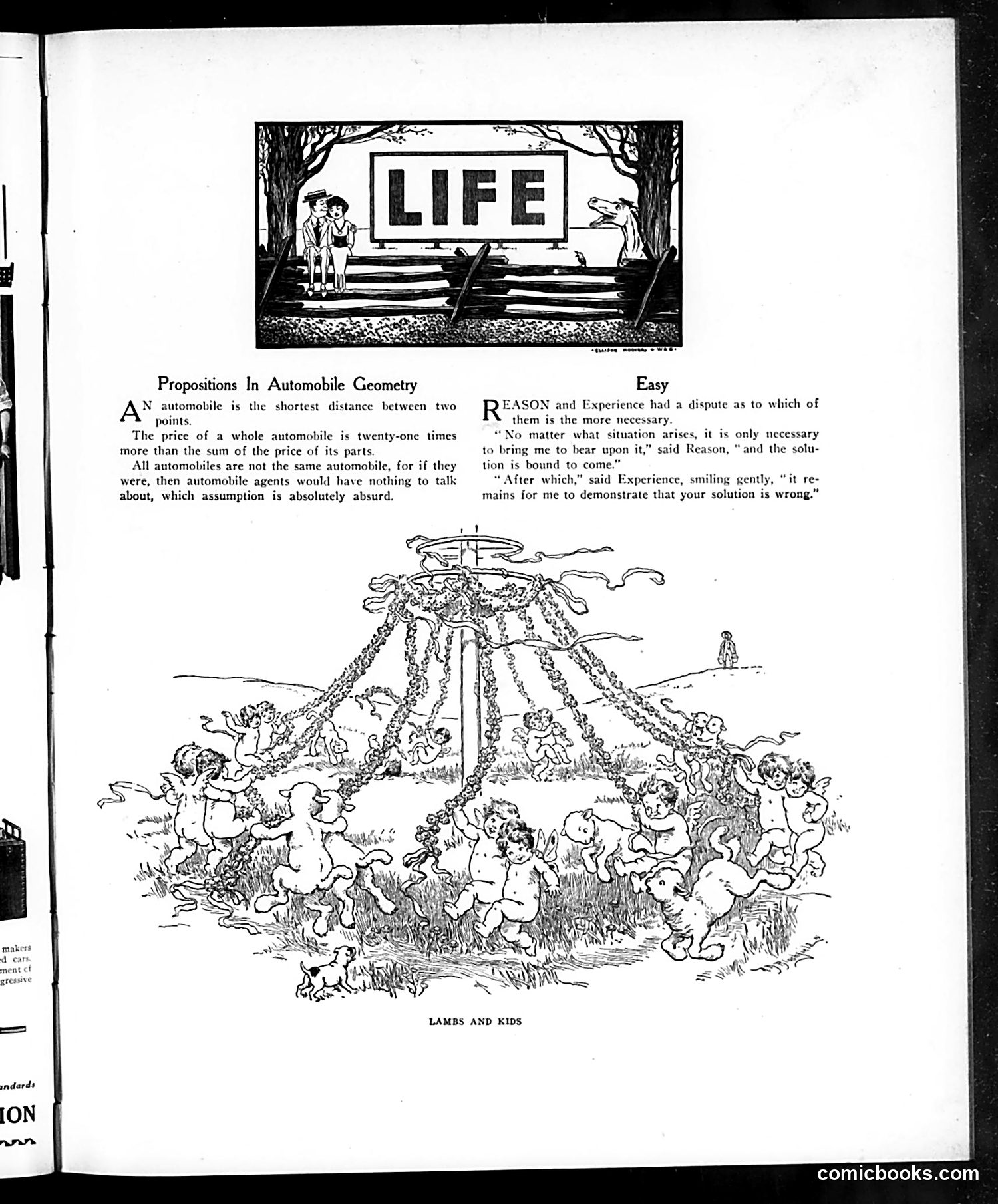
This page satirizes early automobile culture through two pieces: **"Propositions in Automobile Geometry"** (top left) mocks the inflated economics of cars—claiming an automobile costs 21 times more than the sum of its parts, implying massive markup and dealer profit. It suggests this absurdity would give automobile agents nothing to discuss otherwise. **"Easy"** (right) presents a dialogue between "Reason" and "Experience" debating necessity—a philosophical joke about justifying automobile purchases through rationalization rather than actual need. **"Lambs and Kids"** (main illustration) shows cherubic children playing around a maypole, likely satirizing how automobiles were aggressively marketed to families as wholesome, carefree experiences—when the technology was actually new, expensive, and potentially dangerous. The imagery contrasts innocent childhood joy with commercial manipulation.
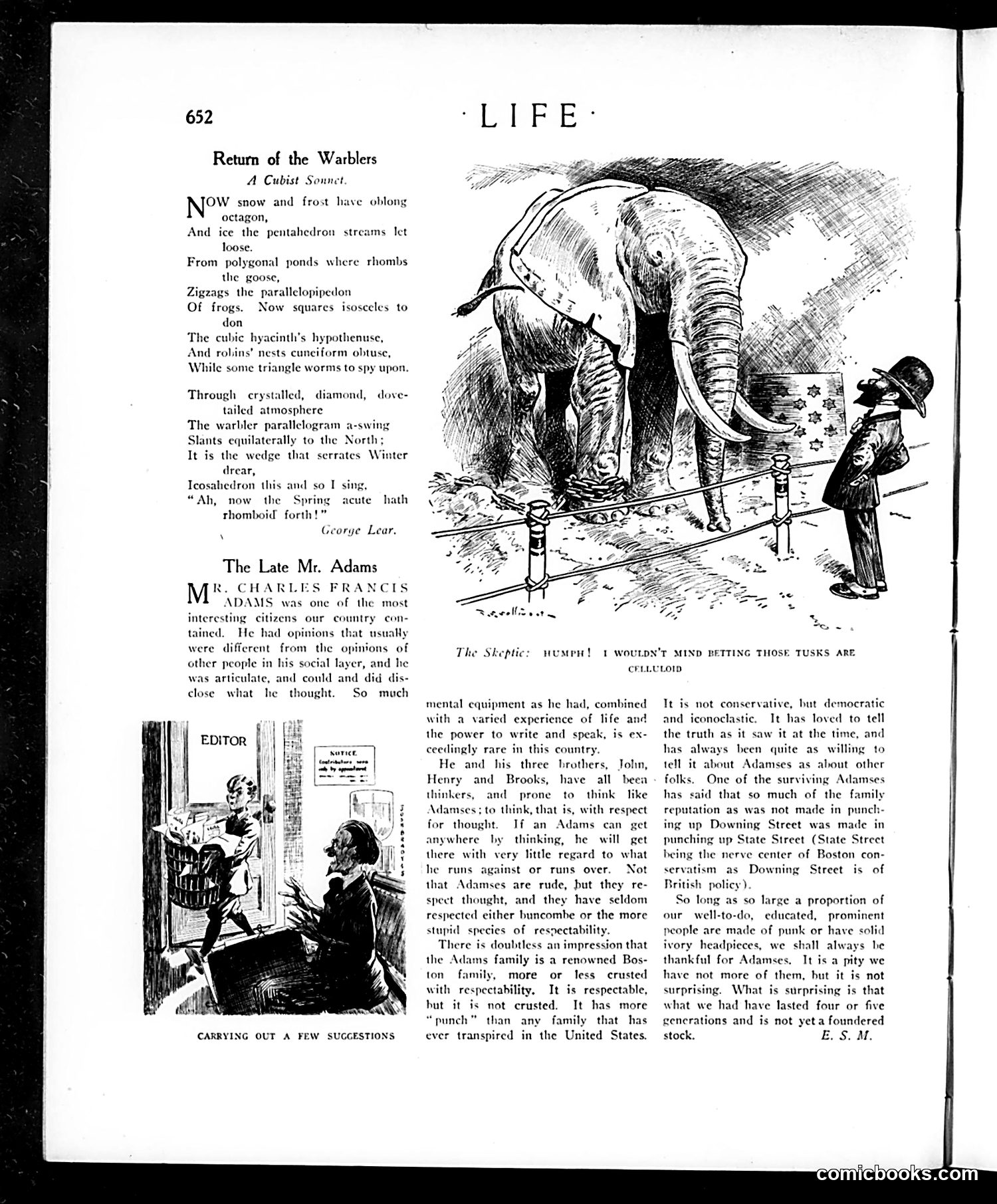
**Main Content:** The page features "Return of the Warblers," a cubist sonnet by George Lear about seasonal change using geometric and biological imagery. **The Cartoon:** The large illustration shows an elephant confronted by a small man in a top hat with a cane. The caption reads: "The Skeptic: HUMPH! I WOULDN'T MIND BETTING THOSE TUSKS ARE CELLULOID." **The Satire:** This appears to mock skepticism and fakery—suggesting someone so cynical they'd doubt even an elephant's authenticity, assuming its tusks are artificial. It satirizes excessive doubt or distrust of obvious things. **Secondary Content:** An article discusses Charles Francis Adams, a prominent Boston family member noted for independent thinking and respectability. The piece debates whether such old-money families deserve their social standing. The page reflects early 20th-century American preoccupations with authenticity, class, and social pretension.
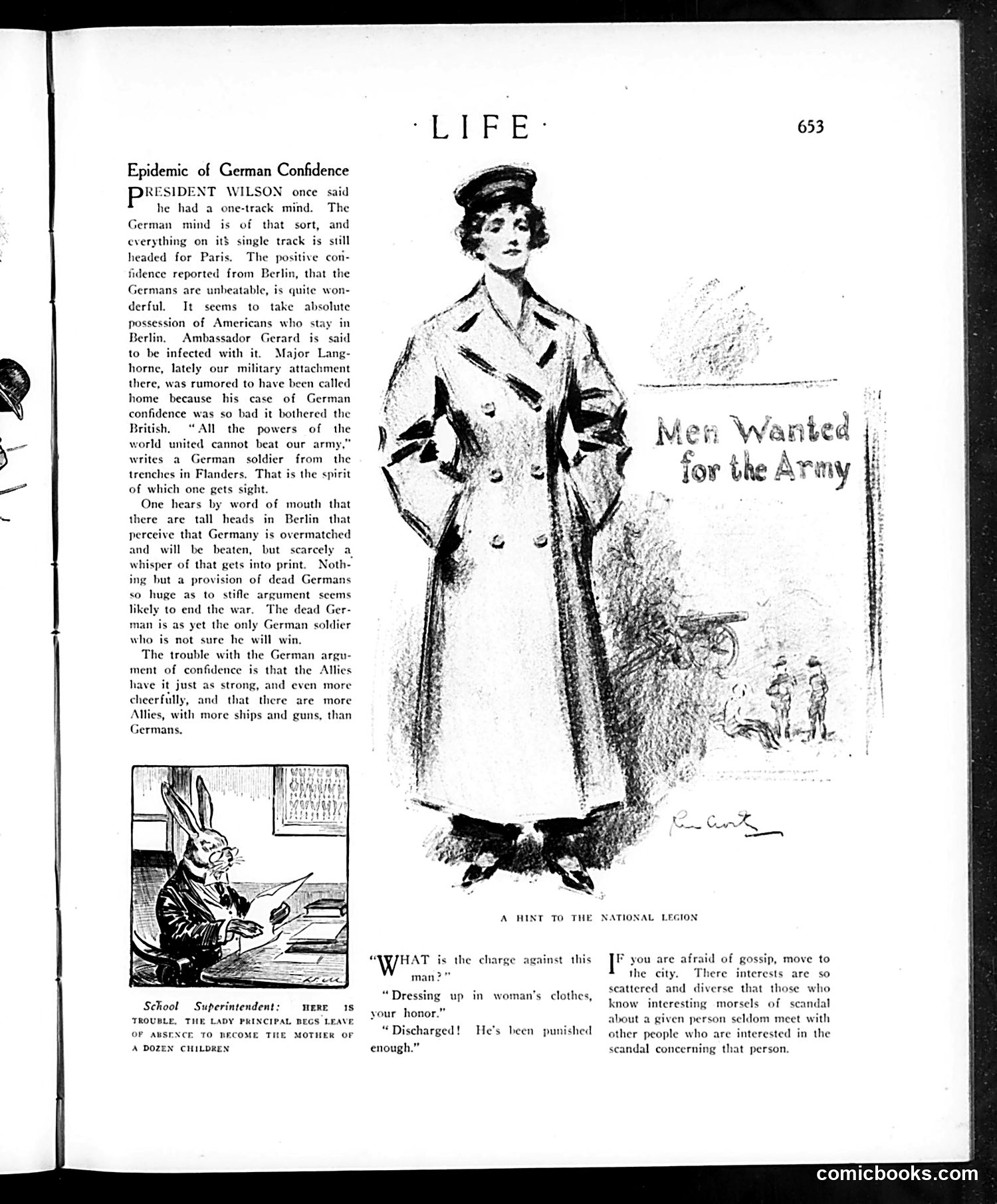
This page satirizes German military overconfidence during World War I. The main article mocks Berlin's belief that Germany will win, citing a German soldier's letter claiming "all the powers of the world united cannot beat our army." The satire argues this confidence is unfounded—the Allies actually have superior naval and military resources. The large illustration shows a woman in a long coat next to a "Men Wanted for the Army" recruiting poster, captioned "A Hint to the National Legion." This appears to encourage American women to support military recruitment. The smaller cartoon depicts a school superintendent as a rabbit—likely critiquing educational leadership during wartime, though the specific reference is unclear from context alone.
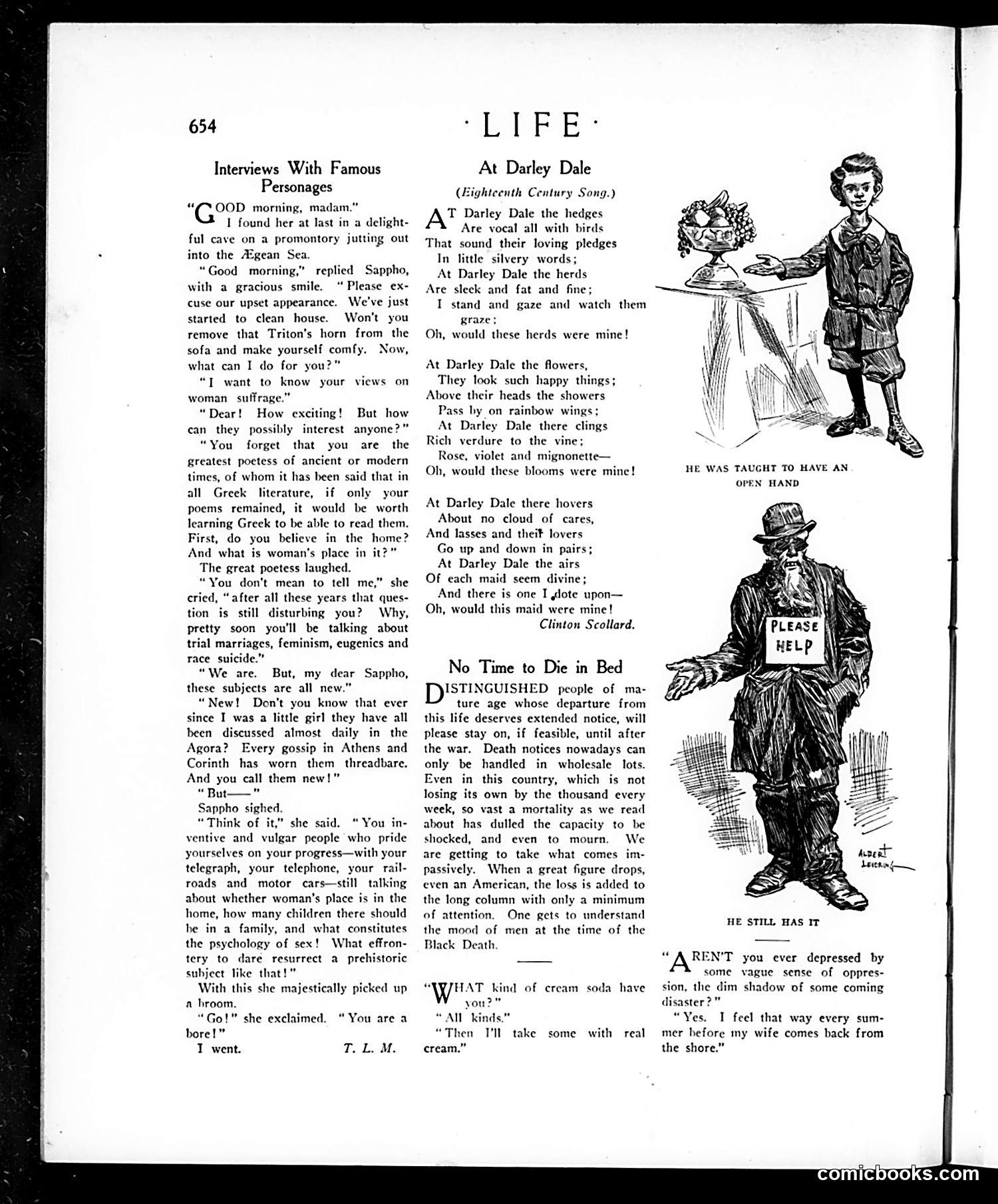
This page contains two distinct sections: **Left side ("Interviews With Famous Personages"):** A satirical interview where an unnamed interviewer challenges a great poetess (likely representing a prominent female poet of the era) about women's suffrage. The poetess dismisses suffrage as vulgar, arguing women should focus on the home. The interviewer counters that suffrage has already been discussed in Athens and Corinth, suggesting the issue is timely and unavoidable. The satire mocks elite women who oppose their own political rights. **Right side:** Illustrations and text about "No Time to Die in Bed" and depression/anxiety, with sketches of sad men. These appear unrelated to the interview. The page satirizes anti-suffrage arguments from educated women during the early 20th-century women's suffrage movement.
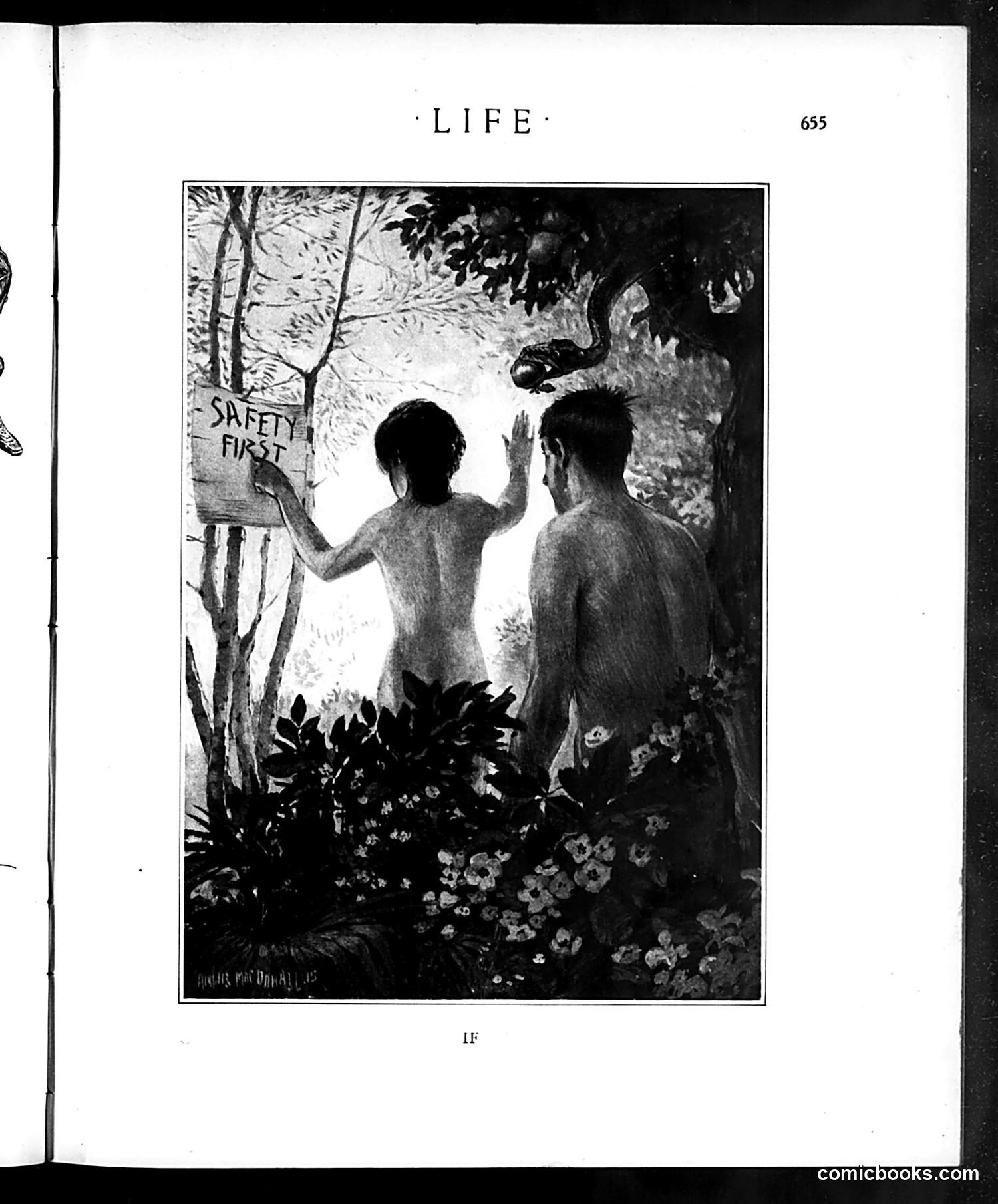
This page appears to be from an early 20th-century issue of Life magazine and features a single illustration titled "IF" at the bottom. The image depicts two shirtless young boys in a natural setting with flowers and foliage. One boy points to a "SAFETY FIRST" sign attached to a tree, while the other boy appears to be reaching toward or touching a snake in the branches above. The cartoon satirizes the disconnect between safety warnings and actual childhood behavior. The "SAFETY FIRST" message—a popular public health campaign of that era—is ironically juxtaposed against the boys' dangerous action of reaching for a snake, suggesting that children ignore safety precautions regardless of how prominently they're displayed. The "IF" title implies a conditional scenario about what happens when warnings go unheeded.
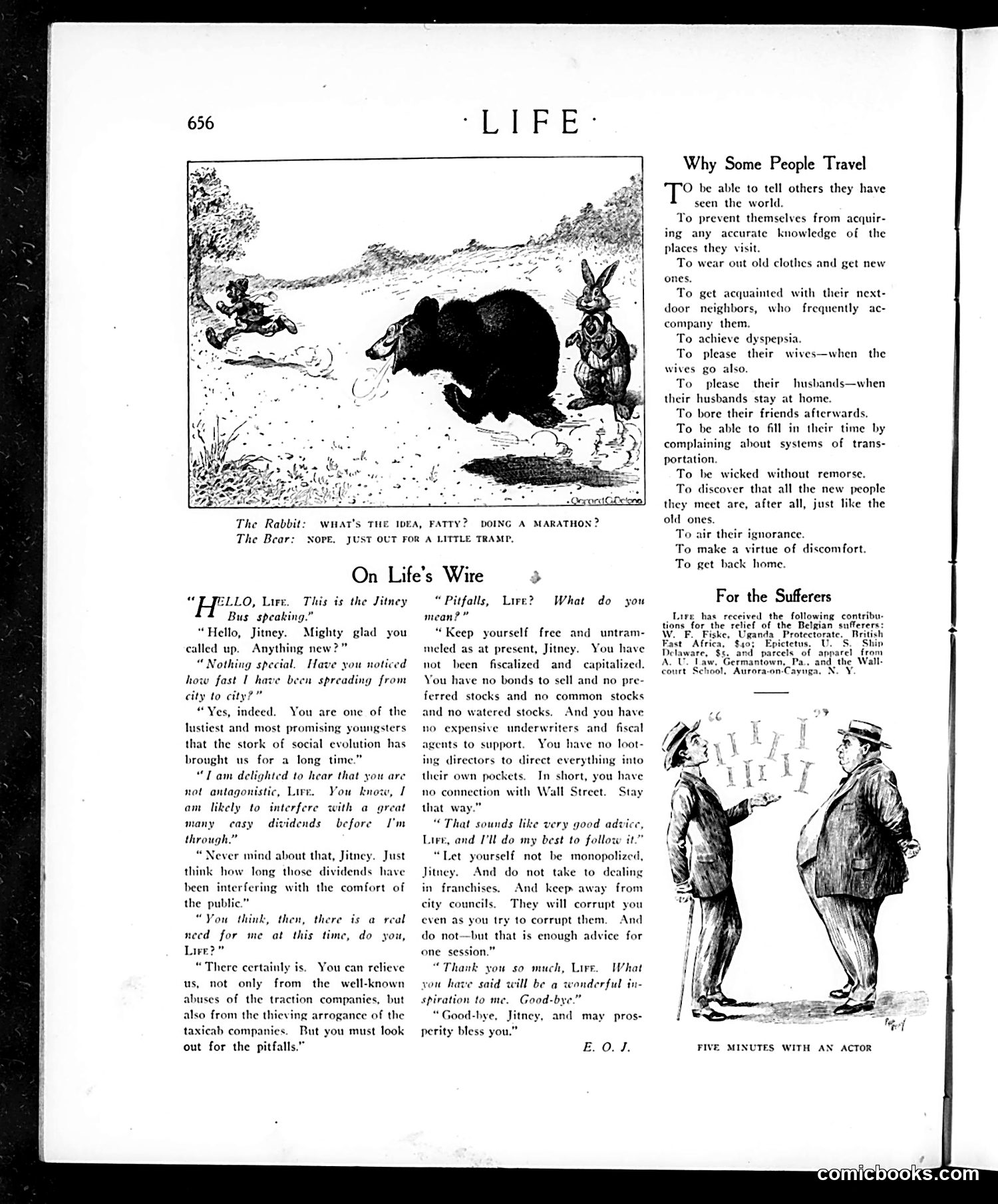
This page from *Life* magazine contains two satirical pieces: **"On Life's Wire"** depicts a conversation between "Life" (personified) and "Jitney" about the latter's financial precarity. The satire targets the "jitney bus" craze—cheap, unregulated shared-ride services that proliferated in the 1910s-20s, undercutting established taxi and streetcar companies. Life advises Jitney to avoid Wall Street speculation and political entanglement, warning that the industry attracts corrupt influences. The joke is that even a humble jitney operator faces the same pressures as wealthy businessmen. The cartoon above shows a bear and rabbit, with the rabbit claiming to run a "marathon," likely satirizing some contemporary endurance craze or questionable business venture. The page also advertises relief efforts for Belgian war sufferers, dating this to WWI era.
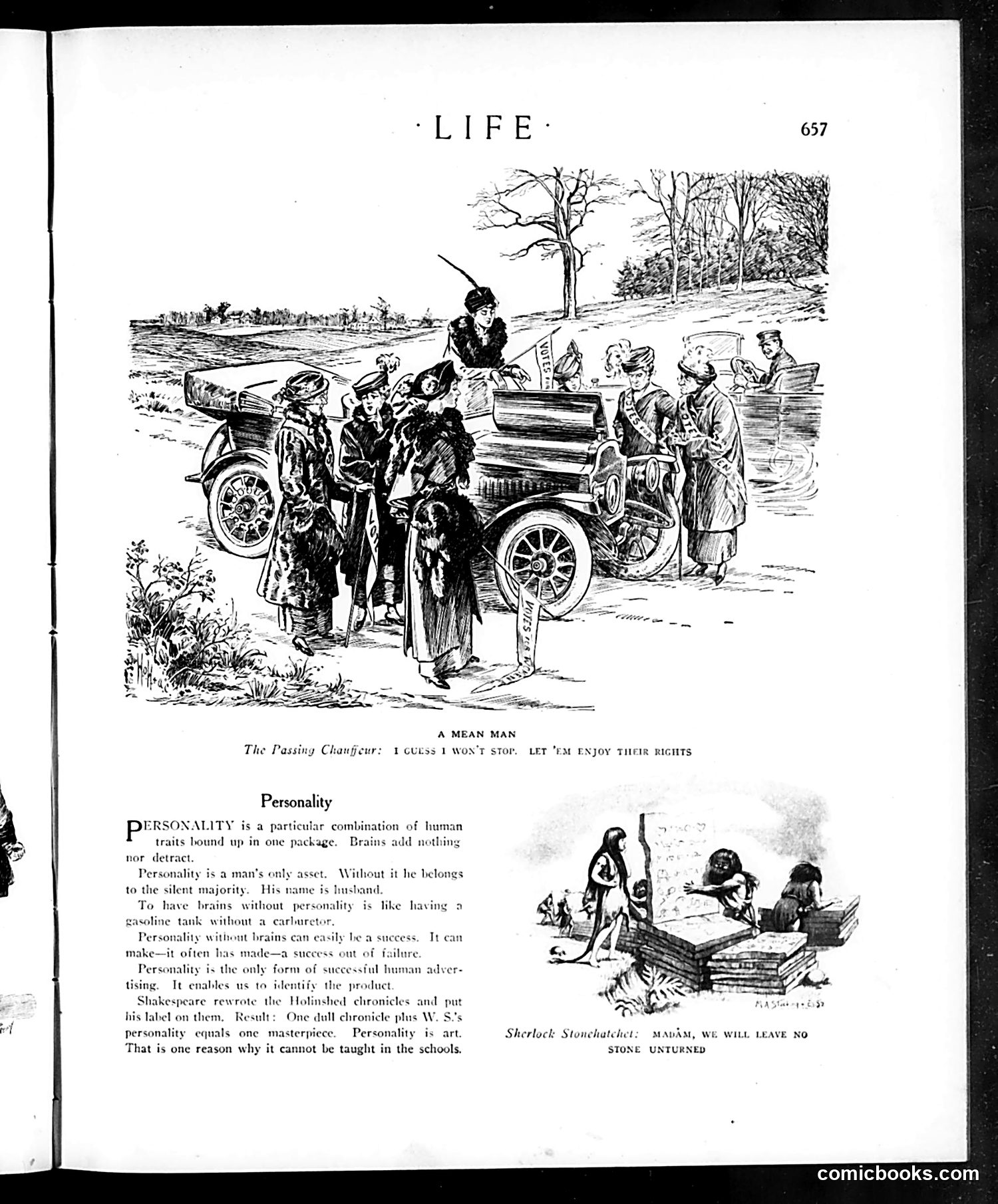
The top cartoon titled "A Mean Man" depicts a motorist blocking pedestrians' passage with his automobile, saying "I guess I won't stop. Let 'em enjoy their rights." This satirizes wealthy automobile owners of the early 1900s who used their vehicles inconsiderately, treating roads as personal property while dismissing ordinary citizens' right to use public spaces. The bottom illustration shows "Sherlock Stonecatcher" with the caption "Madam, we will leave no stone unturned." This appears to be a humorous reference to the famous detective Sherlock Holmes, punning on his name by depicting a character who literally moves stones—likely satirizing excessive or absurdly literal interpretations of detective work. Both pieces mock social attitudes and character types of the era.
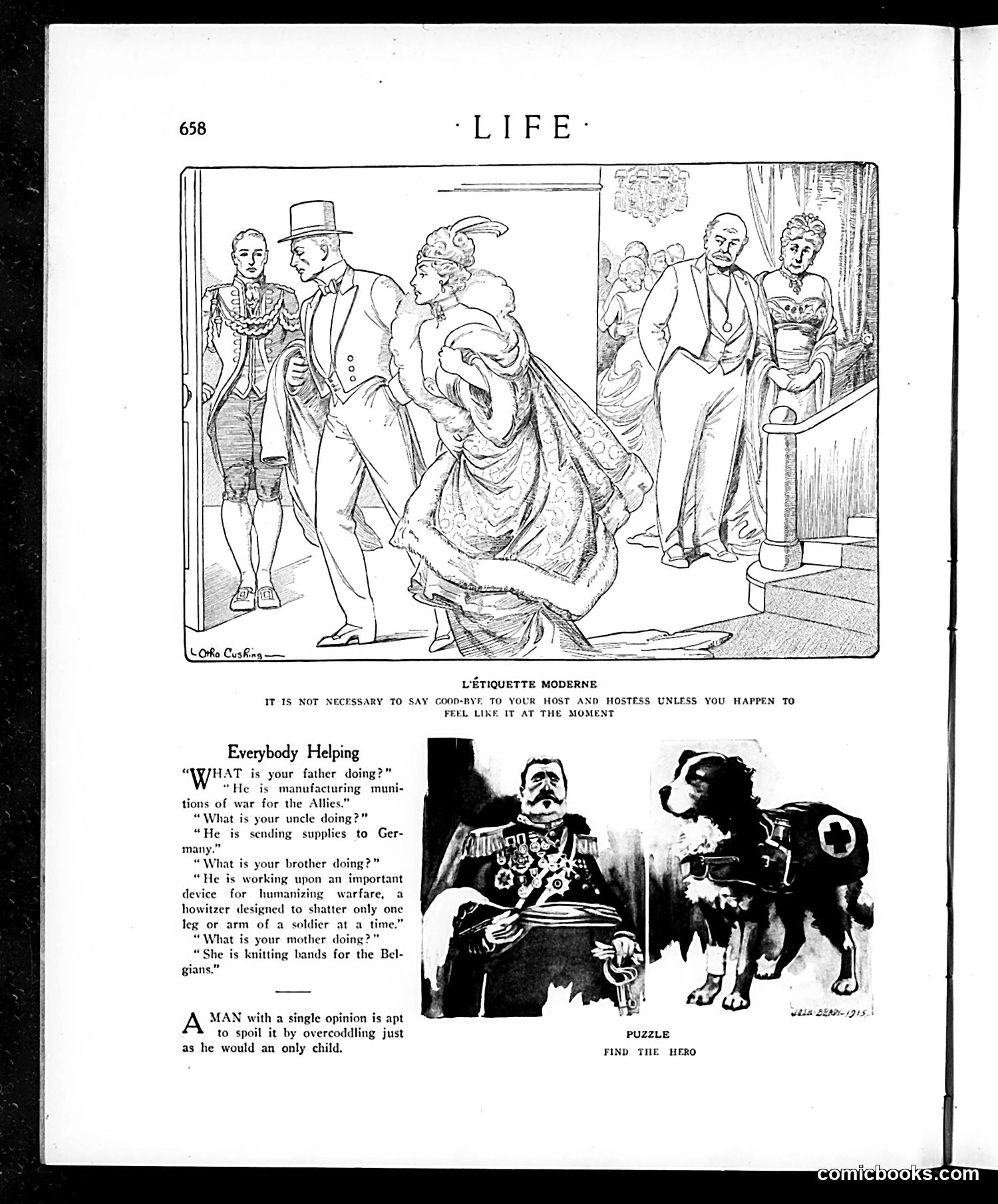
The top cartoon illustrates "L'Etiquette Moderne" (Modern Etiquette), satirizing social departure conventions. The caption notes it's unnecessary to say goodbye to hosts unless you feel like it—mocking increasingly casual social behavior. Below, "Everybody Helping" presents a family where each member contributes to WWI efforts: father manufactures munitions, uncle supplies Germany, mother knits for Belgians. This dark satire exposes profiteering and moral contradictions during wartime—some family members simultaneously benefiting from and aiding different sides of the conflict. The bottom puzzle "Find the Hero" shows a military figure with medals alongside a dog wearing a Red Cross insignia, likely questioning who deserves credit during wartime—a cynical commentary on military glory versus humanitarian work.
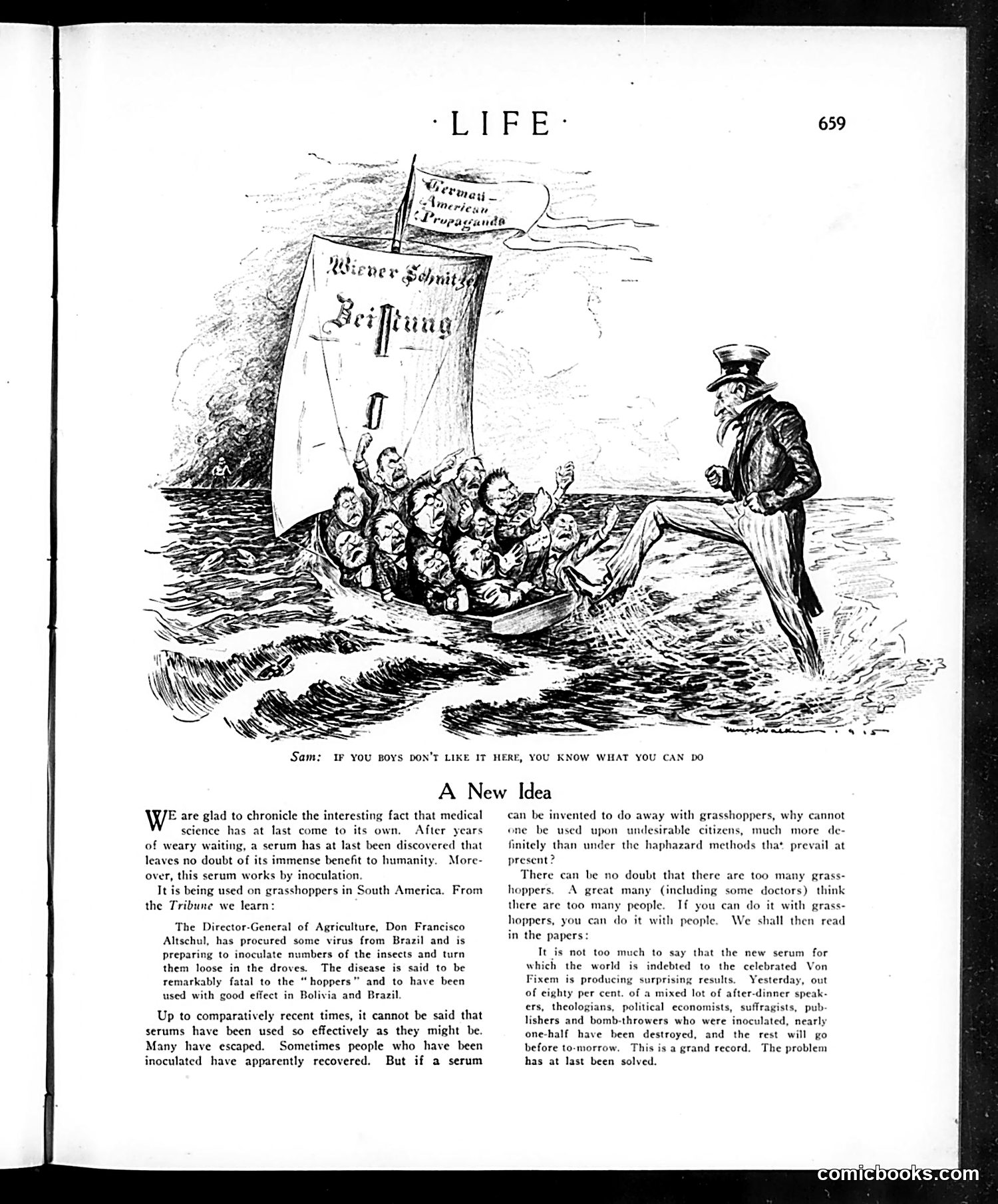
**The Cartoon:** Shows a boat carrying immigrants arriving at shore, with a well-dressed man (likely representing an American official or citizen) telling them "if you boys don't like it here, you know what you can do"—a dismissive threat. **The Article's Dark Satire:** Life uses recent news about Brazilian scientists developing a virus to kill grasshoppers as a springboard for biting social commentary. The piece sarcastically asks: if we can eliminate "undesirable" grasshoppers, why not "undesirable citizens"? It then mockingly lists target groups: after-dinner speakers, theologians, economists, suffragists, publishers, and "bomb-throwers" (likely anarchists feared during this era). **Historical Context:** This reflects early-1900s anxieties about immigration, radical politics, and social reform movements. The "bomb-throwers" reference suggests concern about anarchist violence. The suffragist inclusion reveals anti-feminist sentiment. **The Point:** Life satirizes American intolerance and eugenics-adjacent thinking by taking the logic to absurd extremes—using dark humor to critique those who view certain groups as social problems to be eliminated.
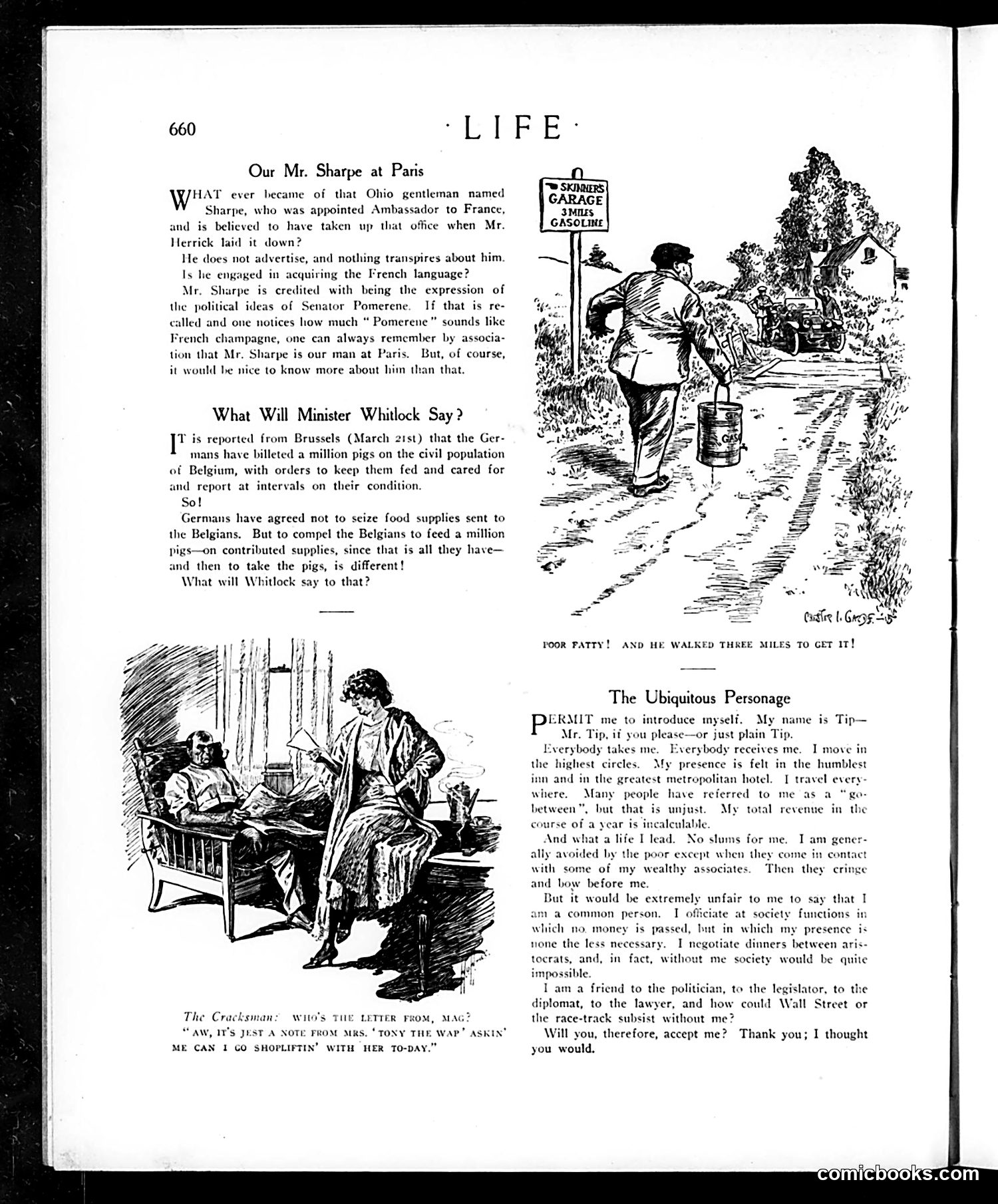
This page contains three satirical pieces: **"Our Mr. Sharpe at Paris"**: Mocks Ambassador Sharpe, appointed by Senator Pomerene, for being invisible and unproductive in his diplomatic role. The joke relies on a pun—"Pomerene" sounds like French champagne—to suggest Sharpe is merely a political appointee without substance. **"What Will Minister Whitlock Say?"**: Critiques German occupation tactics in Belgium during WWI. Though Germans agreed not to seize Belgian food supplies, they billeted a million pigs on civilians, forcing Belgians to feed them from contributed supplies before Germany confiscates the livestock. The satire highlights this as a cruel loophole violating the spirit (if not letter) of agreements. **"The Ubiquitous Personage"**: A monologue by "Tip" (a gratuity/bribe), personified as an omnipresent figure in high society, politics, and business. He boasts of facilitating corrupt dealings among aristocrats, politicians, and Wall Street while remaining ostensibly "common." This satirizes how bribes permeate respectable society.
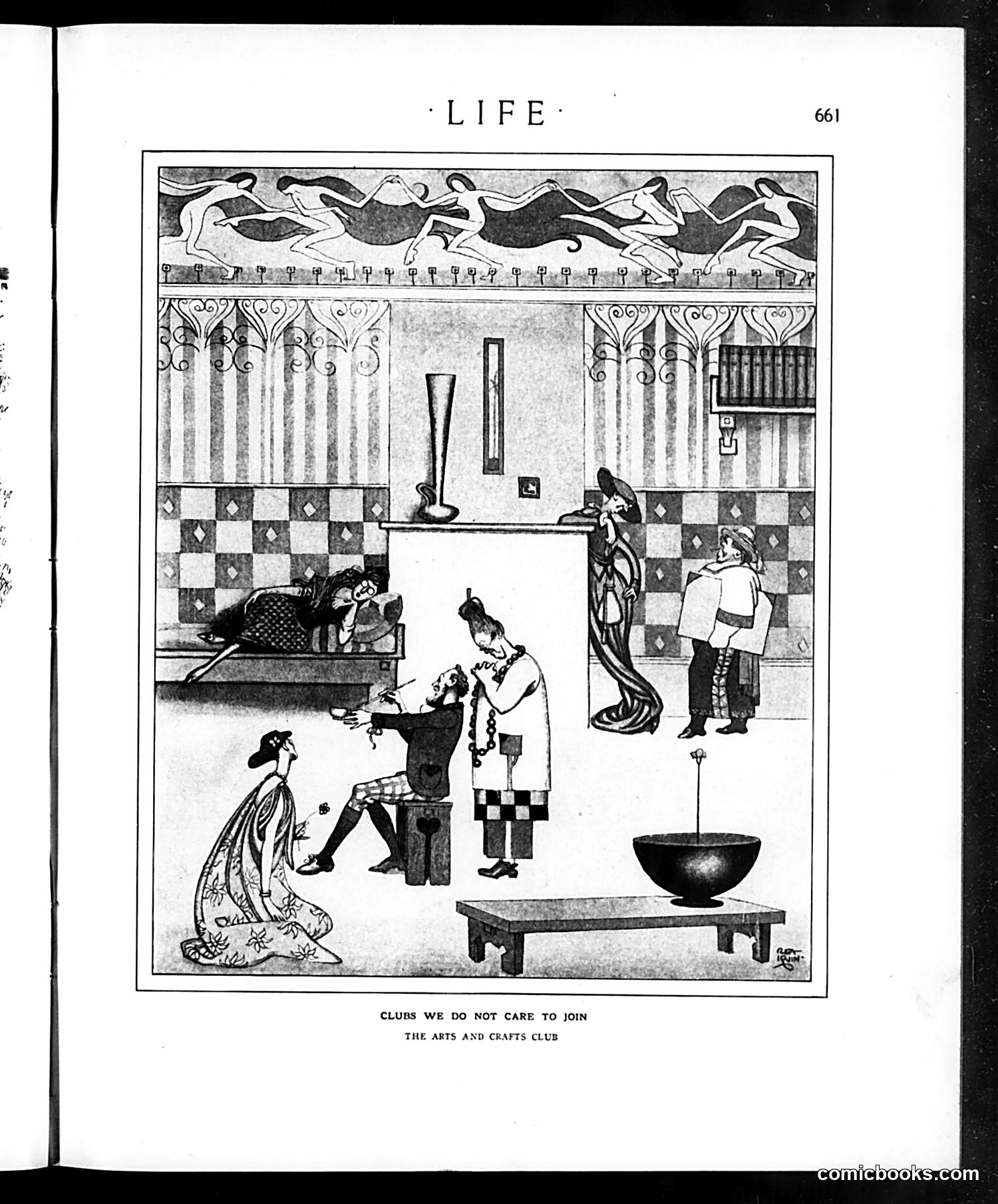
This satirical cartoon mocks the Arts and Crafts Club as pretentious and affected. The illustration depicts an absurdly stylized interior—all decorative excess with ornamental columns, checkered floors, and wall hangings—where elaborately dressed figures pose awkwardly among artistic objects: vases, sculptures, and hanging fabrics. The satire targets what the cartoonist saw as the club's affectation and impracticality. Members are shown in exaggerated, theatrical dress, seemingly more concerned with aesthetic posturing than genuine creativity or purpose. The cluttered, over-decorated space suggests that members prioritize appearance over substance. The title's dismissive tone ("clubs we do not care to join") implies Life magazine's skepticism toward such elite artistic societies, viewing them as exclusionary and frivolously concerned with style rather than meaningful artistic or social contribution.
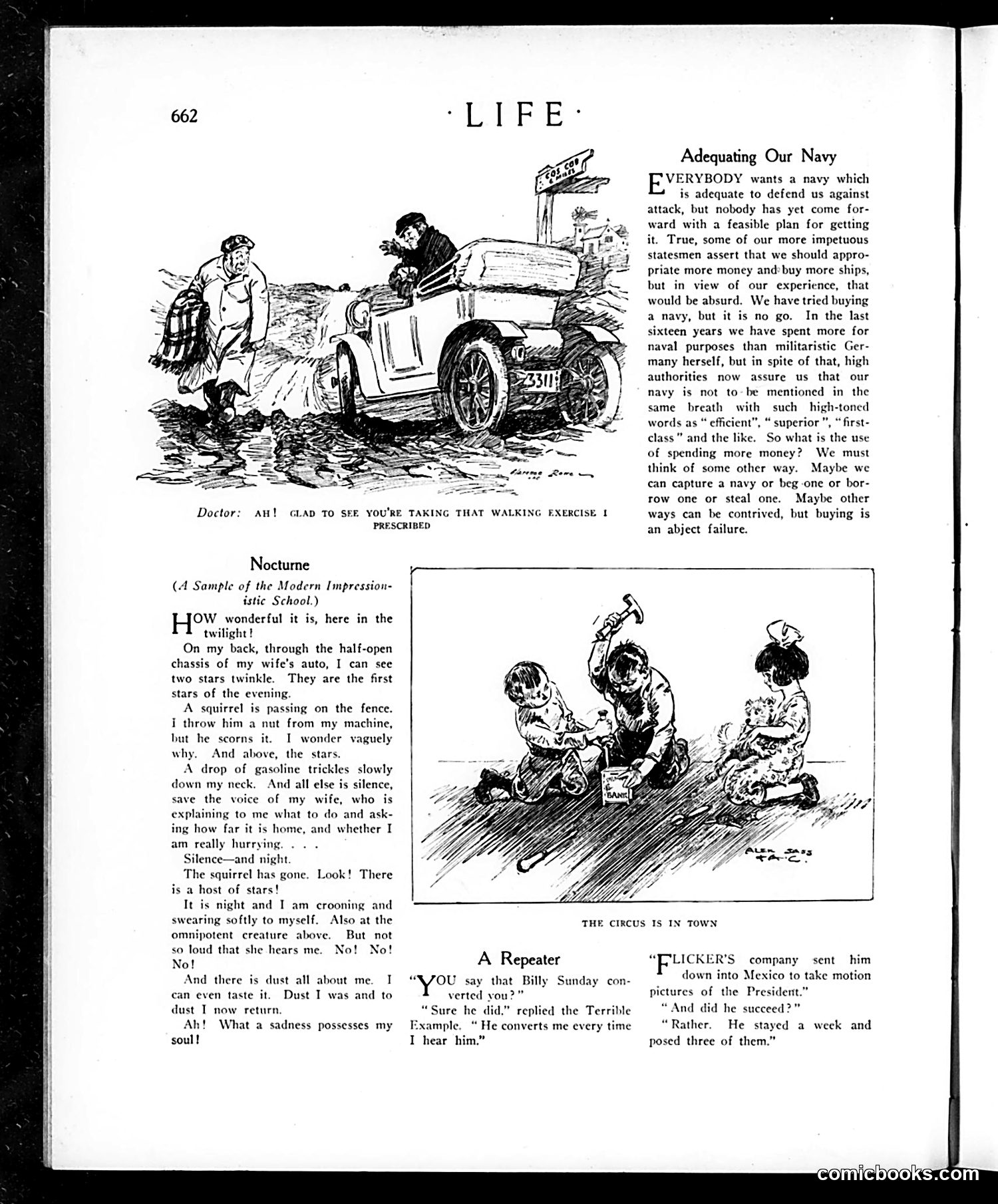
This page contains three satirical pieces typical of early 20th-century American humor: **Top cartoon**: A doctor observes a man stuck in mud with his car, remarking he's "glad" the patient is taking prescribed walking exercise—satirizing the irony that the man is clearly stranded rather than healthily exercising. **"Nocturne"**: Parodies pretentious modernist/impressionistic poetry by describing a mundane, uncomfortable car ride (stuck in his wife's automobile with gasoline dripping on him, dust everywhere) in flowery, overly-serious language. The satire mocks artistic movements that treat trivial subjects as profound. **"Adequating Our Navy"**: A political opinion piece arguing that simply spending more money on naval buildup is wasteful—the U.S. has spent more than Germany but still has an inadequate navy. The author sarcastically suggests alternative methods (capturing, borrowing, or stealing ships) rather than continued spending, critiquing government military policy. **"A Repeater"**: A brief joke about a evangelical preacher who "converts" a chronic sinner repeatedly because the man keeps relapsing into sin.
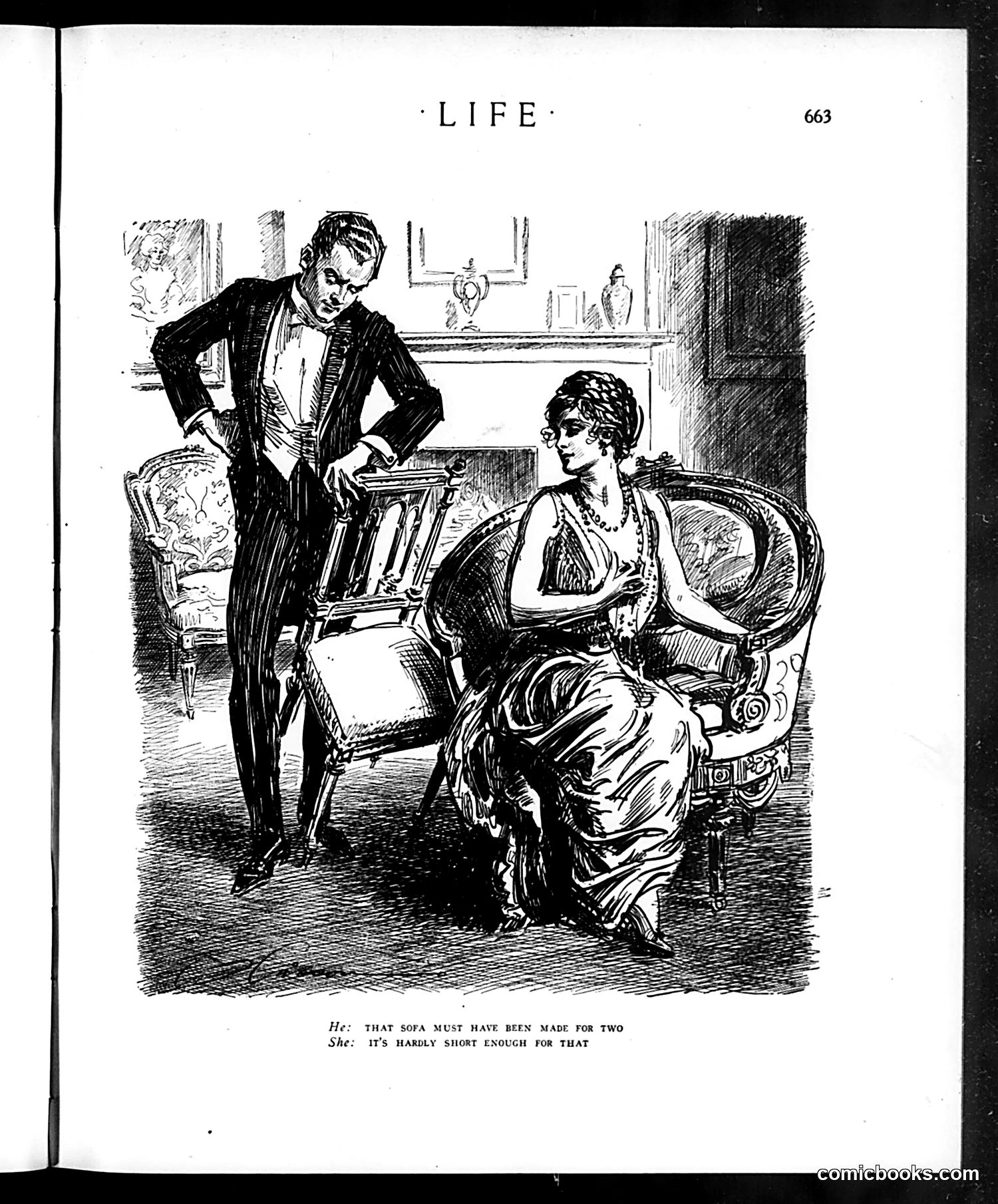
This is a humorous domestic scene from Life magazine (page 663). A well-dressed man stands beside a seated woman on an ornate sofa, commenting that the furniture "must have been made for two." The woman retorts that it's "hardly short enough for that"—implying the sofa is too large, and by extension, making a cutting remark about the man's physical stature or importance. The joke relies on a sharp-witted comeback: she's insulting him by suggesting he takes up so little space that even a small sofa would be too big for him alone. It's a satirical jab at masculine ego, typical of Life's early 20th-century humor targeting marital dynamics and social pretensions among the upper classes. The formal setting and fashionable dress emphasize the genteel context of their banter.
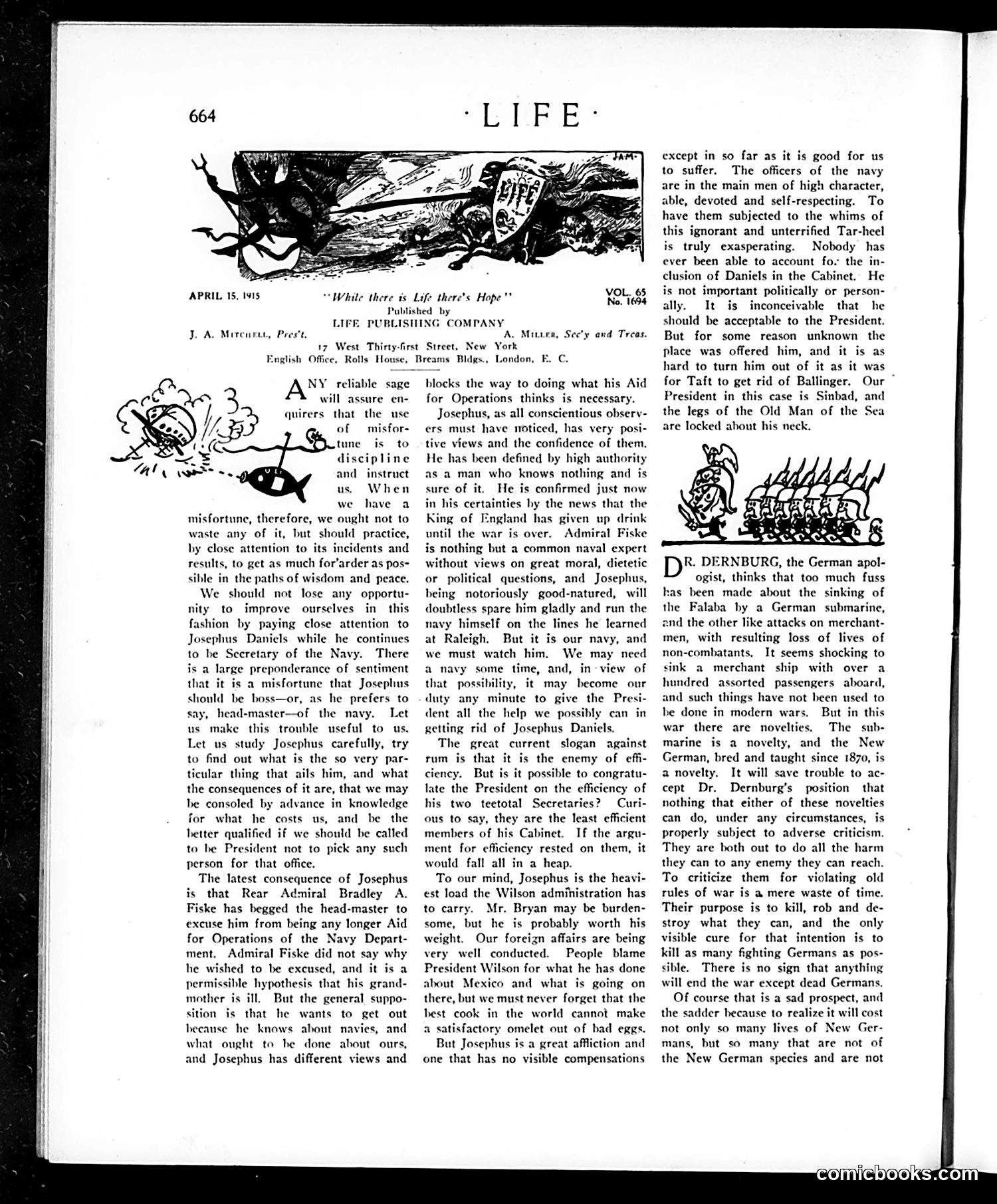
This editorial attacks **Josephus Daniels**, Secretary of the Navy under President Wilson. The piece criticizes Daniels' management of the Navy Department, using his forced resignation of **Rear Admiral Bradley A. Fiske** (Aid for Operations) as the primary example. The satire's core point: Daniels is portrayed as confidently incompetent—"a man who knows nothing and is sure of it"—blocking experienced naval officers like Fiske from doing their jobs. The author suggests Fiske resigned because Daniels' ideological certainties (the editorial references his teetotalism, linking him to Wilson's Secretary of State William Jennings Bryan) override practical naval expertise. The crude cartoon at top left depicts a demonic figure, likely representing misfortune or poor leadership. The editorial frames Daniels as a cautionary lesson in bad administration, warning readers to "study Josephus carefully" to learn what *not* to do in leadership. The sarcastic final section mocks teetotal Secretaries as paradoxically inefficient despite prohibition rhetoric.
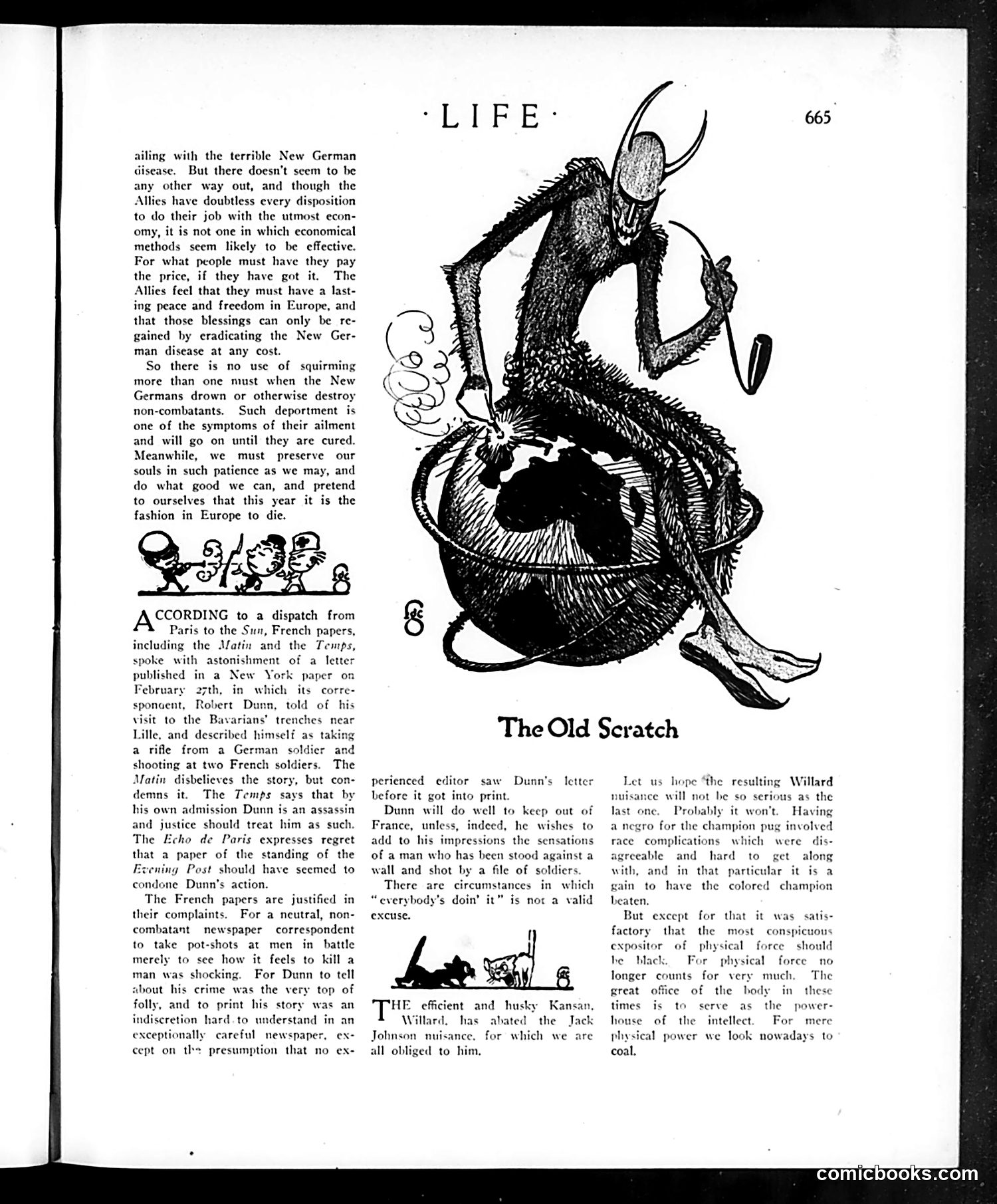
This page contains two separate satirical pieces: **"The Old Scratch"** (main cartoon): The grotesque demon figure represents "New German disease"—a metaphor for German militarism and aggression during WWI. The text argues that while morally troubling, the Allies must wage total war to eradicate this threat, as economical methods won't work. The satire criticizes squeamishness about warfare's brutality as naive given the stakes. **Robert Dunn story**: A correspondent admitted shooting French soldiers "to see how it feels." French papers condemned this as murderous. Life satirizes his admission as shockingly foolish—boasting about a crime he could be executed for. **Willard boxing note**: Brief commentary on boxer Jess Willard defeating Jack Johnson, expressing hope the new champion won't create "race complications" like his predecessor, while noting physical force matters less than intellect in modern times. The page reflects WWI-era American attitudes: justifying harsh warfare, condemning neutral observers who cross ethical lines, and contemporary racial attitudes.
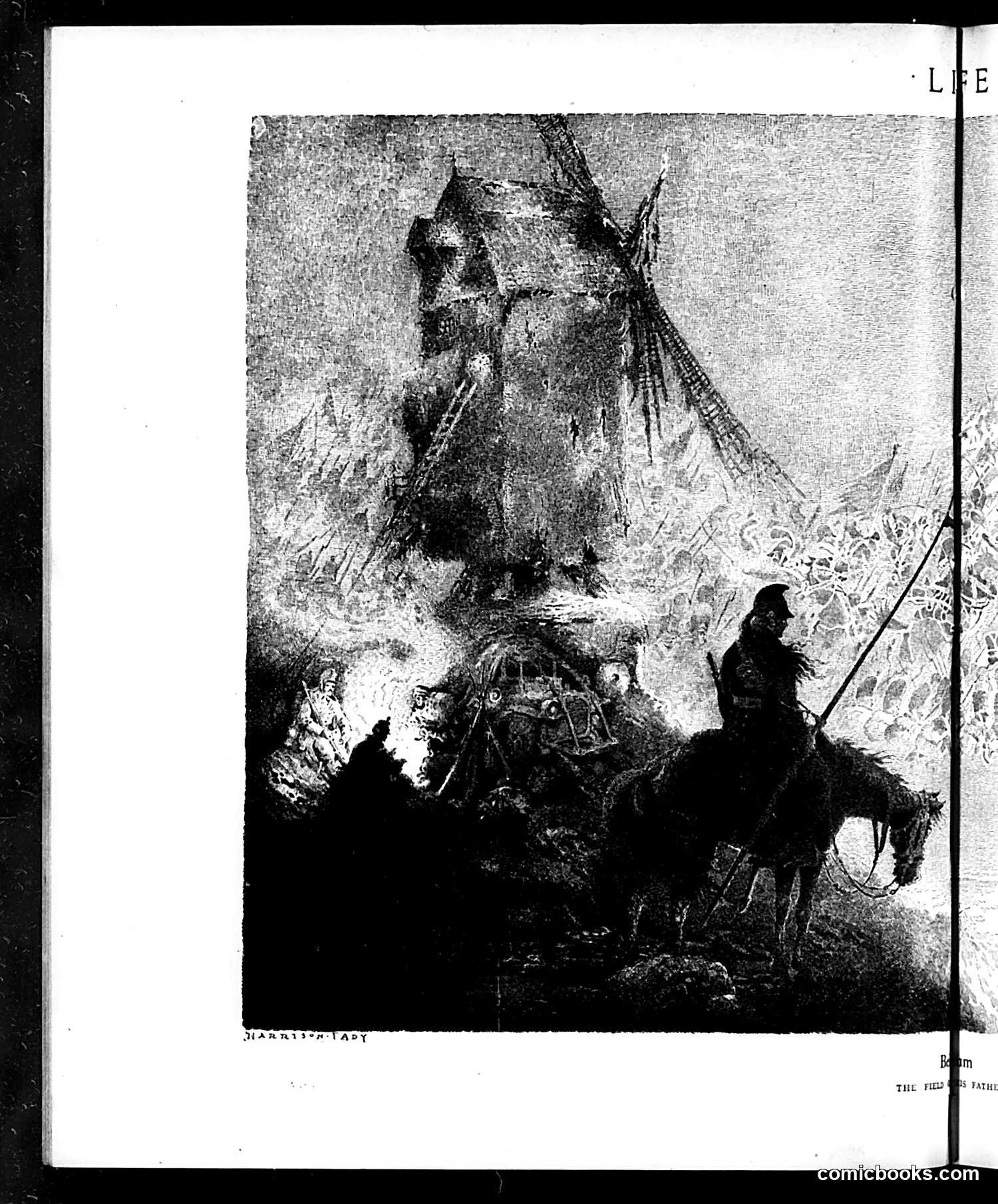
This appears to be an illustration from *Life* magazine showing a dramatic medieval or fantasy scene. The image depicts a large, imposing figure (possibly a wizard, sorcerer, or supernatural being) looming in the background with an elaborate headdress or crown. In the foreground, silhouetted figures on horseback and on foot appear to be confronting or fleeing from this apparition. The text reference "HARRUSELADY" is unclear—it may be a character name, a misspelling, or OCR error. Without additional context about the specific publication date or accompanying article text, the exact satirical or political target remains uncertain. The style suggests early-to-mid 20th century illustration, but the precise commentary is unclear from the image alone.
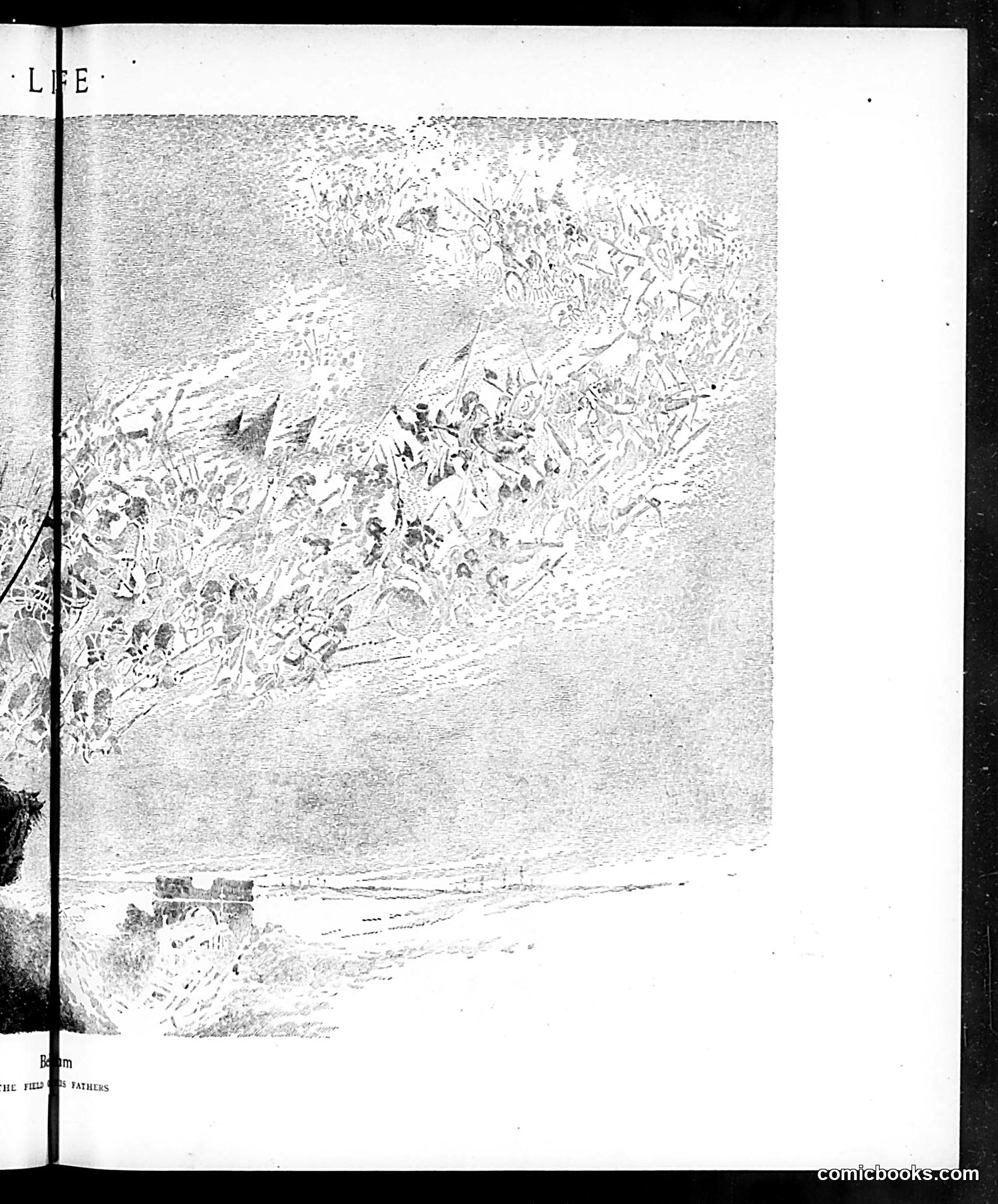
This page from *Life* magazine appears to be primarily a photograph rather than a political cartoon. The image shows an aerial or elevated view of a mountainous or hilly terrain with scattered vegetation and what looks like a winding path or road. The photograph quality is grainy, typical of early-to-mid 20th century printing. The page header reads "LIFE" and there is partial text visible at the bottom mentioning "THE HILLS" and what appears to be "FATHERS," though the complete caption is cut off and unclear. Without the full caption or clearer context, I cannot definitively identify what specific location, event, or political reference this photograph illustrates. The image alone does not convey obvious satirical intent characteristic of *Life* magazine's typical content.
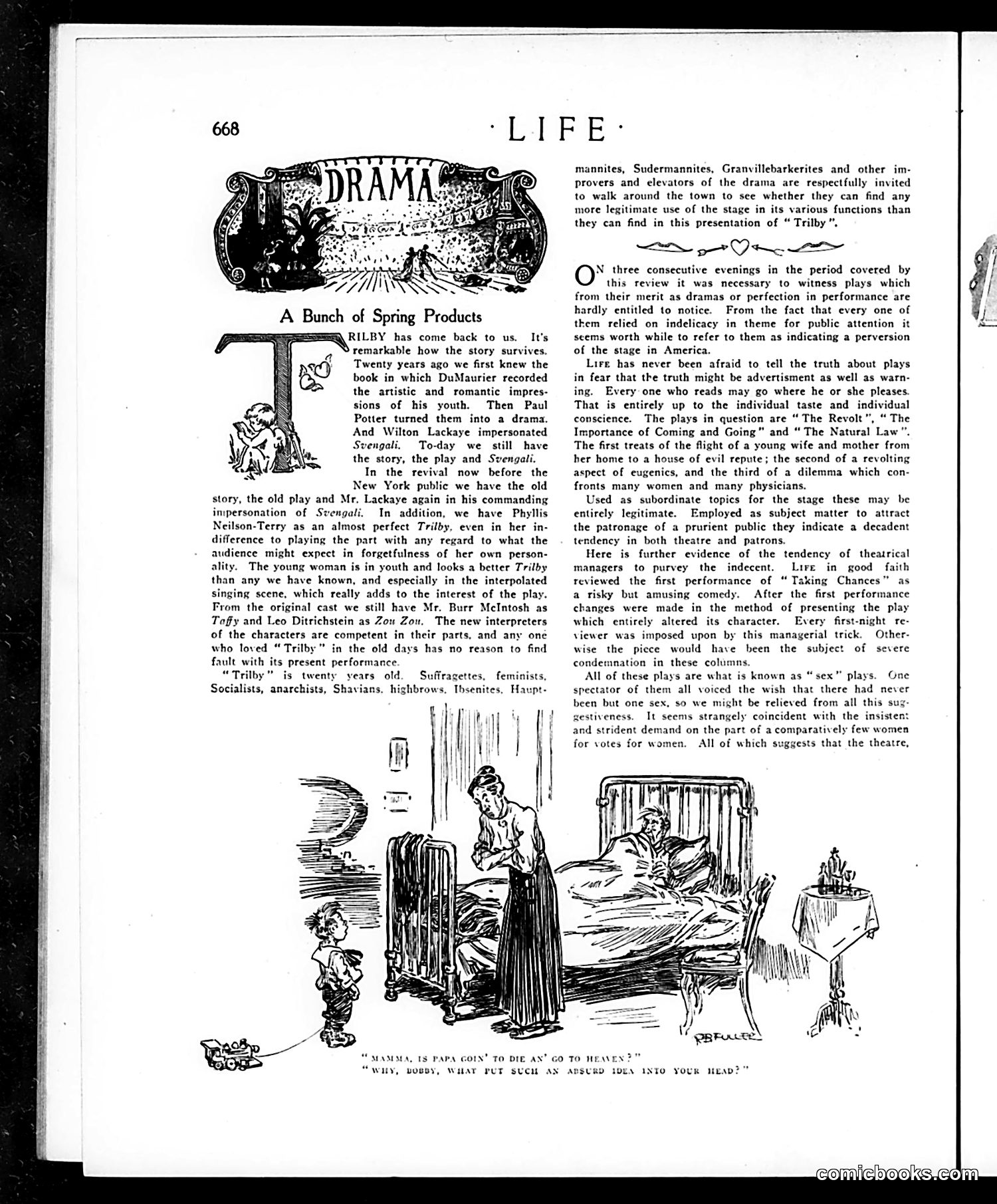
This page reviews theatrical productions, focusing on a revival of "Trilby" (a 20-year-old play based on du Maurier's novel) and condemning three contemporary plays for their indecent subject matter. **The Trilby section** praises the enduring play's revival, noting actor Wilton Lackaye reprises his famous role as Svengali, and young actress Phyllis Neilson-Terry plays Trilby effectively. **The satirical cartoon** (bottom) depicts a sickbed scene with dialogue—"Mama, is Papa goin' to die an' go to heaven?" / "Why, Bobby, what put such an absurd idea into your head?"—seemingly mocking moral instruction or sentimental Victorian sentimentality. **The main critique** attacks three current "sex plays" ("The Revolt," "The Importance of Coming and Going," "The Natural Law") for exploiting indecent topics—infidelity, eugenics, and reproductive dilemmas—to attract prurient audiences rather than serve legitimate dramatic purposes. Life condemns theatrical managers for pandering to base interests.
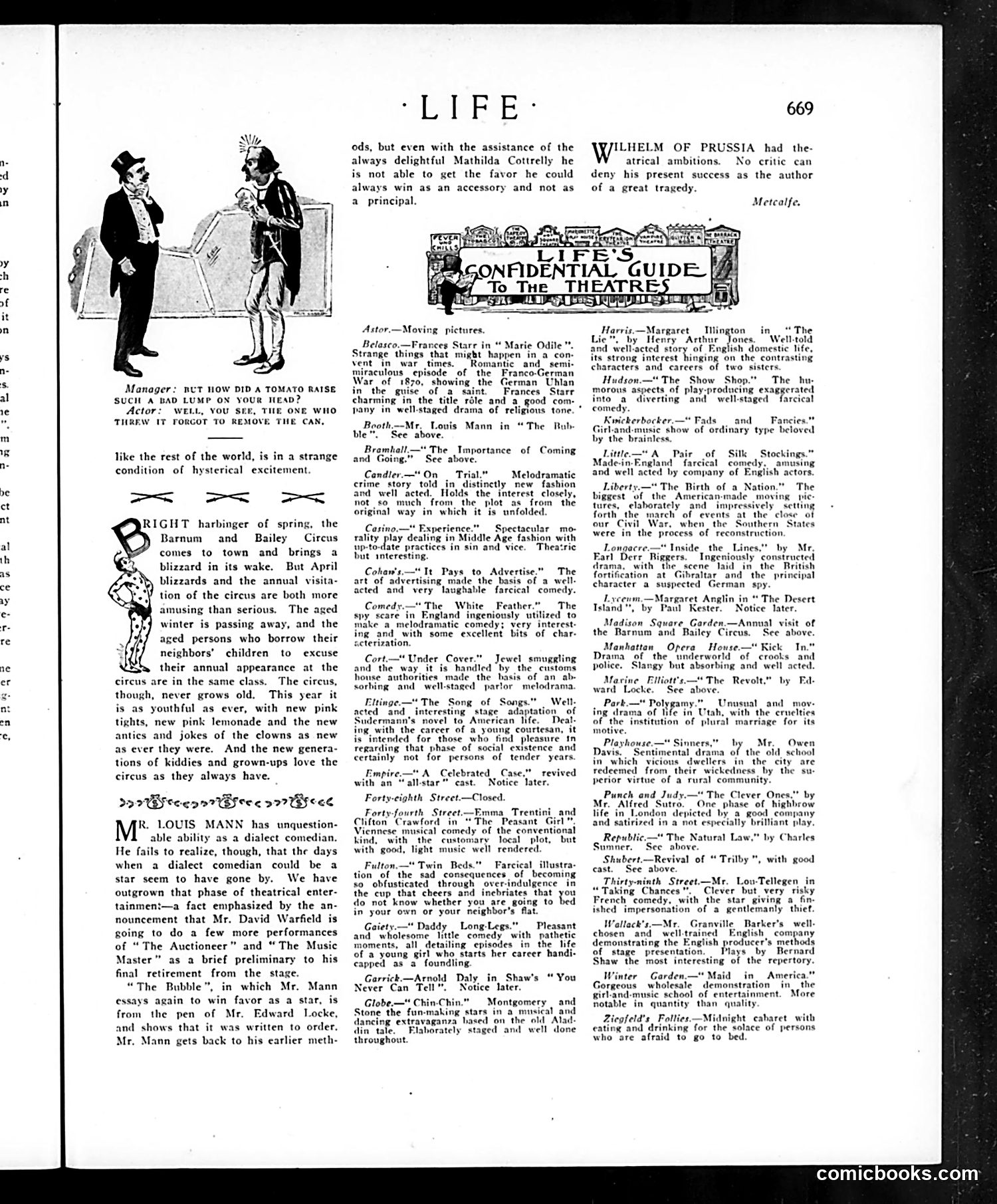
The small cartoon at the top depicts a theatrical exchange: an actor has a large lump on his head, and a manager asks how a tomato caused such injury. The actor replies the person who threw it "forgot to remove the can"—the joke being that the tomato was still in its tin can when thrown, making it a heavy projectile rather than just fruit. This satirizes **audience reactions to poor theatrical performances**. Throwing vegetables at bad actors was a real (if exaggerated) convention of disapproval in early 20th-century theaters. The humor lies in the absurdity of the cause and the actor's deadpan acceptance of this occupational hazard. The rest of the page is a "Confidential Guide to the Theatres"—theater reviews listing current Broadway productions and their merits or flaws. This context shows the cartoon as a lighthearted jab at theater culture during a period when live performance was dominant entertainment and audience participation (including heckling or throwing objects) was an understood, if rowdy, aspect of theater-going.
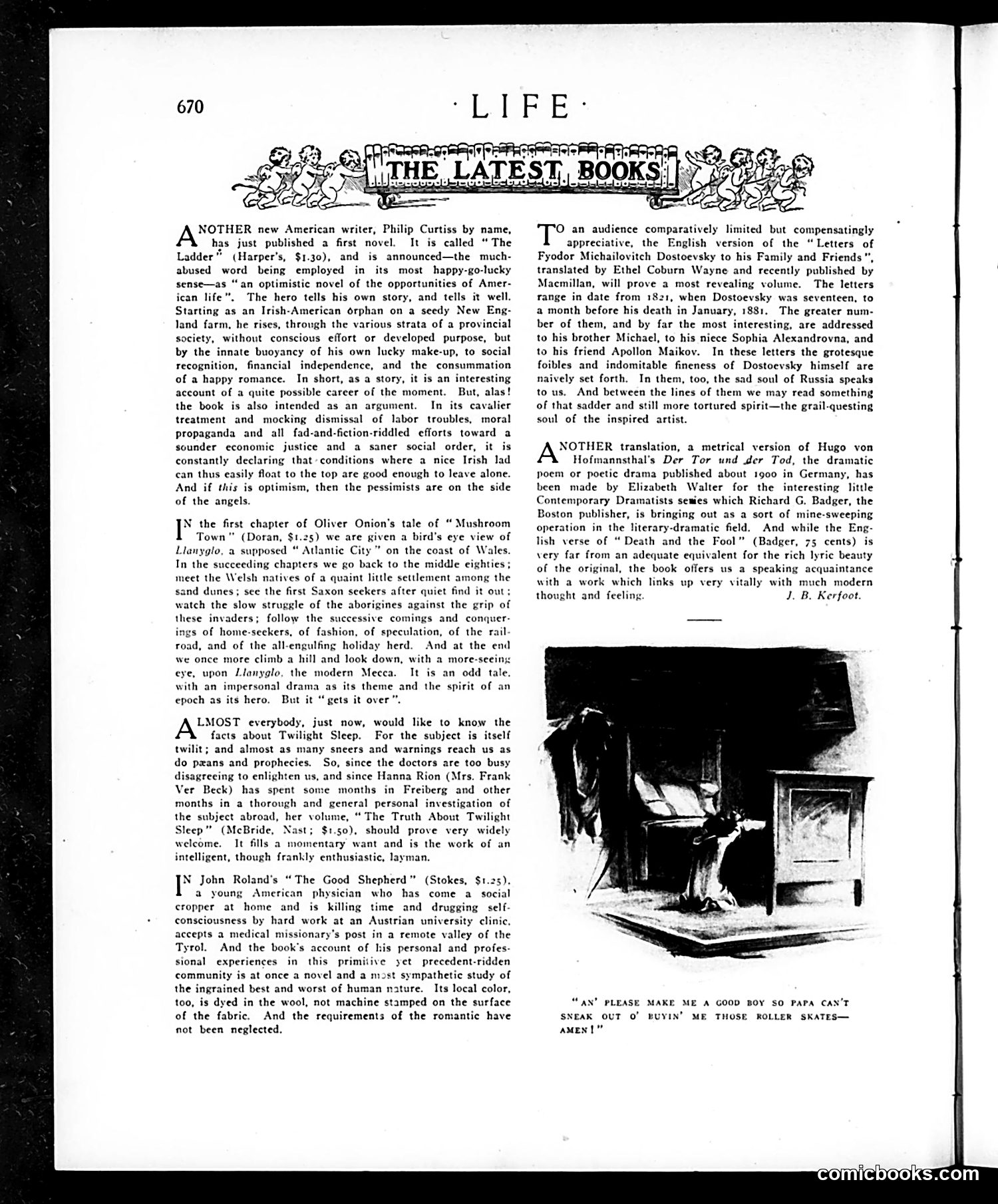
This is a book review section from *Life* magazine featuring five new novels. The only illustration is a captioned drawing (bottom right) showing a figure in period dress, with the caption: "AN' PLEASE MAKE ME A GOOD BOY SO PAPA CAN'T SNEAK OUT O' BUYIN' ME THOSE ROLLER SKATES—AMEN!" The cartoon humorously depicts a child's prayer—the child recognizes their father's tendency to avoid purchases by claiming the child isn't well-behaved, so the child prays to become good specifically to eliminate that excuse. It's a commentary on parental parsimony and childhood manipulation tactics, showing the child's shrewd understanding of family dynamics. The reviews themselves critique books on social mobility, Welsh history, medical innovation ("Twilight Sleep"), missionary work, and Dostoevsky's correspondence—typical highbrow literary fare of the era.
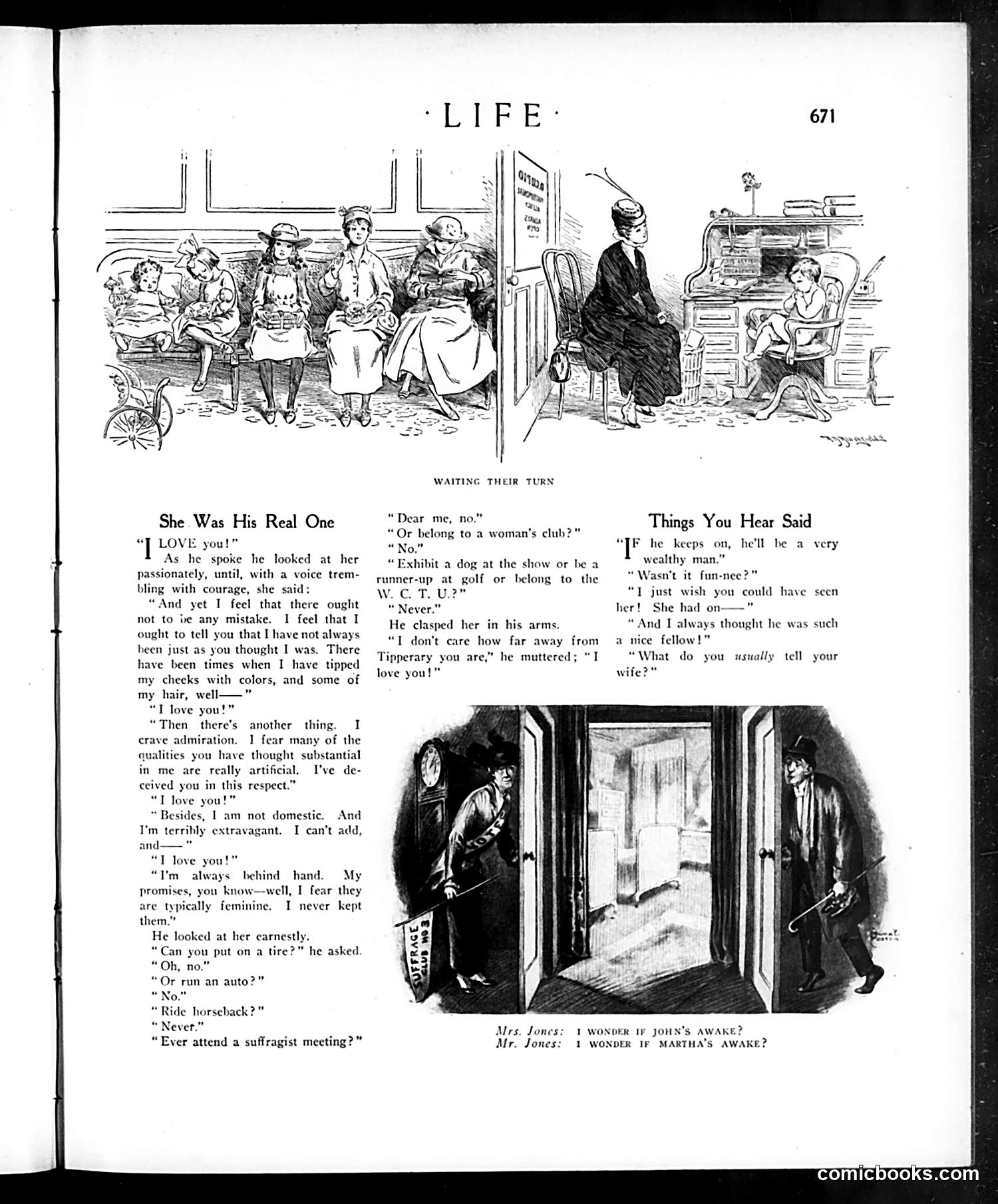
This page satirizes early 20th-century gender roles and the "New Woman" movement. **"She Was His Real One"** mocks modern feminist aspirations. A woman confesses various "deceits"—wearing makeup, being extravagant, breaking promises—expecting rejection. Instead, the man's dealbreakers are entirely practical: Can she fix a tire? Drive an auto? Ride horseback? Attend a suffragist meeting or join a woman's club? When she answers "no" to all, he declares his love, implying that the "real" woman he wants is one who *hasn't* adopted modern, independent behaviors. **"Things You Hear Said"** presents snippets of gossip, with the final panel showing a couple in separate beds wondering if the other is awake—a subtle commentary on marital disconnection. **"Waiting Their Turn"** (top illustration) depicts women in a doctor's or professional's waiting room, likely satirizing women seeking modern opportunities. The satire targets both progressive women's aspirations and traditional male expectations—suggesting incompatibility between the sexes regarding modernity.
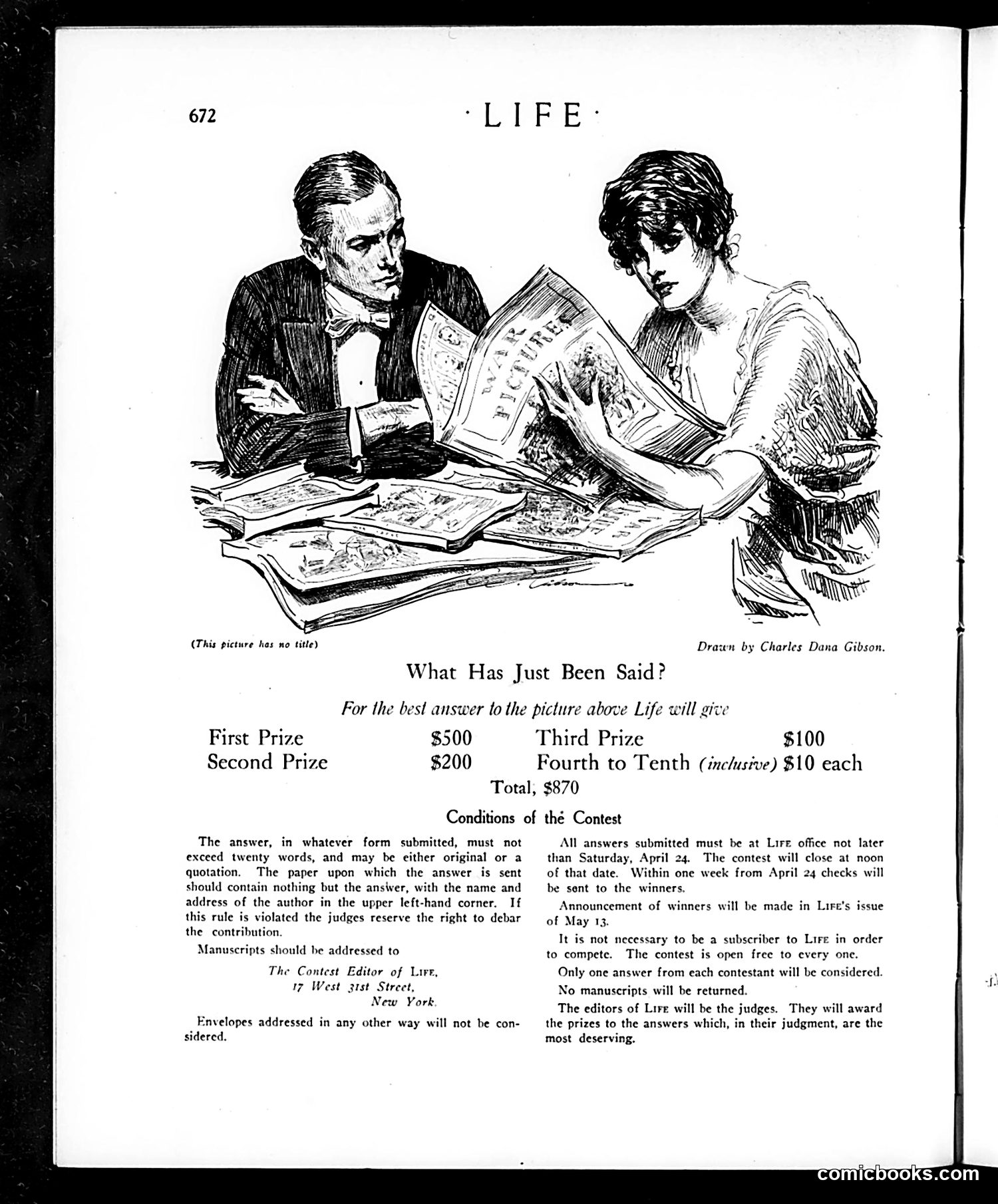
This is a **caption contest** from Life magazine, drawn by the famous illustrator Charles Dana Gibson. The sketch depicts a well-dressed man and woman examining illustrated magazines or publications together at a table. The contest asks readers to supply dialogue—what has "just been said" between these two figures—in 20 words or fewer. The image itself contains no obvious political satire or caricature of identifiable public figures. Instead, it's a genteel domestic scene typical of Gibson's "Gibson Girl" era illustrations, showing middle-class leisure activities. The humor likely plays on the ambiguity of their interaction: are they sharing innocent aesthetic appreciation, or is there flirtation, disagreement, or social commentary implied in their body language and expressions? The substantial prize money ($870 total) indicates Life's confidence in reader engagement with this participatory format.
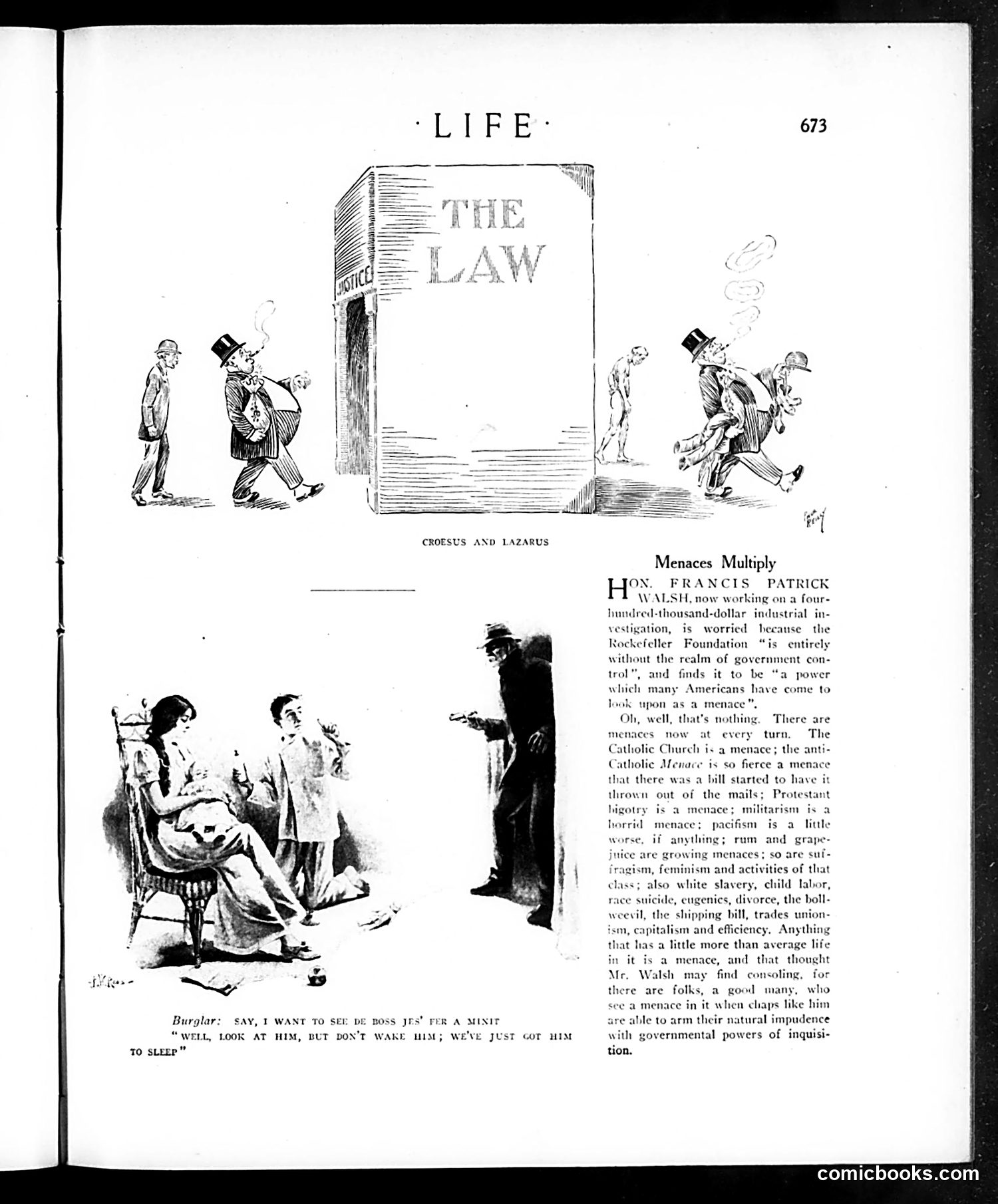
This Life magazine article mocks reformer Francis Patrick Walsh's investigation of the Rockefeller Foundation, which he views as an uncontrolled "menace" to government authority. The satire's point: early 20th-century America was obsessed with identifying "menaces"—the article lists absurdly disparate threats including the Catholic Church, pacifism, rum, feminism, child labor, eugenics, capitalism, and trades unionism. By cataloging this bewildering array, the piece ridicules the era's reflexive panic about social dangers. The bottom cartoon (captioned "Croesus and Lazarus") depicts a burglar requesting to see "the boss" briefly while instructing not to wake him—he's just gotten the boss to sleep. This likely suggests wealthy industrialists control law enforcement, rendering it useless against actual crime. The underlying critique: American reformers and authorities scatter their attention across countless supposed threats while real corruption flourishes unchecked.
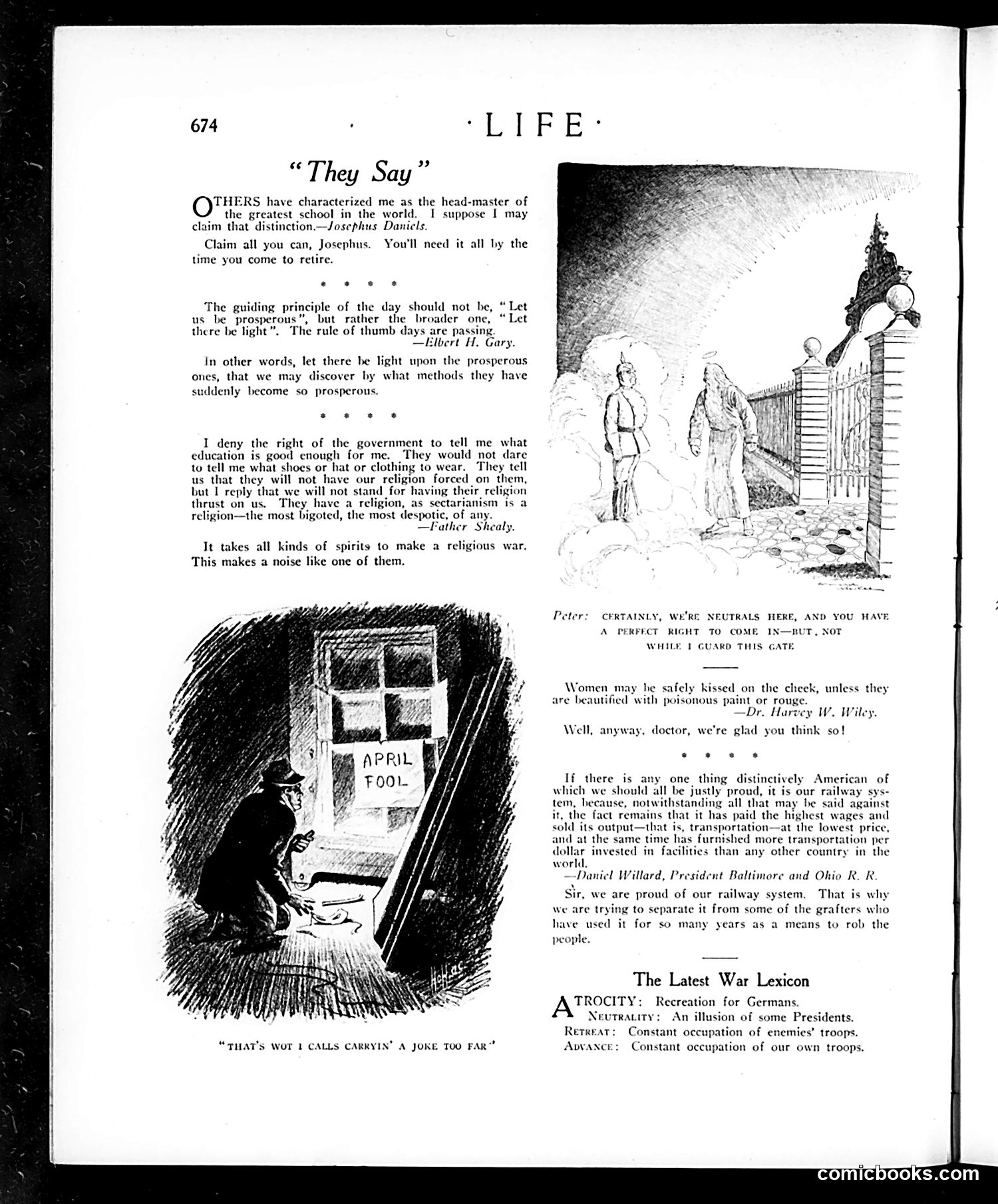
This page contains several editorial comments mocking prominent figures' self-serving statements. Josephus Daniels (Secretary of the Navy) boasts about leading the "greatest school in the world"—Life sarcastically replies he'll need that reputation when he retires, suggesting his actual legacy won't be impressive. The "April Fool" cartoon shows a figure looking foolishly at a calendar, captioning a joke as "carrying a joke too far"—likely referencing wartime absurdities or political contradictions. The right-side illustration depicts soldiers at a gate labeled with Peter's quote about "neutrals," alluding to America's contested neutrality during WWI (the U.S. entered in 1917). The "Latest War Lexicon" at bottom sardonically redefines military terms—"Atrocity" as "Recreation for Germans" suggests German war crimes, while the neutrality entry mocks Presidents' claims of impartiality. Overall, the page satirizes government officials' hypocrisy and America's complicated position regarding the ongoing European war.
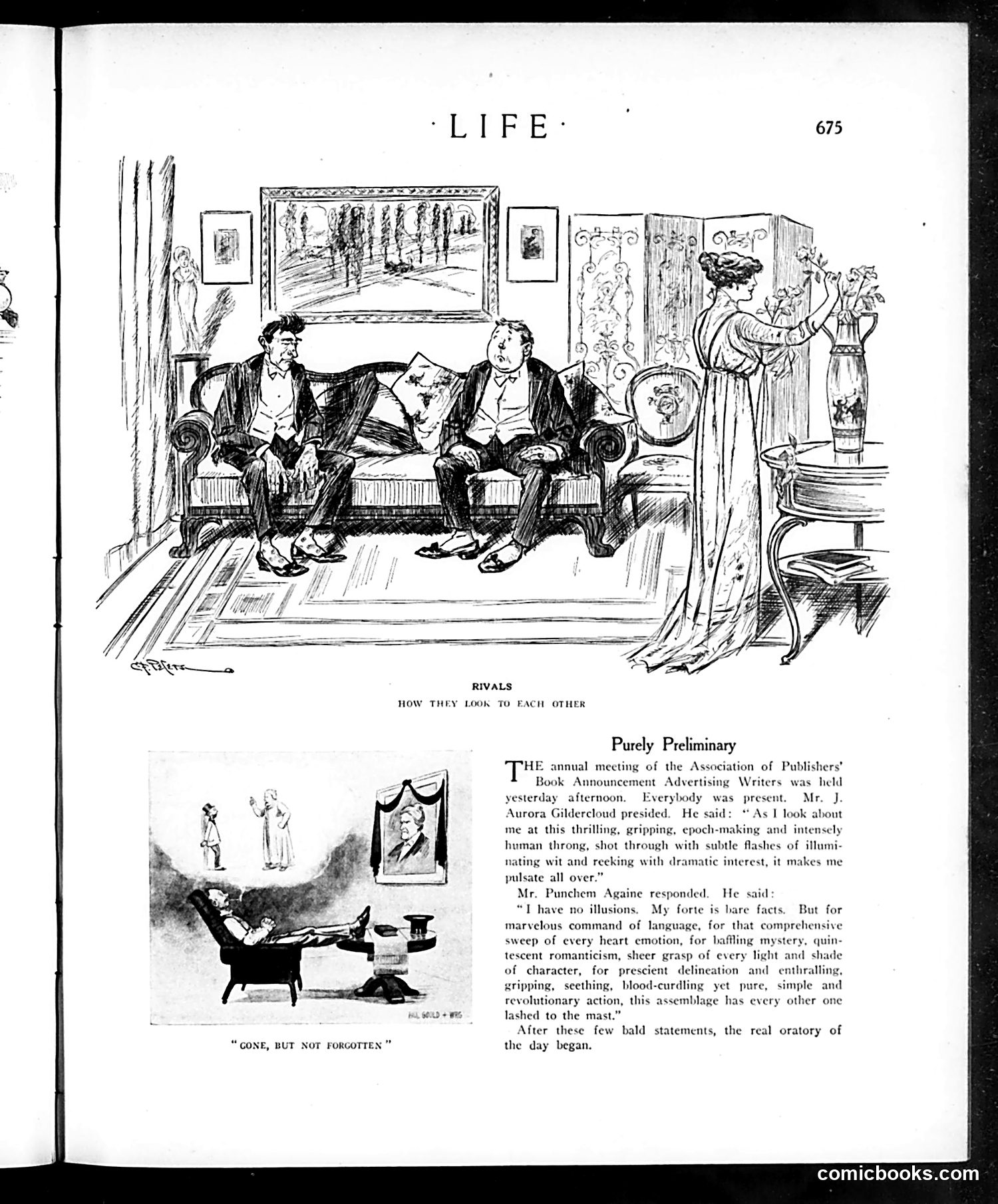
This page satirizes the pomposity and mutual flattery of advertising copywriters in the publishing industry. The top cartoon "Rivals—How They Look to Each Other" depicts two men on a sofa eyeing each other suspiciously while a woman arranges flowers, contrasting their actual rivalry with the text below. "Purely Preliminary" mocks their self-aggrandizing speeches at a professional meeting. Aurora Gildercloud and Punchem Againe (names suggesting flowery exaggeration and aggressive competitiveness) deliver absurdly overwrought tributes to their profession, using grandiose language like "blood-curdling," "revolutionary," and "lashed to the mast" to describe ordinary book advertising work. The satire targets the gap between substance and self-importance: these copywriters inflate trivial commercial work into epic, emotionally profound achievement. The irony is that their actual "rivalry" is masked by insincere flattery—each praises the profession collectively while implicitly positioning themselves as superior. The bottom cartoon "Gone, But Not Forgotten" reinforces the theme of pretentious nostalgia in advertising copy.
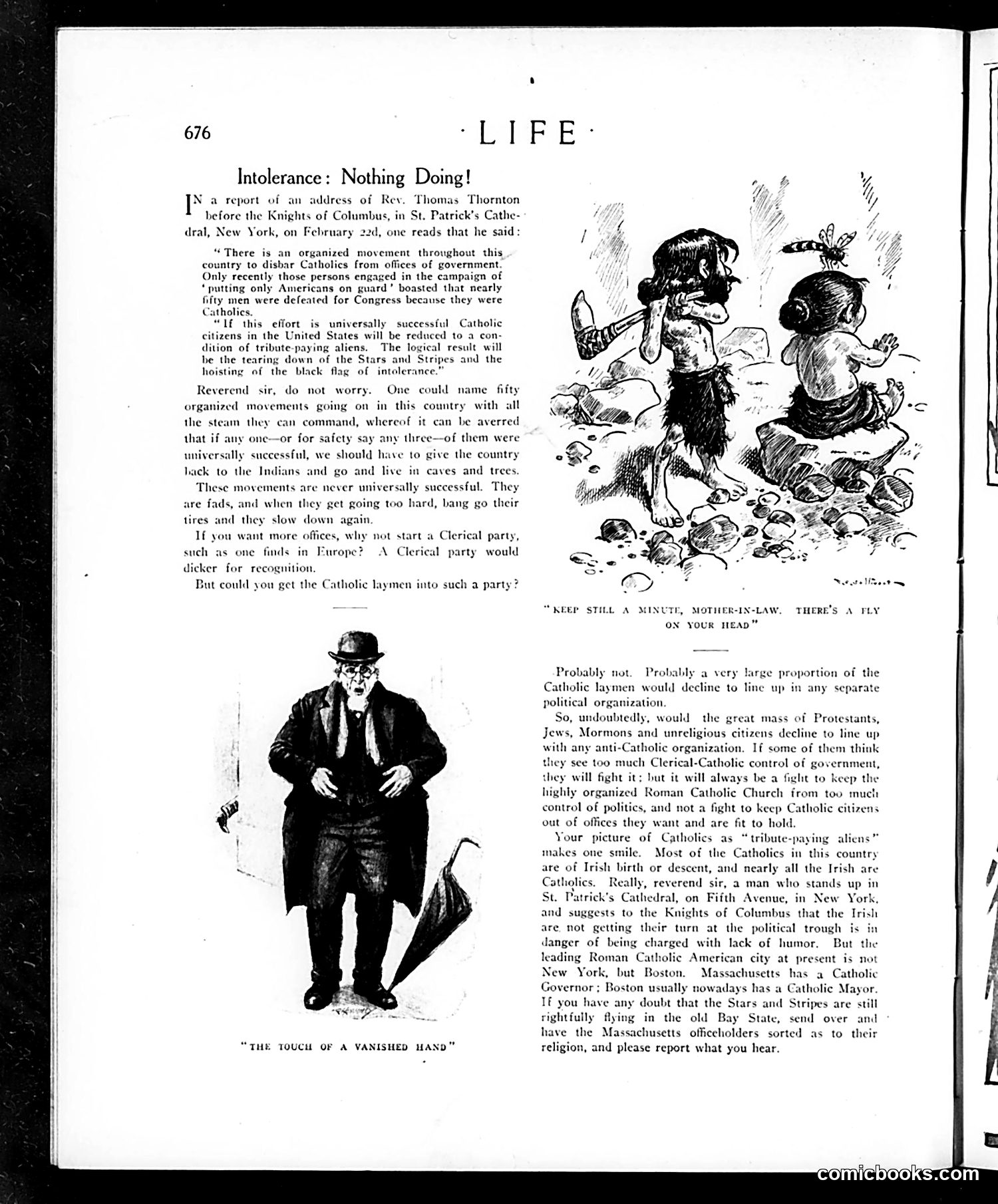
This page satirizes Catholic anxieties about anti-Catholic discrimination in early 20th-century America. Rev. Thomas Thornton claimed an organized campaign was barring Catholics from government office, warning of Catholics reduced to "tribute-paying aliens" if this succeeded. The magazine's response is dismissive mockery. The cartoons show a figure labeled "The Touch of a Vanished Hand" (suggesting outdated concerns) and a domestic scene captioned about keeping quiet—implying the complaints are exaggerated or tedious. The text argues Catholics are already well-represented politically, particularly in Boston, which has a Catholic governor and mayor. It suggests Catholics, like Protestants and Jews, won't form separate political blocs anyway, and that complaints about being excluded from "the political trough" are absurd given Irish-American political dominance. The satire's point: Catholic political power is real and growing, so claims of systematic exclusion are either false or hypocritical.
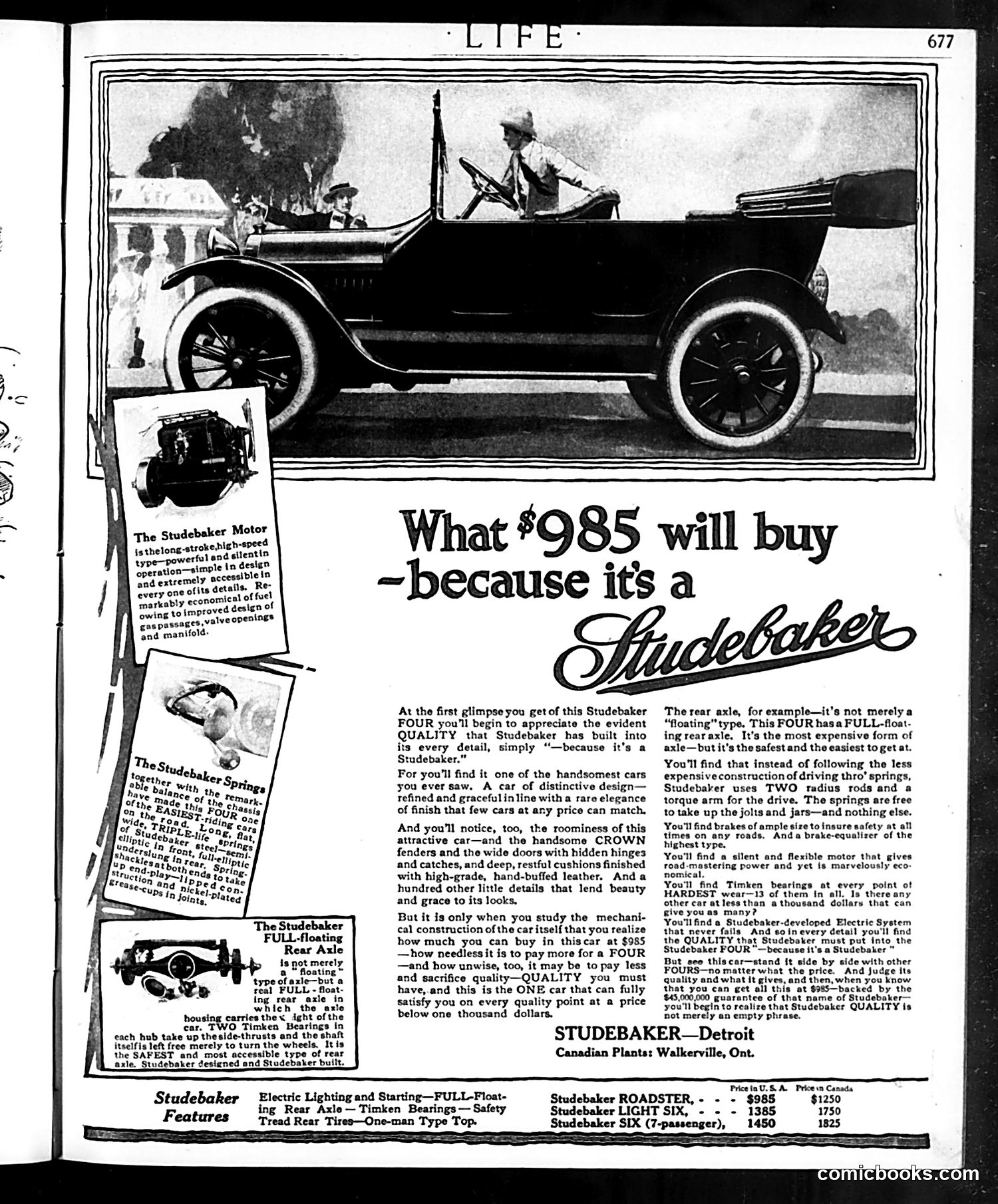
This is primarily a **Studebaker automobile advertisement**, not a political cartoon. It appeared in *Life* magazine (page 677) and promotes the Studebaker Four automobile priced at $985. The ad's central claim is that this car delivers exceptional "QUALITY" at an affordable price—emphasizing engineering details like the full-floating rear axle, Timken bearings, electric starting, and silent motor as proof that buyers needn't overpay for competitors' cars or settle for cheaper alternatives. The left sidebar includes technical diagrams and specifications of mechanical features. The main illustration shows the car in a scenic setting with well-dressed occupants, a common advertising trope suggesting the vehicle appeals to respectable, affluent consumers. For modern readers: this reflects early automotive marketing's emphasis on mechanical innovation and middle-class aspiration—selling reliability and status within budget constraints, a pitch that remains familiar today.
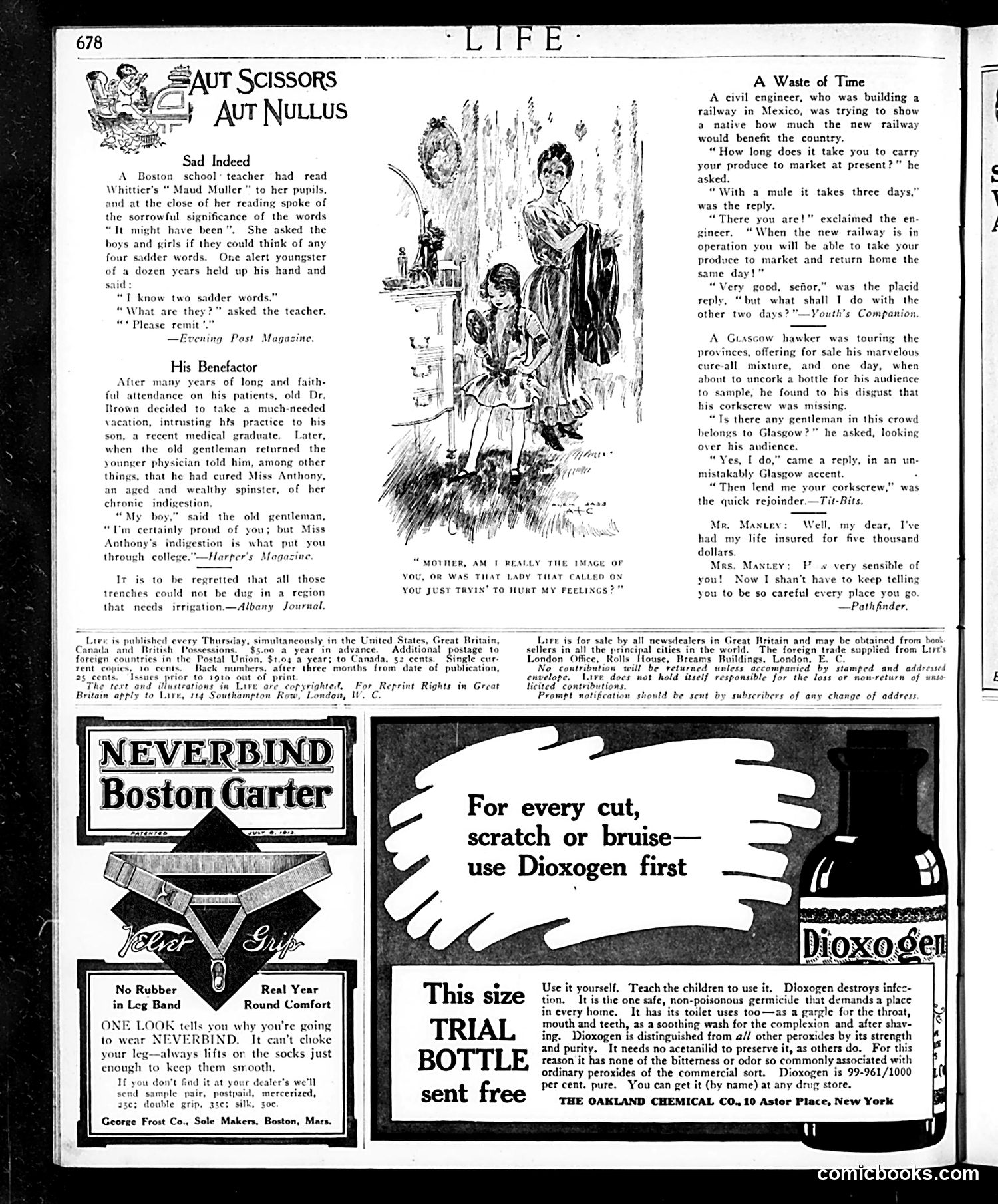
This page contains several short humorous anecdotes typical of Life's satirical style: **"A Waste of Time"** mocks Mexican attitudes toward progress. A civil engineer building a railway boasts of efficiency, but a native replies that with three days saved per trip, he'd have "two days" of leisure—implying the locals see no value in productivity gains. **"His Benefactor"** presents gentle irony: a young doctor cures a wealthy spinster's chronic indigestion, then his father reveals this illness—not the cure—paid for the son's college education, suggesting the patient's ongoing ailment was financially valuable. **The Glasgow anecdote** plays on local pride and quick thinking: when a hawker needs a corkscrew, he asks "Is there a gentleman from Glasgow?" and when one responds, immediately requests to borrow his corkscrew—a jab at Scottish frugality. **"Mr. Manley"** depicts marital comedy: a husband insures himself for five thousand dollars; his wife praises his sense while warning him to be careful, implying she'd benefit from his death. The page balances these brief comedic sketches with product advertisements (Nevermind garter, Dioxogen antiseptic).
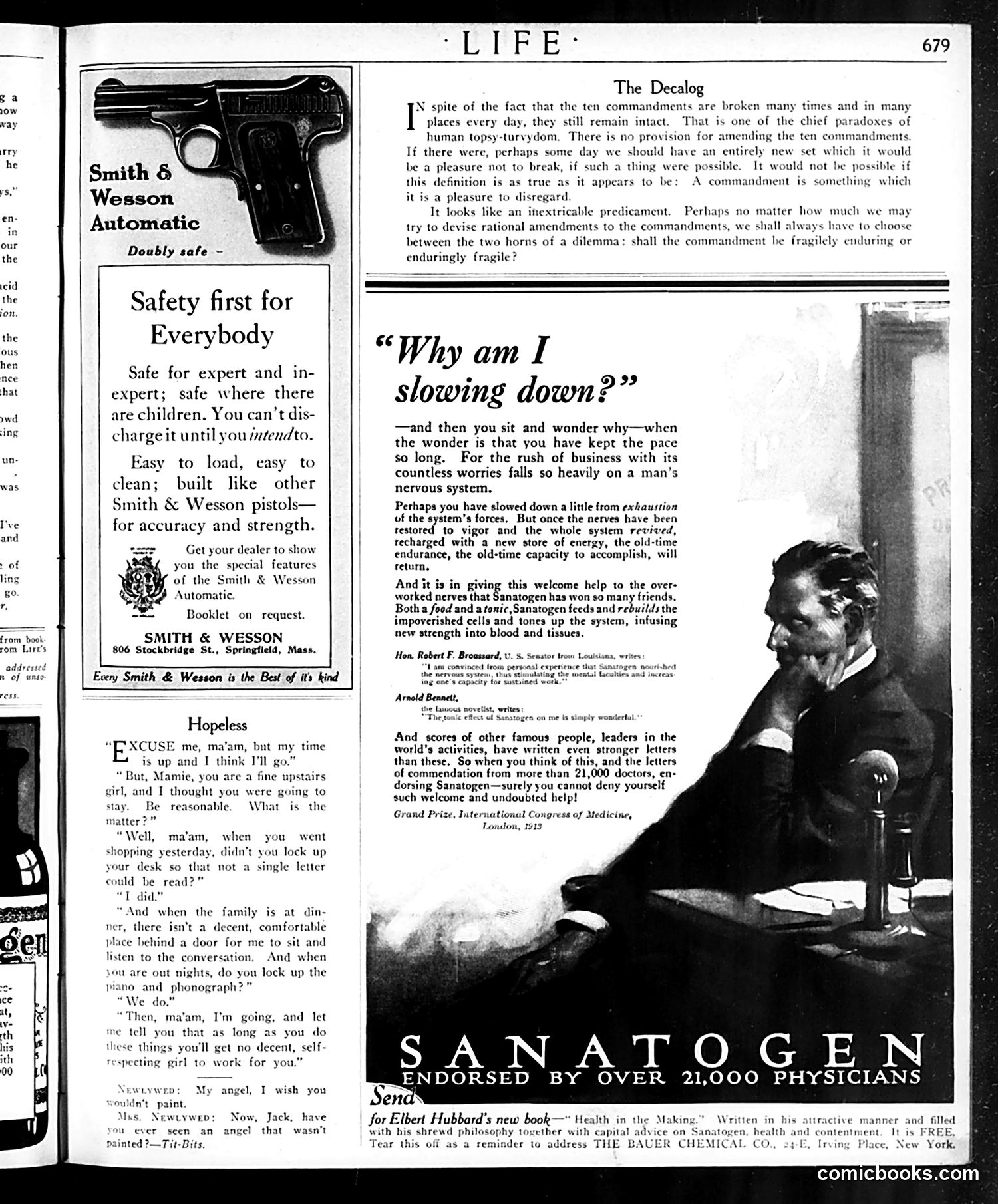
This magazine page contains two distinct elements: **"The Decalog" essay** (top right) presents a philosophical paradox: the Ten Commandments remain unbroken in their definition despite being violated constantly. The writer observes that we cannot rationally amend them without destroying either their permanence or their moral authority—a clever observation on the futility of revising absolutes. **"Hopeless" comic sketch** (bottom left) depicts class tensions of the era through a domestic servant's complaint. The servant demands to leave because her employer—despite entrusting her access to household tasks—locks away valuables, the family's private spaces, and entertainment. The satirical point: respectable servants expect basic dignity and access reflecting their employer's trust, not surveillance that implies dishonesty. This reflects early-20th-century labor anxieties about servant employment. The remaining content consists of period advertisements for a Smith & Wesson revolver and Sanatogen (a nerve tonic), unrelated to the satire above.
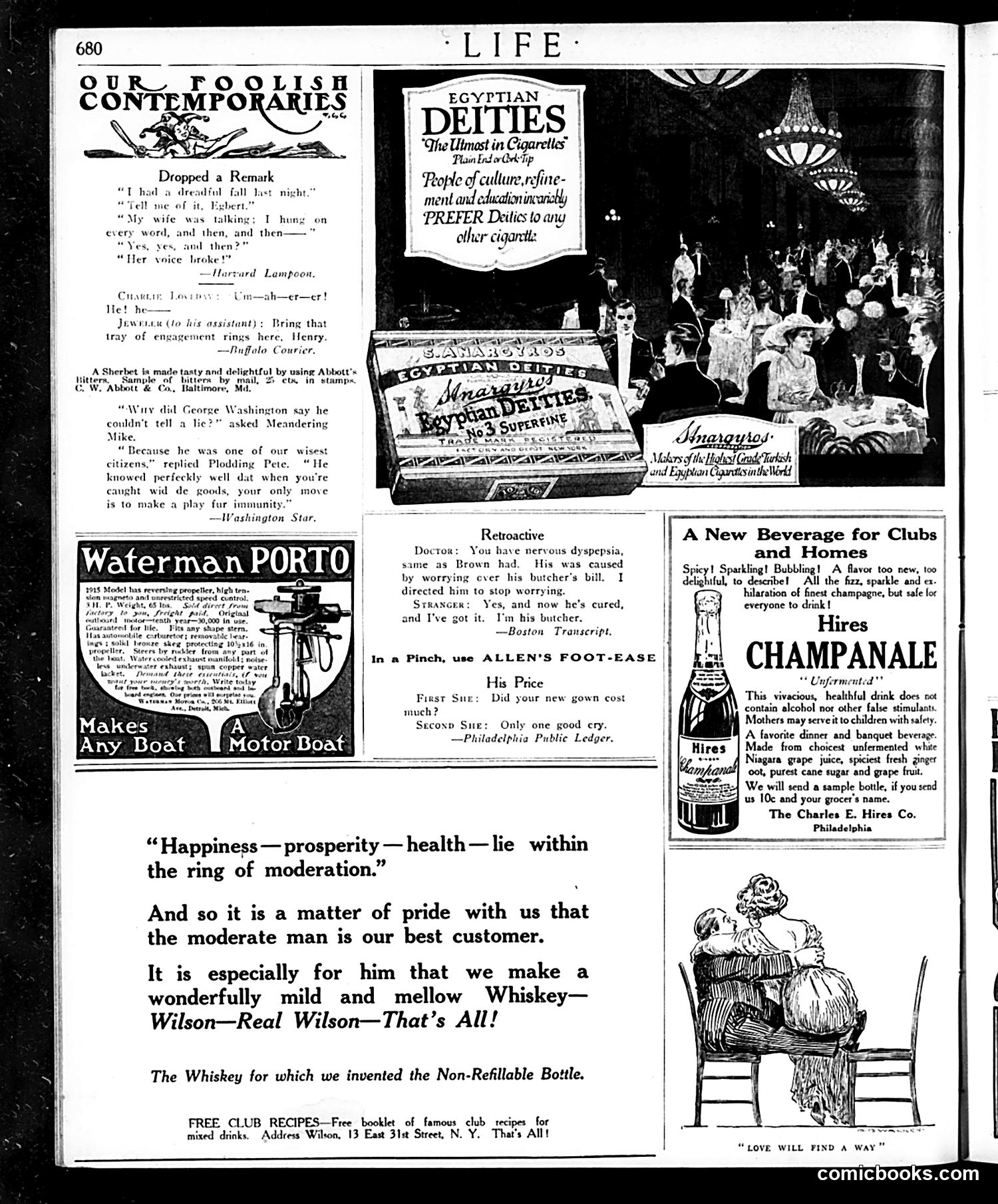
This page from *Life* magazine consists primarily of **humorous anecdotes and advertisements** rather than political cartoons. The jokes reflect early 20th-century humor: a Harvard Lampoon piece about a wife who talks incessantly; a Buffalo Courier quip about a jeweler's assistant mishearing instructions; a *Washington Star* joke playing on George Washington's honesty; and several brief witticisms about nervousness, clothing costs, and foot comfort. The advertisements are notable for what they reveal about the era's attitudes: Egyptian Deities cigarettes marketed to people of "culture and refinement"; Wilson whiskey pitched to "the moderate man"; and Hires Champanale—a non-alcoholic "champagne" substitute explicitly marketed as safe for mothers and children, reflecting Prohibition-era attitudes. The bottom illustration simply shows a couple embracing with the caption "Love Will Find a Way," a sentimental cliché. Overall, this is a **product-heavy entertainment page** with genteel humor rather than sharp political satire.
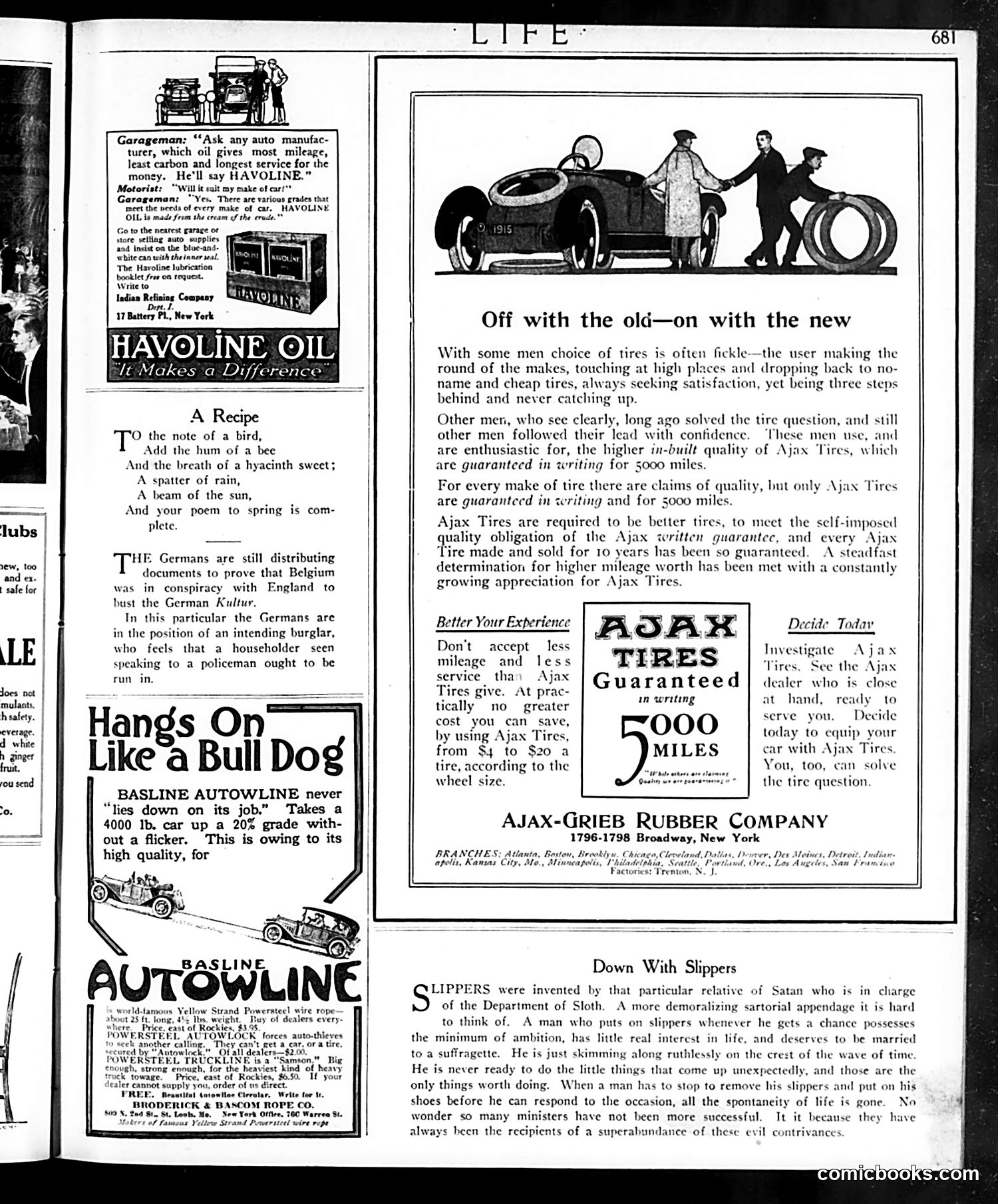
This page contains several automobile advertisements and a brief satirical essay. **Main Content:** The dominant feature is an Ajax Tires advertisement promoting their 5,000-mile written guarantee. The illustrated header shows men removing old tires and installing new ones, visualizing the product claim. **Satire Section:** The essay "Down With Slippers" (bottom) is a humorous social critique. It sarcastically attacks men who wear slippers at home, characterizing them as lazy and unambitious. The author suggests such men lack drive and mockingly states they "deserve to be married to a suffragette"—a contemporary reference to women's rights activists, implying suffragettes were undesirable partners. This reflects early 20th-century gender attitudes and dismissive views of the suffrage movement. **Supporting Advertisements:** Smaller ads promote Havoline Oil and Basline Autowline (auto accessories), using similar "superiority" messaging. The page reflects 1910s-1920s consumer culture and period attitudes toward social issues and masculinity.
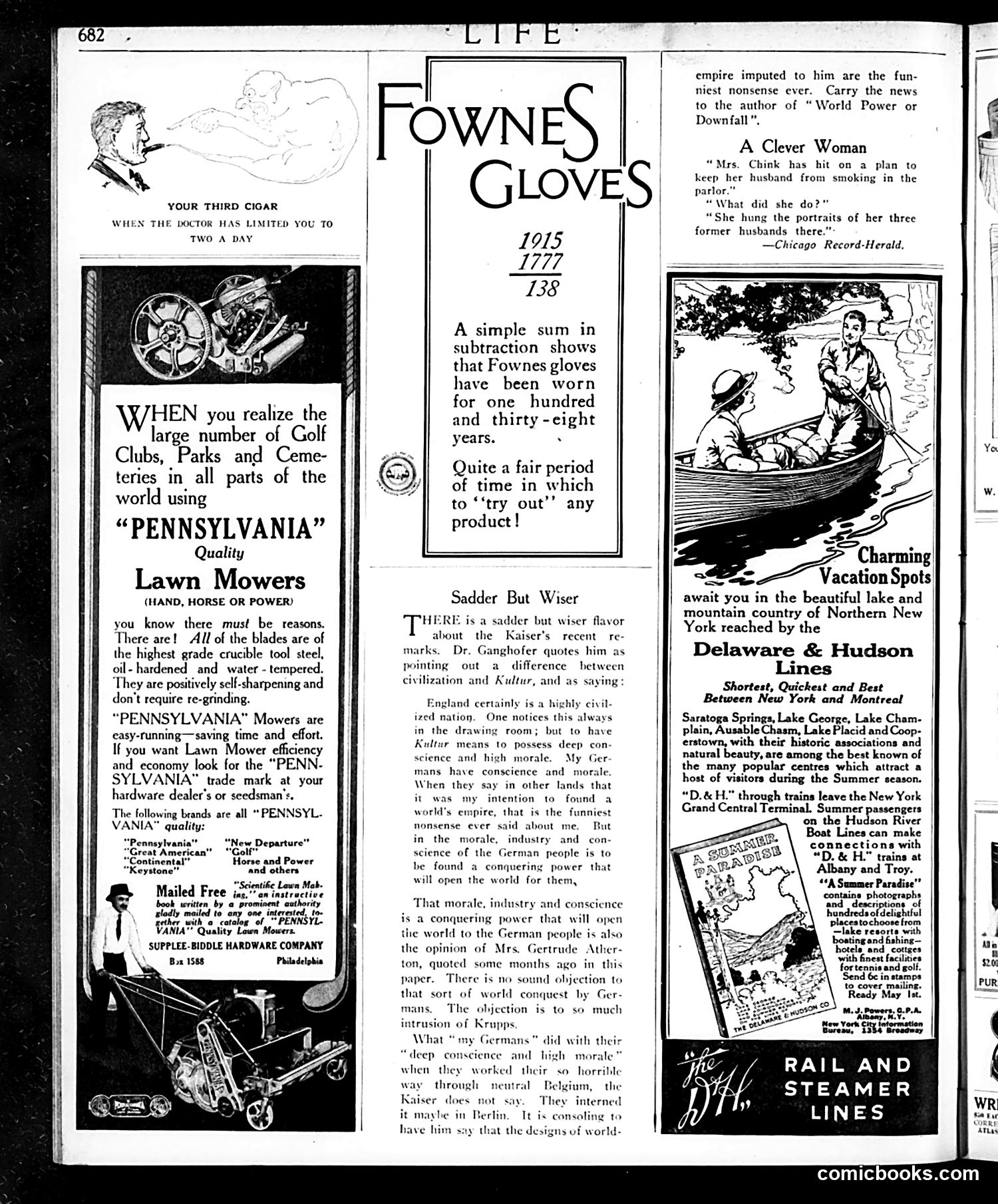
This page is primarily **advertising** with one notable satirical article. The main content is "Sadder But Wiser," which satirizes **Kaiser Wilhelm II's recent remarks** defending German "Kultur" (culture/civilization) against accusations of imperial ambition. Wilhelm claimed his statements about founding a world empire were "the funniest nonsense ever." The satire's point: Life mockingly accepts the Kaiser's distinction between English "civilization" and German "Kultur" (deep conscience and morale), then sarcastically notes that this supposedly noble German character was recently displayed through their invasion of neutral Belgium. The author suggests Wilhelm's denial of world-conquest ambitions is unconvincing given Germany's actual conduct. The piece references **WWI context**—Belgium's invasion in 1914 and contemporary debates about German militarism versus claimed cultural superiority. The remaining content consists of period advertisements for lawn mowers, gloves, cigars, travel lines, and vacation spots—typical of Life's revenue model.
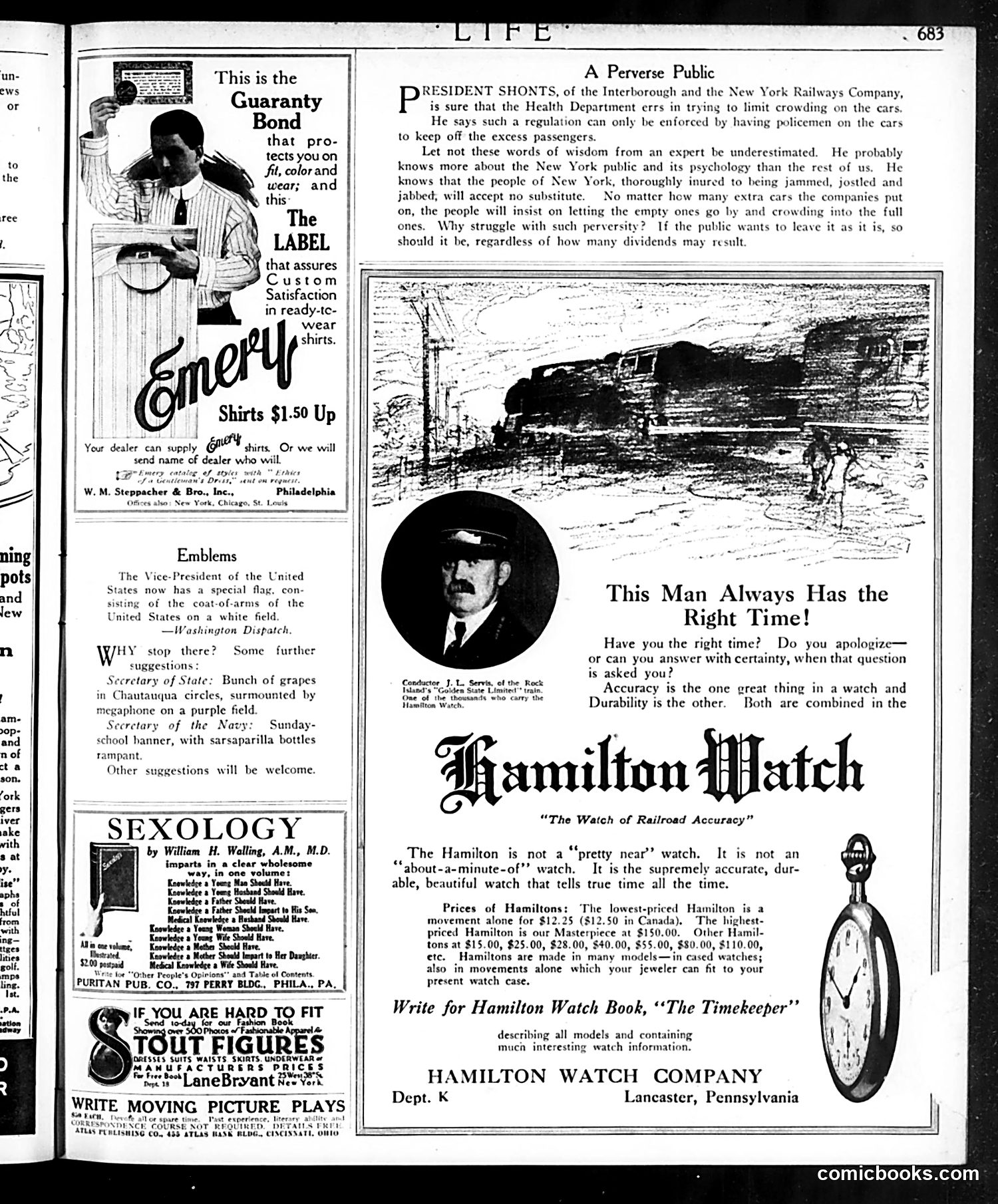
This editorial cartoon critiques President Theodore Roosevelt's ally **Theodore P. Shonts**, president of New York's railway companies, who opposed the Health Department's efforts to limit overcrowding on subway and streetcars. **The satire:** Shonts argues that New Yorkers *prefer* being crammed into packed cars and won't accept regulation. The Life writer mockingly agrees—yes, New Yorkers are so accustomed to being "jammed, jostled and jabbed" that they'll reject empty cars to crowd into full ones. Why fight such perversity? The joke exposes Shonts's self-serving logic: by claiming the public *wants* crowding, he avoids spending money on capacity improvements, protecting corporate profits over public health. This reflects Progressive Era tensions between corporate interests and public welfare regulation—a common target of Life magazine's satirical commentary on American civic life.
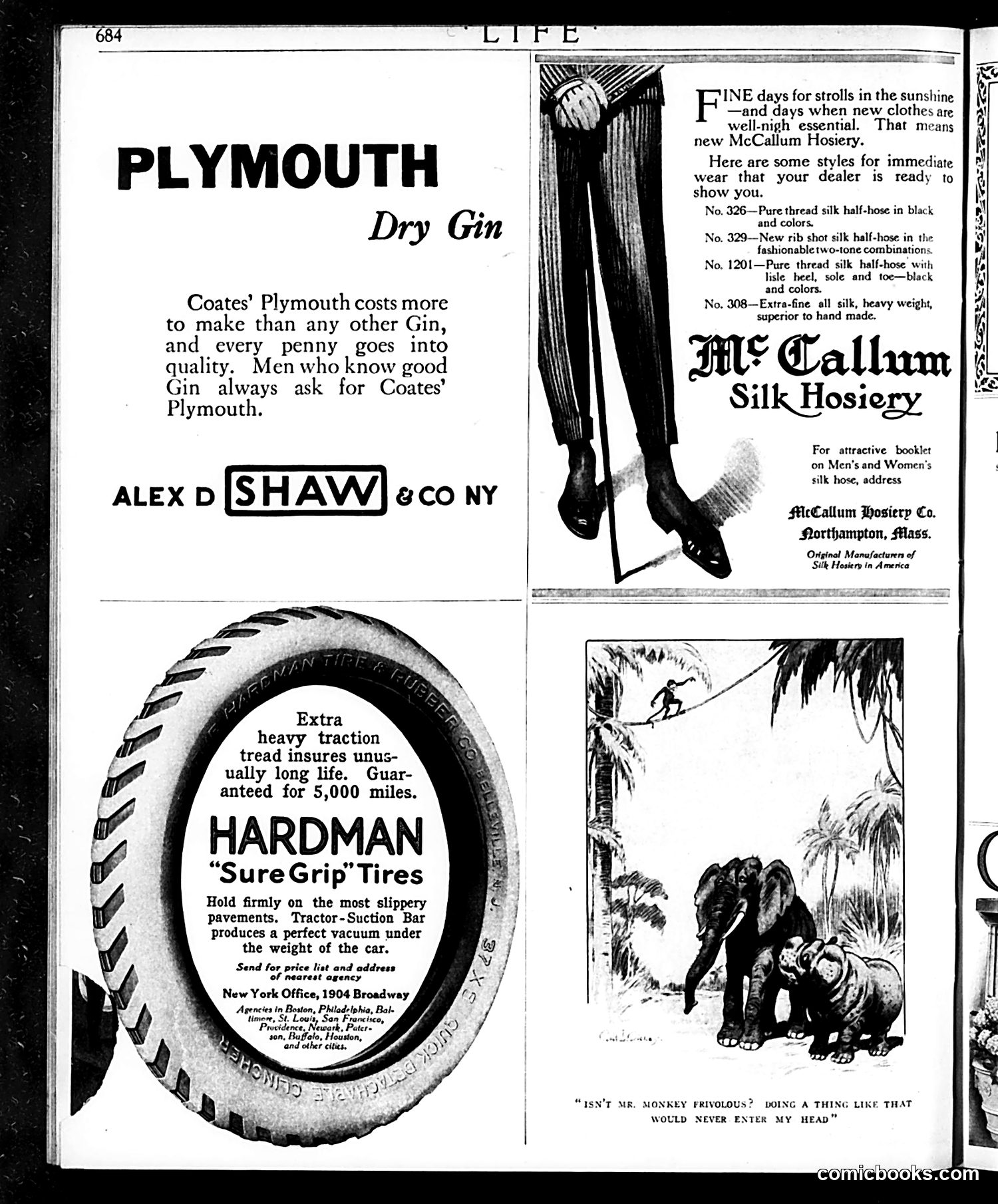
This is primarily an **advertising page** from Life magazine (page 684), not a political cartoon. It contains four separate advertisements with one small cartoon illustration. The only cartoon present depicts a monkey and appears at the bottom right, showing a monkey swinging from a vine while another figure comments dismissively: "Isn't Mr. Monkey frivolous? Doing a thing like that would never enter my head." This is a **humorous social commentary** on human pretension—the speaker's self-righteous claim to propriety is undercut by the absurdity of comparing oneself favorably to a monkey. The joke satirizes people who judge others harshly while being oblivious to their own foolishness. The page otherwise advertises Plymouth Dry Gin, McCallum Silk Hosiery, and Hardman "Sure Grip" Tires—typical early 20th-century product placements emphasizing quality and reliability.
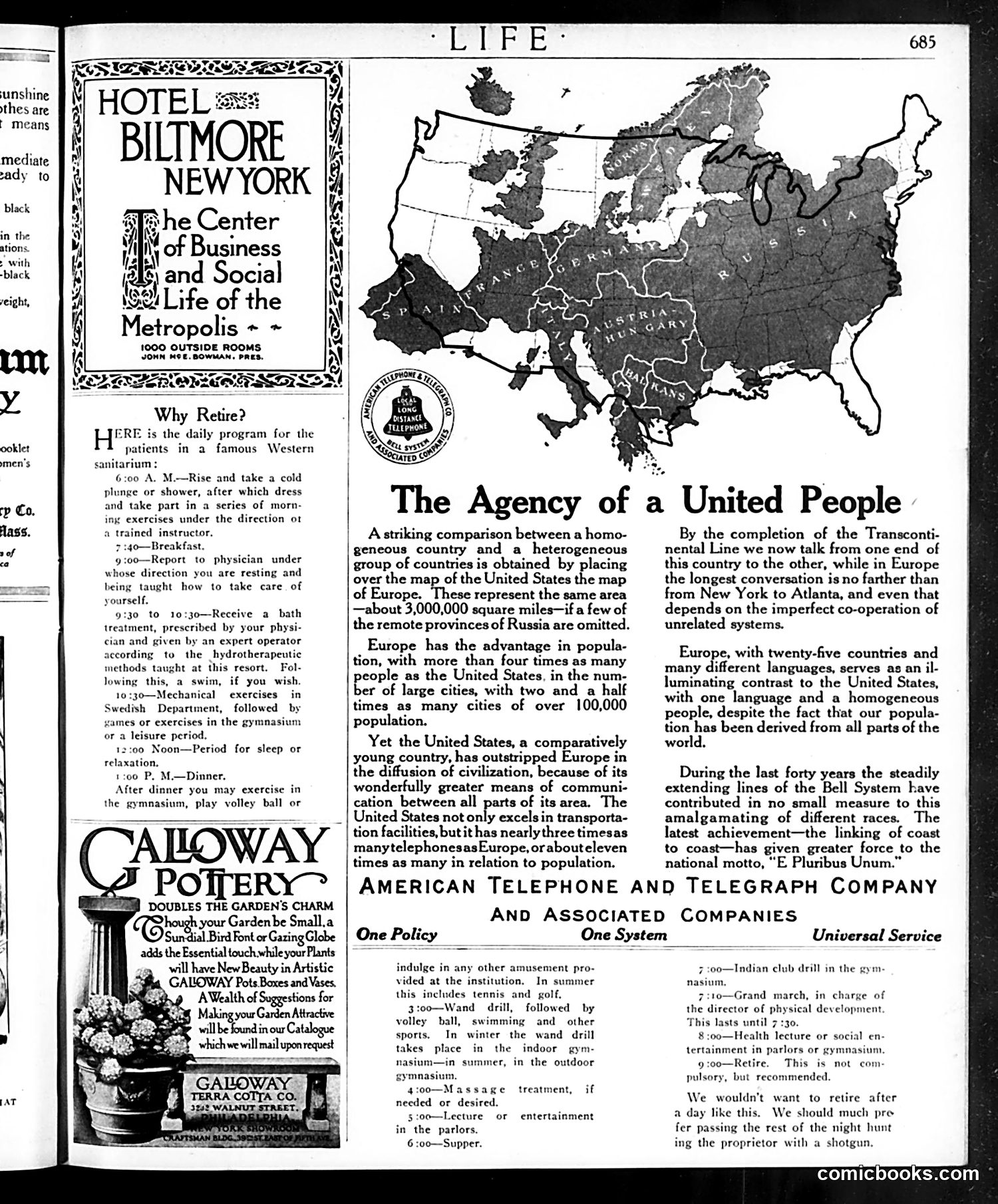
This page is primarily **advertising**, not editorial content or satire. The main feature is a Bell Telephone System advertisement titled "The Agency of a United People." It argues that the United States, though younger and smaller in population than Europe, has achieved greater national unity through superior telecommunications infrastructure. The piece compares the U.S. map overlaid on Europe's, noting America has nearly three times as many telephones per capita. The rhetoric celebrates how the Bell System's transcontinental line enables coast-to-coast communication, fostering national cohesion among America's diverse immigrant populations—framed as "amalgamating of different races." This is corporate messaging presenting technological progress as a unifying force for national identity, wrapped in patriotic language ("E Pluribus Unum"). The page also includes advertisements for the Hotel Biltmore (New York), Galloway Pottery, and a sanitarium daily schedule. No political cartoons appear on this page.
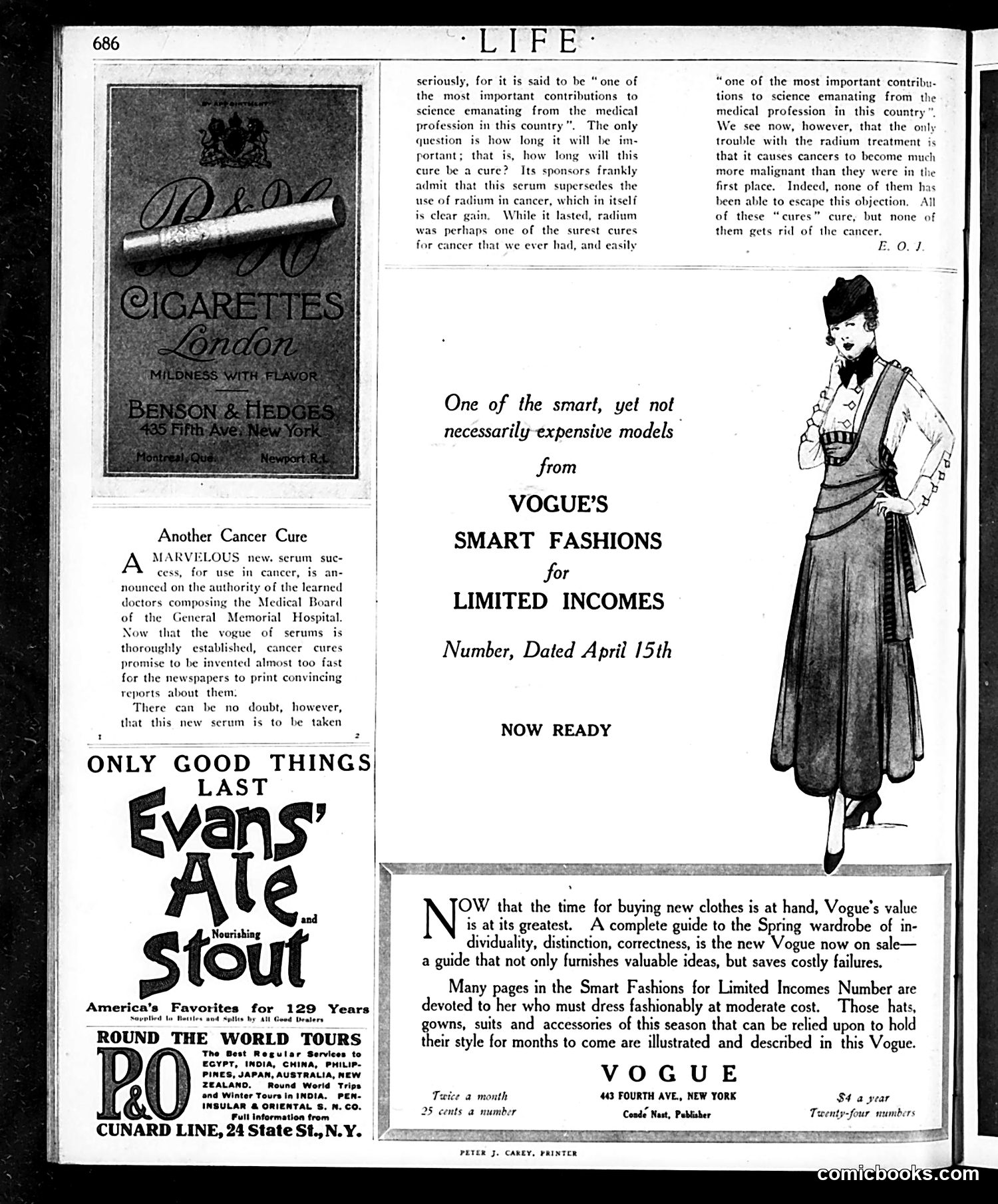
This page is primarily advertising, not political satire. The main editorial content is a brief satirical piece titled "Another Cancer Cure" that critiques the medical establishment's tendency to promote successive "miracle" treatments without addressing underlying problems. The satire's point: doctors enthusiastically announce a new serum as a major breakthrough, claiming it supersedes radium treatment for cancer. However, the author (E.O.J.) notes that radium itself was once celebrated as a sure cure, only to later cause cancers to become more malignant. The piece argues that each new "cure" may eliminate symptoms without actually curing the disease—a cyclical pattern of medical fashion rather than genuine progress. The surrounding advertisements (Evans' Ale, P&O Cunard Line cruises, Vogue fashion magazine, London Cigarettes) are typical period marketing unrelated to the satire's message.
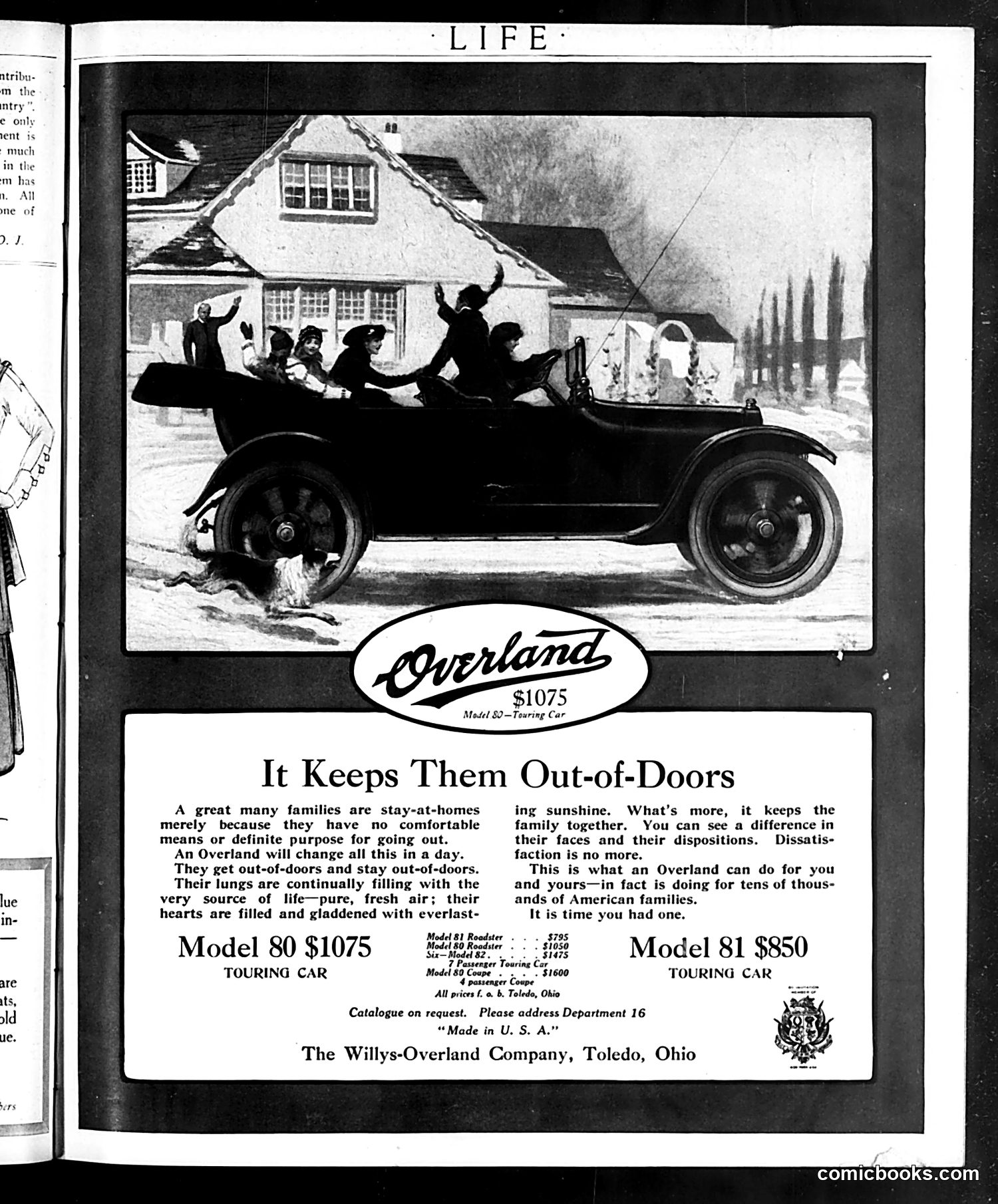
This is **not a cartoon or satire—it's a straight automobile advertisement** from Life magazine for the Willys-Overland Company. The ad promotes the Overland Model 80 ($1075) and Model 81 ($850) touring cars using the sales pitch "It Keeps Them Out-of-Doors." The image shows a family of five joyfully riding in an open-air automobile past a house and countryside, illustrating the advertiser's claim that car ownership encourages wholesome family recreation and fresh-air activity. The text argues that automobiles solve the problem of sedentary "stay-at-home" families by enabling outdoor leisure, improving health ("pure, fresh air"), family bonding, and general happiness. This reflects early 20th-century automobile marketing rhetoric positioning cars as agents of progress, health, and family values rather than mere transportation. The page is advertising copy, not editorial satire.
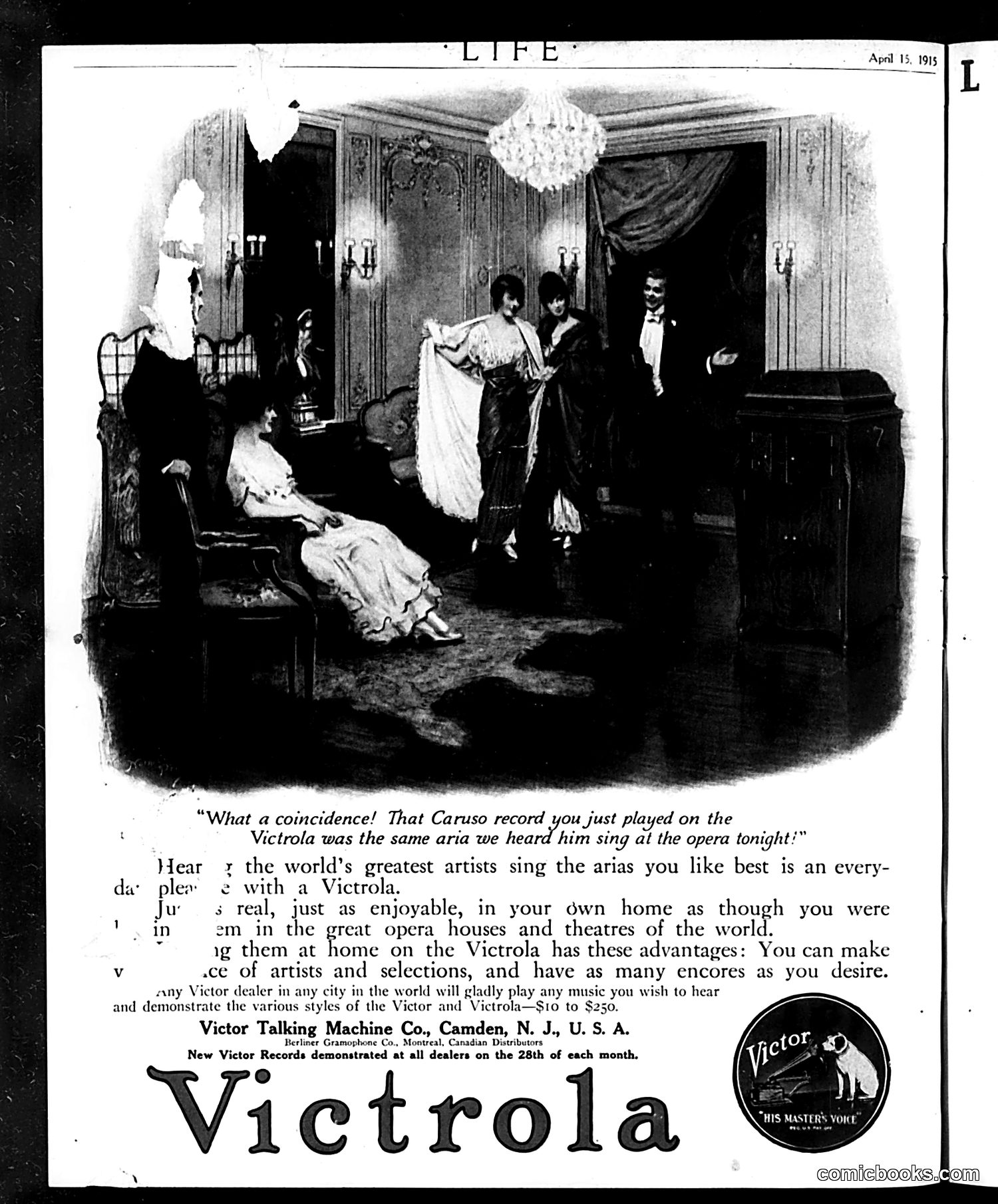
This is primarily a **product advertisement**, not political satire. It promotes the Victrola phonograph by depicting an elegant parlor scene where guests comment on hearing Caruso—likely **Enrico Caruso**, the famous opera tenor of that era—on a Victrola record that matches a live opera performance they attended. The ad's appeal is aspirational: it suggests that owning a Victrola allows middle-class home listeners to enjoy world-class opera performances comparable to attending prestigious opera houses. The convenience and selection advantages are emphasized (choose any artist, replay as desired). The humor is gentle—the "coincidence" of hearing the same aria both at the opera house and on the home phonograph. This reflects early 20th-century amazement at recorded music technology. The ad targets affluent consumers (machines cost $10-$250, substantial sums in 1915) who valued both cultural sophistication and modern technology.