
Life, 1915-04-15 · page 15 of 44
Life — April 15, 1915 — page 15: what you’re looking at
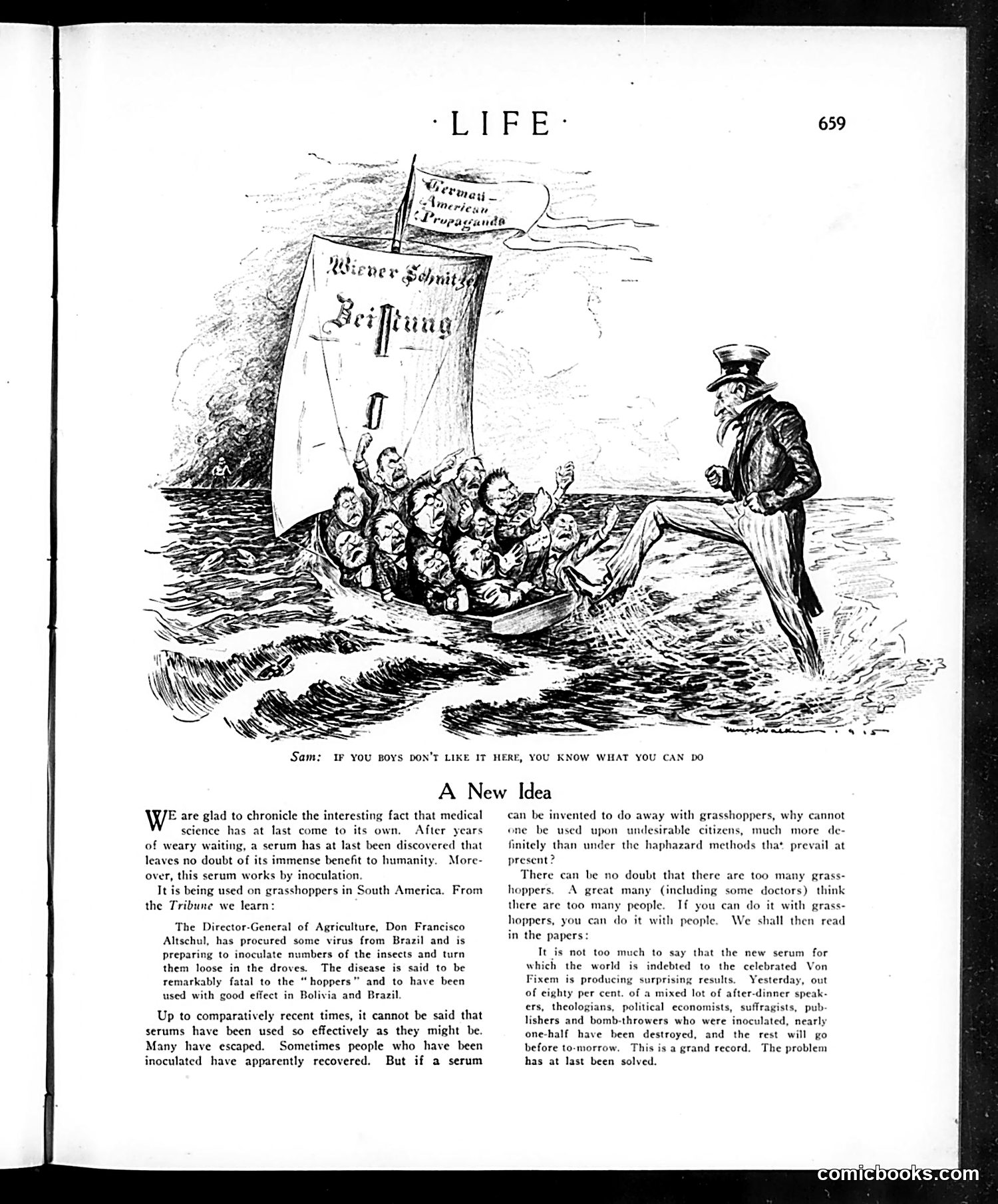
What you’re looking at
**The Cartoon:** Shows a boat carrying immigrants arriving at shore, with a well-dressed man (likely representing an American official or citizen) telling them "if you boys don't like it here, you know what you can do"—a dismissive threat. **The Article's Dark Satire:** Life uses recent news about Brazilian scientists developing a virus to kill grasshoppers as a springboard for biting social commentary. The piece sarcastically asks: if we can eliminate "undesirable" grasshoppers, why not "undesirable citizens"? It then mockingly lists target groups: after-dinner speakers, theologians, economists, suffragists, publishers, and "bomb-throwers" (likely anarchists feared during this era). **Historical Context:** This reflects early-1900s anxieties about immigration, radical politics, and social reform movements. The "bomb-throwers" reference suggests concern about anarchist violence. The suffragist inclusion reveals anti-feminist sentiment. **The Point:** Life satirizes American intolerance and eugenics-adjacent thinking by taking the logic to absurd extremes—using dark humor to critique those who view certain groups as social problems to be eliminated.
📄 Transcribed text from this page (OCR, searchable)
Machine-transcribed from the original scan — historical spelling and the odd misread are preserved.
ifiene Sam: IF YOU BOYS DON'T LIKE IT HERE, YOU KNOW WHAT YOU CAN DO A New Idea E are glad to chronicle the interesting fact that medical science has at last come to its own, After years of weary waiting, a serum has at last been discovered that leaves no doubt of its immense benefit to human over, this serum works by inoculation. It is being used on grasshoppers in South America. From the Tribune we learn: The Director-General of Agriculture, Don Francisco Altschul, has procured some virus from Brazil and is preparing to inoculate numbers of the insects and turn them loose in the droves. The disease is said to be remarkably fatal to the “hoppers” and to have been used with good effect in Bolivia and Brazil. Up to comparatively recent times, it cannot be said that serums have been used so effectively as they might be. Many have escaped. Sometimes people who have been inoculated have apparently recovered. But if a serum can be invented to do away with grasshoppers, why cannot one be used upon undesirable citizens, much more de- finitely than under the haphazard methods tha* prevail at present? There can be no doubt that there are too many grass- hoppers. A great many (including some doctors) think there are too many people. If you can do it with grass- hoppers, you can do it with people. We shall then read in the papers: Tt is not too much to say that the new serum for which the world is indebted to the celebrated Von Fixem is producing surprising results, Yesterday, out of eighty per cent. of a mixed lot of after-dinner speak- ers, theologians, political economists, suffragists, pub- lishers and bomb-throwers who were inoculated, nearly one-half have been destroyed, and the rest will go before to-morrow. This is a grand record. The problem has at last been solved.