
Life, 1915-04-15 · page 10 of 44
Life — April 15, 1915 — page 10: what you’re looking at
What you’re looking at
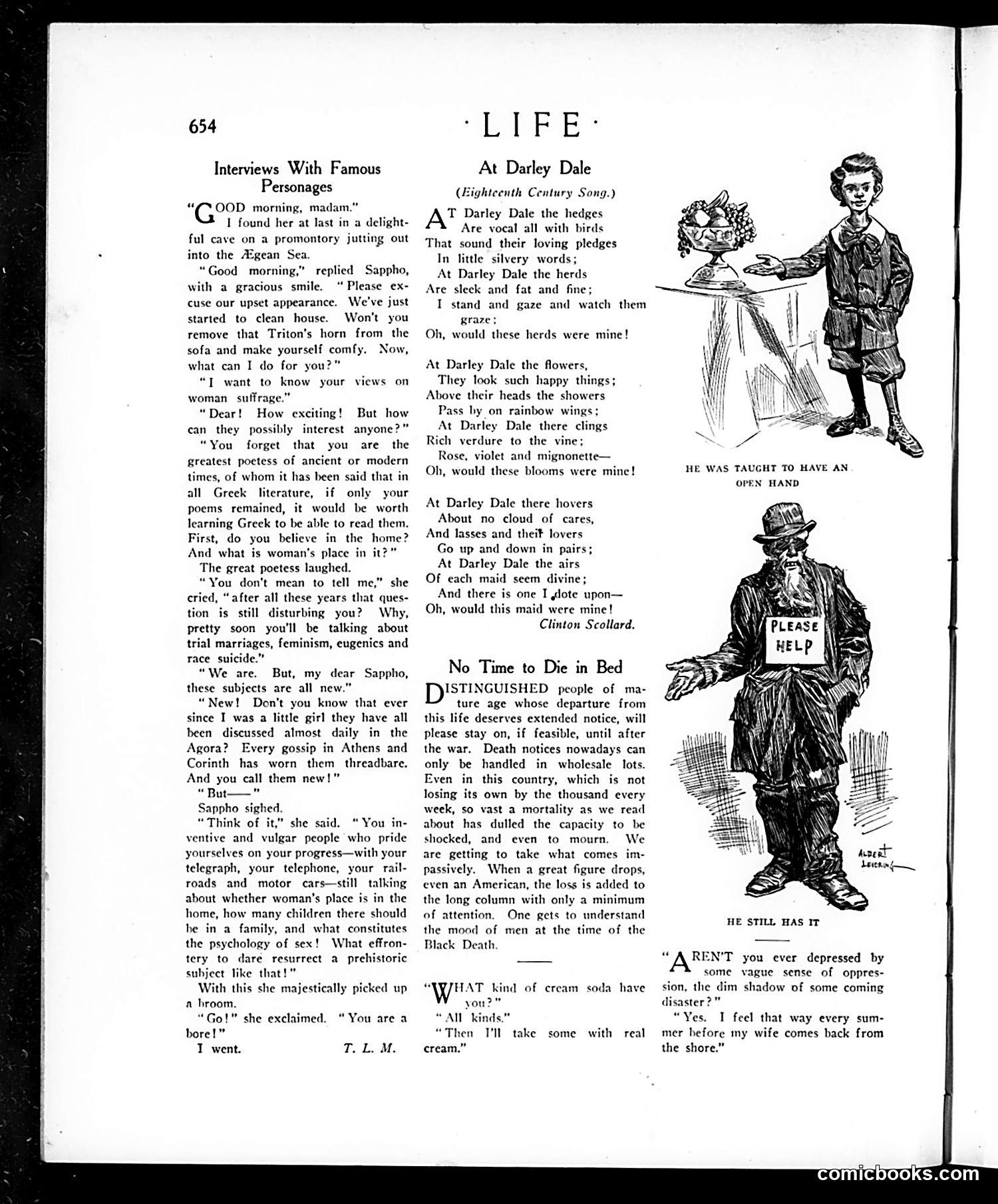
This page contains two distinct sections: **Left side ("Interviews With Famous Personages"):** A satirical interview where an unnamed interviewer challenges a great poetess (likely representing a prominent female poet of the era) about women's suffrage. The poetess dismisses suffrage as vulgar, arguing women should focus on the home. The interviewer counters that suffrage has already been discussed in Athens and Corinth, suggesting the issue is timely and unavoidable. The satire mocks elite women who oppose their own political rights. **Right side:** Illustrations and text about "No Time to Die in Bed" and depression/anxiety, with sketches of sad men. These appear unrelated to the interview. The page satirizes anti-suffrage arguments from educated women during the early 20th-century women's suffrage movement.
📄 Transcribed text from this page (OCR, searchable)
Machine-transcribed from the original scan — historical spelling and the odd misread are preserved.
654 Interviews With Famous Personages “(OOD morning, madam.” 1 found her at last in a delight- ful cave on a promontory jutting out into the AEgean Sea. “Good morning,” replied Sappho, with a gracious smile. “Please ex- cuse our upset appearance. We've just started to clean house. Won't you remove that Triton’s horn from the sofa and make yourself comfy. Now, what can I do for you?” “T want to know your views on woman suffrage.” “Dear! How exciting! But how can they possibly interest anyone?” “You forget that you are the greatest poetess of ancient or modern times, of whom it has been said that in all Greek literature, if only your poems remained, it would be worth learning Greek to be able to read them. First, do you believe in the home? And what is woman's place in it?” The great poetess laughed. “You don't mean to tell me,” she cried, “after all these years that ques- tion is still disturbing you? Why, pretty soon you'll be talking about trial marriages, feminism, eugenics and race suicide.” “We are. But, my dear Sappho, these subjects are all new.” “New! Don’t you know that ever since I was a little girl they have all been discussed almost daily in the Agora? Every gossip in Athens and Corinth has worn them threadbare, And you call them new!” “ But. ” Sappho sighed. “Think of it,” she said. “ You in- yentive and vulgar people who pride yourselves on your progress—with your telegraph, your telephone, your rail- roads and motor cars—still talking about whether woman’s place is in the home, how many children there should he in a family, and what constitutes the psychology of sex! What effron- tery to dare resurrect a prehistoric subject like that!” With this she majestically picked up a broom. “Go!” she exclaimed. bore!” I went. “You are a T. LM. ETP E: At Darley Dale (Eighteenth A’ Darley Dale the hedges Are vocal all with birds That sound their loving pledges In little silvery words; At Darley Dale the herds Are sleck and fat and fine; I stand and gaze and watch them graze; Oh, would these herds were mine! Century Song.) At Darley Dale the flowers, They look such happy things; Above their heads the showers Pass by on rainbow wings; At Darley Dale there clings Rich verdure to the vine; Rose, violet and mignonette— Oh, would these blooms were mine! At Darley Dale there hovers About no cloud of cares, And lasses and theit lovers Go up and down in pairs; At Darley Dale the airs Of each maid seem divine; And there is one I dote upon— Oh, would this maid were mine! Clinton Scollard. No Time to Die in Bed ISTINGUISHED people of ma- ture age whose departure from this life deserves extended notice, will please stay on, if feasible, until after the war. Death notices nowadays can only be handled in wholesale lots. Even in this country, which is not losing its own by the thousand every week, so vast a mortality as we read about has dulled the capacity to be shocked, and even to mourn. We are getting to take what comes im- passively. When a great figure drops, even an American, the loss is added to the long column with only a minimum of attention. One gets to understand the mood of men at the time of the Black Death. “NY7HAT kind of cream soda have you?” “All kinds.” “Then Tl cream.” take some with real T TO HAVE AN OPEN HAND HE WAS NY) pease {i HE STILL HAS IT “A® =N'T you ever depressed by some vague sense of oppres- sion, the dim shadow of some coming disaster?” “Yes. I feel that way every sum- mer before my wife comes back from the shore.”