
Life, 1915-04-15 · page 24 of 44
Life — April 15, 1915 — page 24: what you’re looking at
What you’re looking at
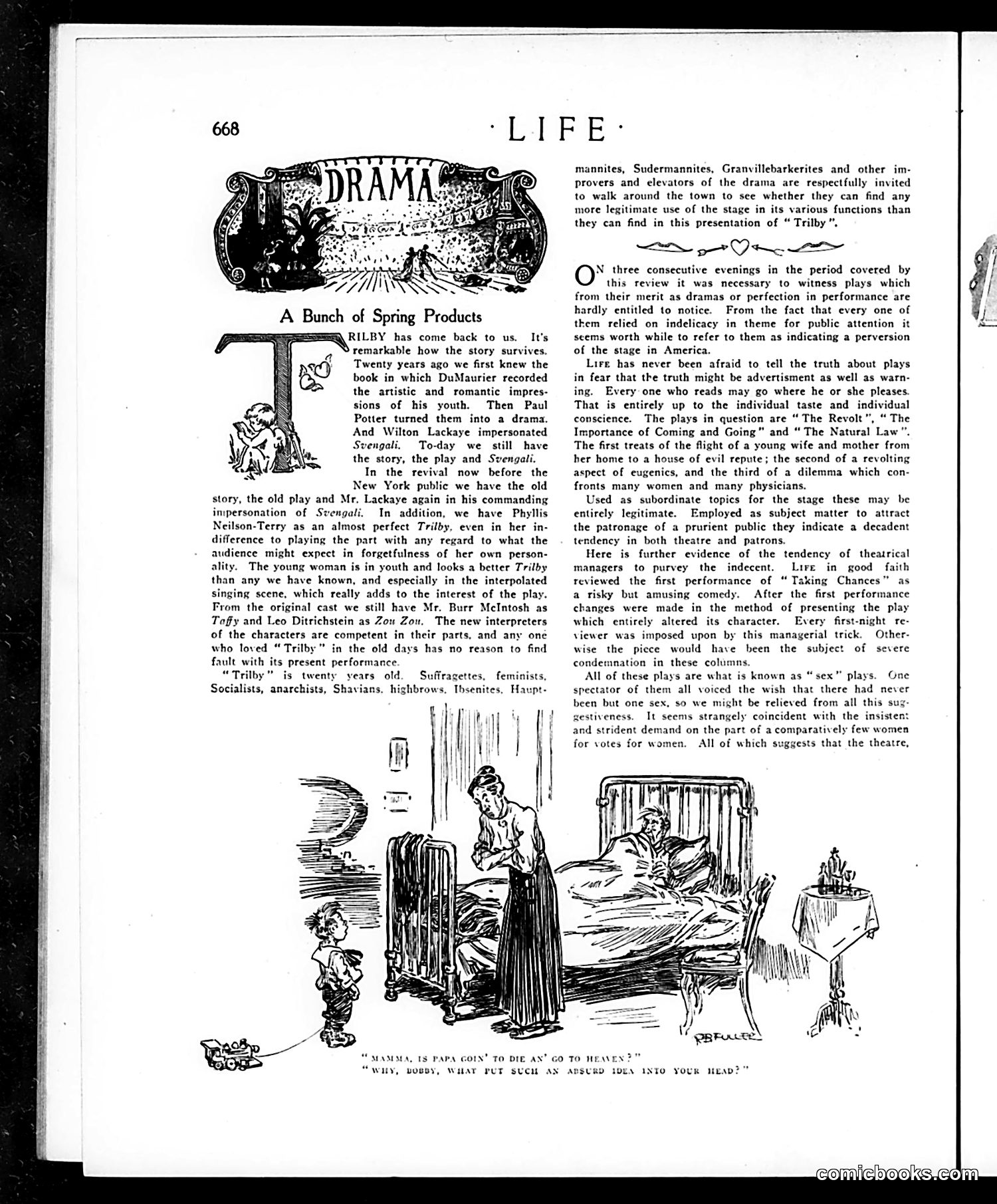
This page reviews theatrical productions, focusing on a revival of "Trilby" (a 20-year-old play based on du Maurier's novel) and condemning three contemporary plays for their indecent subject matter. **The Trilby section** praises the enduring play's revival, noting actor Wilton Lackaye reprises his famous role as Svengali, and young actress Phyllis Neilson-Terry plays Trilby effectively. **The satirical cartoon** (bottom) depicts a sickbed scene with dialogue—"Mama, is Papa goin' to die an' go to heaven?" / "Why, Bobby, what put such an absurd idea into your head?"—seemingly mocking moral instruction or sentimental Victorian sentimentality. **The main critique** attacks three current "sex plays" ("The Revolt," "The Importance of Coming and Going," "The Natural Law") for exploiting indecent topics—infidelity, eugenics, and reproductive dilemmas—to attract prurient audiences rather than serve legitimate dramatic purposes. Life condemns theatrical managers for pandering to base interests.
📄 Transcribed text from this page (OCR, searchable)
Machine-transcribed from the original scan — historical spelling and the odd misread are preserved.
“ETP E * \ It's \ remarkable how the story survives. Twenty years ago we first knew the book in which DuMaurier recorded the artistic and romantic impres- sions of his youth. Then Paul Potter turned them into a drama. And Wilton Lackaye impersonated Svengali, To-day we still have the story, the play and Svengali. In the revival now before the New York public we have the old story, the old play and Mr. Lackaye again in his commanding impersonation of Svengali. In addition, we have Phyllis Neilson-Terry as an almost perfect Trilby, even in her in- difference to playing the part with any regard to what the audience might expect in forgetfulness of her own person- ality. The young woman is in youth and looks a better Trilby than any we have known, and especially in the interpolated ging scene, which really adds to the interest of the play. From the original cast we still have Mr. Burr McIntosh as Toffy and Leo Ditrichstein as Zou Zou, The new interpreters of the characters are competent in their parts, and any one who loved “Trilby" in the old days has no reason to find fault with its present performance. “Trilby” is twenty years old. Suffragettes, Socialists, anarchists, Shavians. highbrows, Thsenites, Haupt- feminists, MAMAEA, TS PARA GOLN’ TO DIE AN’ “Wily, vogoy, WHAT PUT SUCH AN mannites, Sudermannites, Granvillebarkerites and other im- provers and elevators of the drama are respectfully invited to walk around the town to see whether they can find any more legitimate use of the stage in its various functions than they can find in this presentation of “ Trilby”. nN _P—6g + > O*% three consecutive evenings in the period covered by this review it was necessary to witness plays which from their merit as dramas or perfection in performance are hardly entitled to notice. From the fact that every one of them relied on indelicacy in theme for public attention it seems worth while to refer to them as indicating a perversion of the stage in America. Lire has never been afraid to tell the truth about plays in fear that the truth might be advertisment as well as warn- Every one who reads may go where he or she pleases. That is entirely up to the individual taste and individual conscience. The plays in question are “ The Revolt”, “ The Importance of Coming and Going" and “ The Natural Law”. The first treats of the flight of a young wife and mother from her home to a house of evil repute; the second of a revolting aspect of eugenics, and the third of a dilemma which con- fronts many women and many physicians. Used as subordinate topics for the stage these may be entirely legitimate. Employed as subject matter to attract the patronage of a prurient public they indicate a decadent tendency in both theatre and patrons. Here is further evidence of the tendency of theatrical managers to purvey the indecent. Lire in good faith reviewed the first performance of “ Taking Chances” as a risky but amusing comedy. After the first performance changes were made in the method of presenting the play which entirely altered its character. Every first-night re- viewer was imposed upon by this managerial trick. Other- wise the picce would have the subject of severe condemnation in these columns. All of these plays are what is known as “sex” plays. One spectator of them all voiced the wish that there had never been but one sex, so we might be relieved from all this sug- tiveness. It seems strangely coincident with the insistent and strident demand on the part of a comparatively few women for votes for women. All of which suggests that the theatre, been (0 TO MEAVEN?” ABSURD ADEN INTO