
Life, 1915-04-15 · page 26 of 44
Life — April 15, 1915 — page 26: what you’re looking at
What you’re looking at
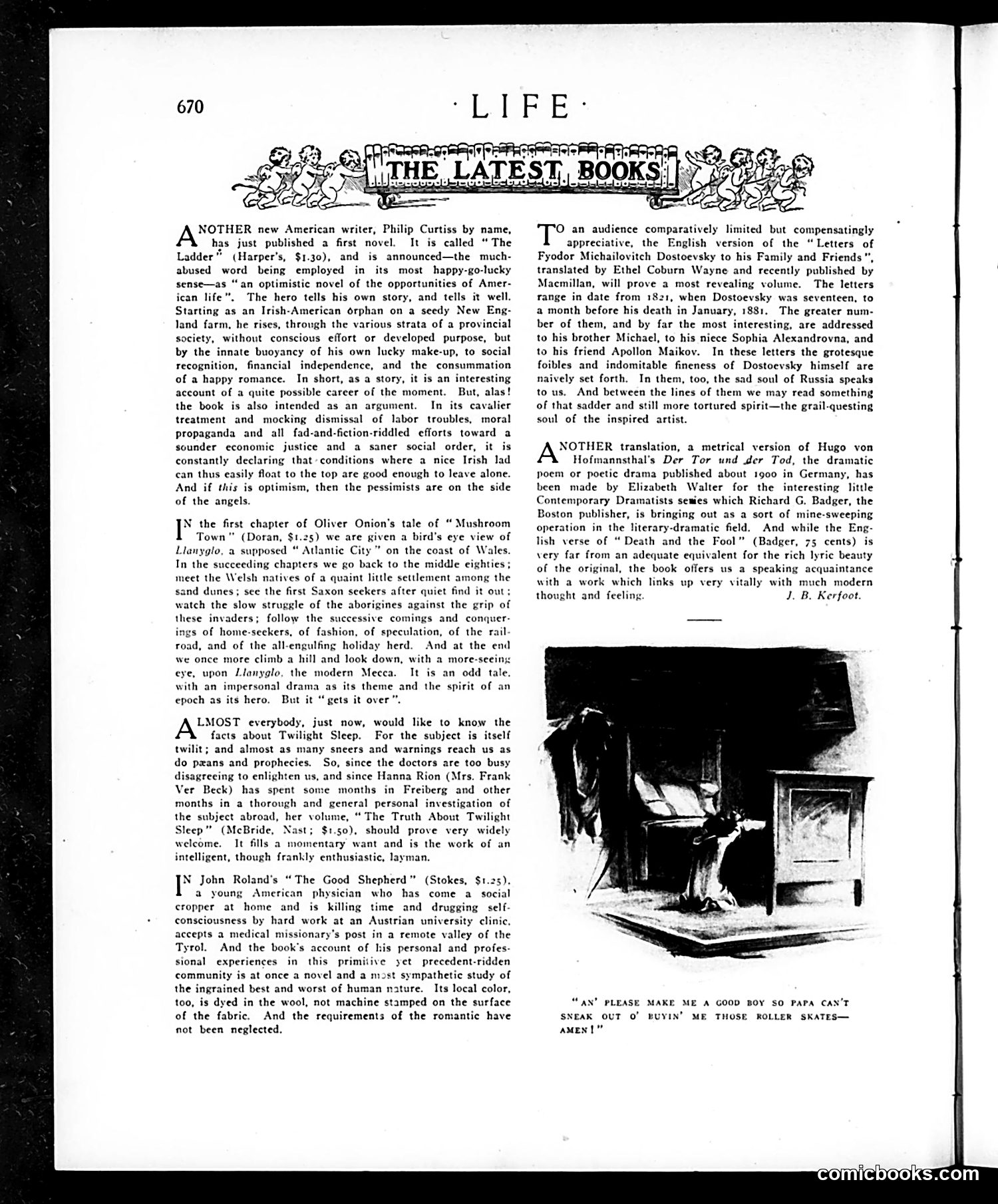
This is a book review section from *Life* magazine featuring five new novels. The only illustration is a captioned drawing (bottom right) showing a figure in period dress, with the caption: "AN' PLEASE MAKE ME A GOOD BOY SO PAPA CAN'T SNEAK OUT O' BUYIN' ME THOSE ROLLER SKATES—AMEN!" The cartoon humorously depicts a child's prayer—the child recognizes their father's tendency to avoid purchases by claiming the child isn't well-behaved, so the child prays to become good specifically to eliminate that excuse. It's a commentary on parental parsimony and childhood manipulation tactics, showing the child's shrewd understanding of family dynamics. The reviews themselves critique books on social mobility, Welsh history, medical innovation ("Twilight Sleep"), missionary work, and Dostoevsky's correspondence—typical highbrow literary fare of the era.
📄 Transcribed text from this page (OCR, searchable)
Machine-transcribed from the original scan — historical spelling and the odd misread are preserved.
NOTHER new American writer, Philip Curtiss by name, has just published a first novel. It is called “The Ladder” (Harper's, $1.30), and is announced—the much- abused word being employed in its most happy-go-lucky sense—as “an optimistic novel of the opportunities of Amer- ican life". The hero tells his own story, and tells it well. Starting as an Irish-American Orphan on a seedy New Eng- land farm, he rises, through the various strata of a provincial society, without conscious effort or developed purpose, but by the innate buoyancy of his own lucky make-up, to social recognition, financial independence, and the consummation of a happy romance. In short, as a story, it is an interesting account of a quite possible career of the moment. But, alas! the book is also intended as an argument. In its cavalier treatment and mocking dismissal of labor troubles, moral propaganda and all fad-and-fiction-riddled efforts toward a sounder economic justice and a saner social order, it is constantly declaring that-conditions where a nice Irish lad can thus easily float to the top are good enough to leave alone. And if this is optimism, then the pessimists are on the side of the angels. I the first chapter of Oliver Onion’s tale of “ Mushroom Town" (Doran, $1.25) we are given a bird’s eye view of Llanyglo, a supposed “ Auantic City” on the coast of Wales. In the succeeding chapters we go back to the middle eighties ; meet the Welsh natives of a quaint little settlement among the sand dunes; see the first Saxon seekers after quiet find it out: watch the slow struggle of the aborigines against the grip of these invaders; follow the successive comings and conquer- ings of home-seekers, of fashion, of speculation, of the rail road, and of the all-engulfing holiday herd. And at the end we once more climb a hill and look down, with a more-seeing eye, upon Llanyglo, the modern Mecca. It is an odd tale, with an impersonal drama as its theme and the spirit of an epoch as its hero, But it “gets it over”. LMOST everybody, just now, would like to know the facts about Twilight Sleep. For the subject is itself twilit; and almost as many sneers and warnings reach us as do pzans and prophecies. So, since the doctors are too busy disagreeing to enlighten us, and since Hanna Rion (Mrs. Frank Ver Beck) has spent some months in Freiberg and other months in a thorough and general personal investigation of the subject abroad, her volume, “ The Truth About Twilight Sleep” (McBride, Nast; $1.50), should prove very widely welcome. It fills a momentary want and is the work of an intelligent, though frankly enthusiastic, layman, I John Roland's “The Good Shepherd” (Stokes, $1.25). a young American physician who has come a social cropper at home and is killing time and drugging self- consciousness by hard work at an Austrian university clinic, accepts a medical missionary’s post in a remote valley of the Tyrol. And the book's account of his personal and profes- sional experiences in this primitive yet precedent-ridden community is at once a novel and a most sympathetic study of the ingrained best and worst of human nature. Its local color, too, is dyed in the wool, not machine stamped on the surface of the fabric, And the requirements of the romantic have not been neglected, ‘an audience comparatively limited but compensatingly appreciative, the English version of the “Letters of Fyodor Michailovitch Dostoevsky to his Family and Friends", translated by Ethel Coburn Wayne and recently published by Macmillan, will prove a most revealing volume. The letters range in date from 1821, when Dostoevsky was seventeen, to a month before his death in January, 1881. The greater num- ber of them, and by far the most interesting, are addressed to his brother Michael, to his niece Sophia Alexandrovna, and to his friend Apollon Maikov. In these letters the grotesque foibles and indomitable fineness of Dostoevsky himself are naively set forth. In them, too, the sad soul of Russia speaks to us. And between the lines of them we may read something of that sadder and still more tortured spirit—the grail-questing soul of the inspired artist. A NOTHER translation, a metrical version of Hugo von Hofmannsthal’s Der Tor und der Tod, the dramatic poem or poetic drama published about 1900 in Germany, has been made by Elizabeth Walter for the interesting little Contemporary Dramatists seaies which Richard G, Badger, the Boston publisher, is bringing out as a sort of mine-sweeping operation in the literary-dramatic field. And while the Eng- lish verse of “Death and the Fool” (Badger, 75 cents) is very far from an adequate equivalent for the rich lyric beauty of the original, the book offers us a speaking acquaintance with a work which links up very vitally with much modern thought and feeling J. B. Kerfoot a ME A GOOD BOY SO PAPA CAN'T ME THOSE ROLLER SKATES— AN’ PLEASE MAK‘ SNEAK OUT 0° BUYIN amen!"