
Life, 1915-04-15 · page 20 of 44
Life — April 15, 1915 — page 20: what you’re looking at
What you’re looking at
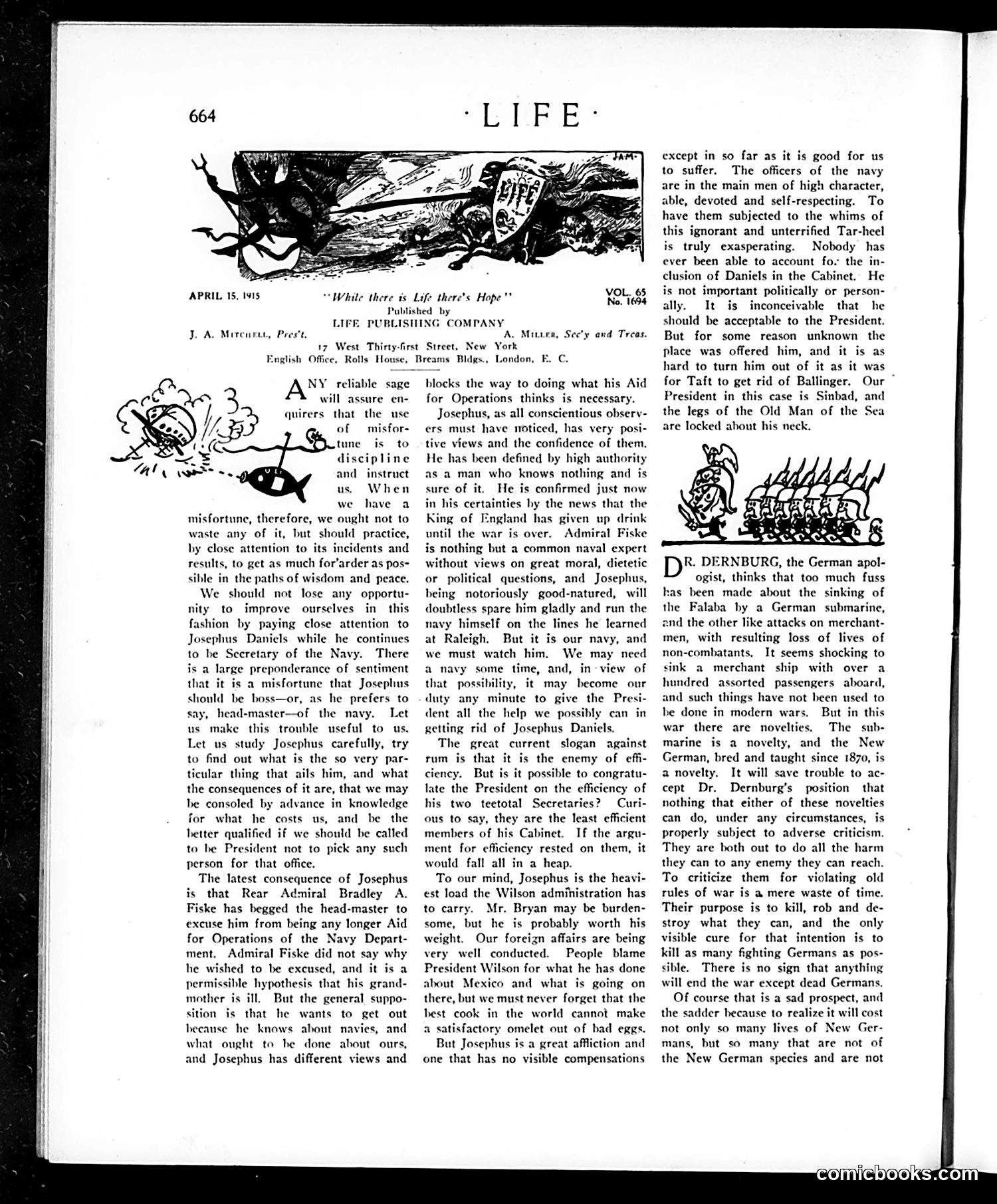
This editorial attacks **Josephus Daniels**, Secretary of the Navy under President Wilson. The piece criticizes Daniels' management of the Navy Department, using his forced resignation of **Rear Admiral Bradley A. Fiske** (Aid for Operations) as the primary example. The satire's core point: Daniels is portrayed as confidently incompetent—"a man who knows nothing and is sure of it"—blocking experienced naval officers like Fiske from doing their jobs. The author suggests Fiske resigned because Daniels' ideological certainties (the editorial references his teetotalism, linking him to Wilson's Secretary of State William Jennings Bryan) override practical naval expertise. The crude cartoon at top left depicts a demonic figure, likely representing misfortune or poor leadership. The editorial frames Daniels as a cautionary lesson in bad administration, warning readers to "study Josephus carefully" to learn what *not* to do in leadership. The sarcastic final section mocks teetotal Secretaries as paradoxically inefficient despite prohibition rhetoric.
📄 Transcribed text from this page (OCR, searchable)
Machine-transcribed from the original scan — historical spelling and the odd misread are preserved.
“While there is Life there's Hope"* Published PUBLISHIIN u J. A. Mireurut, Pres't. No, 1694 by COMPANY A. Munure, See’y end Treas. 17 West Thirty-first Street, New York English Office, Rolls Hous NY reliable sage will assure en- quirers that the use g of — misfor- tune is to discipline and instruct us When we have a misfortune, therefore, we ought not to waste any of it, but should practice, hy close attention to its incidents and results, to get as much for’arder as pos- sible in the paths of wisdom and peace. We should not lose any opportu- nity to improve ourselves in this fashion by paying close attention to Josephus Daniels while he continues to be Secretary of the Navy. There is a large preponderance of sentiment that it is a misfortune that Josephus should be boss—or, as he prefers to say, head-master—of the navy. Let us make this trouble useful to us. Let us study Josephus carefully, try to find out what is the so very par- ticular thing that ails him, and what the consequences of it are, that we may he consoled by advance in knowledge for what he costs us, and be the hetter qualified if we should be called to he President not to pick any such person for that office. The latest consequence of Josephus is that Rear Admiral Bradley A. Fiske has begged the head-master to excuse him from being any longer Aid for Operations of the Navy Depart- ment. Admiral Fiske did not say why he wished to be excused, and it is a permissible hypothesis that his grand- mother is ill, But the general suppo- sition is that he wants to get out because he knows about navies, and what ought to be done about ours, and Josephus has different views and Breams Bldgs, London, FE. C. blocks the way to doing what his Aid for Operations thinks is necessary. Josephus, as all conscientious observ: ers must have noticed, has very pos tive views and the confidence of them. He has been defined by high authority as a man who knows nothing and is sure of it. He is confirmed just now in his certainties hy the news that the King of England has given up drink until the war is over. Admiral Fiske is nothing but a common naval expert without views on great moral, dietetic or political questions, and Josephus, being notoriously good-natured, will doubtless spare him gladly and run the navy himself on the lines he learned at Raleigh. But it is our navy, and we must watch him. We may need a navy some time, and, in view of that possibility, it may become our duty any minute to give the Presi- dent all the help we possibly can in getting rid of Josephus Daniels. The great current slogan against rum is that it is the enemy of effi- ciency. But is it possible to congratu- late the President on the efficiency of his two teetotal Secretaries? Curi- ous to say, they are the least efficient members of his Cabinet. If the argu- ment for efficiency rested on them, it would fall all in a heap. To our mind, Josephus is the heavi- est load the Wilson administration has to carry. Mr. Bryan may be burden- some, but he is probably worth his weight. Our foreign affairs are being very well conducted. People blame President Wilson for what he has done about Mexico and what is going on there, but we must never forget that the best cook in the world cannot make a satisfactory omelet out of bad eggs. But Josephus is a great affliction and one that has no visible compensations except in so far as it is good for us to suffer. The officers of the navy are in the main men of high character, able, devoted and self-respecting. To have them subjected to the whims of this ignorant and unterrified Tar-heel is truly exasperating. Nobody has ever been able to account fo. the in- clusion of Daniels in the Cabinet. He is not important politically or person- ally. It is inconceivable that he should be acceptable to the President. But for some reason unknown the place was offered him, and it is as hard to turn him out of it as it was for Taft to get rid of Ballinger. Our President in this case is Sinbad, and the legs of the Old Man of the Sea are locked about his neck. R. DERNBURG, the German apol- ogist, thinks that too much fuss kas been made about the sinking of the Falaba by a German submarine, and the other like attacks on merchant- men, with resulting loss of lives of non-combatants. It seems shocking to sink a merchant ship with over a hundred assorted passengers aboard, and such things have not been used to he done in modern wars. But in this war there are novelties. The sub- marine is a novelty, and the New German, bred and taught since 1870, is a novelty. It will save trouble to ac- cept Dr. Dernburg’s position that nothing that either of these novelties can do, under any circumstances, is properly subject to adverse criticism. They are both out to do all the harm they can to any enemy they can reach. To criticize them for violating old rules of war is a mere waste of time. Their purpose is to kill, rob and de- stroy what they can, and the only visible cure for that intention is to kill as many fighting Germans as pos- ible. There is no sign that anything will end the war except dead Germans. Of course that is a sad prospect, and the sadder because to realize it will cost not only so many lives of New Ger- mans, but so many that are not of the New German species and are not