
Life, 1915-04-15 · page 8 of 44
Life — April 15, 1915 — page 8: what you’re looking at
What you’re looking at
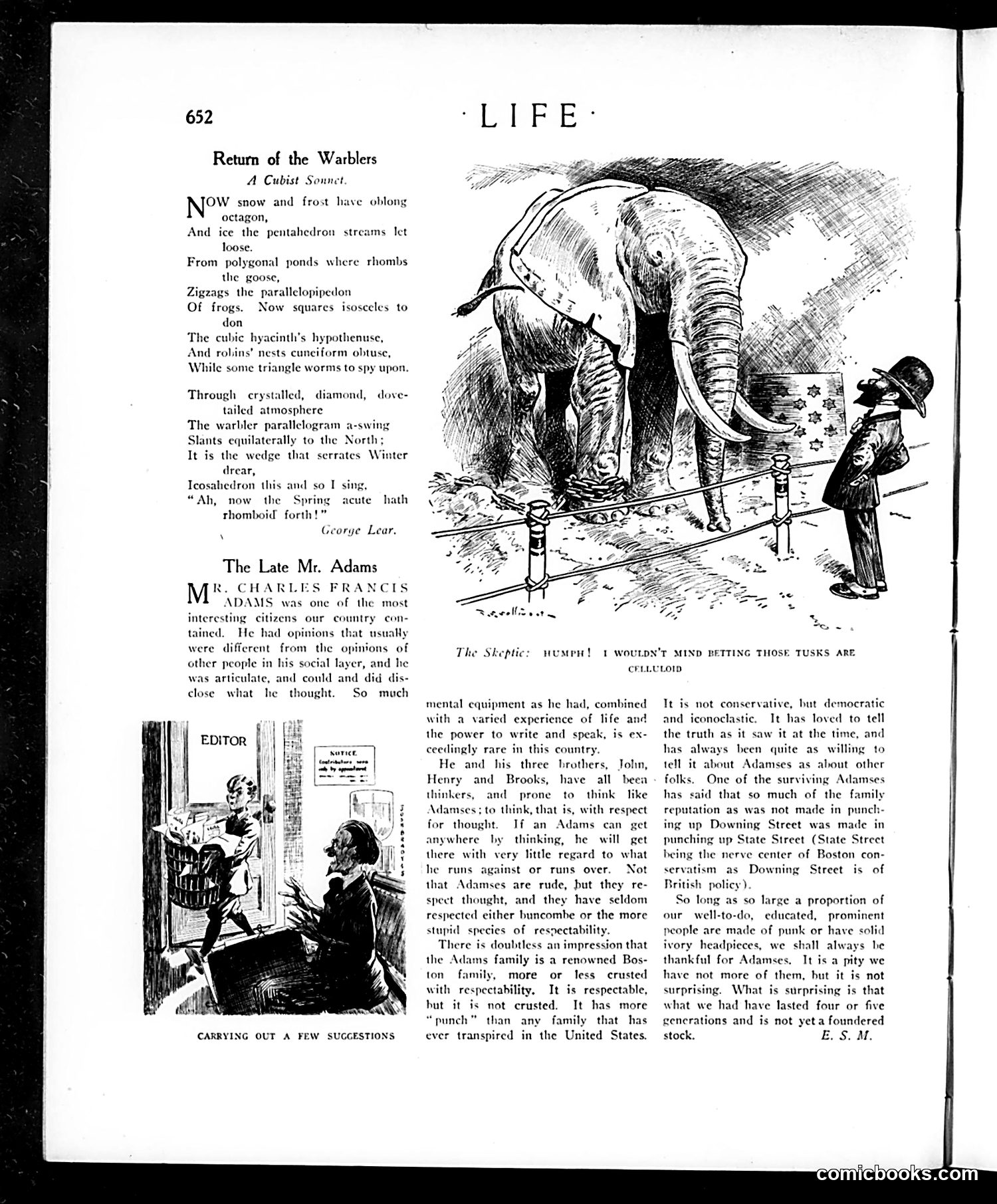
**Main Content:** The page features "Return of the Warblers," a cubist sonnet by George Lear about seasonal change using geometric and biological imagery. **The Cartoon:** The large illustration shows an elephant confronted by a small man in a top hat with a cane. The caption reads: "The Skeptic: HUMPH! I WOULDN'T MIND BETTING THOSE TUSKS ARE CELLULOID." **The Satire:** This appears to mock skepticism and fakery—suggesting someone so cynical they'd doubt even an elephant's authenticity, assuming its tusks are artificial. It satirizes excessive doubt or distrust of obvious things. **Secondary Content:** An article discusses Charles Francis Adams, a prominent Boston family member noted for independent thinking and respectability. The piece debates whether such old-money families deserve their social standing. The page reflects early 20th-century American preoccupations with authenticity, class, and social pretension.
📄 Transcribed text from this page (OCR, searchable)
Machine-transcribed from the original scan — historical spelling and the odd misread are preserved.
652 Return of the Warblers A Cubist Sonnet OW snow and frost have oblong octagon, And ice the pentahedron streams Ict loose. From polygonal ponds where rhombs the goose, Zigzags the parallelopipedon Of frogs. Now squares isosceles to don The cubic hyacinth’s hypothenuse, And robins' nests cuneiform obtuse, While some triangle worms to spy upon. crystalled, diamond, dove- ailed atmosphere The warbler parallelogram a-swing Slants equilaterally to the North; It is the wedge that serrates Winter drear, Icosahedron this and so I sing, “Ah, now the Spring acute rhomboid forth!” George Lear. Through ae hath \ The Late Mr. Adams M®* CHARLES FRANCIS ADAMS was one of the most interesting citizens our country con- tained. He had opinions that usually were different from the opinions of other people in his social layer, and he was articulate, and could and did dis- close what he thought. So much orice CARRYING OUT A FEW SUGGESTIONS The Skeptic: ween! 1 WOULDN'T MIND BETTING THOSE TUSKS ARE CPLLULOID mental equipment as he had, combined with a varied experience of life and the power to write and speak, is ex- ceedingly rare in this country. He and his three brothers, Henry and Brooks, have all beea thinkers, and) prone to think like Adamses; to think, that is, with respect for thought. If an Adams can get anywhere by thinking, he will get there with very little regard to what he runs against or runs over. ‘ot that Adamses are rude, but they re- spect thought, and they have seldom respected either buncombe or the more stupid species of respectability. There is doubtless an impression that the Adams family is a renowned Bos- ton family, more or less crusted with respectability, It is respectable, hut it is not crusted. It has more “punch” than any family that has ever transpired in the United States. John, It is not conservative, but democratic and iconoclastic. It has loved to tell the truth as it saw it at the time, and has always been quite as willing to tell it about Adamses as about other folks. One of the surviving Adamses has said that so much of the family reputation as was not made in punch- ing up Downing Street was made in punching up State Street (State Strect being the nerve center of Boston con- servatism as Downing Street is of British policy) So long as so large a proportion of our well-to-do, educated, prominent people are made of punk or have solid ivory headpieces, we shall alw thankful for Adamses, It is a pity we have not more of them, but it is not surprising. What is surprising is that what we had have lasted four or five generations and is not yeta foundered stock. E.S. M.