
A complete issue · 48 pages · 1914
Life — September 10, 1914
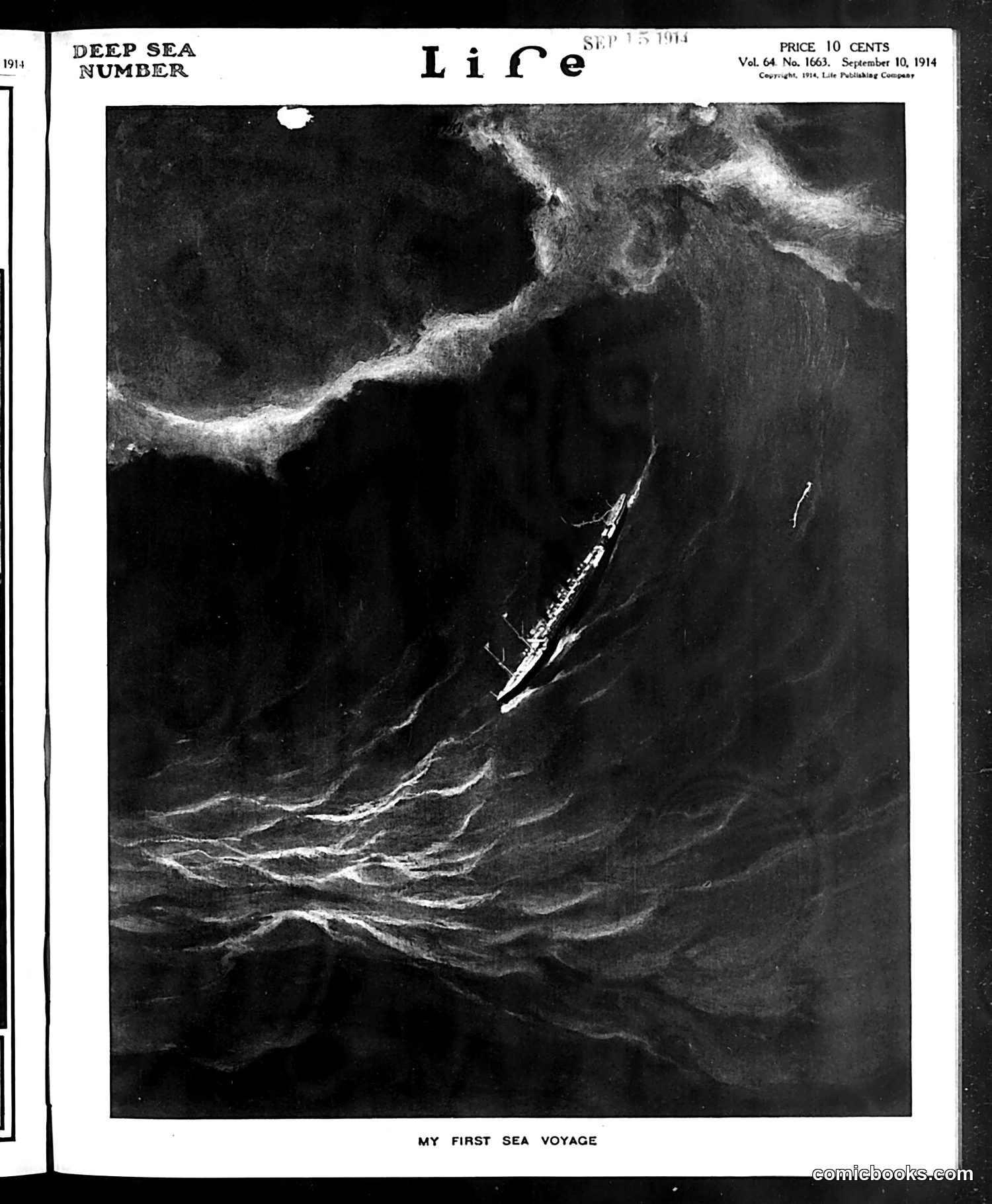
This page from Life magazine (September 10, 1914) features a dramatic illustration titled "MY FIRST SEA VOYAGE." The image shows a small ship being tossed violently on enormous, turbulent waves during what appears to be a severe storm. Given the publication date—just weeks after World War I began in Europe (August 1914)—this likely depicts America's anxious entry into maritime commerce during wartime. The small vessel struggling against massive waves likely symbolizes American shipping ventures navigating the dangerous waters of a war-torn Atlantic, where German U-boats threatened merchant vessels. The "first sea voyage" reference suggests inexperience or vulnerability facing unexpected perils, capturing contemporary American concerns about oceanic travel during the early war period.
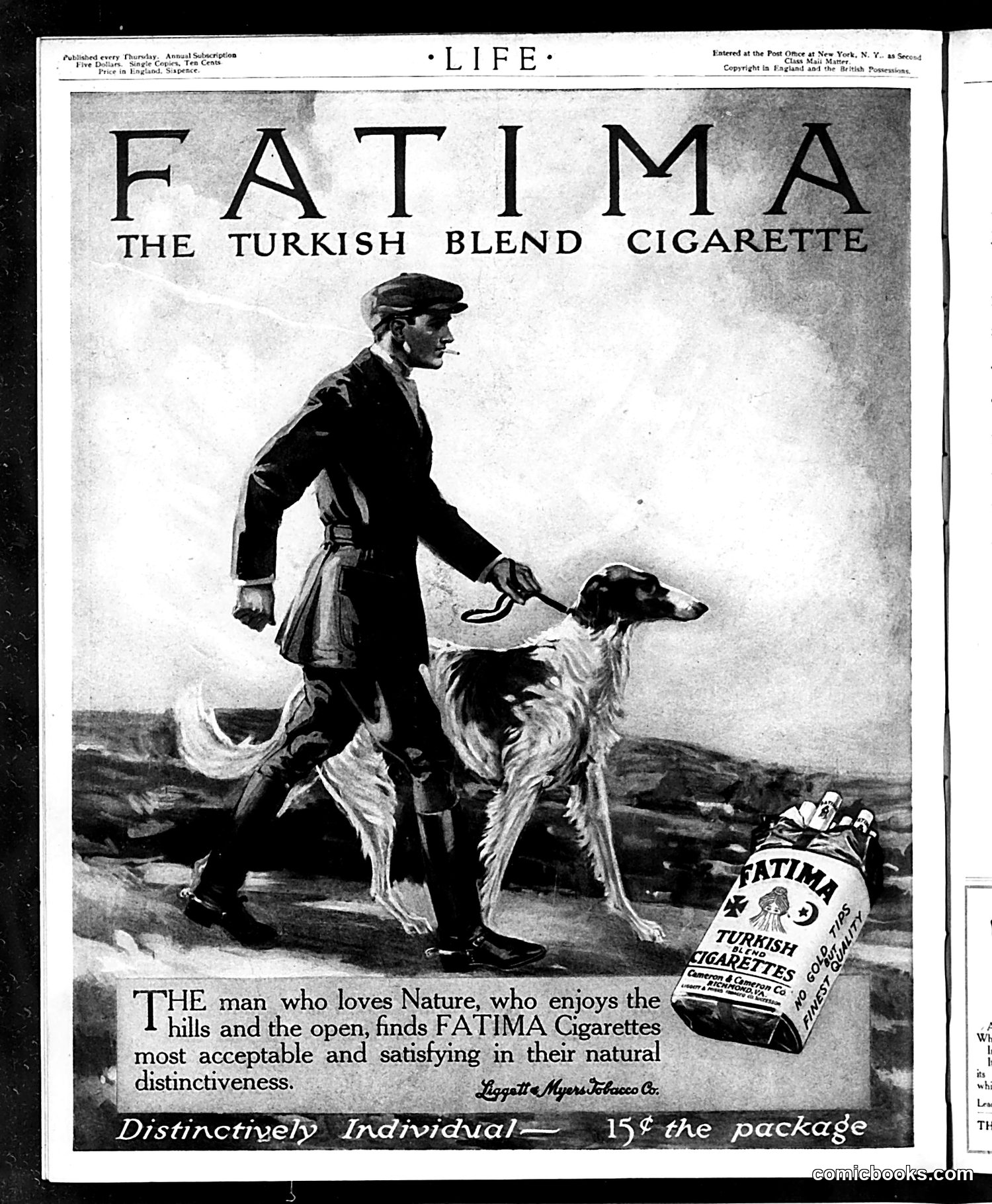
This is **an advertisement, not political satire**. It promotes Fatima Turkish Blend Cigarettes, made by Liggett & Myers Tobacco Co. The ad features a well-dressed man in a coat and cap with a hunting dog on a hillside landscape. The marketing copy appeals to affluent outdoor enthusiasts: "The man who loves Nature, who enjoys the hills and the open, finds FATIMA Cigarettes most acceptable and satisfying in their natural distinctiveness." The "distinctiveness" claim refers to the Turkish tobacco blend, which was marketed as sophisticated and refined compared to domestic American cigarettes. The outdoor hunting scene associates the product with masculine leisure and countryside pursuits. The price was 15¢ per package—premium pricing for the era. This represents typical early-20th-century cigarette marketing before health warnings existed.
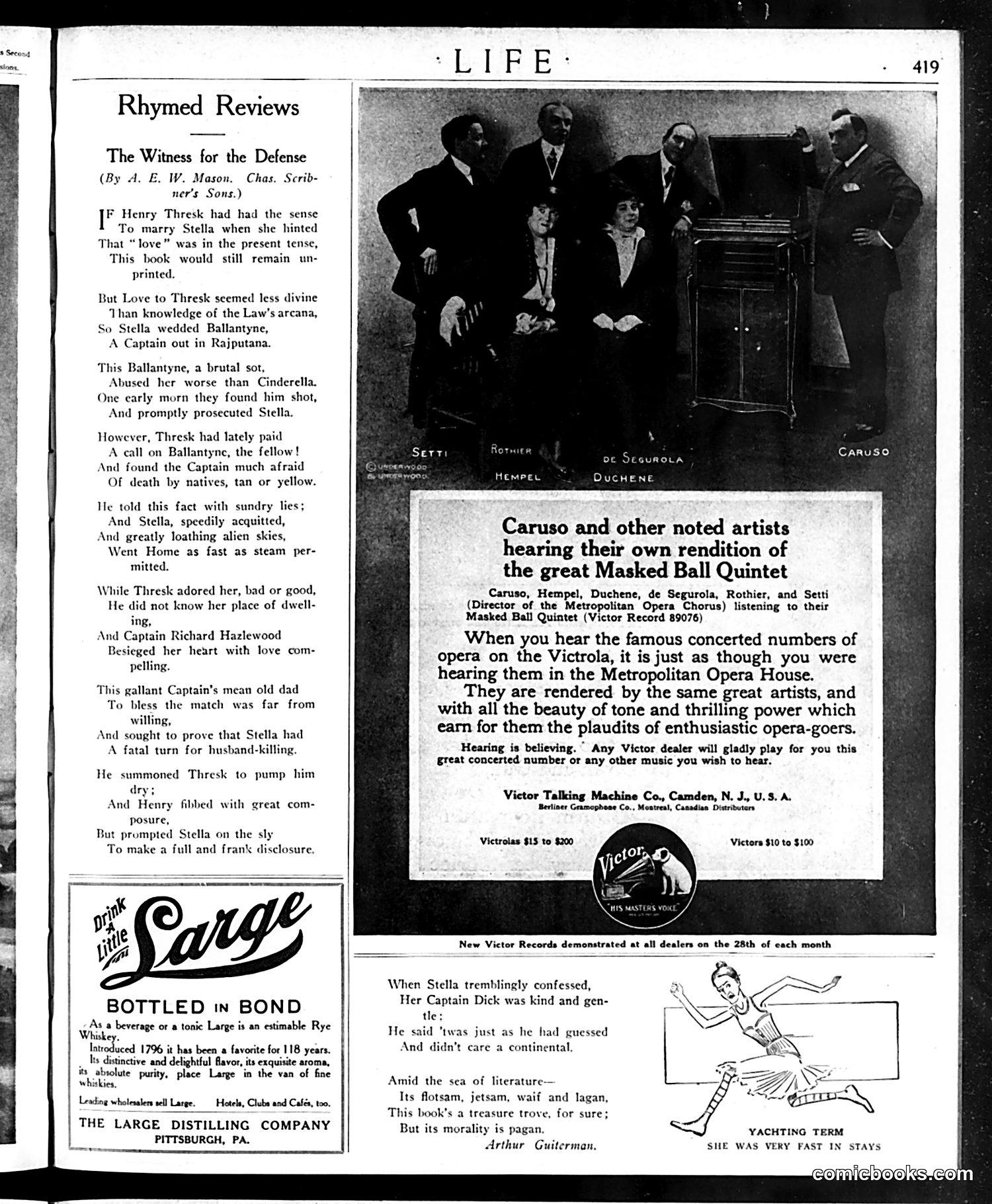
This page is primarily **advertising and entertainment content** rather than political satire. The main visual shows **five men in formal attire examining what appears to be recording or broadcasting equipment**. The accompanying advertisement promotes a **Victor Records release featuring famous opera singers** (Caruso, Hempel, Duchene, de Segurola, and Setti) performing the "Masked Ball Quintet" from the Metropolitan Opera. The ad emphasizes that listeners can experience the performance's quality through the Victrola recording device. The left column contains a **rhymed poem titled "The Witness for the Defense"** by A.E.W. Mason about a legal case involving characters named Stella, Thresk, and Ballantype in India. Additional advertisements for **Sarge whiskey** and other products appear below. The small cartoon "Yachting Term" at bottom-right is unrelated humor.
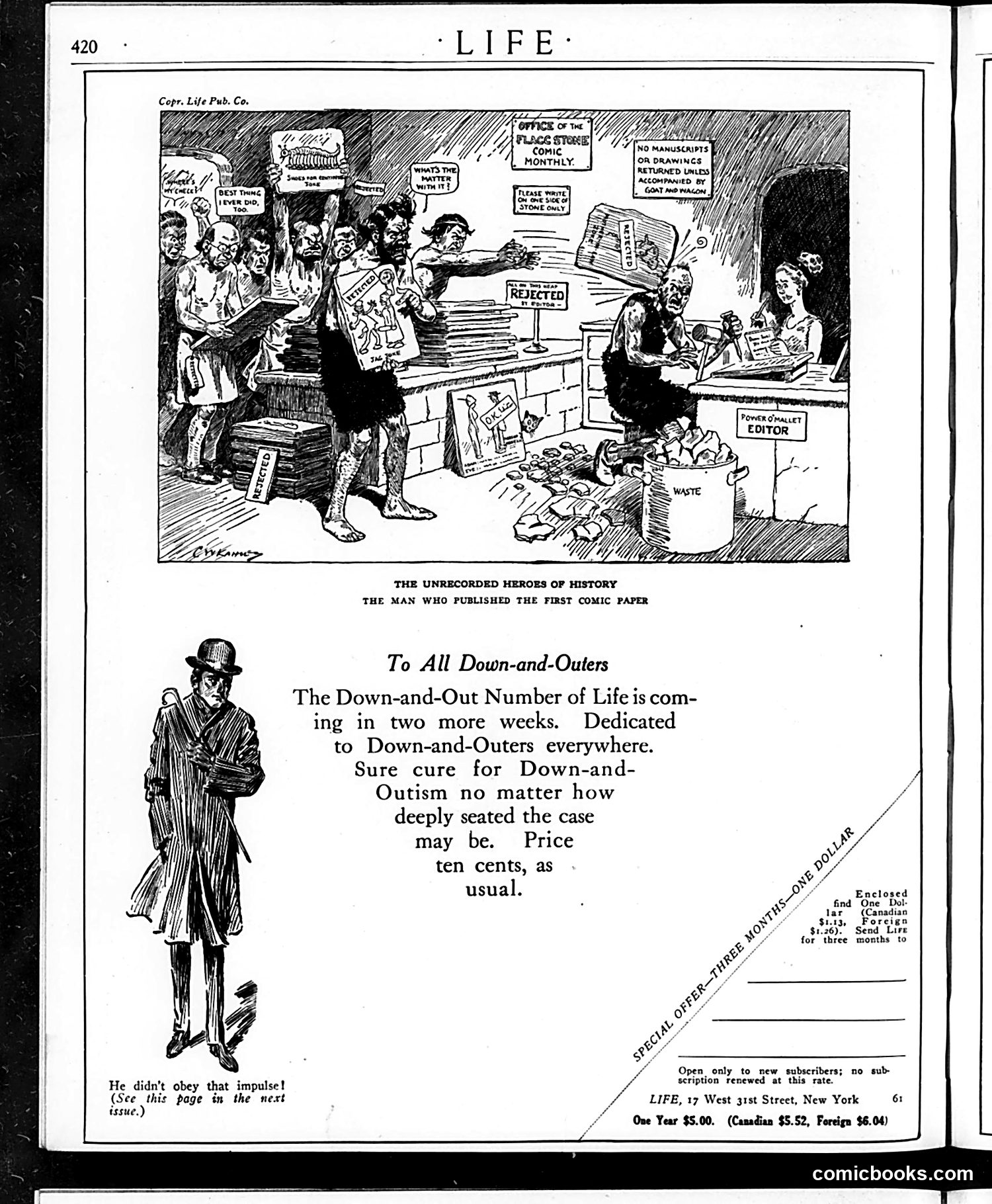
**Main Cartoon (top):** This satirizes the editorial office of a comic publication. A queue of aspiring cartoonists holds rejected manuscripts while the editor sits at a desk, stamping work "REJECTED." Signs read "No manuscripts or drawings returned unless accompanied by stamped envelope" and "Please write on one side of paper only." The cartoon mocks the gatekeeping of early comics publishing—the difficulty new artists faced in getting work accepted, and the bureaucratic frustration of submission processes. **Lower Section:** This is primarily an advertisement for Life magazine's "Down-and-Out Number," promising "sure cure for Down-and-Outism" at ten cents. It targets economic hardship during what appears to be a period of economic difficulty, using satirical messaging to sell subscriptions. The page demonstrates Life's mix of social satire and self-promotion.
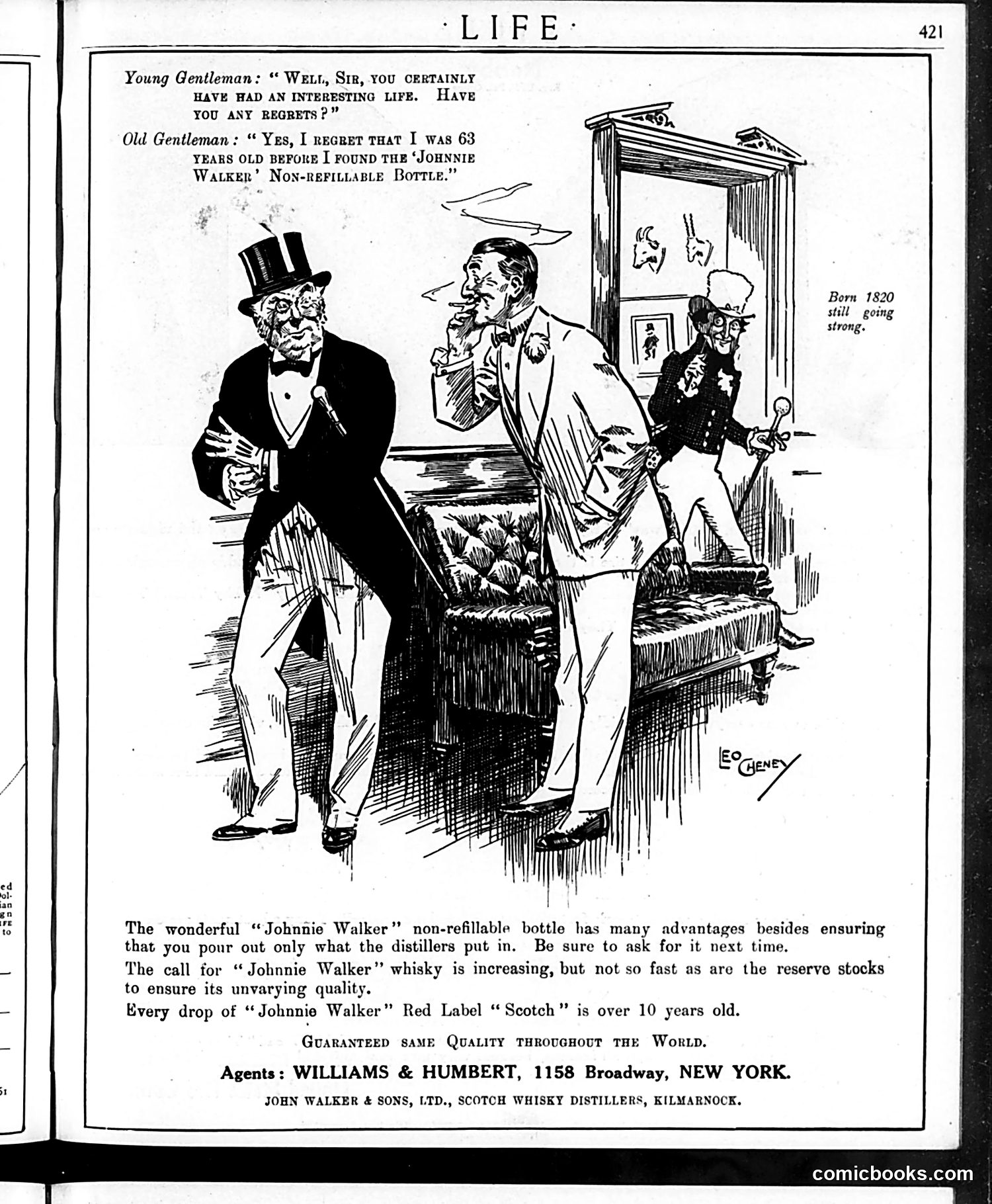
This page is primarily **advertising for Johnnie Walker Scotch whisky**, not political satire. The "cartoon" frames a sales pitch as humor. The dialogue presents an old gentleman (left, wearing top hat) claiming his only regret in 63 years was waiting until age 63 to discover Johnnie Walker whisky. A younger man (center) listens while a tiny figure (right, labeled "Born 1820 still going strong") represents the brand's longevity claim. The joke relies on the premise that discovering this whisky earlier would have improved his life—a common advertising trope of the era. The "non-refillable bottle" reference suggests authenticity and quality control. This represents early-20th-century American magazine advertising dressed as editorial humor, targeting affluent male readers. The satire is gentle and entirely commercial in purpose.
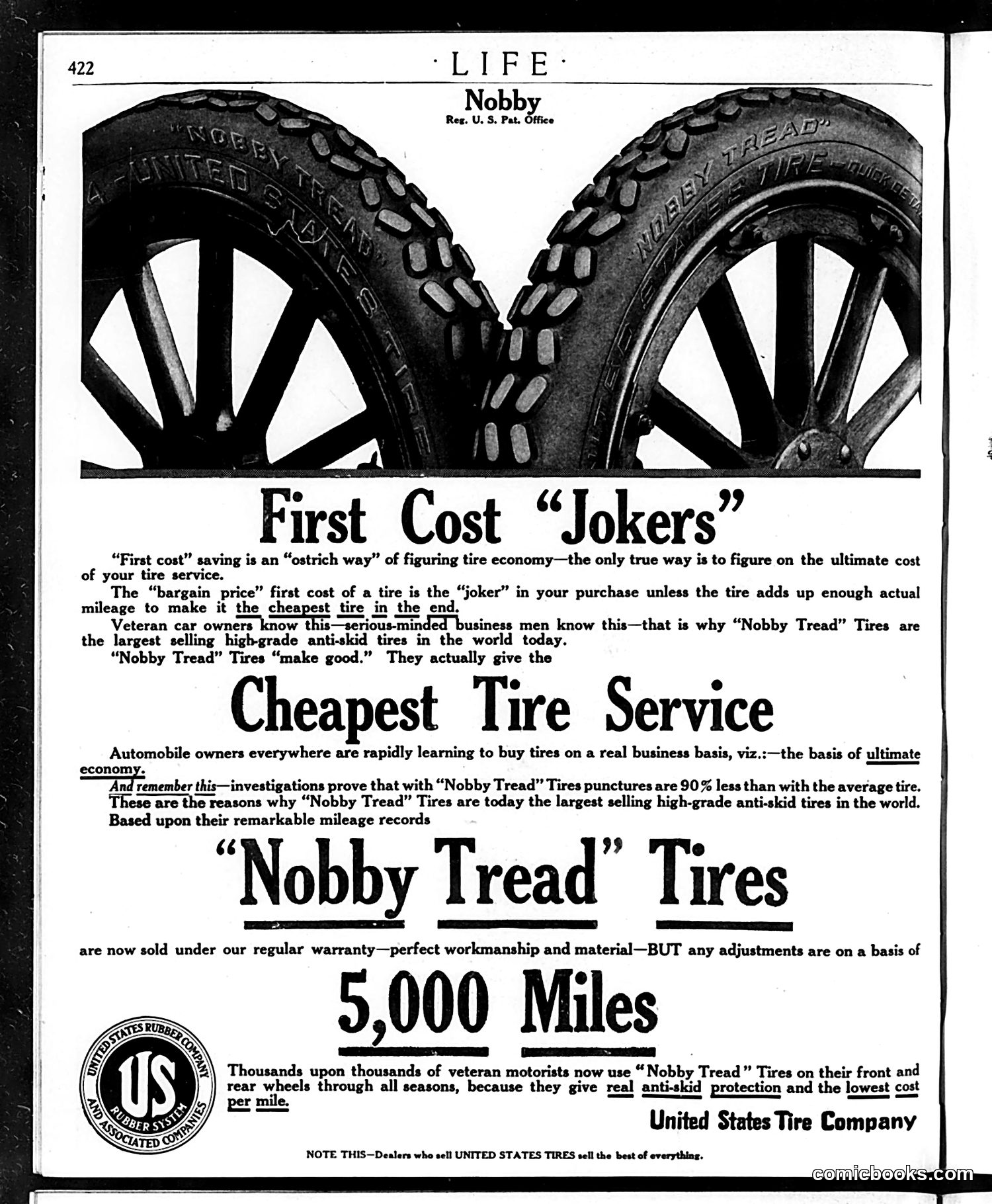
This is **not a political cartoon or satire page**—it's a straightforward advertisement for "Nobby Tread" tires by the United States Tire Company, appearing in Life magazine. The ad uses two tire photographs to argue that buyers should evaluate tires on **total cost of ownership rather than initial price**. It dismisses cheap tires as "jokers"—a play on the phrase "first cost jokers," suggesting bargain-basement pricing is deceptive economy. The advertisement claims Nobby Tread tires offer superior mileage (5,000 miles warranty), fewer punctures (90% fewer than average), and ultimately the "cheapest tire service" despite higher upfront cost. This represents early 20th-century consumer advocacy messaging: buy quality, not price.
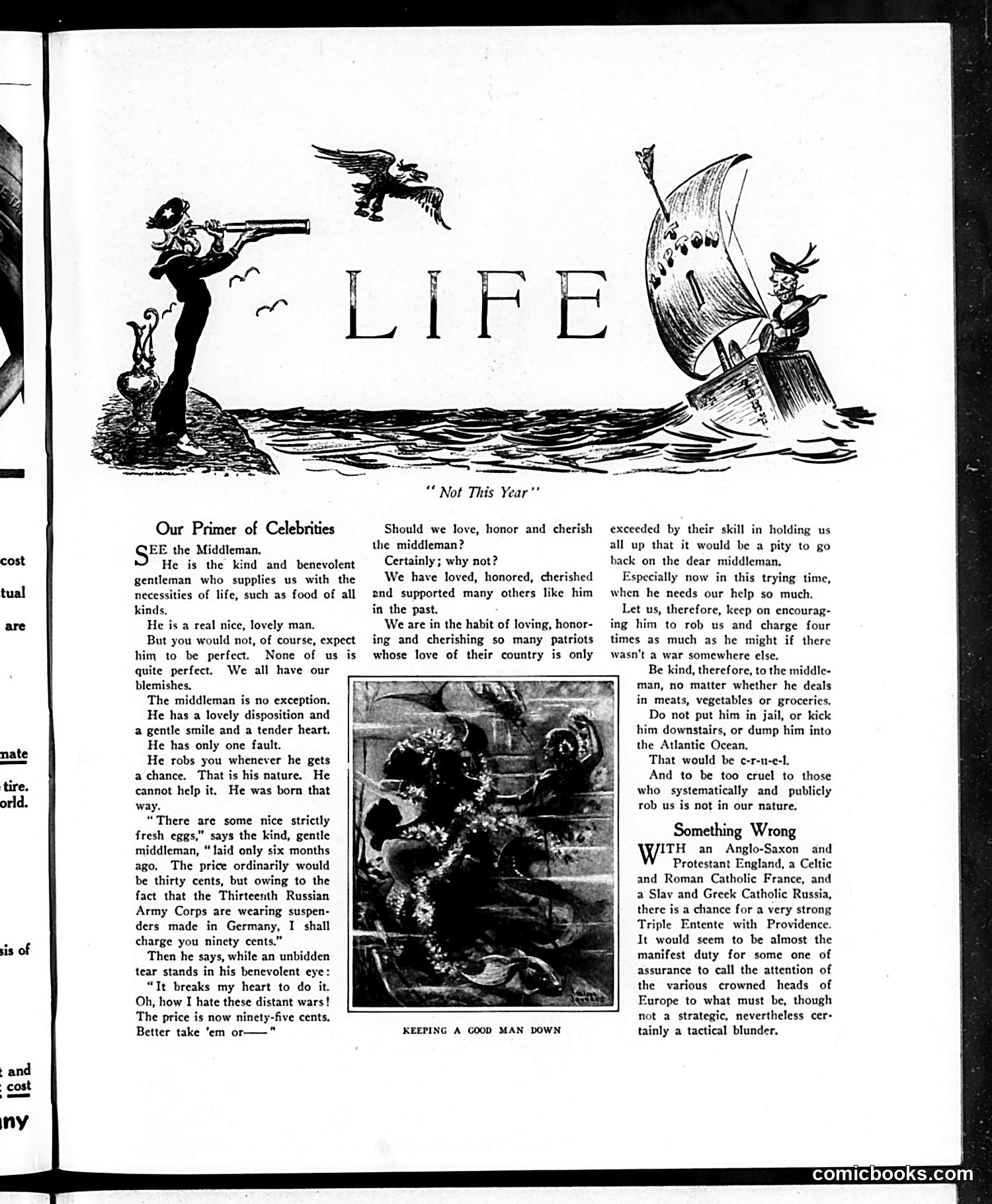
This page critiques the treatment of the "middleman"—likely referring to merchants or grocers during wartime rationing. The header "Not This Year" suggests a plea against profiteering or hoarding during what appears to be WWI. The top illustration shows a hunter aiming at a flying creature (possibly representing the middleman being hunted), while a sailor manages a boat—imagery suggesting conflict over commerce. The main text defends the middleman as "kind and benevolent," acknowledging his wartime struggles. It warns against public shaming, jailing, or violence toward grocers and merchants, even if prices seem unfair. The photograph titled "Keeping a Good Man Down" appears to show someone in difficulty, reinforcing the argument that middlemen deserve sympathy rather than persecution during economic hardship.
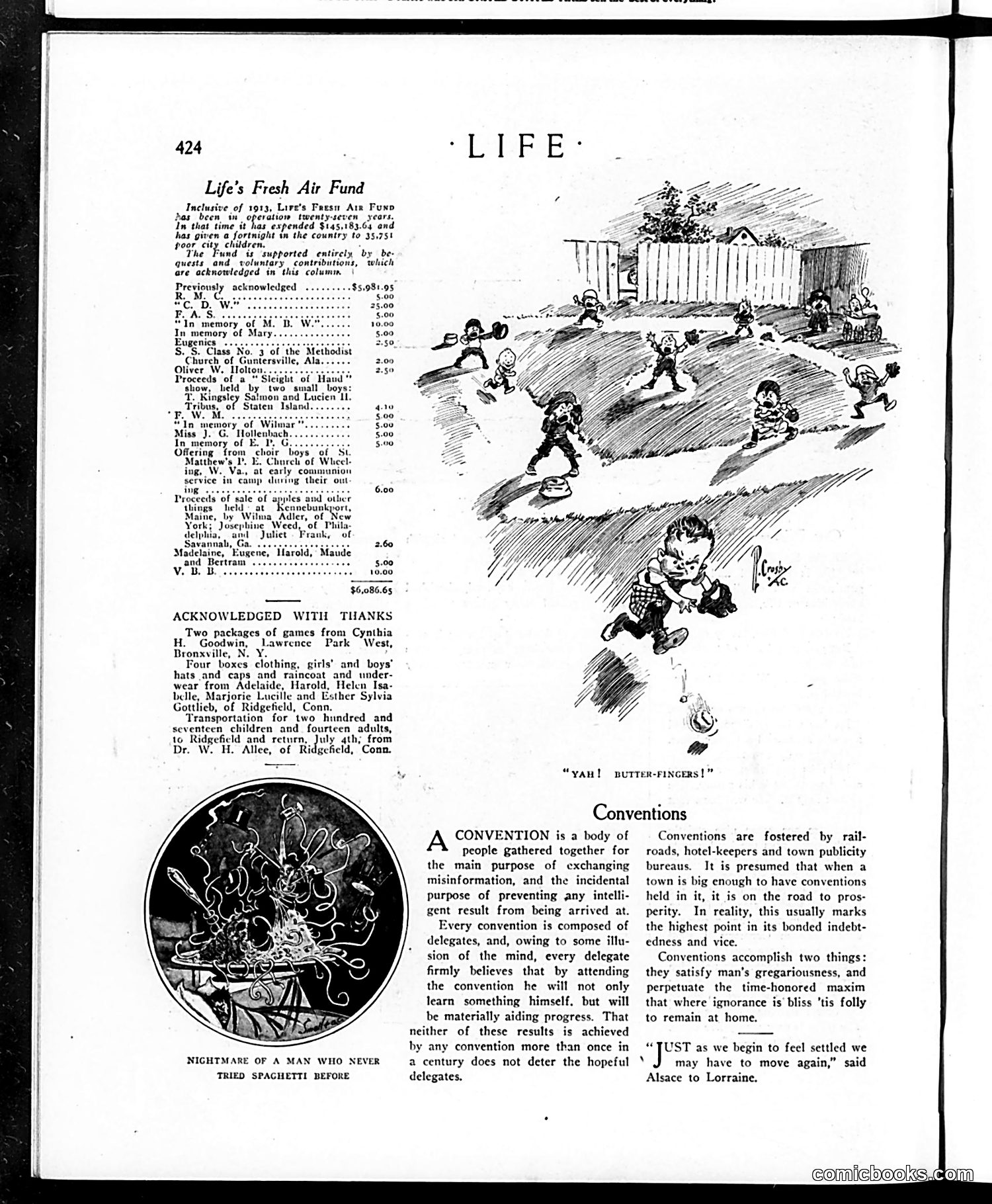
This page contains two distinct elements: **Left side:** A fundraising list for "Life's Fresh Air Fund" (established 1913), detailing donations for children's camps. Below is an illustration titled "Nightmare of a Man Who Never Tried Spaghetti Before"—a surreal, grotesque image depicting tangled spaghetti as nightmarish creatures, likely satirizing both the unfamiliar nature of Italian cuisine to some Americans and anxieties about "foreign" foods. **Right side:** An illustrated scene of children playing outdoors (captioned "Yah! Butter-Fingers!") accompanies an essay on "Conventions." The text humorously defines conventions as gatherings where people exchange misinformation while pretending to accomplish progress. The accompanying quote satirizes the transient nature of such events, suggesting people must frequently relocate—mocking the convention circuit's superficiality.
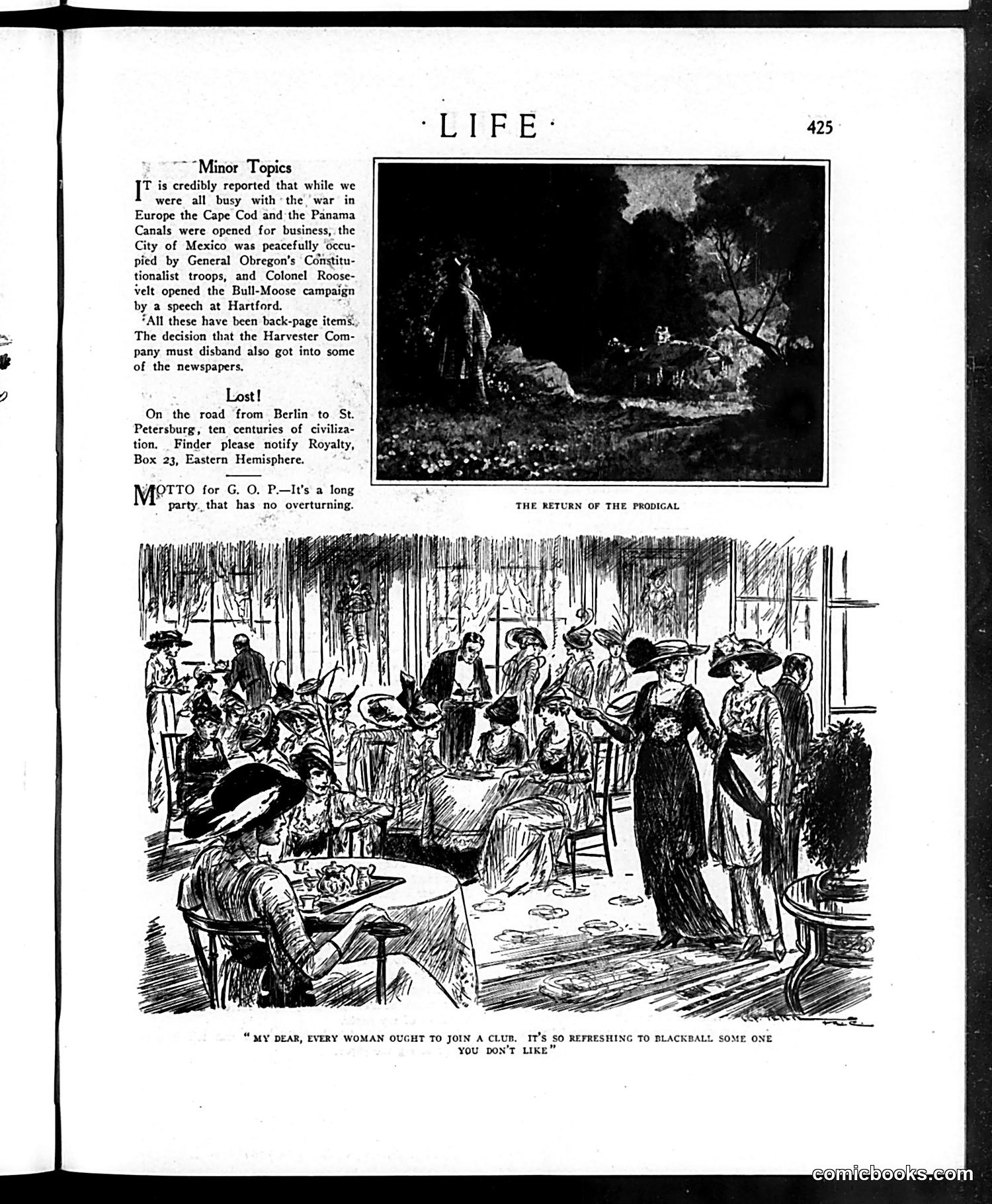
This page contains a social satire cartoon about women's club culture. The illustration depicts an elegant indoor gathering of well-dressed women at what appears to be a social club event. The caption reads: "My dear, every woman ought to join a club. It's so refreshing to blackball some one you don't like." The satire targets the exclusionary practices of exclusive women's clubs—organizations where membership decisions involved voting to accept or reject candidates. "Blackballing" (rejecting someone) was the formal mechanism. The joke suggests that women are drawn to club membership specifically for the social power to exclude and ostracize others they dislike, rather than for the stated purpose of companionship or intellectual enrichment. This mocks both female social hierarchy and the pretensions of exclusive clubs.
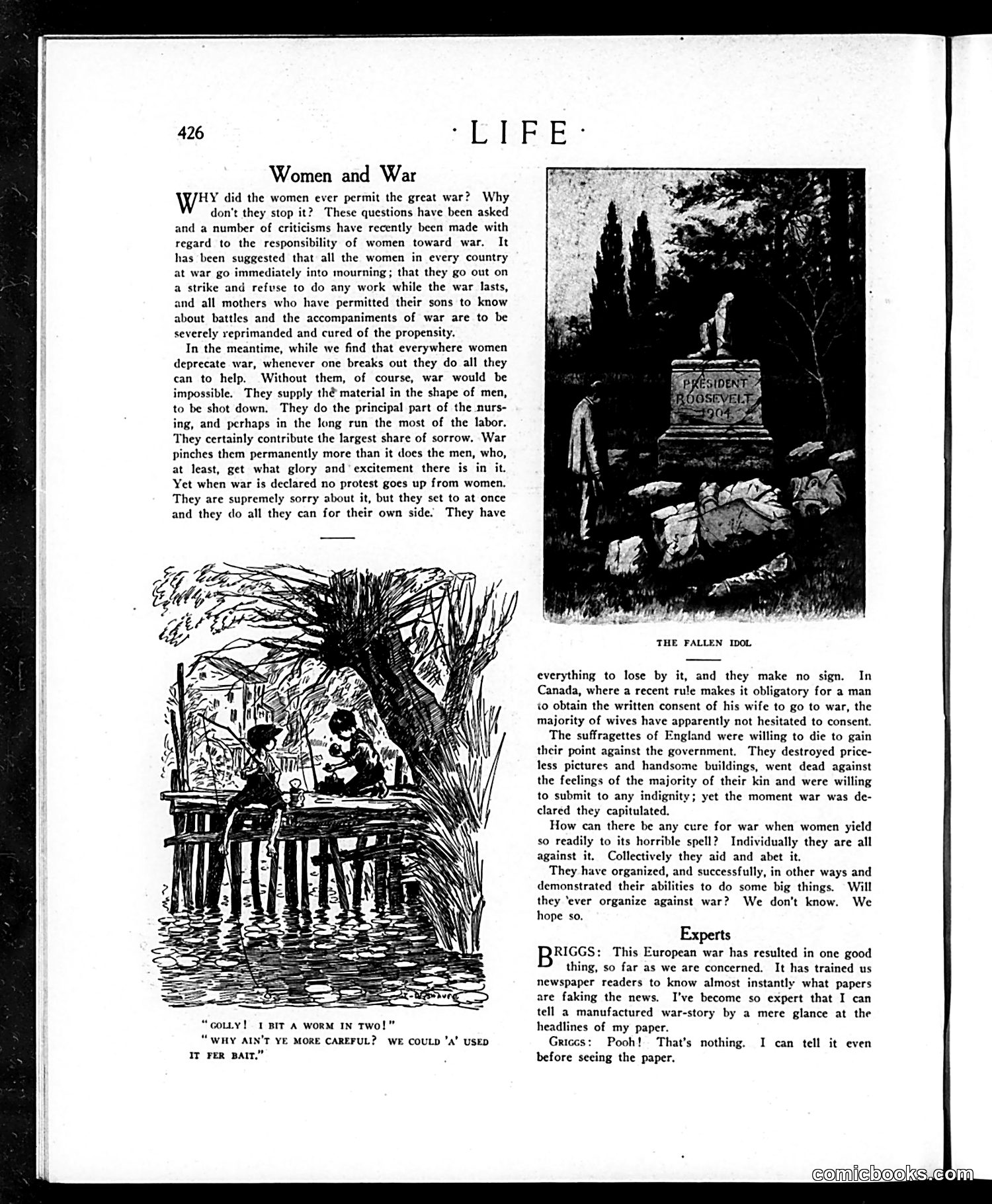
This page critiques women's contradictory positions on war. The article questions why women permit wars yet don't stop them, suggesting they should collectively strike and refuse war work. It argues women suffer war's consequences most severely—supplying soldiers and bearing grief—yet receive no protest credit when war is declared. The two illustrations support this theme: the upper image shows mourners at President Roosevelt's tomb, depicting feminine grief over war casualties. The lower cartoon depicts two women fishing, with dialogue about using worms as bait—a crude analogy satirizing women's perceived passivity in allowing men to be "used" in warfare. The "Experts" section shifts to newspaper accuracy during wartime, offering light relief from the serious preceding argument.
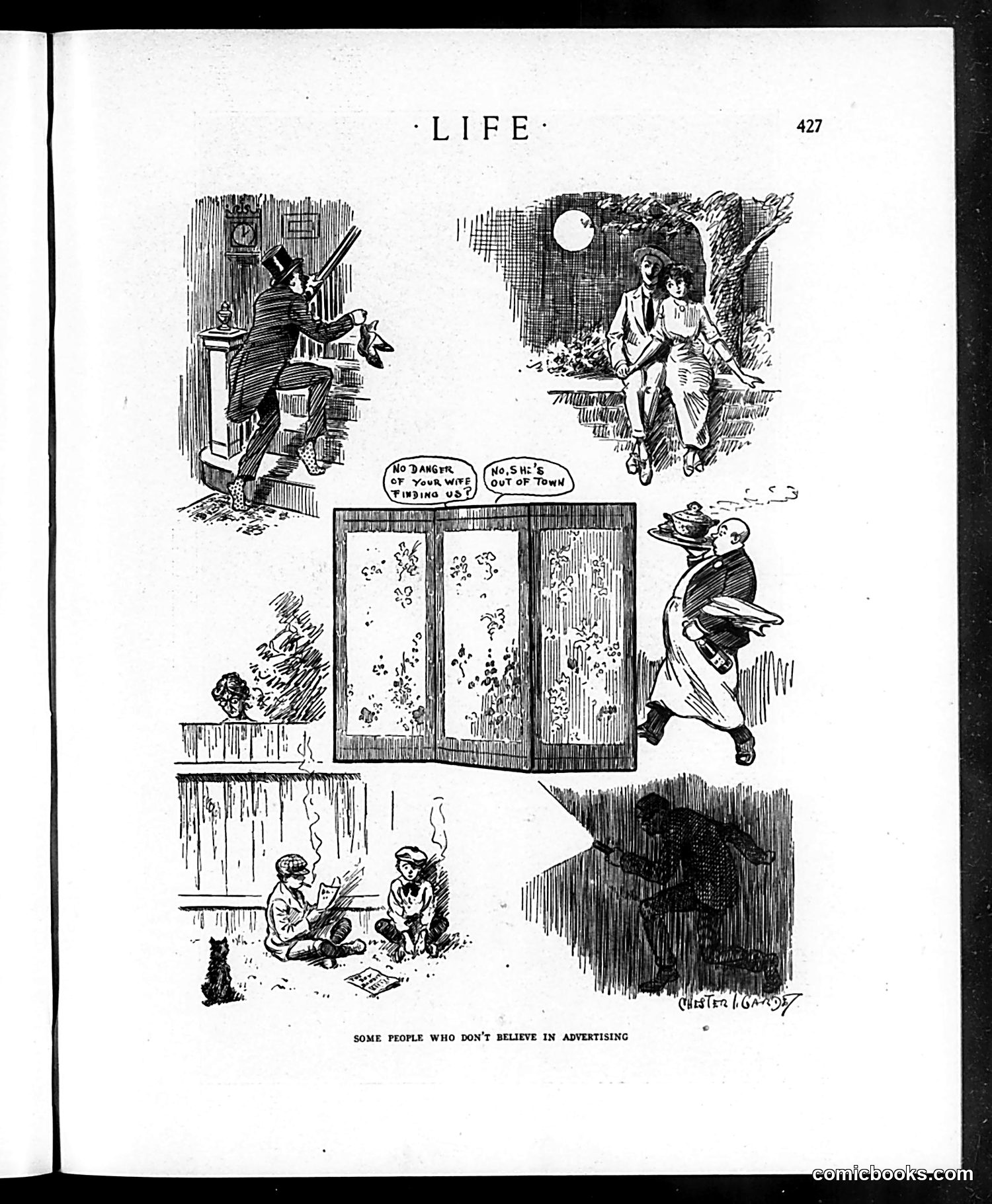
This satirical cartoon collection depicts various scenarios mocking those skeptical of advertising's effectiveness. The top-left shows a burglar breaking in while a clock ticks—suggesting advertising can't stop crime. Top-right illustrates a couple eloping despite presumably being advertised as unmarriageable. The center panel features three window displays that appear empty or ineffective, with a frustrated businessman gesturing at them. The bottom-left shows two vagrants sharing meager provisions, implying advertising hasn't reached or helped them. The bottom-right depicts a silhouetted figure in darkness—possibly representing someone unreached by advertising campaigns. The overall message defends advertising's necessity by showing scenarios where its absence or ineffectiveness would create problems, supporting the advertising industry's claims about marketing's value to society.
I can see this is a black and white photograph or illustration, but the image quality is too degraded and dark for me to make out specific details with confidence. The OCR text provided ("for a stronger you are") appears incomplete or corrupted. Without being able to clearly identify figures, read captions, or determine the specific context from either the image or legible text, I cannot reliably explain what political or social satire this page contains. To provide accurate historical interpretation, I would need either a clearer image or complete, legible OCR text identifying the subject matter, figures depicted, and any accompanying commentary. I'd recommend consulting the original Life magazine archive for this specific page to obtain proper context.
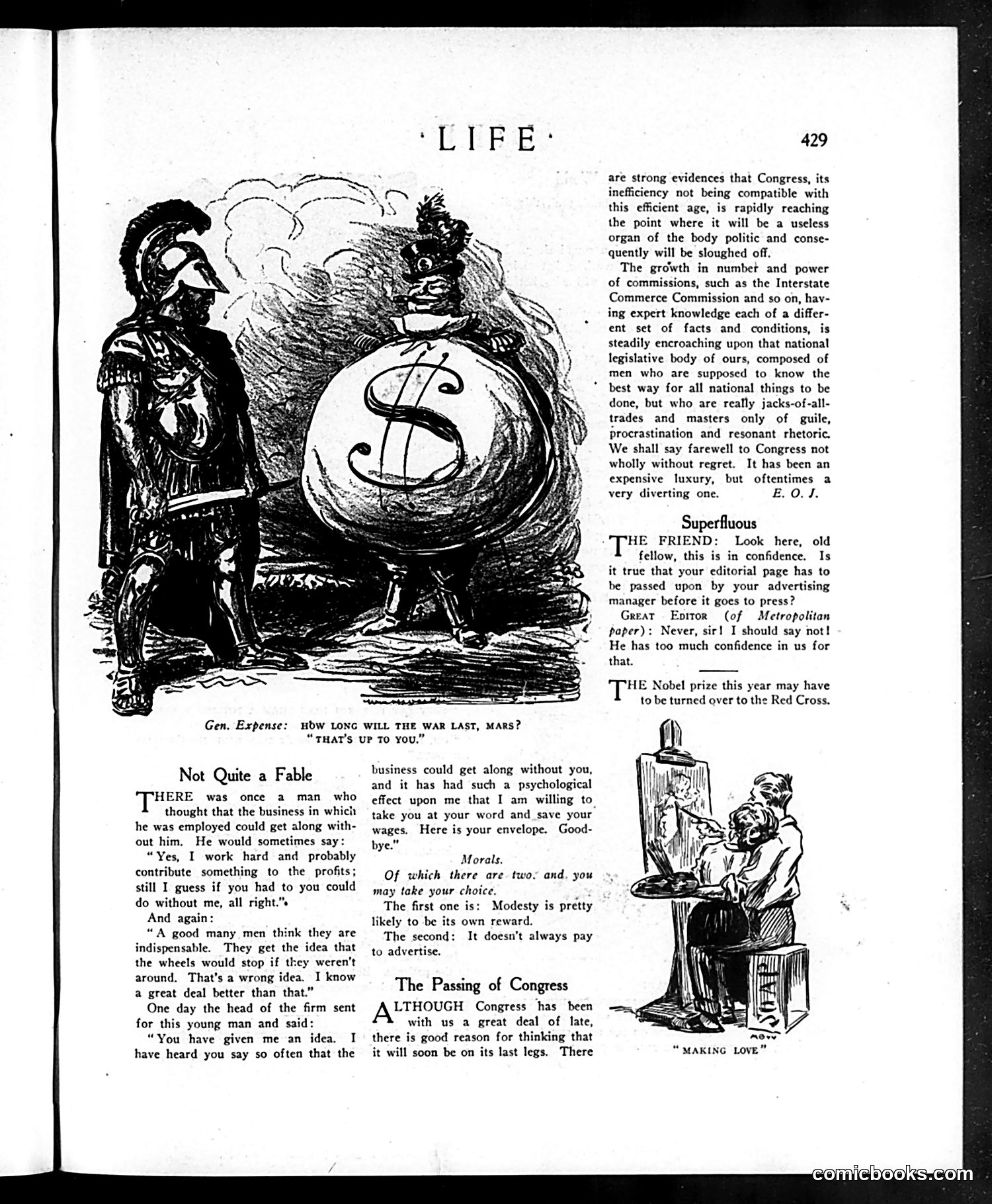
The main political cartoon depicts a military figure (labeled "Gen. Expense") standing beside a enormous dollar sign, with the caption "HOW LONG WILL THE WAR LAST, MARS? 'THAT'S UP TO YOU.'" This satirizes **military spending during wartime** — the implication being that war's duration depends on continued government expenditure rather than strategic necessity. The figure of Mars (Roman god of war) personifies conflict itself, suggesting the cycle feeds on money. The surrounding text critiques **Congress's inefficiency**, arguing the legislative body has become obsolete in the modern age, with regulatory commissions better suited to governance. The page also includes humorous short pieces about business and modesty. The overall tone mocks government waste and bureaucratic irrelevance during what appears to be **World War I era** (based on war references).
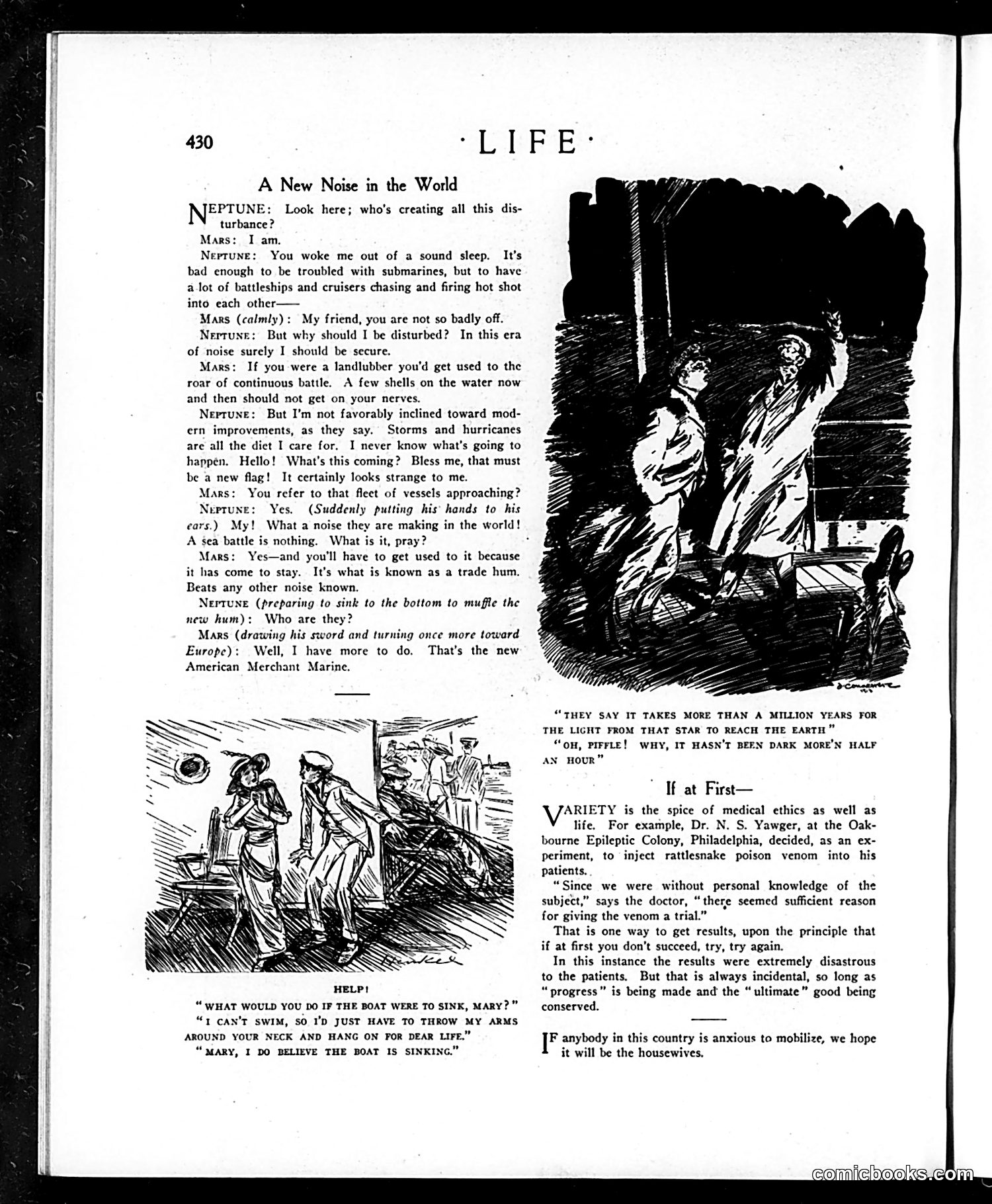
This page contains two satirical pieces about World War I-era noise and disturbance. **Top dialogue ("A New Noise in the World"):** Neptune and Mars debate modern naval warfare. Mars complains about submarines, battleships, and cruisers creating constant noise. Neptune counters that this "trade hum" from the American Merchant Marine is worse than any sea battle. The satire mocks how industrial/commercial warfare noise now rivals actual combat—a commentary on WWI's unprecedented scale and the mobilization of civilian merchant vessels. **Bottom cartoon ("Help!"):** Shows a couple in a sinking boat. The caption presents dark humor about survival instincts during maritime disasters, likely referencing U-boat attacks on merchant and passenger ships, a major WWI concern. **Right section ("If at First"):** Reports a medical ethics experiment injecting rattlesnake venom into patients, justifying it as experimental progress—satirizing the "try, try again" mentality without ethical constraints.
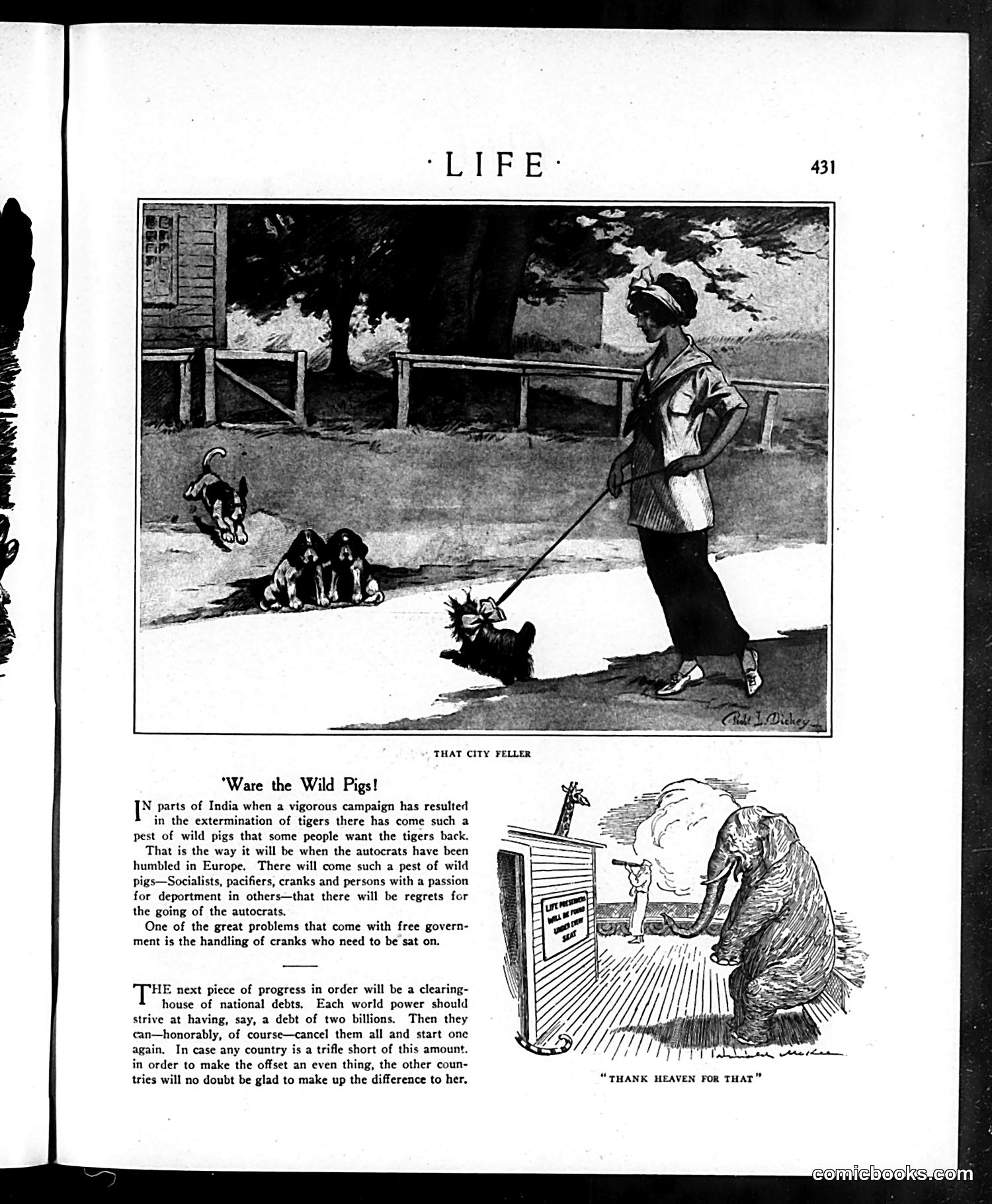
The page contains two satirical pieces from Life magazine, likely post-WWI. **"Ware the Wild Pigs!"** uses an India tiger-to-wild-pig analogy to argue that eliminating European autocrats will create worse problems: a "pest" of Socialists, pacifists, and cranks who interfere in others' affairs. The satire warns that free government brings troublesome ideological activists—implying the author views them as pests requiring suppression, comparable to dangerous animals. **"Thank Heaven for That"** (cartoon) depicts a large bear at a door marked "Life Insurance," apparently relieved. This likely satirizes post-war debt relief proposals—the accompanying text proposes a system where all nations cancel debts equally, which the cartoonist mocks as an absurd financial scheme. Both pieces reflect conservative skepticism toward progressive post-war reforms: suspicion of radical political movements and cynicism about international debt forgiveness schemes.
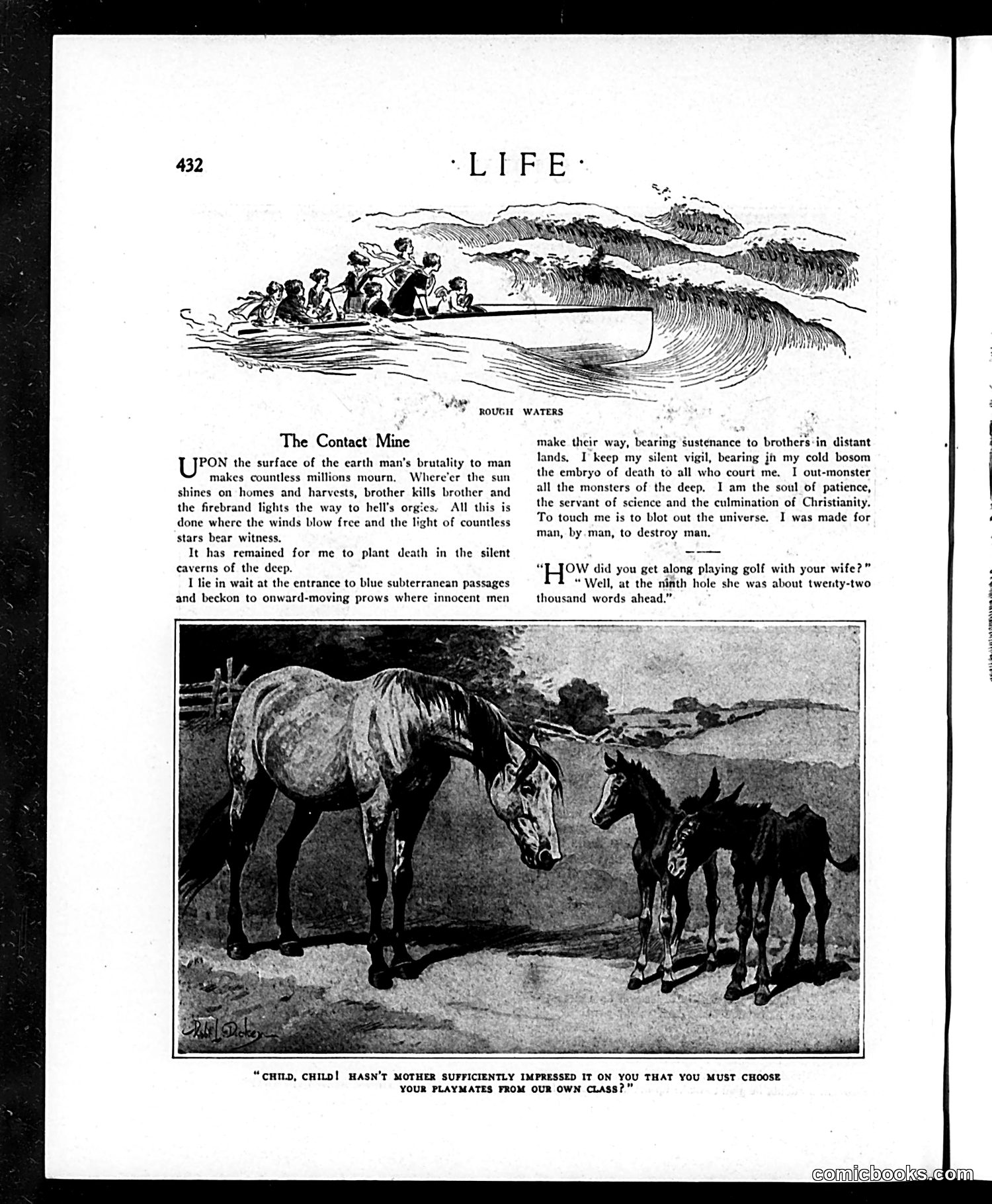
**"The Contact Mine"** is a World War I-era satirical piece personifying naval contact mines as instruments of death. The mine speaks in grandiose, bitter language about its role destroying ships carrying supplies and innocent sailors to allied nations. The satire critiques the hypocrisy of modern warfare—man creates technology to kill on an industrial scale while claiming moral superiority ("culmination of Christianity"). **The lower cartoon** depicts a wealthy mother reprimanding her child for playing with a foal alongside a peasant child. The caption emphasizes class distinction—the child shouldn't associate with those "not of our own class." Together, these pieces form ironic social commentary: while the mine monologue exposes the brutality governments inflict on each other across vast distances, the cartoon shows how the same societies obsessively police class boundaries at home. The contrast suggests hypocrisy: societies wage mechanized death abroad while enforcing rigid social hierarchies domestically.
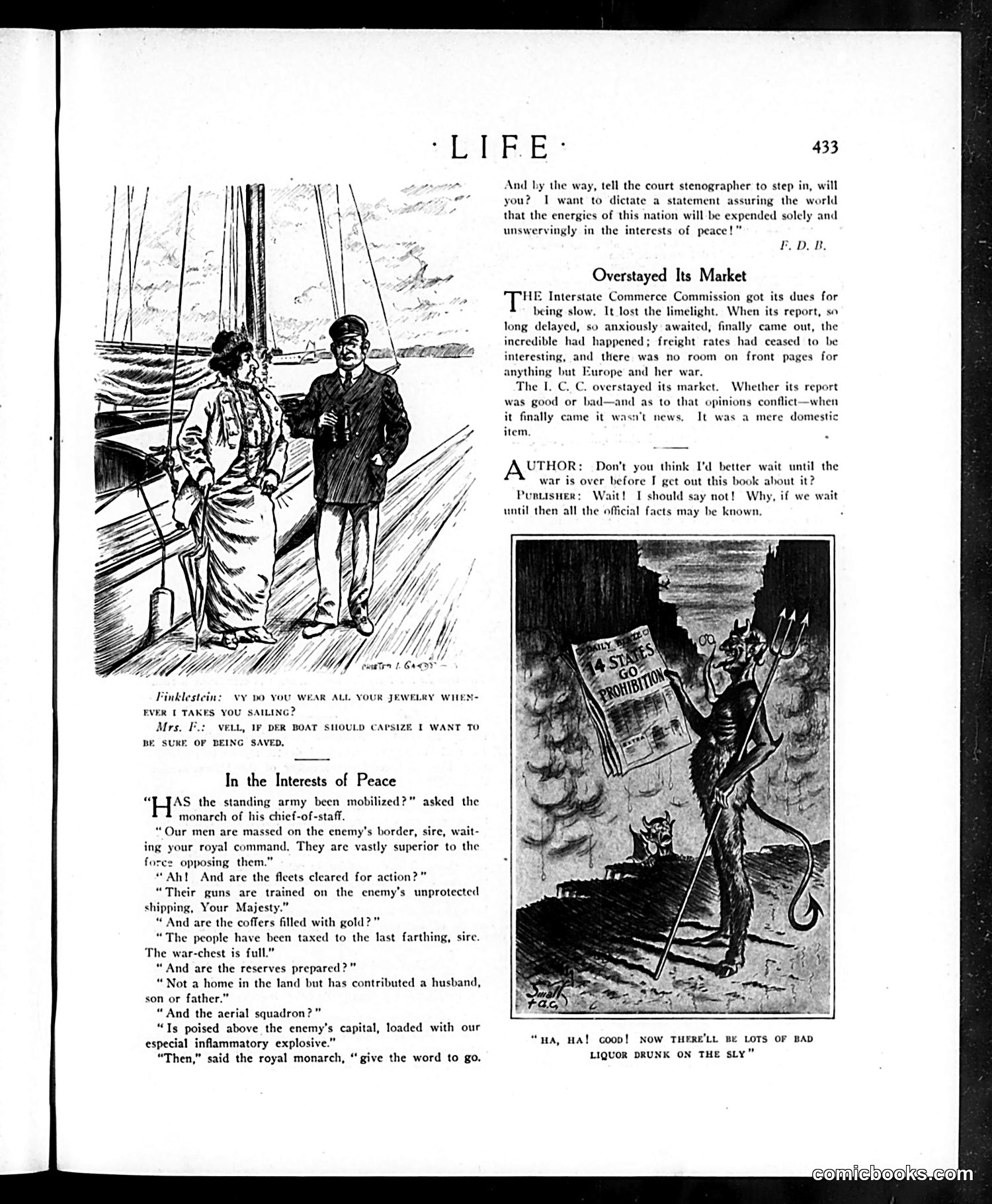
**Top Cartoon**: A domestic humor strip mocking materialism. A woman (Mrs. F.) wears all her jewelry while sailing because if the boat capsizes, the jewelry will ensure her rescue—a joke about valuing possessions over actual safety measures. **"In the Interests of Peace"**: This is the page's main political satire. A monarch asks his chief-of-staff whether the nation is fully mobilized for war—armies massed, fleets armed, treasury emptied, reserves committed, aerial squadrons ready. After confirming total war preparation, the monarch orders: "give the word to go"—then immediately instructs the stenographer to issue a statement claiming the nation's energies will be spent "solely and unswervingly in the interests of peace." The satire targets wartime hypocrisy: governments simultaneously wage total war while publicly professing peaceful intentions. This likely refers to World War I-era propaganda. **Bottom section**: Commentary on the Interstate Commerce Commission's delayed report becoming irrelevant due to the war dominating news cycles. **Right cartoon**: Prohibition-related satire showing illicit liquor production.
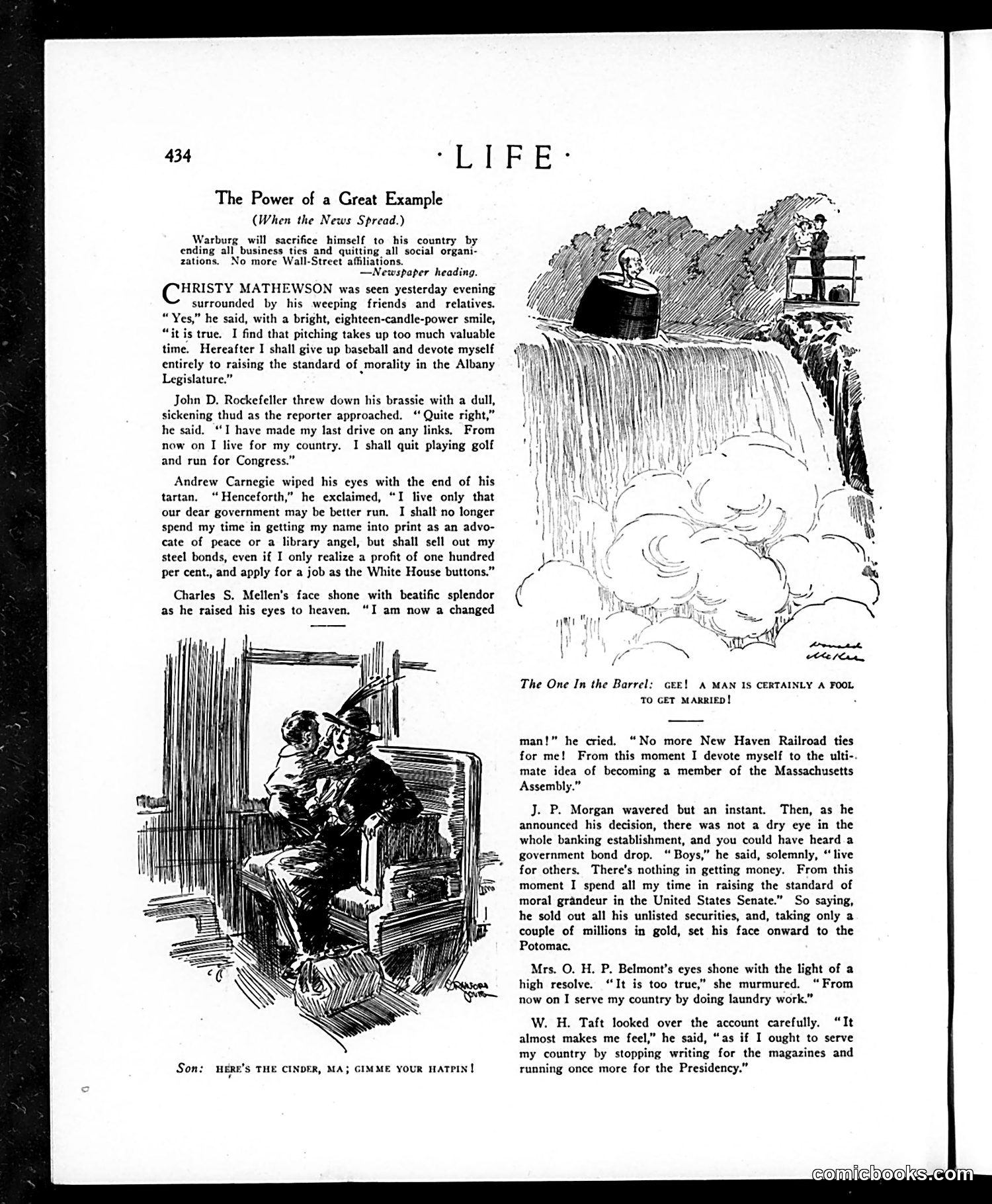
This satirical piece mocks wealthy industrialists and public figures who announced they'd sacrifice personal pursuits for public service, apparently inspired by banker Paul Warburg's publicized commitment. The text presents absurd "conversions" by recognizable figures: Christy Mathewson (baseball star) claiming he'll quit to reform the Albany Legislature; Rockefeller abandoning golf for Congress; Carnegie selling steel bonds for White House custodial work; J.P. Morgan selling securities to serve the Senate; and President Taft considering another presidential run. The humor lies in the obvious hypocrisy—these men are so wealthy and powerful that their "sacrifices" are transparently insincere. The cartoons reinforce this mockery through exaggerated expressions of false piety. The accompanying comic strips ("Son: HERE'S THE CINDER, MA" and "The One In the Barrel") appear unrelated social commentary, though their exact references are unclear today. The satire targets the gap between wealthy elites' public virtue-signaling and their actual priorities—a timeless critique.
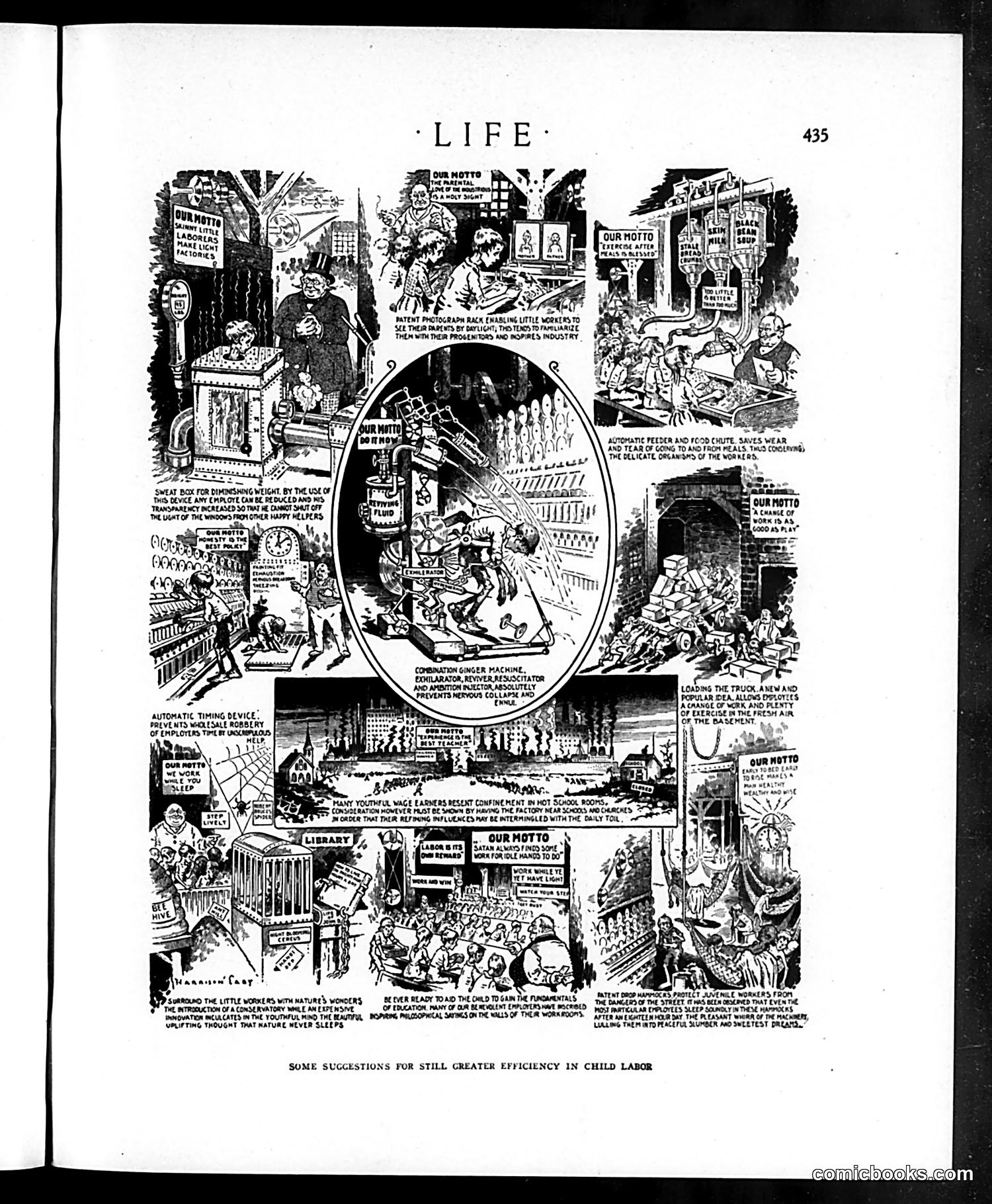
This is a scathing satirical cartoon attacking child labor practices and factory exploitation. The page presents absurd "inventions" and "efficiency suggestions" for exploiting child workers more thoroughly. The central oval illustration shows a factory interior with children laboring at machinery. Surrounding panels mock proposed "improvements": a device allowing children to see parents via photograph while working (no break time); an automatic feeder to eliminate meal breaks; a weight-reduction system; and a "reviver" machine to keep exhausted workers conscious. The text mockingly attributes these ideas to factory owners seeking "efficiency" while using cynical justifications—the Satan quote ("idle hands"), pseudo-moral uplift via "conservatory" art on walls, and "transparency" (literal visibility through workers). The satire's power lies in its grotesque literalism: these absurd proposals expose the actual logic of industrial child exploitation—viewing children purely as productive units whose human needs represent inefficient losses.
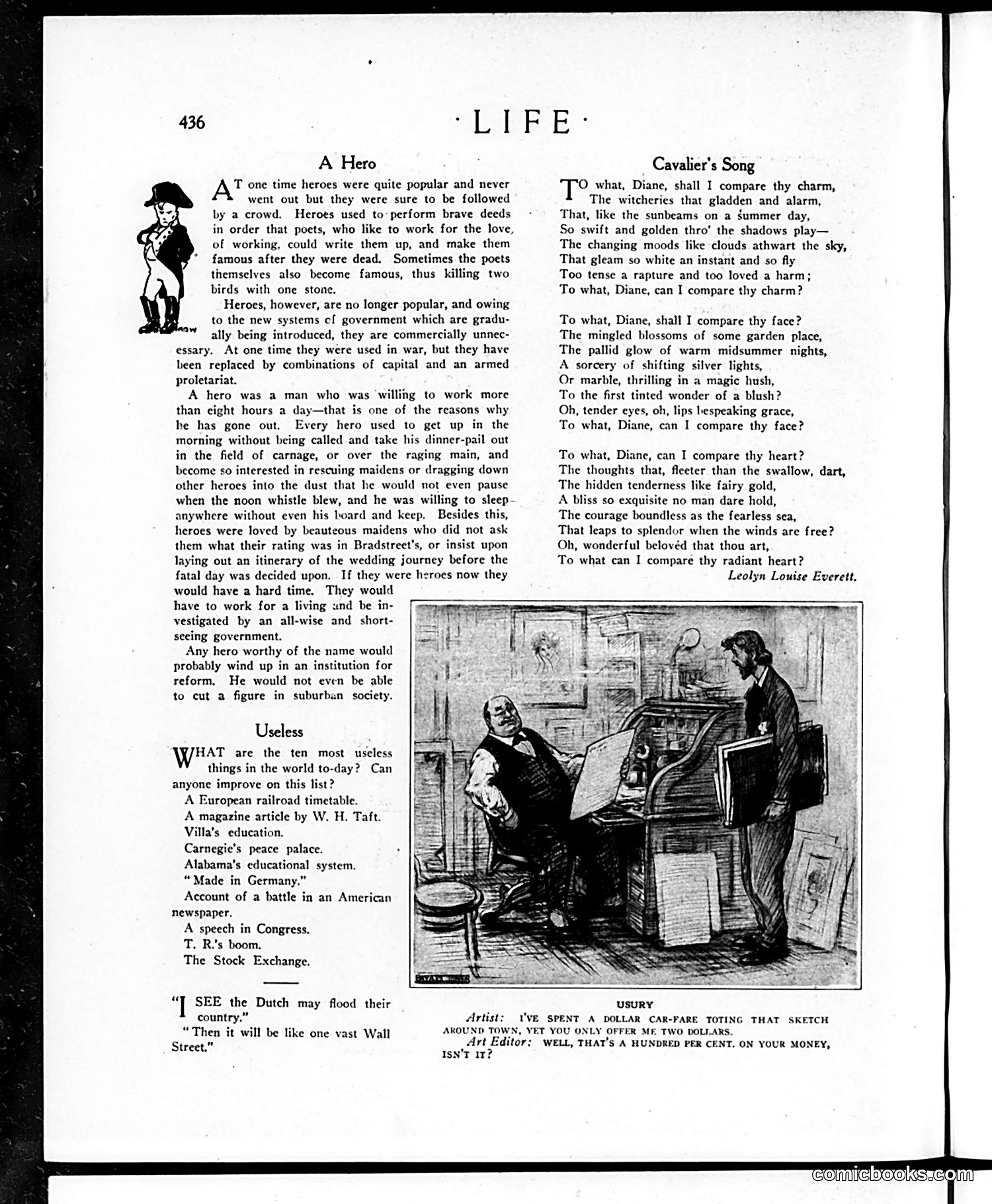
This 1910s *Life* magazine page contains satirical commentary on obsolescence and value: **"A Hero"** argues that traditional heroism is dead. The piece mockingly observes that heroes—men willing to work long hours without complaint, sleep anywhere, and win maidens through valor—are commercially unnecessary in modern industrial society. They've been "replaced by combinations of capital and an armed proletariat." Any modern hero would be investigated by government and institutionalized, unable to function in respectable society. **"Useless"** lists ten supposedly worthless modern things, including European rail timetables, W.H. Taft magazine articles, Villa's education (likely Pancho Villa), and notably "The Stock Exchange"—suggesting financial markets provide no real value. **The cartoon** depicts an artist pitching a sketch to an editor. The artist spent a dollar in transportation costs; the editor offers two dollars. The editor's quip—"that's a hundred per cent on your money"—is sarcastic: the artist made no actual profit, only recovered expenses. It satirizes how undervalued creative work is, even when mathematically appearing profitable.
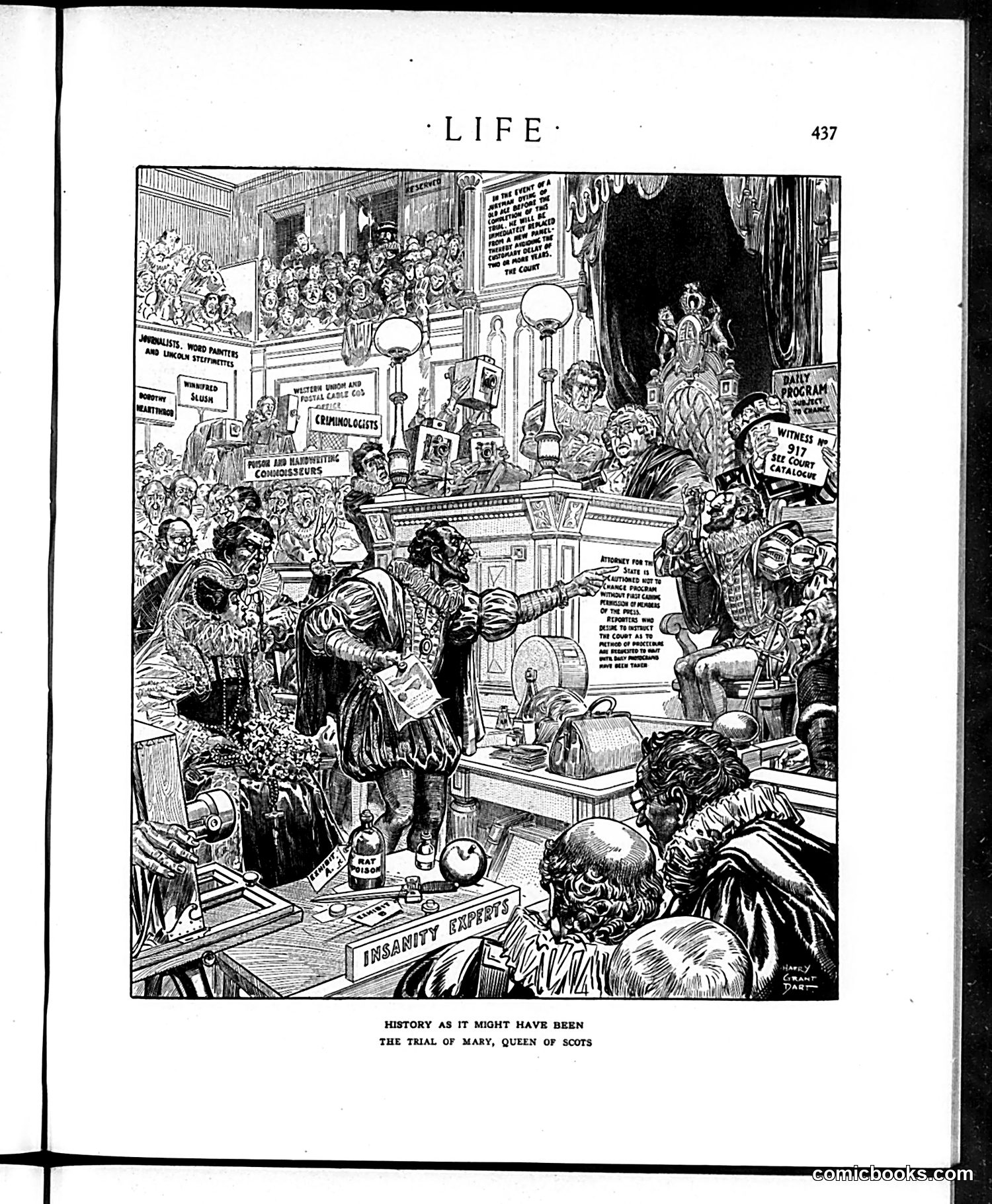
This satirical illustration reimagines Mary, Queen of Scots' historical trial as a modern circus or carnival spectacle. The courtroom is packed with rowdy crowds, carnival attractions, and promotional signage including "Insanity Buffets" and references to "Daily Program" and "Witness No." visible on banners. The satire suggests that famous historical trials—particularly sensational ones—are treated by modern media and public as entertainment spectacles rather than serious legal proceedings. The chaotic scene with its sideshow atmosphere mocks how contemporary newspapers, publicity seekers, and crowds turn serious historical events into commercialized sensationalism. The cartoonist appears to be critiquing early 20th-century journalism and public fascination with trial coverage as pure spectacle rather than justice.
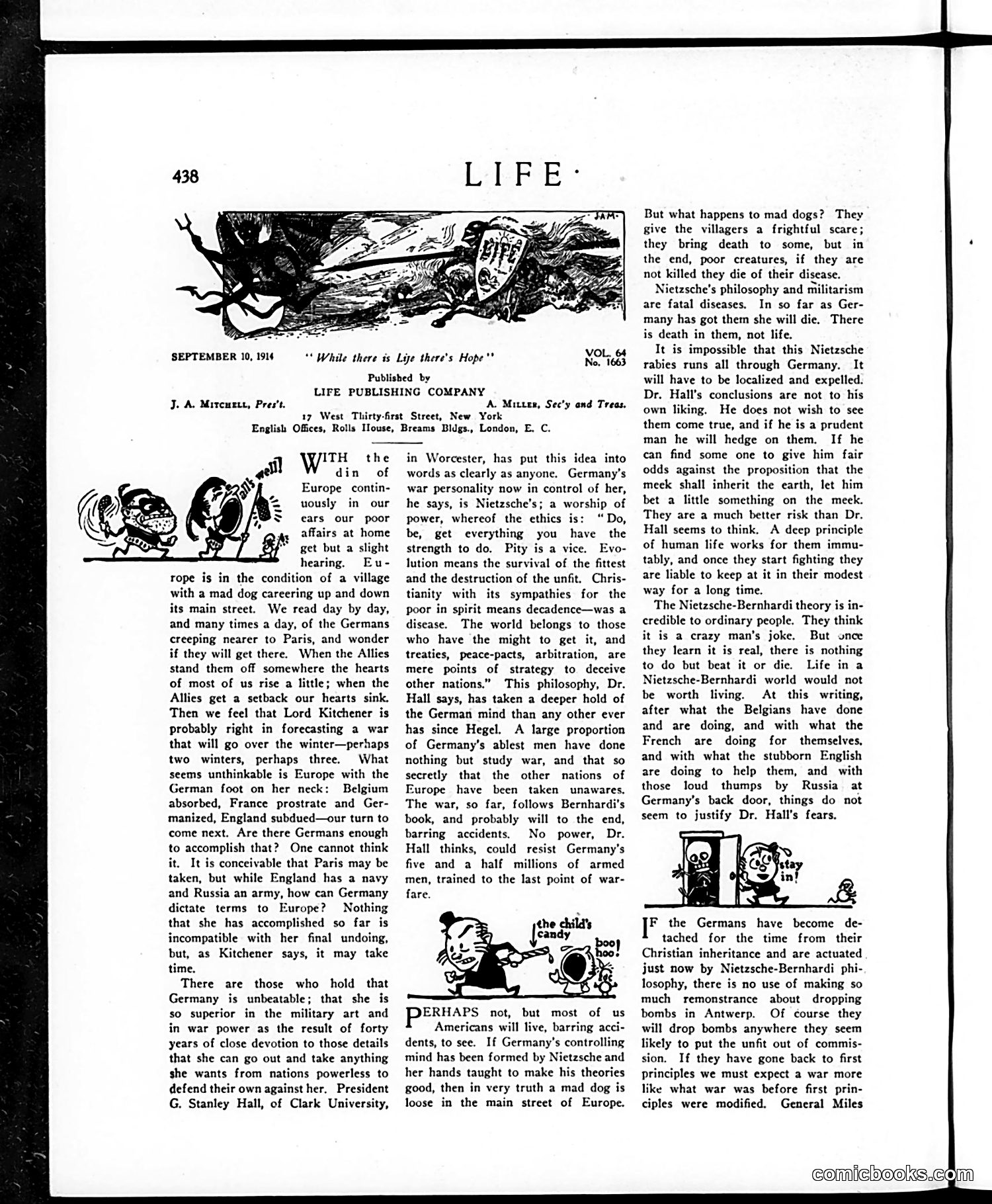
This page discusses Germany's military threat during early World War I. The editorial references President G. Stanley Hall of Clark University, who argued that Germany is driven by Nietzschean philosophy—a "worship of power" that treats pity as vice and celebrates survival of the fittest. The text presents Germany as a "mad dog" loose in Europe, following the militaristic theories of strategist Bernhardt. The editorial's key argument: while Germany appears militarily unstoppable with 5.5 million trained soldiers, Nietzschean philosophy is itself a "fatal disease" that will ultimately destroy Germany. Like a rabid dog, Germany may cause terrifying harm but cannot prevail long-term. The cartoons (top and middle) use animal imagery—appearing to depict chaotic conflict—supporting the "mad dog" metaphor. This reflects American anxiety about German military superiority early in WWI, while maintaining hope that militarism's inherent contradictions would prove self-defeating.
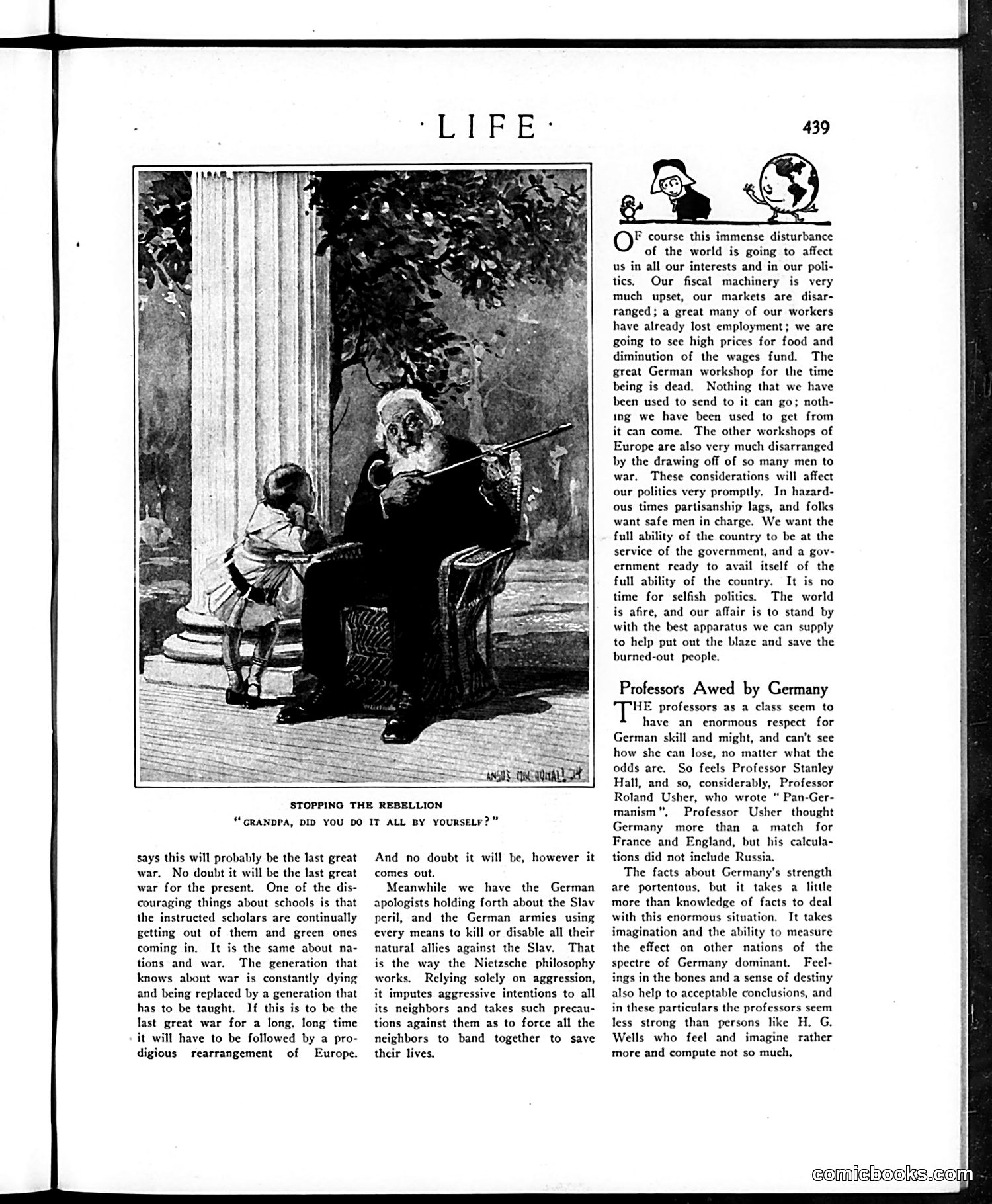
This 1914 *Life* magazine page contains two commentaries on World War I's impact on America. **The Cartoon:** "Stopping the Rebellion" depicts an elderly grandfather figure teaching a young child to shoot a rifle—likely satirizing how each generation must learn warfare anew, suggesting perpetual conflict despite hopes this will be "the last great war." **Context:** The text discusses Germany's aggression toward Slavic nations, driven by Nietzsche-inspired philosophy that assumes neighbors are threats, thereby creating the very coalitions (France, England, Russia) Germany fears. The author argues America's economy will suffer disruption and calls for nonpartisan national unity rather than "selfish politics." **"Professors Awed by Germany"** criticizes American academics like Stanley Hall and Roland Usher who, impressed by German military capability, underestimate allied strength—particularly miscalculating Russia's role. The piece argues emotional imagination and instinct (citing H.G. Wells) better assess war's consequences than pure analytical computation. The overall message: American interests require practical unity and clear-eyed judgment about Germany's actual threat.
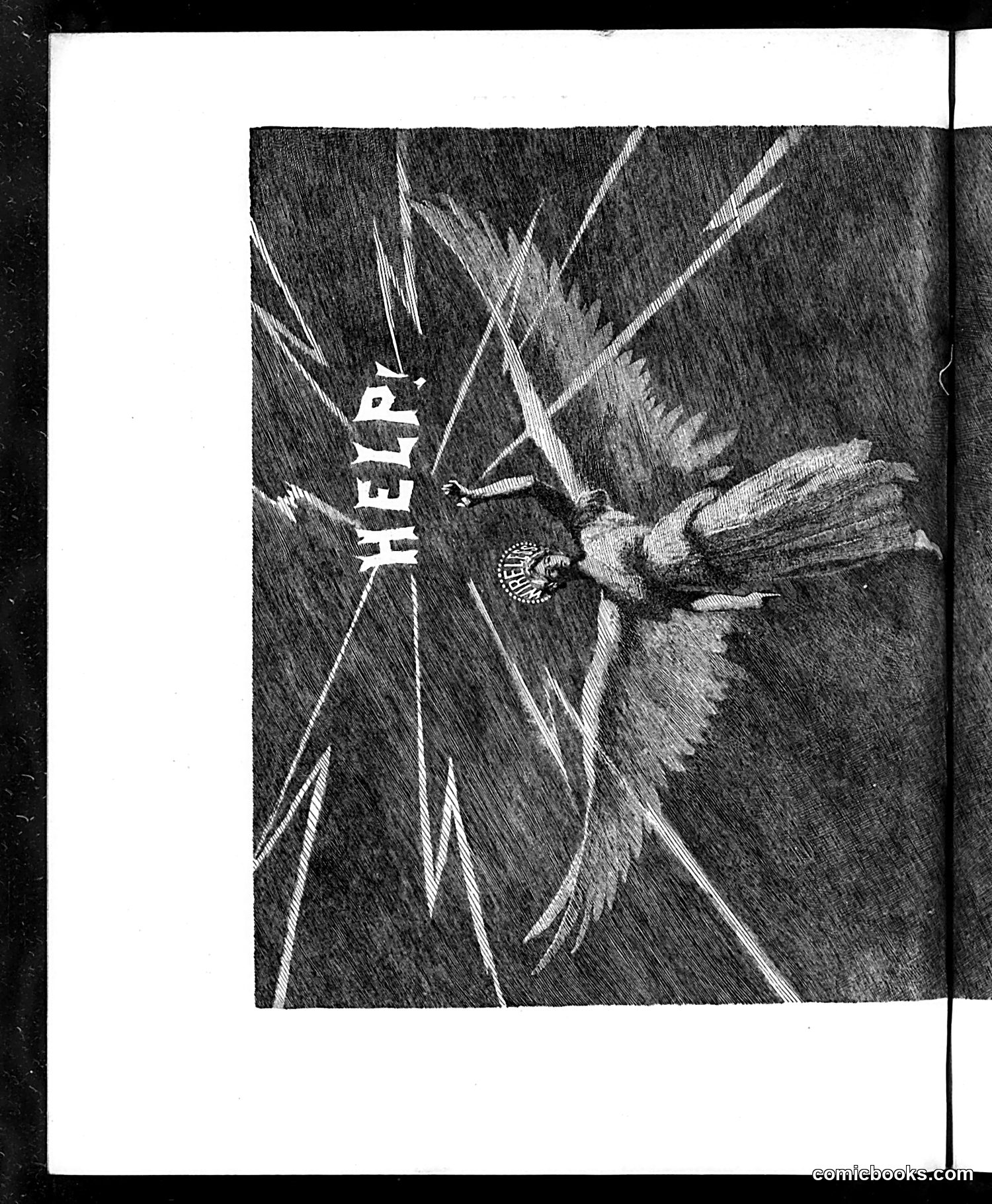
This appears to be a satirical illustration from *Life* magazine featuring an insect (likely a fly or similar creature) positioned near what looks like an explosive device or firework with radiating lines suggesting impact or detonation. The word "HELP!" is visible in the image. The cartoon likely employs insect imagery as a metaphor for something small or insignificant facing a dangerous threat. The "HELP!" cry emphasizes the creature's helplessness. Without clearer context about the publication date or accompanying article text, the specific political or social reference remains unclear. The image could satirize a contemporary political situation, war-related anxiety, or a social issue where the powerless face overwhelming force—common themes in *Life* magazine's satirical work.
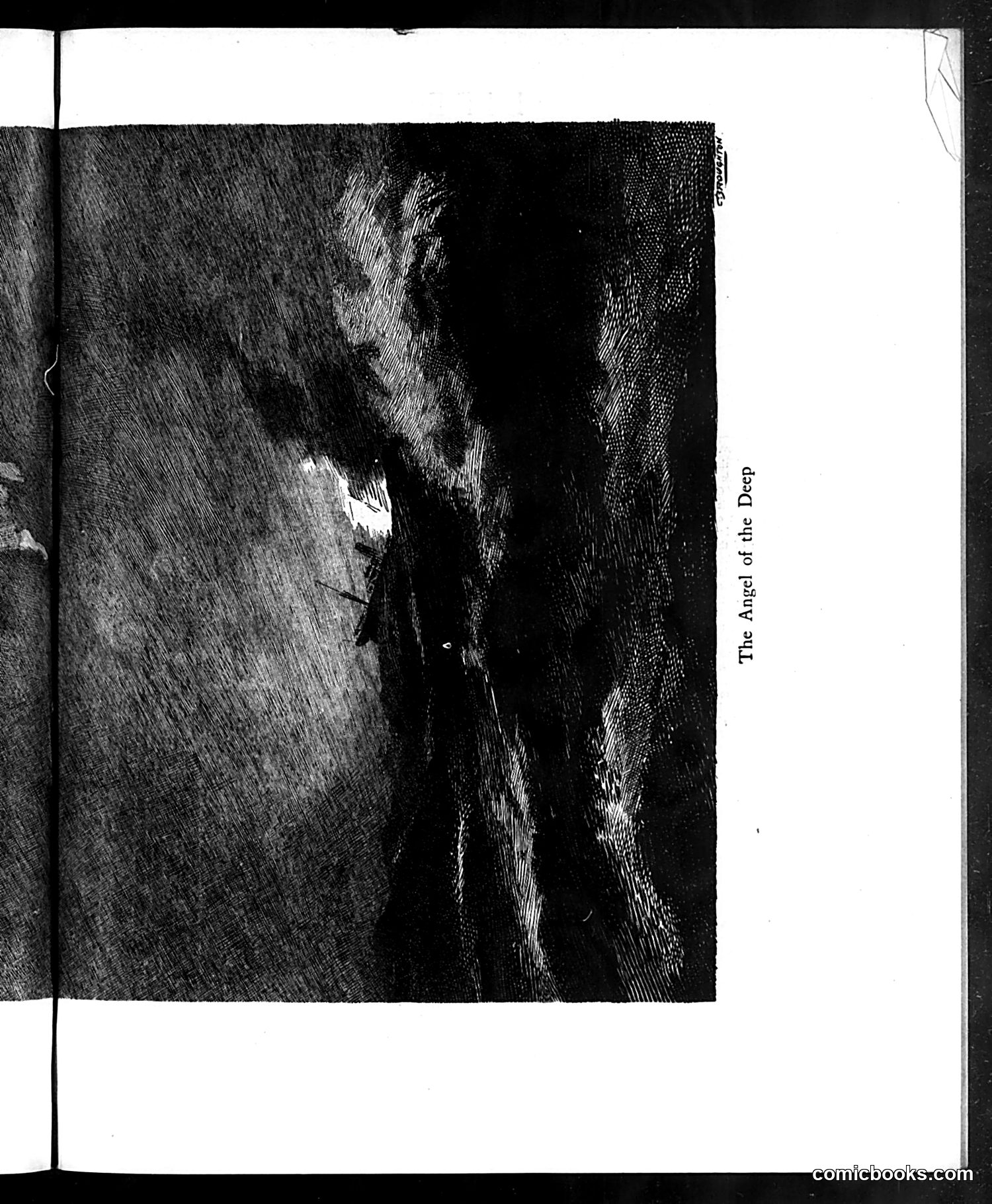
This page appears to be from a satirical magazine (Life) and shows a dark, engraved illustration titled "The Angel of the Deep." The image depicts what seems to be an angelic or ghostly figure in water or deep surroundings, rendered in dramatic black and white cross-hatching typical of 19th-century engraving. However, the OCR text provided is largely unintelligible—appearing to be random characters and numbers rather than readable content. Without legible accompanying text or clearer context about the publication date and political moment, I cannot definitively identify what specific figure, event, or social commentary this cartoon satirizes. The title suggests maritime or possibly spiritual themes, but the actual satirical point remains unclear from the materials provided.
This page reviews two theatrical farces playing in early 1910s New York. **"The High Cost of Loving"** features comedian Lew Fields in a German-sourced comedy about Milwaukee citizens blackmailed by a "Purity League" president (Alice Fischer) who discovers their shared secret—they've all been supporting the same woman for 25 years. The reviewer notes this "uncertain parentage" plot would shock American audiences but works here as light entertainment. Fields, typically a musical performer, transitions to "legitimate" drama with his characteristic dialect and argumentative style intact. **"The Third Party"** follows the familiar formula of a philandering husband, suspicious wife, and restaurant scheming, featuring well-known actors like Walter Jones and Taylor Holmes. The reviewer treats both as competent but formulaic farces—acceptable entertainment if viewers aren't "easily shocked" or demanding artistic rigor. The cartoons illustrate the comedic physical business typical of such productions.
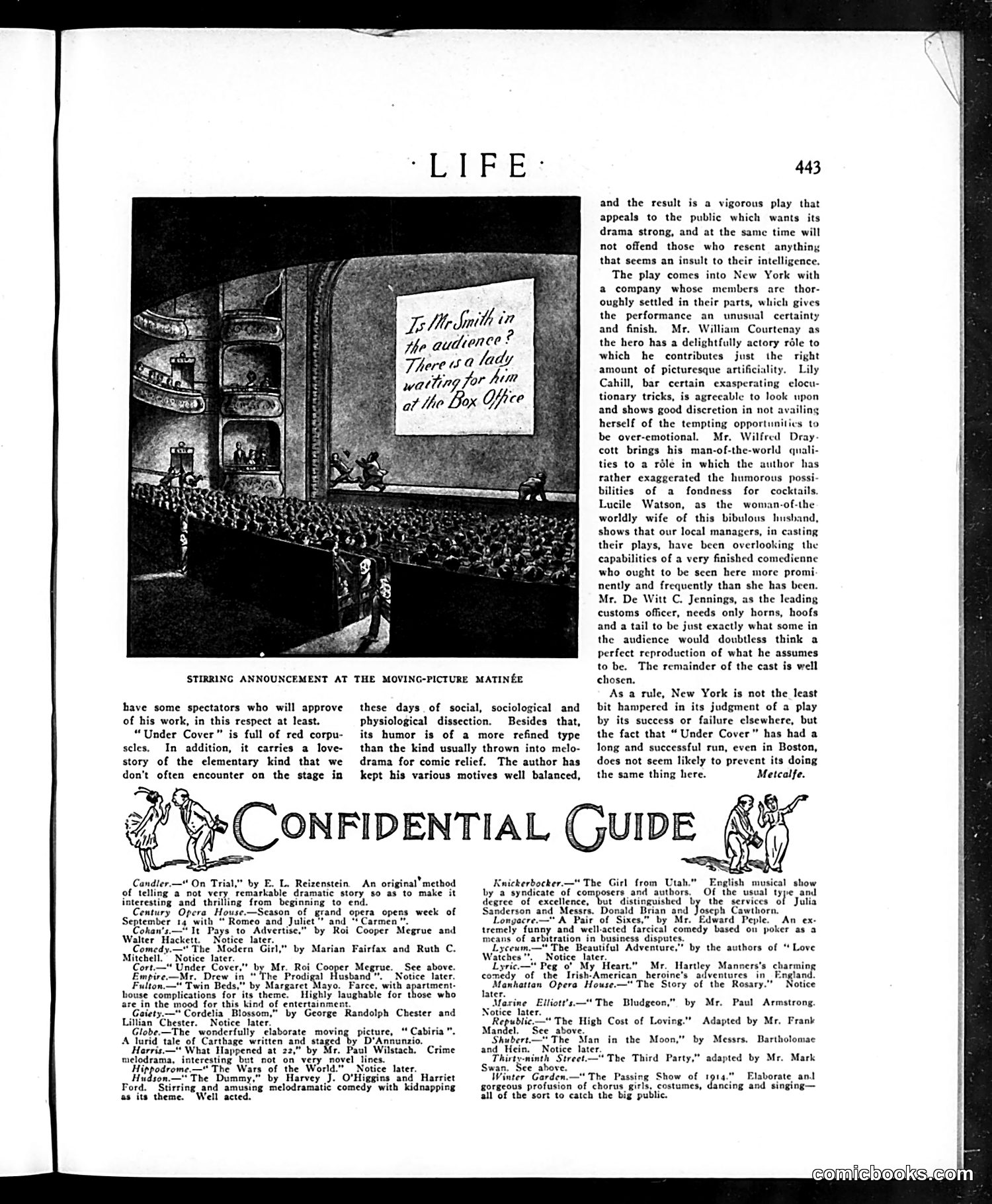
This page reviews New York theater productions. The prominent illustration shows a theater announcement board at a moving-picture matinee, with a sign reading "Is Mr Smith in the audience? There is a lady waiting for him at the Box Office" — a humorous public service announcement typical of early cinema, when theaters would deliver messages to patrons during shows. The joke relies on the suggestive implication that this message might be scandalous or embarrassing to receive publicly. The accompanying review discusses the play "Under Cover," praising its balance of drama, humor, and romance while noting it avoids being offensive to intelligent audiences. The "Confidential Guide" section below provides capsule reviews of current theatrical offerings, mixing praise and criticism of various productions' merit and entertainment value.
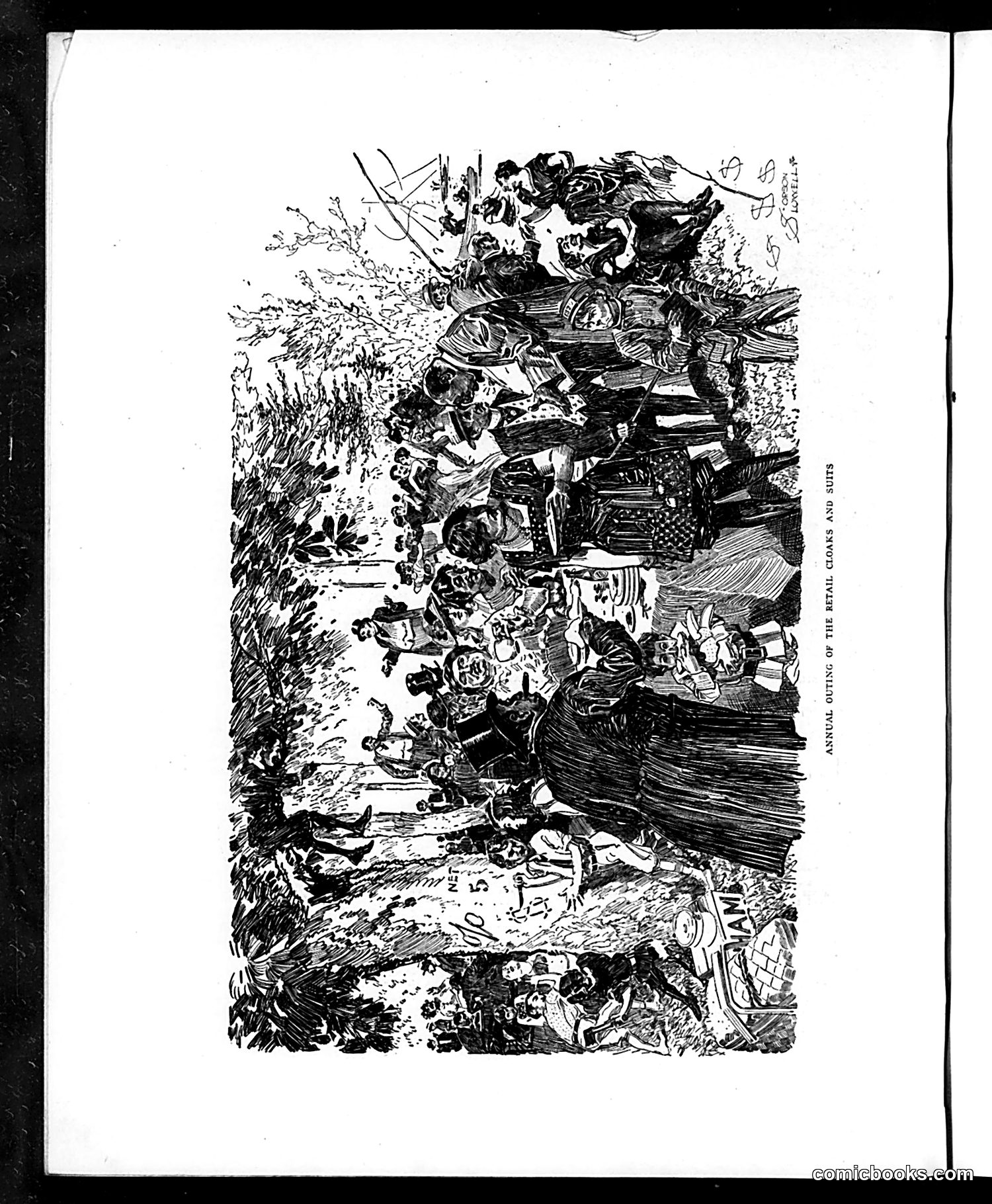
I can see this is a detailed black-and-white satirical engraving/illustration from Life magazine, but the OCR text provided is corrupted and illegible—it appears to be only garbled characters and symbols rather than actual content. The illustration itself shows a complex, densely-packed scene with numerous figures, foliage, and what appears to be chaotic activity, rendered in a detailed crosshatching style typical of 19th-century political satire. However, without legible text identifying the subject, the specific figures depicted, or the title of the piece, I cannot reliably determine what political or social event or figures are being satirized here. To properly explain this cartoon to a modern reader, I would need either a clearer text transcription or additional context about the publication date and subject matter.
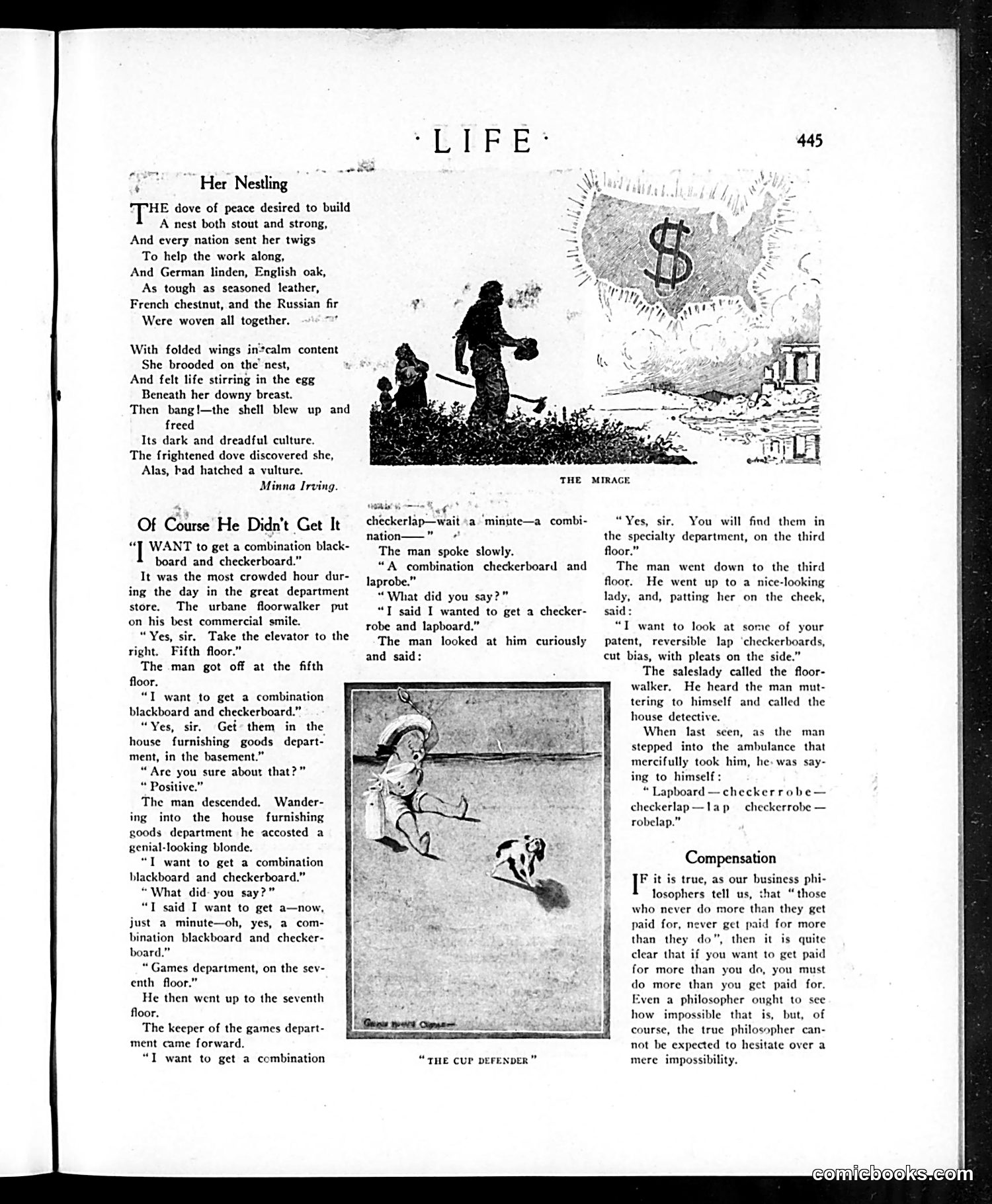
**"Her Nestling"** is an allegory about post-WWI peace efforts. The dove of peace attempts to build a nest using materials from all nations (German linden, English oak, French chestnut, Russian fir), symbolizing international cooperation after World War I. However, the egg hatches into a vulture—the poem's dark joke suggesting that despite nations' contributions to peace, the result is something monstrous and predatory. This satirizes the failure of early peace initiatives and the cynical reality beneath diplomatic gestures. **"Of Course He Didn't Get It"** mocks department store bureaucracy and customer service. A man seeking a "combination blackboard and checkerboard" is shuttled between floors with contradictory directions, increasingly confusing himself and the staff. By the story's end, he's repeating garbled versions ("checkerrobe," "robelap") and ends up in an ambulance. The satire targets incompetent customer service and the absurdity of institutional runaround in modern retail.
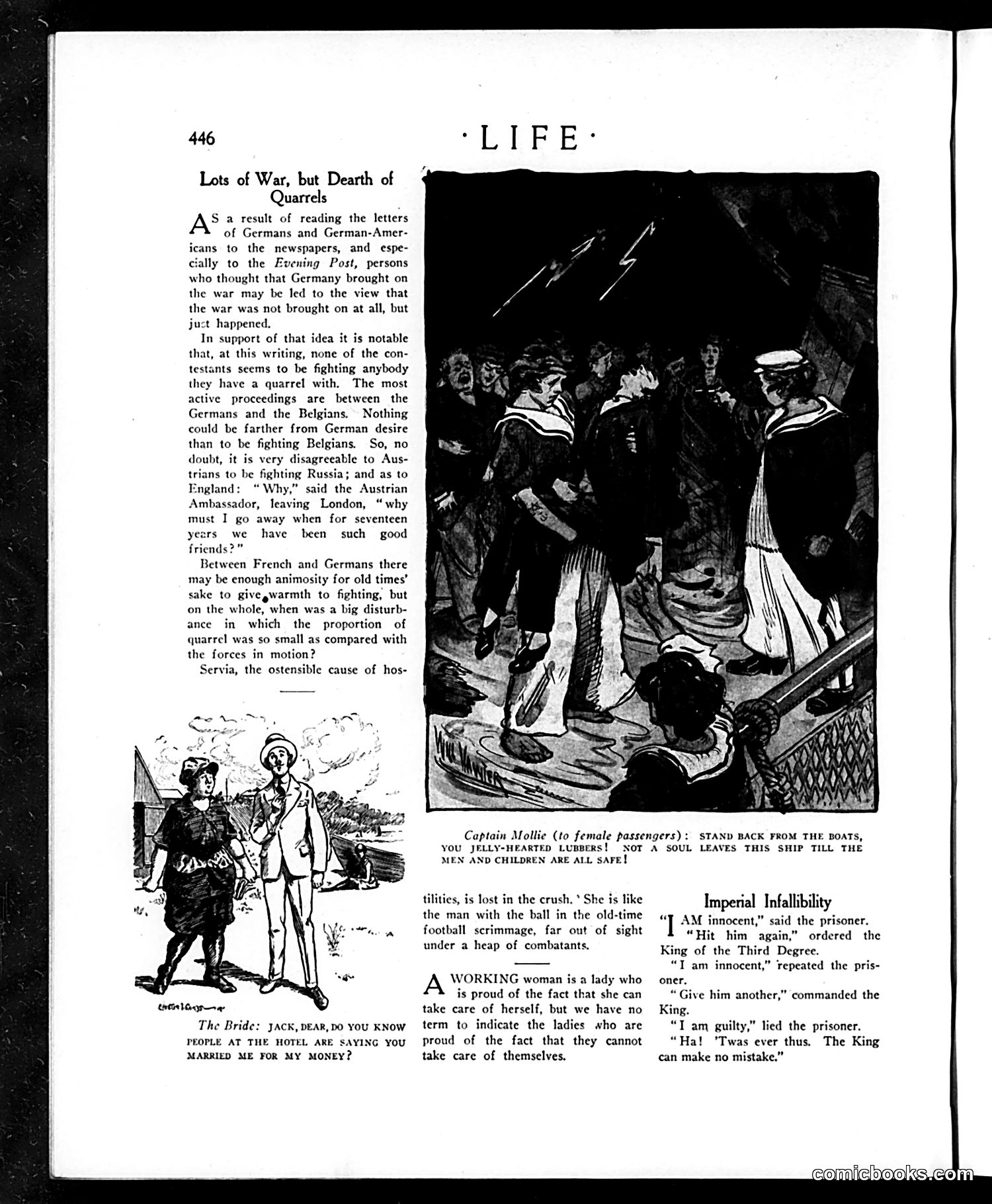
This page satirizes World War I's origins and imperial authority through several pieces: **"Lots of War, but Dearth of Quarrels"** mocks the claim that Germany didn't cause the war—it "just happened." The article notes that combatants don't actually quarrel with their enemies (Germans reluctant to fight Belgians, Austrians unhappy fighting Russia), exposing the absurdity of nations waging massive wars without genuine grievances. Serbia, the actual trigger, is lost in the shuffle. **"The Bride"** cartoon jokes about marrying for money—a domestic concern contrasting sharply with war. **"Captain Mollie"** depicts a female ship captain prioritizing passengers' safety, likely celebrating women's competence during wartime. **"Imperial Infallibility"** satirizes authoritarian logic: a king tortures a prisoner until he confesses guilt (lying), then declares "The King can make no mistake." This attacks imperial justice systems, particularly relevant to Austria-Hungary during WWI's origins in Serbian conflict and Austro-Hungarian aggression.
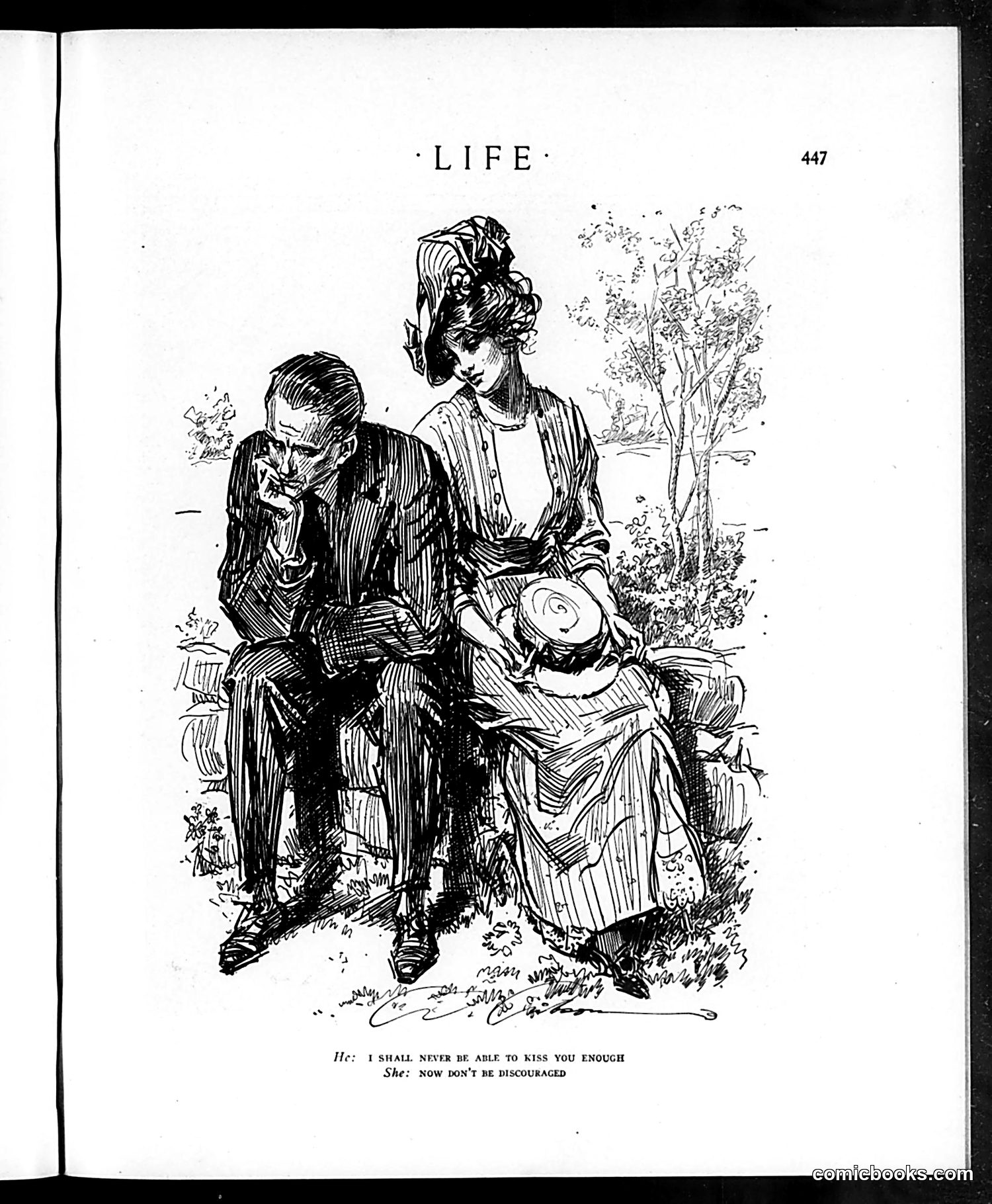
This is a romantic illustration from Life magazine's humor section. It depicts a young couple in an outdoor garden setting—a man in a dark suit leaning toward a woman in a light dress. The dialogue presents a playful romantic exchange: he expresses that he could never kiss her enough, and she reassures him not to be discouraged by this impossible task. The joke relies on early 20th-century courtship conventions, where such earnest romantic declarations were common in popular entertainment. The illustration's sentimental style and the couple's fashionable dress suggest an affluent, refined audience. The humor is gentle and domestic rather than pointed satire—it's meant to amuse readers through relatable romantic sentiment and mild flirtation rather than social commentary.
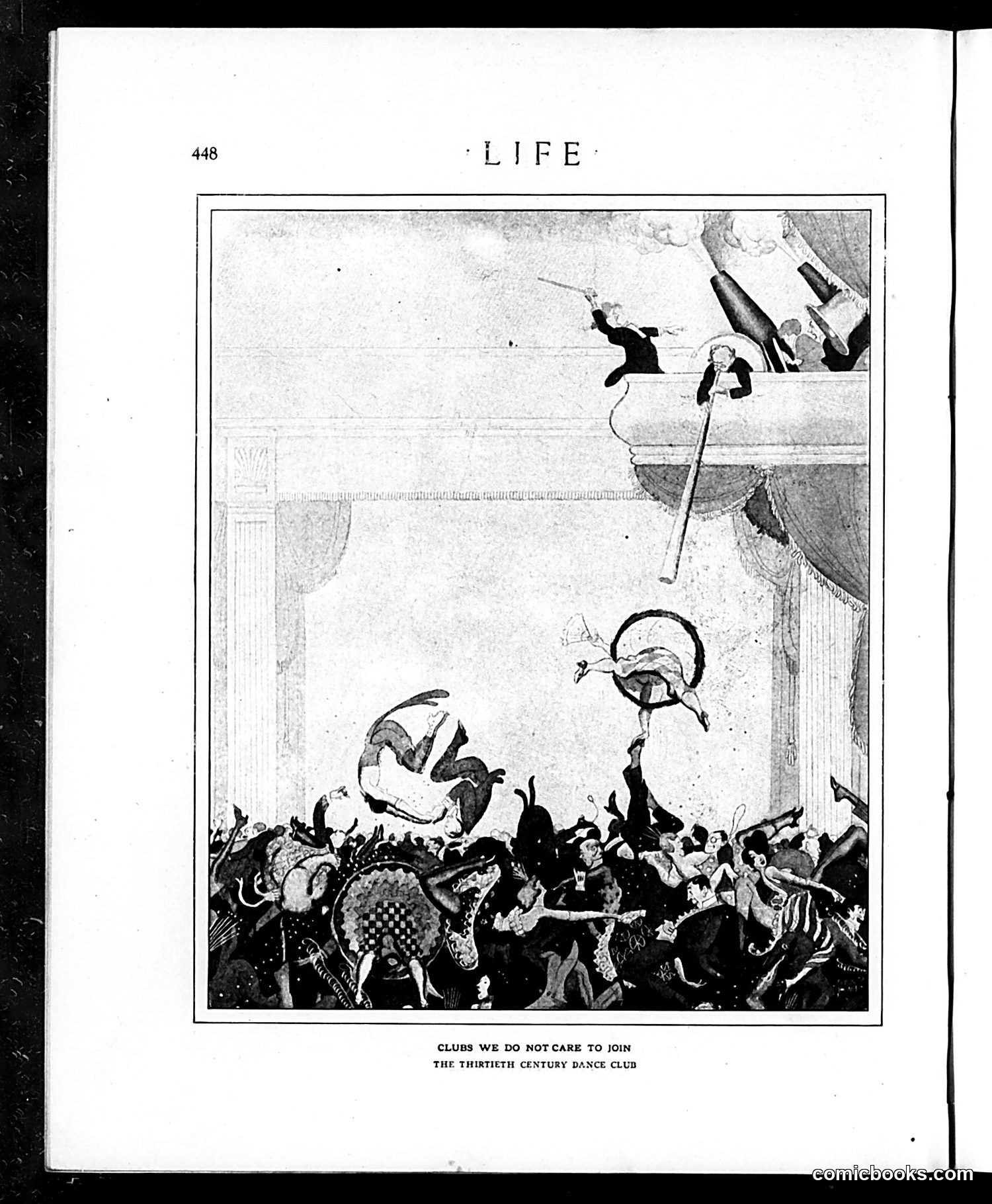
This satirical cartoon depicts a futuristic dance club set in the year 3000. The upper portion shows elegantly dressed figures in a refined ballroom setting, while the lower section portrays a chaotic, grotesque crowd of distorted, animalistic human figures engaged in wild, uncontrolled dancing. The satire contrasts "civilized" society with a dystopian vision of humanity's future moral and physical degradation. The title suggests the magazine's editors are mocking what they view as inevitable social decline—implying that if current trends continue, future generations will devolve into primitive, debased creatures. This reflects early 20th-century anxieties about modernization, changing social norms, and fears about the future trajectory of civilization.
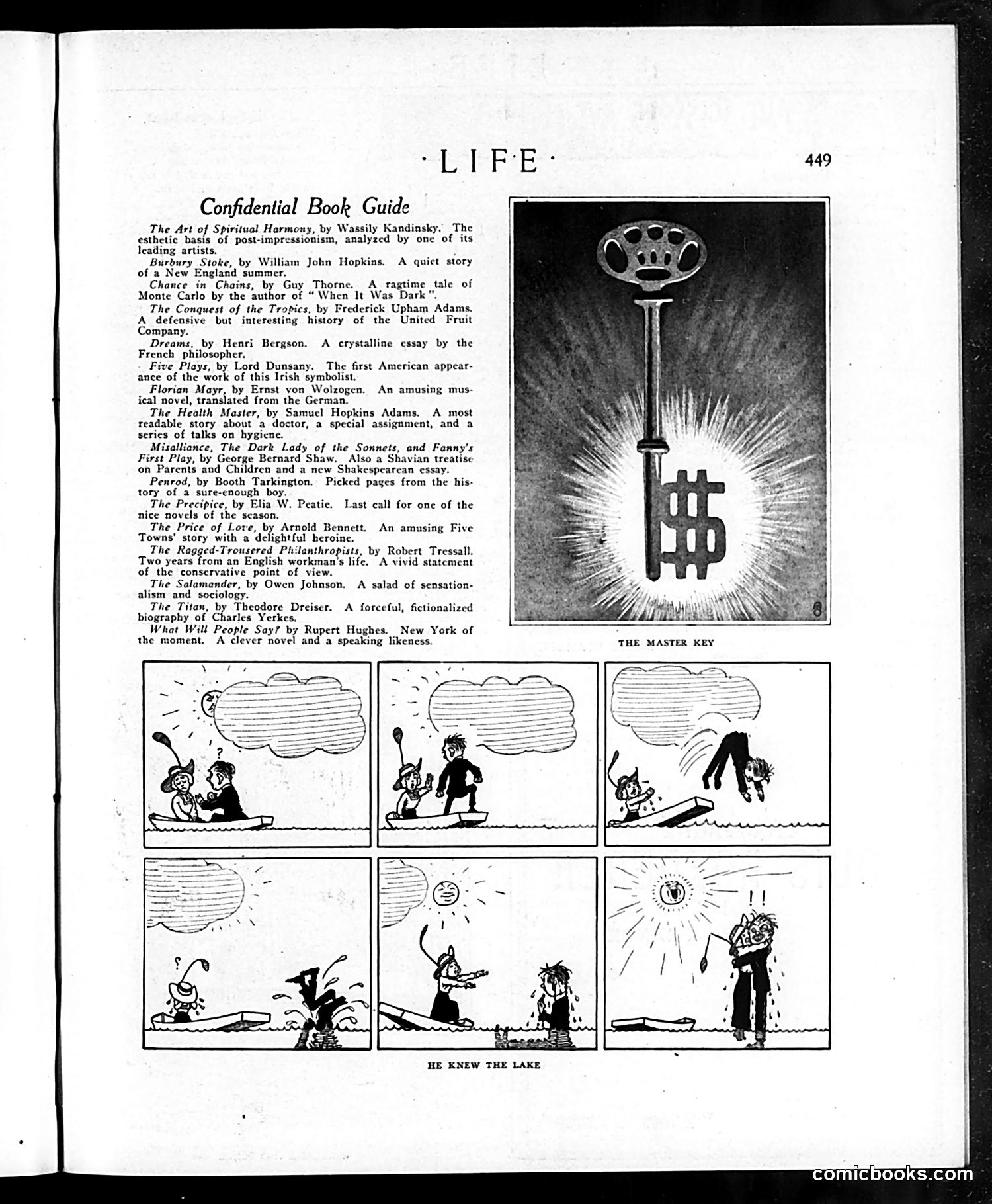
This page contains a book review section and two unrelated comic strips. "The Master Key" (top right) shows a symbolic image of a dollar sign with radiating lines—likely representing money's power or enlightenment in American culture. "He Knew the Lake" is a six-panel comic strip depicting someone attempting to impress others by diving into a lake. The progression shows the diver jumping confidently, then struggling underwater, emerging soaked and bedraggled, and finally being struck by lightning. The humor relies on physical comedy and the contrast between the character's initial confidence and humiliating failure—a common theme in early 20th-century newspaper comics. The "master key" title appears to be unrelated satirical commentary on the books reviewed above.
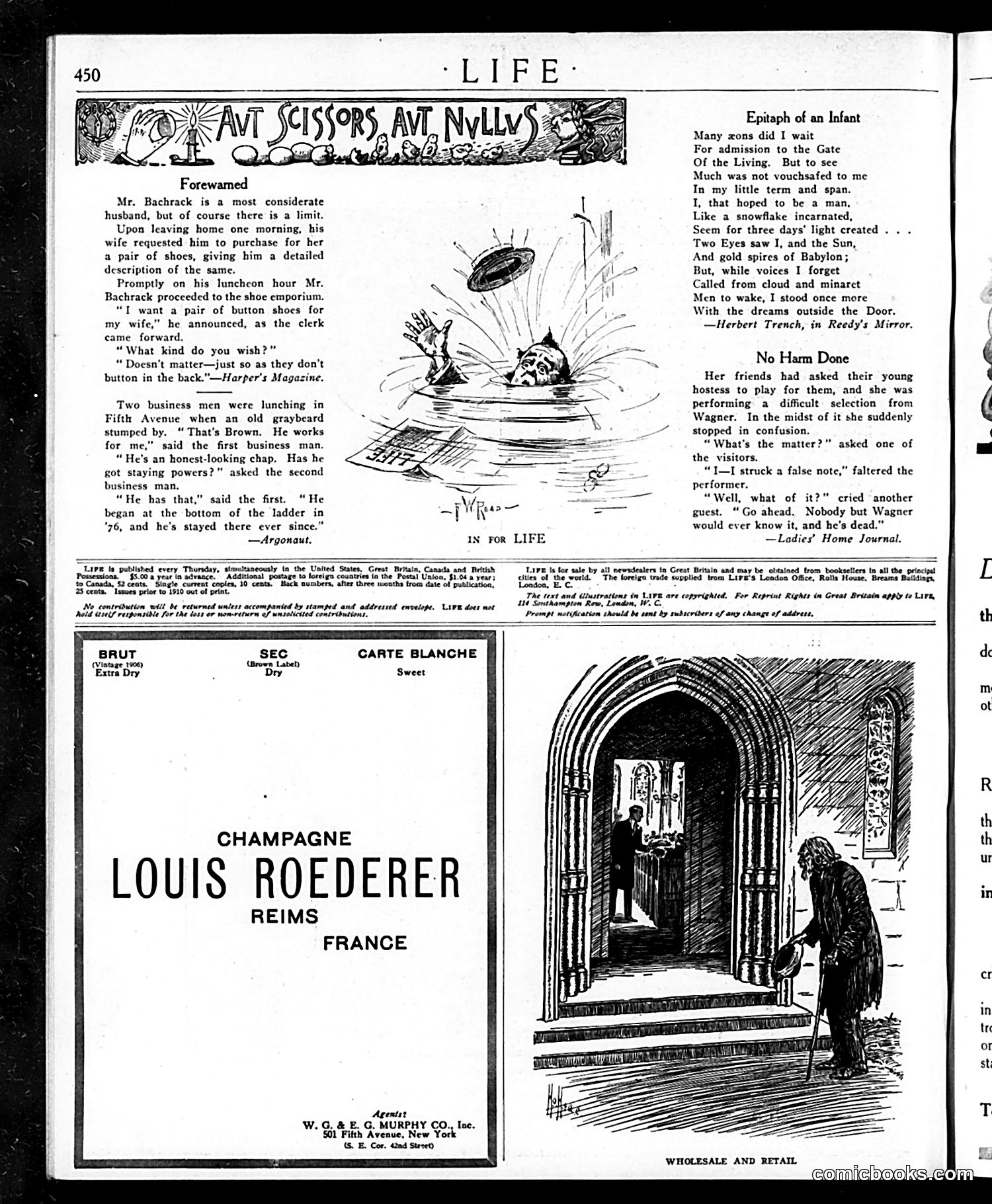
This page contains three satirical short pieces typical of Life's humor: **"Forewarned"**: A domestic joke about Mr. Bachrack purchasing shoes for his wife. The humor lies in his literal interpretation—when told shoes shouldn't "button in the back," he misunderstands the instruction as a practical specification rather than recognizing it as nonsensical advice. The satire targets husbandly confusion about women's fashion requirements. **"No Harm Done"**: Mocks a young hostess performing Wagner who stops mid-piece after striking a false note. A guest reassures her that "nobody but Wagner would know," implying Wagner is dead and thus unavailable to judge. The joke ridicules both pretentious musical performance and the assumption that only the composer would notice errors. **Visual content**: The page includes decorative illustrations and a champagne advertisement (Louis Roederer), typical of Life's mixed editorial-advertising format. The "Epitaph of an Infant" appears to be serious poetry rather than satire, contrasting with the humorous pieces surrounding it.
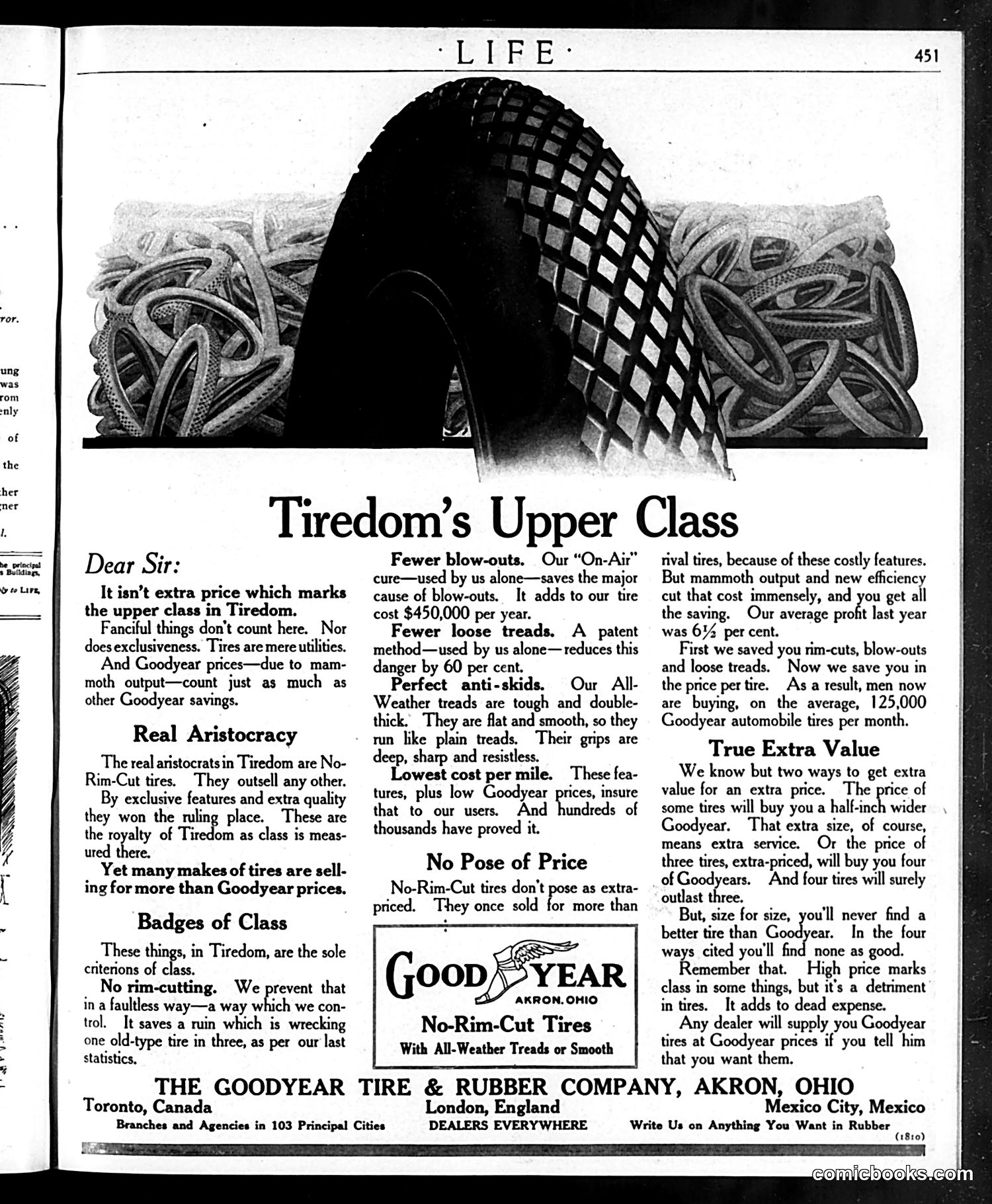
This page is primarily a **Goodyear tire advertisement** disguised as satirical social commentary. It uses an extended metaphor comparing tire quality to social class hierarchy. The satire mocks pretentious class distinctions by arguing that in "Tiredom," true aristocracy isn't about price or exclusivity—it's about functional superiority. Goodyear's "No-Rim-Cut" tires represent the ruling class, earning status through measurable features (fewer blowouts, anti-skid technology, durability) rather than mere expense. The central joke targets competing manufacturers selling tires at premium prices without superior quality. The advertisement insists that Goodyear's massive output actually *reduces* costs while maintaining excellence—suggesting that real value, not snobbery, should determine class status. The satirical tone positions Goodyear as democratically accessible superiority: quality shouldn't require paying extra for pretension.
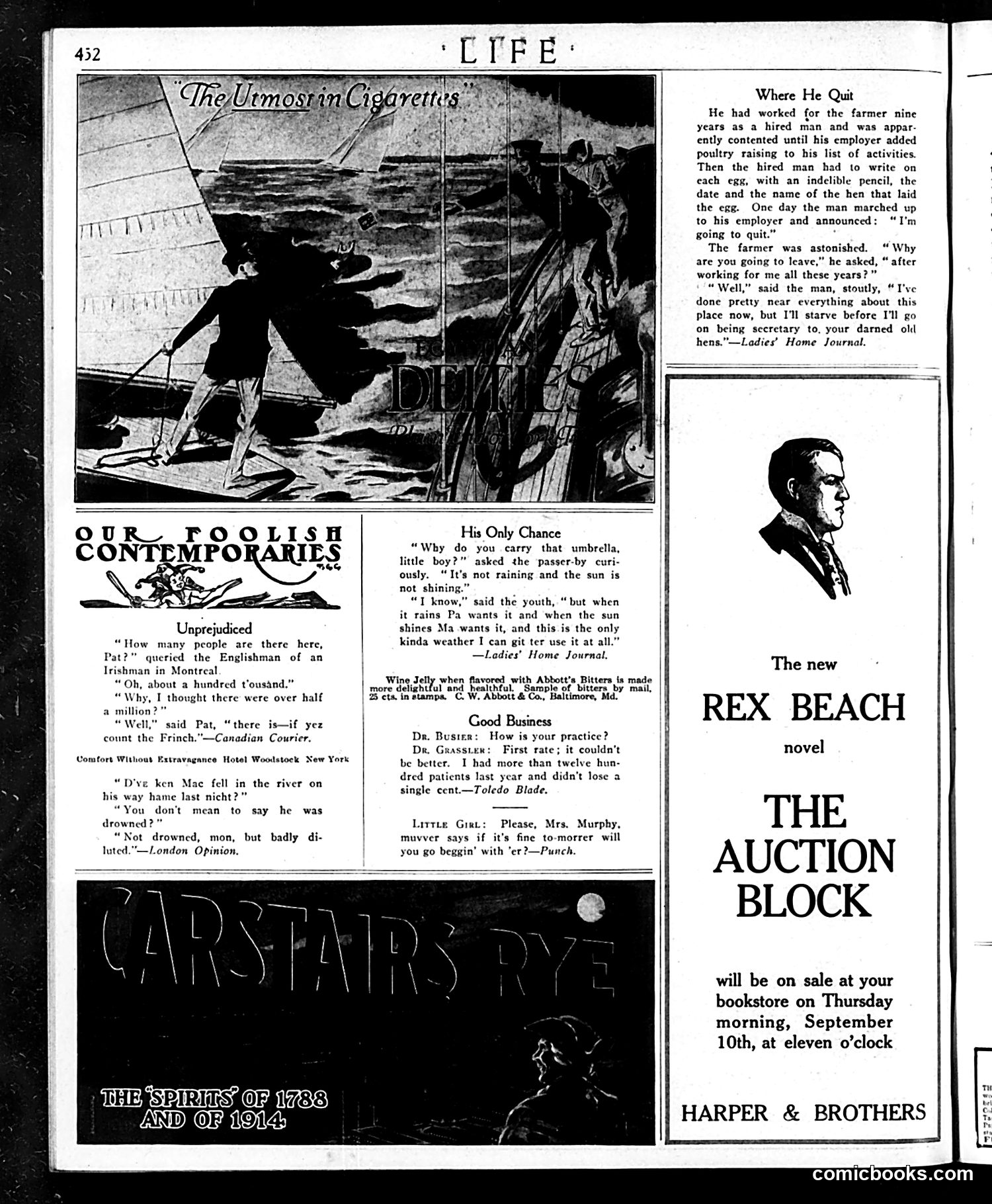
This page from *Life* magazine (a satirical humor publication) contains several brief comedic anecdotes and advertisements typical of early 20th-century American humor. **The jokes** are short, punchy ethnic and class-based humor pieces common to the era: - An Englishman's dismissive view of Irish-French Canadians in Montreal - Scottish dialect humor about a man falling in a river - A boy's predicament about umbrella ownership between his parents - A doctor's success measured by not losing patients (darkly implying he has few) - A beggar child asking to accompany her mother **"Where He Quit"** satirizes rural farm labor: a hired man quits after nine years rather than catalog eggs by hen-name—rejecting bureaucratic indignity despite long employment. The page also advertises **Rex Beach's novel "The Auction Block"** (Harper & Brothers), promoting its bookstore sale for September 10th. The cartoon titled "Our Foolish Contemporaries" frames these jokes as social satire mocking period attitudes.
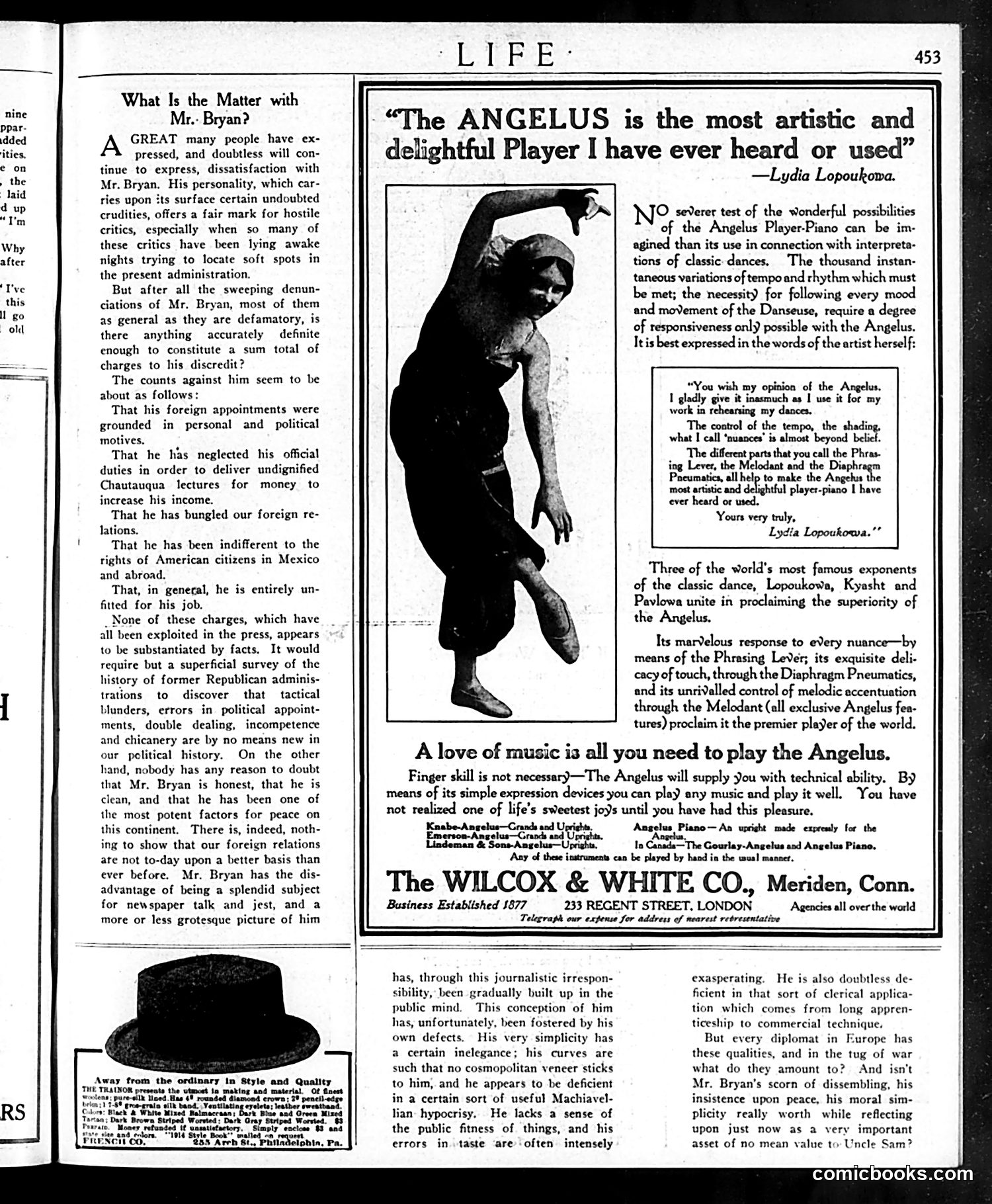
This page contains two distinct elements: **Left side:** A political defense of William Jennings Bryan, who appears to be Secretary of State. The article responds to widespread criticism by listing charges against him—neglecting duties for paid Chautauqua lectures, bungling foreign relations, indifference to American citizens' rights in Mexico—but argues these claims lack substantiation. It defends Bryan as honest and clean, and credits him with promoting peace. The tone suggests Bryan was a controversial figure facing orchestrated attacks, with the article implying critics are hypocritically ignoring similar failures by previous Republican administrations. **Right side:** An advertisement for the Angelus Player Piano, featuring a photograph of dancer Lydia Lopokowa and endorsements from famous dancers (Lopokowa, Kyasht, Pavlova). The ad emphasizes the piano's responsiveness to nuance and tempo—qualities essential for accompanying classical dance. The juxtaposition appears coincidental rather than satirical; the page mixes political commentary with unrelated advertising.
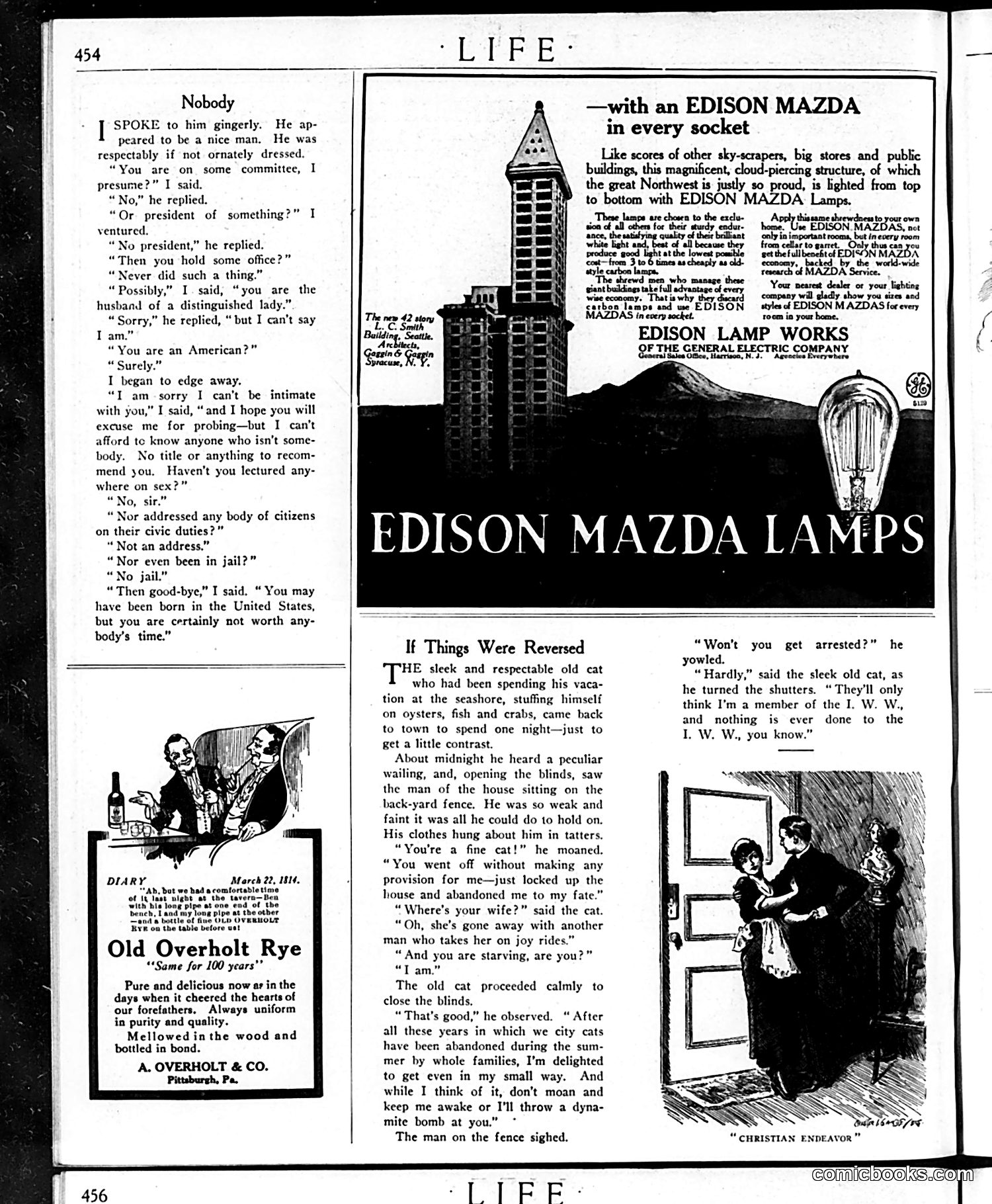
## "Nobody" (Left Column) A satirical short story mocking America's obsession with status and credentials. The narrator refuses to associate with an ordinary American who holds no office, hasn't lectured, addressed citizens, or been jailed—essentially someone with no claim to importance or notoriety. The joke critiques how Americans judge worth entirely by titles and public prominence, finding an unaccomplished person literally not worth knowing. ## "If Things Were Reversed" (Bottom Right) A fable reversing typical household dynamics: a well-fed cat returns from vacation to find the master starving and abandoned (his wife left with another man). The cat callously refuses sympathy, viewing it as revenge for summers when families abandon their pets. The final joke references the I.W.W. (Industrial Workers of the World)—a radical labor union—suggesting that threatening dynamite would go unpunished if attributed to them, implying either anarchist associations or that authorities ignore labor radicals' threats. ## Advertisements Standard period ads for Edison Mazda Lamps and Old Overholt Rye whiskey.
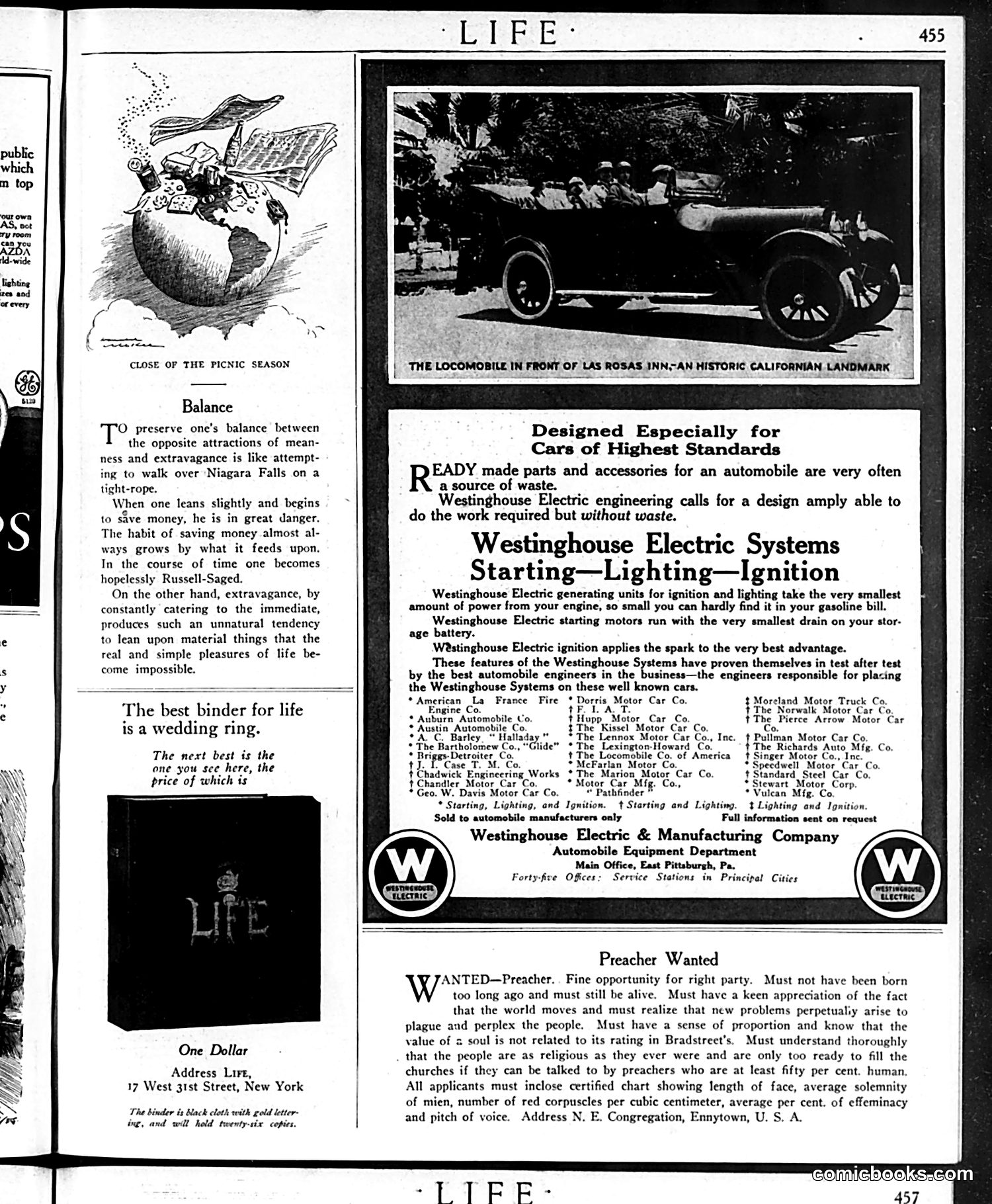
**The Cartoon ("Close of the Picnic Season"):** A sketch depicts the Earth overflowing with vacation paraphernalia—luggage, maps, and leisure items. It satirizes the end of summer picnic season, suggesting that Americans have scattered their possessions and concerns across the landscape, creating visual chaos. The title implies relief that this period of recreational excess is concluding. **The Editorial Essay ("Balance"):** A philosophical piece warns against extremes in personal finance. It compares the difficulty of balancing frugality and spending to "walking over Niagara Falls on a tightrope." References "Russell-Saged" (likely alluding to wealthy financier Russell Sage) to describe miserly hoarding. The essay advocates moderation while promoting Life's magazine binder as a practical, affordable binding solution (priced at one dollar). **The Advertisements:** The remaining space contains ads for Westinghouse Electric automobile systems and a classifieds section seeking a preacher—humorously stipulating requirements like being alive, having a human quality, and possessing acceptable facial proportions for the pulpit.
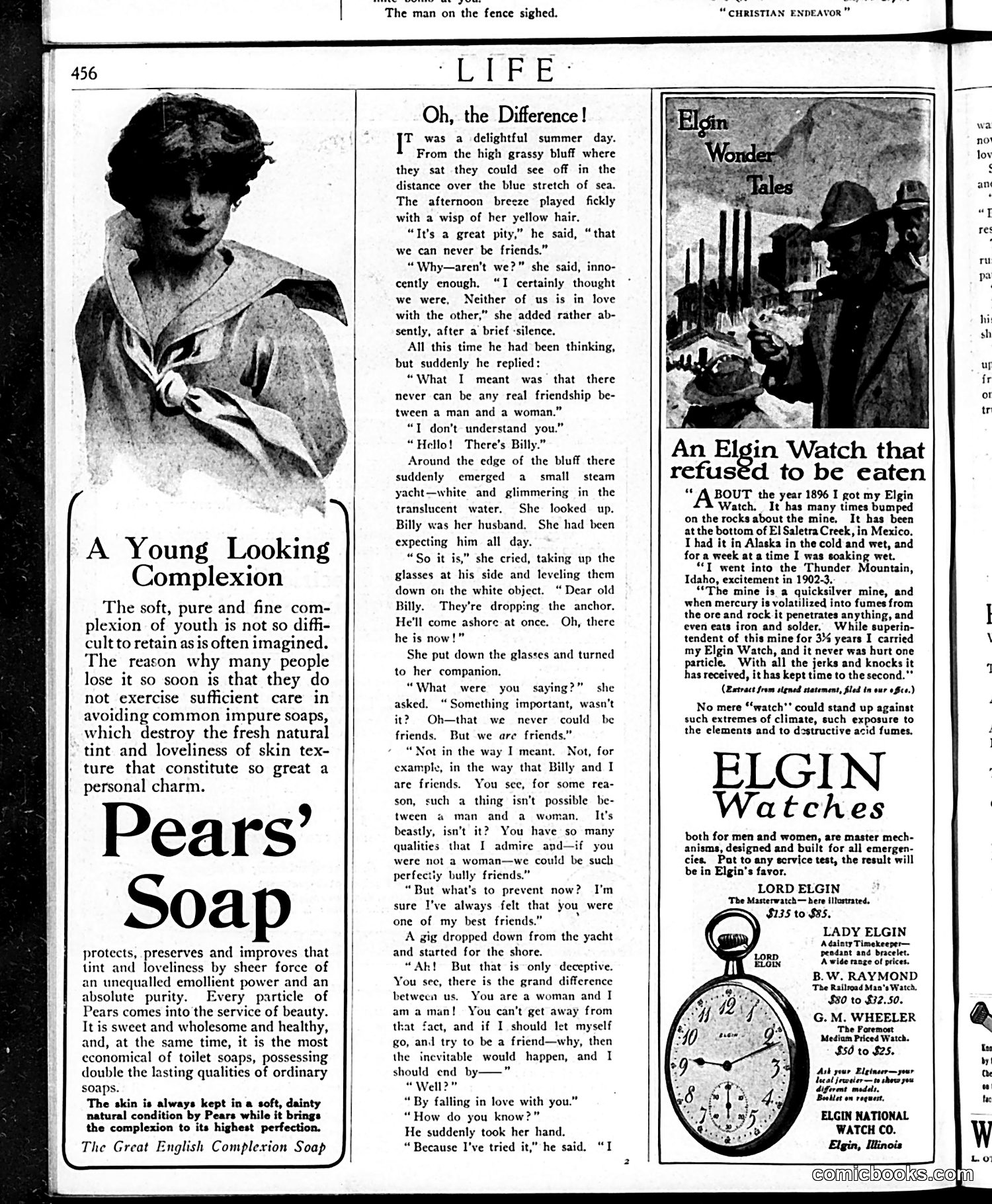
This page contains two distinct elements: **Main Story: "Oh, the Difference!"** A romantic narrative about a man and woman on a seaside bluff discussing whether cross-gender friendship is possible. He argues it's impossible; she questions why. Billy (her husband) arrives by yacht, and the man admits he's always felt they were close friends—but then confesses his true reason for saying friendship between man and woman is impossible: "Because I've tried it. I" (text cuts off). The satire targets the conventional Victorian/Edwardian belief that platonic male-female friendship cannot exist without romantic tension or hidden desire. **Advertisements:** The page is heavily advertised with beauty and luxury products—Pears' Soap (emphasizing youthful complexion) and Elgin Watches (with testimonials about durability). These ads reflect the magazine's commercial nature and appeal to affluent readers. The overall message appears to critique male hypocrisy about cross-gender relationships while simultaneously marketing aspirational products to readers.
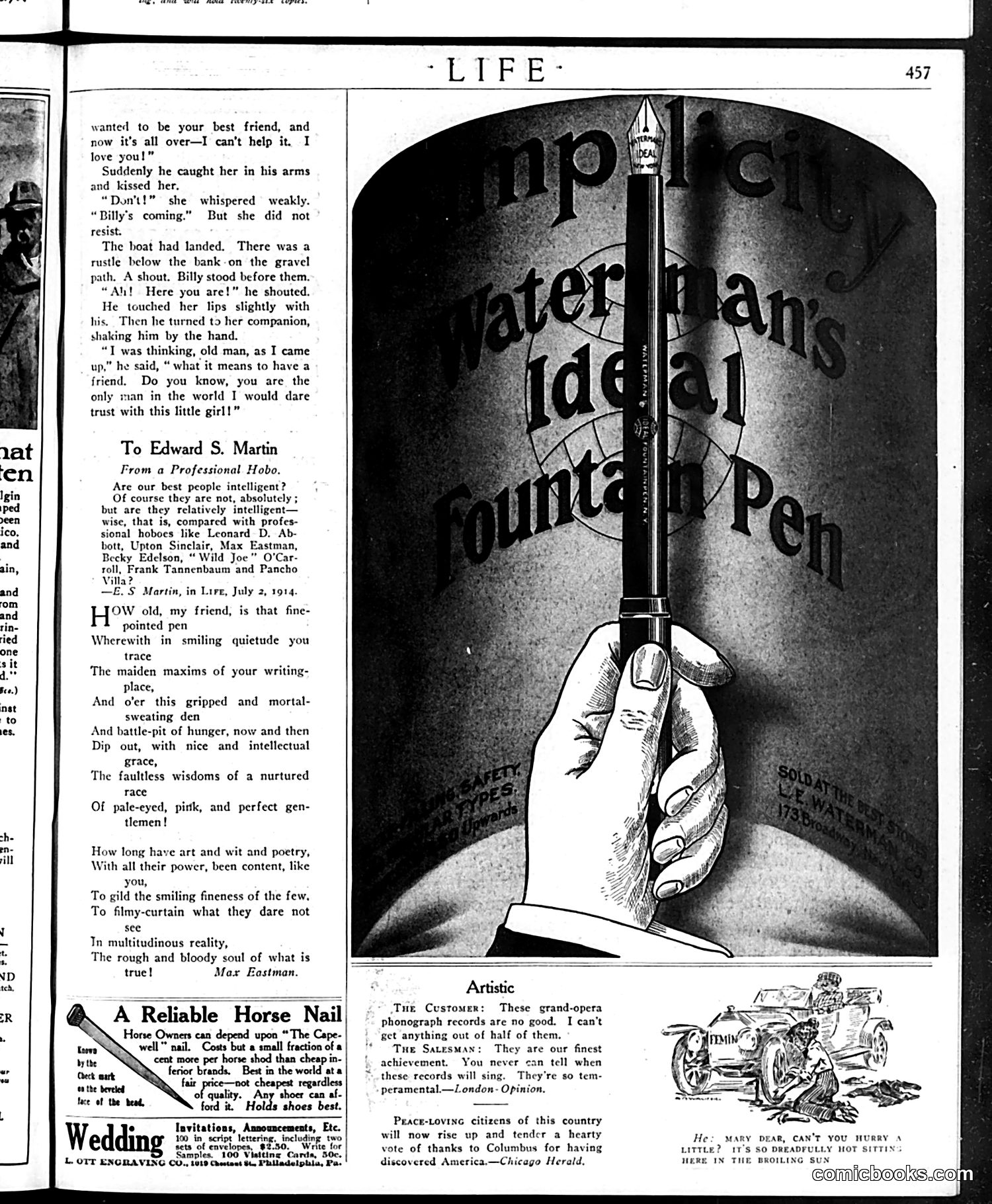
This page mixes fiction, poetry, and social commentary typical of *Life*'s satirical format. **The narrative** at top depicts a romantic triangle—a man and woman kissing are caught by "Billy," who graciously accepts it, declaring the man the only person he'd trust with "this little girl." The satire likely mocks sentimental melodrama and naive trust. **The poetry section** by Max Eastman attacks E.S. Martin, mocking his claim that professional hoboes (including Upton Sinclair and Pancho Villa) lack intelligence. Eastman retorts that Martin's refined writing obscures harsh social reality behind "smiling fineness" while ignoring "multitudinous reality" and "rough and bloody" truth. **The cartoons below** are minor: one about phonograph records being temperamental, another a domestic joke about a woman delaying ("It's so dreadfully hot sitting here in the broiling sun"). The page exemplifies *Life*'s blend of literary debate and light humor, with Eastman's critique representing early-20th-century progressive calls for social realism over genteel aestheticism.
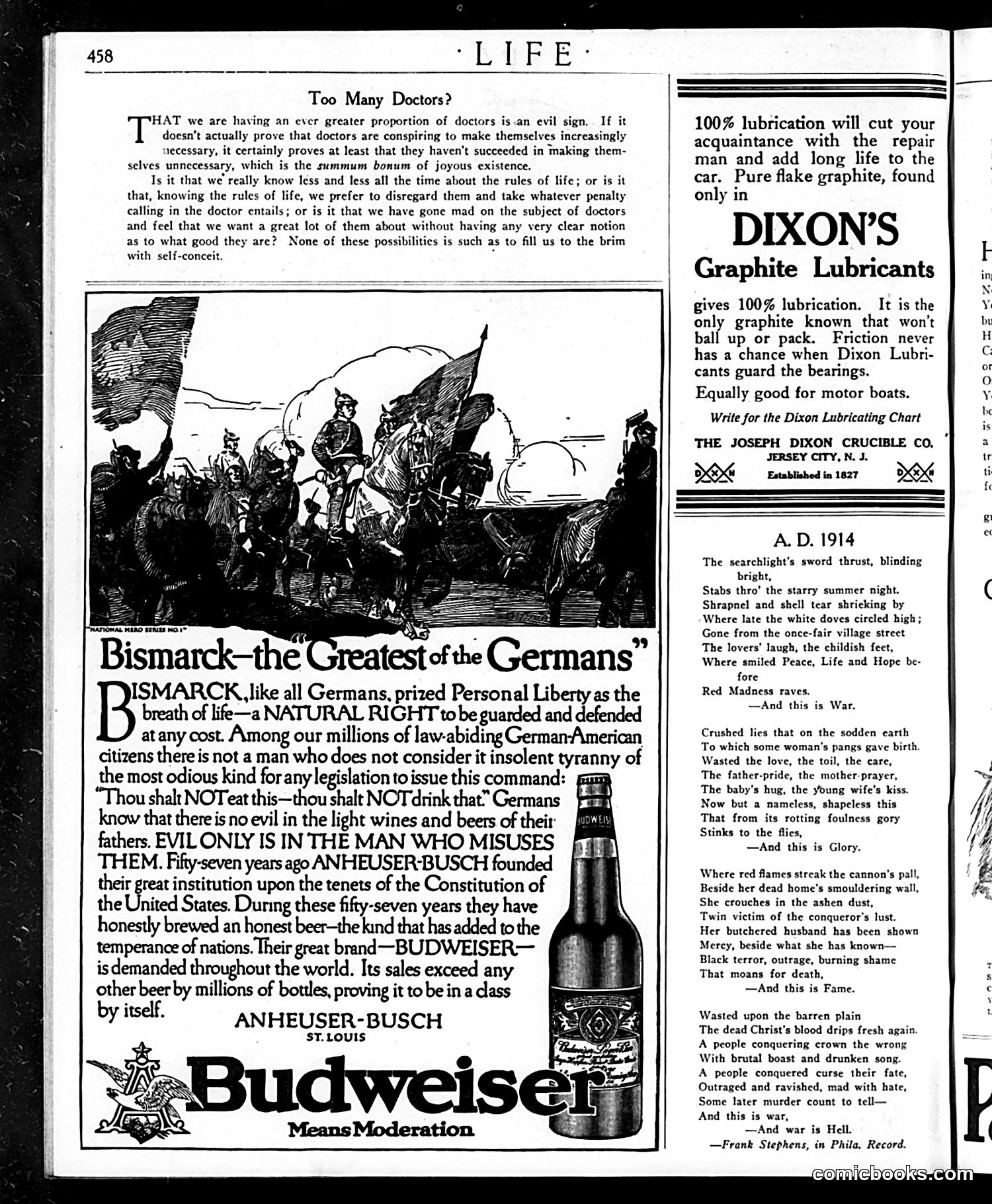
This page juxtaposes three competing messages about WWI-era America: **Left side:** A Budweiser advertisement using Bismarck to defend German-American beer culture against Prohibition. It frames alcohol as a "natural right" and claims German-Americans cherish personal liberty—a patriotic appeal despite growing anti-German sentiment. **Center:** An editorial questioning why America has "too many doctors," satirizing medical professionalization and suggesting Americans either ignore health rules or obsess over physicians. **Right side:** A brutal anti-war poem titled "A.D. 1914" by Frank Stephens depicting WWI's devastation—violence, death, sexual assault, and suffering. It equates war with "Hell" and mocks notions of glory and fame. The page's internal contradiction is striking: the Budweiser ad celebrates German values and liberty while the poem condemns the very war Germany was fighting. This reflects America's conflicted position in 1914—officially neutral but increasingly critical of European warfare, while managing substantial German-American populations.
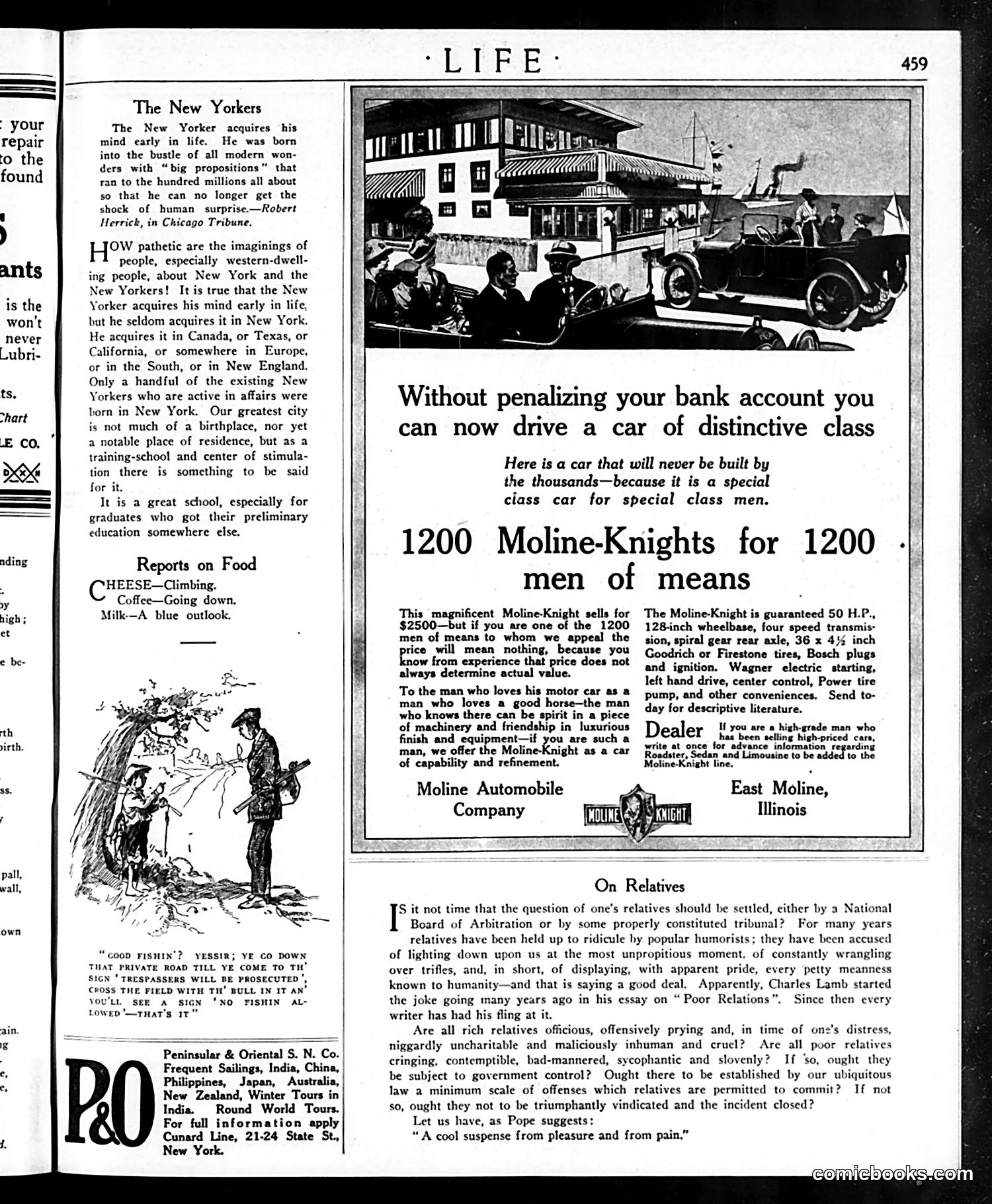
This page contains three distinct sections: **"The New Yorkers"** essay argues that New York City, while not a birthplace for most of its prominent citizens, serves as an excellent "training-school" for developing minds—particularly for those educated elsewhere. It's a subtle defense of the city's value as an intellectual center. **"Reports on Food"** offers brief satirical market commentary: cheese prices climbing, coffee falling, milk's outlook "blue" (pessimistic). The fishing joke depicts the absurdity of accessing private land—you must cross a field guarded by a bull to reach posted "no fishing" signs, making the entire endeavor pointless. **The Moline-Knight automobile advertisement** uses explicit class-based marketing, targeting "1200 men of means" with language emphasizing exclusivity and refinement over mass production. It appeals to wealthy buyers who appreciate mechanical quality and "spirit" in machinery. **"On Relatives"** essay criticizes how literature stereotypes relatives as either meddlesome or parasitic, questioning whether such harsh generalizations are fair. It references Charles Lamb's famous essay "Poor Relations."
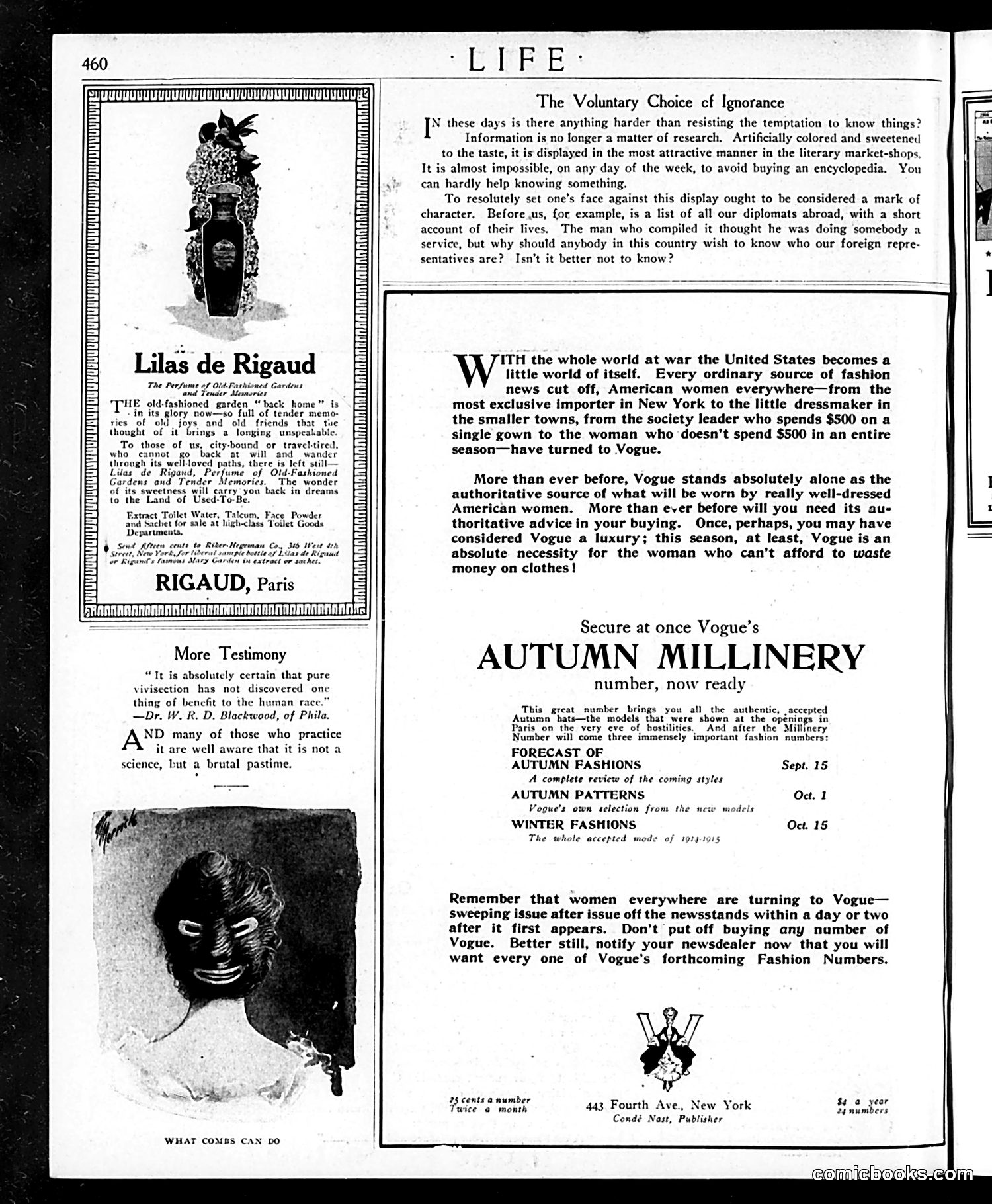
This page combines editorial satire with advertising. The main satirical piece, "The Voluntary Choice of Ignorance," mocks the modern impulse to consume information indiscriminately. The author argues that resisting the temptation to know things—such as details about foreign diplomats—should be considered admirable. The piece satirizes how information is now packaged and marketed like consumer goods in "literary market-shops," making it nearly impossible to avoid acquiring knowledge. The page also features advertisements for Lilas de Rigaud perfume (evoking nostalgic "old-fashioned gardens") and a prominent Vogue advertisement emphasizing that with the world at war, Vogue magazine has become not a luxury but a "necessity" for well-dressed American women. The Vogue ad exploits WWI uncertainty to market fashion guidance as essential.
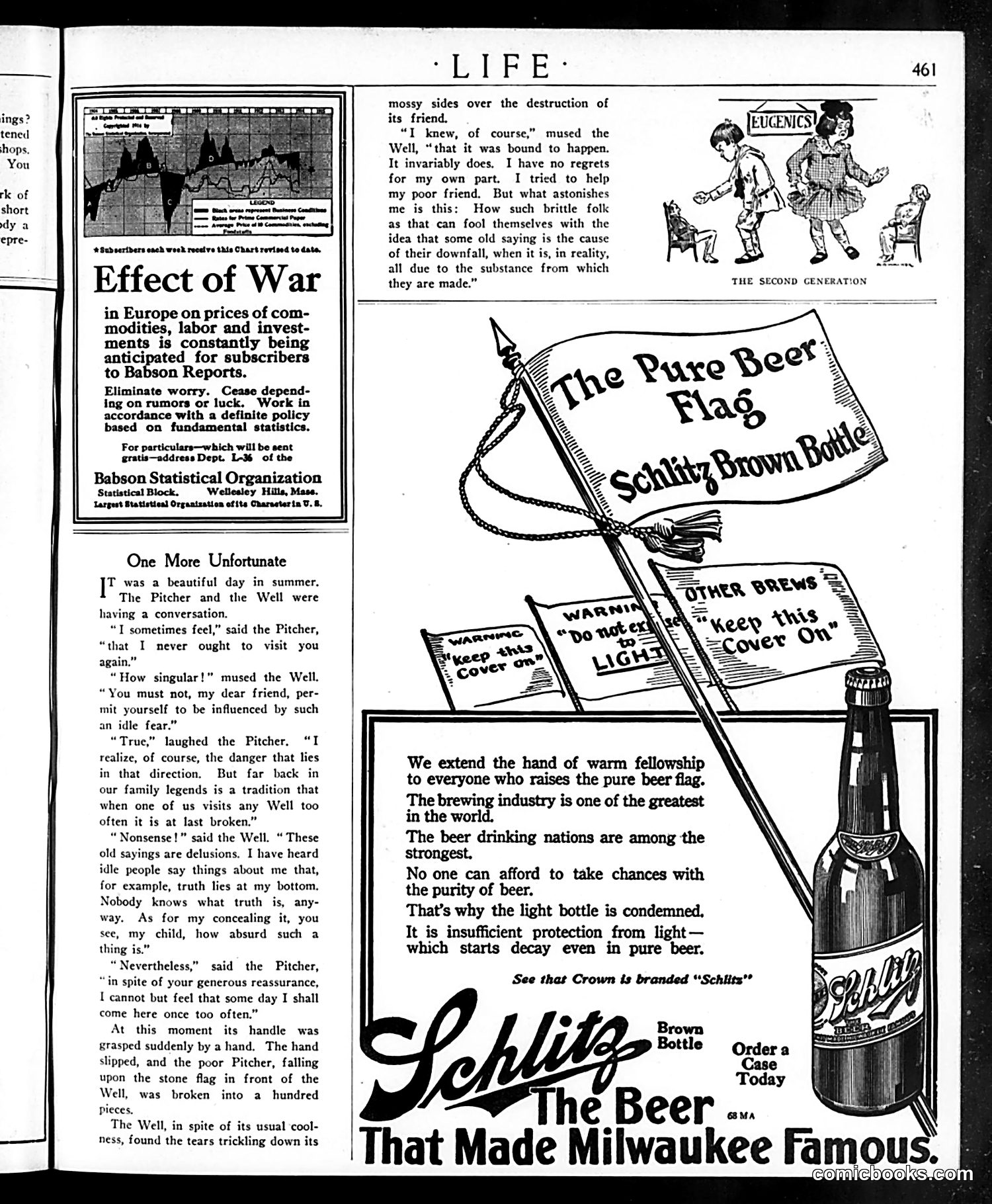
This Life magazine page (461) contains two main elements: **"One More Unfortunate" Fable:** An allegorical story where a Pitcher and Well converse. The Well dismisses folk wisdom ("old sayings are delusions"), claiming truth doesn't exist at its bottom. The Pitcher, ignoring warnings passed down through family tradition, visits too often and breaks. The moral satirizes those who reject ancestral wisdom or superstition, only to suffer the predicted consequences—suggesting that old sayings, however irrational-seeming, contain practical truth. **Schlitz Beer Advertisement:** Dominates the lower half. It defends brown bottles against "light bottles," claiming purity requires protection from light-induced decay. The ad positions beer-drinking nations as "strongest" and frames the brewing industry patriotically. The juxtaposition appears coincidental rather than intentional satire—the fable's theme about dismissing traditional warnings doesn't directly mock the beer industry, though both concern purity and trust.
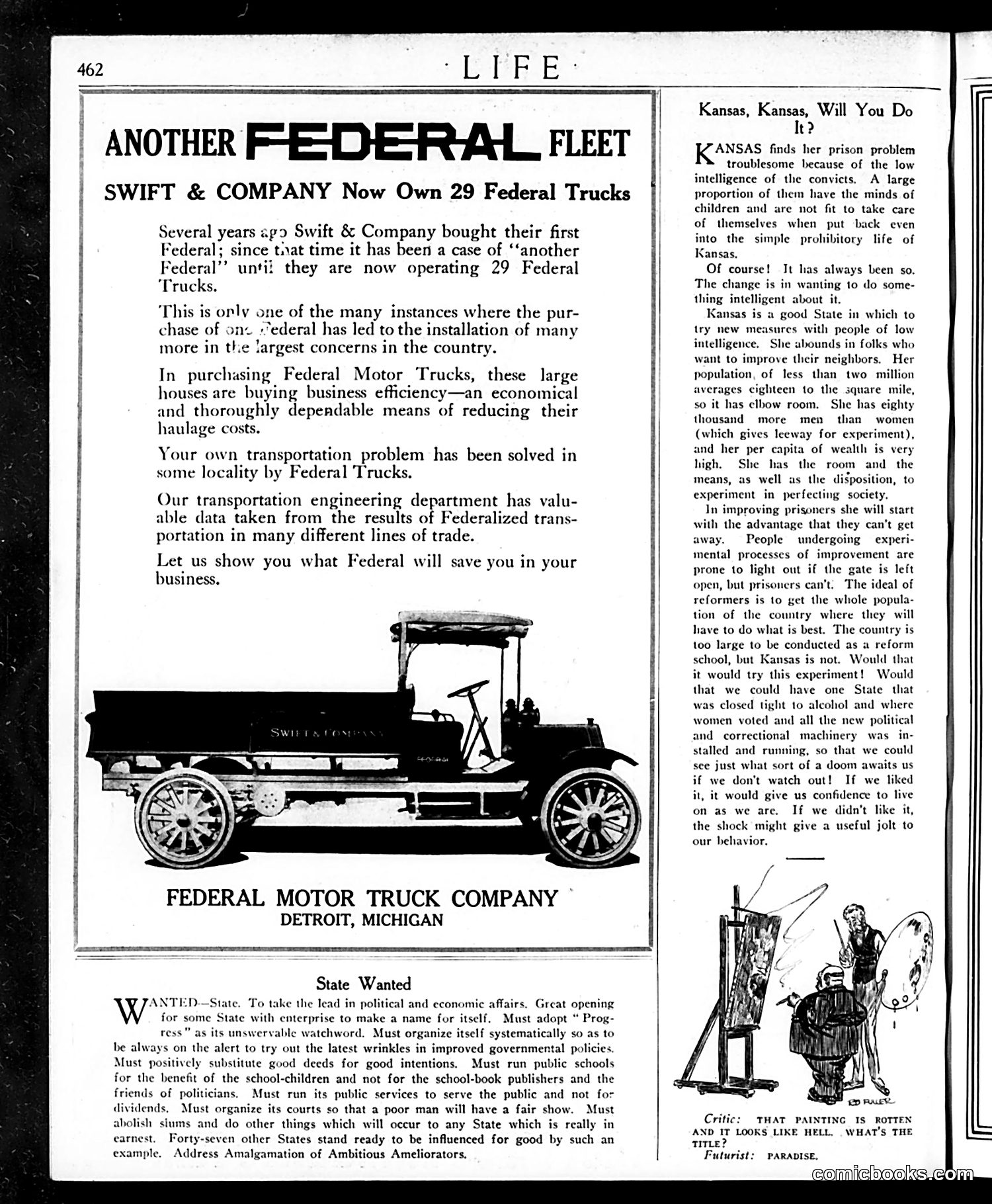
This page combines a **Federal Motor Truck advertisement** (left) with **satirical editorial content** (right). The ad promotes Federal trucks to businesses, using Swift & Company's adoption of 29 trucks as proof of efficiency and cost-savings. The editorial "Kansas, Kansas, Will You Do It?" proposes Kansas as a testing ground for progressive social reform. The author argues Kansas has ideal conditions: small population, gender imbalance (more men than women), high per-capita wealth, and citizens disposed to improving neighbors. He specifically suggests using the state's prison system as an experimental laboratory for rehabilitation. The satire's edge: the author proposes Kansas essentially become a "closed" reform state—locked to alcohol, with women voting and new "correctional machinery" installed—to test whether such policies work before potentially expanding them nationally. It's both sincere progressive idealism and tongue-in-cheek: treating an entire state as a social experiment to discover what doom awaits America if reform fails.
This is **not a cartoon or satirical content**, but rather a full-page advertisement—specifically a notice to consumers from E. Lamontagne's Sons, a wine and spirits importer. **Historical Context:** Dated August 10, 1914, this appears just after **World War I's outbreak in Europe** (late July 1914). The notice addresses disruptions caused by war: suspended commerce, increased insurance costs, freight scarcity, and foreign export prohibitions on wines and spirits. **The Message:** Lamontagne's assures American consumers that price increases on imported French wines (Barton & Guestier clarets), gins, whiskeys, ports, and sherries reflect only *actual costs* incurred—not profiteering. They claim to have made "material sacrifices" to keep beloved brands affordable. **Why It Matters:** The note at bottom indicates this replaced a planned illustrated advertisement, suggesting wartime disruptions affected even advertising itself. This document captures early American consumer anxiety about accessing European luxury goods during the war's opening weeks.
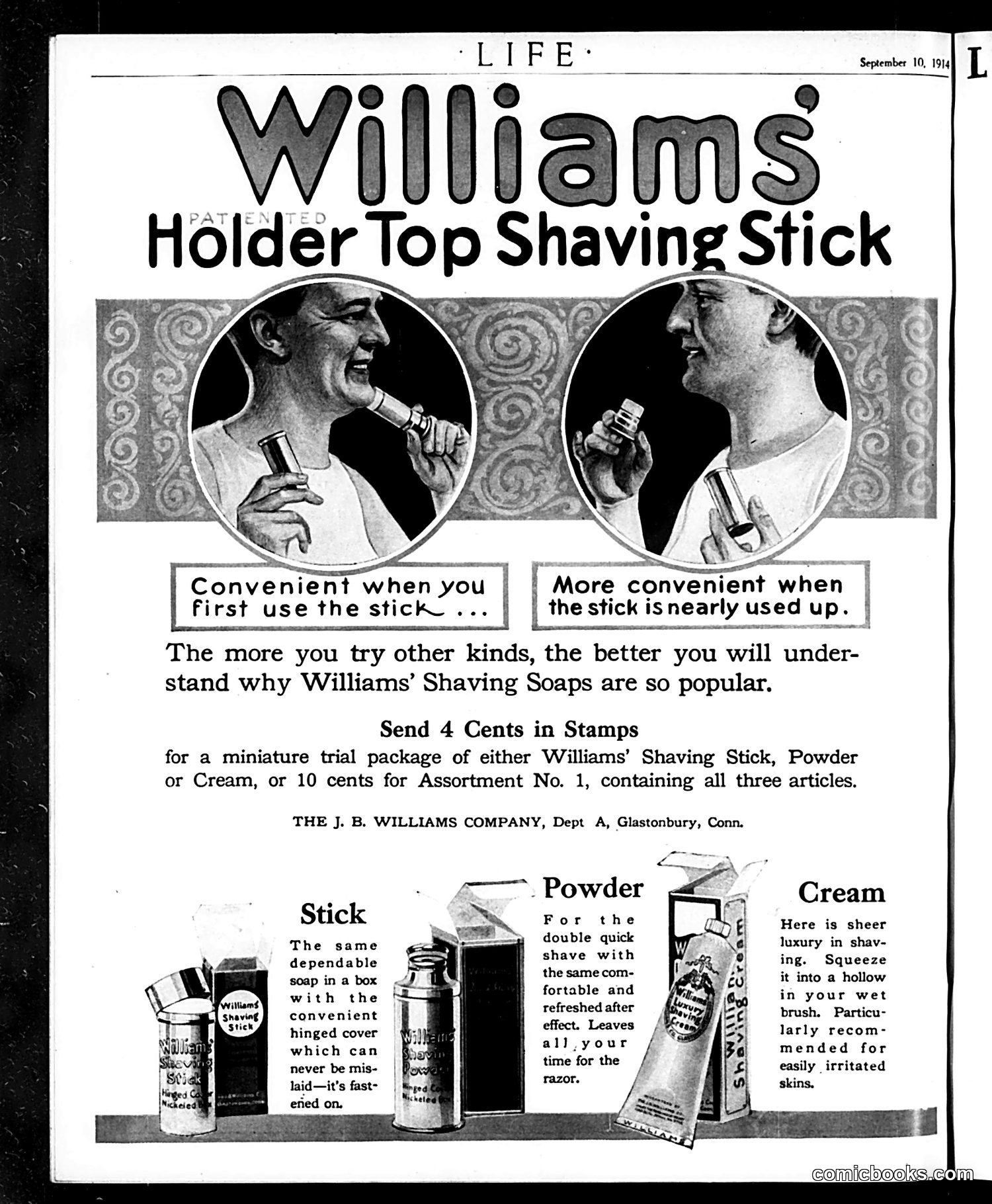
This is a **commercial advertisement**, not political satire. The J.B. Williams Company promotes its "Holder Top Shaving Stick"—a solid soap product in a convenient container with a hinged cover. The two circular photographs show men demonstrating the product's practical advantage: when the stick is fresh (left image), it's convenient to use; when nearly depleted (right image), the hinged holder keeps the remaining soap accessible rather than wasteful. The ad emphasizes three product variants: a stick form, powder, and cream. Customers could order trial samples for 4-10 cents in stamps. The sales pitch stresses durability, convenience, and that trying competing products would confirm Williams' superiority. This reflects early-20th-century consumer marketing—using before/after scenarios and competitive claims to sell household grooming products to American men.