
Life, 1914-09-10 · page 18 of 48
Life — September 10, 1914 — page 18: what you’re looking at
What you’re looking at
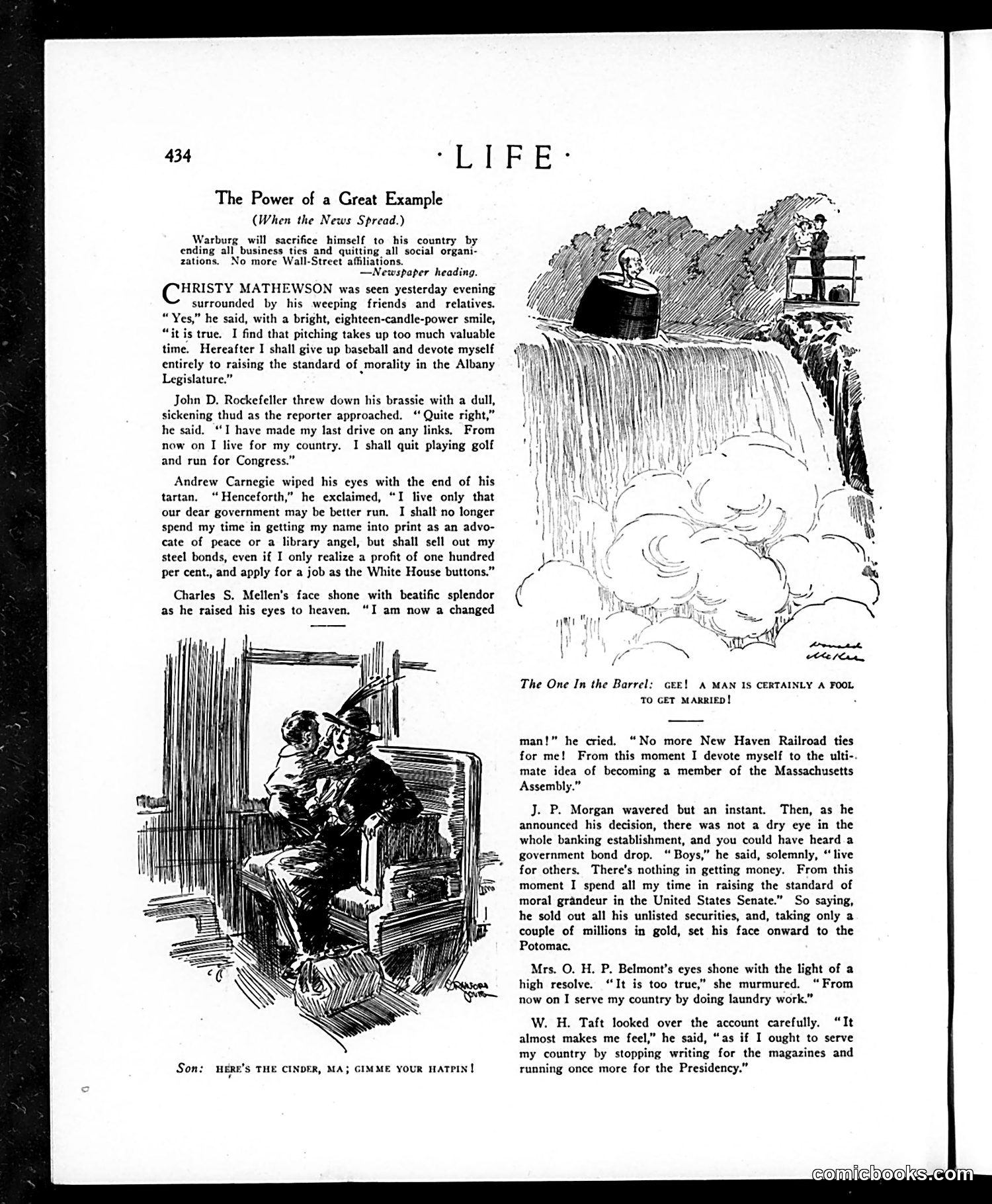
This satirical piece mocks wealthy industrialists and public figures who announced they'd sacrifice personal pursuits for public service, apparently inspired by banker Paul Warburg's publicized commitment. The text presents absurd "conversions" by recognizable figures: Christy Mathewson (baseball star) claiming he'll quit to reform the Albany Legislature; Rockefeller abandoning golf for Congress; Carnegie selling steel bonds for White House custodial work; J.P. Morgan selling securities to serve the Senate; and President Taft considering another presidential run. The humor lies in the obvious hypocrisy—these men are so wealthy and powerful that their "sacrifices" are transparently insincere. The cartoons reinforce this mockery through exaggerated expressions of false piety. The accompanying comic strips ("Son: HERE'S THE CINDER, MA" and "The One In the Barrel") appear unrelated social commentary, though their exact references are unclear today. The satire targets the gap between wealthy elites' public virtue-signaling and their actual priorities—a timeless critique.
📄 Transcribed text from this page (OCR, searchable)
Machine-transcribed from the original scan — historical spelling and the odd misread are preserved.
~ISBsE = The Power of a Great Example (When the News Spread.) Warburg will sacrifice himself to his country by ending all business ties and quitting all social organi- zations. No more Wall-Street affiliations. —Newspaper heading. Guess, MATHEWSON was seen yesterday evening surrounded by his weeping friends and relatives. “Yes,” he said, with a bright, eighteen-candle-power smile, “it is true. I find that pitching takes up too much valuable time. Hereafter I shall give up baseball and devote myself entirely to raising the standard of morality in the Albany Legislature.” John D. Rockefeller threw down his brassie with a dull, sickening thud as the reporter approached. “Quite right,” he said. “I have made my last drive on any links, From now on I live for my country. I shall quit playing golf and run for Congress.” Andrew Carnegie wiped his eyes with the end of his tartan, “Henceforth,” he exclaimed, “I live only that our dear government may be better run. I shalt no longer spend my time in getting my name into print as an advo- cate of peace or a library angel, but shall sell out my steel bonds, even if I only realize a profit of one hundred per cent., and apply for a job as the White House buttons.” Charles S. Mellen’s face shone with beatific splendor as he raised his eyes to heaven. “I am now a changed Son: WERE’S THE CINDER, MA; GIMME YOUR HATPIN! The One In the Barrel: cee! A MAN IS CERTAINLY A FOOL TO GET MARRIED! : man!” he cried. “No more New Haven Railroad ties for me! From this moment I devote myself to the ulti-. mate idea of becoming a member of the Massachusetts Assembly.” J. P. Morgan wavered but an instant. Then, as he announced his decision, there was not a dry eye in the whole banking establishment, and you could have heard a government bond drop. “ Boys,” he said, solemnly, “live for others, There's nothing in getting money. From this moment I spend all my time in raising the standard of moral grandeur in the United States Senate.” So saying, he sold out all his unlisted securities, and, taking only a couple of millions in gold, set his face onward to the Potomac. Mrs. O. H. P. Belmont’s eyes shone with the light of a high resolve. “It is too true,” she murmured. “From now on I serve my country by doing laundry work.” W. H. Taft looked over the account carefully. “It almost makes me feel,” he said, “as if I ought to serve my country by stopping writing for the magazines and running once more for the Presidency.”