
Life, 1914-09-10 · page 13 of 48
Life — September 10, 1914 — page 13: what you’re looking at
What you’re looking at
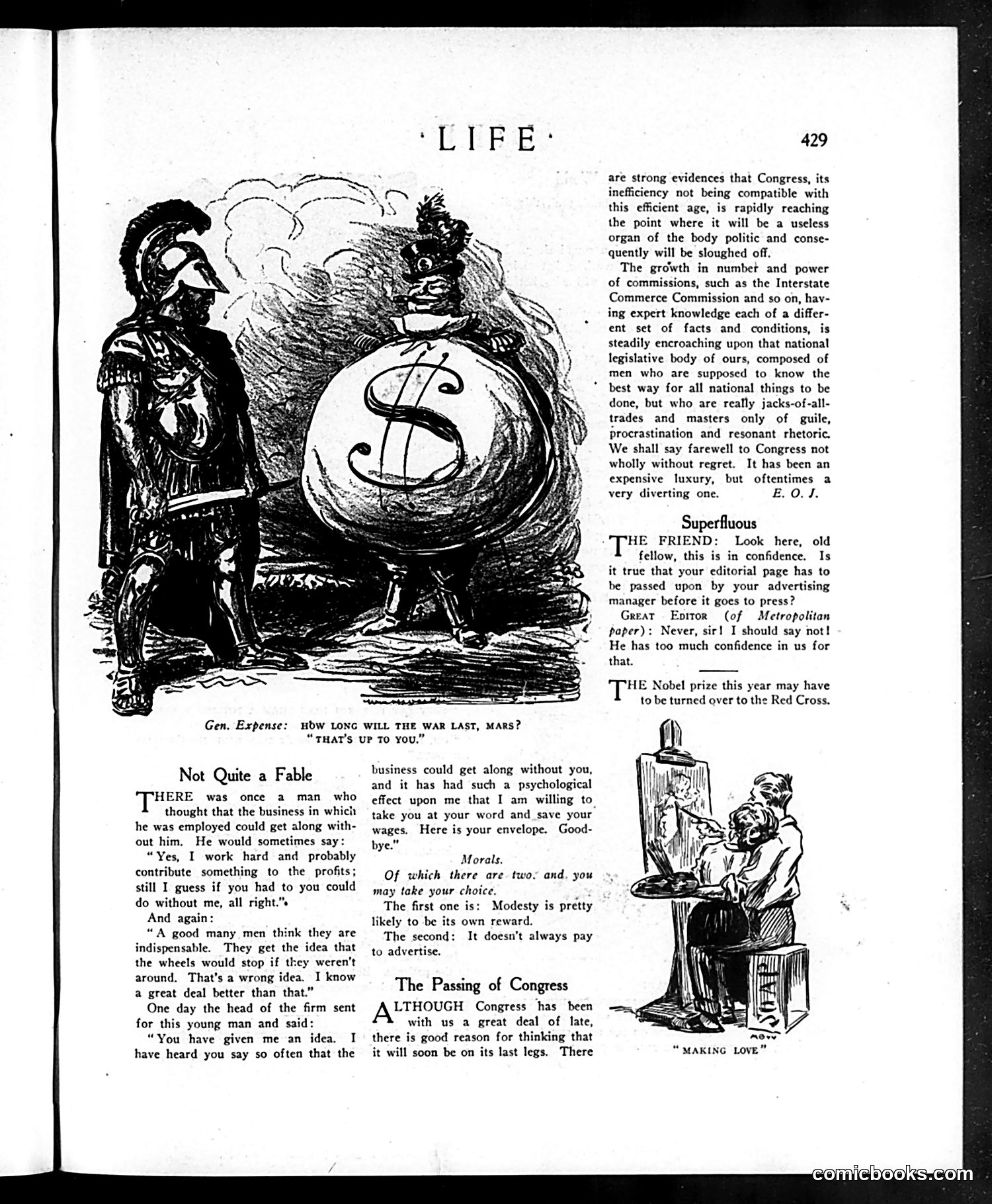
The main political cartoon depicts a military figure (labeled "Gen. Expense") standing beside a enormous dollar sign, with the caption "HOW LONG WILL THE WAR LAST, MARS? 'THAT'S UP TO YOU.'" This satirizes **military spending during wartime** — the implication being that war's duration depends on continued government expenditure rather than strategic necessity. The figure of Mars (Roman god of war) personifies conflict itself, suggesting the cycle feeds on money. The surrounding text critiques **Congress's inefficiency**, arguing the legislative body has become obsolete in the modern age, with regulatory commissions better suited to governance. The page also includes humorous short pieces about business and modesty. The overall tone mocks government waste and bureaucratic irrelevance during what appears to be **World War I era** (based on war references).
📄 Transcribed text from this page (OCR, searchable)
Machine-transcribed from the original scan — historical spelling and the odd misread are preserved.
Gen. Expense: HOW LONG WILL THE WAR LAST, MARS? “THAT'S UP TO You.” Not Quite a Fable 'HERE was thought that the business in which he was employed could get along with- once a man who out him. He would sometimes say: “Yes, I work hard and probably contribute something to the profits; still I guess if you had to you could do without me, all right.» And again: “A good many men think they are indispensable. They get the idea that the wheels would stop if they weren't around. That's a wrong idea. I know a great deal better than that.” One day the head of the firm sent for this young man and said: “You have given me an idea. I have heard you say so often that the business could get along without you, and it has had such a psychological effect upon me that I am willing to take you at your word and save your wages. Here is your envelope. Good- bye.” Morals. Of which there are two. and. you may take your choice. xs The first one is: Modesty is pretty likely to be its own reward. The second: It doesn’t always pay to advertise. The Passing of Congress LTHOUGH Congress ‘thas been with us a great deal of late, there is good reason for thinking that it will soon be on its last legs. There 429 are strong evidences that Congress, its inefficiency not being compatible with this efficient age, is rapidly reaching the point where it will be a useless organ of the body politic and conse- quently will be sloughed off. The growth in numbet and power of commissions, such as the Interstate Commerce Commission and so on, hav- ing expert knowledge each of a differ- ent set of facts and conditions, is steadily encroaching upon that national legislative body of ours, composed of men who are supposed to know the best way for all national things to be done, but who are really jacks-of-all- trades and masters only of guile, procrastination and resonant rhetoric. We shall say farewell to Congress not wholly without regret. It has been an expensive luxury, but oftentimes a very diverting one. E.0. J. Superfluous HE FRIEND: Look here, old fellow, this is in confidence. Is it true that your editorial page has to be passed upon by your advertising manager before it goes to press? Great Epitor (of Metropolitan paper): Never, sir! I should say not! He has too much confidence in us for that. HE Nobel prize this year may have to be turned over to the Red Cross. “MAKING LOVE”