
Life, 1914-09-10 · page 20 of 48
Life — September 10, 1914 — page 20: what you’re looking at
What you’re looking at
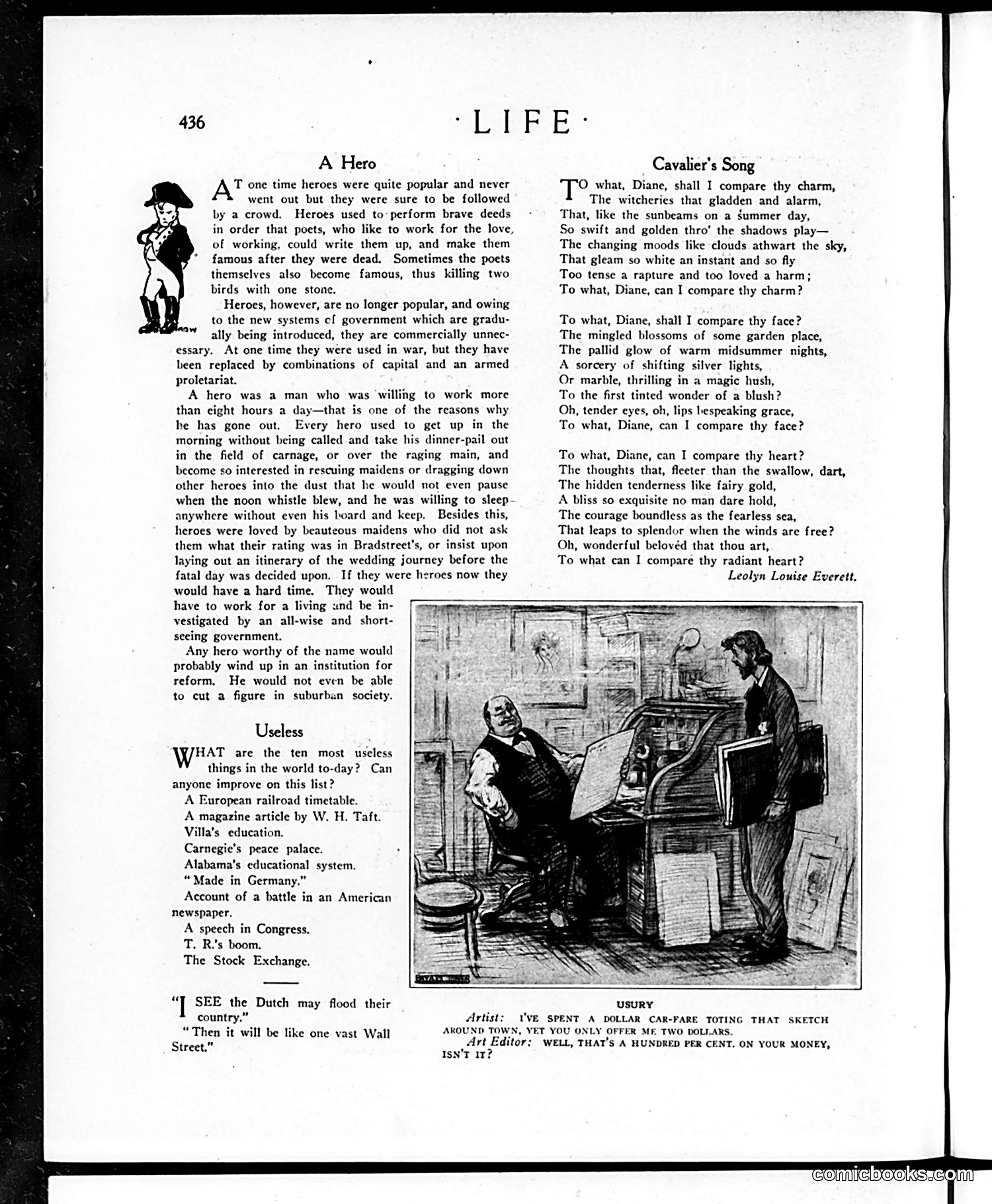
This 1910s *Life* magazine page contains satirical commentary on obsolescence and value: **"A Hero"** argues that traditional heroism is dead. The piece mockingly observes that heroes—men willing to work long hours without complaint, sleep anywhere, and win maidens through valor—are commercially unnecessary in modern industrial society. They've been "replaced by combinations of capital and an armed proletariat." Any modern hero would be investigated by government and institutionalized, unable to function in respectable society. **"Useless"** lists ten supposedly worthless modern things, including European rail timetables, W.H. Taft magazine articles, Villa's education (likely Pancho Villa), and notably "The Stock Exchange"—suggesting financial markets provide no real value. **The cartoon** depicts an artist pitching a sketch to an editor. The artist spent a dollar in transportation costs; the editor offers two dollars. The editor's quip—"that's a hundred per cent on your money"—is sarcastic: the artist made no actual profit, only recovered expenses. It satirizes how undervalued creative work is, even when mathematically appearing profitable.
📄 Transcribed text from this page (OCR, searchable)
Machine-transcribed from the original scan — historical spelling and the odd misread are preserved.
“SEGRE A Hero T one time heroes were quite popular and never went out but they were sure to be followed by a crowd. Heroes used to perform brave deeds in order that poets, who like to work for the love, of working, could write them up, and make them famous after they were dead. Sometimes the poets themselves also become famous, thus killing two birds with one stone, Heroes, however, are no longer popular, and owing to the new systems cf government which are gradu- ally being introduced, they are commercially unnec- essary. At one time they were used in war, but they have Leen replaced by combinations of capital and an armed proletariat. A hero was a man who was willing to work more than cight hours a day—that is one of the reasons why he has gone out. Every hero used to get up in the morning without being called and take his dinner-pail out in the field of carnage, or over the raging main, and become so interested in rescuing maidens or dragging down other heroes into the dust that he would not even pause when the noon whistle blew, and he was willing to sleep- anywhere without even his board and keep. Besides this, heroes were loved by beauteous maidens who did not ask them what their rating was in Bradstreet’s, or insist upon laying out an itinerary of the wedding journey before the fatal day was decided upon. If they were heroes now they would have a hard time. They would Cavalier's Song 'O what, Diane, shall I compare thy charm, The witcheries that gladden and alarm, That, like the sunbeams on a Summer day, So swift and golden thro’ the shadows play— The changing moods like clouds athwart the sky, That gleam so white an instant and so fly Too tense a rapture and too loved a harm; To what, Diane, can I compare thy charm? To what, Diane, shall I compare thy face? The mingled blossoms of some garden place, The pallid glow of warm midsummer nights, A sorcery of shifting silver lights, Or marble, thrilling in a magic hush, To the first tinted wonder of a blush? Oh, tender eyes, oh, lips bespeaking grace, To what, Diane, can I compare thy face? To what, Diane, can I compare thy heart? The thoughts that, fleeter than the swallow, dart, The hidden tenderness like fairy gold, A bliss so exquisite no man dare hold, The courage boundless as the fearless sea, That leaps to splendor when the winds are free? Oh, wonderful belovéd that thou art, To what can I compare thy radiant heart? Leolyn Louise Everett. have to work for a living und be in- vestigated by an all-wise and short- seeing government. Any hero worthy of the name would probably wind up in an institution for reform, He would not even be able to cut a figure in suburban society. Useless HAT are the ten most useless things in the world to-day? Can anyone improve on this list? A European railroad timetable. A magazine article by W. H. Taft. Villa’s education. Carnegic’s peace palace. Alabama's educational system. “Made in Germany.” Account of a battle in an American newspaper. A speech in Congress. T. R.’s boom. The Stock Exchange. ‘J SEE the Dutch may flood their country.” “Then it will be like one vast Wall Street.” Artist: AROUND TOW Isn't 17? IVE SPENT A DOLLAR CAR-FARE TOTING THAT SKETCH , YET YOU ONLY OFFER MF. TWO DOLI.ARS. Art Editor: weit, THAT's A HUNDRED PER CENT. ON YOUR MONEY,