
Life, 1914-09-10 · page 26 of 48
Life — September 10, 1914 — page 26: what you’re looking at
What you’re looking at
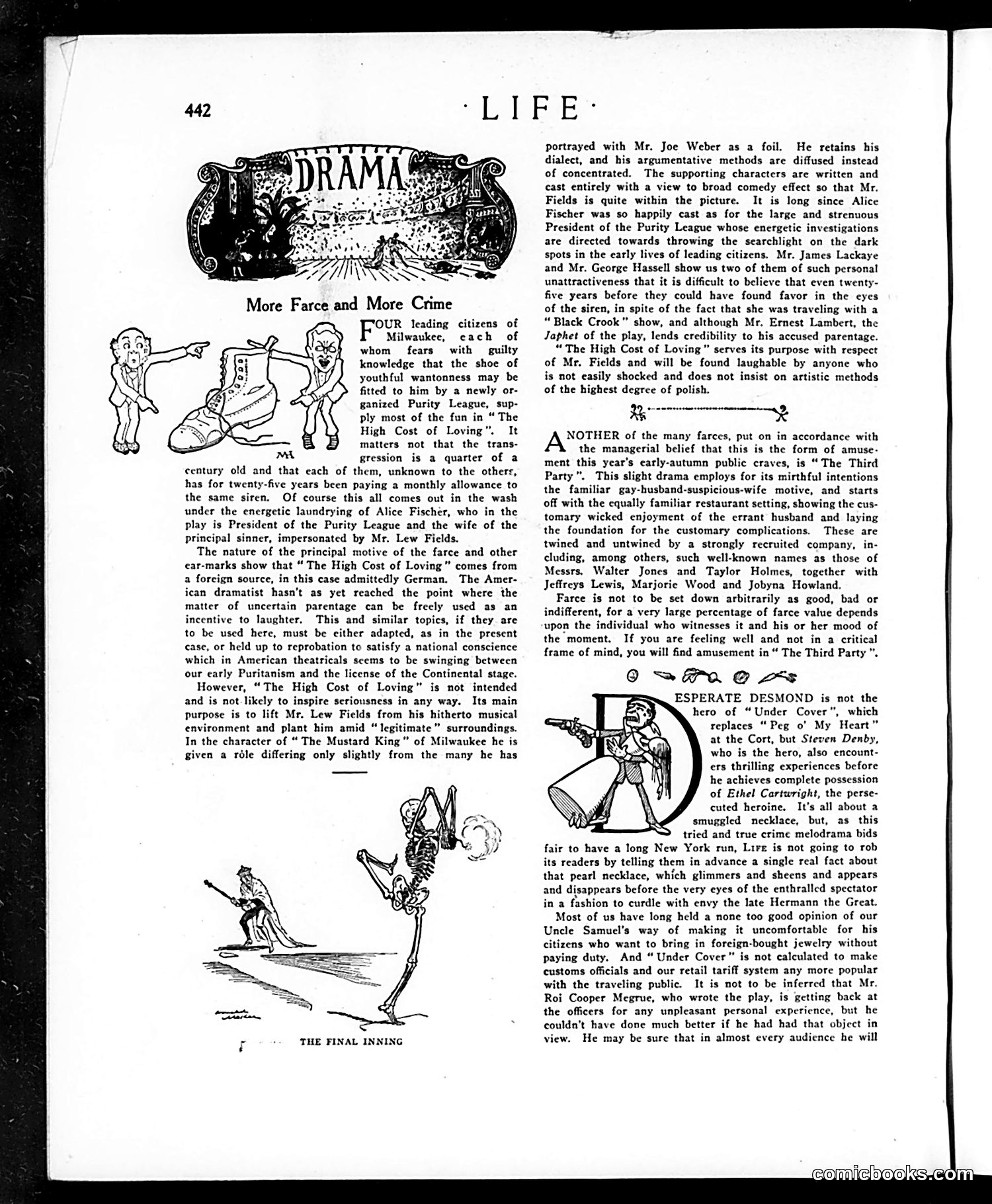
This page reviews two theatrical farces playing in early 1910s New York. **"The High Cost of Loving"** features comedian Lew Fields in a German-sourced comedy about Milwaukee citizens blackmailed by a "Purity League" president (Alice Fischer) who discovers their shared secret—they've all been supporting the same woman for 25 years. The reviewer notes this "uncertain parentage" plot would shock American audiences but works here as light entertainment. Fields, typically a musical performer, transitions to "legitimate" drama with his characteristic dialect and argumentative style intact. **"The Third Party"** follows the familiar formula of a philandering husband, suspicious wife, and restaurant scheming, featuring well-known actors like Walter Jones and Taylor Holmes. The reviewer treats both as competent but formulaic farces—acceptable entertainment if viewers aren't "easily shocked" or demanding artistic rigor. The cartoons illustrate the comedic physical business typical of such productions.
📄 Transcribed text from this page (OCR, searchable)
Machine-transcribed from the original scan — historical spelling and the odd misread are preserved.
“E.REIE- More Farce and More Crime OUR leading citizens of Milwaukee, cach of whom fears with guilty knowledge that the shoe of youthful wantonness may be fitted to him by a newly or- ganized Purity League, sup- ply most of the fun in “ The High Cost of Loving”. It matters not that the trans- gression is a quarter of a century old and that each of them, unknown to the others, has for twenty-five years been paying a monthly allowance to the same siren. Of course this all comes out in the wash under the energetic laundrying of Alice Fischer, who in the play is President of the Purity League and the wife of the principal sinner, impersonated by Mr. Lew Ficlds. The nature of the principal motive of the farce and other car-marks show that “ The High Cost of Loving” comes from a foreign source, in this case admittedly German. The Amer- ican dramatist hasn't as yet reached the point where the matter of uncertain parentage can be freely used as an incentive to laughter. This and similar topics, if they are to be used here, must be cither adapted, as in the present case, or held up to reprobation to satisfy a national conscience which in American theatricals seems to be swinging between our early Puritanism and the license of the Continental stage. However, “The High Cost of Loving" is not intended and is not. likely to inspire seriousness in any way. Its main purpose is to lift Mr. Lew Fields from his hitherto musical environment and plant him amid “legitimate” surroundings. In the character of “ The Mustard King" of Milwaukee he is given a réle differing only slightly from the many he has THE FINAL INNING Portrayed with Mr. Joe Weber as a foil. He retains his dialect, and his argumentative methods are diffused instead of concentrated. The supporting characters are written and cast entirely with a view to broad comedy effect so that Mr. Fields is quite within the picture. It is long since Alice Fischer was so happily cast as for the large and strenuous President of the Purity League whose energetic investigations are directed towards throwing the searchlight on the dark spots in the early lives of leading citizens. Mr. James Lackaye and Mr. George Hassell show us two of them of such personal unattractiveness that it is difficult to believe that even twenty- five years before they could have found favor in the eyes of the siren, in spite of the fact that she was traveling with a “ Black Crook” show, and although Mr. Ernest Lambert, the Japhet of the play, lends credibility to his accused parentage. “ The High Cost of Loving” serves its purpose with respect of Mr. Fields and will be found laughable by anyone who is not easily shocked and does not insist on artistic methods of the highest degree of polish. oc ANOTHER of the many farces, put on in accordance with the managerial belief that this is the form of amuse- ment this year’s carly-autumn public craves, is “The Third Party". This slight drama employs for its mirthful intentions the familiar gay-husband-suspicious-wife motive, and starts off with the equally familiar restaurant setting, showing the cus- tomary wicked enjoyment of the errant husband and laying the foundation for the customary complications. These are twined and untwined by a strongly recruited company, in- cluding, among others, such well-known names as those of Messrs. Walter Jones and Taylor Holmes, together with Jeffreys Lewis, Marjorie Wood and Jobyna Howland. Farce is not to be set down arbitrarily as good, bad or indifferent, for a very large percentage of farce value depends upon the individual who witnesses it and his or her mood of the moment, If you are feeling well and not in a critical frame of mind, you will find amusement in“ The Third Party ". 09 S&O OZ: ESPERATE DESMOND is not the hero of “Under Cover”, which replaces “Peg o' My Heart” at the Cort, but Steven Denby, who is the hero, also encount- ers thrilling experiences before he achieves complete possession of Ethel Cartwright, the perse- cuted heroine. It’s all about a smuggled necklace, but, as this tried and true crime melodrama bids fair to have a long New York run, Live is not going to rob its readers by telling them in advance a single real fact about that pearl necklace, which glimmers and sheens and appears and disappears before the very eyes of the enthralled spectator in a fashion to curdle with envy the late Hermann the Great. Most of us have long held a none too good opinion of our Uncle Samuel's way of making it uncomfortable for his citizens who want to bring in forcign-bought jewelry without paying duty. And “Under Cover” is not calculated to make customs officials and our retail tariff system any more popular with the traveling public. It is not to be inferred that Mr. Roi Cooper Megrue, who wrote the play, is getting back at the officers for any unpleasant personal experience, but he couldn't have done much better if he had had that object in view. He may be sure that in almost every audience he will