
Life, 1914-09-10 · page 10 of 48
Life — September 10, 1914 — page 10: what you’re looking at
What you’re looking at
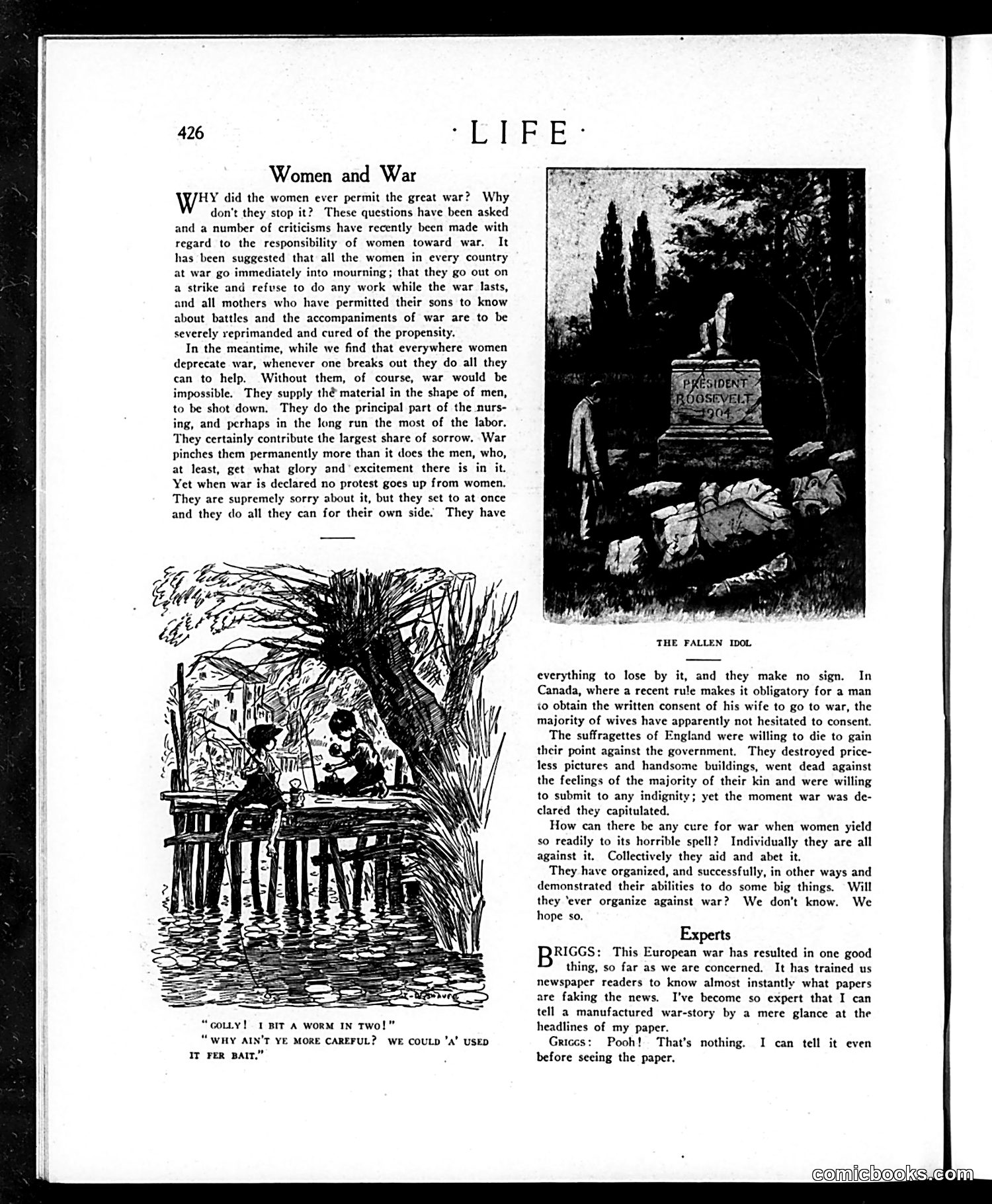
This page critiques women's contradictory positions on war. The article questions why women permit wars yet don't stop them, suggesting they should collectively strike and refuse war work. It argues women suffer war's consequences most severely—supplying soldiers and bearing grief—yet receive no protest credit when war is declared. The two illustrations support this theme: the upper image shows mourners at President Roosevelt's tomb, depicting feminine grief over war casualties. The lower cartoon depicts two women fishing, with dialogue about using worms as bait—a crude analogy satirizing women's perceived passivity in allowing men to be "used" in warfare. The "Experts" section shifts to newspaper accuracy during wartime, offering light relief from the serious preceding argument.
📄 Transcribed text from this page (OCR, searchable)
Machine-transcribed from the original scan — historical spelling and the odd misread are preserved.
426 Women and War 'HY did the women ever permit the great war? Why don’t they stop it? These questions have been asked and a number of criticisms have recently been made with regard to the responsibility of women toward war. It has been suggested that all the women in every country at war go immediately into mourning; that they go out on a strike and refuse to do any work while the war lasts, and all mothers who have permitted their sons to know about battles and the accompaniments of war are to be severely reprimanded and cured of the propensity. In the meantime, while we find that everywhere women deprecate war, whenever one breaks out they do all they can to help. Without them, of course, war would be impossible. They supply thé material in the shape of men, to be shot down, They do the principal part of the nurs- ing, and perhaps in the long run the most of the labor. They certainly contribute the largest share of sorrow. War pinches them permanently more than it does the men, who, at least, get what glory and excitement there is in it. Yet when war is declared no protest goes up from women, They are supremely sorry about it, but they set to at once and they do all they can for their own side. They have “GoLLy! 1 BIT A WoRM IN Two!" “WHY AIN'T YE MORE CAREFUL? WE COULD ’A’ USED iT FER BAIT.” THE FALLEN IDOL everything to lose by it, and they make no sign. In Canada, where a recent rule makes it obligatory for a man to obtain the written consent of his wife to go to war, the majority of wives have apparently not hesitated to consent. The suffragettes of England were willing to die to gain their point against the government. They destroyed price- less pictures and handsome buildings, went dead against the feelings of the majority of their kin and were willing to submit to any indignity; yet the moment war was de- clared they capitulated. How can there be any cure for war when women yield so readily to its horrible spell? Individually they are all against it. Collectively they aid and abet it. They have organized, and successfully, in other ways and demonstrated their abilities to do some big things. Will they ‘ever organize against war? We don’t know. We hope so. Experts BRces: This European war has resulted in one good thing, so far as we are concerned. It has trained us newspaper readers to know almost instantly what papers are faking the news. I’ve become so expert that I can tell a manufactured war-story by a mere glance at the headlines of my paper. Griccs: Pooh! That’s nothing. I can tell it even before seeing the paper.