
Life, 1914-09-10 · page 22 of 48
Life — September 10, 1914 — page 22: what you’re looking at
What you’re looking at
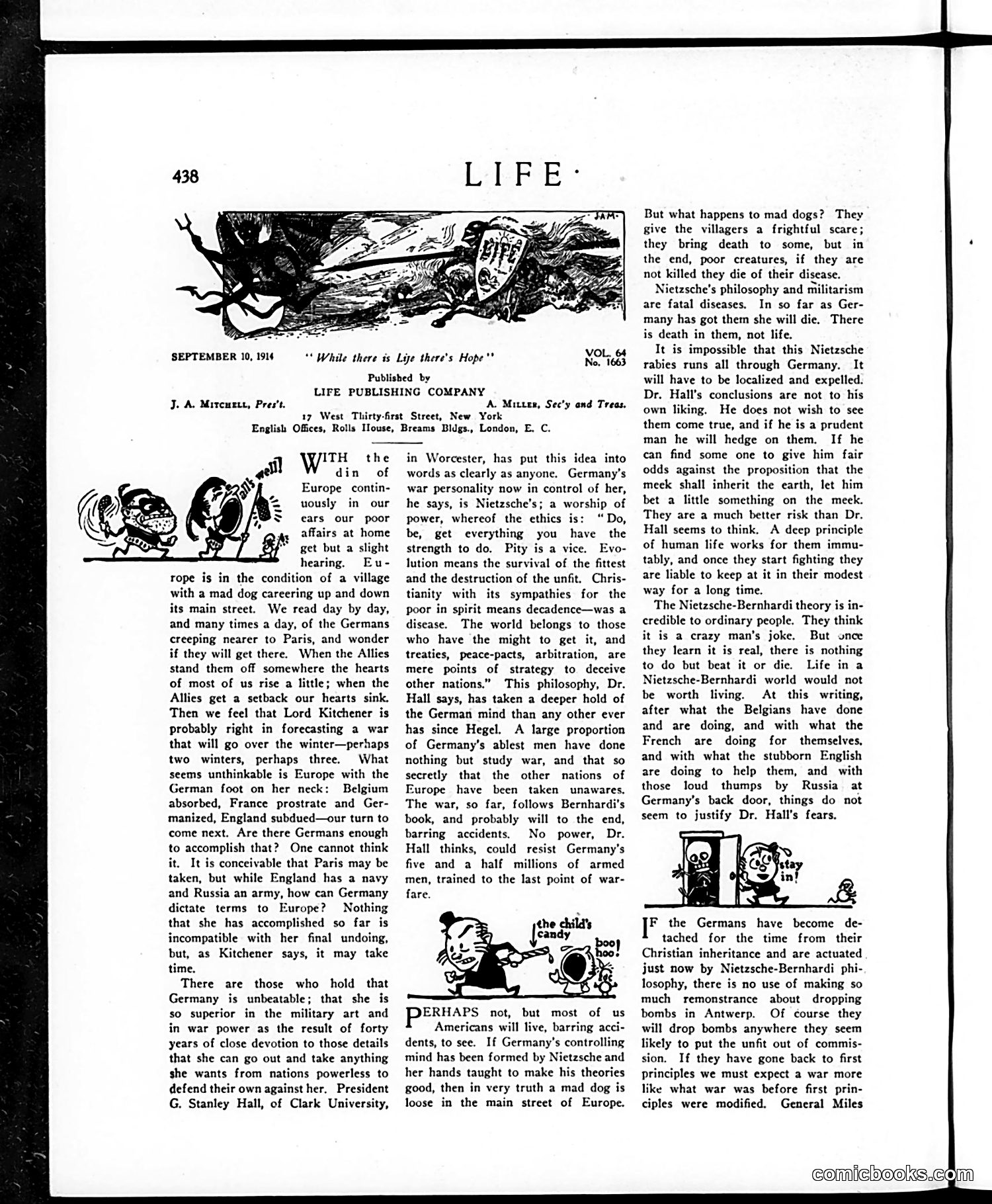
This page discusses Germany's military threat during early World War I. The editorial references President G. Stanley Hall of Clark University, who argued that Germany is driven by Nietzschean philosophy—a "worship of power" that treats pity as vice and celebrates survival of the fittest. The text presents Germany as a "mad dog" loose in Europe, following the militaristic theories of strategist Bernhardt. The editorial's key argument: while Germany appears militarily unstoppable with 5.5 million trained soldiers, Nietzschean philosophy is itself a "fatal disease" that will ultimately destroy Germany. Like a rabid dog, Germany may cause terrifying harm but cannot prevail long-term. The cartoons (top and middle) use animal imagery—appearing to depict chaotic conflict—supporting the "mad dog" metaphor. This reflects American anxiety about German military superiority early in WWI, while maintaining hope that militarism's inherent contradictions would prove self-defeating.
📄 Transcribed text from this page (OCR, searchable)
Machine-transcribed from the original scan — historical spelling and the odd misread are preserved.
SEPTEMBER 10, 1914 “While there is Lise there's Hope" VOL. 64 No, 1663 Published by LIFE PUBLISHING COMPANY J. A. Mircurtt, Pres't. ITH the din of Europe contin- uously in our ears our poor affairs at home get but a slight hearing. Eu- rope is in the condition of a village with a mad dog careering up and down its main street. We read day by day, and many times a day, of the Germans creeping nearer to Paris, and wonder if they will get there. When the Allies stand them off somewhere the hearts of most of us rise a little; when the Allies get a setback our hearts sink. Then we feel that Lord Kitchener is probably right in forecasting a war that will go over the winter—perhaps two winters, perhaps three. What seems unthinkable is Europe with the German foot on her neck: Belgium absorbed, France prostrate and Ger- manized, England subdued—our turn to come next. Are there Germans enough to accomplish that? One cannot think it. It is conceivable that Paris may be taken, but while England has a navy and Russia an army, how can Germany dictate terms to rope? Nothing that she has accomplished so far is incompatible with her final undoing, but, as Kitchener says, it may take time. There are those who hold that Germany is unbeatable; that she is so superior in the military art and in war power as the result of forty years of close devotion to those details that she can go out and take anything she wants from nations powerless to defend their own against her. President G. Stanley Hall, of Clark University, A. Mitten, Sec’y and Treas. 17 West Thirty-first Street, New York English Offices, Rolls House, Breams Bldgs., London, E. C. in Worcester, has put this idea into words as clearly as anyone. Germany’s war personality now in control of her, he says, is Nietzsche's; a worship of power, whereof the ethics is: “Do, be, get everything you have the strength to do. Pity is a vice. Ev lution means the survival of the fittest and the destruction of the unfit. Chris- tianity with its sympathies for the poor in spirit means decadence—was a disease. The world belongs to those who have the might to get it, and treaties, peace-pacts, arbitration, are mere points of strategy to deceive other nations.” This philosophy, Dr. Hall says, has taken a deeper hold of the German mind than any other ever has since Hegel. A large proportion of Germany's ablest men have done nothing but study war, and that so secretly that the other nations of Europe have been taken unawares, The war, so far, follows Bernhardi's book, and probably will to the end, barring accidents. No power, Dr. Hall thinks, could resist Germany's five and a half millions of armed men, trained to the last point of war- fare. ERHAPS not, but most of us Americans will live, barring acci- dents, to see. If Germany's controlling mind has been formed by Nietzsche and her hands taught to make his theories good, then in very truth a mad dog is loose in the main street of Europe. But what happens to mad dogs? They give the villagers a frightful scare; they bring death to some, but in the end, poor creatures, if they are not killed they die of their disease. Nietzsche's philosophy and militarism are fatal diseases. In so far as Ger- many has got them she will die, There is death in them, not life. It is impossible that this Nietzsche rabies runs all through Germany. It will have to be localized and expelled. Dr. Hall’s conclusions are not to his own liking. He does not wish to see them come true, and if he is a prudent man he will hedge on them. If he can find some one to give him fair odds against the proposition that the meek shall inherit the earth, let him bet a little something on the meek. They are a much better risk than Dr. Hall seems to think. A deep principle of human life works for them immu- tably, and once they start fighting they are liable to keep at it in their modest way for a long time. The Nietzsche-Bernhardi theory is in- credible to ordinary people. They think it is a crazy man’s joke. But once they learn it is real, there is nothing to do but beat it or dic. Life in a Nietzsche-Bernhardi world would not be worth living. At this writing, after what the Belgians have done and are doing, and with what the French are doing for themselves, and with what the stubborn English are doing to help them, and with those loud thumps by Russia at Germany’s back door, things do not seem to justify Dr. Hall’s fears, F the Germans have become de- tached for the time from their Christian inheritance and are actuated just now by Nietzsche-Bernhardi phi- losophy, there is no use of making so much remonstrance about dropping bombs in Antwerp. Of course they will drop bombs anywhere they seem likely to put the unfit out of commis- sion. If they have gone back to first principles we must expect a war more like what war was before first prin- ciples were modified. General Miles comichooks.cem