
Life, 1914-09-10 · page 23 of 48
Life — September 10, 1914 — page 23: what you’re looking at
What you’re looking at
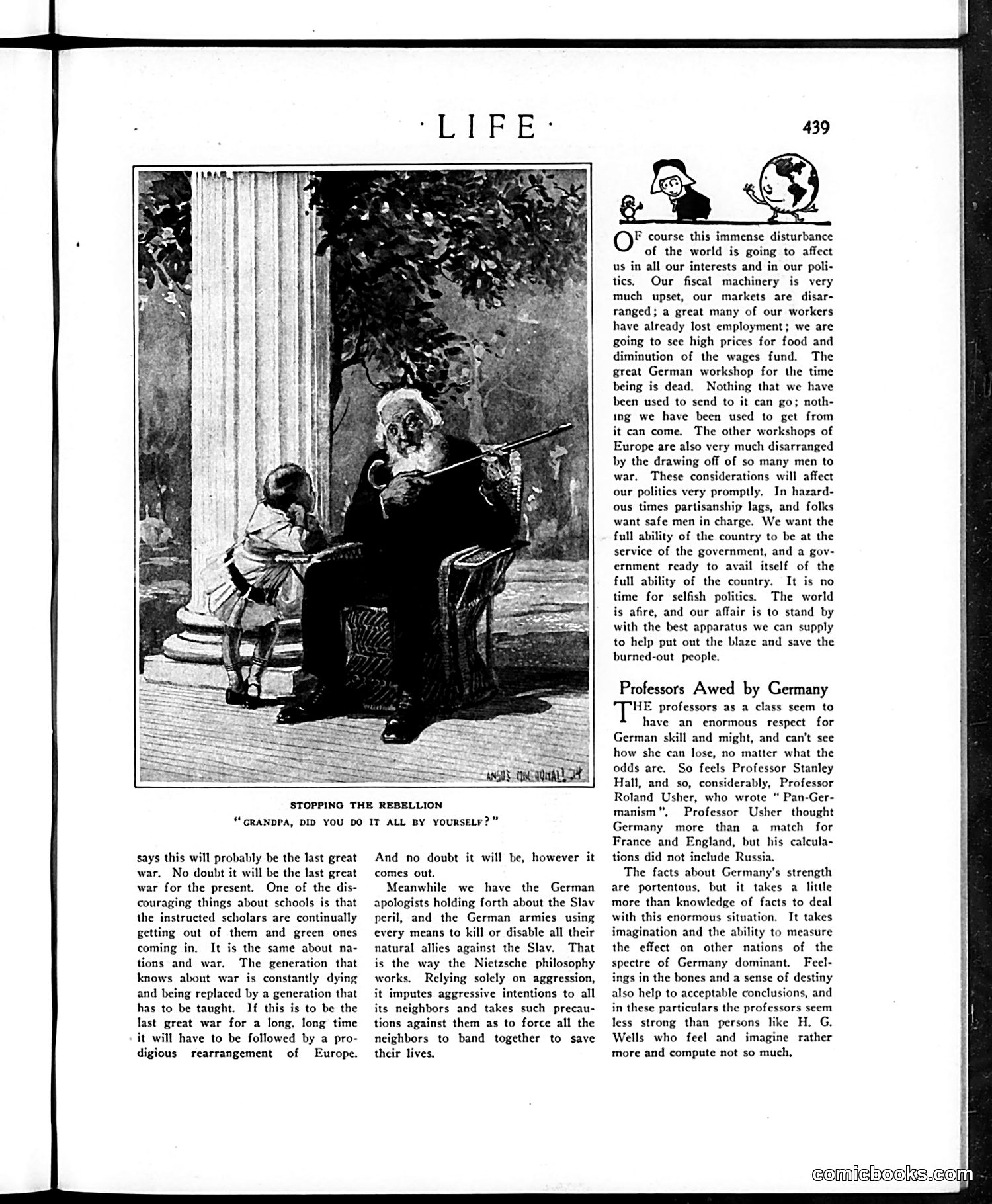
This 1914 *Life* magazine page contains two commentaries on World War I's impact on America. **The Cartoon:** "Stopping the Rebellion" depicts an elderly grandfather figure teaching a young child to shoot a rifle—likely satirizing how each generation must learn warfare anew, suggesting perpetual conflict despite hopes this will be "the last great war." **Context:** The text discusses Germany's aggression toward Slavic nations, driven by Nietzsche-inspired philosophy that assumes neighbors are threats, thereby creating the very coalitions (France, England, Russia) Germany fears. The author argues America's economy will suffer disruption and calls for nonpartisan national unity rather than "selfish politics." **"Professors Awed by Germany"** criticizes American academics like Stanley Hall and Roland Usher who, impressed by German military capability, underestimate allied strength—particularly miscalculating Russia's role. The piece argues emotional imagination and instinct (citing H.G. Wells) better assess war's consequences than pure analytical computation. The overall message: American interests require practical unity and clear-eyed judgment about Germany's actual threat.
📄 Transcribed text from this page (OCR, searchable)
Machine-transcribed from the original scan — historical spelling and the odd misread are preserved.
STOPPING THE REBELLION “GRANDPA, DID YOU DO IT ALL BY YOURSELF?” says this will probably be the last great war, No doubt it will be the last great war for the present. One of the dis- couraging things about schools is that the instructed scholars are continually getting out of them and green ones coming in. It is the same about na- tions and war. The generation that knows about war is constantly dying and being replaced by a generation that has to be taught. If this is to be the last great war for a long, long time it will have to be followed by a pro- digious rearrangement of Europe. And no doubt it will be, however it comes out. Meanwhile we have the German apologists holding forth about the Slav peril, and the German armies using every means to kill or disable all their natural allies against the Slav. That is the way the Nietzsche philosophy works. Relying solely on aggression, it imputes aggressive intentions to all its neighbors and takes such precau- tions against them as to force all the neighbors to band together to save their lives. OF course this immense disturbance of the world is going to affect us in all our interests and in our poli- tics. Our fiscal machinery is very much upset, our markets are disar- ranged; a great many of our workers have already lost employment; we are going to see high prices for food and diminution of the wages fund. The great German workshop for the time being is dead. Nothing that we have been used to send to it can go; noth- ing we have been used to get from it can come. The other workshops of Europe are also very much disarranged by the drawing off of so many men to war. These considerations will affect our politics very promptly. In hazard- ous times partisanship lags, and folks want safe men in charge. We want the full ability of the country to be at the service of the government, and a gov- ernment ready to avail itself of the full ability of the country. It is no time for selfish politics. The world is afire, and our affair is to stand by with the best apparatus we can supply to help put out the blaze and save the burned-out people. Professors Awed by Germany HE professors as a class seem to have an enormous respect for German skill and might, and can't see how she can lose, no matter what the odds are. So feels Professor Stanley Hall, and so, considerably, Professor Roland Usher, who wrote “ Pan-Ger- manism". Professor Usher thought Germany more than a match for France and England, but his calcula- tions did not include Russia. The facts about Germany's strength are portentous, but it takes a little more than knowledge of facts to deal with this enormous situation. It takes imagination and the ability to measure the effect on other nations of the spectre of Germany dominant. Feel- ings in the bones and a sense of destiny also help to acceptable conclusions, and in these particulars the professors seem less strong than persons like H. G. Wells who feel and imagine rather more and compute not so much, comichooks.