
A complete issue · 40 pages · 1913
Life — December 18, 1913
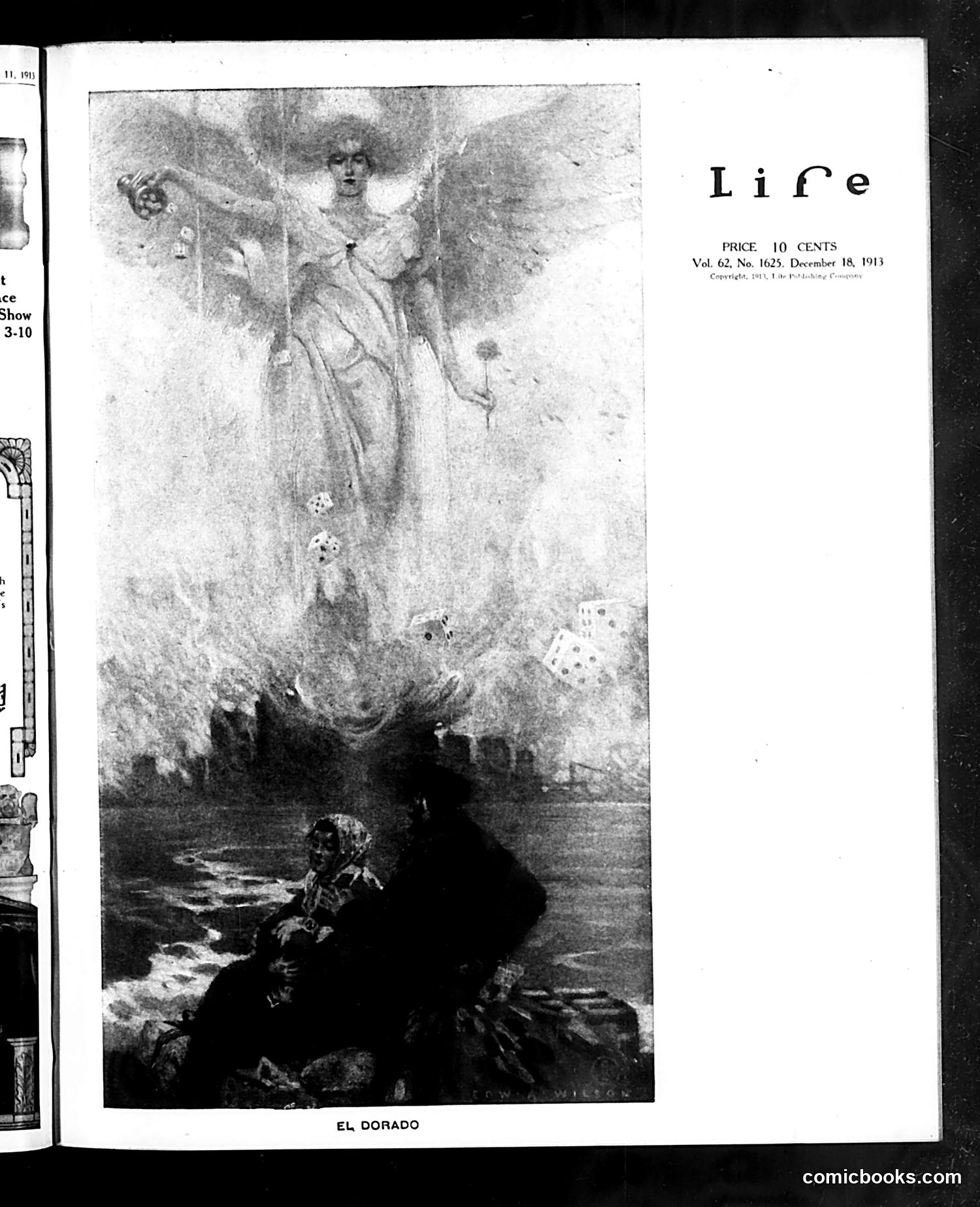
This illustration depicts a legendary or mythological scene titled "El Dorado"—the fabled lost city of gold. The image shows an ethereal, winged female figure (possibly representing Prosperity, Wealth, or a classical muse) hovering above a dark, shadowy landscape with what appears to be figures below reaching upward toward her. The composition suggests a satirical commentary on human desire and aspiration—the perpetual human chase after an impossible dream or unattainable wealth. The contrast between the luminous, angelic figure above and the dark masses below likely critiques the gap between idealized wealth and the earthly struggle of ordinary people. In 1913, during the Progressive Era, this probably reflected contemporary anxieties about economic inequality and the elusive nature of prosperity.
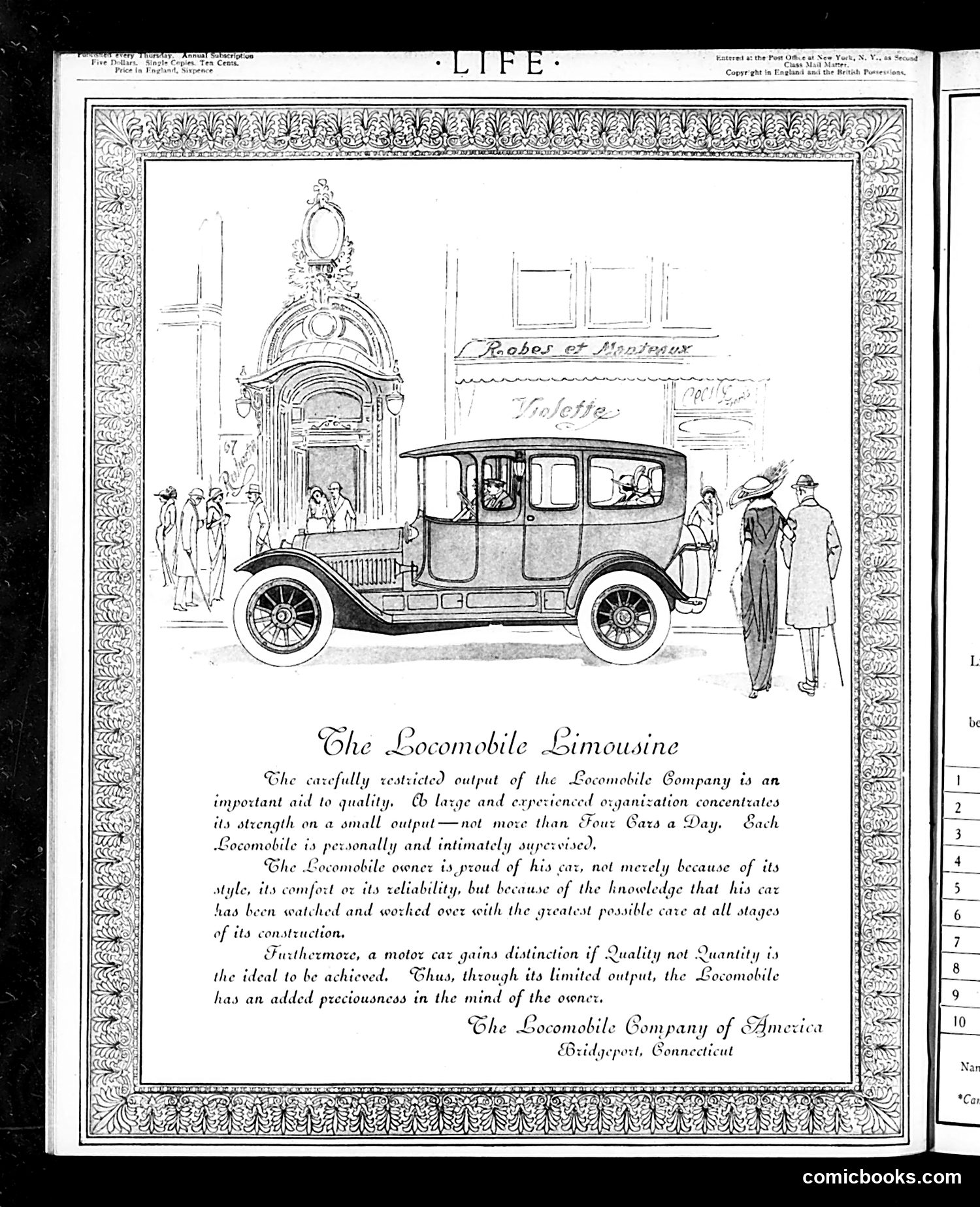
This is **not a cartoon or satire**, but rather a **straightforward advertisement** from Life magazine for the Locomobile Company of America (Bridgeport, Connecticut). The page features an illustration of an early automobile limousine parked in front of what appears to be a Parisian storefront, with well-dressed pedestrians nearby. The advertisement emphasizes the car's quality and craftsmanship rather than quantity of production—"not more than Four Cars a Day." The text appeals to wealthy buyers by stressing exclusivity, personal supervision, careful construction, and reliability. This positioning reflects the early 1900s luxury automobile market when cars were handcrafted, expensive goods for the affluent. The French setting suggests aspirational European sophistication appealing to American consumers.
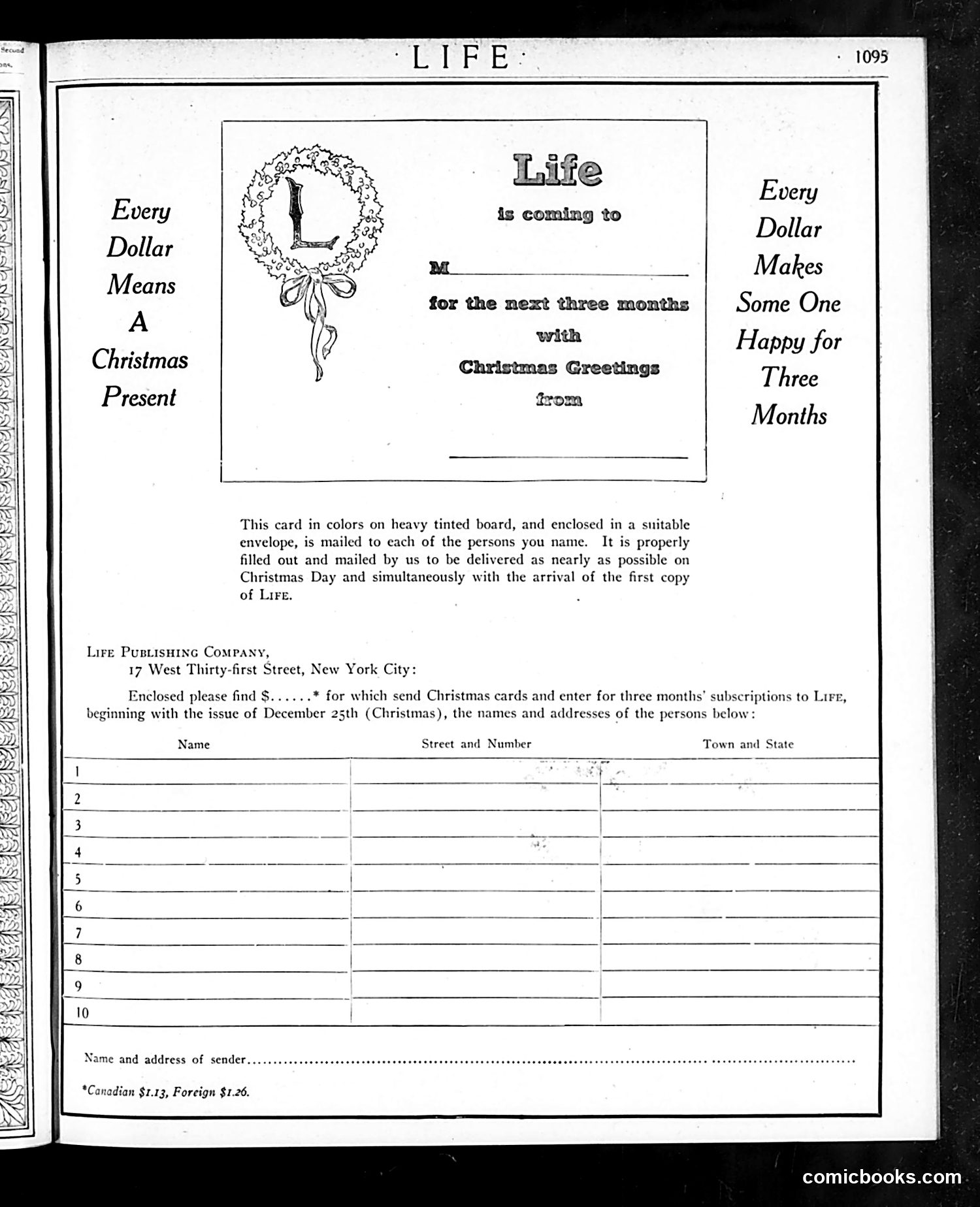
This is a **subscription advertisement** for Life magazine, not a cartoon. The page promotes Life's Christmas gift subscription service. The central design features a wreath with a ribbon bow and the text "Life is coming to M_____ for the next three months with Christmas Greetings from _____." The blank spaces allow personalization. **The pitch**: For each dollar spent, the sender gives someone three months of Life magazine subscriptions—presented as a meaningful holiday gift. The taglines emphasize value: "Every Dollar Means A Christmas Present" and "Every Dollar Makes Some One Happy for Three Months." The form below collects recipient names and addresses for mailing starting December 25th. This represents early 20th-century magazine marketing, leveraging holiday giving to build subscriptions.
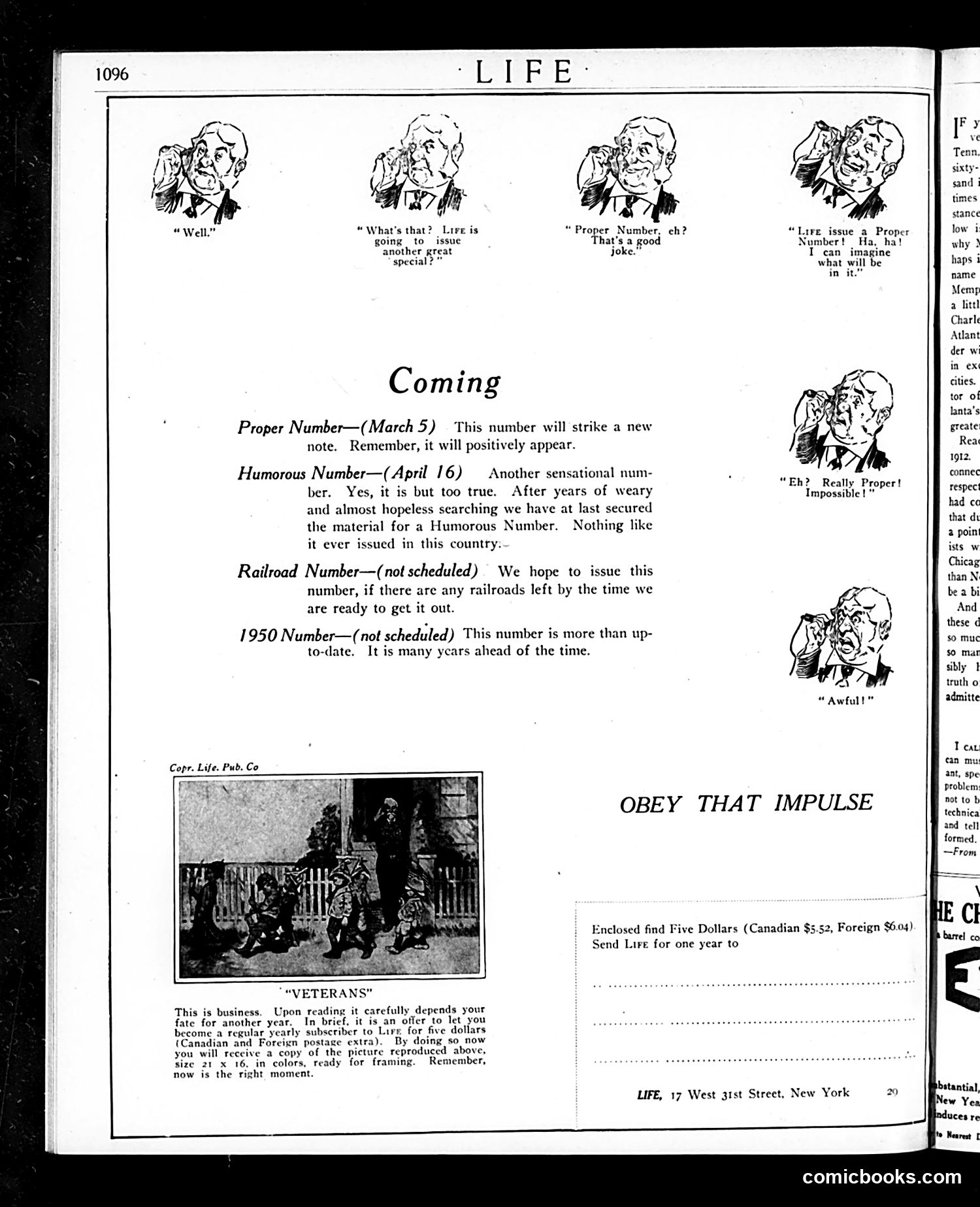
This page features comedic sketches of a man's changing reactions to receiving a "Proper Number" issue of Life magazine. The four cartoon panels show him progressing from skepticism ("Well") to curiosity about what Life plans as their special issue, then to approval of the concept, and finally to enthusiasm ("Eh? Really Proper! Impossible!"). The "Coming" section announces upcoming special issues, including a "Humorous Number" (April 16) described as the first such issue "in this country." It also humorously notes that a "Railroad Number" and "1950 Number" may never materialize due to changing times. The bottom features a subscription advertisement showing a vintage photograph labeled "VETERANS," offering Life subscriptions for five dollars.
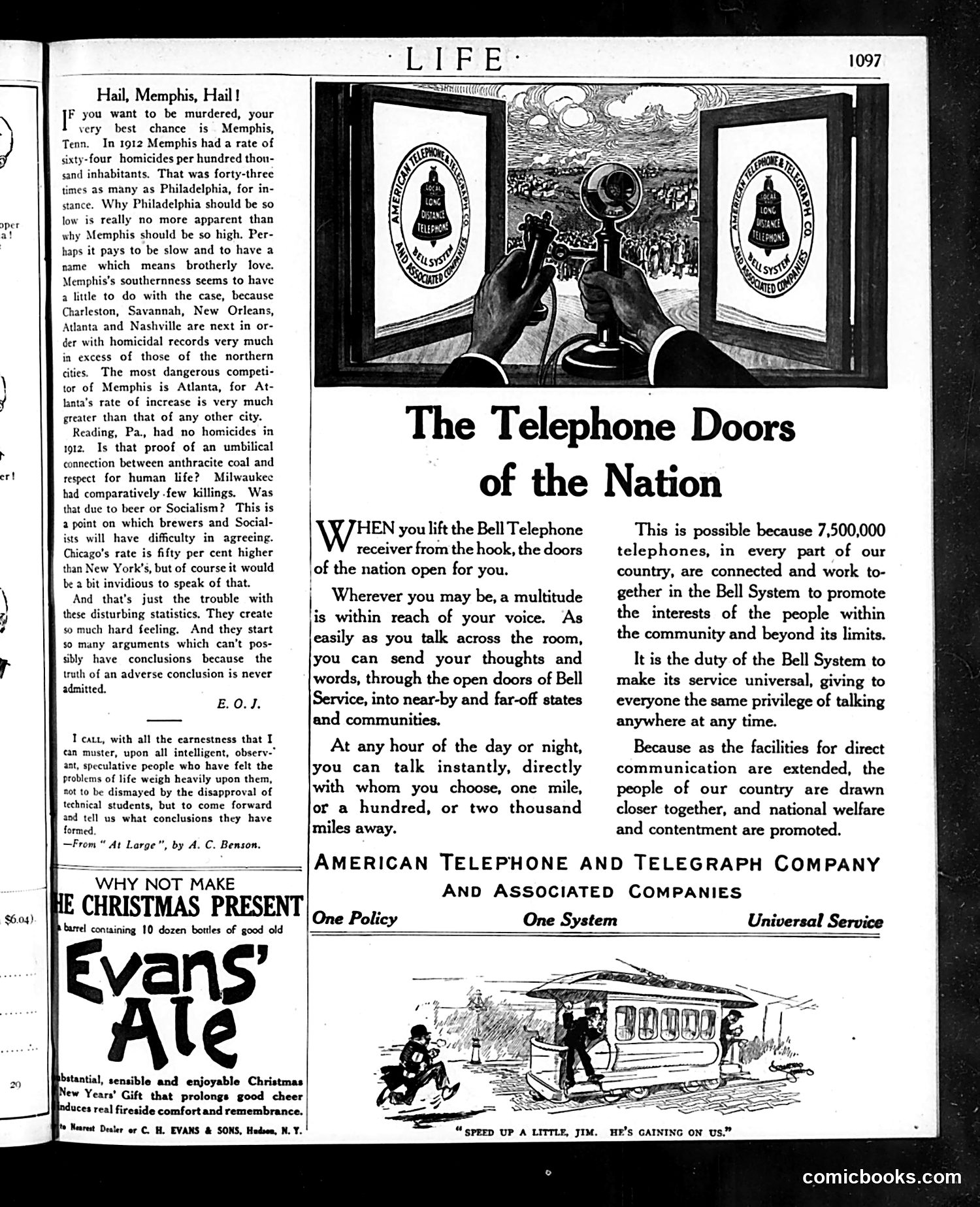
This page contains two distinct elements: **Left side:** An article criticizing Memphis's high homicide rate (60+ per 100,000 inhabitants in 1912), arguing the city's "slowness" and "brotherly love" culture contributed to violence. It compares Memphis unfavorably to Northern industrial cities, suggesting economic factors (beer, Socialism) may explain crime differences elsewhere. The piece appears satirical social commentary on regional violence disparities. **Right side:** A Bell Telephone advertisement featuring illustration of a woman using a telephone, promoting the Bell System's national network of 7,500,000 connected phones. The ad emphasizes universal service accessibility across the country, positioning telephone technology as promoting national welfare and unity. **Bottom:** A small Evans' Ale Christmas advertisement.
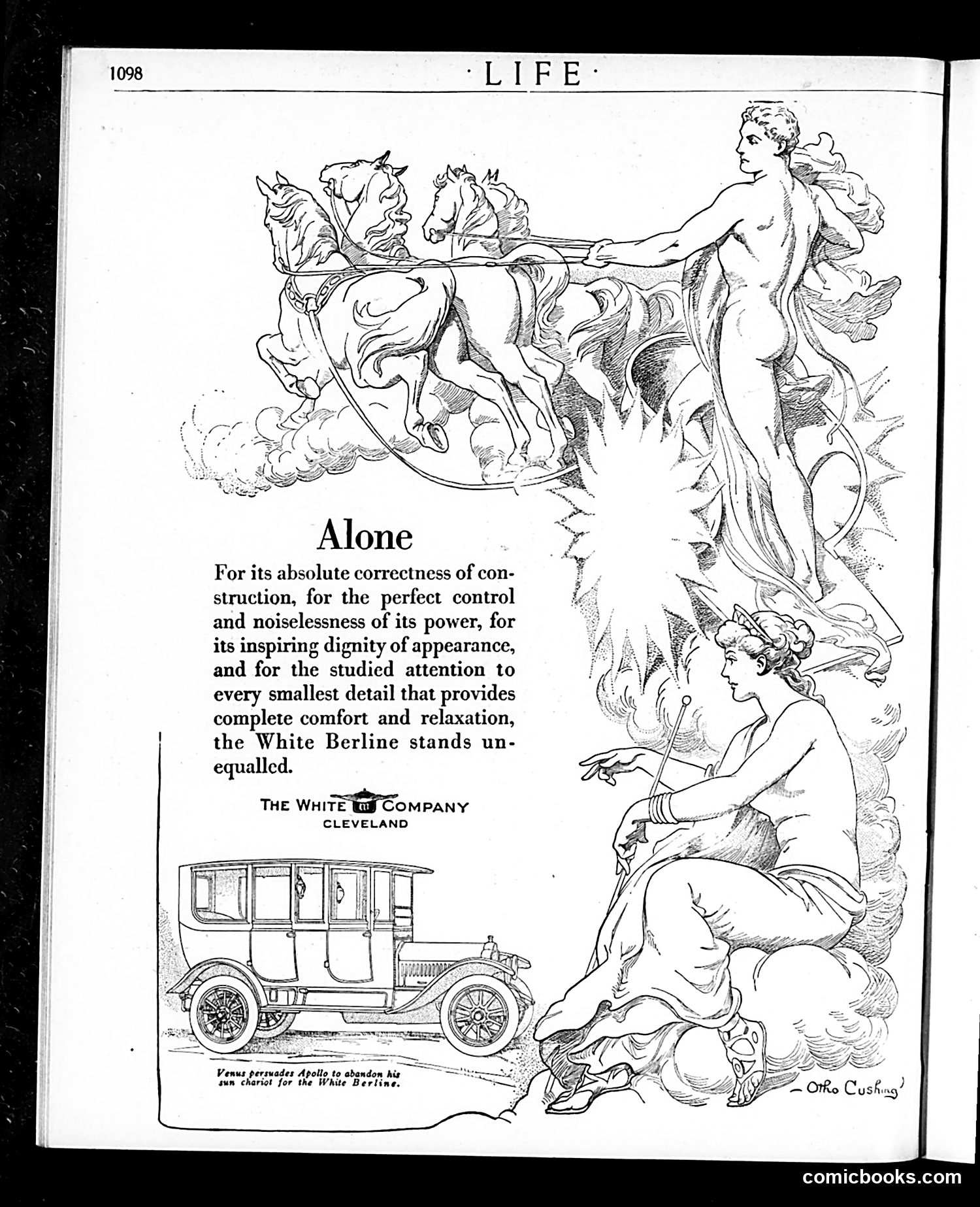
This page is primarily a **car advertisement**, not political satire. It advertises the White Berline automobile made by The White Company of Cleveland. The classical imagery—featuring Venus (goddess of love) abandoning her chariot pulled by doves to ride in the White Berline instead—uses mythological allegory as a sales pitch. The caption states Venus "persuades Apollo to abandon his sun chariot for the White Berline," suggesting the car is superior even to divine transportation. The satire is gentle and commercial rather than political: the joke is that this automobile is so superior that it would tempt even the gods to upgrade. The classical figures represent luxury and prestige, reinforcing the product's appeal to affluent buyers.
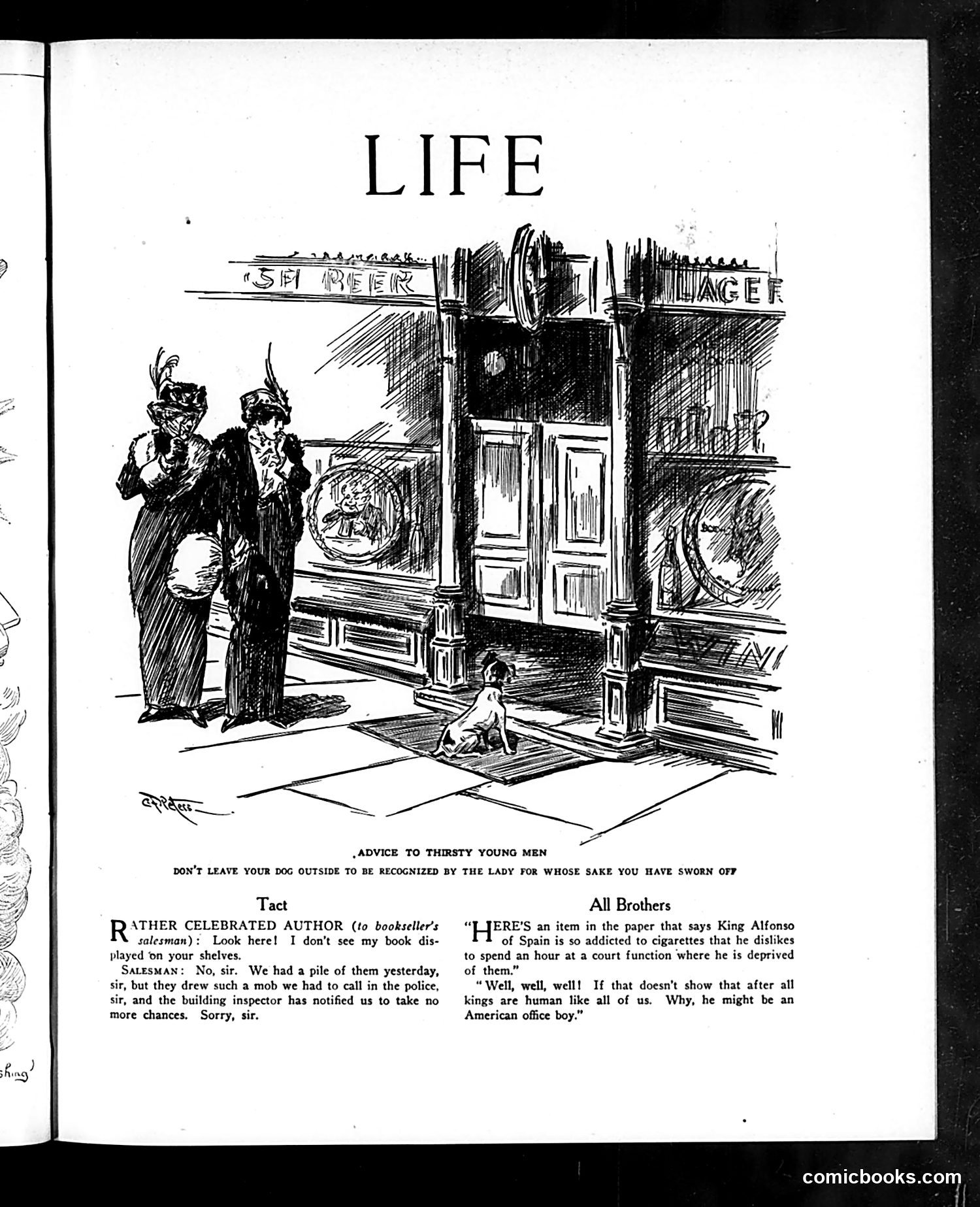
This page from *Life* magazine presents satirical humor about social etiquette and class distinctions. The main illustration shows two well-dressed gentlemen and a dog outside what appears to be an upscale establishment marked "BEER" and "LAGER." The two text pieces below mock social pretension: "Tact" depicts a celebrated author embarrassed when his display books attract an unruly crowd; "All Brothers" presents a witty exchange about King Alfonso of Spain's cigarette addiction, with the punchline suggesting even royalty shares common human weaknesses with ordinary "American office boy[s]." The overall theme ridicules how the wealthy and famous aren't fundamentally different from everyday people—a recurring satirical motif in early 20th-century *Life* magazine.
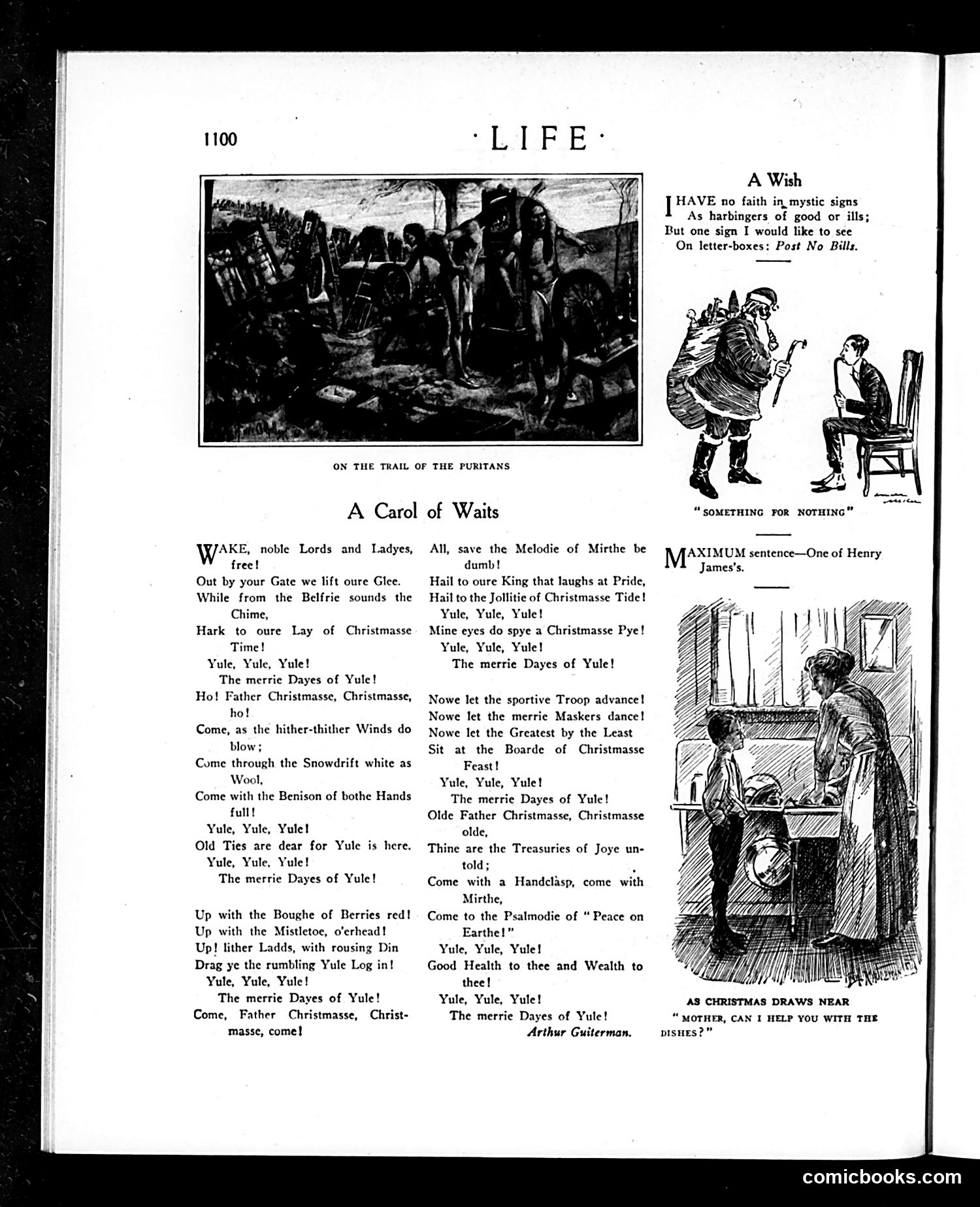
This page contains three distinct pieces: 1. **"A Carol of Waits"** - A Christmas poem celebrating traditional holiday imagery (Yule logs, mistletoe, caroling). It's sentimental Victorian-era festive content. 2. **"A Wish"** - A brief satirical poem mocking superstition, expressing skepticism about mystic signs while humorously wishing for a practical sign on letterboxes reading "Post No Bills"—likely referencing unwanted poster advertisements. 3. **Two illustrations** - The sketches show Santa Claus and a domestic Christmas scene. The caption below reads "AS CHRISTMAS DRAWS NEAR 'MOTHER, CAN I HELP YOU WITH THE DISHES?'"—satirizing children's sudden willingness to help at holiday time, suggesting ulterior motives (likely wanting gifts). The page blends genuine holiday sentiment with gentle social satire about commercialism and family dynamics.
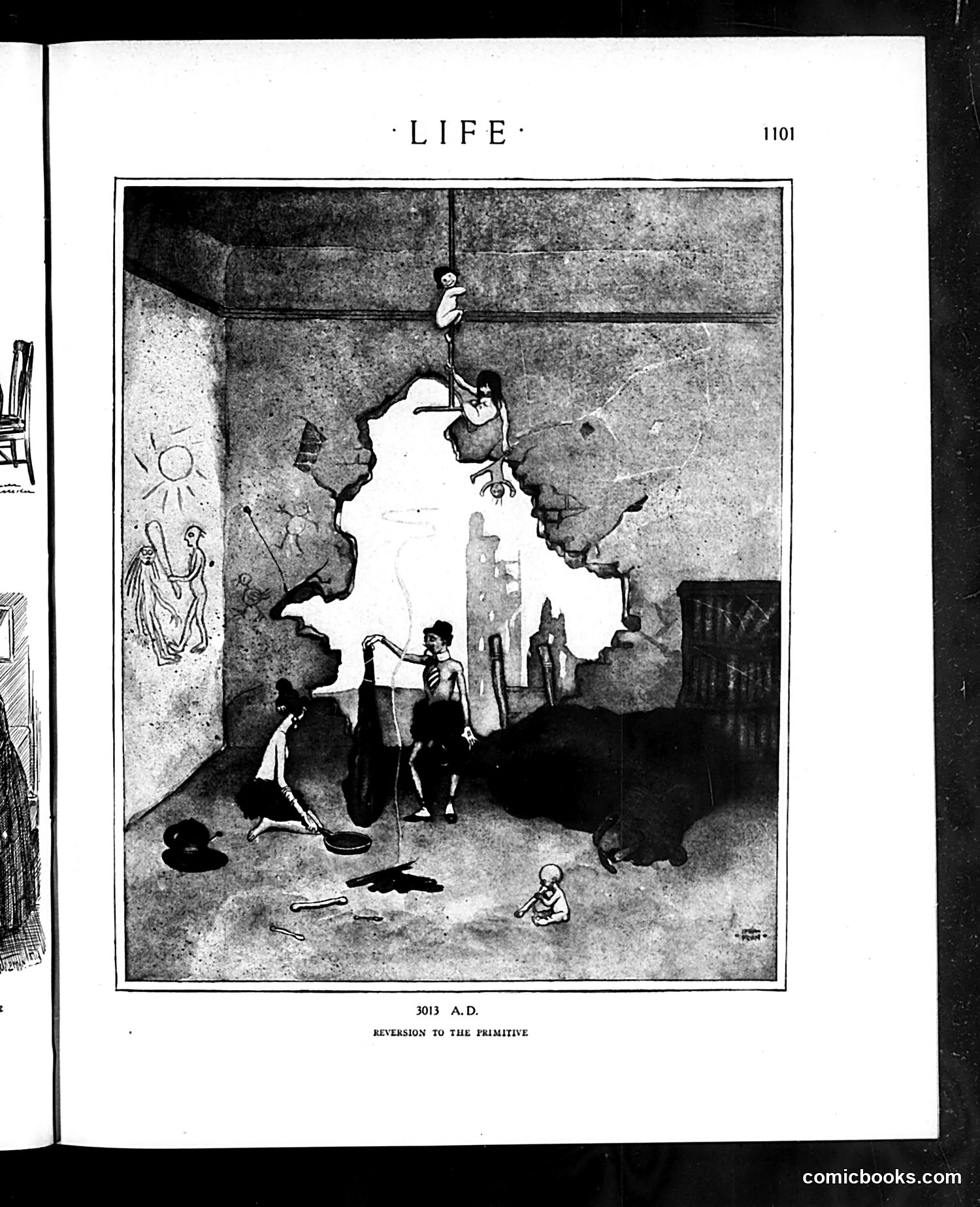
This satirical cartoon depicts a dystopian future where civilization has collapsed and regressed to primitive conditions. The illustration shows figures in what appears to be a cave or ruined structure, with crude drawings on the walls (including a sun and human figures) reminiscent of paleolithic art. The title suggests societal "reversion to the primitive"—a commentary on fears about civilization's fragility. The figures seem to be engaged in basic survival activities, surrounded by decay and ruin. This likely reflects early 20th-century anxieties about technological progress, warfare, or social disorder potentially undoing human advancement. The satirical point appears to be warning readers about the consequences of ignoring present dangers—that modern society could collapse into barbarism if not properly maintained.
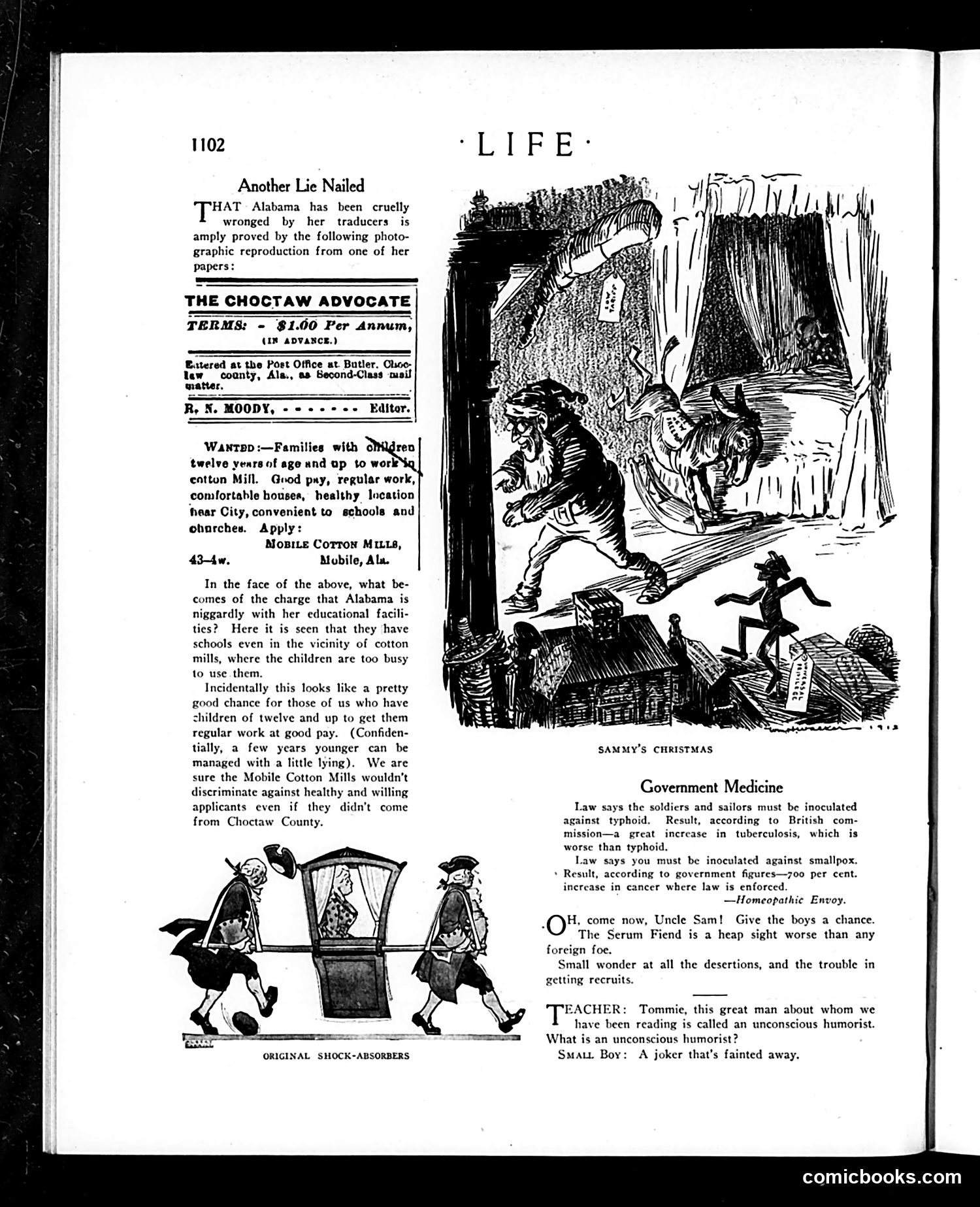
This page contains satirical commentary on Alabama's educational and labor conditions, plus unrelated jokes. **"Another Lie Nailed"** criticizes Alabama's "traductors" (detractors) by reproducing a newspaper notice from the *Choctaw Advocate* advertising for families with children to work in cotton mills near Mobile. The article argues this contradicts claims Alabama lacks educational facilities—the mills are near schools and churches, offering good wages. The satire suggests critics exaggerate Alabama's deficiencies. **"Sammy's Christmas"** and **"Original Shock-Absorbers"** are unrelated cartoons: the first appears to satirize compulsory military vaccination policies (comparing typhoid inoculation to smallpox vaccination), while the second shows people carrying a sedan chair—likely mocking an invention or social practice. The page is primarily argumentative rather than purely satirical, defending Alabama's conditions against contemporary criticism.
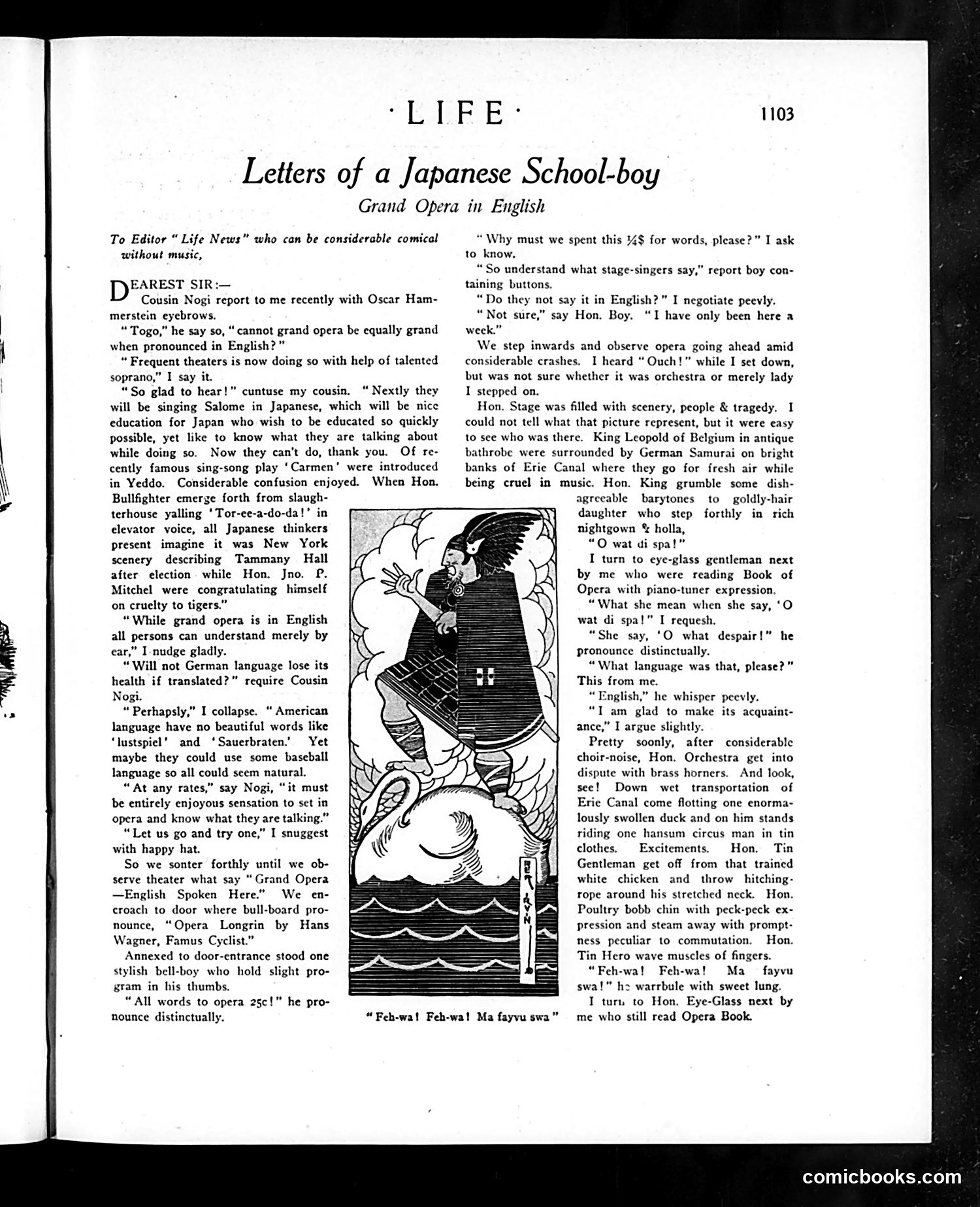
This satirical piece mocks the experience of a Japanese visitor attending an English-language opera performance. The humor centers on the absurdity and pretension of opera sung in English, with the school-boy narrator observing comedic mishaps: stage mishaps, confused translations, and overly dramatic performances (including a man with "hitching-rope around his stretched neck"). The central illustration depicts a caricatured figure in traditional Japanese dress observing the chaos below—likely representing the bemused foreign perspective. The satire targets early 20th-century American cultural pretensions and the incongruity of grand opera performed in English rather than Italian, suggesting English lacks operatic elegance. It's gentle mockery of both opera culture and cross-cultural misunderstanding.
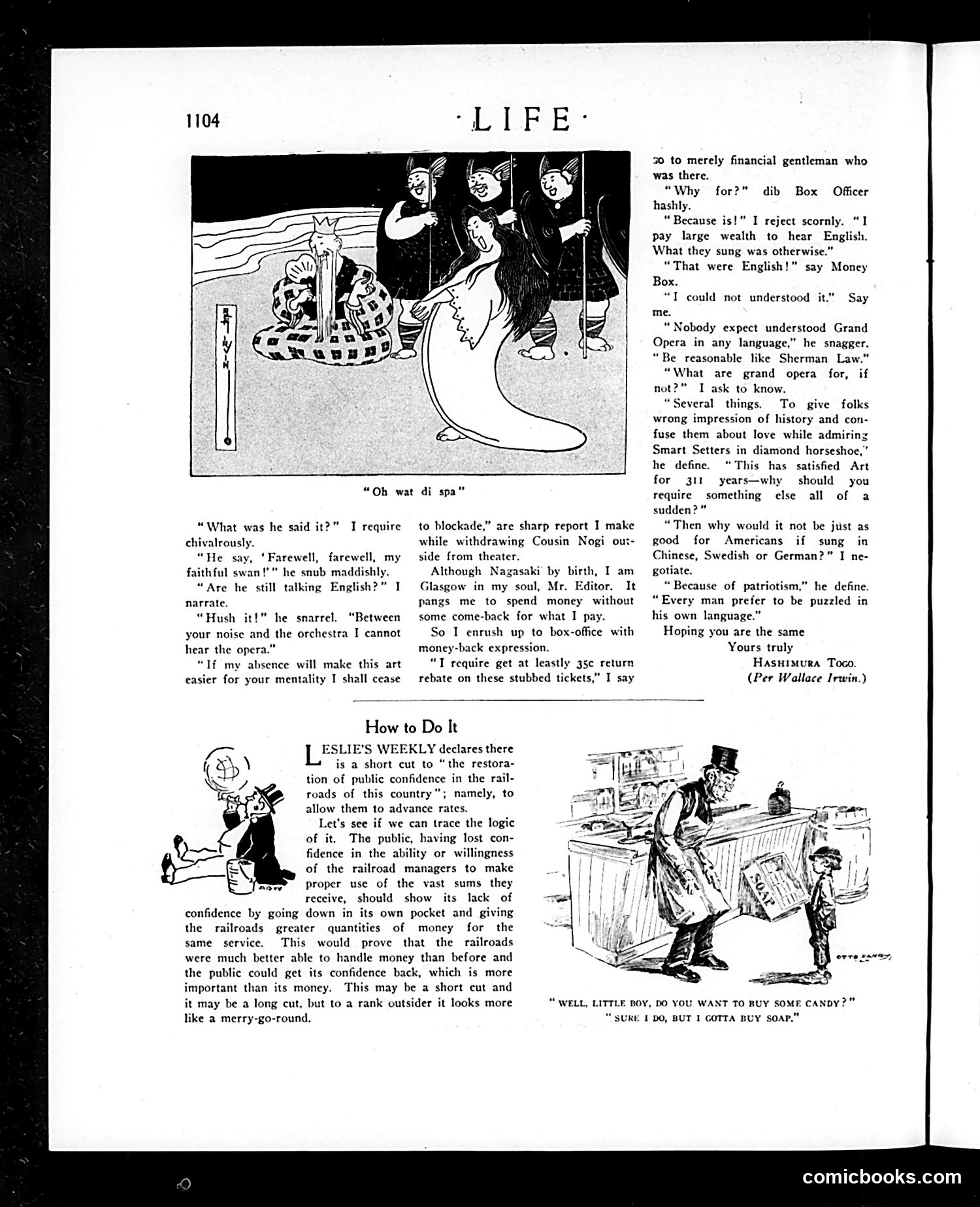
**Top Cartoon ("Oh wai di spa"):** This satirizes an opera patron's complaint. A dib Box Officer dismisses criticism of English-language opera by noting that Grand Opera is incomprehensible in *any* language anyway—a 311-year tradition. The cartoon mocks both operatic pretension and American attempts at cultural refinement through foreign art forms. **"How to Do It" Article:** This piece proposes restoring public confidence in railroads through financial transparency. The argument: if railroads prove competent handling money through public accountability, citizens will trust them more—a "merry-go-round" logic suggesting circularity in solving the trust crisis. **Bottom Cartoon:** A street vendor comic showing a child's priorities: asked about candy, the child insists on buying soap instead—likely commentary on Depression-era poverty or moral necessity over indulgence.
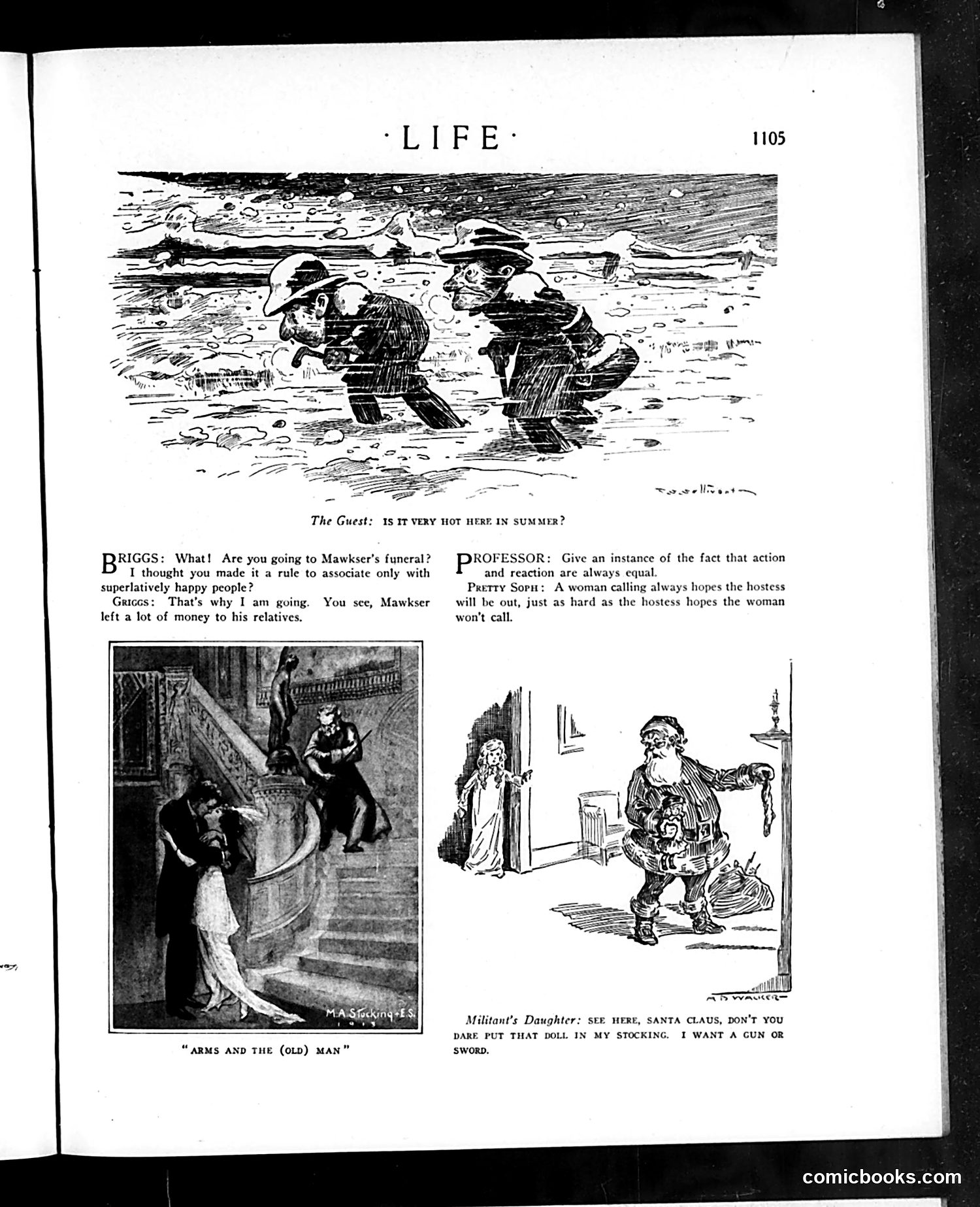
This page contains three separate satirical pieces: 1. **Top cartoon**: Beach scene depicting wealthy people in summer attire, with the caption "Is it very hot here in summer?" - appears to mock superficial small talk among the affluent. 2. **Middle dialogue**: Briggs and Griggs discuss attending a wealthy man's (Mawkser's) funeral. The joke: Briggs attends only for the inheritance money, while Griggs notes the superstitious practice of befriending the rich for financial gain. 3. **Bottom cartoons**: - "Arms and the (Old) Man" shows a romantic couple with an older man watching—likely satirizing age differences in relationships. - The Santa Claus panel jokes about a militant's daughter demanding weapons instead of dolls as Christmas gifts, satirizing either militarism or changing gender expectations in toys. All pieces target wealth, social pretense, and shifting cultural attitudes.
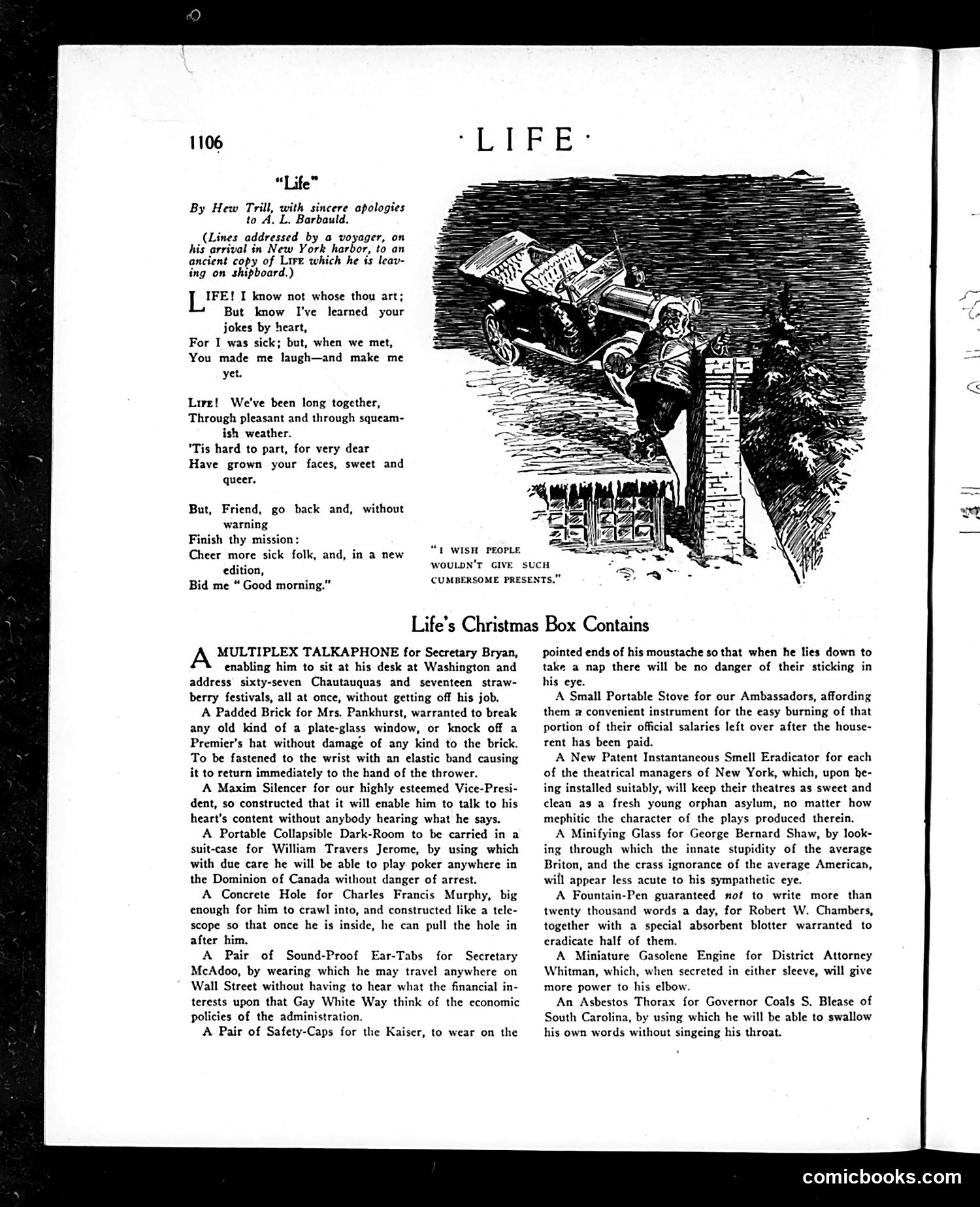
This page from *Life* magazine presents satirical "Christmas gift" suggestions for various political and public figures of the era. The gifts are intentionally absurd and mocking, designed to highlight each recipient's perceived flaws or failings. The poem "Life" at top, by Hew Trill, addresses a voyager carrying an old book, establishing a reflective tone. The main content lists ridiculous presents for named officials—Secretary Bryan, Vice-President (appears to be Sherman), William Travers Jerome, Charles Francis Murphy, Secretary McAdoo, and the Kaiser—each gift sarcastically "solving" a problem associated with that person through impossible or insulting means. The humor relies on readers recognizing these contemporary figures and their well-known controversies or personality traits.
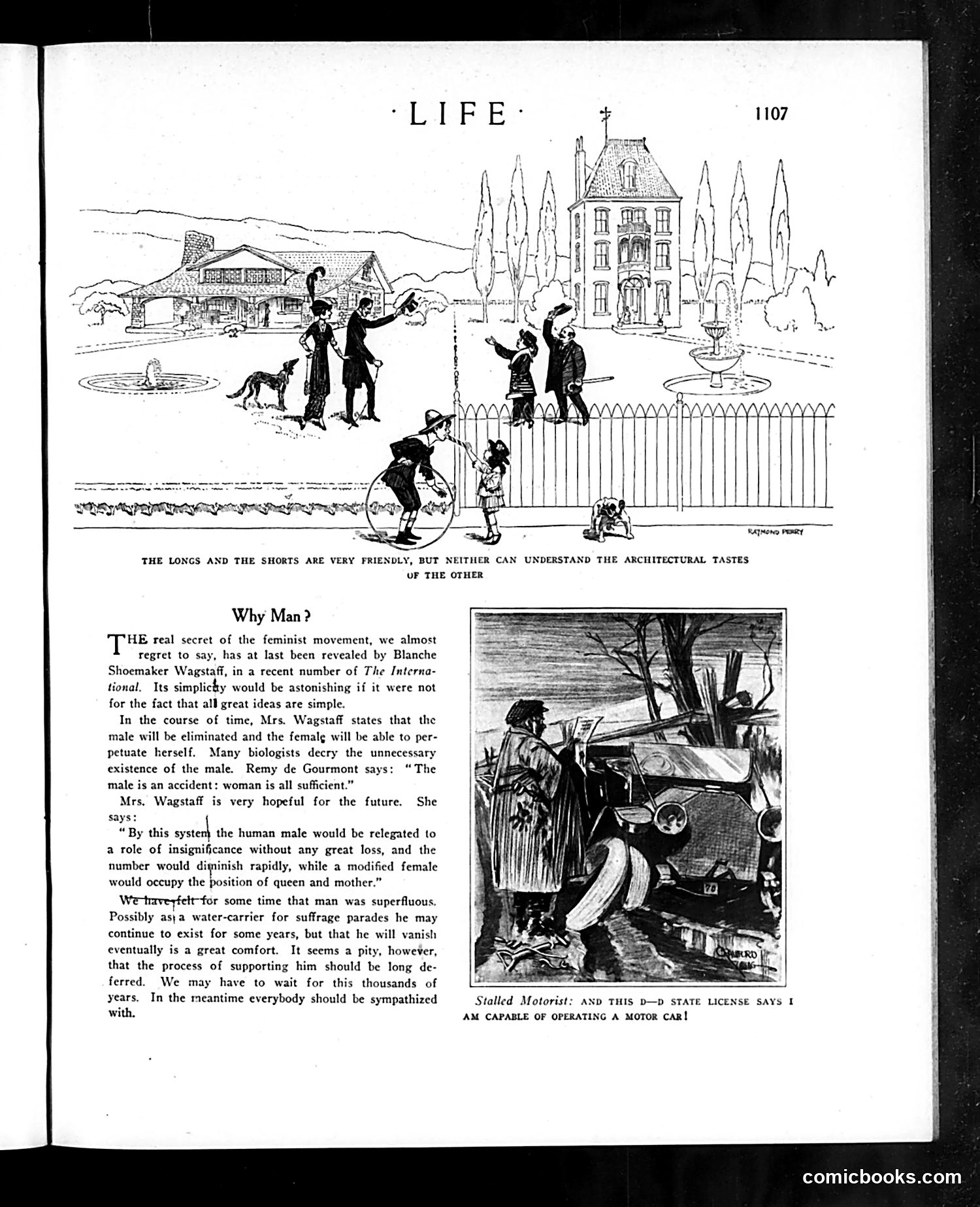
This *Life* magazine page satirizes early 20th-century feminist arguments through two separate pieces: **Top cartoon:** "The Longs and the Shorts" depicts tall and short people with incompatible architectural preferences—a visual metaphor for how different groups simply cannot understand each other's values. **Main article:** The piece mocks radical feminist theorist Blanche Shoemaker Wagstaff's argument (published in *The International*) that males are biologically unnecessary and should eventually be eliminated from society. *Life* treats this seriously while subtly ridiculing it—praising the "simplicity" of the idea while sarcastically suggesting men should be eliminated immediately rather than waiting "thousands of years," and sarcastically pitying that supporting men must be "long deferred." **Bottom cartoon:** A stalled motorist complains that his state license claims he's capable of operating a motor car—likely a dig at women obtaining driver's licenses, implying that licensing standards are absurdly low if even women (or incompetent drivers) can pass. The page reflects anti-feminist sentiment common in this era, mocking both extreme feminist theory and women's increasing independence.
This page argues that Britain should reform its discriminatory laws regarding women to defuse militant suffragist activism—just as Ireland's land reforms quieted Irish discontent. The author cites specific legal inequalities: divorce law permits husbands to divorce unfaithful wives, but wives cannot divorce unfaithful husbands unless cruelty accompanies infidelity. The piece references the "Pankhurstites" (Emmeline Pankhurst's suffragist movement) and suggests that modernizing women's legal status—as some American states had done—would eliminate "reasonable grievances" fueling militant action. The accompanying dark photograph captioned "At the Club" appears to depict a social scene, though its specific relevance is unclear from the image quality. The "Headlines Seldom Used" section uses irony to mock unlikely newspaper scenarios, contrasting with the page's serious advocacy for legal equality.
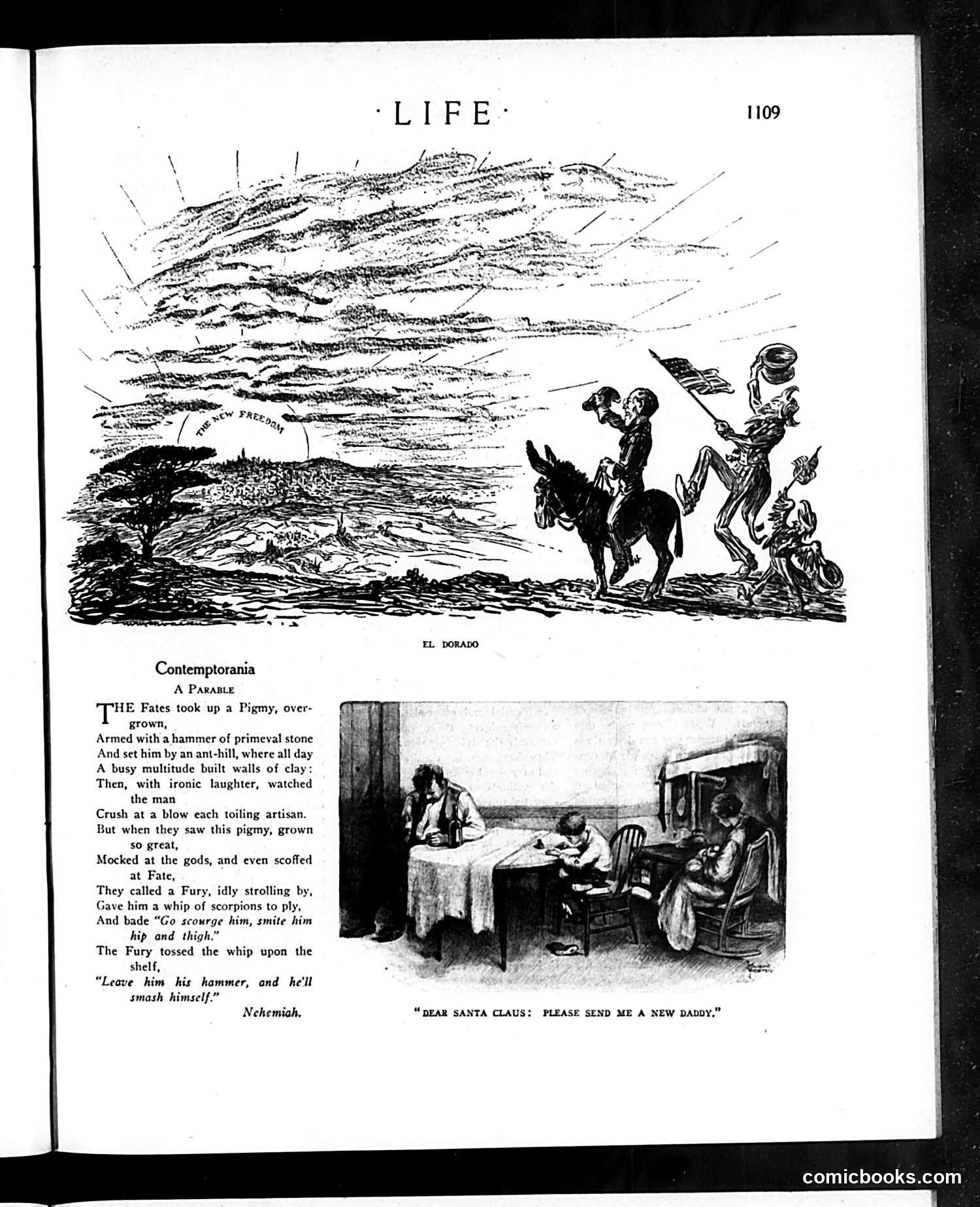
This page contains two distinct works: **"El Dorado" (top illustration)**: A Goya-style engraving depicting Don Quixote-like figures—a man on a donkey and fantastical characters—pursuing an illusory golden city on the horizon. It references the legendary "El Dorado," symbolizing futile pursuit of impossible wealth or dreams. **"Contemporania: A Parable" (text and lower cartoon)**: The poem warns against unchecked power. The narrative describes a "Pigmy" given destructive force (a hammer) who grows arrogant, mocking gods and fate. When summoned, a Fury chooses not to punish him directly but leaves the hammer—implying the powerful will self-destruct through their own ambition and hubris. **The lower cartoon** shows a child writing to Santa Claus requesting "a new daddy," likely commentary on social problems—absent fathers, poverty, or family dissolution—presented as what children actually need versus material gifts. Together, the page satirizes human folly: the pursuit of impossible dreams, the corruption of power, and unmet basic social needs.
This Life magazine editorial discusses President Wilson's recommendation for direct primaries in presidential nominations. The top cartoon depicts a dog with fleas, illustrating the article's metaphor about removing problematic systems. The piece critiques objections to federal involvement in primary elections, noting that while concerns about constitutional authority have merit, the issue deserves serious consideration. The editorial acknowledges that direct primaries are trendy in politics but remain untested. It references **Governor Hughes and Charles F. Murphy** (New York political figures), **Governor Sulzer** (recently removed), and **Governor Glynn** (current), noting New York's primary system is inferior to Wilson's New Jersey model. The article sardonically suggests stock brokers with chalkboards might educate the public on different primary methods—implying most people don't understand the mechanics of these nomination processes. The satire targets both political elites who resist reform and ordinary citizens' ignorance of electoral mechanics.
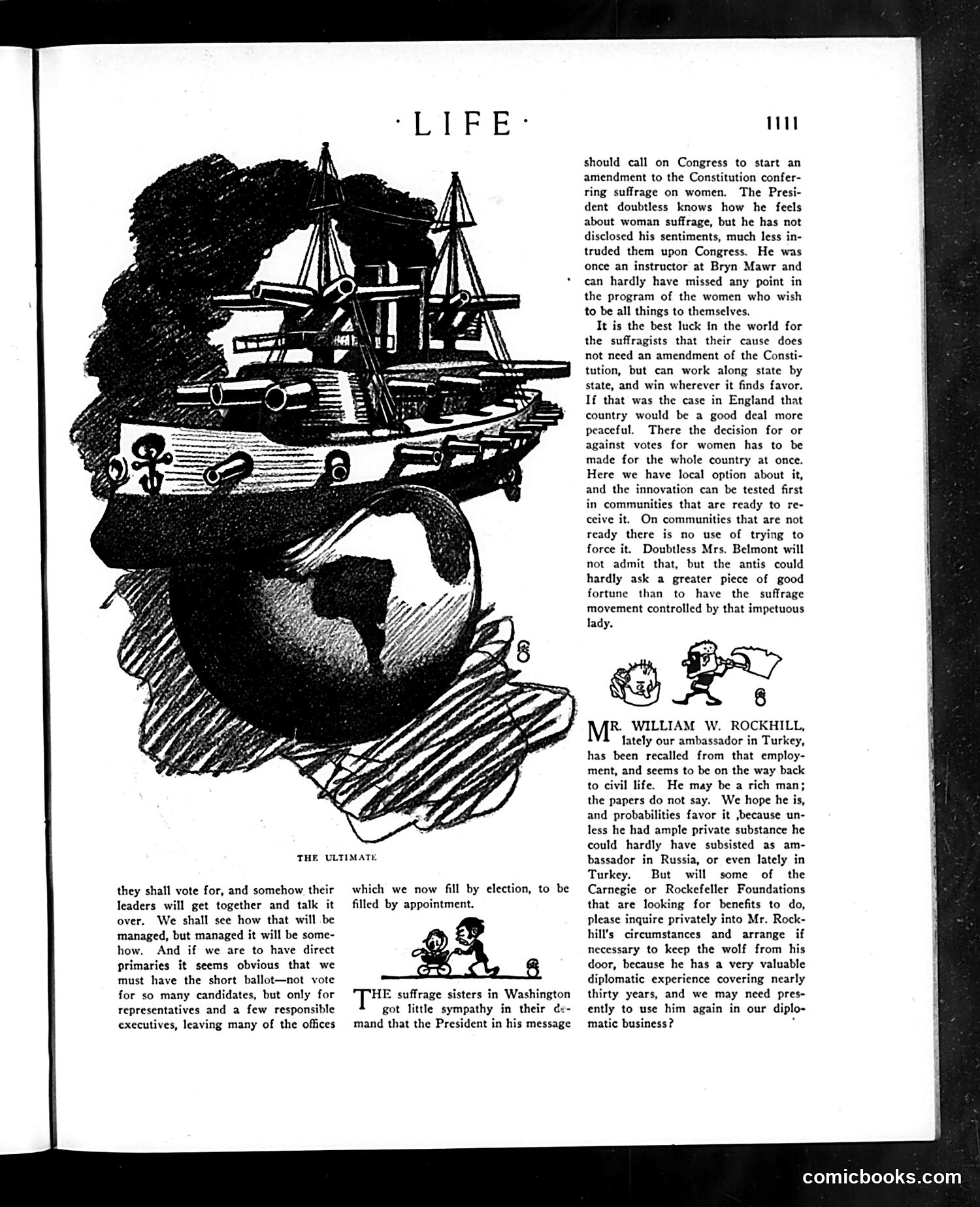
The page contains two satirical pieces about early 20th-century American politics. **"The Ultimate" cartoon** depicts a ship balanced precariously on a woman's head, satirizing the women's suffrage movement. The text criticizes "suffrage sisters in Washington" for demanding the President endorse a constitutional amendment for voting rights. The author argues suffragists are fortunate that suffrage can be won state-by-state rather than requiring national consensus, and mocks Mrs. Belmont (a prominent suffragist) as "impetuous," suggesting her activism is counterproductive. **The second item** concerns William W. Rockhill, recently recalled as U.S. ambassador to Turkey. The text humorously suggests wealthy foundations (Carnegie, Rockefeller) should investigate whether Rockhill needs financial assistance, implying diplomatic posts paid poorly and that his "valuable experience" might be needed again—a backhanded compliment suggesting he's useful but possibly destitute. Both pieces use satire to critique political figures and movements, characteristic of *Life*'s editorial approach.
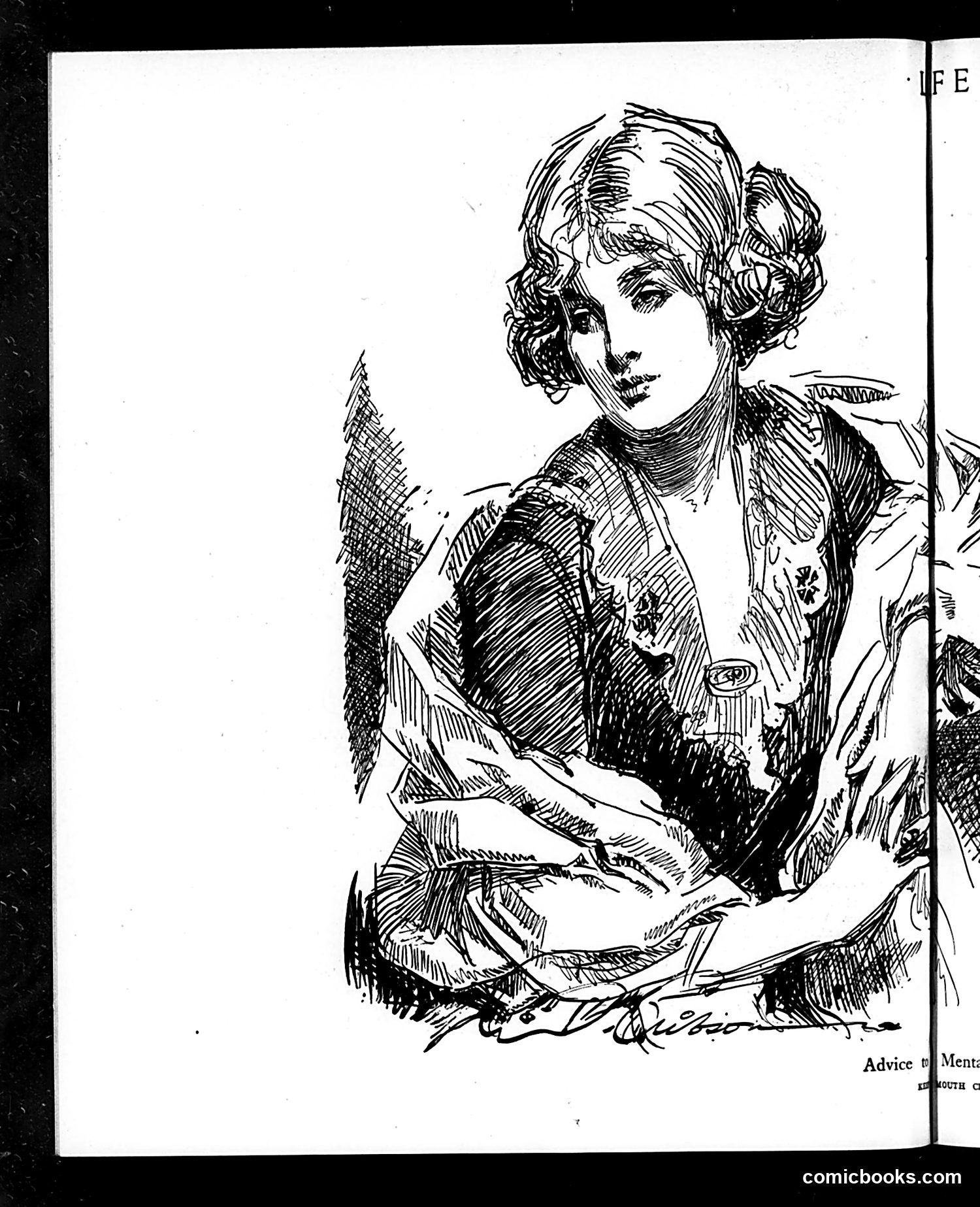
This appears to be a portrait illustration from *Life* magazine showing a fashionably dressed woman in early 20th-century attire, rendered in ink-line style typical of the era's editorial illustrations. The figure wears an ornate jacket with decorative details and has styled hair characteristic of the period. The partial text visible at bottom reads "Advice" and "Ment[al]," suggesting this illustration accompanied an advice column or article about mental/social matters. Without the complete text or headline, the specific satirical intent isn't entirely clear, but the careful rendering of fashionable dress and grooming suggests commentary on women's social roles, appearance standards, or perhaps marital/romantic advice—common *Life* magazine topics from this period. The signature appears visible but is not clearly legible.
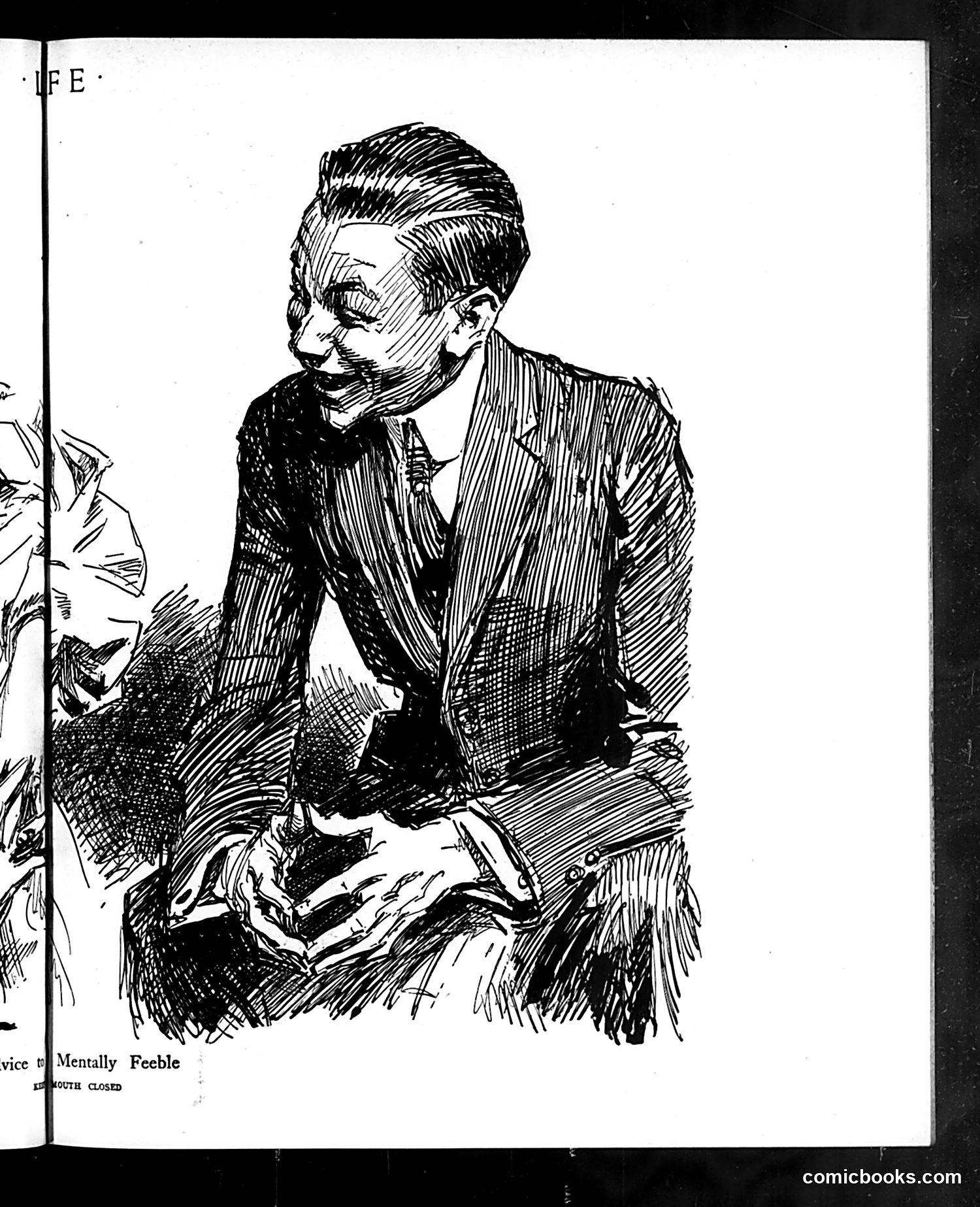
This appears to be a satirical illustration from *Life* magazine depicting a man in formal business attire (suit and tie) seated and looking downward with a somewhat vacant expression. The caption reads "Vice of Mentally Feeble" with partial text suggesting "MOUTH CLOSED." The satire likely critiques someone—possibly a public figure or businessman of the era—by suggesting intellectual deficiency or foolishness despite their respectable appearance. The "mouth closed" reference may imply ironic commentary about someone who remains silent, refuses to speak truthfully, or lacks the capacity for intelligent discourse. Without additional context about the specific date and political moment, the precise target remains unclear, though the caricatured style suggests mockery of a contemporary public personality.
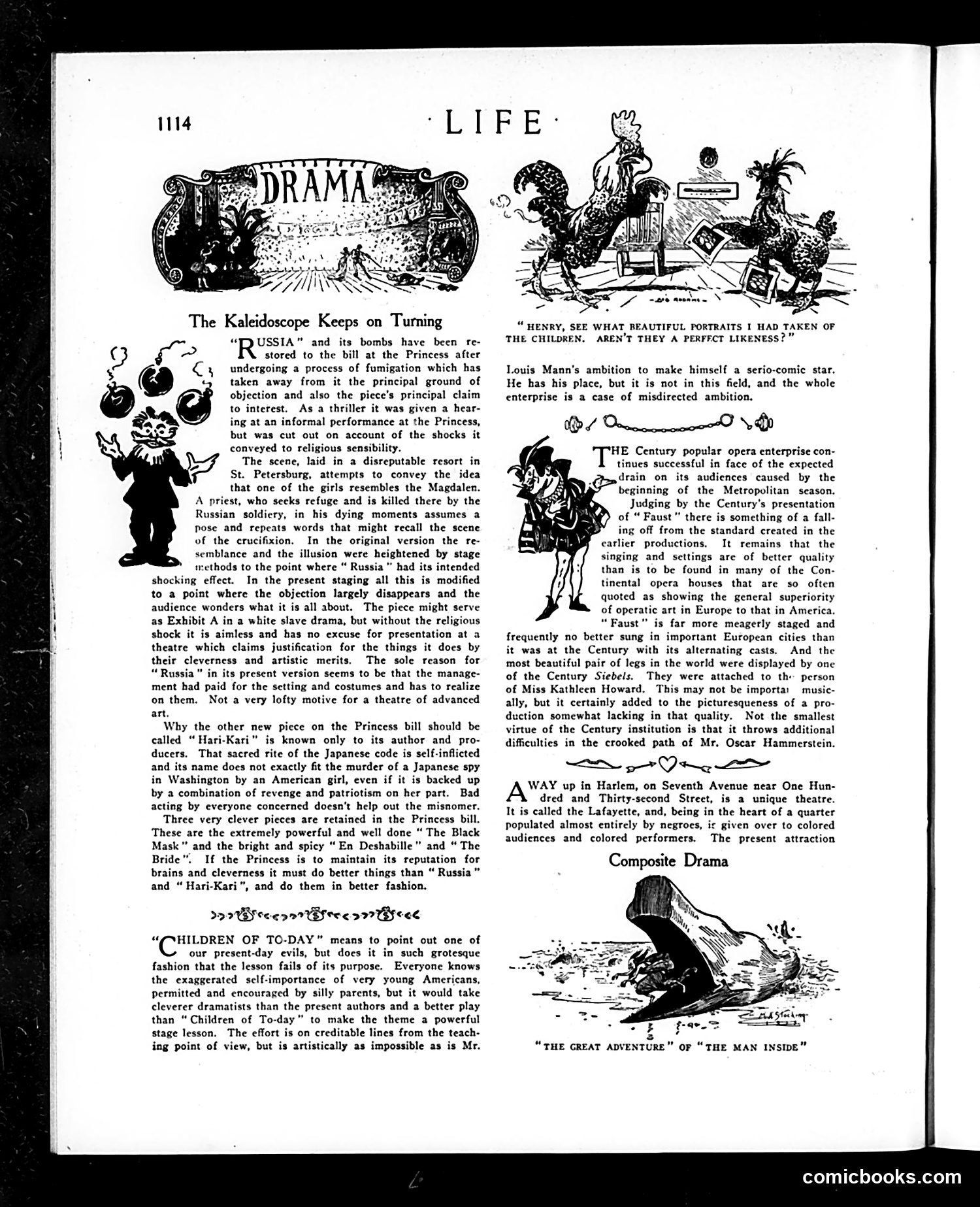
This page contains theater reviews typical of Life's satirical arts criticism. The main critique concerns plays at the Princess Theatre, particularly "Russia"—a drama set in a disreputable St. Petersburg establishment featuring a priest who dies in a crucifixion-like pose. The reviewer notes the play was originally shocking for its religious imagery but was censored due to "religious sensibility." Now sanitized, it's artistically pointless—merely performed because management needed to recoup costume and set investments. The piece mocks another play, "Hari-Kari," for absurdly naming itself after a Japanese ritual while depicting an American girl murdering a spy. The cartoon above shows a figure (possibly representing theatrical ambition or pretension) displaying portraits while asking about their "likeness"—likely satirizing actors' self-importance or poor artistic judgment. Other reviews dismiss "Children of To-Day" as heavy-handed moralizing about spoiled American youth, and praise the Century Opera's continued success despite the Metropolitan season's competition.
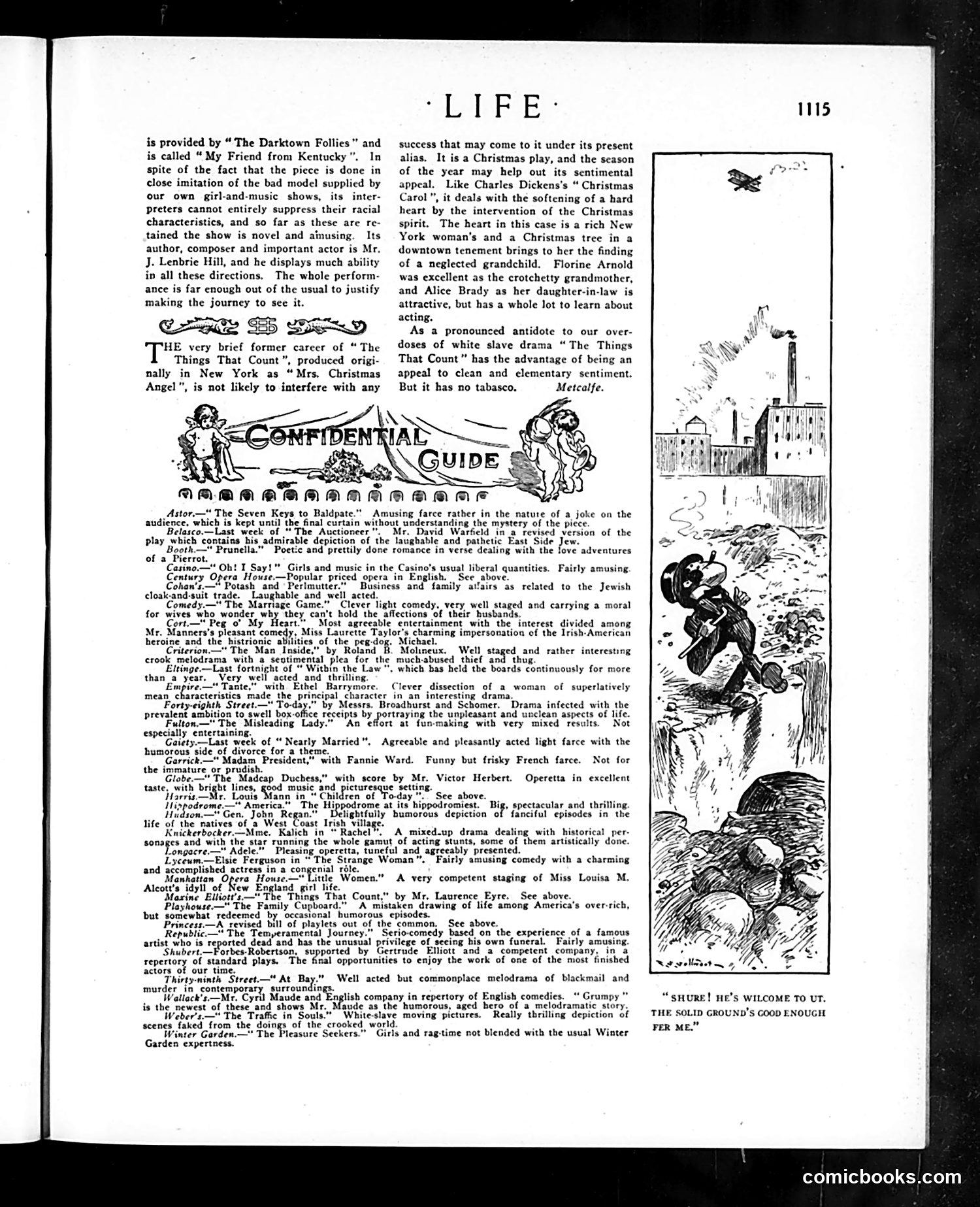
This page is primarily **theater reviews**, not political cartoons. The main content consists of brief critical synopses of Broadway productions, written in the caustic style typical of Life magazine's drama critic (likely identified as "Metcalfe"). The reviews reference several shows with racial or ethnic themes popular in that era: - **"The Darktown Follies"** and **"My Friend from Kentucky"** — minstrel-style productions featuring Black performers. The critic notes these shows, despite imitating "bad model[s]" from mainstream theater, retain authentic "racial characteristics" that make them novel. - **"Potash and Perlmutter"** and **"The Auctioneer"** — plays depicting Jewish immigrant characters (garment trade workers, East Side stereotypes). The reviews are patronizing by modern standards, evaluating these shows primarily by how well they conform to or diverge from white theatrical conventions. The illustration on the right appears unrelated to the text—a sketch of urban tenement housing.
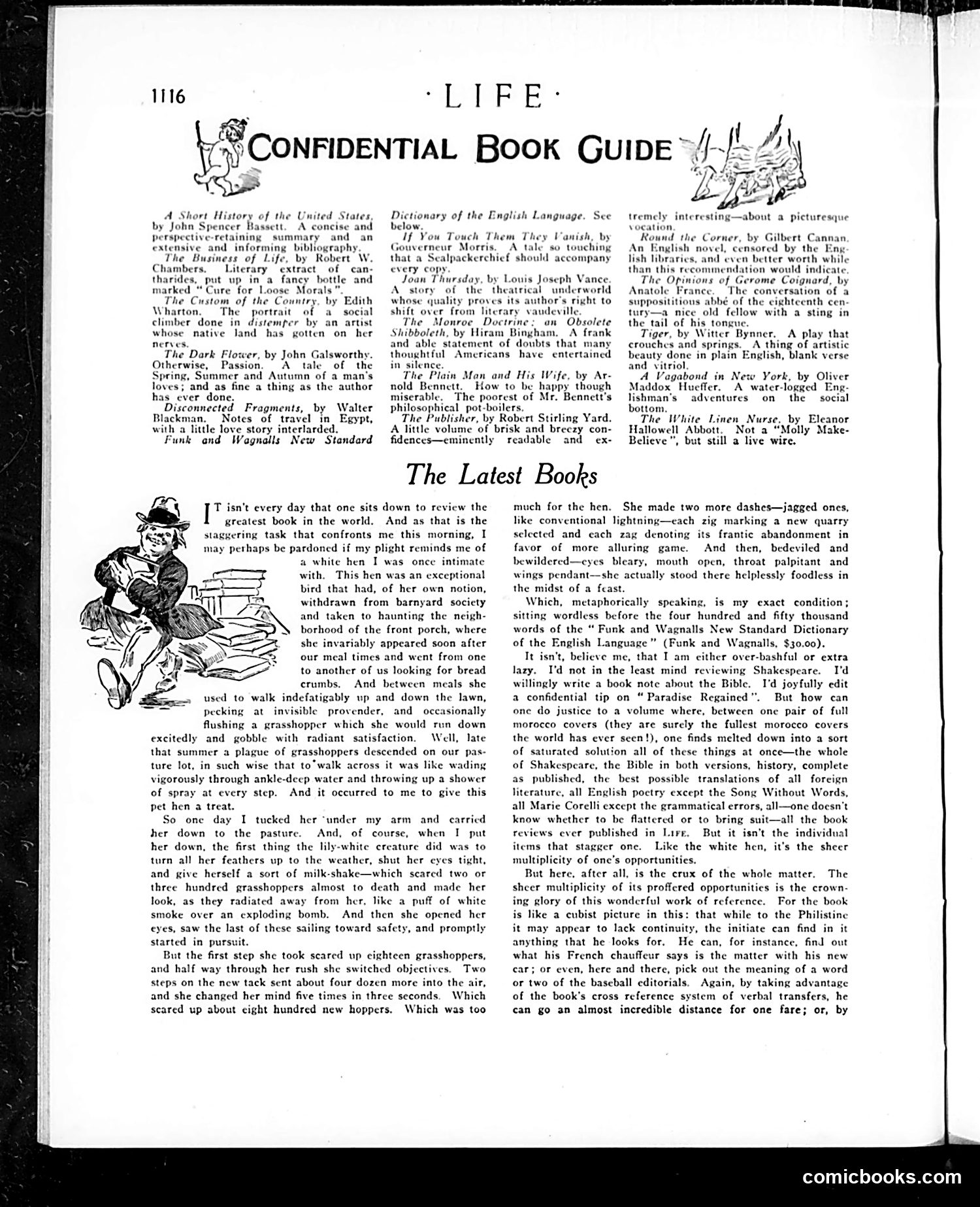
This page presents a satirical book review column titled "The Latest Books." The main cartoon shows a man reviewing books while reflecting on a hen he once owned—an elaborate, humorous metaphor for the reviewer's own predicament. The "Confidential Book Guide" section above lists recent publications with tongue-in-cheek descriptions. Titles like *The Business of Life* (marked as a "Cure for Loose Morals") and *The Custom of the Country* are presented with witty, mocking summaries that critique both the books and broader social trends. The extended hen anecdote that follows uses absurdist humor to illustrate the reviewer's dilemma when confronted with overwhelming choice and abundance—when the hen is placed in a field of grasshoppers, she's so overwhelmed by plenty that she does nothing. This appears to satirize intellectual paralysis when faced with too many books to review, reflecting early 20th-century anxieties about information overload and literary excess.
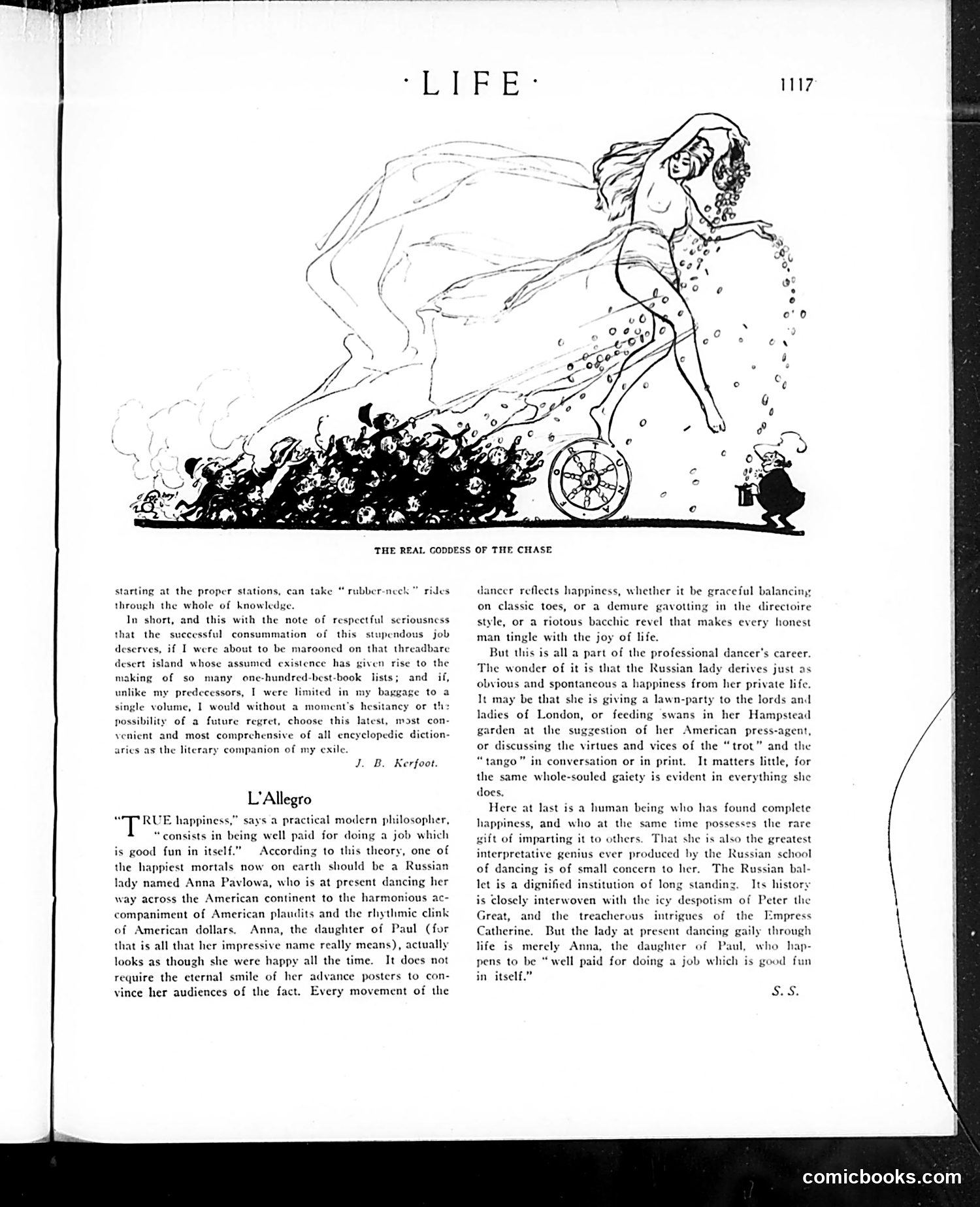
This page features an illustration and article celebrating Anna Pavlova, a celebrated Russian prima ballerina performing across America. The cartoon depicts her as a classical nude figure driving a chariot pulled by a mass of skulls and bones—a visual pun on "the chase" (both hunting and pursuit of happiness). The accompanying article praises Pavlova as an embodiment of the modern philosophical ideal: happiness derived from being "well paid for doing a job which is good fun in itself." The text notes she radiates genuine joy both professionally (through her acclaimed dancing) and privately (at social gatherings and leisure activities). The satire gently mocks American materialism and the era's fascination with celebrity performers, while genuinely admiring Pavlova's apparent authenticity. The grotesque chariot imagery—converting the pursuit of happiness into a macabre procession—subtly undercuts the article's earnest celebration, suggesting that even ideal happiness rests on darker foundations.
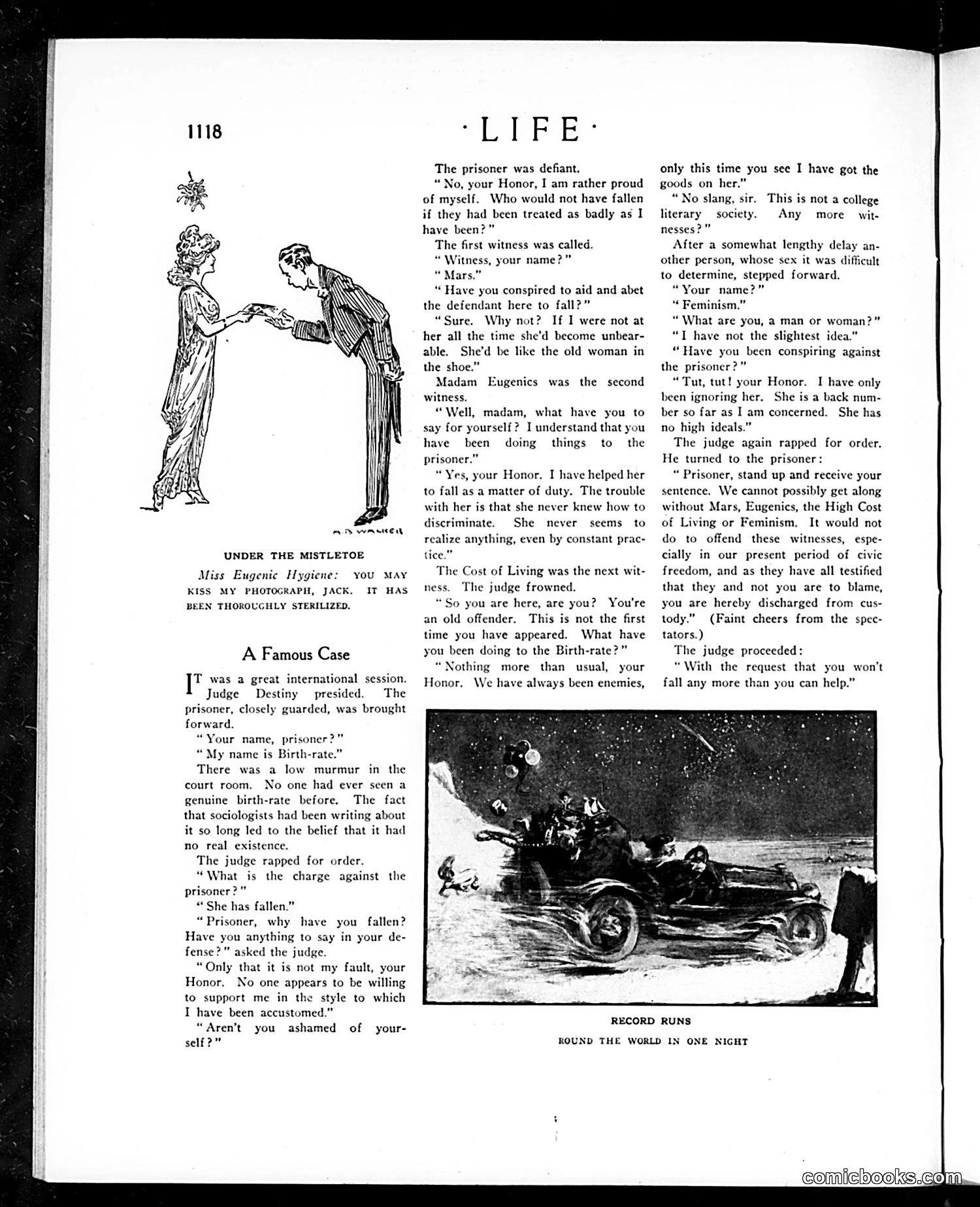
This page satirizes early 20th-century concerns about declining birth rates through an allegorical courtroom drama. "Birth-rate" is prosecuted as a criminal defendant who has "fallen"—a metaphor for the declining number of births, particularly among educated middle and upper-class women. The witnesses personify social forces blamed for this decline: **Mars** (war, which removes men), **Madam Eugenics** (the eugenics movement, which discouraged "unfit" reproduction), **the Cost of Living** (economic hardship), and **Feminism** (women's liberation and rejection of traditional roles). The satire's point: society blames these external forces rather than acknowledging birth-rate decline as inevitable consequence of modernization. The judge's lenient sentence—asking birth-rate merely to "fall any more than you can help"—underscores the futility of resistance. The top cartoon about "Miss Eugenic Hygiene" reinforces the era's obsession with scientific approaches to reproduction and heredity.
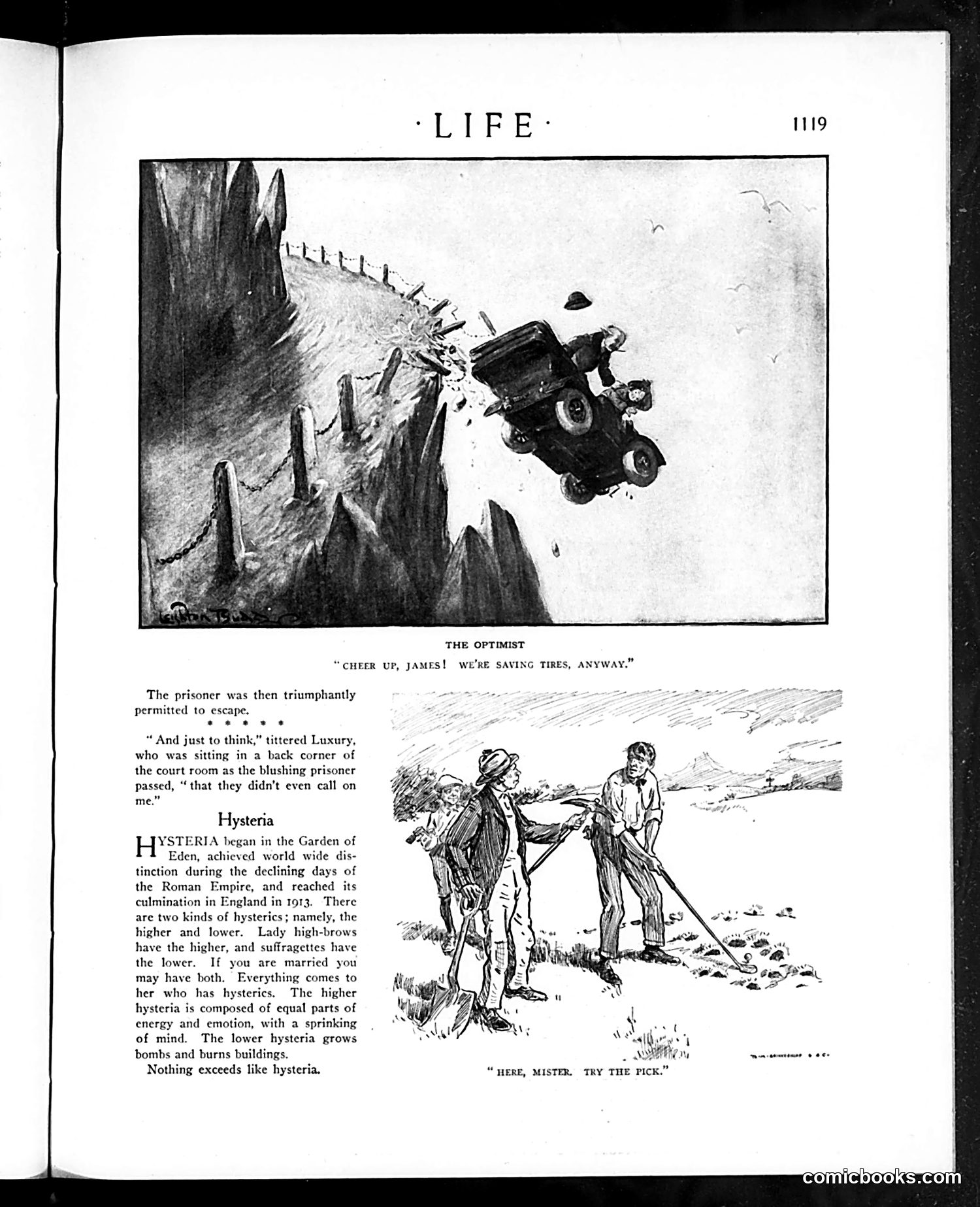
**Top Cartoon ("The Optimist"):** A car flies off a cliff while the driver cheerfully remarks they're "saving tires." This is dark satire about wartime rationing—suggesting that people find absurd silver linings in catastrophic situations. The prisoner's escape and "Luxury" character appearing in court suggests commentary on social inequality and frivolous priorities during serious times. **Bottom Section ("Hysteria"):** This is a satirical essay mocking women's suffrage activism. It distinguishes between "higher hysteria" (upper-class women's emotional behavior) and "lower hysteria" (suffragettes' militant tactics like bombing buildings—referencing actual pre-WWI British suffragette violence). The text uses "hysteria" dismissively, equating political activism with emotional instability. This reflects early 20th-century anti-suffrage rhetoric that portrayed women's rights advocates as irrational and dangerous.
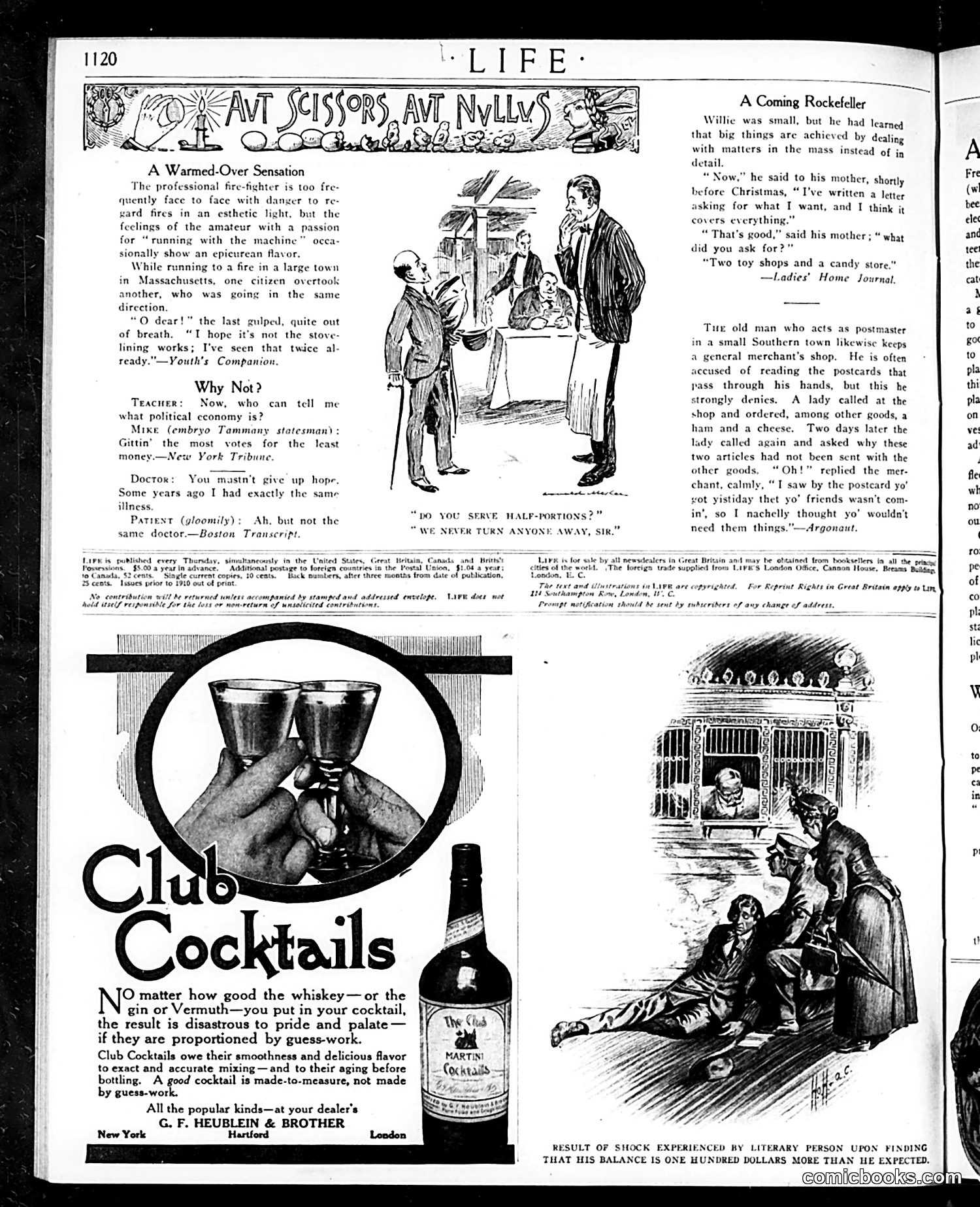
This page contains several brief satirical pieces typical of *Life* magazine's humor: **"A Warmed-Over Sensation"** mocks amateur fire enthusiasts who treat fires as entertainment rather than danger—a citizen hopes a fire is at the exciting "stove-lining works" he's already seen twice. **"Why Not?"** satirizes Tammany Hall politics (New York's corrupt Democratic machine) through a student's definition of political economy as "gettin' the most votes for the least money." **"A Coming Rockefeller"** depicts a child learning business ruthlessness by asking his mother for "two toy shops and a candy store" for Christmas—treating commercial acquisition as normal ambition. **The postmaster story** jokes about small-town gossip: a Southern postmaster reads postcards despite denials, explaining why a customer's ordered goods weren't sent. The **Club Cocktails advertisement** promotes professionally-mixed drinks over home bartending, using precision as a selling point—reflecting Prohibition-era anxieties about quality spirits. The page represents *Life's* typical blend of middle-class satire, political commentary, and advertising.
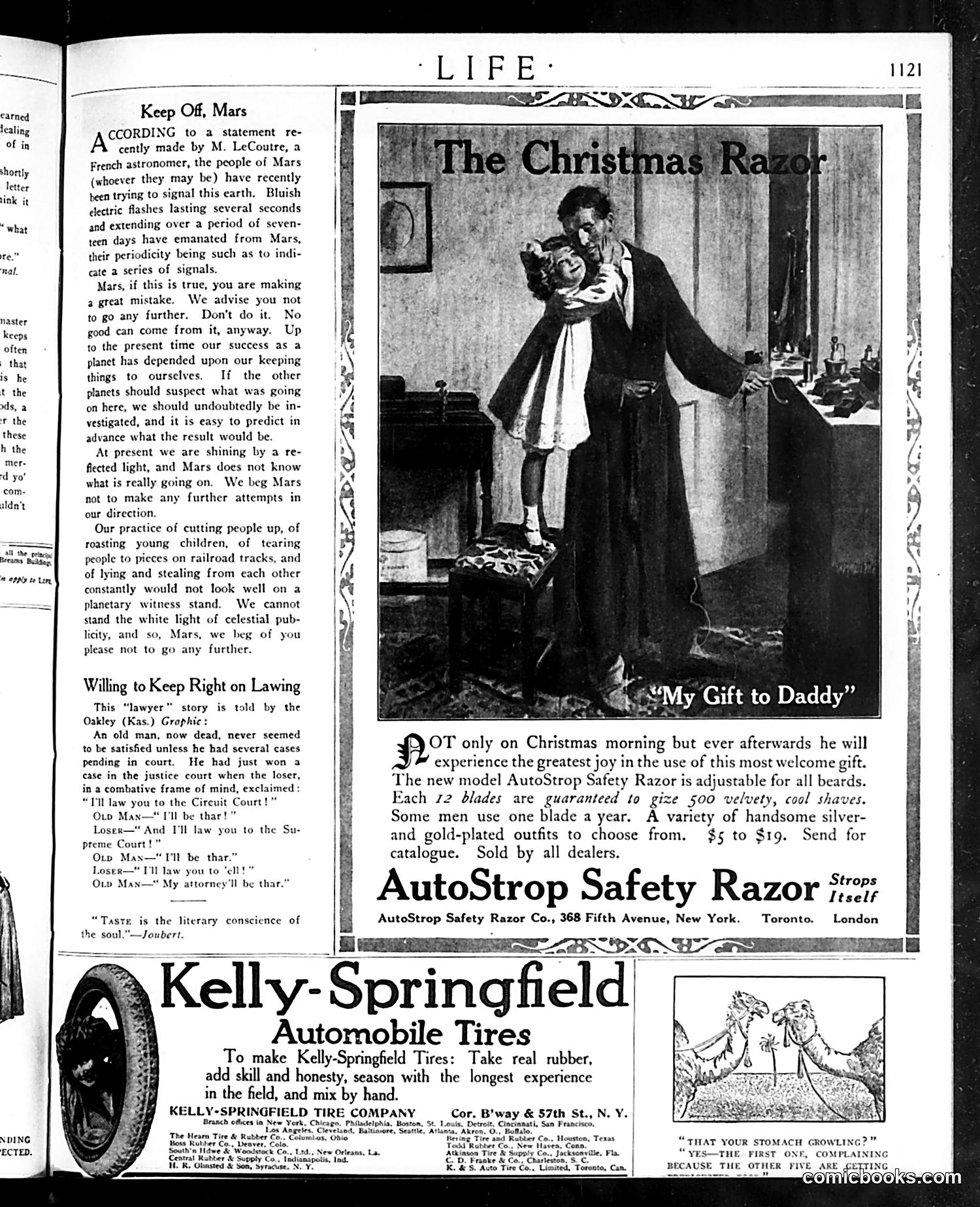
This page from *Life* magazine contains several distinct pieces: **"Keep Off, Mars"** (top left) is satirical commentary on American society. Referencing recent claims by French astronomer M. LeCourtre about signals from Mars, the piece sarcastically warns Mars not to investigate Earth further. The joke: it lists American moral failings—"cutting people up, of roasting young children, of tearing people to pieces on railroad tracks, and of lying and stealing from each other"—as reasons Mars shouldn't look too closely at human civilization. It's social criticism disguised as absurdist humor, suggesting America's violent and dishonest practices would be shameful if exposed to extraterrestrial scrutiny. The page is otherwise dominated by period advertisements (AutoStrop razors, Kelly-Springfield tires) and a brief anecdote about litigation ("Willing to Keep Right on Lawing"), a gentle jab at lawsuit-prone Americans.
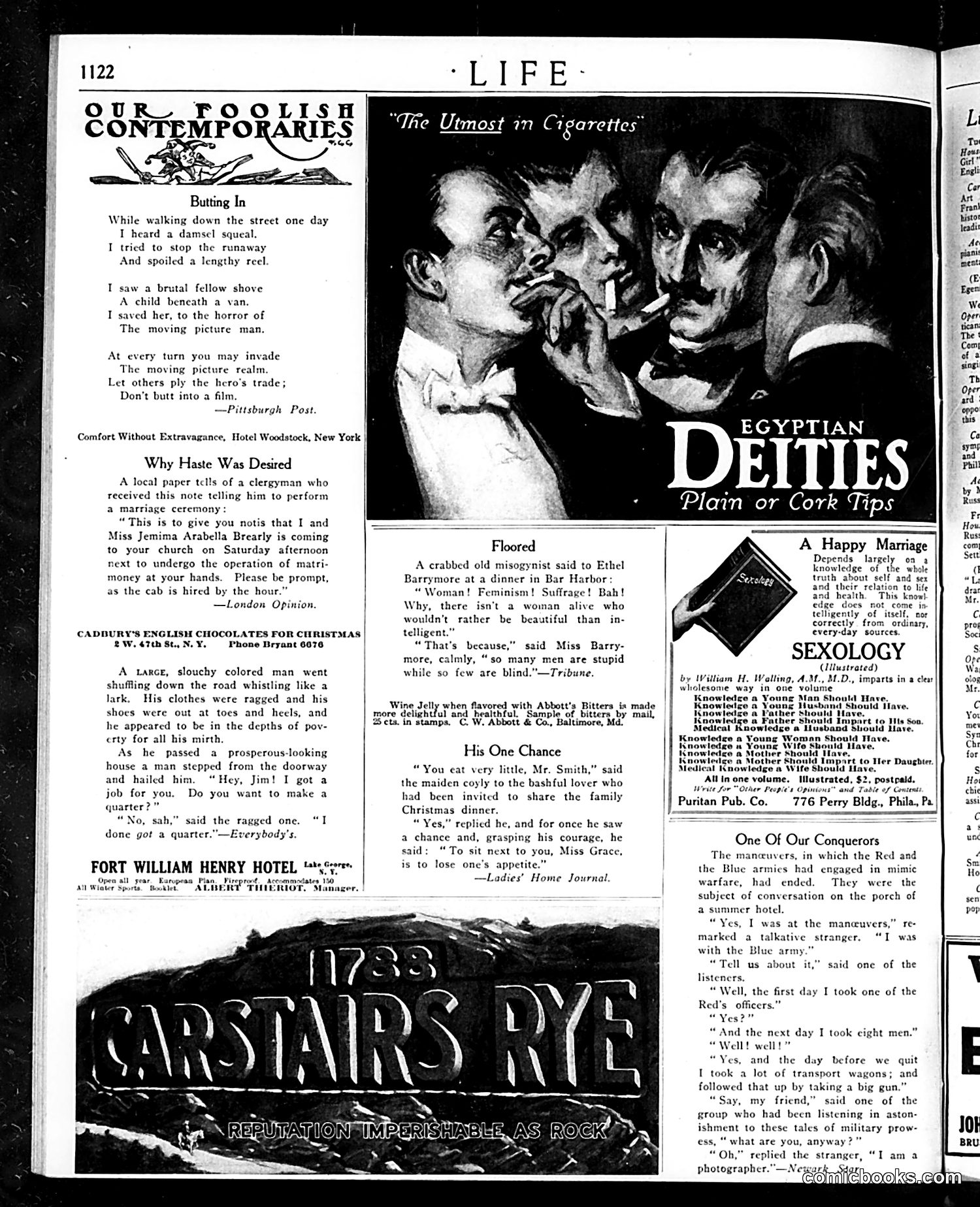
This page contains several satirical pieces typical of early 20th-century Life magazine humor: **"Butting In"** (top left): A poem mocking people who interfere with film productions. The joke: a man heroically stops a runaway and saves a child, but "the moving picture man" is horrified because the interference ruined his shot. The satire targets both the emerging film industry's priorities and public interference with professional work. **"Floored"** (center): Actress Ethel Barrymore delivers a cutting retort to a misogynist dinner guest who insists women prefer beauty to intelligence. Her response—that men are often stupid while few are blind—is the "floor" (knockout blow) of wit. This satirizes anti-feminist attitudes of the era. **"His One Chance"** (right): A bashful lover's attempt at flirtation by claiming proximity to his beloved causes loss of appetite. Light romantic humor. The page also contains period advertisements and other minor comic anecdotes. The overall tone reflects Life's satirical approach to contemporary social issues, particularly gender relations and emerging modern institutions like cinema.
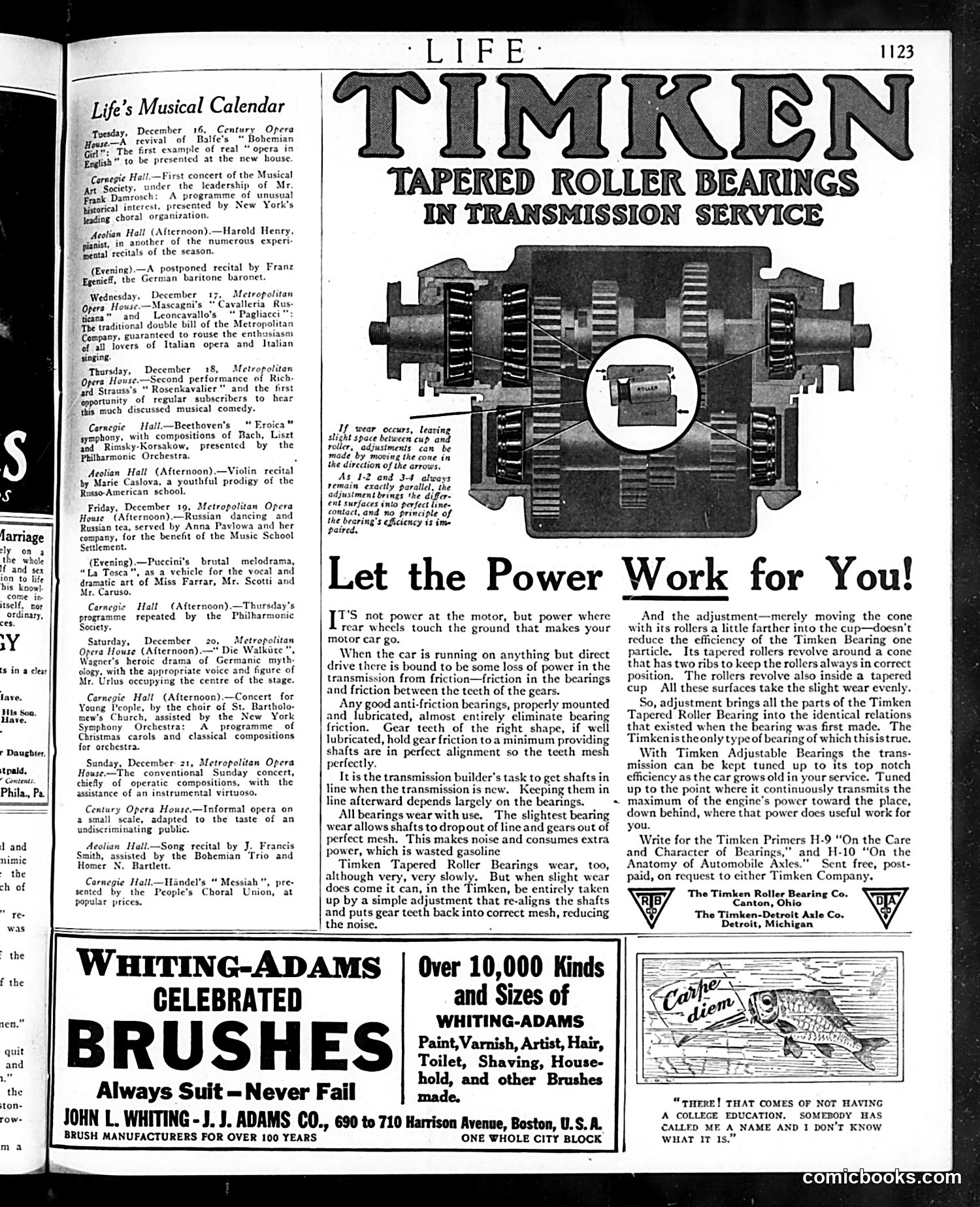
This page is primarily **advertising**, not satire or political commentary. The dominant content is a large advertisement for **Timken Tapered Roller Bearings**, featuring a technical diagram of transmission components. The ad uses educational copy explaining how proper bearings reduce friction and power loss in automobile transmissions—a straightforward industrial product pitch targeting car owners and mechanics. Below are smaller ads for **Whiting-Adams brushes** (painting and household supplies) and what appears to be a **Cadillac automobile** advertisement with a humorous caption about a college education. The left column contains **Life's Musical Calendar**—listings of December concerts and opera performances at venues like the Metropolitan Opera House and Carnegie Hall, featuring popular classical works and celebrated performers of the era. There is no political cartoon or satirical content on this page. It represents typical early 20th-century magazine content: cultural listings and commercial advertisements.
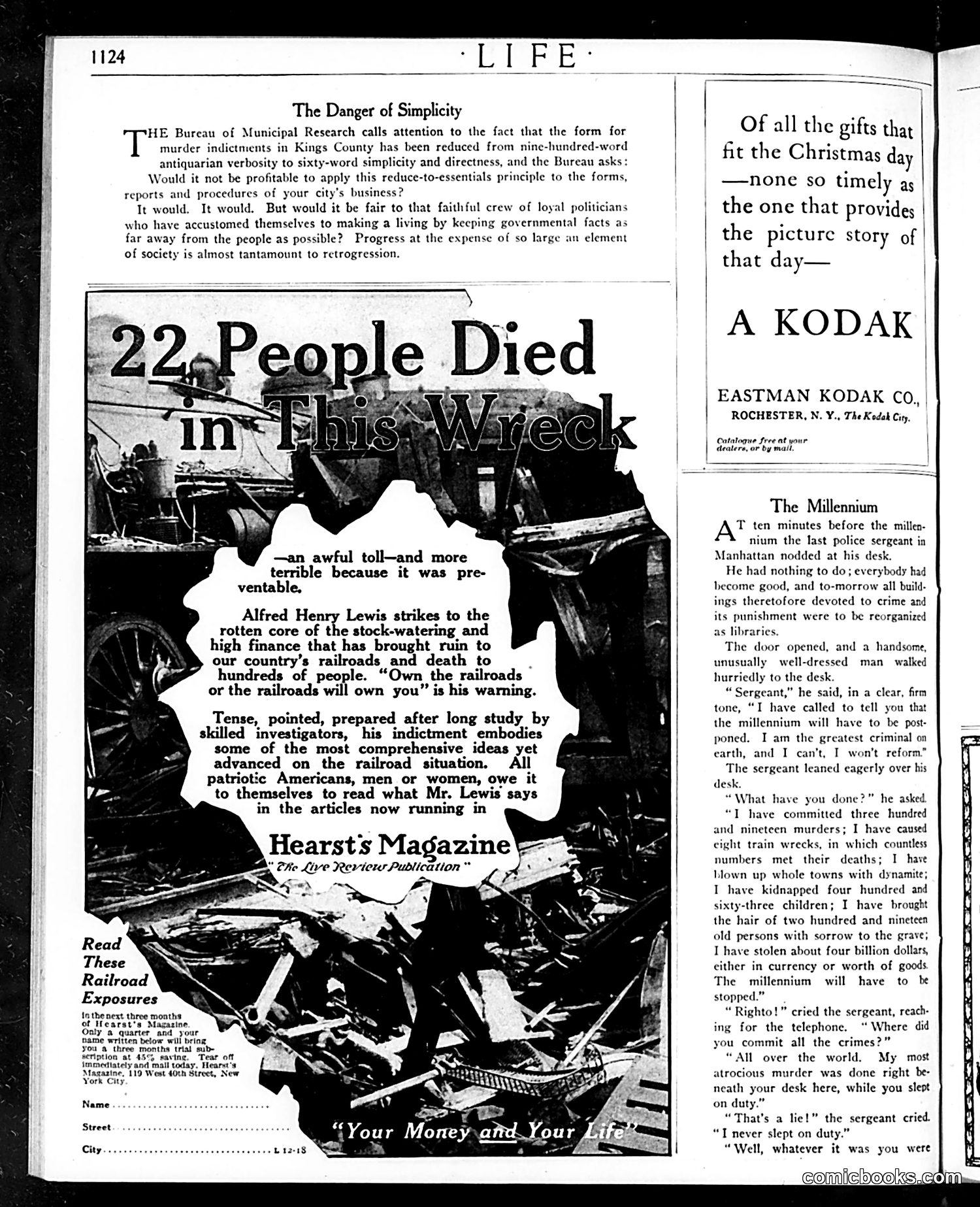
This page combines political satire with advertisements and fiction, typical of Life's format. **"The Danger of Simplicity"** (top left) ironically mocks government corruption. It attacks Kings County's reform effort to simplify murder indictment forms from 900 to 60 words. The satire argues this transparency threatens corrupt politicians who profit by obscuring governmental facts behind bureaucratic complexity. The piece sarcastically suggests such reforms harm "society"—really meaning dishonest officials. **The Hearst's Magazine advertisement** (center) promotes Alfred Henry Lewis's railroad exposé articles, attacking stock-watering schemes and dangerous financial practices that caused deaths. It positions reform journalism as patriotic duty. **"The Millennium"** (right) is satirical fiction depicting a future where crime ceases—except one criminal appears to confess. The joke appears to mock either utopian thinking or police incompetence, suggesting crime is inevitable despite optimistic reform. Together, the page critiques both government corruption and advocates for investigative journalism as reform.
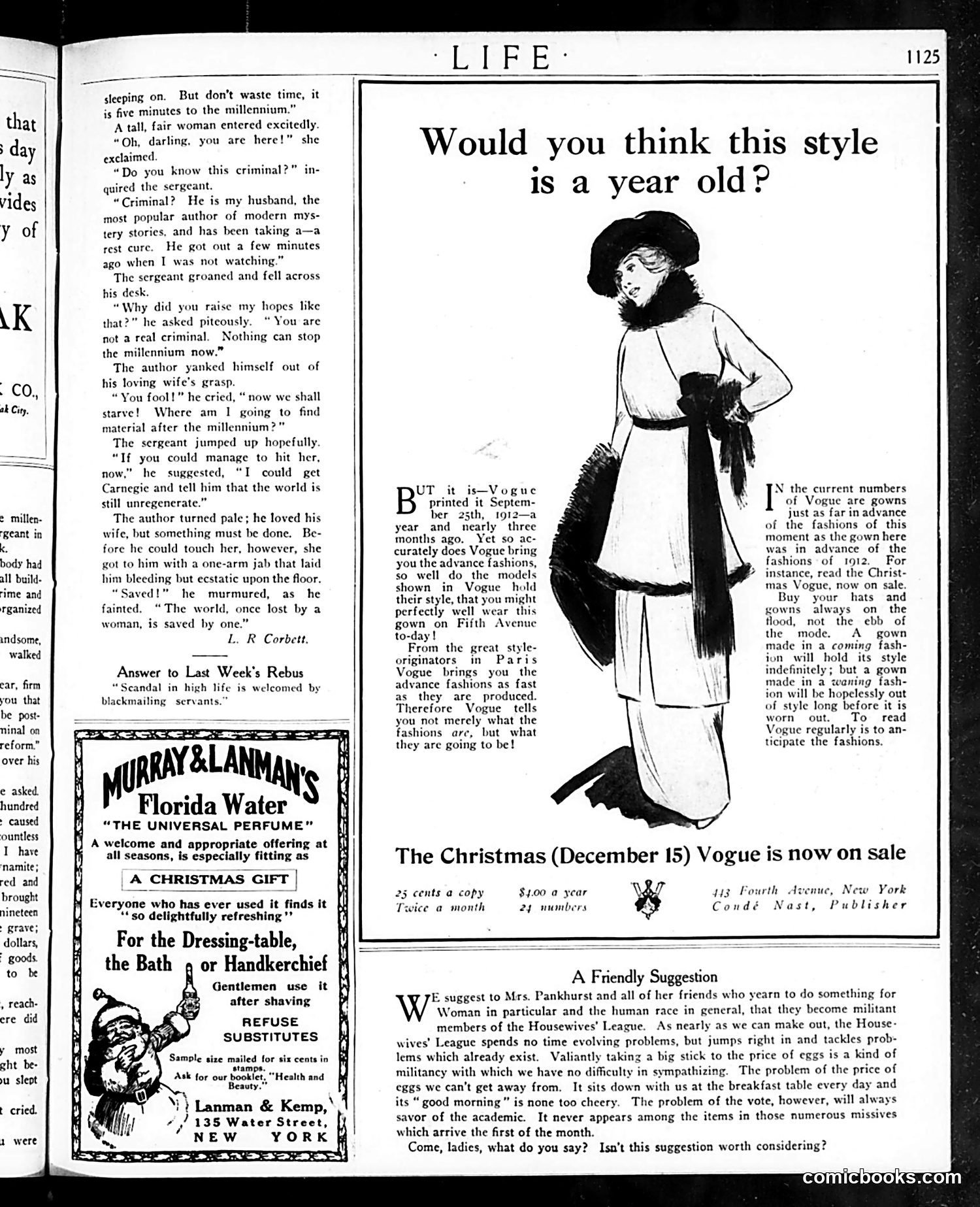
This page contains two distinct pieces of satire: **The Short Story "Scandal in High Life"**: A humorous tale by L.R. Corbett mocking the imminent "millennium" (year 1913). A mystery writer, desperate for criminal material after this prophesied peaceful era arrives, considers attacking his wife to generate scandal. The joke satirizes both sensationalist mystery fiction and the period's millennial anxiety—the absurd notion that 1913 would usher in utopian peace. **The Vogue Advertisement**: This is ironic advertising disguised as editorial advice. Vogue claims its September 1912 fashions remain current a year later, positioning the magazine as a fashion oracle predicting trends. The actual point: buy Vogue to stay ahead of fashion changes, though the ad humorously admits styles featured months ago still look modern. **"A Friendly Suggestion"**: Mildly satirizes the Pankhurst suffragettes, suggesting they redirect their militant energy toward joining the Housewives' League instead—contemporary anti-feminist mockery. The page reflects 1912's obsession with predicting the future and anxiety about rapid social/fashion change.
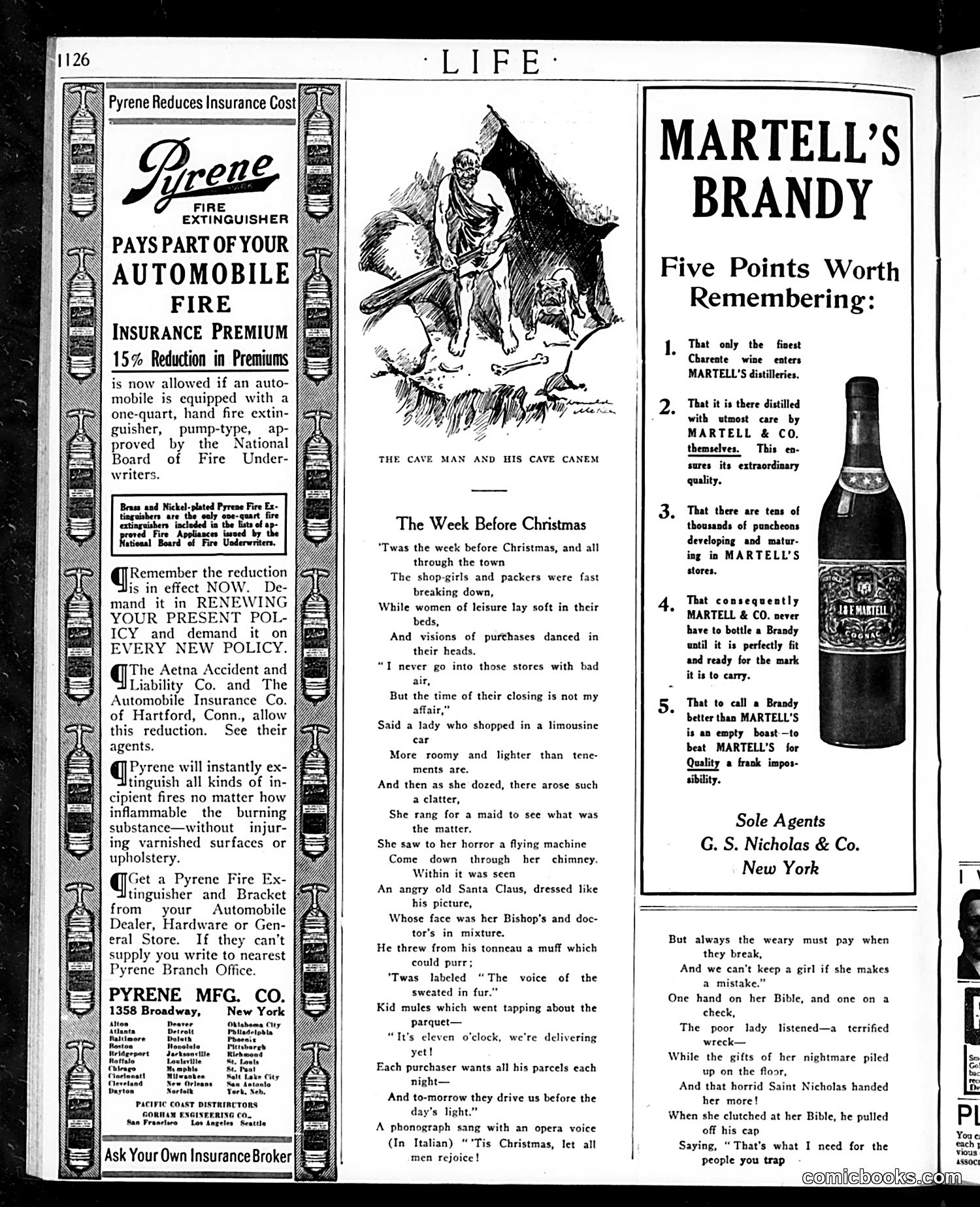
This page features a lengthy humorous poem parodying Clement Clarke Moore's "A Visit from St. Nicholas" ("'Twas the Night Before Christmas"). Rather than Santa's wholesome visit, this version depicts a chaotic pre-Christmas scene in 1920s urban America. The satire targets consumer excess and social hypocrisy: shop-girls exhausted from work while wealthy women lounge in limousines; a "flying machine" (early airplane) crashing through a chimney instead of Santa descending; an angry, disheveled Santa delivering a muff labeled "The voice of the sweated in fur"—apparently critiquing the fur industry and labor exploitation. The final twist mocks religious contradiction: a terrified society woman clutches her Bible while receiving luxuries, prompting the poem's closing moral about needing faith "for the people you trap." The surrounding ads for Pyrene fire extinguishers and Martell's Brandy are period product placement. This was *Life* magazine's signature blend of social commentary wrapped in entertainment.
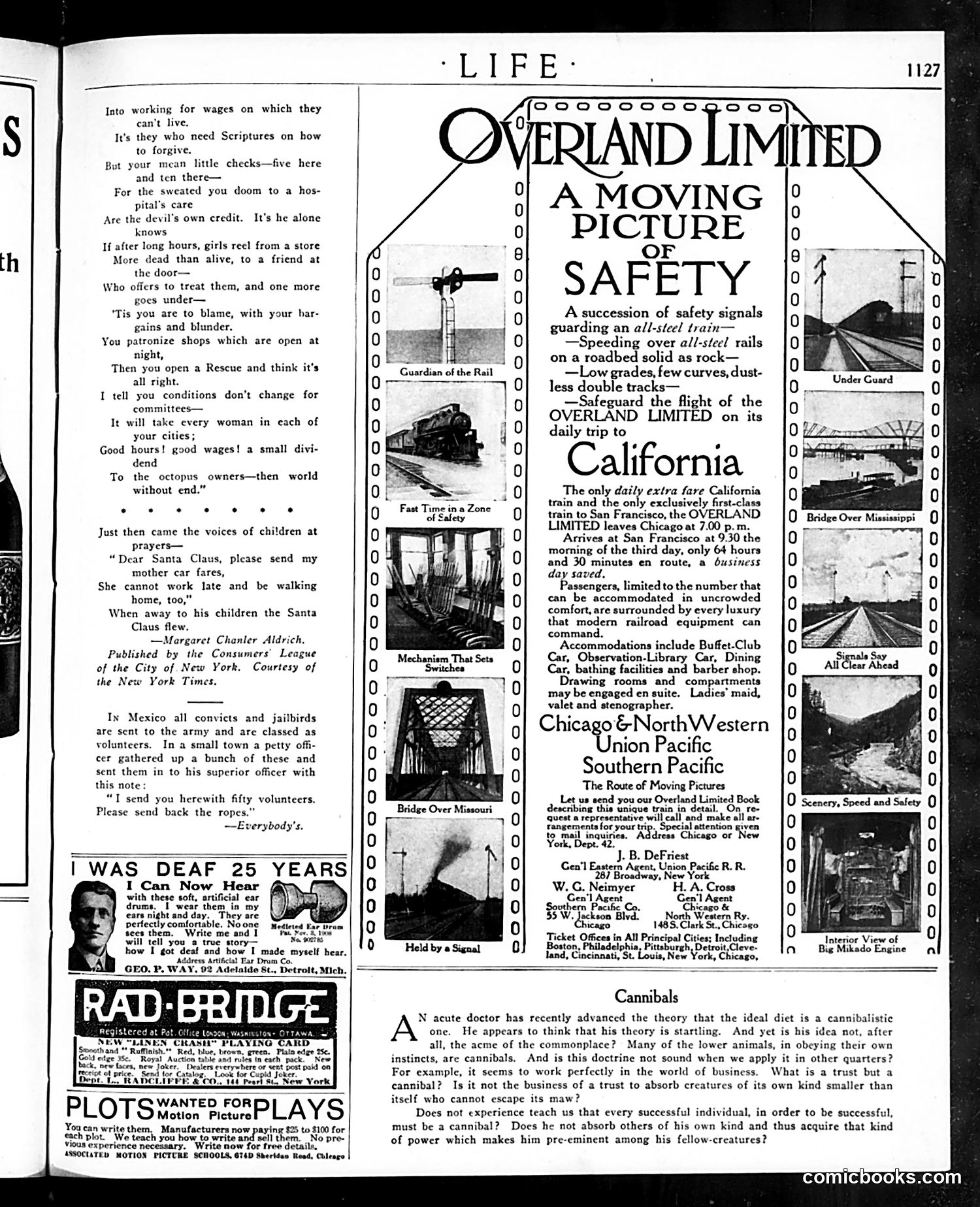
This page contains social commentary and advertising from an early 20th-century American magazine. **Main Content:** A poem by Margaret Chanler Aldrich critiques wealthy consumers' hypocrisy. She attacks shop owners who pay women starvation wages (forcing some into prostitution—"goes under"), while those same owners patronize rescue missions to ease their conscience. The poem argues structural economic change, not charity, is needed. A child's prayer for "car fares" for her working mother underscores the poem's point about systemic poverty. **Satirical Thrust:** The piece mocks the moral contradiction of the comfortable class: they profit from exploiting workers, then perform charity to feel righteous—missing the real solution. **Supporting Content:** A Mexican joke about sending convicts as "volunteers" to the army, plus various period advertisements (artificial ear drums, railroad service, motion picture schools). The page reflects Progressive Era concerns about labor exploitation and consumer responsibility.
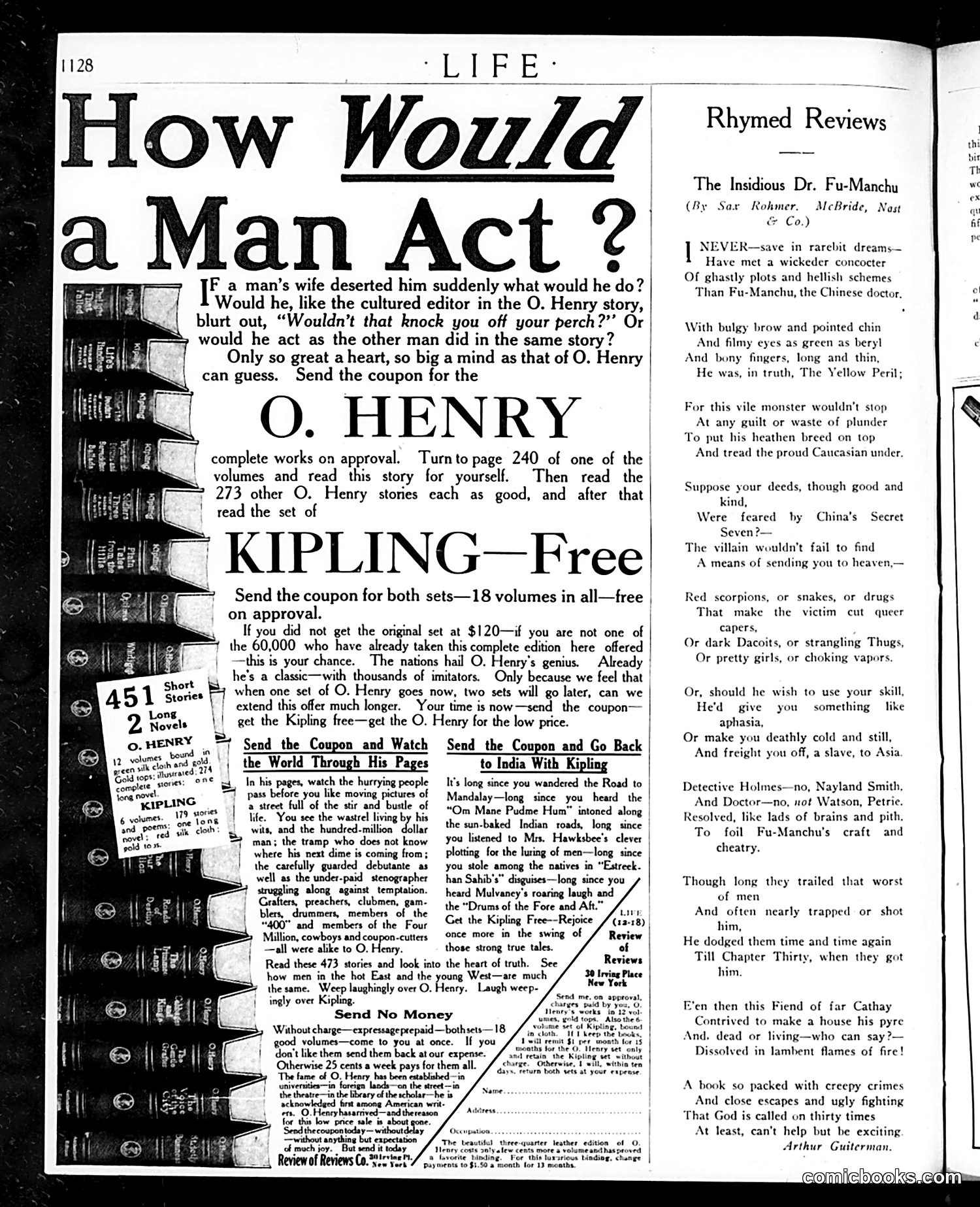
This page is primarily **advertising** for book sets—O. Henry's complete works and Rudyard Kipling's collected stories—disguised as entertainment content. The left side features a prominent ad asking "How Would a Man Act?" referencing an O. Henry story to hook readers' interest, then pivots to selling 18-volume sets on approval without upfront payment. On the right, under "Rhymed Reviews," is a poem about **Fu-Manchu**, a villainous Chinese character created by Sax Rohmer. The poem reflects early 20th-century "Yellow Peril" racism—depicting an Asian villain with exaggerated features ("bulgy brow," "pointed chin") who threatens Western ("Caucasian") superiority through plots involving poison, drugs, and enslavement. This content reveals period attitudes: Fu-Manchu stories were popular entertainment, and casual xenophobic caricature was acceptable magazine material. The juxtaposition—selling "cultured" literature alongside racist stereotypes—was unremarkable to contemporary readers but represents values modern audiences would find offensive.
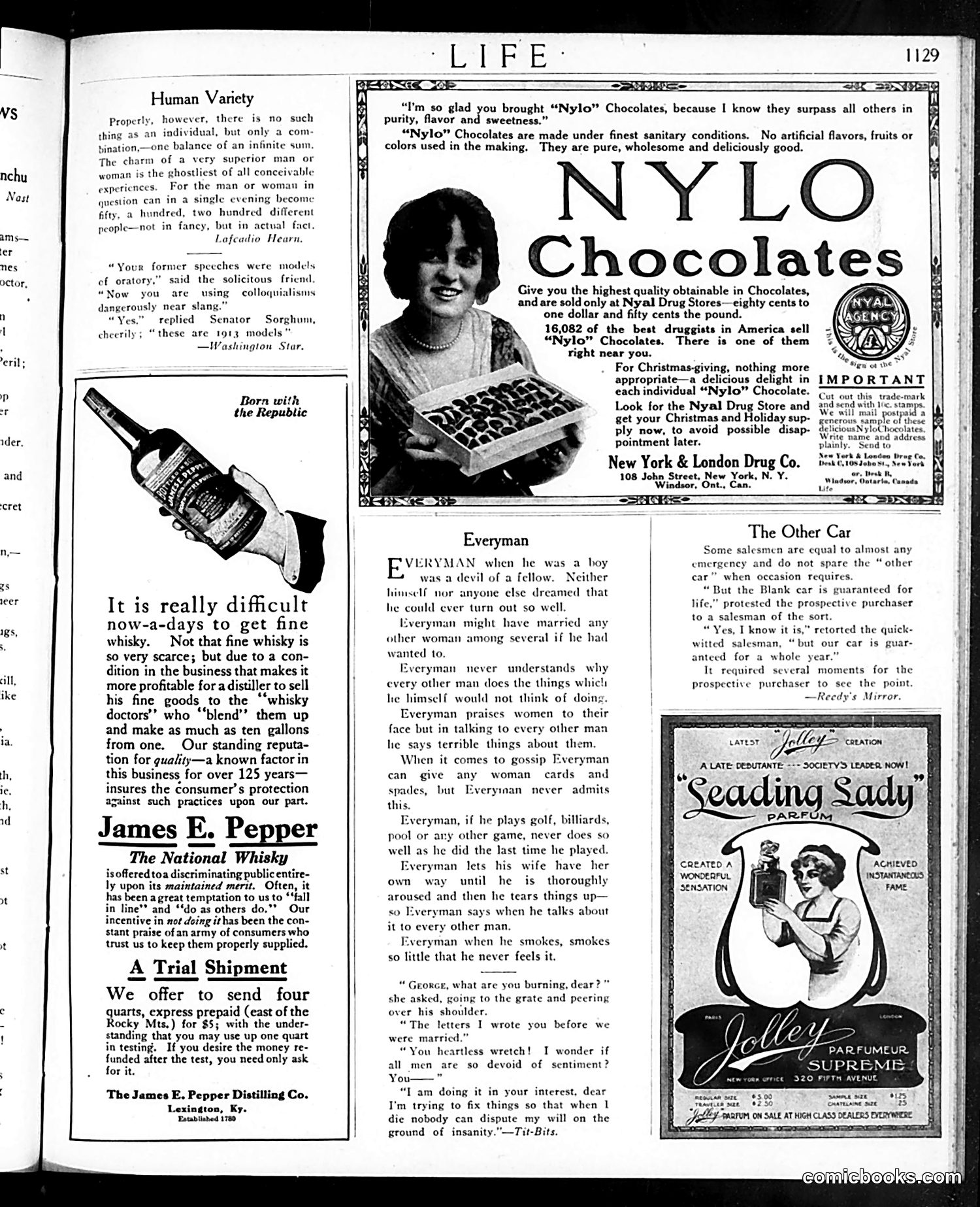
This page mixes light satirical commentary with period advertising. The "Human Variety" section opens with a philosophical quote about how superior individuals can embody many different personas in a single evening. A brief joke follows: Senator Sorghum defends using "slang" in speeches by claiming they're "1913 models"—satirizing how politicians justify adopting whatever rhetorical style seems trendy or advantageous. The longer "Everyman" piece (likely by Life's editorial staff) catalogs stereotypical male behavior: Everyman was once a rascal but reformed; he never understands why other men behave badly; he gossips about women while praising them to their faces; he always performed better at games previously. This gentle satire mocks masculine self-deception and hypocrisy through accumulated observation rather than specific targets. The tone is more wry observation of human nature than hard-hitting political commentary.
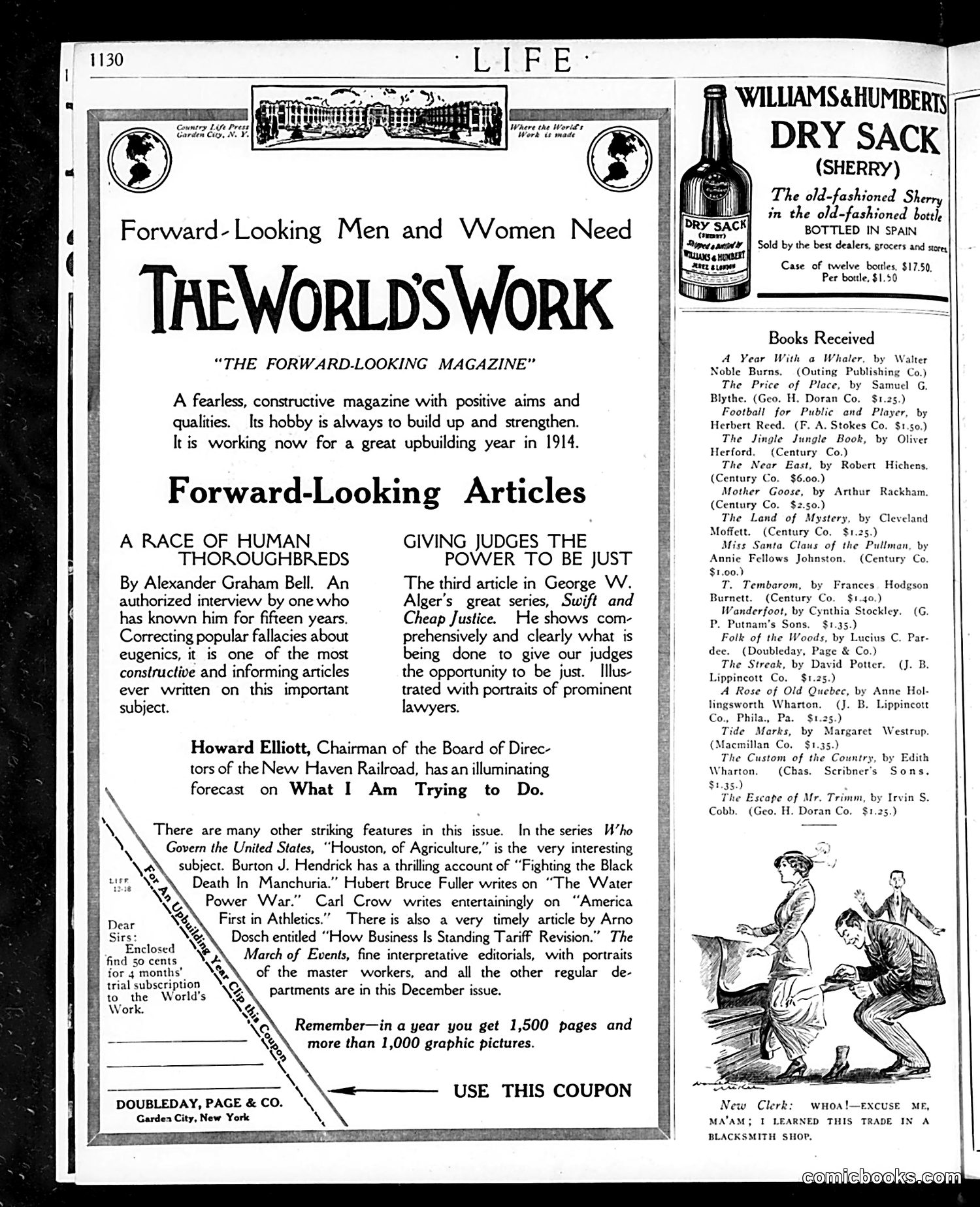
This page is primarily an advertisement for *The World's Work* magazine (December 1913 or early 1914) and a liquor advertisement, with only one small cartoon. The cartoon at bottom right shows a young man explaining to a woman that he learned his "trade" as a clerk in a blacksmith shop—an absurdist joke playing on the mismatch between his claimed experience and his actual job. It's a mild, fairly generic humor piece. The magazine's promotional text emphasizes "forward-looking" content, including an Alexander Graham Bell interview on eugenics as "constructive" science—reflecting early-20th-century enthusiasm for eugenics among progressive intellectuals, before its association with Nazi ideology became apparent. Articles also promise coverage of "judges being just" and economic matters like tariff revision.
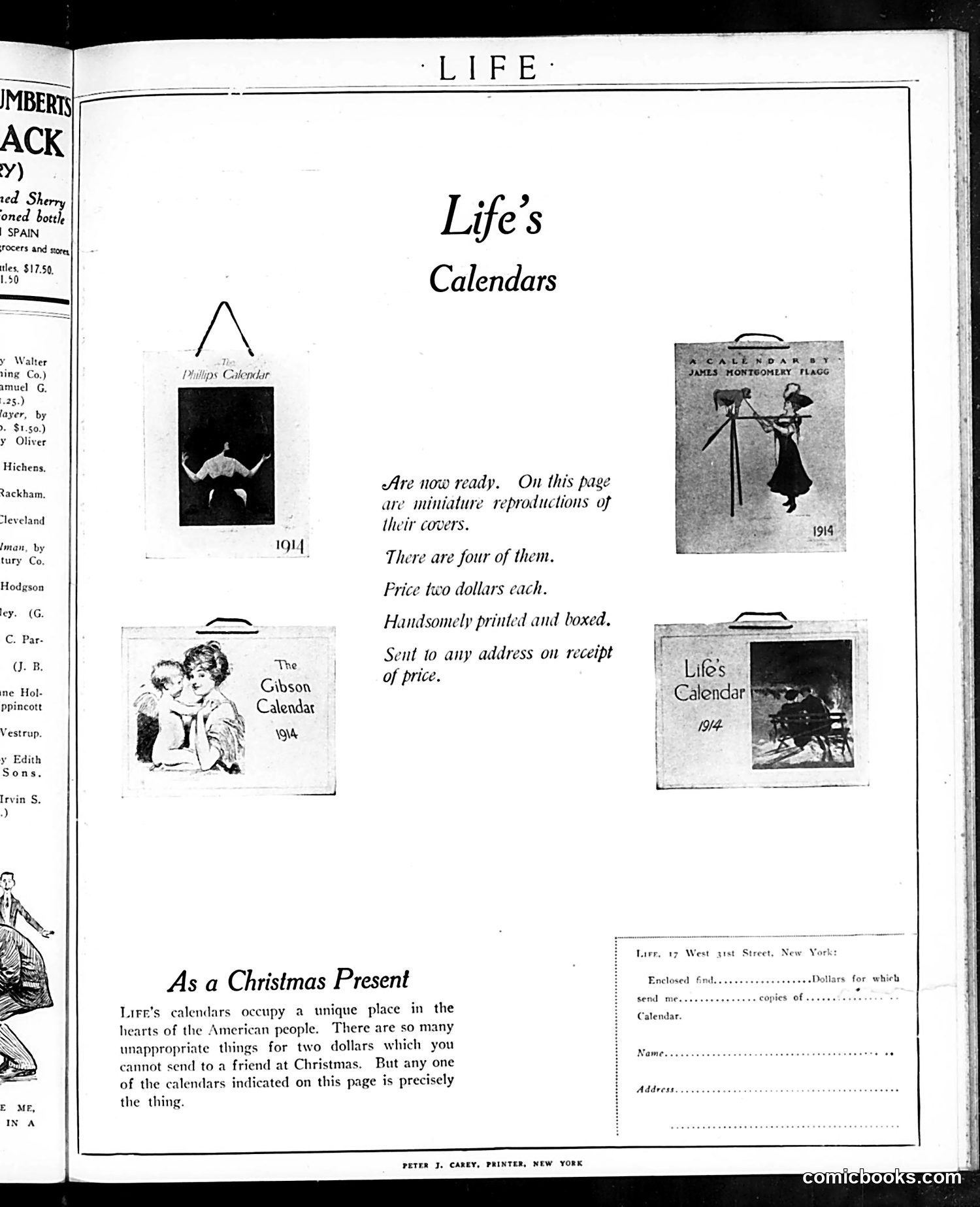
This is a **product advertisement**, not a political cartoon. Life magazine is promoting four decorative calendars for the 1914 Christmas season, priced at two dollars each. The page displays miniature reproductions of four calendar covers: - **Phillips Calendar** (1914) - **The Gibson Calendar** (1914), featuring Gibson Girl-style illustration - **James Montgomery Flagg Calendar** (1914) - **Life's Calendar** (1914) The advertisement's pitch emphasizes that these calendars are ideal Christmas gifts—"unique" and appropriate, unlike "so many unappropriate things for two dollars." The calendars are described as "handsomely printed and boxed." A mail-order form appears at bottom for purchasing. This reflects early-20th-century consumer culture where calendars with artwork by famous illustrators (Gibson, Flagg) were popular, desirable gift items.
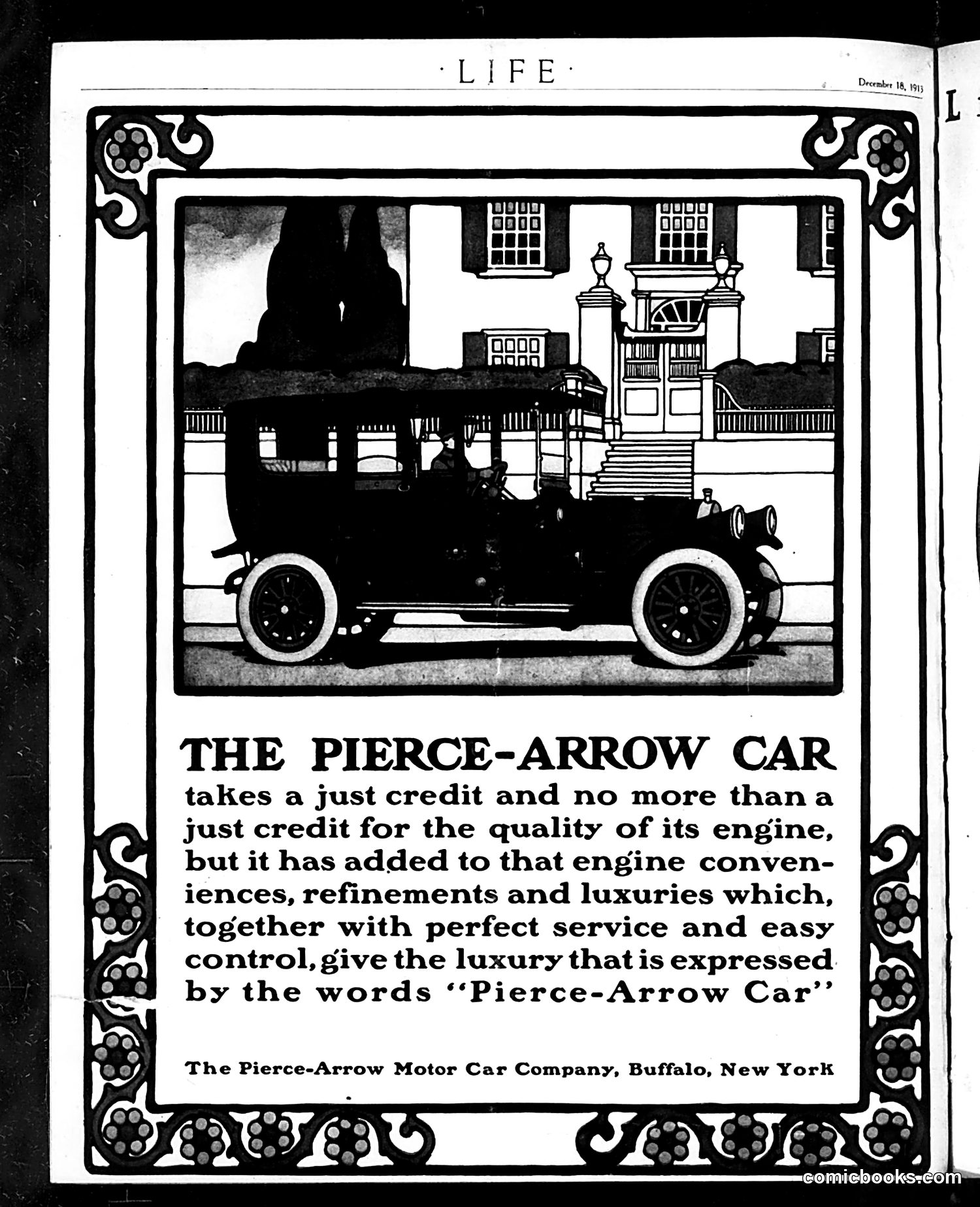
This is a straightforward advertisement, not political satire. It promotes the Pierce-Arrow automobile, a luxury car manufactured in Buffalo, New York. The ad claims the vehicle deserves credit not merely for engine quality, but for additional "conveniences, refinements and luxuries" that collectively define the Pierce-Arrow brand as a luxury product. The illustration shows a black open-air touring car parked before an elegant Georgian-style mansion with manicured grounds, visually reinforcing the car's association with wealth and sophistication. The decorative art nouveau border frames the advertisement. This appears in *Life* magazine from December 18, 1911, during the early automotive era when such vehicles represented significant luxury purchases.