
Life, 1913-12-18 · page 24 of 40
Life — December 18, 1913 — page 24: what you’re looking at
What you’re looking at
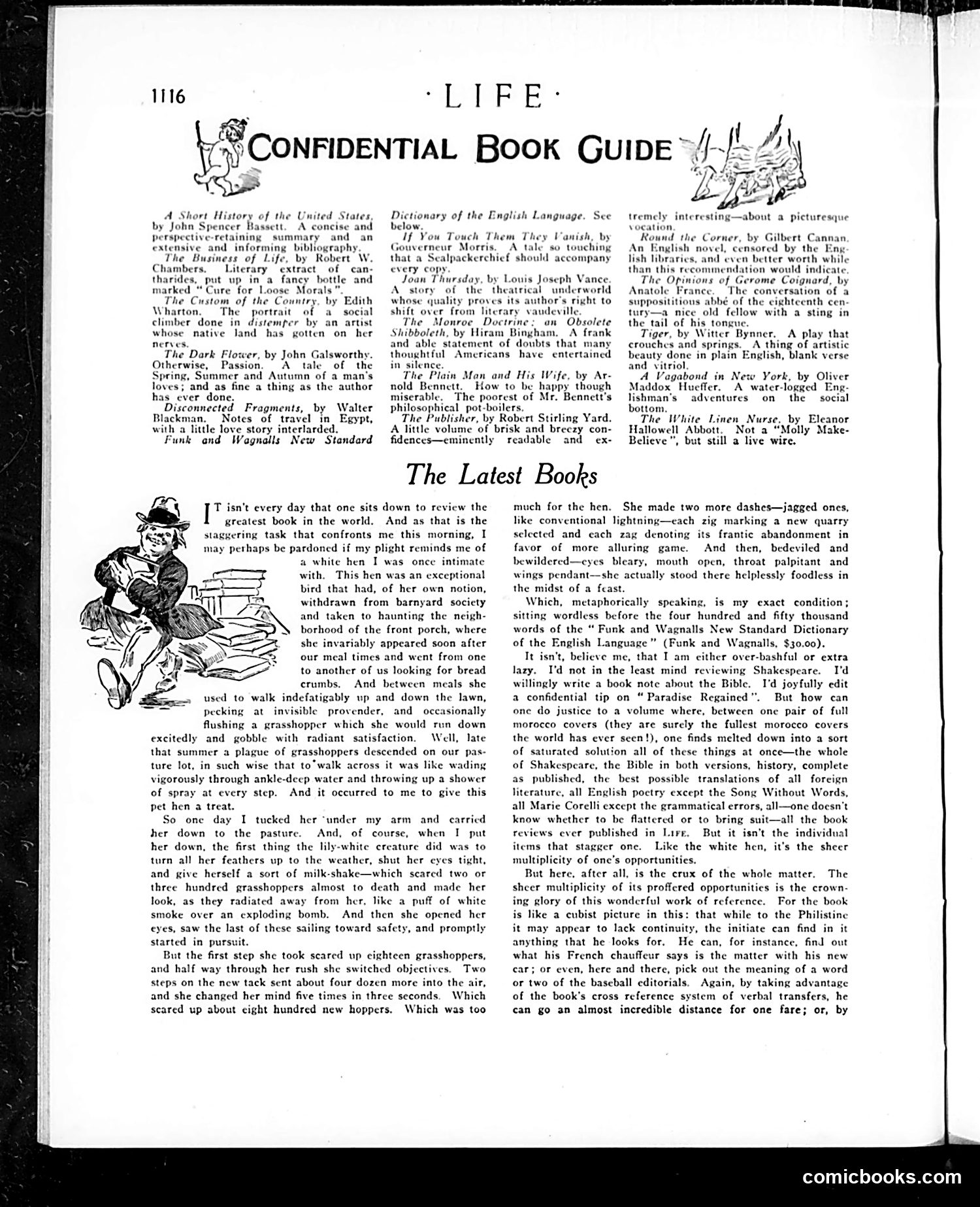
This page presents a satirical book review column titled "The Latest Books." The main cartoon shows a man reviewing books while reflecting on a hen he once owned—an elaborate, humorous metaphor for the reviewer's own predicament. The "Confidential Book Guide" section above lists recent publications with tongue-in-cheek descriptions. Titles like *The Business of Life* (marked as a "Cure for Loose Morals") and *The Custom of the Country* are presented with witty, mocking summaries that critique both the books and broader social trends. The extended hen anecdote that follows uses absurdist humor to illustrate the reviewer's dilemma when confronted with overwhelming choice and abundance—when the hen is placed in a field of grasshoppers, she's so overwhelmed by plenty that she does nothing. This appears to satirize intellectual paralysis when faced with too many books to review, reflecting early 20th-century anxieties about information overload and literary excess.
📄 Transcribed text from this page (OCR, searchable)
Machine-transcribed from the original scan — historical spelling and the odd misread are preserved.
STE IGEAE ~)CONFIDENTIAL BOOK GUIDE ~\/~ we A Short History of the United States by John Spencer Bassett, A concise and perspective-retaining summary 1 an If Ye extensive and informing bibliography Gouver The Business of Life, by Robert W. that Chambers. Literary extract of can- every copy tharides, put up in-a fancy bottle and marked “Cure for Loose Morals” A’ story of the The Custom of the Country, by Edith Wharton. The port of a social climber done in dist an artist T whose native land has gotten on her nerves. The Dark Flower, by John Galsworthy. Otherwise, . A tale of the Spring, Summer and Autumn of a man’s loves; and as fine a thing as the author has ever done, Disconnected Fragments, by Walter Blackma Notes of travel in Egypt, with a little love story interlarded. Funk and Wagnalls New Standard below Touch in silence. nold Bennett Dictionary of the English Language. See ur Morris Joan Thursday, by Louis Jo: theatrical underworld — Ana rance whose quality proves its author's right to t over from literary vaudeville Monroe Doctrine; an Obsolete Shibboleth, by Hiram Bingham, A frank and able statement of doubts that many thoughtful Americans have entertaine The Plain Man and His Wife, by Ar- How to be happy. though miserable. The poorest of Mr. Bennett's philosophical pot-boilers. The Publisher, by Robert Stirling Yard. A little volume of brisk and breezy con- fidences—eminently readable and ex- tremely interesting—about a picturesque Them They Vanish, by p Ci er, by Gilbert Ca A tale so touch: Scalpackerchief should accompany nglish novel, censored by th lish libraries, leven better worth while than this rec n would indicate The Opinions of Gerome Coignard, by The conversation of a supposititious abbé of the eighteenth cen tury—a nice old fellow with a sting in the tail of his tongue Tiger, by Witter Bynner, A pla crouches and springs. A thing of a beauty done in plain English, blank verse and. vitriol. A Vagabond in New York, by Oliver Maddox Hueffer. A water-logged Eni lishman’s adventures on the social bottom. The White Linen Nurse, by Eleanor Hallowell Abbott. Not a “Molly Make- Believe”, but still a live wire. h Vance. The Latest Books T isn't every day that one sits down to review the greatest book in the world. And as that is the staggering task that confronts me this morning, I may perhaps be pardoned if my plight reminds me of a white hen I was once intimate with, This hen was an exceptional bird that had, of her own notion, withdrawn from barnyard society and taken to haunting the neigh- borhood of the front porch, where she invariably appeared soon after our meal times and went from one to another of us looking for bread crumbs. And between meals she used to walk indefatigably up and down the lawn, pecking at invisible provender, and occasionally flushing a grasshopper which she would run down excitedly and gobble with radiant satisfaction. Well, late that summer a plague of grasshoppers descended on our pas- ture lot, in such wise that to’walk across it was like wading vigorously through ankle-deep water and throwing up a shower of spray at every step. And it occurred to me to give this pet hen a treat. So one day I tucked her “under my arm and carried her down to the pasture. And, of course, when I put her down, the first thing the lily-white creature did was to turn all her feathers up to the weather, shut her eyes tight, and give herself a sort of milk-shake—which scared two or three hundred grasshoppers almost to death and made her look, as they radiated away from her, like a puff of white smoke over an exploding bomb. And then she opened her eyes, saw the last of these sailing toward safety, and promptly started in pursuit. But the first step she took scared up cighteen grasshoppers, and half way through her rush she switched objectives. Two steps on the new tack sent about four dozen more into the and she changed her mind five times in three seconds. Which scared up about cight hundred new hoppers. Which was too much for the hen. She made two more dashes—jagged ones, like conventional lightning—each zig marking a new quarry selected and cach zag denoting its frantic abandonment in favor of more alluring game. And then, bedeviled and bewildered—eyes bleary, mouth open, throat palpitant and wings pendant—she actually stood there helplessly foodless in the midst of a feast. Which, metaphorically speaking, is my exact condition; sitting wordless before the four hundred and fifty thousand words of the “ Funk and Wagnalls New Standard Dictionary of the English Language” (Funk and Wagnalls, $30.00). It isn't, believe me, that I am cither over-bashful or extra lazy. I'd not in the least mind reviewing Shakespeare. I'd willingly write a book note about the Bible. I'd joyfully edit a confidential tip on “ Paradise Regained But how can one do justice to a volume where, between one pair of full morocco covers (they are surely the fullest morocco covers the world has ever seen!), one finds melted down into a sort of saturated solution all of these things at once—the whole of Shakespeare, the Bible in both version: complete as published, the best possible translations of all foreign literature, all lish poctry except the Song Without Words, all Marie Corelli except the grammatical errors, all—one doesn’t know whether to be flattered or to bring suit—all the book reviews ever published in Lire, But it isn't the individual items that stagger one. Like the white hen, it's the sheer multiplicity of one’s opportunities. But here, after all, is the crux of the whole matter. The shcer multiplicity of its proffcred opportunities is the crown- ing glory of this wonderful work of reference. For the book is like a cubist picture in this: that while to the Philistine it may appear to lack continuity, the initiate can find in it anything that he looks for. He can, for instance, find out what his French chauffeur says is the matter with his new car; or even, here and there, pick out the meaning of a word or two of the baseball editorials. Again, by taking advantage of the book's cross reference system of verbal transfers, he can go an almost incredible distance for one fare; or, by comicbooks.com