
Life, 1913-12-18 · page 32 of 40
Life — December 18, 1913 — page 32: what you’re looking at
What you’re looking at
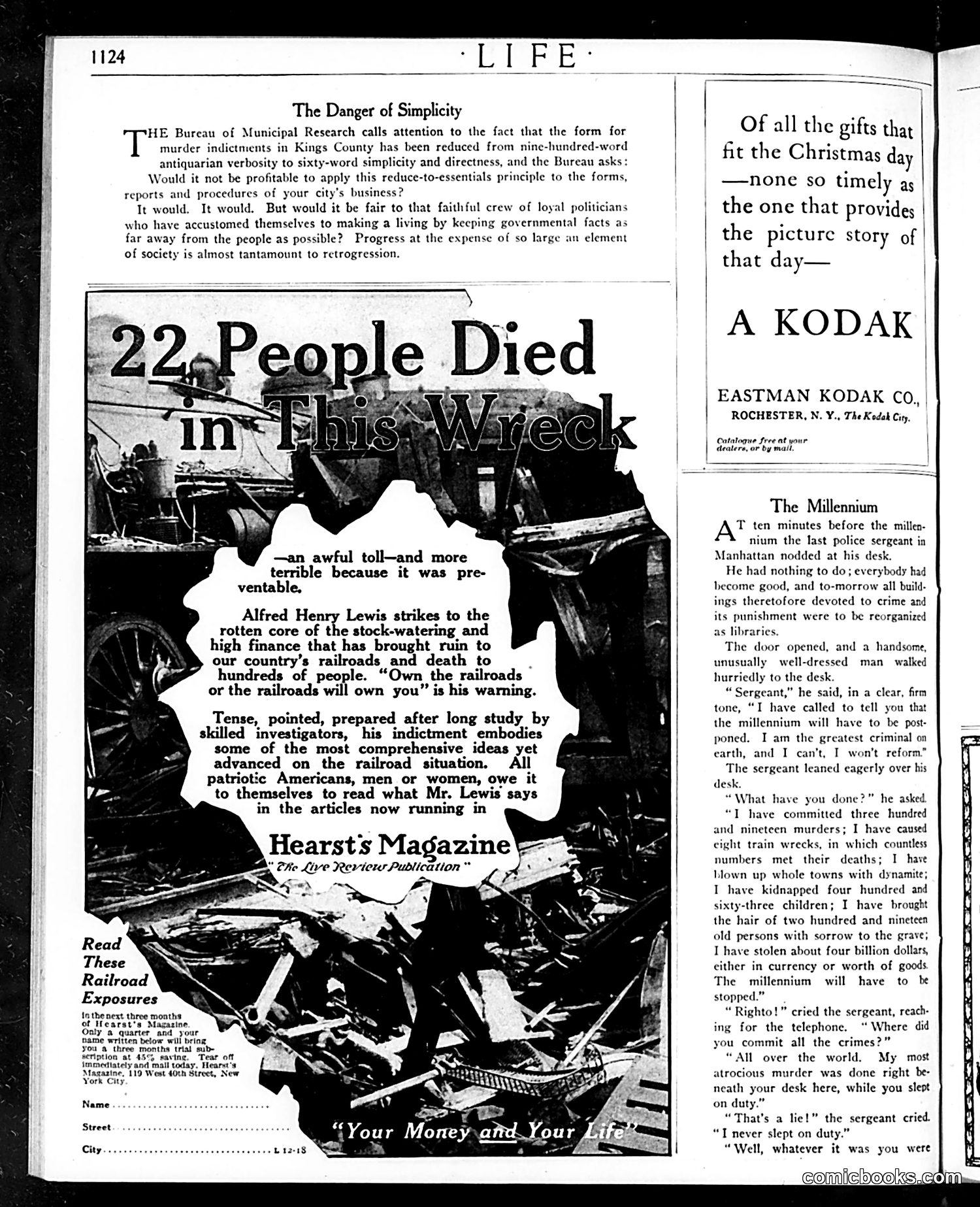
This page combines political satire with advertisements and fiction, typical of Life's format. **"The Danger of Simplicity"** (top left) ironically mocks government corruption. It attacks Kings County's reform effort to simplify murder indictment forms from 900 to 60 words. The satire argues this transparency threatens corrupt politicians who profit by obscuring governmental facts behind bureaucratic complexity. The piece sarcastically suggests such reforms harm "society"—really meaning dishonest officials. **The Hearst's Magazine advertisement** (center) promotes Alfred Henry Lewis's railroad exposé articles, attacking stock-watering schemes and dangerous financial practices that caused deaths. It positions reform journalism as patriotic duty. **"The Millennium"** (right) is satirical fiction depicting a future where crime ceases—except one criminal appears to confess. The joke appears to mock either utopian thinking or police incompetence, suggesting crime is inevitable despite optimistic reform. Together, the page critiques both government corruption and advocates for investigative journalism as reform.
📄 Transcribed text from this page (OCR, searchable)
Machine-transcribed from the original scan — historical spelling and the odd misread are preserved.
The Danger of Simplicity HE Bureau of Municipal Research calls attention to the fact that the form for murder indictments in Kings County has been reduced from nine-hundred-word antiquarian verbosity to sixty-word simplicity and directness, and the Bureau asks: Would it not be profitable to apply this reduce-to-essentials principle to the forms, reports and procedures of your city’s business? It would. It would. But would it be fair to that faithful crew of loyal politicians who have accustomed themselves to making a living by keeping governmental facts as far away from the people as possible? Progress at the expense of so large an element of society is almost tantamount to retrogression. —an awful toll—and more terrible because it was pre- ventable, Alfred Henry Lewis strikes to the rotten core of the stock-watering and high finance that has brought ruin to our country’s railroads and death to . hundreds of people. “Own the railroads or the railroads will own you” is his warning. Tense, pointed, prepared after long study by skilled investigators, his indictment embodies some of the most comprehensive ideas yet advanced on the railroad situation. All patriotic Americans, men or women, owe it to themselves to read what Mr. Lewis says in the articles now running in Railroad Exposures In the next three months of Hearst's Magazine. Only a quarter and your ame written below will bring you & three months trial sub- scription at 45% saving. Tear off immediately and mall today. Hearst's Magazine, 119 West 40th Street, New York City Name Street City. Of all the gifts that fit the Christmas day —none so timely as the one that Provides | the picture story of that day— | A KODAK EASTMAN KODAK CO, | ROCHESTER, N. Y., The Kedah Cir, Catalogue Sree at your The Millennium T ten minutes before the millen- nium the last police sergeant in Manhattan nodded at his desk. He had nothing to do; everybody had become good, and to-morrow all build- ings theretofore devoted to crime and its punishment were to be reorganized as libraries. The door opened, and a handsome, unusually well-dressed man walked hurriedly to the desk. “Sergeant,” he said, in a clear, firm tone, “I have called to tell you that the millennium will have to be post- poned. I am the greatest criminal on earth, and I can’t, I won't reform.” The sergeant leaned eagerly over his desk. “What have you done?” he asked. “IT have committed three hundred and nineteen murders; I have caused cight train wrecks, in which countless numbers met their deaths; I have Lown up whole towns with dynamite; I have kidnapped four hundred and sixty-three children; I have brought the hair of two hundred and nineteen old persons with sorrow to the grave; I have stolen about four billion dollars, either in currency or worth of goods. The millennium will have to be stopped.” “ Righto!” cried the sergeant, reach- ing for the telephone. “Where did you commit all the crimes?” “All over the world. My most atrocious murder was done right be- neath your desk here, while you slept on duty.” “That's a lie!” the sergeant cried. “T never slept on duty.” “Well, whatever it was you were