
Life, 1913-12-18 · page 25 of 40
Life — December 18, 1913 — page 25: what you’re looking at
What you’re looking at
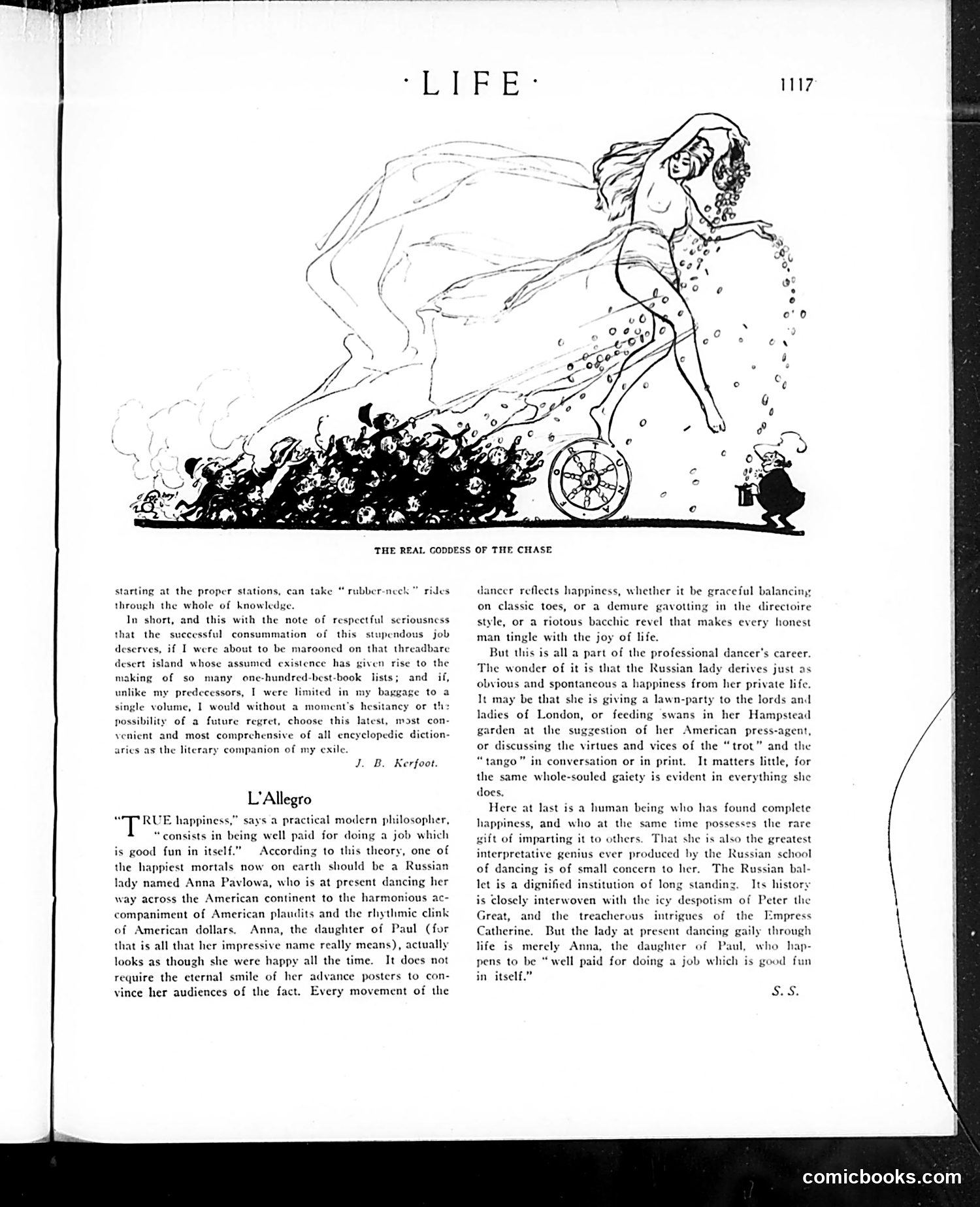
This page features an illustration and article celebrating Anna Pavlova, a celebrated Russian prima ballerina performing across America. The cartoon depicts her as a classical nude figure driving a chariot pulled by a mass of skulls and bones—a visual pun on "the chase" (both hunting and pursuit of happiness). The accompanying article praises Pavlova as an embodiment of the modern philosophical ideal: happiness derived from being "well paid for doing a job which is good fun in itself." The text notes she radiates genuine joy both professionally (through her acclaimed dancing) and privately (at social gatherings and leisure activities). The satire gently mocks American materialism and the era's fascination with celebrity performers, while genuinely admiring Pavlova's apparent authenticity. The grotesque chariot imagery—converting the pursuit of happiness into a macabre procession—subtly undercuts the article's earnest celebration, suggesting that even ideal happiness rests on darker foundations.
📄 Transcribed text from this page (OCR, searchable)
Machine-transcribed from the original scan — historical spelling and the odd misread are preserved.
1117 THE REAL GODDESS OF THE CHASE starting at the proper stations, can take “ rubber-neck ” rides through the whole of knowledge. In short, and this with the note of respectful seriousness that the successful consummation of this stupendous job deserves, if I were about to be marooned on that threadbare desert island whose assumed existence has given rise to the making of so many one-hundred-best-book lists; and if, unlike my predecessors, I were limited in my baggage to a single volume, I would without a moment's hesitancy or th: possibility of a future regret, choose this latest, most con- venient and most comprehensive of all encyclopedic diction- aries as the literary companion of my exile. J. B. Kerfoot. L’Allegro “PRUE happiness,” says a practical modern philosopher, “consists in being well paid for doing a job which is good fun in itself.” According to this theory, one of the happiest mortals now on earth should be a Russian lady named Anna Pavlowa, who is at present dancing her way across the American continent to the harmonious ac- companiment of American plaudits and the rhythmic clink Anna, the daughter of Paul (for of American dollars. that is all that her impressive name really means), actually looks as though she were happy all the time. It does not require the eternal smile of her advance posters to con- vince her audiences of the fact. Every movement of the dancer reflects happiness, whether it be graceful balanciny: on classic toes, or a demure gavotting in 1 style, or a riotous bacchic revel that makes eve: man tingle with the joy of life. But this is alla part of the professional dancer's career. The wonder of it is that the Russian lady derives just as obvious and spontancous a happiness from her private life. It may be that she is giving a lawn-party to the lords and ladies of London, or feeding swans in her Hampstead garden at the suggestion of her American press-agent, or discussing the virtues and vices of the “trot” and the “tango” in conversation or in print. It matters little, for the same whole-souled gaiety is evident in everything she does. directoire y honest Here at last is a human being who has found complete happiness, and who at the same time possesses the rare t of imparting it to others. That she is also the greatest interpretative genius ever produced hy the Russian school of dancing is of small concern to her. The Russian let is a dignified institution of long standing. Its history is closely interwoven with the icy despotism of Peter the Great, and the treacherous intrigues of the Empress Catherine. But the lady at present dancing gaily through life is merely Anna, the daughter of Paul, who hap- pens to be “well paid for doing a job which is good fun in itself.” comicbooks.com