
Life, 1913-12-18 · page 22 of 40
Life — December 18, 1913 — page 22: what you’re looking at
What you’re looking at
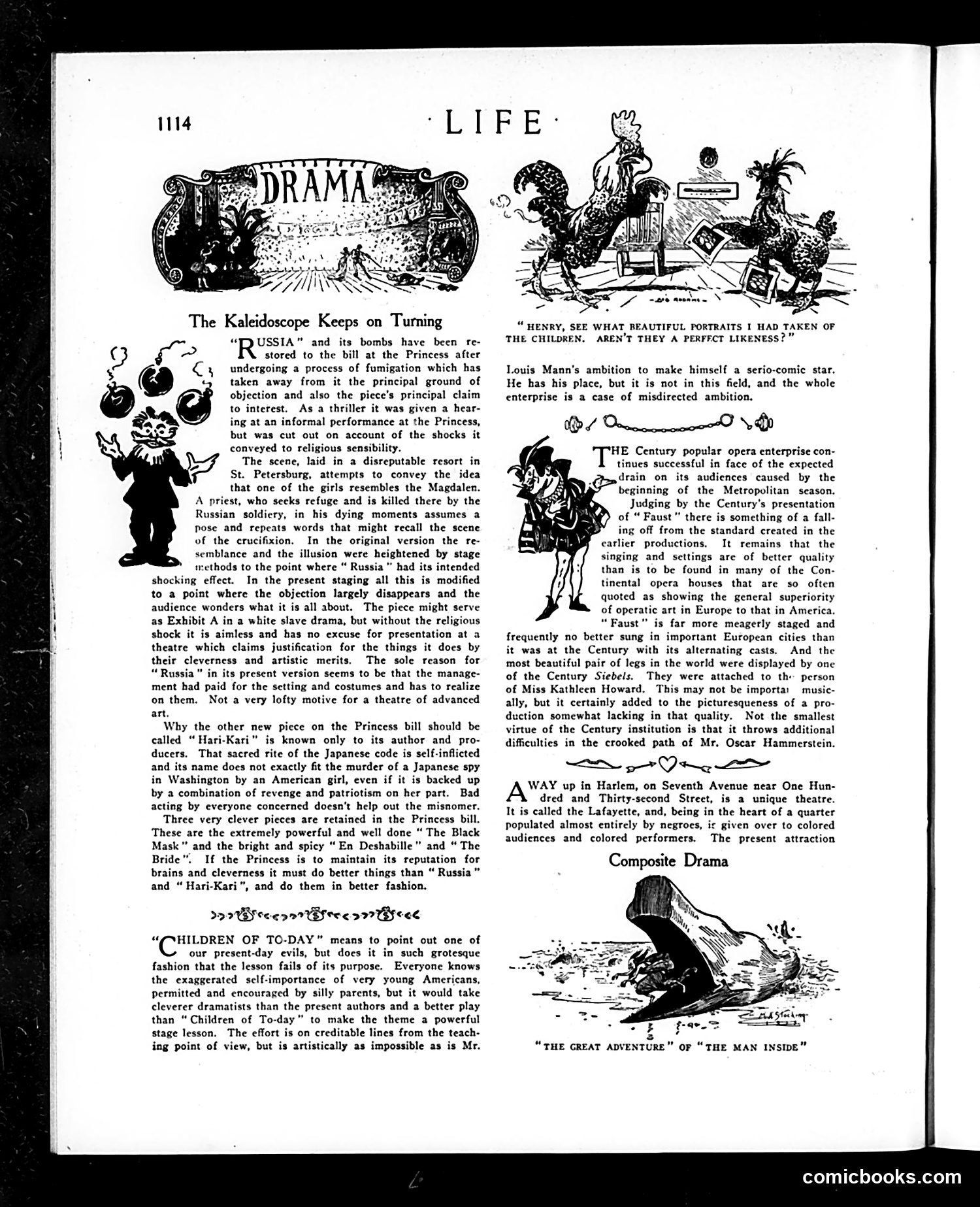
This page contains theater reviews typical of Life's satirical arts criticism. The main critique concerns plays at the Princess Theatre, particularly "Russia"—a drama set in a disreputable St. Petersburg establishment featuring a priest who dies in a crucifixion-like pose. The reviewer notes the play was originally shocking for its religious imagery but was censored due to "religious sensibility." Now sanitized, it's artistically pointless—merely performed because management needed to recoup costume and set investments. The piece mocks another play, "Hari-Kari," for absurdly naming itself after a Japanese ritual while depicting an American girl murdering a spy. The cartoon above shows a figure (possibly representing theatrical ambition or pretension) displaying portraits while asking about their "likeness"—likely satirizing actors' self-importance or poor artistic judgment. Other reviews dismiss "Children of To-Day" as heavy-handed moralizing about spoiled American youth, and praise the Century Opera's continued success despite the Metropolitan season's competition.
📄 Transcribed text from this page (OCR, searchable)
Machine-transcribed from the original scan — historical spelling and the odd misread are preserved.
The Kaleidoscope Keeps on Turning “DUSSIA” and its bombs have been re- stored to the bill at the Princess after undergoing a process of fumigation which has taken away from it the principal ground of objection and also the piece’s principal claim to interest. As a thriller it was given a hear- ing at an informal performance at the Princess, but was cut out on account of the shocks it conveyed to religious sensibility. The scene, laid in a disreputable resort in St. Petersburg, attempts to convey the idea that one of the girls resembles the Magdalen. A priest, who seeks refuge and is killed there by the Russian soldicry, in his dying moments assumes a pose and repeats words that might recall the scene of the crucifixion, In the original version the re- semblance and the illusion were heightened by stage methods to the point where “ Russia” had its intended shocking effect. In the present staging all this is modified to a point where the objection largely disappears and the audience wonders what it is all about. The piece might serve as Exhibit A in a white slave drama, but without the religious shock it is aimless and has no excuse for presentation at a theatre which claims justification for the things it does by their cleverness and artistic merits. The sole reason for “Russia” in its present version scems to be that the manage- ment had paid for the setting and costumes and has to realize on them. Not a very lofty motive for a theatre of advanced art. Why the other new piece on the Princess bill should be called “ Hari-Kari" is known only to its author and pro- ducers, That sacred rite of the Japanese code is self-inflicted and its name does not exactly fit the murder of a Japanese spy in Washington by an American girl, even if it is backed up by a combination of revenge and patriotism on her part. Bad acting by everyone concerned doesn’t help out the misnomer. Three very clever pieces are retained in the Princess bill. These are the extremely powerful and well done “ The Black Mask” and the bright and spicy “En Deshabille” and “ The Bride”. If the Princess is to maintain its reputation for brains and cleverness it must do better things than “ Russia” and “ Hari-Kari”, and do them in better fashion. DIVE ccc 9 27 VESF wc 977 VH Ce “(AHILDREN OF TO-DAY” means to point out one of our present-day evils, but does it in such grotesque fashion that the lesson fails of its purpose. Everyone knows the exaggerated self-importance of very young Americans, permitted and encouraged by silly parents, but it would take cleverer dramatists than the present authors and a better play than “Children of To-day” to make the theme a powerful stage lesson. The effort is on creditable lines from the teach- ing point of view, but is artistically as impossible as is Mr. “ HENRY, SEE WHAT BEAUTIFUL PORTRAITS I HAD THE CHILDREN, AREN'T THEY A PERFFCT LIKENESS? Louis Mann's ambition to make himself a serio-comic star. He has his place, but it is not in this field, and the whole enterprise is a case of misdirected ambition. 1D / On ooo SL dfp HE Century popular opera enterprise con- tinues successful in face of the expected drain on its audiences caused by the beginning of the Metropolitan season. Judging by the Century's presentation of “ Faust” there is something of a fall- ing off from the standard created in the earlier productions, It remains that the singing and settings are of better quality than is to be found in many of the Con- tinental opera houses that are so often quoted as showing the general superiority of operatic art in Europe to that in America. is far more meagerly staged and frequently no better sung in important European cities than it was at the Century with its alternating casts. And the most beautiful pair of legs in the world were displayed by one of the Century Siebels. They were attached to th» person of Miss Kathleen Howard. This may not be importa: music- ally, but it certainly added to the picturesqueness of a pro- duction somewhat lacking in that quality. Not the smallest virtue of the Century institution is that it throws additional difficulties in the crooked path of Mr. Oscar Hammerstein. —m OB tO He e> AY up in Harlem, on Seventh Avenue near One Hun- dred and Thirty-second Street, is a unique theatre. It is called the Lafayette, and, being in the heart of a quarter populated almost entirely by negroes, ic given over to colored audiences and colored performers. The present attraction Composite Drama comicbooks.com